

ASTM F2805-16(2022)
(Specification)Standard Specification for Multilayer Thermoplastic And Flexible Steel Pipe And Connections
General Information
- Abstract
SCOPE
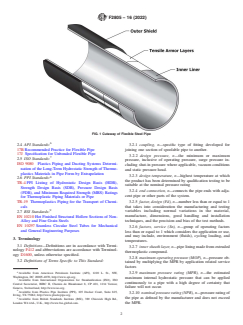
1.1 This specification covers requirements and test methods for materials, dimensions, workmanship, markings for factory manufactured multilayer flexible steel pipe with thermoplastic inner and outer layers and end connections (Fig. 1). It covers nominal sizes 2 in. through 8 in. (50 mm through 200 mm). Flexible steel pipes are multilayered pipe products manufactured in long continuous lengths and reeled for storage, transport and installation. The multilayer thermoplastic and flexible steel pipe governed by this standard are intended for use for the transport of crude oil, natural gas, hazardous chemicals, industrial chemicals and water.2
FIG. 1 Cutaway of Flexible Steel Pipe
1.2 The values stated in inch-pound units are to be regarded as standard. The values given in parentheses are mathematical conversions to SI units that are provided for information only and are not considered standard.
1.3 This standard does not purport to address all of the safety concerns, if any, associated with its use. It is the responsibility of the user of this standard to establish appropriate safety, health, and environmental practices and determine the applicability of regulatory limitations prior to use.
1.4 This international standard was developed in accordance with internationally recognized principles on standardization established in the Decision on Principles for the Development of International Standards, Guides and Recommendations issued by the World Trade Organization Technical Barriers to Trade (TBT) Committee.
- Status
- Published
- Publication Date
- 31-Jan-2022
- Technical Committee
- F17 - Plastic Piping Systems
- Drafting Committee
- F17.68 - Energy Piping Systems
Overview
ASTM F2805-16(2022) - Standard Specification for Multilayer Thermoplastic and Flexible Steel Pipe and Connections defines the requirements for factory-manufactured multilayer flexible steel pipe featuring thermoplastic inner and outer layers and end connections. This international standard covers nominal sizes from 2 in. to 8 in. (50 mm to 200 mm), providing a reliable specification for pipes used in the transport of crude oil, natural gas, hazardous chemicals, industrial chemicals, and water. Designed in accordance with recognized principles, this ASTM standard ensures consistent manufacturing quality, performance, and traceability.
Flexible steel pipes as defined by this standard are characterized by multilayered construction, typically produced in long continuous lengths suitable for reeling, storage, and efficient installation. The specification is aligned with key safety, health, and environmental practices, and is updated periodically to reflect technological advancements and industry requirements.
Key Topics
- Materials and Construction
- Multilayer pipe design combining thermoplastic layers and structural steel reinforcement.
- Specification of polyethylene and crosslinked polyethylene (PEX) compounds for internal and external pipe layers.
- Use of steel strip or tubing manufactured per ASTM and EN standards for tensile strength and durability.
- Pipe Sizes and Ratings
- Covers pipes from 2 in. to 8 in. diameter, with detailed regulations on wall thickness, outside diameter, and pressure ratings for each size.
- Multiple pressure ratings are defined, supporting a range of demanding industry applications.
- Workmanship and Markings
- Requirements for clean, defect-free surfaces and consistent semi-matte or glossy appearance.
- Mandatory pipe marking including the ASTM designation, manufacturer’s identity, pressure ratings, minimum bend radius (MBR), and traceability data.
- Testing and Quality Assurance
- Detailed testing protocols for dimensions, wall thickness, and pressure integrity.
- Hydrostatic pressure testing before shipping, with material and product qualification methods ensuring consistent quality.
- End Connections
- Qualified connection types to ensure leak-free performance at design pressures.
- Flanges and steel connectors must meet ASME and ANSI standards.
- Traceability and Certification
- Requirements for product documentation and test certification, ensuring full traceability for quality assurance and compliance.
Applications
Multilayer thermoplastic and flexible steel pipes specified by ASTM F2805-16(2022):
- Oil and Gas Industry: Transport of crude oil and natural gas, offering durability and flexibility for both onshore and offshore installations.
- Chemical Processing: Safe conveyance of hazardous and industrial chemicals, with resistance to permeation and environmental stresses.
- Water Supply and Industrial Pipelines: Suitable for potable water, process water, and other fluid transport scenarios where strength and corrosion resistance are critical.
- Infrastructure Projects: Used in applications requiring spoolable, flexible solutions for long lengths, reducing installation time and costs compared with rigid piping.
- Temporary and Mobile Applications: Ideal for projects that require pipe to be deployed and retrieved, as multilayer flexible pipes can be easily reeled and transported.
Related Standards
ASTM F2805-16(2022) references and aligns with numerous standards, including:
- ASTM A109/A109M, A312/A312M, A333/A333M, A506, A519: Steel materials specifications.
- ASTM D792, D1505, D1600, D2122, D2765, D3350, F412: Plastic piping testing, terminology, and classification.
- ASME B16.5: Pipe flanges and flanged fittings.
- API 17B, 17J: Flexible pipe specifications for oil & gas applications.
- ISO 9080: Long-term hydrostatic strength determination for thermoplastics.
- PPI TR-4, TR-19: Plastic pipe design and performance data.
- BS EN 10210, EN 10297: European standards for steel pipes.
By adhering to ASTM F2805-16(2022), manufacturers and users ensure that multilayer flexible steel pipes and connections meet internationally recognized standards for safety, reliability, and performance across a wide range of industrial applications.
Relations
- Effective Date
- 01-Apr-2024
- Effective Date
- 01-Mar-2024
- Effective Date
- 01-Mar-2024
- Effective Date
- 01-Feb-2024
- Effective Date
- 01-Apr-2020
- Effective Date
- 01-Jan-2019
- Effective Date
- 01-Nov-2018
- Refers
ASTM D1600-18 - Standard Terminology for Abbreviated Terms Relating to Plastics (Withdrawn 2024) - Effective Date
- 01-Jan-2018
- Effective Date
- 01-Aug-2017
- Effective Date
- 01-Feb-2017
- Effective Date
- 15-Nov-2016
- Effective Date
- 01-Sep-2016
- Effective Date
- 01-Sep-2016
- Effective Date
- 01-Sep-2016
- Effective Date
- 01-Aug-2016
Get Certified
Connect with accredited certification bodies for this standard

Institut za varilstvo d.o.o. (Welding Institute)
Slovenia's leading welding institute since 1952. ISO 3834, EN 1090, pressure equipment certification, NDT personnel, welder qualification. Only IIW Au
Sponsored listings
Frequently Asked Questions
ASTM F2805-16(2022) is a technical specification published by ASTM International. Its full title is "Standard Specification for Multilayer Thermoplastic And Flexible Steel Pipe And Connections". This standard covers: SCOPE 1.1 This specification covers requirements and test methods for materials, dimensions, workmanship, markings for factory manufactured multilayer flexible steel pipe with thermoplastic inner and outer layers and end connections (Fig. 1). It covers nominal sizes 2 in. through 8 in. (50 mm through 200 mm). Flexible steel pipes are multilayered pipe products manufactured in long continuous lengths and reeled for storage, transport and installation. The multilayer thermoplastic and flexible steel pipe governed by this standard are intended for use for the transport of crude oil, natural gas, hazardous chemicals, industrial chemicals and water.2 FIG. 1 Cutaway of Flexible Steel Pipe 1.2 The values stated in inch-pound units are to be regarded as standard. The values given in parentheses are mathematical conversions to SI units that are provided for information only and are not considered standard. 1.3 This standard does not purport to address all of the safety concerns, if any, associated with its use. It is the responsibility of the user of this standard to establish appropriate safety, health, and environmental practices and determine the applicability of regulatory limitations prior to use. 1.4 This international standard was developed in accordance with internationally recognized principles on standardization established in the Decision on Principles for the Development of International Standards, Guides and Recommendations issued by the World Trade Organization Technical Barriers to Trade (TBT) Committee.
SCOPE 1.1 This specification covers requirements and test methods for materials, dimensions, workmanship, markings for factory manufactured multilayer flexible steel pipe with thermoplastic inner and outer layers and end connections (Fig. 1). It covers nominal sizes 2 in. through 8 in. (50 mm through 200 mm). Flexible steel pipes are multilayered pipe products manufactured in long continuous lengths and reeled for storage, transport and installation. The multilayer thermoplastic and flexible steel pipe governed by this standard are intended for use for the transport of crude oil, natural gas, hazardous chemicals, industrial chemicals and water.2 FIG. 1 Cutaway of Flexible Steel Pipe 1.2 The values stated in inch-pound units are to be regarded as standard. The values given in parentheses are mathematical conversions to SI units that are provided for information only and are not considered standard. 1.3 This standard does not purport to address all of the safety concerns, if any, associated with its use. It is the responsibility of the user of this standard to establish appropriate safety, health, and environmental practices and determine the applicability of regulatory limitations prior to use. 1.4 This international standard was developed in accordance with internationally recognized principles on standardization established in the Decision on Principles for the Development of International Standards, Guides and Recommendations issued by the World Trade Organization Technical Barriers to Trade (TBT) Committee.
ASTM F2805-16(2022) is classified under the following ICS (International Classification for Standards) categories: 23.040.01 - Pipeline components and pipelines in general. The ICS classification helps identify the subject area and facilitates finding related standards.
ASTM F2805-16(2022) has the following relationships with other standards: It is inter standard links to ASTM A333/A333M-24, ASTM A312/A312M-24, ASTM A109/A109M-24, ASTM D2765-16(2024), ASTM F412-20, ASTM F412-19, ASTM A109/A109M-16(2018), ASTM D1600-18, ASTM F412-17a, ASTM F412-17, ASTM F412-16a, ASTM A109/A109M-16, ASTM D2765-16, ASTM A312/A312M-16a, ASTM F412-16. Understanding these relationships helps ensure you are using the most current and applicable version of the standard.
ASTM F2805-16(2022) is available in PDF format for immediate download after purchase. The document can be added to your cart and obtained through the secure checkout process. Digital delivery ensures instant access to the complete standard document.
Standards Content (Sample)
This international standard was developed in accordance with internationally recognized principles on standardization established in the Decision on Principles for the
Development of International Standards, Guides and Recommendations issued by the World Trade Organization Technical Barriers to Trade (TBT) Committee.
Designation:F2805 −16 (Reapproved 2022)
Standard Specification for
Multilayer Thermoplastic And Flexible Steel Pipe And
Connections
This standard is issued under the fixed designation F2805; the number immediately following the designation indicates the year of
original adoption or, in the case of revision, the year of last revision. A number in parentheses indicates the year of last reapproval. A
superscript epsilon (´) indicates an editorial change since the last revision or reapproval.
1. Scope* 2. Referenced Documents
1.1 This specification covers requirements and test methods 2.1 ASTM Standards:
for materials, dimensions, workmanship, markings for factory A109/A109M Specification for Steel, Strip, Carbon (0.25
manufactured multilayer flexible steel pipe with thermoplastic Maximum Percent), Cold-Rolled
inner and outer layers and end connections (Fig. 1). It covers A312/A312M Specification for Seamless, Welded, and
nominal sizes 2 in. through 8 in. (50 mm through 200 mm). Heavily Cold Worked Austenitic Stainless Steel Pipes
Flexible steel pipes are multilayered pipe products manufac- A333/A333M Specification for Seamless and Welded Steel
tured in long continuous lengths and reeled for storage, PipeforLow-TemperatureServiceandOtherApplications
transport and installation. The multilayer thermoplastic and with Required Notch Toughness
flexible steel pipe governed by this standard are intended for A506 Specification for Alloy and Structural Alloy Steel,
use for the transport of crude oil, natural gas, hazardous Sheet and Strip, Hot-Rolled and Cold-Rolled
chemicals, industrial chemicals and water. A519 Specification for Seamless Carbon and Alloy Steel
Mechanical Tubing
1.2 The values stated in inch-pound units are to be regarded
D792 Test Methods for Density and Specific Gravity (Rela-
as standard. The values given in parentheses are mathematical
tive Density) of Plastics by Displacement
conversions to SI units that are provided for information only
D1505 Test Method for Density of Plastics by the Density-
and are not considered standard.
Gradient Technique
1.3 This standard does not purport to address all of the
D1600 Terminology forAbbreviatedTerms Relating to Plas-
safety concerns, if any, associated with its use. It is the
tics
responsibility of the user of this standard to establish appro-
D2122 Test Method for Determining Dimensions of Ther-
priate safety, health, and environmental practices and deter-
moplastic Pipe and Fittings
mine the applicability of regulatory limitations prior to use.
D2765 Test Methods for Determination of Gel Content and
1.4 This international standard was developed in accor-
Swell Ratio of Crosslinked Ethylene Plastics
dance with internationally recognized principles on standard-
D3350 Specification for Polyethylene Plastics Pipe and Fit-
ization established in the Decision on Principles for the
tings Materials
Development of International Standards, Guides and Recom-
F412 Terminology Relating to Plastic Piping Systems
mendations issued by the World Trade Organization Technical 4
2.2 ASME Standard:
Barriers to Trade (TBT) Committee.
B16.5 Pipe Flanges and Flanged Fittings: NPS ⁄2 through
NPS 24 Metric/Inch Standard
2.3 ANSI Standard:
This specification is under the jurisdiction ofASTM Committee F17 on Plastic
Piping Systems and is the direct responsibility of Subcommittee F17.68 on Energy
B 16.5 Pipe, Flanges, and Flanged Fittings
Piping Systems.
Current edition approved Feb. 1, 2022. Published March 2022. Originally
approved in 2009. Last previous edition approved in 2016 as F2805–16. For referenced ASTM standards, visit the ASTM website, www.astm.org, or
DOI:10.1520/F2805–16R22. contact ASTM Customer Service at service@astm.org. For Annual Book of ASTM
The multilayer thermoplastic and flexible steel pipe and connections described Standards volume information, refer to the standard’s Document Summary page on
in this standard is covered by patents (FlexSteel Pipeline Technologies, 500 Dallas the ASTM website.
Street Suite 500, Houston,TX 77002, USA). Interested parties are invited to submit Available from American Society of Mechanical Engineers (ASME), ASME
information regarding the identification of acceptable alternatives to this patented International Headquarters, Two Park Ave., New York, NY 10016-5990, http://
item to the Committee on Standards, ASTM Headquarters, 100 Barr Harbor Drive, www.asme.org.
West Conshohocken, PA 19428-2959. Your comments will receive careful consid- Available fromAmerican National Standards Institute (ANSI), 25 W. 43rd St.,
eration at a meeting of the responsible technical committee which you may attend. 4th Floor, New York, NY 10036, http://www.ansi.org.
*A Summary of Changes section appears at the end of this standard
Copyright © ASTM International, 100 Barr Harbor Drive, PO Box C700, West Conshohocken, PA 19428-2959. United States
F2805−16 (2022)
FIG. 1Cutaway of Flexible Steel Pipe
2.4 API Standards: 3.2.1 coupling, n—specific type of fitting developed for
17B Recommended Practice for Flexible Pipe joining one section of spoolable pipe to another.
17J Specification for Unbonded Flexible Pipe
3.2.2 design pressure, n—the minimum or maximum
2.5 ISO Standards:
pressure, inclusive of operating pressure, surge pressure in-
ISO 9080 Plastics Piping and Ducting Systems Determi-
cluding shut-in pressure where applicable, vacuum conditions
nation of the Long-Term Hydrostatic Strength of Thermo-
and static pressure head.
plastics Materials in Pipe Form by Extrapolation
3.2.3 design temperature, n—highest temperature at which
2.6 PPI Standards:
the product has been determined by qualification testing to be
TR-4 PPI Listing of Hydrostatic Design Basis (HDB),
suitable at the nominal pressure rating
Strength Design Basis (SDB), Pressure Design Basis
3.2.4 end connection, n—connects the pipe ends with adja-
(PDB), and Minimum Required Strength (MRS) Ratings
cent pipe or other parts of the system.
for Thermoplastic Piping Materials or Pipe
3.2.5 factor, design (Fd), n—number less than or equal to 1
TR-19 Thermoplastics Piping for the Transport of Chemi-
that takes into consideration the manufacturing and testing
cals
variables including normal variations in the material,
2.7 BSI Standards:
manufacture, dimensions, good handling and installation
EN 10210 Hot Finished Structural Hollow Sections of Non-
techniques, and the precision and bias of the test methods.
Alloy and Fine Grain Steels
EN 10297 Seamless Circular Steel Tubes for Mechanical
3.2.6 factors, service (Sn), n—group of operating factors
and General Engineering Purposes
less than or equal to 1 which considers the application or use,
and may include, environment (fluids), cycling loading, and
3. Terminology
temperatures.
3.1 Definitions—Definitions are in accordance with Termi-
3.2.7 inner sheath layer, n—pipe lining made from extruded
nology F412 and abbreviations are accordance with Terminol-
thermoplastic compound.
ogy D1600, unless otherwise specified.
3.2.8 maximum operating pressure (MOP), n—pressure ob-
3.2 Definitions of Terms Specific to This Standard:
tained by multiplying the MPR by application related service
factors
Available from American Petroleum Institute (API), 1220 L. St., NW,
3.2.9 maximum pressure rating (MPR), n—the estimated
Washington, DC 20005-4070, http://www.api.org.
maximum internal hydrostatic pressure that can be applied
Available from International Organization for Standardization (ISO), ISO
continuously to a pipe with a high degree of certainty that
Central Secretariat, BIBC II, Chemin de Blandonnet 8, CP 401, 1214 Vernier,
failure will not occur.
Geneva, Switzerland, http://www.iso.org.
Available from Plastics Pipe Institute (PPI), 105 Decker Court, Suite 825,
3.2.10 nominal pressure rating (NPR), n—pressure rating of
Irving, TX 75062, http://www.plasticpipe.org.
the pipe as defined by the manufacturer and does not exceed
Available from British Standards Institute (BSI), 389 Chiswick High Rd.,
London W4 4AL, U.K., http://www.bsi-global.com. the MPR.
F2805−16 (2022)
3.2.11 outer sheath layer, n—external extruded thermoplas- dance with ISO 9080. Addition of pigments or stabilizers to
tic coating applied to resist mechanical damage and to provide natural polyethylene compounds during extrusion is permitted.
the underlying layers of the pipe protection from the environ-
4.2 Crosslinked Polyethylene Materials—Crosslinked poly-
ment.
ethylene compounds used in the manufacture of these products
3.2.12 product family, n—group of pipe products being a
shall be made from polyethylene compounds which have been
rangeofsizesandpressureratingsmanufacturedwiththesame
crosslinked by peroxides, azo compounds or silane compounds
material types, production process and process controls and
in extrusion or by other means such that the inner sheath layer
pipe construction.
and/or the outer sheath layer meets the following performance
3.2.13 product family representative (PFR), n—product
requirements:
variant chosen for full qualification.
4.2.1 Density—When determined in accordance with Test
3.2.14 productvariant(PV),n—memberofaproductfamily Method D1505 or D792, the crosslinked polyethylene material
3 3
with a specific pressure rating and diameter. shall have a minimum density of 0.033 lb/in (0.926 g/cm ).
3.2.15 qualified procedure—procedure subjected to suffi- 4.2.2 Degree of Crosslinking—When tested in accordance
cient testing to show that the procedure produces consistently withTestMethodD2765,MethodB,thedegreeofcrosslinking
reliableresultsandhasbeendemonstratedtomeetthespecified for the PEX material shall be within the range of 65 % to 89 %
requirements for its intended purpose. inclusive.
3.2.16 tensile armor layer, n—hoopandstructuralreinforce-
4.3 Long Term Hydrostatic Strength— Polyethylene and
ment helically wrapped over the inner sheath layer. The steel
crosslinked polyethylene compounds used in the manufacture
layers are not bonded.
of these products shall have Hydrostatic Design Basis (HDB)
3.2.17 traceability, n—ability to track the history, applica-
listings in PPI TR-4.
tion or location of a material or component by means of
4.4 Rework materials—Reground or reprocessed thermo-
recorded identifications
plastic materials are not permitted to be used.
4. Materials
4.5 Steel Materials:
4.1 Polyethylene Materials—Polyethylene compounds used 4.5.1 Steel tensile armor layers shall consist of steel strip
manufactured in accordance with Specification A506 or Speci-
inthemanufactureoftheseproductsshallhaveaminimumcell
classification of 444474 in accordance with Specification fication A109/A109M with a number 3 edge and number 1 or
D3350 (PE4710 as defined in PPI TR-4) or PE100 in accor-
2 finish.
FIG. 2Typical End Connection
F2805−16 (2022)
4.5.2 Steel in end connections shall meet the requirements 7. Test Methods
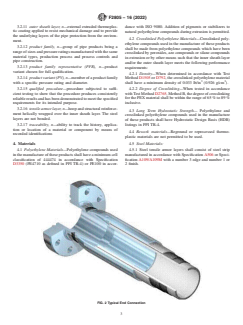
of Specification A312/A312M, Specification A333/A333M,
7.1 Outside Diameter—The outside diameter of each com-
SpecificationA519,EN10210,orEN10297(Fig.2).Specialty
pleted layer shall be measured and recorded according to
steel grades requested by the purchaser must meet the same
manufacturer’s procedures. The outside pipe diameter of each
minimum performance requirements.
completed layer shall be measured at a frequency of every 30
4.5.3 Flanges which are incorporated within the design of
ft (10 m) for the first 150 ft (50 m) and according to
end connections shall meet the requirements ofASME B 16.5.
manufacturer’s procedures thereafter.
4.6 The manufacturer shall have procedures for ensuring
7.2 Wall Thickness—The thickness of the extruded polymer
that materials are received in a condition that is suitable for
layers shall be checked by means of a calibrated ultrasonic
processing, including receiving inspection to discover damage
thickness instrument, with an absolute accuracy of at least 50
or contamination from shipping and verification of appropriate
T (2 mil). The extruded layer wall thickness shall be measured
material properties and shall include measurable physical,
at a frequency of every 30 ft (10 m) for the first 150 ft (50 m)
mechanical, chemical, and performance characteristics and
and according to manufacturer’s procedures thereafter.
tolerances.
7.3 Pressure Testing—Unless otherwise specified by the
5. Requirements
purchaser, the pipe shall be tested for a minimum of8hat1.3
5.1 Workmanship—The inside and outside surfaces of the
times the stated design pressure.
pipe shall be semi-matte or glossy in appearance and free of
NOTE 2—Apipeline system is typically commissioned after completion
chalking, sticky or tacky materials. The pipe surfaces shall be
by filling it with water and conducting a pressure test. Flexible steel pipe
free of cracks, holes, blisters, voids, foreign inclusions or other
behavior when hydrotested is somewhat different from the behavior of
defects that are visible to the naked eye.
rigid steel pipes. The layers are un-bonded and upon initial pressurization
undergo a stabilization process referred to as conditioning. After
5.2 Multilayer Pipe Dimensions—Pipe Dimensions shall
conditioning, the pipe is held at the test pressure for a period of time.
comply with Table 1, Table 2 and Table 3, when measured in
accordance with Test Method D2122.
8. Test Reports and Certification
5.3 Design Pressure—The pipe shall have the design pres-
8.1 Upon request of the purchaser, the manufacturer shall
sures listed in Table 2 and Table 3.
provide certification that the product was manufactured and
NOTE 1—The typical multilayer pipe construction is a three layer
tested in accordance with this specification. This certification
structure consisting of an extruded thermoplastic inner liner or pipe,
shall be furnished at the time of shipment.
helically wrapped layers of steel strips, and an extruded thermoplastic
outer layer or sheath.
8.2 When test reports are requested by the purchaser, the
5.4 Outside Diameter—The outside diameter of the appli- manufacturer shall report the results of tests required by this
cable pipe layer shall be as shown in Table 1, Table 2 or Table specification as well as any additional tests required by the
3 when measured in accordance with Section 7. purchaser.
5.5 Pipe Wall Thickness—The wall thickness of the appli-
9. Marking
cable pipe layer shall be as shown in Table 1, Table 2 or Table
3 when measured in accordance with Section 7.
9.1 Quality of Marking—The marking shall be applied to
the pipe in such a manner that it remains legible (easily read)
5.6 Laying Length—The pipe may be sold in any laying
after installation and inspection. It shall be spaced at intervals
length agreeable to the user.
of not more than 10 ft. (3.0 m).
6. Quality Assurance Tests
9.2 Markings—Each length of pipe in compliance with this
6.1 Factory Acceptance Test—Prior to shipment, the con-
specification shall be clearly marked by the manufacturer with
tinuous length of pipe shall be pressure tested in accordance
the following information: this designation, (ASTM F2805),
with manufacturer’s documented procedures as detailed in 7.3.
the nominal pipe size, the pressure rating, the
...