

ASTM D1945-14(2019)
(Test Method)Standard Test Method for Analysis of Natural Gas by Gas Chromatography
General Information
- Abstract
SIGNIFICANCE AND USE
4.1 This test method is of significance for providing data for calculating physical properties of the sample, such as heating value and relative density, or for monitoring the concentrations of one or more of the components in a mixture.
SCOPE
1.1 This test method covers the determination of the chemical composition of natural gases and similar gaseous mixtures within the range of composition shown in Table 1. This test method may be abbreviated for the analysis of lean natural gases containing negligible amounts of hexanes and higher hydrocarbons, or for the determination of one or more components, as required.
1.2 The values stated in SI units are to be regarded as standard. No other units of measurement are included in this standard.
1.3 This standard does not purport to address all of the safety concerns, if any, associated with its use. It is the responsibility of the user of this standard to establish appropriate safety, health, and environmental practices and determine the applicability of regulatory limitations prior to use.
1.4 This international standard was developed in accordance with internationally recognized principles on standardization established in the Decision on Principles for the Development of International Standards, Guides and Recommendations issued by the World Trade Organization Technical Barriers to Trade (TBT) Committee.
- Status
- Published
- Publication Date
- 30-Nov-2019
- Technical Committee
- D03 - Gaseous Fuels
Overview
ASTM D1945-14(2019), "Standard Test Method for Analysis of Natural Gas by Gas Chromatography," is a widely recognized standard issued by ASTM International. Developed by ASTM Committee D03 on Gaseous Fuels, this method is designed for the precise determination of the chemical composition of natural gas and related gaseous mixtures. It utilizes gas chromatography (GC) to separate and quantify the individual components in natural gas samples, enabling accurate assessment of fuel properties such as heating value, relative density, and constituent concentrations.
Key Topics
Gas Chromatography for Natural Gas
The standard details the methodology of using gas chromatography to physically separate and analyze components in natural gas, comparing peak responses from the sample to those of calibration reference standards.Component Range
Components measured include, but are not limited to: helium, hydrogen, oxygen, nitrogen, carbon dioxide, methane, ethane, hydrogen sulfide, propane, various butanes, pentanes, hexanes, heptanes+, across wide concentration ranges.Instrument Requirements
The method prescribes the use of thermal conductivity detectors, high-precision recording instruments, temperature-controlled columns and detectors, inert sample inlet systems, and suitable driers to ensure analytical accuracy.Accuracy and Precision
Repeatability and reproducibility thresholds are established, along with recommendations for proper calibration, sample introduction, and instrument performance checks.Safety and Compliance
Users are responsible for implementing suitable safety, health, and environmental controls, and for aligning with relevant regulatory standards throughout laboratory procedures.
Applications
Quality Control in Natural Gas Processing
This standard is routinely used in the oil and gas industry and by analytical laboratories to monitor the quality and consistency of natural gas delivered through pipelines or stored.Calculation of Fuel Properties
Accurate compositional data acquired according to ASTM D1945 are essential inputs for calculating important physical properties, such as calorific value (heating value) and gas density, which are critical for commercial transactions and energy content reporting.Compliance and Regulatory Reporting
Regulatory bodies and energy market participants rely on this method for standardized reporting of gas quality, ensuring that compositions meet industry specifications and legal requirements.Process Optimization and Safety
The data derived from this method support decisions on process adjustments, help identify trace contaminants, and confirm product suitability for various commercial and industrial applications, contributing to both efficiency and safety.
Related Standards
- ASTM D2597 - Formerly specified for analysis of demethanized hydrocarbon liquids by gas chromatography (Withdrawn 2016).
- ASTM E260 - Practice for Packed Column Gas Chromatography, referenced for instrument procedures.
- ISO 6974-1 - International standard for natural gas analysis by gas chromatography.
- ISO 6976 - Standard for calculation of calorific values, density, and Wobbe index from composition determined by methods such as ASTM D1945.
Practical Value
Adherence to ASTM D1945-14(2019) ensures consistent, reliable, and internationally comparable natural gas analysis. The standard delineates best practices for both routine and specialized gas testing, supports safe and efficient operations, and facilitates transparent communication in the energy sector. Whether for regulatory reporting, contractual compliance, or process control, this test method provides a robust framework for accurate natural gas composition analysis by gas chromatography.
Relations
- Effective Date
- 01-Sep-2019
- Effective Date
- 01-Nov-2011
- Effective Date
- 01-Mar-2006
- Effective Date
- 01-May-2004
- Effective Date
- 01-Jan-2001
- Effective Date
- 01-Jan-2001
- Effective Date
- 10-Apr-1999
Get Certified
Connect with accredited certification bodies for this standard

Element Materials Technology
Materials testing and product certification.

ABS Group Brazil
ABS Group certification services in Brazil.

ABS Quality Evaluations Inc.
American Bureau of Shipping quality certification.
Sponsored listings
Frequently Asked Questions
ASTM D1945-14(2019) is a standard published by ASTM International. Its full title is "Standard Test Method for Analysis of Natural Gas by Gas Chromatography". This standard covers: SIGNIFICANCE AND USE 4.1 This test method is of significance for providing data for calculating physical properties of the sample, such as heating value and relative density, or for monitoring the concentrations of one or more of the components in a mixture. SCOPE 1.1 This test method covers the determination of the chemical composition of natural gases and similar gaseous mixtures within the range of composition shown in Table 1. This test method may be abbreviated for the analysis of lean natural gases containing negligible amounts of hexanes and higher hydrocarbons, or for the determination of one or more components, as required. 1.2 The values stated in SI units are to be regarded as standard. No other units of measurement are included in this standard. 1.3 This standard does not purport to address all of the safety concerns, if any, associated with its use. It is the responsibility of the user of this standard to establish appropriate safety, health, and environmental practices and determine the applicability of regulatory limitations prior to use. 1.4 This international standard was developed in accordance with internationally recognized principles on standardization established in the Decision on Principles for the Development of International Standards, Guides and Recommendations issued by the World Trade Organization Technical Barriers to Trade (TBT) Committee.
SIGNIFICANCE AND USE 4.1 This test method is of significance for providing data for calculating physical properties of the sample, such as heating value and relative density, or for monitoring the concentrations of one or more of the components in a mixture. SCOPE 1.1 This test method covers the determination of the chemical composition of natural gases and similar gaseous mixtures within the range of composition shown in Table 1. This test method may be abbreviated for the analysis of lean natural gases containing negligible amounts of hexanes and higher hydrocarbons, or for the determination of one or more components, as required. 1.2 The values stated in SI units are to be regarded as standard. No other units of measurement are included in this standard. 1.3 This standard does not purport to address all of the safety concerns, if any, associated with its use. It is the responsibility of the user of this standard to establish appropriate safety, health, and environmental practices and determine the applicability of regulatory limitations prior to use. 1.4 This international standard was developed in accordance with internationally recognized principles on standardization established in the Decision on Principles for the Development of International Standards, Guides and Recommendations issued by the World Trade Organization Technical Barriers to Trade (TBT) Committee.
ASTM D1945-14(2019) is classified under the following ICS (International Classification for Standards) categories: 75.060 - Natural gas. The ICS classification helps identify the subject area and facilitates finding related standards.
ASTM D1945-14(2019) has the following relationships with other standards: It is inter standard links to ASTM E260-96(2019), ASTM E260-96(2011), ASTM E260-96(2006), ASTM D2597-94(2004), ASTM E260-96, ASTM E260-96(2001), ASTM D2597-94(1999). Understanding these relationships helps ensure you are using the most current and applicable version of the standard.
ASTM D1945-14(2019) is available in PDF format for immediate download after purchase. The document can be added to your cart and obtained through the secure checkout process. Digital delivery ensures instant access to the complete standard document.
Standards Content (Sample)
This international standard was developed in accordance with internationally recognized principles on standardization established in the Decision on Principles for the
Development of International Standards, Guides and Recommendations issued by the World Trade Organization Technical Barriers to Trade (TBT) Committee.
Designation: D1945 − 14 (Reapproved 2019)
Standard Test Method for
Analysis of Natural Gas by Gas Chromatography
This standard is issued under the fixed designation D1945; the number immediately following the designation indicates the year of
original adoption or, in the case of revision, the year of last revision. A number in parentheses indicates the year of last reapproval. A
superscript epsilon (´) indicates an editorial change since the last revision or reapproval.
1. Scope* calibration data obtained under identical operating conditions
from a reference standard mixture of known composition. The
1.1 This test method covers the determination of the chemi-
numerous heavy-end components of a sample can be grouped
cal composition of natural gases and similar gaseous mixtures
into irregular peaks by reversing the direction of the carrier gas
within the range of composition shown in Table 1. This test
through the column at such time as to group the heavy ends
method may be abbreviated for the analysis of lean natural
either as C and heavier, C and heavier, or C and heavier. The
5 6 7
gases containing negligible amounts of hexanes and higher
composition of the sample is calculated by comparing either
hydrocarbons, or for the determination of one or more
the peak heights, or the peak areas, or both, with the corre-
components, as required.
sponding values obtained with the reference standard.
1.2 The values stated in SI units are to be regarded as
standard. No other units of measurement are included in this
4. Significance and Use
standard.
4.1 This test method is of significance for providing data for
1.3 This standard does not purport to address all of the
calculating physical properties of the sample, such as heating
safety concerns, if any, associated with its use. It is the
value and relative density, or for monitoring the concentrations
responsibility of the user of this standard to establish appro-
of one or more of the components in a mixture.
priate safety, health, and environmental practices and deter-
mine the applicability of regulatory limitations prior to use.
5. Apparatus
1.4 This international standard was developed in accor-
5.1 Detector—The detector shall be a thermal-conductivity
dance with internationally recognized principles on standard-
type, or its equivalent in sensitivity and stability. The thermal
ization established in the Decision on Principles for the
conductivity detector must be sufficiently sensitive to produce
Development of International Standards, Guides and Recom-
a signal of at least 0.5 mV for 1 mol % n-butane in a 0.25-mL
mendations issued by the World Trade Organization Technical
sample.
Barriers to Trade (TBT) Committee.
5.2 Recording Instruments—Either strip-chart recorders or
2. Referenced Documents
electronic integrators, or both, are used to display the separated
2.1 ASTM Standards:
components. Although a strip-chart recorder is not required
D2597 Test Method for Analysis of Demethanized Hydro-
when using electronic integration, it is highly desirable for
carbon Liquid Mixtures Containing Nitrogen and Carbon
evaluation of instrument performance.
Dioxide by Gas Chromatography (Withdrawn 2016)
5.2.1 The recorder shall be a strip-chart recorder with a
E260 Practice for Packed Column Gas Chromatography
full-range scale of 5 mV or less (1 mV preferred). The width of
the chart shall be not less than 150 mm. A maximum pen
3. Summary of Test Method
response time of 2 s (1 s preferred) and a minimum chart speed
3.1 Components in a representative sample are physically
of 10 mm/min shall be required. Faster speeds up to 100 mm-
separated by gas chromatography (GC) and compared to
⁄min are desirable if the chromatogram is to be interpreted
using manual methods to obtain areas.
This test method is under the jurisdiction of ASTM Committee D03 on Gaseous
5.2.2 Electronic or Computing Integrators—Proof of sepa-
Fuels and is the direct responsibility of Subcommittee D03.06.01 on Analysis of
ration and response equivalent to that for a recorder is required
Major Constituents by Gas Chromatography.
for displays other than by chart recorder. Baseline tracking
Current edition approved Dec. 1, 2019. Published January 2020. Originally
approved in 1962. Last previous edition approved in 2014 as D1945 – 14. DOI:
with tangent skim peak detection is recommended.
10.1520/D1945-14R19.
5.3 Attenuator—If the chromatogram is to be interpreted
For referenced ASTM standards, visit the ASTM website, www.astm.org, or
contact ASTM Customer Service at service@astm.org. For Annual Book of ASTM
using manual methods, an attenuator must be used with the
Standards volume information, refer to the standard’s Document Summary page on
detector output signal to maintain maximum peaks within the
the ASTM website.
3 recorder chart range. The attenuator must be accurate to within
The last approved version of this historical standard is referenced on
www.astm.org. 0.5 % between the attenuator range steps.
*A Summary of Changes section appears at the end of this standard
Copyright © ASTM International, 100 Barr Harbor Drive, PO Box C700, West Conshohocken, PA 19428-2959. United States
D1945 − 14 (2019)
TABLE 1 Natural Gas Components and Range of
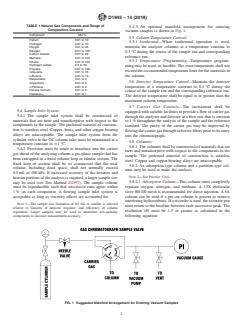
5.4.3 An optional manifold arrangement for entering
Composition Covered
vacuum samples is shown in Fig. 1.
Component Mol %
5.5 Column Temperature Control:
Helium 0.01 to 10
5.5.1 Isothermal—When isothermal operation is used,
Hydrogen 0.01 to 10
maintain the analyzer columns at a temperature constant to
Oxygen 0.01 to 20
Nitrogen 0.01 to 100
0.3 °C during the course of the sample run and corresponding
Carbon dioxide 0.01 to 20
reference run.
Methane 0.01 to 100
Ethane 0.01 to 100 5.5.2 Temperature Programming—Temperature program-
Hydrogen sulfide 0.3 to 30
ming may be used, as feasible. The oven temperature shall not
Propane 0.01 to 100
exceed the recommended temperature limit for the materials in
Isobutane 0.01 to 10
n-Butane 0.01 to 10 the column.
Neopentane 0.01 to 2
5.6 Detector Temperature Control—Maintain the detector
Isopentane 0.01 to 2
n-Pentane 0.01 to 2 temperature at a temperature constant to 0.3 °C during the
Hexane isomers 0.01 to 2
course of the sample run and the corresponding reference run.
Heptanes+ 0.01 to 1
The detector temperature shall be equal to or greater than the
maximum column temperature.
5.7 Carrier Gas Controls—The instrument shall be
5.4 Sample Inlet System:
equipped with suitable facilities to provide a flow of carrier gas
5.4.1 The sample inlet system shall be constructed of
through the analyzer and detector at a flow rate that is constant
materials that are inert and nonadsorptive with respect to the
to 1 % throughout the analysis of the sample and the reference
components in the sample. The preferred material of construc-
standard. The purity of the carrier gas may be improved by
tion is stainless steel. Copper, brass, and other copper-bearing
flowing the carrier gas through selective filters prior to its entry
alloys are unacceptable. The sample inlet system from the
into the chromatograph.
cylinder valve to the GC column inlet must be maintained at a
5.8 Columns:
temperature constant to 61 °C.
5.8.1 The columns shall be constructed of materials that are
5.4.2 Provision must be made to introduce into the carrier
inert and nonadsorptive with respect to the components in the
gas ahead of the analyzing column a gas-phase sample that has
sample. The preferred material of construction is stainless
been entrapped in a fixed volume loop or tubular section. The
steel. Copper and copper-bearing alloys are unacceptable.
fixed loop or section shall be so constructed that the total
5.8.2 An adsorption-type column and a partition-type col-
volume, including dead space, shall not normally exceed
umn may be used to make the analysis.
0.5 mL at 100 kPa. If increased accuracy of the hexanes and
NOTE 2—See Practice E260.
heavier portions of the analysis is required, a larger sample size
5.8.2.1 Adsorption Column—This column must completely
may be used (see Test Method D2597). The sample volume
separate oxygen, nitrogen, and methane. A 13X molecular
must be reproducible such that successive runs agree within
sieve 80/100 mesh is recommended for direct injection. A 5A
1 % on each component. A flowing sample inlet system is
column can be used if a pre-cut column is present to remove
acceptable as long as viscosity effects are accounted for.
interfering hydrocarbons. If a recorder is used, the recorder pen
NOTE 1—The sample size limitation of 0.5 mL or smaller is selected
must return to the baseline between each successive peak. The
relative to linearity of detector response, and efficiency of column
resolution (R) must be 1.5 or greater as calculated in the
separation. Larger samples may be used to determine low-quantity
components to increase measurement accuracy. following equation:
FIG. 1 Suggested Manifold Arrangement for Entering Vacuum Samples
D1945 − 14 (2019)
x 2 x 5.11 Vacuum Gauge—Any type of vacuum gauge may be
2 1
R~1,2! 5 × 2, (1)
y 1y used which has a resolution of 0.14 kPa or better and covers the
2 1
range of 0 to 120 kPa or larger.
where x , x are the retention times and y , y are the peak
1 2 1 2
5.12 Vacuum Pump—Must have the capability of producing
widths. Fig. 2 illustrates the calculation for resolution. Fig. 3 is
a vacuum of 0.14 kPa absolute or less.
a chromatogram obtained with an adsorption column.
5.8.2.2 Partition Column—This column must separate eth-
6. Preparation of Apparatus
ane through pentanes and carbon dioxide. If a recorder is used,
the recorder pen must return to the base line between each peak
6.1 Linearity Check—To establish linearity of response for
for propane and succeeding peaks, and to base line within 2 %
the thermal conductivity detector, it is necessary to complete
of full-scale deflection for components eluted ahead of
the following procedure:
propane, with measurements being at the attenuation of the
6.1.1 The major component of interest (methane for natural
peak. Separation of carbon dioxide must be sufficient so that a
gas) is charged to the chromatograph by way of the fixed-size
0.25-mL sample containing 0.1-mol % carbon dioxide will
sample loop at partial pressure increments of 13 kPa from 13
produce a clearly measurable response. The resolution (R)
to 100 kPa or the prevailing atmospheric pressure.
must be 1.5 or greater as calculated in the above equation. The
6.1.2 The integrated peak responses for the area generated at
separation should be completed within 40 min, including
each of the pressure increments are plotted versus their partial
reversal of flow after n-pentane to yield a group response for
pressure (see Fig. 9).
hexanes and heavier components. Figs. 4-6 are examples of
6.1.3 The plotted results should yield a straight line. A
chromatograms obtained on some of the suitable partition
perfectly linear response would display a straight line at a 45°
columns.
angle using the logarithmic values.
5.8.3 General—Other column packing materials that pro-
6.1.4 Any curved line indicates the fixed volume sample
vide satisfactory separation of components of interest may be
loop is too large. A smaller loop size should replace the fixed
used (see Fig. 7). In multicolumn applications, it is preferred to
volume loop and 6.1.1 through 6.1.4 should be repeated (see
use front-end backflush of the heavy ends.
Fig. 9).
6.1.5 The linearity over the range of interest must be known
NOTE 3—The chromatograms in Figs. 3-8 are only illustrations of
for each component. It is useful to construct a table noting the
typical separations. The operating conditions, including columns, are also
typical and are subject to optimization by competent personnel.
response factor deviation in changing concentration. (See
Table 2 and Table 3).
5.9 Drier—Unless water is known not to interfere in the
6.1.6 It should be noted that nitrogen, methane, and ethane
analysis, a drier must be provided in the sample entering
exhibit less than 1 % compressibility at atmospheric pressure.
system, ahead of the sample valve. The drier must remove
Other natural gas components do exhibit a significant com-
moisture without removing selective components to be deter-
pressibility at pressures less than atmospheric.
mined in the analysis.
6.1.7 Most components that have vapor pressures of less
NOTE 4—See A2.2 for preparation of a suitable drier.
than 100 kPa cannot be used as a pure gas for a linearity study
5.10 Valves—Valves or sample splitters, or both, are re- because they will not exhibit sufficient vapor pressure for a
quired to permit switching, backflushing, or for simultaneous vacuum gauge reading to 100 kPa. For these components, a
analysis. mixture with nitrogen or methane can be used to establish a
FIG. 2 Calculation for Resolution
D1945 − 14 (2019)
FIG. 3 Separation Column for Oxygen, Nitrogen, and Methane (See Annex A2)
FIG. 4 Chromatogram of Natural Gas (BMEE Column) (See Annex A2)
partial pressure that can extend the total pressure to 100 kPa. where:
Using Table 4 for vapor pressures at 38 °C, calculate the
B = blend pressure, max, kPa;
maximum pressure to which a given component can be blended
V = vapor pressure, kPa;
with nitrogen as follows: i = mol %;
P = partial pressure, kPa; and
B 5 100 × V /i (2)
~ !
M = vacuum gauge pressure, kPa.
P 5 ~i × M!/100 (3)
D1945 − 14 (2019)
FIG. 5 Chromatogram of Natural Gas (Silicone 200/500 Column) (See Annex A2)
FIG. 6 Chromatogram of Natural Gas (See Annex A2)
6.2 Procedure for Linearity Check: 6.2.2 Carefully open the needle valve to admit the pure
6.2.1 Connect the pure-component source to the sample- component up to 13 kPa of partial pressure.
entry system. Evacuate the sample-entry system and observe
6.2.3 Record the exact partial pressure and actuate the
the vacuum gauge for leaks. (See Fig. 1 for a suggested
sample valve to place the sample onto the column. Record the
manifold arrangement.) The sample-entry system must be
peak area of the pure component.
vacuum tight.
D1945 − 14 (2019)
FIG. 7 Chromatogram of Natural Gas (Multi-Column Application) (See Annex A2)
FIG. 8 Separation of Helium and Hydrogen
6.2.4 Repeat 6.2.3 for 26, 39, 52, 65, 78, and 91 kPa on the 6.2.6 An alternative method is to obtain a blend of all the
vacuum gauge, recording the peak area obtained for sample components and charge the sample loop at partial pressure over
analysis at each of these pressures. the range of interest. If a gas blender is available, the mixture
6.2.5 Plot the area data (x axis) versus the partial pressures can be diluted with methane thereby giving response curves for
(y axis) on a linear graph as shown in Fig. 9. all the components. (Warning—If it is not possible to obtain
D1945 − 14 (2019)
FIG. 9 Linearity of Detector Response
TABLE 2 Linearity Evaluation of Methane TABLE 3 Linearity Evaluation for Nitrogen
S/B diff = (low mole % − high mole %) ⁄low mole % × 100 S/B diff = (low mole % − high mole %) ⁄low mole % × 100
S/B diff., % on low S/B diff., % on low
B area S mole % S/B mole % ⁄area B area S mole % S/B mole % ⁄area
value value
223 119 392 51 2.2858e-07 5 879 836 1 1.7007e-07
242 610 272 56 2.3082e-07 −0.98 29 137 066 5 1.7160e-07 −0.89
261 785 320 61 2.3302e-07 −0.95 57 452 364 10 1.7046e-07 −1.43
280 494 912 66 2.3530e-07 −0.98 84 953 192 15 1.7657e-07 −1.44
299 145 504 71 2.3734e-07 −0.87 111 491 232 20 1.7939e-07 −1.60
317 987 328 76 2.3900e-07 −0.70 137 268 784 25 1.8212e-07 −1.53
336 489 056 81 2.4072e-07 −0.72 162 852 288 30 1.8422e-07 −1.15
351 120 721 85 2.4208e-07 −0.57 187 232 496 35 1.8693e-07 −1.48
information on the linearity of the available gas chromatograph
contain known percents of the components, except oxygen
detector for all of the test gas components, then as a minimum
(Note 5), that are to be determined in the unknown sample. All
requirement the linearity data must be obtained for any gas
components in the reference standard must be homogenous in
component that exceeds a concentration of 5 mol%. Chromato-
the vapor state at the time of use. The concentration of a
graphs are not truly linear over wide concentration ranges and
component in the reference standard gas should not be less than
linearity should be established over the range of interest.)
one half nor more than twice the concentration of the corre-
7. Reference Standards
sponding component in the test gas.
7.1 Moisture-free gas mixtures of known composition are
NOTE 5—Unless the reference standard is stored in a container that has
required for comparison with the test sample. They must been tested and proved for inertness to oxygen, it is preferable to calibrate
D1945 − 14 (2019)
A
TABLE 4 Vapor Pressure at 38 °C
8.2.2 Connections from the sample container to the sample
Component kPa absolute
inlet of the instrument should be made with stainless steel or
Nitrogen >34 500
with short pieces of TFE-fluorocarbon. Copper, vinyl, or
Methane >34 500
rubber connections are not acceptable. Heated lines may be
Carbon dioxide >5 520
necessary for high hydrocarbon content samples.
Ethane >5 520
Hydrogen sulfide 2 720
8.3 Sample Introduction—The size of the sample introduced
Propane 1 300
to the chromatographic columns shall not exceed 0.5 mL. (This
Isobutane 501
n-Butane 356
small sample size is necessary to obtain a linear detector
Isopentane 141
response for methane.) Sufficient accuracy can be obtained for
n-Pentane 108
n-Hexane 34.2 the determination of all but the minor constituents by the use of
n-Heptane 11.2
this sample size. When increased response is required for the
A
The most recent data for the vapor pressures listed are available from the
determination of components present in concentrations not
Thermodynamics Research Center, Texas A&M University System, College
exceeding 5 mol %, it is permissible to use sample and
Station, TX 77843.
reference standard volumes not exceeding 5 mL. (Avoid
introduction of liquids into the sample system.)
8.3.1 Purging Method—Open the outlet valve of the sample
for oxygen by an alternative method.
cylinder and purge the sample through the inlet system and
7.2 Preparation—A reference standard may be prepared by
sample loop or tube. The amount of purging required must be
blending pure components. Diluted dry air is a suitable
established and verified for each instrument. The sample loop
4,5
standard for oxygen and nitrogen (see 8.5.1).
pressure should be near atmospheric. Close the cylinder valve
and allow the pressure of the sample in the loop or tube to
8. Procedure
stabilize. Then immediately inject the contents of the loop or
8.1 Instrument Preparation—Place the proper column(s) in
tube into the chromatographic column to avoid infiltration of
operation as needed for the desired run (as described in either
contaminants.
8.4, 8.5, or 8.6). Adjust the operating conditions and allow the
8.3.2 Water Displacement—If the sample was obtained by
chromatograph to stabilize.
water displacement, then water displacement may be used to
8.1.1 For hexanes and higher, heat the sample loop.
purge and fill the sample loop or tube. (Warning—Some
NOTE 6—Most modern chromatographs have valve ovens that can be components, such as carbon dioxide, hydrogen sulfide, and
temperature controlled. It is strongly recommended in the absence of
hexanes and higher hydrocarbons, may be partially or com-
valve ovens to mount the gas sampling valve in the chromatograph oven
pletely removed by the water.)
and operate at the column temperature.
8.3.3 Evacuation Method—Evacuate the charging system,
8.1.2 After the instrument has apparently stabilized, make
including the sample loop, and the sample line back to the
check runs on the reference standard to establish instrument
valve on the sample cylinder, to less than 0.1 kPa absolute
repeatability. Two consecutive checks must agree within the
pressure. Close the valve to the vacuum source and carefully
repeatability limits for the mol % amount present of each
meter the fuel-gas sample from the sample cylinder until the
component. Either the average of the two consecutive checks,
sample loop is filled to the desired pressure, as indicated on the
or the latest check agreeing within the repeatability limits of
vacuum gauge (see Fig. 1). Inject the sample into the chro-
the previous check on each component may be used as the
matograph.
reference standard for all subsequent runs until there is a
8.4 Partition Column Run for Ethane and Heavier Hydro-
change in instrument operating conditions. Daily calibrations
carbons and Carbon Dioxide—This run is made using either
are recommended.
helium or hydrogen as the carrier gas; if other than a thermal
8.2 Sample Preparation—If desired, hydrogen sulfide may
conductivity detector is used, select a suitable carrier gas for
be removed by at least two methods (see Annex A2.3).
that detector. Select a sample size in accordance with 8.1. Enter
8.2.1 Preparation and Introduction of Sample—Samples
the sample, and backflush heavy components when appropri-
must be equilibrated in the laboratory at 10 to 30 °C above the
ate. Obtain a corresponding response on the reference standard.
source temperature of the field sampling. The higher the
8.4.1 Methane may also be determined on this column if the
temperature the shorter the equilibration time (approximately
column will separate the methane from nitrogen and oxygen
2 h for small sample containers of 300 mL or less). This
(such as with silicone 200/500 as shown in Fig. 5), and the
analysis method assumes field sampling methods have re-
sample size does not exceed 0.5 mL.
moved entrained liquids. If the hydrocarbon dewpoint of the
8.5 Adsorption Column Run for Oxygen, Nitrogen, and
sample is known to be lower than the lowest temperature to
Methane—Make this run using helium or hydrogen as the
which the sample has been exposed, it is not necessary to heat
carrier gas. The sample size must not exceed 0.5 mL for the
the sample.
determination of methane. Enter the sample and obtain a
response through methane (Note 5). Likewise, obtain a re-
A suitable reference standard is available from Scott Specialty Gases Inc.,
sponse on the reference standard for nitrogen and methane.
Plumsteadville, PA.
Obtain a response on dry air for nitrogen and oxygen, if
A ten-component reference standard traceable to the National Institute of
desired. The air must be either entered at an accurately
Standards and Technology (NIST) is available from Institute of Gas Technology
(IGT), 3424 S. State St., Chicago, IL 60616. measured reduced pressure, or from a helium-diluted mixture.
D1945 − 14 (2019)
8.5.1 A mixture containing approximately 1 % of oxygen 9.2.2 Hexanes and Heavier Components—Measure the ar-
can be prepared by pressurizing a container of dry air at eas of the hexanes portion and the heptanes and heavier portion
atmospheric pressure to 2 MPa with pure helium. This pressure of the reverse-flow peak (see Annex A1, Fig. A1.1, and X3.6).
need not be measured precisely, as the concentration of Also measure the areas of both pentane peaks on the sample
nitrogen in the mixture thus prepared must be determined by chromatogram, and adjust all measured areas to the same
comparison to nitrogen in the reference standard. The percent attenuation basis.
nitrogen is multiplied by 0.268 to obtain the mole percent of
9.2.3 Calculate corrected areas of the reverse flow peaks as
oxygen or by 0.280 to obtain the mole percent total of oxygen follows:
and argon. Do not rely on oxygen standards that have been
Corrected C area 5 72/86 × measured C area (6)
6 6
prepared for more than a few days. It is permissible to use a
Corrected C and heavier area (7)
response factor for oxygen that is relative to a stable constitu-
ent.
5 72/A × measured C and heavier area
8.6 Adsorption Column Run for Helium and Hydrogen—
where A = average molecular weight of the C and heavier
Make this run using either nitrogen or argon as the carrier gas.
fraction.
Enter a 1 to 5 mL sample and record the response for helium,
NOTE 7—The value of 98 is usually sufficiently accurate for use as the
followed by hydrogen, which will be just ahead of oxygen
C and heavier fraction average molecular weight; the small amount of C
(Note 5). Obtain a corresponding response on a reference 7 8
and heavier present is usually offset by the lighter methyl cyclopentane
standard containing suitable concentrations of helium and
and cyclohexane that occur in this fraction. A more accurate value for the
hydrogen (see Fig. 8).
molecular weight of C and heavier can be obtained as described in Annex
A1.3.
9. Calculation
9.2.4 Calculate the concentration of the two fractions in the
sample as follows:
9.1 The number of significant digits retained for the quan-
titative value of each component shall be such that accuracy is
Mol % C6 5 ~corrected C area! (8)
neither sacrificed or exaggerated. The expressed numerical
× mol % iC 1nC / iC 1nC area .
value of any component in the sample should not be presumed ~ ! ~ !
5 5 5 5
to be more accurate than the corresponding certified value of
Mol % C 1 5 corrected C area (9)
~ !
7 7
that component in the calibration standard.
×~mol % i C 1nC !/~iC 1nC area!.
5 5 5 5
9.2 External Standard Method:
9.2.1 Pentanes and Lighter Components—Measure the 9.2.4.1 If the mole percent of iC + nC has been deter-
5 5
mined by a separate run with a smaller sized sample, this value
height of each component peak for pentanes and lighter,
need not be redetermined.
convert to the same attenuation for corresponding components
in the sample and reference standard, and calculate the con- 9.2.5 The entire reverse flow area may be calculated in this
centration of each component in the sample as follows: manner as C and heavier, or as C and heavier should the
6 5
carrier gas reversal be made after n-butane. The measured area
C 5 S × A/B (4)
~ !
should be corrected by using the average molecular weights of
where:
the entire reverse-flow components for the value of A. The
C = compon
...