


ASTM E2269-05
(Test Method)Standard Test Method for Determining Argon Concentration in Sealed Insulating Glass Units using Gas Chromatography
Standard Test Method for Determining Argon Concentration in Sealed Insulating Glass Units using Gas Chromatography
SCOPE
1.1 This test method covers procedures for using gas chromatographs to determine the concentration of argon gas in the space between the panes of sealed insulating glass.
1.2 This test method is not applicable to insulating glass units containing open capillary/breather tubes.
1.3 The values stated in SI units are to be regarded as the standard. The values given in parentheses are for information only.
1.4 This standard does not purport to address all of the safety concerns, if any, associated with its use. It is the responsibility of the user of this standard to establish appropriate safety and health practices and determine the applicability of regulatory limitations prior to use.
General Information
Relations
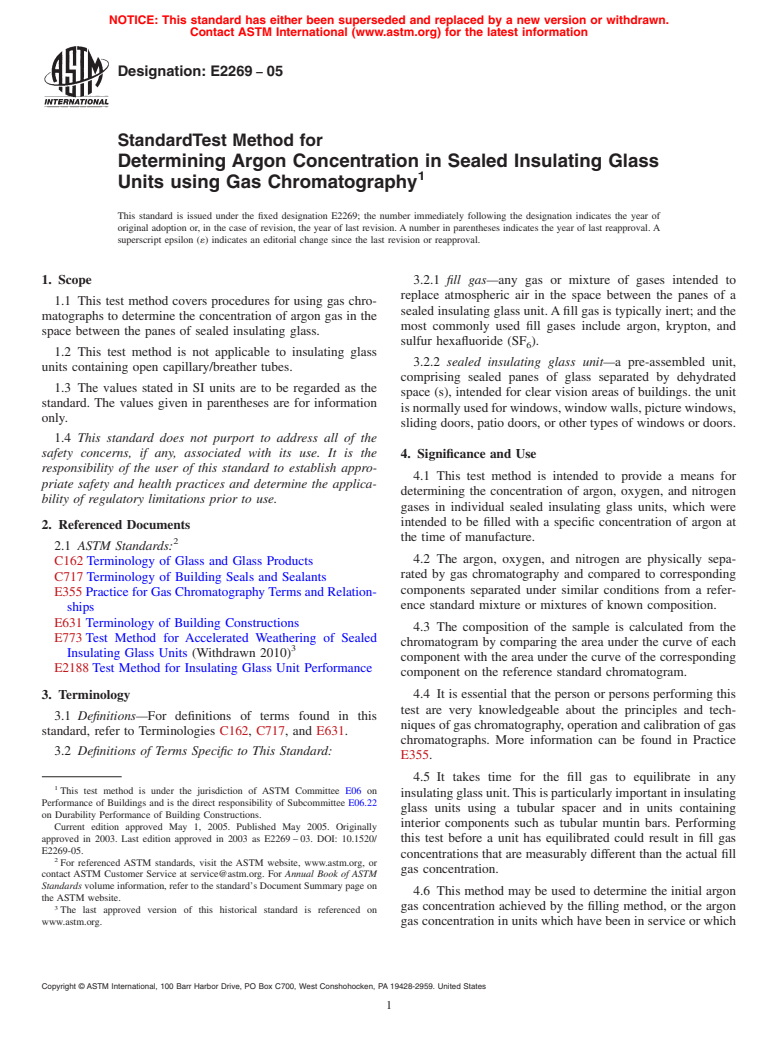

Standards Content (Sample)
NOTICE: This standard has either been superseded and replaced by a new version or withdrawn.
Contact ASTM International (www.astm.org) for the latest information
Designation: E2269 − 05
StandardTest Method for
Determining Argon Concentration in Sealed Insulating Glass
1
Units using Gas Chromatography
This standard is issued under the fixed designation E2269; the number immediately following the designation indicates the year of
original adoption or, in the case of revision, the year of last revision. A number in parentheses indicates the year of last reapproval. A
superscript epsilon (´) indicates an editorial change since the last revision or reapproval.
1. Scope 3.2.1 fill gas—any gas or mixture of gases intended to
replace atmospheric air in the space between the panes of a
1.1 This test method covers procedures for using gas chro-
sealed insulating glass unit.Afill gas is typically inert; and the
matographs to determine the concentration of argon gas in the
most commonly used fill gases include argon, krypton, and
space between the panes of sealed insulating glass.
sulfur hexafluoride (SF ).
6
1.2 This test method is not applicable to insulating glass
3.2.2 sealed insulating glass unit—a pre-assembled unit,
units containing open capillary/breather tubes.
comprising sealed panes of glass separated by dehydrated
1.3 The values stated in SI units are to be regarded as the
space (s), intended for clear vision areas of buildings. the unit
standard. The values given in parentheses are for information
isnormallyusedforwindows,windowwalls,picturewindows,
only.
sliding doors, patio doors, or other types of windows or doors.
1.4 This standard does not purport to address all of the
safety concerns, if any, associated with its use. It is the
4. Significance and Use
responsibility of the user of this standard to establish appro-
4.1 This test method is intended to provide a means for
priate safety and health practices and determine the applica-
determining the concentration of argon, oxygen, and nitrogen
bility of regulatory limitations prior to use.
gases in individual sealed insulating glass units, which were
intended to be filled with a specific concentration of argon at
2. Referenced Documents
the time of manufacture.
2
2.1 ASTM Standards:
4.2 The argon, oxygen, and nitrogen are physically sepa-
C162 Terminology of Glass and Glass Products
rated by gas chromatography and compared to corresponding
C717 Terminology of Building Seals and Sealants
components separated under similar conditions from a refer-
E355 Practice for Gas ChromatographyTerms and Relation-
ence standard mixture or mixtures of known composition.
ships
E631 Terminology of Building Constructions
4.3 The composition of the sample is calculated from the
E773 Test Method for Accelerated Weathering of Sealed
chromatogram by comparing the area under the curve of each
3
Insulating Glass Units (Withdrawn 2010)
component with the area under the curve of the corresponding
E2188 Test Method for Insulating Glass Unit Performance
component on the reference standard chromatogram.
3. Terminology 4.4 It is essential that the person or persons performing this
test are very knowledgeable about the principles and tech-
3.1 Definitions—For definitions of terms found in this
niques of gas chromatography, operation and calibration of gas
standard, refer to Terminologies C162, C717, and E631.
chromatographs. More information can be found in Practice
3.2 Definitions of Terms Specific to This Standard:
E355.
4.5 It takes time for the fill gas to equilibrate in any
1
This test method is under the jurisdiction of ASTM Committee E06 on
insulatingglassunit.Thisisparticularlyimportantininsulating
Performance of Buildings and is the direct responsibility of Subcommittee E06.22
glass units using a tubular spacer and in units containing
on Durability Performance of Building Constructions.
interior components such as tubular muntin bars. Performing
Current edition approved May 1, 2005. Published May 2005. Originally
approved in 2003. Last edition approved in 2003 as E2269 – 03. DOI: 10.1520/
this test before a unit has equilibrated could result in fill gas
E2269-05.
concentrations that are measurably different than the actual fill
2
For referenced ASTM standards, visit the ASTM website, www.astm.org, or
gas concentration.
contact ASTM Customer Service at service@astm.org. For Annual Book of ASTM
Standards volume information, refer to the standard’s Document Summary page on
4.6 This method may be used to determine the initial argon
the ASTM website.
3
gas concentration achieved by the filling method, or the argon
The last approved version of this historical standard is referenced on
www.astm.org. gas concentration in units which have been in service or which
Copyright © ASTM International, 100 Barr Harbor Drive, PO Box C700, West Conshohocken, PA 19428-2959. United States
1
---------------------- Page: 1 ----------------------
E2269 − 05
The accuracy of the results of this method depends on
...
Questions, Comments and Discussion
Ask us and Technical Secretary will try to provide an answer. You can facilitate discussion about the standard in here.