

ASTM D7853-13(2020)
(Test Method)Standard Test Method for Hydraulic Pullout Resistance of a Geomembrane with Locking Extensions Embedded in Concrete
General Information
- Abstract
SIGNIFICANCE AND USE
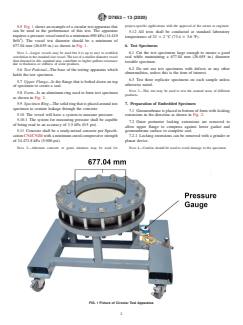
5.1 Due to hydraulic pressure that may be present on some applications, engineers need to understand the capability of these products to resist this pressure. This test allows engineers to compare products and verify pullout strength.
5.2 Hydraulic pullout resistance is a function of locking extension dimensions, locking extension geometry, locking extensions per area, locking extension polymer composition, and the properties of the concrete in which the locking extensions are embedded.
5.3 The data from this test method provides comparative information for rating hydraulic pullout resistance of different geomembranes with locking extensions embedded in concrete. Hydraulic pullout resistance, while partly dependent on locking extension dimensions, has no simple correlation to locking extension dimensions and geometry. Hence, hydraulic pullout resistance cannot be determined with a small sample without potentially producing misleading data to the actual hydraulic pullout resistance of the material. Therefore, the hydraulic pullout resistance is expressed in kPa (lb/ft2).
5.4 The apparatus can be circular or square in nature and must have a test area of 0.36 m2 (558 in.2).
5.5 Fig. 1 shows an example of a circular test apparatus that can be used in the performance of this test. The apparatus requires a pressure vessel rated to a minimum 690 kPa (14 410 lb/ft2). The vessel test diameter should be a minimum of 677.04 mm (26.655 in.) as shown in Fig. 1.
FIG. 1 Picture of Circular Test Apparatus
Note 1: Larger vessels may be used but it is up to user to establish correlation to the standard size vessel. The use of a smaller diameter vessel than denoted in this standard may contribute to higher pullout resistance due to thickness or stiffness of some products.
5.6 Test Pedestal—The base of the testing apparatus which holds the test specimen.
5.7 Upper Flange—Is the flange that is bolted down on top of specimen to create a seal.
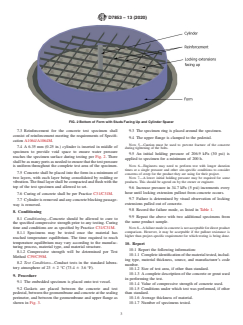
5.8 Form—Is an alumi...
SCOPE
1.1 This test method covers the determination of the hydraulic pullout resistance of a geomembrane with locking extensions embedded in concrete by determining the pressure required for locking extensions of the embedded specimen to pullout of the concrete.
1.2 The values stated in SI units are to be regarded as standard. The values given in parentheses are provided for information only and are not considered standard.
1.3 This standard does not purport to address all of the safety concerns, if any, associated with its use. It is the responsibility of the user of this standard to establish appropriate safety, health, and environmental practices and determine the applicability of regulatory limitations prior to use.
1.4 This international standard was developed in accordance with internationally recognized principles on standardization established in the Decision on Principles for the Development of International Standards, Guides and Recommendations issued by the World Trade Organization Technical Barriers to Trade (TBT) Committee.
- Status
- Published
- Publication Date
- 31-May-2020
- Technical Committee
- D35 - Geosynthetics
- Drafting Committee
- D35.01 - Mechanical Properties

Overview
ASTM D7853-13(2020): Standard Test Method for Hydraulic Pullout Resistance of a Geomembrane with Locking Extensions Embedded in Concrete provides a systematic test procedure to determine the hydraulic pullout resistance of geomembranes equipped with locking extensions when embedded in concrete. This method is essential for evaluating the performance and durability of geomembrane-concrete composite systems subjected to hydraulic pressures, enabling engineers and designers to compare products and verify their suitability for specific applications.
Key aspects assessed through this test include the dimensions and geometry of the locking extensions, the material composition, the density of extensions per area, and the properties of the surrounding concrete. The method expresses hydraulic pullout resistance in kPa (kilopascals) or lb/ft², ensuring reliable data for engineering analysis and product selection.
Key Topics
- Hydraulic Pullout Resistance: Evaluation of the pressure required to pull locking extensions from concrete, a critical property for geomembrane performance in hydrostatic environments.
- Locking Extension Design: The influence of design factors such as geometry, dimensions, polymer composition, and density on the pullout strength.
- Concrete Compatibility: Importance of concrete compressive strength and concrete-geomembrane interaction in determining overall system resistance.
- Standardized Apparatus: Specification of a circular or square pressure vessel (minimum area 0.36 m²) and associated test setup to achieve reproducible and comparable results.
- Failure Modes: Classification of observed specimen failures, including pullout, breakage at the liner, or failure of the concrete substrate.
Applications
ASTM D7853-13(2020) is particularly valuable in the following applications:
- Infrastructure Waterproofing: Assessing geomembrane systems in tunnel linings, below-grade waterproofing, and water containment where hydraulic pressures are present.
- Concrete Protection: Evaluating the long-term attachment and reliability of geomembrane liners installed in concrete tanks, retaining walls, and reservoirs.
- Product Development and Comparison: Enabling manufacturers and specifiers to compare the hydraulic pullout resistance among various geomembrane designs and select optimal solutions for specific projects.
- Project-Specific Validation: Supporting engineers in verifying that a chosen geomembrane-concrete system meets or exceeds hydraulic resistance requirements for unique site conditions.
- Quality Control: Providing standardized data for compliance verification and ongoing quality assurance during construction and installation.
Related Standards
The following ASTM standards are referenced within ASTM D7853-13(2020) and may be relevant for broader testing and specification:
- ASTM D4439: Terminology for Geosynthetics
- ASTM D5947: Test Methods for Physical Dimensions of Solid Plastics Specimens
- ASTM A1064/A1064M: Specification for Carbon-Steel Wire and Welded Wire Reinforcement for Concrete
- ASTM C31/C31M: Practice for Making and Curing Concrete Test Specimens in the Field
- ASTM C39/C39M: Test Method for Compressive Strength of Cylindrical Concrete Specimens
- ASTM C94/C94M: Specification for Ready-Mixed Concrete
- ASTM D618: Practice for Conditioning Plastics for Testing
Practical Value
By following ASTM D7853-13(2020), stakeholders in civil engineering, geotechnical design, concrete construction, and geomembrane manufacturing can:
- Ensure robust product selection based on empirical data.
- Mitigate the risk of geomembrane failure under hydraulic load.
- Achieve superior long-term performance for critical infrastructure through verified system compatibility.
- Meet regulatory and project-specific documentation requirements for geosynthetic installations.
Keywords: hydraulic pullout resistance, geomembrane, locking extensions, concrete protection, waterproofing, ASTM D7853, geosynthetics, liner testing, infrastructure durability
Relations
- Effective Date
- 01-Jun-2020
- Effective Date
- 15-Apr-2024
- Effective Date
- 01-Apr-2024
- Refers
ASTM C31/C31M-24a - Standard Practice for Making and Curing Concrete Test Specimens in the Field - Effective Date
- 01-Apr-2024
- Effective Date
- 01-Feb-2024
- Effective Date
- 01-Jan-2024
- Refers
ASTM C31/C31M-24 - Standard Practice for Making and Curing Concrete Test Specimens in the Field - Effective Date
- 01-Jan-2024
- Refers
ASTM C39/C39M-23 - Standard Test Method for Compressive Strength of Cylindrical Concrete Specimens - Effective Date
- 01-Dec-2023
- Effective Date
- 01-Jul-2019
- Effective Date
- 01-Nov-2018
- Effective Date
- 15-Apr-2018
- Refers
ASTM C31/C31M-18 - Standard Practice for Making and Curing Concrete Test Specimens in the Field - Effective Date
- 01-Jan-2018
- Effective Date
- 01-Aug-2017
- Refers
ASTM C39/C39M-17b - Standard Test Method for Compressive Strength of Cylindrical Concrete Specimens - Effective Date
- 01-Aug-2017
- Effective Date
- 01-Aug-2017
Get Certified
Connect with accredited certification bodies for this standard

Control Union Certifications
Global certification for agriculture and sustainability.

DIBt (Deutsches Institut für Bautechnik)
German Institute for Building Technology.
DIN CERTCO
DIN Group product certification.
Sponsored listings
Frequently Asked Questions
ASTM D7853-13(2020) is a standard published by ASTM International. Its full title is "Standard Test Method for Hydraulic Pullout Resistance of a Geomembrane with Locking Extensions Embedded in Concrete". This standard covers: SIGNIFICANCE AND USE 5.1 Due to hydraulic pressure that may be present on some applications, engineers need to understand the capability of these products to resist this pressure. This test allows engineers to compare products and verify pullout strength. 5.2 Hydraulic pullout resistance is a function of locking extension dimensions, locking extension geometry, locking extensions per area, locking extension polymer composition, and the properties of the concrete in which the locking extensions are embedded. 5.3 The data from this test method provides comparative information for rating hydraulic pullout resistance of different geomembranes with locking extensions embedded in concrete. Hydraulic pullout resistance, while partly dependent on locking extension dimensions, has no simple correlation to locking extension dimensions and geometry. Hence, hydraulic pullout resistance cannot be determined with a small sample without potentially producing misleading data to the actual hydraulic pullout resistance of the material. Therefore, the hydraulic pullout resistance is expressed in kPa (lb/ft2). 5.4 The apparatus can be circular or square in nature and must have a test area of 0.36 m2 (558 in.2). 5.5 Fig. 1 shows an example of a circular test apparatus that can be used in the performance of this test. The apparatus requires a pressure vessel rated to a minimum 690 kPa (14 410 lb/ft2). The vessel test diameter should be a minimum of 677.04 mm (26.655 in.) as shown in Fig. 1. FIG. 1 Picture of Circular Test Apparatus Note 1: Larger vessels may be used but it is up to user to establish correlation to the standard size vessel. The use of a smaller diameter vessel than denoted in this standard may contribute to higher pullout resistance due to thickness or stiffness of some products. 5.6 Test Pedestal—The base of the testing apparatus which holds the test specimen. 5.7 Upper Flange—Is the flange that is bolted down on top of specimen to create a seal. 5.8 Form—Is an alumi... SCOPE 1.1 This test method covers the determination of the hydraulic pullout resistance of a geomembrane with locking extensions embedded in concrete by determining the pressure required for locking extensions of the embedded specimen to pullout of the concrete. 1.2 The values stated in SI units are to be regarded as standard. The values given in parentheses are provided for information only and are not considered standard. 1.3 This standard does not purport to address all of the safety concerns, if any, associated with its use. It is the responsibility of the user of this standard to establish appropriate safety, health, and environmental practices and determine the applicability of regulatory limitations prior to use. 1.4 This international standard was developed in accordance with internationally recognized principles on standardization established in the Decision on Principles for the Development of International Standards, Guides and Recommendations issued by the World Trade Organization Technical Barriers to Trade (TBT) Committee.
SIGNIFICANCE AND USE 5.1 Due to hydraulic pressure that may be present on some applications, engineers need to understand the capability of these products to resist this pressure. This test allows engineers to compare products and verify pullout strength. 5.2 Hydraulic pullout resistance is a function of locking extension dimensions, locking extension geometry, locking extensions per area, locking extension polymer composition, and the properties of the concrete in which the locking extensions are embedded. 5.3 The data from this test method provides comparative information for rating hydraulic pullout resistance of different geomembranes with locking extensions embedded in concrete. Hydraulic pullout resistance, while partly dependent on locking extension dimensions, has no simple correlation to locking extension dimensions and geometry. Hence, hydraulic pullout resistance cannot be determined with a small sample without potentially producing misleading data to the actual hydraulic pullout resistance of the material. Therefore, the hydraulic pullout resistance is expressed in kPa (lb/ft2). 5.4 The apparatus can be circular or square in nature and must have a test area of 0.36 m2 (558 in.2). 5.5 Fig. 1 shows an example of a circular test apparatus that can be used in the performance of this test. The apparatus requires a pressure vessel rated to a minimum 690 kPa (14 410 lb/ft2). The vessel test diameter should be a minimum of 677.04 mm (26.655 in.) as shown in Fig. 1. FIG. 1 Picture of Circular Test Apparatus Note 1: Larger vessels may be used but it is up to user to establish correlation to the standard size vessel. The use of a smaller diameter vessel than denoted in this standard may contribute to higher pullout resistance due to thickness or stiffness of some products. 5.6 Test Pedestal—The base of the testing apparatus which holds the test specimen. 5.7 Upper Flange—Is the flange that is bolted down on top of specimen to create a seal. 5.8 Form—Is an alumi... SCOPE 1.1 This test method covers the determination of the hydraulic pullout resistance of a geomembrane with locking extensions embedded in concrete by determining the pressure required for locking extensions of the embedded specimen to pullout of the concrete. 1.2 The values stated in SI units are to be regarded as standard. The values given in parentheses are provided for information only and are not considered standard. 1.3 This standard does not purport to address all of the safety concerns, if any, associated with its use. It is the responsibility of the user of this standard to establish appropriate safety, health, and environmental practices and determine the applicability of regulatory limitations prior to use. 1.4 This international standard was developed in accordance with internationally recognized principles on standardization established in the Decision on Principles for the Development of International Standards, Guides and Recommendations issued by the World Trade Organization Technical Barriers to Trade (TBT) Committee.
ASTM D7853-13(2020) is classified under the following ICS (International Classification for Standards) categories: 59.080.70 - Geotextiles; 91.080.40 - Concrete structures. The ICS classification helps identify the subject area and facilitates finding related standards.
ASTM D7853-13(2020) has the following relationships with other standards: It is inter standard links to ASTM D7853-13, ASTM A1064/A1064M-24, ASTM C94/C94M-24a, ASTM C31/C31M-24a, ASTM D4439-24, ASTM C94/C94M-24, ASTM C31/C31M-24, ASTM C39/C39M-23, ASTM C94/C94M-19, ASTM A1064/A1064M-18, ASTM D4439-18, ASTM C31/C31M-18, ASTM D4439-17, ASTM C39/C39M-17b, ASTM C94/C94M-17a. Understanding these relationships helps ensure you are using the most current and applicable version of the standard.
ASTM D7853-13(2020) is available in PDF format for immediate download after purchase. The document can be added to your cart and obtained through the secure checkout process. Digital delivery ensures instant access to the complete standard document.
Standards Content (Sample)
This international standard was developed in accordance with internationally recognized principles on standardization established in the Decision on Principles for the
Development of International Standards, Guides and Recommendations issued by the World Trade Organization Technical Barriers to Trade (TBT) Committee.
Designation: D7853 − 13 (Reapproved 2020)
Standard Test Method for
Hydraulic Pullout Resistance of a Geomembrane with
Locking Extensions Embedded in Concrete
This standard is issued under the fixed designation D7853; the number immediately following the designation indicates the year of
original adoption or, in the case of revision, the year of last revision. A number in parentheses indicates the year of last reapproval. A
superscript epsilon (´) indicates an editorial change since the last revision or reapproval.
1. Scope D4439 Terminology for Geosynthetics
D5947 Test Methods for Physical Dimensions of Solid
1.1 This test method covers the determination of the hy-
Plastics Specimens
draulic pullout resistance of a geomembrane with locking
extensions embedded in concrete by determining the pressure
3. Terminology
required for locking extensions of the embedded specimen to
pullout of the concrete.
3.1 Definitions of terms applying to this test method appear
in Terminology D4439.
1.2 The values stated in SI units are to be regarded as
standard. The values given in parentheses are provided for
4. Summary of Test Method
information only and are not considered standard.
1.3 This standard does not purport to address all of the
4.1 Ageomembrane with locking extensions on at least one
safety concerns, if any, associated with its use. It is the surface is embedded into concrete. The pullout resistance is
responsibility of the user of this standard to establish appro-
determined by measuring the maximum pressure required to
priate safety, health, and environmental practices and deter- initiate pullout of the locking extensions from the concrete.
mine the applicability of regulatory limitations prior to use.
Alternatively, the geomembrane with locking extensions is
1.4 This international standard was developed in accor- embeddedinconcreteandpressurizedtoaspecifiedpressureto
dance with internationally recognized principles on standard-
verify whether a minimum level of in-place strength has been
ization established in the Decision on Principles for the attained.
Development of International Standards, Guides and Recom-
mendations issued by the World Trade Organization Technical
5. Significance and Use
Barriers to Trade (TBT) Committee.
5.1 Due to hydraulic pressure that may be present on some
applications, engineers need to understand the capability of
2. Referenced Documents
these products to resist this pressure.This test allows engineers
2.1 ASTM Standards:
to compare products and verify pullout strength.
A1064/A1064M Specification for Carbon-Steel Wire and
5.2 Hydraulic pullout resistance is a function of locking
Welded Wire Reinforcement, Plain and Deformed, for
extension dimensions, locking extension geometry, locking
Concrete
extensions per area, locking extension polymer composition,
C31/C31M Practice for Making and Curing Concrete Test
and the properties of the concrete in which the locking
Specimens in the Field
extensions are embedded.
C39/C39M Test Method for Compressive Strength of Cylin-
drical Concrete Specimens
5.3 The data from this test method provides comparative
C94/C94M Specification for Ready-Mixed Concrete
information for rating hydraulic pullout resistance of different
D618 Practice for Conditioning Plastics for Testing
geomembranes with locking extensions embedded in concrete.
Hydraulic pullout resistance, while partly dependent on lock-
ing extension dimensions, has no simple correlation to locking
This test method is under the jurisdiction of ASTM Committee D35 on
extension dimensions and geometry. Hence, hydraulic pullout
Geosynthetics and is the direct responsibility of Subcommittee D35.01 on Mechani-
cal Properties. resistance cannot be determined with a small sample without
Current edition approved June 1, 2020. Published June 2020. Originally
potentially producing misleading data to the actual hydraulic
approved in 2013. Last previous edition approved in 2013 as D7853 – 13. DOI:
pullout resistance of the material. Therefore, the hydraulic
10.1520/D7853-13R20.
pullout resistance is expressed in kPa (lb/ft ).
For referenced ASTM standards, visit the ASTM website, www.astm.org, or
contact ASTM Customer Service at service@astm.org. For Annual Book of ASTM
5.4 The apparatus can be circular or square in nature and
Standards volume information, refer to the standard’s Document Summary page on
2 2
the ASTM website. must have a test area of 0.36 m (558 in. ).
Copyright © ASTM International, 100 Barr Harbor Drive, PO Box C700, West Conshohocken, PA 19428-2959. United States
D7853 − 13 (2020)
project-specific applications with the approval of the owner or engineer.
5.5 Fig. 1 shows an example of a circular test apparatus that
can be used in the performance of this test. The apparatus
5.12 All tests shall be conducted at standard laboratory
requires a pressure vessel rated to a minimum 690 kPa (14 410
temperatures of 23 6 2 °C (73.4 6 3.6 °F).
lb/ft ). The vessel test diameter should be a minimum of
677.04 mm (26.655 in.) as shown in Fig. 1.
6. Test Specimens
NOTE 1—Larger vessels may be used but it is up to user to establish 6.1 Cut the test specimens large enough to ensure a good
correlationtothestandardsizevessel.Theuseofasmallerdiametervessel
seal while maintaining a 677.04 mm (26.655 in.) diameter
than denoted in this standard may contribute to higher pullout resistance
testable specimen.
due to thickness or stiffness of some products.
6.2 Do not use test specimens with defects or any other
5.6 Test Pedestal—The base of the testing apparatus which
abnormalities, unless this is the item of interest.
holds the test specimen.
6.3 Test three replicate specimens on each sample unless
5.7 Upper Flange—Is the flange that is bolted down on top
otherwise noted.
of specimen to create a seal.
NOTE 3—This test may be used to test the seamed areas of different
5.8 Form—Is an aluminum ring used to form test specimen
products.
as shown in Fig. 2.
5.9 SpecimenRing—Thesolidringthatisplacedaroundtest 7. Preparation of Embedded Specimen
specimen to contain leakage through the concrete.
7.1 Geomembrane is placed in bottom of form with locking
5.10 The vessel will have a system to measure pressur
...