

ASTM D5304-20
(Test Method)Standard Test Method for Assessing Middle Distillate Fuel Storage Stability by Oxygen Overpressure
General Information
- Abstract
SIGNIFICANCE AND USE
5.1 The results of this test method are useful in ranking a specific fuel sample against other specific fuel samples or standards when tested under identical conditions. Specific fuel samples containing dispersant additives, such as dispersant-containing stability additives, have shown inaccurate ranking against fuel samples that do not contain dispersant additives using this test method.3 This test method is not meant to relate a specific fuel to specific field handling and storage conditions. The formation of insolubles is affected by the material present in the storage container and by the ambient conditions. Since this test method is conducted in glass under standardized conditions, the results from different fuels can be compared on a common basis.
SCOPE
1.1 This test method covers a procedure for assessing the potential storage stability of middle distillate fuels such as Grade No. 1D and Grade No. 2D diesel fuels, in accordance with Specification D975.
1.2 This test method is applicable to either freshly refined fuels or fuels already in storage.
1.3 This test method is suitable for fuels containing stabilizer additives as well as fuels containing no such additives. However, fuels additized with dispersant additives, including dispersant-containing stability additives, may be ranked inaccurately using this test method compared to fuels that are not additized with dispersant additives.
1.4 Appendix X1 provides information on other suggested test times and temperatures for which this test method may be used.
1.5 The values stated in SI units are to be regarded as standard. The values given in parentheses are for information only.
1.6 This standard does not purport to address all of the safety concerns, if any, associated with its use. It is the responsibility of the user of this standard to establish appropriate safety, health, and environmental practices and determine the applicability of regulatory limitations prior to use. For specific warning statements, see 4.1, 6.2, 6.3, and 7.4.
1.7 This international standard was developed in accordance with internationally recognized principles on standardization established in the Decision on Principles for the Development of International Standards, Guides and Recommendations issued by the World Trade Organization Technical Barriers to Trade (TBT) Committee.
- Status
- Published
- Publication Date
- 31-Aug-2020
- Technical Committee
- D02 - Petroleum Products, Liquid Fuels, and Lubricants
- Drafting Committee
- D02.14 - Stability, Cleanliness and Compatibility of Liquid Fuels
Buy Documents
ASTM D5304-20 - Standard Test Method for Assessing Middle Distillate Fuel Storage Stability by Oxygen Overpressure
REDLINE ASTM D5304-20 - Standard Test Method for Assessing Middle Distillate Fuel Storage Stability by Oxygen Overpressure
Overview
ASTM D5304-20: Standard Test Method for Assessing Middle Distillate Fuel Storage Stability by Oxygen Overpressure provides a widely recognized procedure for evaluating the potential storage stability of middle distillate fuels, notably diesel fuels such as Grade No. 1D and Grade No. 2D. Developed by ASTM International, this test method allows fuel users, suppliers, and regulators to compare the relative stability of diesel fuel samples under standardized laboratory conditions using oxygen overpressure.
Storage stability is a critical property for middle distillate fuels, as deterioration can lead to the formation of insoluble materials during storage, impacting fuel quality, engine performance, and maintenance requirements. The test outlined in ASTM D5304-20 measures the tendency of fuels to form insolubles, thus supporting quality assurance, fuel formulation, and supply chain management.
Key Topics
- Scope: The method applies to freshly refined fuels as well as fuels that are already in storage. It is suitable for fuels with or without stabilizer additives.
- Procedure: The test exposes a filtered fuel sample in a glass container to elevated temperature (90°C) and oxygen overpressure (800 kPa) for a set duration. After aging, the quantity of insoluble products is measured gravimetrically.
- Ranking: This method enables the comparison of fuel samples' storage stability under identical, controlled conditions. It is not intended to predict performance under actual field storage conditions.
- Limitations: Dispersant-containing fuel additives may affect the accuracy of rankings as compared to non-additized fuels, which should be considered when interpreting results.
- Safety Considerations: The procedure involves pressurized oxygen and heated apparatus, requiring compliance with safety, health, and environmental practices.
Applications
- Fuel Quality Control: Refineries, fuel suppliers, and distributors use this standard to ensure the storage stability of diesel fuels within the supply chain.
- Regulatory Compliance: Meets the requirements of specifications such as ASTM D975 for diesel fuels, supporting regulatory review and certification processes.
- Product Development: Fuel formulators and additive manufacturers apply this test during research and development to evaluate the effectiveness of stabilizer additives and optimize fuel blends.
- Comparative Analysis: Useful for ranking different batches or sources of diesel fuel prior to long-term storage or deployment in critical applications, such as transportation and military operations.
- Research: Provides a basis for academic and industrial studies on diesel fuel degradation, oxidation stability, and the impact of various storage conditions.
Related Standards
- ASTM D975 - Specification for Diesel Fuel Oils
- ASTM D525 - Test Method for Oxidation Stability of Gasoline (Induction Period Method)
- ASTM D4057 - Practice for Manual Sampling of Petroleum and Petroleum Products
- ASTM D4177 - Practice for Automatic Sampling of Petroleum and Petroleum Products
- ASTM D4306 - Practice for Aviation Fuel Sample Containers for Tests Affected by Trace Contamination
By following ASTM D5304-20, stakeholders in the petroleum industry can confidently assess and compare the storage stability of middle distillate fuels. This enhances quality assurance in fuel procurement, supports compliance with diesel fuel regulations, and informs decisions concerning storage and usage, all under the rigorous and internationally recognized framework provided by ASTM International.
Keywords: distillate fuel stability, diesel fuel storage, ASTM D5304, oxidative stability, fuel insolubles, oxygen overpressure, fuel quality testing, petroleum standards.
Relations
- Refers
ASTM D4175-23a - Standard Terminology Relating to Petroleum Products, Liquid Fuels, and Lubricants - Effective Date
- 15-Dec-2023
- Effective Date
- 15-Dec-2023
- Refers
ASTM D4175-23e1 - Standard Terminology Relating to Petroleum Products, Liquid Fuels, and Lubricants - Effective Date
- 01-Jul-2023
- Effective Date
- 01-Feb-2019
- Effective Date
- 01-Dec-2018
- Effective Date
- 15-Dec-2017
- Effective Date
- 01-May-2017
- Effective Date
- 01-Oct-2016
- Effective Date
- 01-Sep-2016
- Effective Date
- 01-Oct-2015
- Effective Date
- 01-Oct-2015
- Effective Date
- 01-Jul-2015
- Effective Date
- 01-Jun-2015
- Effective Date
- 01-Mar-2015
- Effective Date
- 01-Jul-2014
Buy Documents
ASTM D5304-20 - Standard Test Method for Assessing Middle Distillate Fuel Storage Stability by Oxygen Overpressure
REDLINE ASTM D5304-20 - Standard Test Method for Assessing Middle Distillate Fuel Storage Stability by Oxygen Overpressure
Get Certified
Connect with accredited certification bodies for this standard

Element Materials Technology
Materials testing and product certification.

ABS Group Brazil
ABS Group certification services in Brazil.

ABS Quality Evaluations Inc.
American Bureau of Shipping quality certification.
Sponsored listings
Frequently Asked Questions
ASTM D5304-20 is a standard published by ASTM International. Its full title is "Standard Test Method for Assessing Middle Distillate Fuel Storage Stability by Oxygen Overpressure". This standard covers: SIGNIFICANCE AND USE 5.1 The results of this test method are useful in ranking a specific fuel sample against other specific fuel samples or standards when tested under identical conditions. Specific fuel samples containing dispersant additives, such as dispersant-containing stability additives, have shown inaccurate ranking against fuel samples that do not contain dispersant additives using this test method.3 This test method is not meant to relate a specific fuel to specific field handling and storage conditions. The formation of insolubles is affected by the material present in the storage container and by the ambient conditions. Since this test method is conducted in glass under standardized conditions, the results from different fuels can be compared on a common basis. SCOPE 1.1 This test method covers a procedure for assessing the potential storage stability of middle distillate fuels such as Grade No. 1D and Grade No. 2D diesel fuels, in accordance with Specification D975. 1.2 This test method is applicable to either freshly refined fuels or fuels already in storage. 1.3 This test method is suitable for fuels containing stabilizer additives as well as fuels containing no such additives. However, fuels additized with dispersant additives, including dispersant-containing stability additives, may be ranked inaccurately using this test method compared to fuels that are not additized with dispersant additives. 1.4 Appendix X1 provides information on other suggested test times and temperatures for which this test method may be used. 1.5 The values stated in SI units are to be regarded as standard. The values given in parentheses are for information only. 1.6 This standard does not purport to address all of the safety concerns, if any, associated with its use. It is the responsibility of the user of this standard to establish appropriate safety, health, and environmental practices and determine the applicability of regulatory limitations prior to use. For specific warning statements, see 4.1, 6.2, 6.3, and 7.4. 1.7 This international standard was developed in accordance with internationally recognized principles on standardization established in the Decision on Principles for the Development of International Standards, Guides and Recommendations issued by the World Trade Organization Technical Barriers to Trade (TBT) Committee.
SIGNIFICANCE AND USE 5.1 The results of this test method are useful in ranking a specific fuel sample against other specific fuel samples or standards when tested under identical conditions. Specific fuel samples containing dispersant additives, such as dispersant-containing stability additives, have shown inaccurate ranking against fuel samples that do not contain dispersant additives using this test method.3 This test method is not meant to relate a specific fuel to specific field handling and storage conditions. The formation of insolubles is affected by the material present in the storage container and by the ambient conditions. Since this test method is conducted in glass under standardized conditions, the results from different fuels can be compared on a common basis. SCOPE 1.1 This test method covers a procedure for assessing the potential storage stability of middle distillate fuels such as Grade No. 1D and Grade No. 2D diesel fuels, in accordance with Specification D975. 1.2 This test method is applicable to either freshly refined fuels or fuels already in storage. 1.3 This test method is suitable for fuels containing stabilizer additives as well as fuels containing no such additives. However, fuels additized with dispersant additives, including dispersant-containing stability additives, may be ranked inaccurately using this test method compared to fuels that are not additized with dispersant additives. 1.4 Appendix X1 provides information on other suggested test times and temperatures for which this test method may be used. 1.5 The values stated in SI units are to be regarded as standard. The values given in parentheses are for information only. 1.6 This standard does not purport to address all of the safety concerns, if any, associated with its use. It is the responsibility of the user of this standard to establish appropriate safety, health, and environmental practices and determine the applicability of regulatory limitations prior to use. For specific warning statements, see 4.1, 6.2, 6.3, and 7.4. 1.7 This international standard was developed in accordance with internationally recognized principles on standardization established in the Decision on Principles for the Development of International Standards, Guides and Recommendations issued by the World Trade Organization Technical Barriers to Trade (TBT) Committee.
ASTM D5304-20 is classified under the following ICS (International Classification for Standards) categories: 75.080 - Petroleum products in general. The ICS classification helps identify the subject area and facilitates finding related standards.
ASTM D5304-20 has the following relationships with other standards: It is inter standard links to ASTM D4175-23a, ASTM D975-23a, ASTM D4175-23e1, ASTM D975-19, ASTM D975-18a, ASTM D975-17a, ASTM D975-17, ASTM D975-16a, ASTM D975-16, ASTM D975-15c, ASTM D4306-15, ASTM D975-15b, ASTM D975-15a, ASTM D975-15, ASTM D975-14a. Understanding these relationships helps ensure you are using the most current and applicable version of the standard.
ASTM D5304-20 is available in PDF format for immediate download after purchase. The document can be added to your cart and obtained through the secure checkout process. Digital delivery ensures instant access to the complete standard document.
Standards Content (Sample)
This international standard was developed in accordance with internationally recognized principles on standardization established in the Decision on Principles for the
Development of International Standards, Guides and Recommendations issued by the World Trade Organization Technical Barriers to Trade (TBT) Committee.
Designation: D5304 − 20
Standard Test Method for
Assessing Middle Distillate Fuel Storage Stability by
Oxygen Overpressure
This standard is issued under the fixed designation D5304; the number immediately following the designation indicates the year of
original adoption or, in the case of revision, the year of last revision. A number in parentheses indicates the year of last reapproval. A
superscript epsilon (´) indicates an editorial change since the last revision or reapproval.
This standard has been approved for use by agencies of the U.S. Department of Defense.
1. Scope* 2. Referenced Documents
2.1 ASTM Standards:
1.1 This test method covers a procedure for assessing the
potential storage stability of middle distillate fuels such as D525 Test Method for Oxidation Stability of Gasoline (In-
duction Period Method)
Grade No. 1D and Grade No. 2D diesel fuels, in accordance
with Specification D975. D975 Specification for Diesel Fuel
D4057 Practice for Manual Sampling of Petroleum and
1.2 This test method is applicable to either freshly refined
Petroleum Products
fuels or fuels already in storage.
D4175 Terminology Relating to Petroleum Products, Liquid
Fuels, and Lubricants
1.3 This test method is suitable for fuels containing stabi-
D4177 Practice for Automatic Sampling of Petroleum and
lizer additives as well as fuels containing no such additives.
Petroleum Products
However, fuels additized with dispersant additives, including
D4306 Practice for Aviation Fuel Sample Containers for
dispersant-containing stability additives, may be ranked inac-
Tests Affected by Trace Contamination
curately using this test method compared to fuels that are not
E1 Specification for ASTM Liquid-in-Glass Thermometers
additized with dispersant additives.
1.4 Appendix X1 provides information on other suggested
3. Terminology
test times and temperatures for which this test method may be
3.1 Definitions:
used.
3.1.1 For definitions of terms used in this test method, see
1.5 The values stated in SI units are to be regarded as
Terminology D4175.
standard. The values given in parentheses are for information
3.1.2 membrane filter, n—a porous article of closely con-
only.
trolled pore size through which a liquid is passed to separate
1.6 This standard does not purport to address all of the matter in suspension.
safety concerns, if any, associated with its use. It is the
3.2 Definitions of Terms Specific to This Standard:
responsibility of the user of this standard to establish appro-
3.2.1 oxygen overpressure, n—partial pressures of oxygen
priate safety, health, and environmental practices and deter-
higher than that of air at atmospheric pressure.
mine the applicability of regulatory limitations prior to use.
3.2.2 potential storage stability, n—the tendency of a fuel to
For specific warning statements, see 4.1, 6.2, 6.3, and 7.4.
form insolubles under the conditions of this test method.
1.7 This international standard was developed in accor-
dance with internationally recognized principles on standard-
3.2.3 reactor, n—any vessel capable of sustaining pressures
ization established in the Decision on Principles for the
and temperatures above ambient, sometimes designated pres-
Development of International Standards, Guides and Recom-
sure vessel.
mendations issued by the World Trade Organization Technical
3.2.4 weighing assembly, n—a set of two filters and two
Barriers to Trade (TBT) Committee.
aluminum weighing dishes used to determine total insolubles
for each sample or blank.
This test method is under the jurisdiction of ASTM Committee D02 on
Petroleum Products, Liquid Fuels, and Lubricants and is the direct responsibility of
Subcommittee D02.14 on Stability, Cleanliness and Compatibility of Liquid Fuels. For referenced ASTM standards, visit the ASTM website, www.astm.org, or
Current edition approved Sept. 1, 2020. Published September 2020. Originally contact ASTM Customer Service at service@astm.org. For Annual Book of ASTM
approved in 1992. Last previous edition approved in 2015 as D5304 – 15. DOI: Standards volume information, refer to the standard’s Document Summary page on
10.1520/D5304-20. the ASTM website.
*A Summary of Changes section appears at the end of this standard
Copyright © ASTM International, 100 Barr Harbor Drive, PO Box C700, West Conshohocken, PA 19428-2959. United States
D5304 − 20
4. Summary of Test Method accommodate multiple sample or blank containers). The pres-
sure vessel(s) (reactor(s)) must be obtained only from com-
4.1 A 100 mL aliquot of filtered fuel is placed in a
mercial sources.
borosilicate glass container. The container is placed in a
pressure vessel which has been preheated to 90 °C. The 6.3 Heater, capable of maintaining the test temperature at
90 °C 6 1 °C for the duration of the test. Ensure heater
pressure vessel is pressurized with oxygen to 800 kPa (abso-
lute) (100 psig) for the duration of the test.The pressure vessel temperature uniformity. Heater shall be capable of holding the
pressure vessel(s) (reactor(s)) described in 6.2. Static (non-
is placed in a forced air oven at 90 °C for 16 h. (Warning—
Observe all normal precautions while using oxygen under forced air) ovens and unstirred liquid medium baths, such as
the Test Method D525 water bath, are unsuitable. Use of these
pressure and at high temperatures in the presence of combus-
tible liquids. Appropriate shielding should be used for any heaters will give erroneous results due to nonuniformity of
temperature.) The reactor should be placed in an oven so that
containers under pressure. Pressurize and depressurize the
containers slowly using appropriate personnel shielding. Never the entire reactor is uniformly receiving heat. (Warning—Use
of an explosion-proof oven is required.)
attempt to open the pressure vessel while it is pressurized. All
fuel and solvent handling should be done in an appropriate
6.4 Drying Oven, forced air operated at 110 °C 6 5 °C.
fume hood only.) After aging and cooling, the total amount of
Static ovens or vacuum ovens are not suitable.
fuel insoluble products is determined gravimetrically and
6.5 Water Aspirator or Vacuum Pump, as a source of
corrected according to blank determinations.
vacuum.
5. Significance and Use 6.6 Aluminum Dish (disposable), capable of holding 47 mm
diameter filters and 30 mL of adherent insolubles solvent.
5.1 The results of this test method are useful in ranking a
specific fuel sample against other specific fuel samples or 6.7 Analytical Balance, capable of weighing to the nearest
standards when tested under identical conditions. Specific fuel 0.1 mg.
samples containing dispersant additives, such as dispersant-
6.8 Filtration System—Arrange the following components
containing stability additives, have shown inaccurate ranking
as shown in Fig. 1.
against fuel samples that do not contain dispersant additives
6.8.1 Funnel and Funnel Base, with filter support for a
using this test method. This test method is not meant to relate
47 mm diameter membrane and a locking ring or spring action
a specific fuel to specific field handling and storage conditions.
clip.
The formation of insolubles is affected by the material present
6.8.2 Ground/Bond Wire, 0.912 mm to 2.59 mm (No. 10
in the storage container and by the ambient conditions. Since
through No. 19) bare-stranded, flexible, stainless steel, or
this test method is conducted in glass under standardized
copper installed in the flasks and grounded as shown in Fig. 1.
conditions, the results from different fuels can be compared on
6.8.3 Receiving Flask, 1.5 L or larger borosilicate glass
a common basis.
vacuum filter flask, which the filtration apparatus fits into,
equipped with a sidearm to connect to the safety flask.
6. Apparatus
6.8.4 Safety Flask, 1.5 Lor larger borosilicate glass vacuum
6.1 Sample or Blank Container, a brown borosilicate glass filter flask equipped with a sidearm to connect the vacuum
bottle capable of holding 100 mL of sample but with total system.Afuel and solvent resistant rubber hose through which
volume less than 200 mL, or a Test Method D525 glass insert. the grounding wire passes shall connect the sidearm of the
Atop closure of aluminum foil, perforated with small holes for receiving flask to the tube passing through the rubber stopper
breathing, will be required if there is more than one sample per in the top of the safety flask.
pressure vessel.
6.9 Hot Plate, capable of operating at low heat so that
6.2 Pressure Vessel(s) (Reactor(s)), designed for safe oper- 10 mLof toluene placed in the aluminum dish described in 6.6
ating pressures of 800 kPa (100 psig) in oxygen service will require 10 min to 25 min to evaporate.
(Warning—See 4.1.) equipped with a pressure gauge.
6.10 Thermometer, conforming to the requirements pre-
(Warning—The pressure for the procedure in this test method
scribed in Specification E1. Temperature measuring devices
is 800 kPa (absolute) (100 psig). Many pressure gauges are
such as ASTM 61C (IP No. 63C), liquid-in-glass
calibrated in kPa (gauge). For such gauges, the test pressure
thermometers, thermocouples, or platinum resistance ther-
would be 700 kPa (gauge). Maximum gauge gradations should
mometers that provide equivalent or better accuracy and
be 20 kPa (5 psig)). The gauge should be calibrated against
precision may be used.
standards, and capable of holding the four sample containers.
6.11 Forceps, approximately 12 cm long, flat-bladed, with
Pressure vessels having internal volumes from 250 mL to
non-serrated, non-pointed tips.
8000 mL have been used and found to be suitable. If 250 mL
vessels such as Test Method D525 oxidation vessels are used,
7. Reagents and Materials
four will be required. The larger volume pressure vessels can
7.1 Purity of Reagents—Reagent grade chemicals shall be
used in all tests. Unless otherwise indicated, it is intended that
all reagents conform to the specifications of the Committee on
Williams, S., “Engineering Investigation of 2004/05 East Coast F-76 Rapid
Fuel Degradation,” NAVAIRSYSCOM REPORT 4451/06-006, August 14, 2006. Analytical Reagents of the American Chemical Society where
D5304 − 20
FIG. 1 Schematic of Filtration System
such specifications are available. Other grades may be used, 8.2 Laboratory Subsampling—Fuel to be sampled must be
provided it is first ascertained that the reagent is of sufficiently above its cloud point and thoroughly mixed prior to aliquot
high purity to permit its use without lessening the accuracy or
sampling. Use clean amber or clean borosilicate glass contain-
precision of the determination.
ers for laboratory handling. Fuel in clear bottles must be
protected from light, for example, by wrapping in aluminum
7.2 Nylon Membrane Filters, plain, 47 mm diameter, pore
foil.
size 0.8 µm.
7.3 Hydrocarbon Solvent—Hexanes, heptane, isooctane, or
9. Preparation of Apparatus
petroleum ether with residue upon evaporation of less than
0.001 % and boiling range between 35 °C and 100 °C are
9.1 Rinse the sample containers thoroughly with the TAM
satisfactory. Filter before use with the filter specified in 7.2.
solvent followed by water.Then wash with a mildly alkaline or
7.4 Oxygen—Use 99.5 % minimum oxygen from cylinders neutral pH laboratory detergent. Rinse with deionized or
with two stage regulators capable of delivering up to 1600 kPa distilled water. Let bottles stand overnight with distilled water
(200 psig). The secondary regulator should be calibrated
in them. Dry in a drying oven at 105 °C to 115 °C. Ensure the
against standards to deliver 800 kPa 6 10 kPa (100 psig 6
sample bottles are cleaned thoroughly. Leave no soap residue
1 psig). (Warning—Oxygen at elevated temperature and pres-
on the inside of the bottles (Note 1).
sure is capable of causing explosion or fire.)
NOTE 1—Even a slight soap residue left on the walls of
...
This document is not an ASTM standard and is intended only to provide the user of an ASTM standard an indication of what changes have been made to the previous version. Because
it may not be technically possible to adequately depict all changes accurately, ASTM recommends that users consult prior editions as appropriate. In all cases only the current version
of the standard as published by ASTM is to be considered the official document.
Designation: D5304 − 15 D5304 − 20
Standard Test Method for
Assessing Middle Distillate Fuel Storage Stability by
Oxygen Overpressure
This standard is issued under the fixed designation D5304; the number immediately following the designation indicates the year of
original adoption or, in the case of revision, the year of last revision. A number in parentheses indicates the year of last reapproval. A
superscript epsilon (´) indicates an editorial change since the last revision or reapproval.
This standard has been approved for use by agencies of the U.S. Department of Defense.
1. Scope*
1.1 This test method covers a procedure for assessing the potential storage stability of middle distillate fuels such as Grade No.
1D and Grade No. 2D diesel fuels, in accordance with Specification D975.
1.2 This test method is applicable to either freshly refined fuels or fuels already in storage.
1.3 This test method is suitable for fuels containing stabilizer additives as well as fuels containing no such additives. However,
fuels additized with dispersant additives, including dispersant-containing stability additives, may be ranked inaccurately using this
test method compared to fuels that are not additized with dispersant additives.
1.4 Appendix X1 provides information on other suggested test times and temperatures for which this test method may be used.
1.5 The values stated in SI units are to be regarded as standard. The values given in parentheses are for information only.
1.6 This standard does not purport to address all of the safety concerns, if any, associated with its use. It is the responsibility
of the user of this standard to establish appropriate safety safety, health, and healthenvironmental practices and determine the
applicability of regulatory limitations prior to use. For specific warning statements, see 4.1, 6.2, 6.3, and 7.4.
1.7 This international standard was developed in accordance with internationally recognized principles on standardization
established in the Decision on Principles for the Development of International Standards, Guides and Recommendations issued
by the World Trade Organization Technical Barriers to Trade (TBT) Committee.
2. Referenced Documents
2.1 ASTM Standards:
D525 Test Method for Oxidation Stability of Gasoline (Induction Period Method)
D975 Specification for Diesel Fuel
D4057 Practice for Manual Sampling of Petroleum and Petroleum Products
D4175 Terminology Relating to Petroleum Products, Liquid Fuels, and Lubricants
D4177 Practice for Automatic Sampling of Petroleum and Petroleum Products
This test method is under the jurisdiction of ASTM Committee D02 on Petroleum Products, Liquid Fuels, and Lubricants and is the direct responsibility of Subcommittee
D02.14 on Stability Stability, Cleanliness and CleanlinessCompatibility of Liquid Fuels.
Current edition approved April 1, 2015Sept. 1, 2020. Published May 2015September 2020. Originally approved in 1992. Last previous edition approved in 20112015 as
D5304 – 11.D5304 – 15. DOI: 10.1520/D5304-15.10.1520/D5304-20.
For referenced ASTM standards, visit the ASTM website, www.astm.org, or contact ASTM Customer Service at service@astm.org. For Annual Book of ASTM Standards
volume information, refer to the standard’s Document Summary page on the ASTM website.
*A Summary of Changes section appears at the end of this standard
Copyright © ASTM International, 100 Barr Harbor Drive, PO Box C700, West Conshohocken, PA 19428-2959. United States
D5304 − 20
D4306 Practice for Aviation Fuel Sample Containers for Tests Affected by Trace Contamination
E1 Specification for ASTM Liquid-in-Glass Thermometers
3. Terminology
3.1 Definitions:
3.1.1 For definitions of terms used in this test method, see Terminology D4175.
3.1.2 membrane filter, n—a porous article of closely controlled pore size through which a liquid is passed to separate matter in
suspension.
3.2 Definitions of Terms Specific to This Standard:
3.2.1 oxygen overpressure, n—partial pressures of oxygen higher than that of air at atmospheric pressure.
3.2.2 potential storage stability, n—the tendency of a fuel to form insolubles under the conditions of this test method.
3.2.3 reactor, n—any vessel capable of sustaining pressures and temperatures above ambient, sometimes designated pressure
vessel.
3.2.4 weighing assembly, n—a set of two filters and two aluminum weighing dishes used to determine total insolubles for each
sample or blank.
4. Summary of Test Method
4.1 A 100 mL aliquot of filtered fuel is placed in a borosilicate glass container. The container is placed in a pressure vessel which
has been preheated to 90 °C. The pressure vessel is pressurized with oxygen to 800 kPa (absolute) (100 psig) for the duration of
the test. The pressure vessel is placed in a forced air oven at 90 °C for 16 h. (Warning—Observe all normal precautions while
using oxygen under pressure and at high temperatures in the presence of combustible liquids. Appropriate shielding should be used
for any containers under pressure. Pressurize and depressurize the containers slowly using appropriate personnel shielding. Never
attempt to open the pressure vessel while it is pressurized. All fuel and solvent handling should be done in an appropriate fume
hood only.) After aging and cooling, the total amount of fuel insoluble products is determined gravimetrically and corrected
according to blank determinations.
5. Significance and Use
5.1 The results of this test method are useful in ranking a specific fuel sample against other specific fuel samples or standards when
tested under identical conditions. Specific fuel samples containing dispersant additives, such as dispersant-containing stability
additives, have shown inaccurate ranking against fuel samples that do not contain dispersant additives using this test method. This
test method is not meant to relate a specific fuel to specific field handling and storage conditions. The formation of insolubles is
affected by the material present in the storage container and by the ambient conditions. Since this test method is conducted in glass
under standardized conditions, the results from different fuels can be compared on a common basis.
6. Apparatus
6.1 Sample or Blank Container, a brown borosilicate glass bottle capable of holding 100 mL of sample but with total volume less
than 200 mL, or a Test Method D525 glass insert. A top closure of aluminum foil, perforated with small holes for breathing, will
be required if there is more than one sample per pressure vessel.
6.2 Pressure Vessel(s) (Reactor(s)), designed for safe operating pressures of 800 kPa (100 psig) in oxygen service (Warning—See
4.1.) equipped with a pressure gauge. (Warning—The pressure for the procedure in this test method is 800 kPa (absolute)
(100 psig). Many pressure gauges are calibrated in kPa (gauge). For such gauges, the test pressure would be 700 kPa (gauge).
Maximum gauge gradations should be 20 kPa (5 psig)). The gauge should be calibrated against standards, and capable of holding
the four sample containers. Pressure vessels having internal volumes from 250 mL to 8000 mL have been used and found to be
Williams, S., “Engineering Investigation of 2004/05 East Coast F-76 Rapid Fuel Degradation,” NAVAIRSYSCOM REPORT 4451/06-006, August 14, 2006.
D5304 − 20
suitable. If 250 mL vessels such as Test Method D525 oxidation vessels are used, four will be required. The larger volume pressure
vessels can accommodate multiple sample or blank containers). The pressure vessel(s) (reactor(s)) must be obtained only from
commercial sources.
6.3 Heater, capable of maintaining the test temperature at 90 °C 6 1 °C for the duration of the test. Ensure heater temperature
uniformity. Heater shall be capable of holding the pressure vessel(s) (reactor(s)) described in 6.2. Static (non-forced air) ovens and
unstirred liquid medium baths, such as the Test Method D525 water bath, are unsuitable. Use of these heaters will give erroneous
results due to nonuniformity of temperature.) The reactor should be placed in an oven so that the entire reactor is uniformly
receiving heat. (Warning—Use of an explosion-proof oven is required.)
6.4 Drying Oven, forced air operated at 110 °C 6 5 °C. Static ovens or vacuum ovens are not suitable.
6.5 Water Aspirator or Vacuum Pump, as a source of vacuum.
6.6 Aluminum Dish (disposable), capable of holding 47 mm diameter filters and 30 mL of adherent insolubles solvent.
6.7 Analytical Balance, capable of weighing to the nearest 0.1 mg.
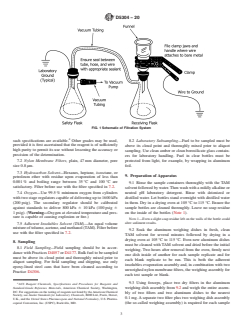
6.8 Filtration System—Arrange the following components as shown in Fig. 1.
6.8.1 Funnel and Funnel Base, with filter support for a 47 mm diameter membrane and a locking ring or spring action clip.
6.8.2 Ground/Bond Wire, 0.912 mm to 2.59 mm (No. 10 through No. 19) bare-stranded, flexible, stainless steel, or copper installed
in the flasks and grounded as shown in Fig. 1.
6.8.3 Receiving Flask, 1.5 L or larger borosilicate glass vacuum filter flask, which the filtration apparatus fits into, equipped with
a sidearm to connect to the safety flask.
6.8.4 Safety Flask, 1.5 L or larger borosilicate glass vacuum filter flask equipped with a sidearm to connect the vacuum system.
A fuel and solvent resistant rubber hose through which the grounding wire passes shall connect the sidearm of the receiving flask
to the tube passing through the rubber stopper in the top of the safety flask.
FIG. 1 Schematic of Filtration System
D5304 − 20
6.9 Hot Plate, capable of operating at low heat so that 10 mL of toluene placed in the aluminum dish described in 6.6 will require
10 min to 25 min to evaporate.
6.10 Thermometer, conforming to the requirements prescribed in Specification E1. Temperature measuring devices such as ASTM
61C (IP No. 63C), liquid-in-glass thermometers, thermocouples, or platinum resistance thermometers that provide equivalent or
better accuracy and precision may be used.
6.11 Forceps, approximately 12 cm long, flat-bladed, with non-serrated, non-pointed tips.
7. Reagents and Materials
7.1 Purity of Reagents—Reagent grade chemicals shall be used in all tests. Unless otherwise indicated, it is intended that all
reagents conform to the specifications of the Committee on Analytical Reagents of the American Chemical Society where such
specifications are available. Other grades may be used, provided it is first ascertained that the reagent is of sufficiently high purity
to permit its use without lessening the accuracy or precision of the determination.
7.2 Nylon Membrane Filters, plain, 47 mm diameter, pore size 0.8 μm.
7.3 Hydrocarbon Solvent—Hexanes, heptane, isooctane, or petroleum ether with residue upon evaporation of less than 0.001 %
and boiling range between 35 °C and 100 °C are satisfactory. Filter before use with the filter specified in 7.2.
7.4 Oxygen—Use 99.5 % minimum oxygen from cylinders with two stage regulators capable of delivering up to 1600 kPa
(200 psig). The secondary regulator should be calibrated against standards to deliver 800 kPa 6 10 kPa (100 psig 6 1 psig).
(Warning—Oxygen at elevated temperature and pressure is capable of causing explosion or fire.)
7.5 Adherent Insolubles Solvent (TAM)—An equal volume mixture of toluene, acetone, and methanol (TAM). Filter before use
with the filter specified in 7.2.
8. Sampling
8.1 Field Sampling—Field sampling should be in accordance with Practices D4057 or D4177. Bulk fuel to be sampled must be
above its cloud point and thoroughly mixed prior to aliquot sampling. For field sampling and shipping, use only epoxy-lined steel
cans that have been cleaned according to Practice D4306.
8.2 Laboratory Subsampling—Fuel to be sampled must be above its cloud point and thoroughly mixed prior to aliquot sampling.
Use clean amber or clean borosilicate glass containers for laboratory handling. Fuel in clear bottles must be protected from light,
for example, by wrapping in aluminum foil.
9. Preparation of Apparat
...