

ASTM D1201-13(2022)e1
(Specification)Standard Specification for Thermosetting Polyester Molding Compounds
General Information
- Abstract
ABSTRACT
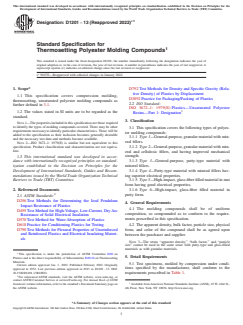
This specification deals with the classification, requirements, and testing of compression molding, thermosetting, unsaturated polyester molding compounds. Covered here are the following types of polyester molding compounds: Type 1 - general-purpose granular materials with mineral fillers; Type 2 - general-purpose granular materials with mineral and cellulosic fillers, and having improved mechanical strength; Type 3 - general-purpose putty-type materials with mineral fillers; Type 4 - putty-type materials with mineral fillers and having superior electrical properties; Type 5 - high-impact glass-fiber filled materials in mat form, and has good electrical properties; and Type 6 - high-impact glass-fiber filled materials in putty form. Sampled specimens shall be tested and conform accordingly to material requirements such as specific gravity, flexural strength, modulus of elasticity in flexure, Izod impact resistance, arc resistance, and water absorption.
SCOPE
1.1 This specification covers compression molding, thermosetting, unsaturated polyester molding compounds as further defined in 3.1.
1.2 The values stated in SI units are to be regarded as the standard.
Note 1: The properties included in this specification are those required to identify the types of molding compounds covered. There may be other requirements necessary to identify particular characteristics. These will be added to the specification as their inclusion becomes generally desirable and the necessary test data and methods become available.
Note 2: ISO 3672–1: 1979(E) is similar but not equivalent to this specification. Product classification and characterization are not equivalent.
1.3 This international standard was developed in accordance with internationally recognized principles on standardization established in the Decision on Principles for the Development of International Standards, Guides and Recommendations issued by the World Trade Organization Technical Barriers to Trade (TBT) Committee.
- Status
- Published
- Publication Date
- 31-Dec-2021
- Technical Committee
- D20 - Plastics
- Drafting Committee
- D20.16 - Thermosetting Materials


Overview
ASTM D1201-13(2022)e1: Standard Specification for Thermosetting Polyester Molding Compounds establishes the classification, requirements, and testing methodologies for compression molding, thermosetting, unsaturated polyester molding compounds. This globally recognized standard ensures the consistent identification and quality assurance of polyester molding compounds used in diverse industrial processes. By defining acceptable property ranges, performance characteristics, and testing procedures, ASTM D1201 supports manufacturers, suppliers, and users in verifying product integrity and suitability for specific molding applications.
Key Topics
Material Types: The standard classifies polyester molding compounds into six main types based on filler content, physical form, and performance characteristics:
- Type 1: General-purpose granular, mineral filled
- Type 2: General-purpose granular, mineral and cellulosic filled, improved strength
- Type 3: General-purpose putty, mineral filled
- Type 4: Putty-type with superior electrical properties
- Type 5: High-impact, glass-fiber filled mat, good electrical properties
- Type 6: High-impact, glass-fiber filled putty
Testing Requirements:
- Physical and mechanical properties such as specific gravity, flexural strength, modulus of elasticity, Izod impact resistance, arc resistance, and water absorption
- Standard testing conditions, sampling procedures, and statistical methods for evaluating compound batches
- All tests conform to referenced ASTM methods, ensuring repeatability and comparability
Product Quality Assurance:
- Outlines requirements for material uniformity and composition
- Specifies packaging, labeling, and marking criteria for traceability and safe handling
Applications
Thermosetting polyester molding compounds are vital in industries requiring materials with robust mechanical, electrical, and thermal properties. ASTM D1201 guides their use in:
- Electrical and Electronic Components: Types 4, 5, and 6 are preferred for insulating parts and assemblies where strong dielectric and arc resistance are critical.
- Automotive and Transportation: Various types serve roles in body panels, trim, and high-impact components that must withstand stress and environmental factors.
- Consumer Goods: From appliance housings to structural supports, these compounds offer consistent quality and performance.
- Industrial Equipment: The adaptability of the compounds makes them suitable for technical parts requiring rigidity, impact resistance, and minimal water absorption.
- Custom Molding Operations: The classification helps molders match material performance with specific application needs, optimizing production and end-use effectiveness.
Related Standards
Several standards complement or provide additional guidance for thermosetting polyester molding compounds and their applications:
- ASTM D792: Test Methods for Density and Specific Gravity of Plastics
- ASTM D256: Determining the Izod Pendulum Impact Resistance of Plastics
- ASTM D495: High-Voltage, Low-Current, Dry Arc Resistance of Solid Electrical Insulation
- ASTM D570: Water Absorption of Plastics
- ASTM D618: Practice for Conditioning Plastics for Testing
- ASTM D790: Flexural Properties of Unreinforced and Reinforced Plastics
- ASTM D3892: Practice for Packaging/Packing of Plastics
- ISO 3672-1: Plastics-Unsaturated Polyester Resins-Part 1: Designation (note: similar but not equivalent to ASTM D1201)
ASTM D1201-13(2022)e1 remains an essential reference for selecting and testing thermosetting polyester molding compounds, providing a foundation for product innovation and compliance in global plastics manufacturing and quality assurance.
Relations
- Effective Date
- 01-Jul-2017
- Effective Date
- 01-Dec-2015
- Effective Date
- 01-Dec-2015
- Effective Date
- 01-Sep-2015
- Effective Date
- 01-Apr-2009
- Effective Date
- 01-Nov-2008
- Effective Date
- 15-Jun-2008
- Effective Date
- 01-Sep-2007
- Effective Date
- 01-Sep-2007
- Effective Date
- 01-Dec-2006
- Effective Date
- 01-Dec-2006
- Refers
ASTM D256-06 - Standard Test Methods for Determining the Izod Pendulum Impact Resistance of Plastics - Effective Date
- 15-Mar-2006
- Effective Date
- 01-Nov-2005
- Effective Date
- 01-Nov-2005
- Effective Date
- 01-Nov-2005
Get Certified
Connect with accredited certification bodies for this standard

DIN CERTCO
DIN Group product certification.

Smithers Quality Assessments
US management systems and product certification.
Sponsored listings
Frequently Asked Questions
ASTM D1201-13(2022)e1 is a technical specification published by ASTM International. Its full title is "Standard Specification for Thermosetting Polyester Molding Compounds". This standard covers: ABSTRACT This specification deals with the classification, requirements, and testing of compression molding, thermosetting, unsaturated polyester molding compounds. Covered here are the following types of polyester molding compounds: Type 1 - general-purpose granular materials with mineral fillers; Type 2 - general-purpose granular materials with mineral and cellulosic fillers, and having improved mechanical strength; Type 3 - general-purpose putty-type materials with mineral fillers; Type 4 - putty-type materials with mineral fillers and having superior electrical properties; Type 5 - high-impact glass-fiber filled materials in mat form, and has good electrical properties; and Type 6 - high-impact glass-fiber filled materials in putty form. Sampled specimens shall be tested and conform accordingly to material requirements such as specific gravity, flexural strength, modulus of elasticity in flexure, Izod impact resistance, arc resistance, and water absorption. SCOPE 1.1 This specification covers compression molding, thermosetting, unsaturated polyester molding compounds as further defined in 3.1. 1.2 The values stated in SI units are to be regarded as the standard. Note 1: The properties included in this specification are those required to identify the types of molding compounds covered. There may be other requirements necessary to identify particular characteristics. These will be added to the specification as their inclusion becomes generally desirable and the necessary test data and methods become available. Note 2: ISO 3672–1: 1979(E) is similar but not equivalent to this specification. Product classification and characterization are not equivalent. 1.3 This international standard was developed in accordance with internationally recognized principles on standardization established in the Decision on Principles for the Development of International Standards, Guides and Recommendations issued by the World Trade Organization Technical Barriers to Trade (TBT) Committee.
ABSTRACT This specification deals with the classification, requirements, and testing of compression molding, thermosetting, unsaturated polyester molding compounds. Covered here are the following types of polyester molding compounds: Type 1 - general-purpose granular materials with mineral fillers; Type 2 - general-purpose granular materials with mineral and cellulosic fillers, and having improved mechanical strength; Type 3 - general-purpose putty-type materials with mineral fillers; Type 4 - putty-type materials with mineral fillers and having superior electrical properties; Type 5 - high-impact glass-fiber filled materials in mat form, and has good electrical properties; and Type 6 - high-impact glass-fiber filled materials in putty form. Sampled specimens shall be tested and conform accordingly to material requirements such as specific gravity, flexural strength, modulus of elasticity in flexure, Izod impact resistance, arc resistance, and water absorption. SCOPE 1.1 This specification covers compression molding, thermosetting, unsaturated polyester molding compounds as further defined in 3.1. 1.2 The values stated in SI units are to be regarded as the standard. Note 1: The properties included in this specification are those required to identify the types of molding compounds covered. There may be other requirements necessary to identify particular characteristics. These will be added to the specification as their inclusion becomes generally desirable and the necessary test data and methods become available. Note 2: ISO 3672–1: 1979(E) is similar but not equivalent to this specification. Product classification and characterization are not equivalent. 1.3 This international standard was developed in accordance with internationally recognized principles on standardization established in the Decision on Principles for the Development of International Standards, Guides and Recommendations issued by the World Trade Organization Technical Barriers to Trade (TBT) Committee.
ASTM D1201-13(2022)e1 is classified under the following ICS (International Classification for Standards) categories: 83.140.99 - Other rubber and plastics products. The ICS classification helps identify the subject area and facilitates finding related standards.
ASTM D1201-13(2022)e1 has the following relationships with other standards: It is inter standard links to ASTM D790-17, ASTM D790-15e1, ASTM D790-15, ASTM D3892-15, ASTM D3892-93(2009), ASTM D618-08, ASTM D792-08, ASTM D790-07e1, ASTM D790-07, ASTM D256-06a, ASTM D256-06ae1, ASTM D256-06, ASTM D618-05, ASTM D256-05a, ASTM D570-98(2005). Understanding these relationships helps ensure you are using the most current and applicable version of the standard.
ASTM D1201-13(2022)e1 is available in PDF format for immediate download after purchase. The document can be added to your cart and obtained through the secure checkout process. Digital delivery ensures instant access to the complete standard document.
Standards Content (Sample)
This international standard was developed in accordance with internationally recognized principles on standardization established in the Decision on Principles for the
Development of International Standards, Guides and Recommendations issued by the World Trade Organization Technical Barriers to Trade (TBT) Committee.
´1
Designation:D1201 −13(Reapproved 2022)
Standard Specification for
Thermosetting Polyester Molding Compounds
This standard is issued under the fixed designation D1201; the number immediately following the designation indicates the year of
original adoption or, in the case of revision, the year of last revision. A number in parentheses indicates the year of last reapproval. A
superscript epsilon (´) indicates an editorial change since the last revision or reapproval.
ε NOTE—Reapproved with editorial changes in January 2022.
1. Scope* D792 Test Methods for Density and Specific Gravity (Rela-
tive Density) of Plastics by Displacement
1.1 This specification covers compression molding,
D3892 Practice for Packaging/Packing of Plastics
thermosetting, unsaturated polyester molding compounds as
2.2 ISO Standard:
further defined in 3.1.
ISO 3672–1: 1979(E) Plastics—Unsaturated Polyester
1.2 The values stated in SI units are to be regarded as the
Resins—Part 1: Designation
standard.
3. Classification
NOTE1—Thepropertiesincludedinthisspecificationarethoserequired
to identify the types of molding compounds covered. There may be other
3.1 This specification covers the following types of polyes-
requirements necessary to identify particular characteristics.These will be
ter molding compounds:
added to the specification as their inclusion becomes generally desirable
3.1.1 Type 1—General-purpose, granular material with min-
and the necessary test data and methods become available.
eral fillers.
NOTE 2—ISO 3672–1: 1979(E) is similar but not equivalent to this
3.1.2 Type 2—General-purpose, granular material with min-
specification. Product classification and characterization are not equiva-
lent.
eral and cellulosic fillers, and having improved mechanical
strength.
1.3 This international standard was developed in accor-
dance with internationally recognized principles on standard- 3.1.3 Type 3—General-purpose, putty-type material with
mineral fillers.
ization established in the Decision on Principles for the
Development of International Standards, Guides and Recom- 3.1.4 Type 4—Putty-type material with mineral fillers hav-
ing superior electrical properties.
mendations issued by the World Trade Organization Technical
Barriers to Trade (TBT) Committee. 3.1.5 Type 5—High-impact,glass-fiberfilledmaterialinmat
form having good electrical properties.
2. Referenced Documents 3.1.6 Type 6—High-impact, glass-fiber filled material in
2 putty form.
2.1 ASTM Standards:
D256 Test Methods for Determining the Izod Pendulum
4. General Requirements
Impact Resistance of Plastics
4.1 The molding compounds shall be of uniform
D495 Test Method for High-Voltage, Low-Current, Dry Arc
composition, so compounded as to conform to the require-
Resistance of Solid Electrical Insulation
ments prescribed in this specification.
D570 Test Method for Water Absorption of Plastics
D618 Practice for Conditioning Plastics for Testing 4.2 The apparent density, bulk factor, particle size, physical
D790 Test Methods for Flexural Properties of Unreinforced
form, and color of the compound shall be as agreed upon
and Reinforced Plastics and Electrical Insulating Materi- between the purchaser and supplier.
als
NOTE 3—The terms “apparent density,” “bulk factor,” and “particle
size” cannot be used in the same sense with putty-type and glass-filled
materials as with granular materials.
This specification is under the jurisdiction of ASTM Committee D20 on
5. Detail Requirements
Plastics and is the direct responsibility of Subcommittee D20.16 on Thermosetting
Materials.
5.1 Test specimens, molded by compression under condi-
Current edition approved Jan. 1, 2022. Published February 2022. Originally
tions specified by the manufacturer, shall conform to the
approved in 1952. Last previous edition approved in 2013 as D1201 - 13. DOI:
10.1520/D1201-13R22E01.
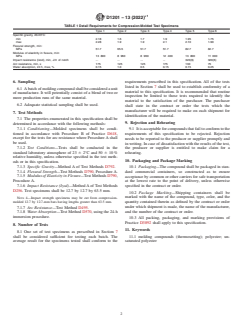
requirements prescribed in Table 1.
For referenced ASTM standards, visit the ASTM website, www.astm.org, or
contact ASTM Customer Service at service@astm.org. For Annual Book of ASTM
Standards volume information, refer to the standard’s Document Summary page on Available from American National Standards Institute (ANSI), 25 W. 43rd St.,
the ASTM website. 4th Floor, New York, NY 10036, http://www.ansi.org.
*A Summary of Changes section appears at the end of this standard
Copyright © ASTM International, 100 Barr Harbor Drive, PO Box C700, West Conshohocken, PA 19428-2959. United States
´1
D1201−13(2022)
TABLE 1 Detail Requirements for Compression-Molded Test Specimens
Type 1 Type 2 Type 3 Type 4 Type 5 Type 6
Specific gravity, 23/23°C:
min 2.18 1.6 1.7 1.9 1.95 1.75
max 2.28 1.9 1.9 2.1 2.10 1.90
Flexural strength, min:
MPa 51.7 65.5 51.7 51.7 82.7 82.7
Modulus of elastici
...