

ASTM D7406-20
(Test Method)Standard Test Method for Time-Dependent Compressive Deformation Under Constant Pressure for Geosynthetic Drainage Products
General Information
- Abstract
SIGNIFICANCE AND USE
5.1 The performance characteristics of a drainage geosynthetic are directly related to the integrity under compressive loading. If the product is sensitive to compressive deformation, its flow capacity could be greatly reduced or even shut off completely.
5.2 The deformation sensitivity of a candidate geosynthetic can be tested at field-simulated normal stress and potential tangential stresses.
5.3 This test method does not evaluate the effect of deformation of a geotextile filter or adjacent membrane.
5.4 Compression deformation, as it relates to reduction in flow capacity of a geosynthetic drainage product, is manufacturer and product specific. For example, a 10 % reduction in original thickness of a geonet made by Manufacturer A does not necessarily equal the same reduction in flow capacity as a 10 % reduction in thickness of the same or another type of geonet made by Manufacturer B.
5.5 This deformation data has merit directly to the end user, because it can be easily interpreted to result in a reduction factor for compressive deformation.4 The reduction factor can then be used to derive an allowable flow rate.5
SCOPE
1.1 This test method is used to determine the unconfined compressive deformation (consolidation) characteristics of drainage geotextiles, geocomposites, geonets, or any other geosynthetic associated with drainage at a constant temperature, when subjected to a constant compressive stress.
1.2 This test method is intended for use as an unconfined compressive performance deformation test only. For a detailed procedure on how to establish an index test, see EN ISO 25619-1. For performance tests, the specimen shall be subjected to the site-specific liquid, the site-specific stress (normal and potentially a tangential stress on the upper and parallel loading platen), or both.
Note 1: Results achieved from unconfined compressive performance deformation testing may differ from testing performed under confined conditions.
1.3 Because of the changing nature of the geosynthetic industry and the wide variety of products already available, this particular test method may have to be slightly modified for unconfined compression deformation testing of some products.
1.4 The values given in SI units are to be considered as the standard. The values given in parentheses are for information only.
1.5 This standard does not purport to address all of the safety concerns, if any, associated with its use. It is the responsibility of the user of this standard to establish appropriate safety, health, and environmental practices and determine the applicability of regulatory limitations prior to use.
1.6 This international standard was developed in accordance with internationally recognized principles on standardization established in the Decision on Principles for the Development of International Standards, Guides and Recommendations issued by the World Trade Organization Technical Barriers to Trade (TBT) Committee.
- Status
- Published
- Publication Date
- 31-Dec-2019
- Technical Committee
- D35 - Geosynthetics
- Drafting Committee
- D35.02 - Endurance Properties
Buy Documents

ASTM D7406-20 - Standard Test Method for Time-Dependent Compressive Deformation Under Constant Pressure for Geosynthetic Drainage Products
REDLINE ASTM D7406-20 - Standard Test Method for Time-Dependent Compressive Deformation Under Constant Pressure for Geosynthetic Drainage Products
Overview
ASTM D7406-20: Standard Test Method for Time-Dependent Compressive Deformation Under Constant Pressure for Geosynthetic Drainage Products establishes a procedure to evaluate the unconfined compressive deformation-or creep-characteristics of drainage geosynthetics such as geotextiles, geocomposites, and geonets under a constant compressive load and temperature. This standard is critical for assessing how geosynthetic drainage products perform under sustained field loads, directly impacting flow capacity and long-term system reliability in applications such as landfill liners, road construction, and retaining walls.
Key Topics
- Purpose and Significance
- Evaluates the compressive creep and deformation of geosynthetic drainage products.
- Helps determine the reduction in flow capacity due to compressive deformation over time.
- Directly relates to product selection and design for drainage capacity retention.
- Test Scope
- Applicable to geosynthetics used in drainage, including geotextiles, geocomposites, and geonets.
- Conducted under unconfined conditions at a constant temperature and compressive stress.
- Emulates field-simulated normal and, if required, tangential (shear) stresses.
- Data Output
- Provides deformation results for end users to calculate a reduction factor for compressive deformation.
- Supports derivation of allowable flow rates for drainage designs.
- Product Specificity
- Performance outcomes are specific to individual products and manufacturers.
- A given thickness reduction does not equate to the same flow reduction across different geosynthetic products.
Applications
Geosynthetic drainage products are widely used in civil engineering for:
- Landfill and environmental containment systems (liners, caps)
- Road and pavement subgrade drainage
- Retaining wall and embankment drainage
- Sports field and recreational facility drainage systems
The ASTM D7406-20 standard aids engineers and designers by:
- Allowing realistic assessment of long-term product performance under site-specific stresses and fluids.
- Informing decisions on factor of safety and product selection based on projected in-service deformation.
- Supporting compliance and quality assurance for regulatory and design requirements.
- Providing data necessary to calculate reduction factors for compressive deformation, which helps maintain the intended flow capacity of drainage layers throughout the lifespan of a project.
Related Standards
- ASTM D2990 - Test Methods for Tensile, Compressive, and Flexural Creep and Creep-Rupture of Plastics
- ASTM D4439 - Terminology for Geosynthetics
- ASTM D5199 - Test Method for Measuring the Nominal Thickness of Geosynthetics
- ASTM D5261 - Test Method for Measuring Mass per Unit Area of Geotextiles
- ASTM D5262 - Test Method for Evaluating the Unconfined Tension Creep and Creep Rupture Behavior of Geosynthetics
- ASTM D6364 - Test Method for Determining Short-Term Compression Behavior of Geosynthetics
- EN ISO 25619-1 - Geosynthetics-Determination of Compression Behavior-Compressive Creep Properties
- GRI GC-8 - Standard Guide for Determination of Allowable Flow Rate of a Drainage Geocomposite
Practical Value
Adopting ASTM D7406-20 improves reliability in geosynthetic drainage design, ensuring that selected materials maintain their flow performance over time, even under significant compressive loads. This standard is an essential reference for geotechnical, civil, and environmental engineers tasked with drainage system design and specification, providing a scientific basis for long-term project durability and regulatory compliance in infrastructure and environmental protection projects.
Keywords: ASTM D7406-20, geosynthetic drainage, compressive deformation, creep, geotextile, geocomposite, geonet, drainage capacity, civil engineering standards, flow reduction, reduction factor.
Relations
- Effective Date
- 01-Jan-2020
- Effective Date
- 01-Feb-2024
- Refers
ASTM D5199-12(2019) - Standard Test Method for Measuring the Nominal Thickness of Geosynthetics - Effective Date
- 15-Jun-2019
- Effective Date
- 01-Jul-2018
- Effective Date
- 15-Apr-2018
- Effective Date
- 01-Feb-2018
- Effective Date
- 01-Aug-2017
- Effective Date
- 01-Mar-2017
- Effective Date
- 01-Sep-2015
- Effective Date
- 01-Jul-2015
- Effective Date
- 01-Mar-2014
- Effective Date
- 01-Feb-2012
- Effective Date
- 01-Oct-2011
- Effective Date
- 01-Oct-2011
- Effective Date
- 01-Feb-2011
Buy Documents
ASTM D7406-20 - Standard Test Method for Time-Dependent Compressive Deformation Under Constant Pressure for Geosynthetic Drainage Products
REDLINE ASTM D7406-20 - Standard Test Method for Time-Dependent Compressive Deformation Under Constant Pressure for Geosynthetic Drainage Products
Get Certified
Connect with accredited certification bodies for this standard

Control Union Certifications
Global certification for agriculture and sustainability.

Hohenstein Institut
Textile testing and certification.

Bureau Veritas Bangladesh
Bureau Veritas certification services in Bangladesh.
Sponsored listings
Frequently Asked Questions
ASTM D7406-20 is a standard published by ASTM International. Its full title is "Standard Test Method for Time-Dependent Compressive Deformation Under Constant Pressure for Geosynthetic Drainage Products". This standard covers: SIGNIFICANCE AND USE 5.1 The performance characteristics of a drainage geosynthetic are directly related to the integrity under compressive loading. If the product is sensitive to compressive deformation, its flow capacity could be greatly reduced or even shut off completely. 5.2 The deformation sensitivity of a candidate geosynthetic can be tested at field-simulated normal stress and potential tangential stresses. 5.3 This test method does not evaluate the effect of deformation of a geotextile filter or adjacent membrane. 5.4 Compression deformation, as it relates to reduction in flow capacity of a geosynthetic drainage product, is manufacturer and product specific. For example, a 10 % reduction in original thickness of a geonet made by Manufacturer A does not necessarily equal the same reduction in flow capacity as a 10 % reduction in thickness of the same or another type of geonet made by Manufacturer B. 5.5 This deformation data has merit directly to the end user, because it can be easily interpreted to result in a reduction factor for compressive deformation.4 The reduction factor can then be used to derive an allowable flow rate.5 SCOPE 1.1 This test method is used to determine the unconfined compressive deformation (consolidation) characteristics of drainage geotextiles, geocomposites, geonets, or any other geosynthetic associated with drainage at a constant temperature, when subjected to a constant compressive stress. 1.2 This test method is intended for use as an unconfined compressive performance deformation test only. For a detailed procedure on how to establish an index test, see EN ISO 25619-1. For performance tests, the specimen shall be subjected to the site-specific liquid, the site-specific stress (normal and potentially a tangential stress on the upper and parallel loading platen), or both. Note 1: Results achieved from unconfined compressive performance deformation testing may differ from testing performed under confined conditions. 1.3 Because of the changing nature of the geosynthetic industry and the wide variety of products already available, this particular test method may have to be slightly modified for unconfined compression deformation testing of some products. 1.4 The values given in SI units are to be considered as the standard. The values given in parentheses are for information only. 1.5 This standard does not purport to address all of the safety concerns, if any, associated with its use. It is the responsibility of the user of this standard to establish appropriate safety, health, and environmental practices and determine the applicability of regulatory limitations prior to use. 1.6 This international standard was developed in accordance with internationally recognized principles on standardization established in the Decision on Principles for the Development of International Standards, Guides and Recommendations issued by the World Trade Organization Technical Barriers to Trade (TBT) Committee.
SIGNIFICANCE AND USE 5.1 The performance characteristics of a drainage geosynthetic are directly related to the integrity under compressive loading. If the product is sensitive to compressive deformation, its flow capacity could be greatly reduced or even shut off completely. 5.2 The deformation sensitivity of a candidate geosynthetic can be tested at field-simulated normal stress and potential tangential stresses. 5.3 This test method does not evaluate the effect of deformation of a geotextile filter or adjacent membrane. 5.4 Compression deformation, as it relates to reduction in flow capacity of a geosynthetic drainage product, is manufacturer and product specific. For example, a 10 % reduction in original thickness of a geonet made by Manufacturer A does not necessarily equal the same reduction in flow capacity as a 10 % reduction in thickness of the same or another type of geonet made by Manufacturer B. 5.5 This deformation data has merit directly to the end user, because it can be easily interpreted to result in a reduction factor for compressive deformation.4 The reduction factor can then be used to derive an allowable flow rate.5 SCOPE 1.1 This test method is used to determine the unconfined compressive deformation (consolidation) characteristics of drainage geotextiles, geocomposites, geonets, or any other geosynthetic associated with drainage at a constant temperature, when subjected to a constant compressive stress. 1.2 This test method is intended for use as an unconfined compressive performance deformation test only. For a detailed procedure on how to establish an index test, see EN ISO 25619-1. For performance tests, the specimen shall be subjected to the site-specific liquid, the site-specific stress (normal and potentially a tangential stress on the upper and parallel loading platen), or both. Note 1: Results achieved from unconfined compressive performance deformation testing may differ from testing performed under confined conditions. 1.3 Because of the changing nature of the geosynthetic industry and the wide variety of products already available, this particular test method may have to be slightly modified for unconfined compression deformation testing of some products. 1.4 The values given in SI units are to be considered as the standard. The values given in parentheses are for information only. 1.5 This standard does not purport to address all of the safety concerns, if any, associated with its use. It is the responsibility of the user of this standard to establish appropriate safety, health, and environmental practices and determine the applicability of regulatory limitations prior to use. 1.6 This international standard was developed in accordance with internationally recognized principles on standardization established in the Decision on Principles for the Development of International Standards, Guides and Recommendations issued by the World Trade Organization Technical Barriers to Trade (TBT) Committee.
ASTM D7406-20 is classified under the following ICS (International Classification for Standards) categories: 59.080.70 - Geotextiles. The ICS classification helps identify the subject area and facilitates finding related standards.
ASTM D7406-20 has the following relationships with other standards: It is inter standard links to ASTM D7406-07(2012), ASTM D4439-24, ASTM D5199-12(2019), ASTM D5261-10(2018), ASTM D4439-18, ASTM D6364-06(2018), ASTM D4439-17, ASTM D2990-17, ASTM D4439-15a, ASTM D4439-15, ASTM D4439-14, ASTM D5199-12, ASTM D6364-06(2011), ASTM D4439-11, ASTM D5199-11. Understanding these relationships helps ensure you are using the most current and applicable version of the standard.
ASTM D7406-20 is available in PDF format for immediate download after purchase. The document can be added to your cart and obtained through the secure checkout process. Digital delivery ensures instant access to the complete standard document.
Standards Content (Sample)
This international standard was developed in accordance with internationally recognized principles on standardization established in the Decision on Principles for the
Development of International Standards, Guides and Recommendations issued by the World Trade Organization Technical Barriers to Trade (TBT) Committee.
Designation: D7406 − 20
Standard Test Method for
Time-Dependent Compressive Deformation Under Constant
Pressure for Geosynthetic Drainage Products
This standard is issued under the fixed designation D7406; the number immediately following the designation indicates the year of
original adoption or, in the case of revision, the year of last revision. A number in parentheses indicates the year of last reapproval. A
superscript epsilon (´) indicates an editorial change since the last revision or reapproval.
1. Scope 2. Referenced Documents
1.1 This test method is used to determine the unconfined 2.1 ASTM Standards:
compressive deformation (consolidation) characteristics of A1030/A1030M Practice for Measuring Flatness Character-
drainage geotextiles, geocomposites, geonets, or any other istics of Steel Sheet Products
geosynthetic associated with drainage at a constant D2990 Test Methods for Tensile, Compressive, and Flexural
temperature, when subjected to a constant compressive stress. Creep and Creep-Rupture of Plastics
D4439 Terminology for Geosynthetics
1.2 This test method is intended for use as an unconfined
D5199 Test Method for Measuring the Nominal Thickness
compressive performance deformation test only. For a detailed
of Geosynthetics
procedure on how to establish an index test, see EN ISO
D5261 Test Method for Measuring Mass per Unit Area of
25619-1. For performance tests, the specimen shall be sub-
Geotextiles
jected to the site-specific liquid, the site-specific stress (normal
D6364 Test Method for Determining Short-Term Compres-
and potentially a tangential stress on the upper and parallel
sion Behavior of Geosynthetics
loading platen), or both.
2.2 ISO Standard:
NOTE 1—Results achieved from unconfined compressive performance
EN ISO 25619-1 Geosynthetics—Determination of Com-
deformation testing may differ from testing performed under confined
pression Behavior—Part 1: Compressive Creep Properties
conditions.
1.3 Because of the changing nature of the geosynthetic 3. Terminology
industryandthewidevarietyofproductsalreadyavailable,this
3.1 For definitions related to geosynthetics, see Terminol-
particular test method may have to be slightly modified for
ogy D4439.
unconfined compression deformation testing of some products.
4. Summary of Test Method
1.4 The values given in SI units are to be considered as the
standard. The values given in parentheses are for information
4.1 In this performance test method, a geosynthetic drain-
only.
age product is subjected to a sustained normal and potentially
tangential stress. Deformations of the specimen are recorded at
1.5 This standard does not purport to address all of the
designated time intervals, and a graph is drawn.
safety concerns, if any, associated with its use. It is the
responsibility of the user of this standard to establish appro-
4.2 The specimen may be immersed in a site-specific water
priate safety, health, and environmental practices and deter-
or permeant, to simulate actual field conditions.
mine the applicability of regulatory limitations prior to use.
4.3 For long-term testing, it is recommended that the test be
1.6 This international standard was developed in accor-
run for at least 1000 h. Seating times up to 10 000 h have been
dance with internationally recognized principles on standard-
used, if that longer time data is required.
ization established in the Decision on Principles for the
4.4 Deformation load (normal as well as potentially tangen-
Development of International Standards, Guides and Recom-
tial) should reflect the actual field conditions.
mendations issued by the World Trade Organization Technical
Barriers to Trade (TBT) Committee.
4.5 The test will be conducted at site-specific temperatures.
For referenced ASTM standards, visit the ASTM website, www.astm.org, or
This test method is under the jurisdiction of ASTM Committee D35 on contact ASTM Customer Service at service@astm.org. For Annual Book of ASTM
Geosynthetics and is the direct responsibility of Subcommittee D35.02 on Endur- Standards volume information, refer to the standard’s Document Summary page on
ance Properties. the ASTM website.
Current edition approved Jan. 1, 2020. Published January 2020. Originally Available from International Organization for Standardization (ISO), ISO
approved in 2007. Last previous edition approved in 2012 as D7406 – 07 (2012). Central Secretariat, BIBC II, Chemin de Blandonnet 8, CP 401, 1214 Vernier,
DOI: 10.1520/D7406-20. Geneva, Switzerland, http://www.iso.org.
Copyright © ASTM International, 100 Barr Harbor Drive, PO Box C700, West Conshohocken, PA 19428-2959. United States
D7406 − 20
5. Significance and Use be large enough to hold a minimum specimen size of 150 by
150 mm (6.0 by 6.0 in.), but can have size of 300 by 300 mm
5.1 The performance characteristics of a drainage geosyn-
(12.0 by 12.0 in.) or larger to ensure the test setup remains
thetic are directly related to the integrity under compressive
unconfined.
loading. If the product is sensitive to compressive deformation,
its flow capacity could be greatly reduced or even shut off 6.3 Base Platen—The base platen shall be rigid enough to
resist bending and, in turn, support a uniform normal stress.A
completely.
thick steel plate is advisable; steel is preferable given potential
5.2 The deformation sensitivity of a candidate geosynthetic
rusting once immersed in site-specific liquid. The base platen
can be tested at field-simulated normal stress and potential
shall be placed in the specimen container to support the tested
tangential stresses.
specimen. Practice A1030/A1030M provides a standard prac-
5.3 This test method does not evaluate the effect of defor-
tice for measuring the flatness characteristics of steel sheet
mation of a geotextile filter or adjacent membrane.
products, which is applicable here. When a tangential stress is
applied, it is necessary to avoid any slippage of the tested
5.4 Compression deformation, as it relates to reduction in
specimenwiththebaseplaten(roughsurfacesontheplatenare
flow capacity of a geosynthetic drainage product, is manufac-
recommended). Ideally, the base platen will be larger than the
turer and product specific. For example, a 10 % reduction in
specimen size to support the specimen during draping and
original thickness of a geonet made by Manufacturer A does
flexing under the stress assembly.
not necessarily equal the same reduction in flow capacity as a
10 % reduction in thickness of the same or another type of
6.4 Loading Platen—The loading platen shall be rigid
geonet made by Manufacturer B.
enough to resist bending and, in turn, apply a uniform normal
stress. Planarity and maintaining flatness of the loading platen
5.5 This deformation data has merit directly to the end user,
are important as well, especially when the normal stress is
because it can be easily interpreted to result in a reduction
applied via a point load. Practice A1030/A1030M provides a
factor for compressive deformation. The reduction factor can
practice of how to measure the flatness. When tangential stress
then be used to derive an allowable flow rate.
is applied, it is necessary to avoid slippage of the tested
6. Apparatus
specimen with the loading platen (rough surfaces on the platen
are recommended). The loading platen shall be slightly larger
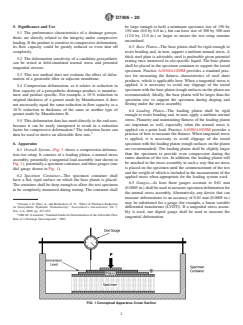
6.1 Overall System—Fig. 1 shows a compression deforma-
than the specimen to provide even compression during the
tion test setup. It consists of a loading platen, a normal stress
entire duration of the test. In addition, the loading platen will
assembly, potentially a tangential load assembly (not shown in
be attached to the stress assembly in such a way that no stress
Fig.1),potentiallyaspecimencontainer,andthreegauges(one
is placed on the specimen until the commencement of the test
dial gauge shown in Fig. 1).
and the weight of which is included in the measurement of the
6.2 Specimen Container—The specimen container shall
applied stress when appropriate for the loading system used.
have a flat, rigid surface on which the base platen is placed.
6.5 Gauges—At least three gauges accurate to 0.01 mm
The container shall be deep enough to allow the test specimen
(0.0005in.)shallbeusedtomeasurespecimendeformationfor
to be completely immersed during testing. The container shall
the normal stress assembly. Alternatively, any device that can
measure deformations to an accuracy of 0.01 mm (0.0005 in.)
4 may be substituted for a gauge (for example, a linear variable
Giroud, J.-P., Zhao,A., and Richardson, G. N., “Effect of Thickness Reduction
on Geosynthetic Hydraulic Transmissivity,” Geosyntheti
...
This document is not an ASTM standard and is intended only to provide the user of an ASTM standard an indication of what changes have been made to the previous version. Because
it may not be technically possible to adequately depict all changes accurately, ASTM recommends that users consult prior editions as appropriate. In all cases only the current version
of the standard as published by ASTM is to be considered the official document.
Designation: D7406 − 07 (Reapproved 2012) D7406 − 20
Standard Test Method for
Time-Dependent (Creep)Compressive Deformation Under
Constant Pressure for Geosynthetic Drainage Products
This standard is issued under the fixed designation D7406; the number immediately following the designation indicates the year of
original adoption or, in the case of revision, the year of last revision. A number in parentheses indicates the year of last reapproval. A
superscript epsilon (´) indicates an editorial change since the last revision or reapproval.
1. Scope
1.1 This test method is used to determine the unconfined compressive creep deformation (consolidation) characteristics of
drainage geotextiles, geocomposites, geonets, or any other geosynthetic associated with drainage at a constant temperature, when
subjected to a constant compressive stress.
1.2 This test method is intended for use as an unconfined compressive performance creepdeformation test only. For a detailed
procedure on how to establish an index test, see the EN standard 1897.ISO 25619-1. For performance tests, the specimen shall be
subjected to the site-specific liquid and/or liquid, the site-specific stress (normal and potentially shear stress).a tangential stress on
the upper and parallel loading platen), or both.
NOTE 1—Results achieved from unconfined compressive performance creep deformation testing may differ from testing performed under confined
conditions.
1.3 Because of the changing nature of the geosynthetic industry,industry and the wide variety of products already available, this
particular test method may have to be slightly modified for unconfined compression creepdeformation testing of some
products.products.
1.4 The values given in SI units are to be considered as the standard. The values given in parentheses are for information only.
1.5 This standard does not purport to address all of the safety concerns, if any, associated with its use. It is the responsibility
of the user of this standard to establish appropriate safety safety, health, and healthenvironmental practices and determine the
applicability of regulatory limitations prior to use.
1.6 This international standard was developed in accordance with internationally recognized principles on standardization
established in the Decision on Principles for the Development of International Standards, Guides and Recommendations issued
by the World Trade Organization Technical Barriers to Trade (TBT) Committee.
2. Referenced Documents
2.1 ASTM Standards:
A1030/A1030M Practice for Measuring Flatness Characteristics of Steel Sheet Products
D2990 Test Methods for Tensile, Compressive, and Flexural Creep and Creep-Rupture of Plastics
D4439 Terminology for Geosynthetics
D5199 Test Method for Measuring the Nominal Thickness of Geosynthetics
D5261 Test Method for Measuring Mass per Unit Area of Geotextiles
D5262 Test Method for Evaluating the Unconfined Tension Creep and Creep Rupture Behavior of Geosynthetics
D6364 Test Method for Determining Short-Term Compression Behavior of Geosynthetics
2.2 ENISO Standard:
EN 1897ISO 25619-1 Geosynthetics—Determination of Compression Behavior—Part 1: Compressive Creep Properties
This test method is under the jurisdiction of ASTM Committee D35 on Geosynthetics and is the direct responsibility of Subcommittee D35.02 on Endurance Properties.
Current edition approved July 1, 2012Jan. 1, 2020. Published July 2012January 2020. Originally approved in 2007. Last previous edition approved in 2012 as D7406 – 07
(2012). DOI: 10.1520/D7406-07R12.10.1520/D7406-20.
For referenced ASTM standards, visit the ASTM website, www.astm.org, or contact ASTM Customer Service at service@astm.org. For Annual Book of ASTM Standards
volume information, refer to the standard’s Document Summary page on the ASTM website.
Available from International Organization for Standardization (ISO), ISO Central Secretariat, BIBC II, Chemin de Blandonnet 8, CP 401, 1214 Vernier, Geneva,
Switzerland, http://www.iso.org.
Copyright © ASTM International, 100 Barr Harbor Drive, PO Box C700, West Conshohocken, PA 19428-2959. United States
D7406 − 20
3. Terminology
3.1 For definitions related to geosynthetics, see Terminology D4439.
3.2 For definitions related to creep, see Test Methods D2990 and D5262.
3.3 Definitions:
3.3.1 compressive creep, n—time-dependent deformation or compressive strain of a material subjected to a constant
compressive stress.
3.3.2 compressive creep rupture, n—failure by collapse of a material subjected to a constant compressive stress.
4. Summary of Test Method
4.1 In this performance test method, a geosynthetic drainage product is subjected to a sustained normal and potentially shear
stresses.tangential stress. Deformations of the specimen are recorded at designated time intervals, and a graph is drawn.
4.2 The specimen may be immersed in a site-specific water or permeant, to simulate actual field conditions.
4.3 For long-term testing, it is recommended that the test be run for at least 1000 h. Dwell 1000 h. Seating times up to 10000
hr 10 000 h have been used, if that longer time data is required.
4.4 CreepDeformation load (normal as well as potentially shear)tangential) should reflect the actual field conditions conditions.
4.5 The test will be conducted at site specific site-specific temperatures.
5. Significance and Use
5.1 The performance characteristics of a drainage geosynthetic are directly related to the integrity under compressive loading.
If the product is sensitive to compressive creep,deformation, its flow capacity could be greatly reduced or even shut off completely.
5.2 The creepdeformation sensitivity of a candidate geosynthetic can be tested at field-simulated normal stress and potentially
shearpotential tangential stresses.
5.3 This test method does not evaluate the effect of creepdeformation of a geotextile filter or adjacent membrane.
5.4 Compression creepdeformation, as it relates to reduction in flow capacity of a geosynthetic drainage product, is
manufacturer and product specific. For example, a 10%10 % reduction in original thickness of a geonet made by manufactur-
erManufacturer A does not necessarily equal the same reduction in flow capacity as a 10%10 % reduction in thickness of the same
or another type of geonet made by manufacturerManufacturer B.
5.5 This creepdeformation data has is merit directly to the end user, because it can be easily interpreted to result intoin a
reduction factor for creepcompressive deformation. . The Reductionreduction factor can then be used to derive an allowable flow
raterate. .
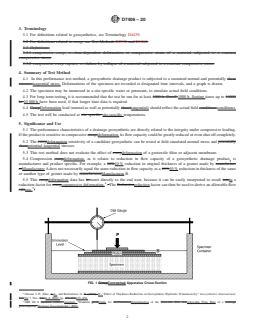
FIG. 1 CreepConceptual Apparatus Cross Section
Giroud, J.-P., Zhao, A.A., and Richardson, G. N. (2000), N., “Effect of Thickness Reduction on Geosynthetic Hydraulic Transmissivity,” Geosynthetics International,
Vol.Vol 7, Nos. 4-6, 4–6, 2000, pp. 433-452.433–452.
GRI GC-8 standard (2001), standard, “Standard guideGuide for determinationDetermination of the allowable flow rateAllowable Flow Rate of a drainage
geocomposite”Drainage Geocomposite,” 2001.
D7406 − 20
6. Apparatus
6.1 Overall System—Overall System— Fig. 1 shows a compression creepdeformation test setup. It consists of a loading platen,
a normal stress assembly, potentially a sheartangential load assembly (not shown in Fig. 1), potentially a specimen container, and
three digital gages (one gauges (one dial gauge shown in Fig. 1).
6.2 Specimen Container—Specimen Container— The specimen container shall have a flat, rigid surface on which the base
platen is placed. The container shall be deep enough to allow the test specimen to be completely immersed during testing. The
container shall be large enough to hold a minimum specimen size of 150 by 150 mm (6.0 by 6.0 in.), but can have size of 300
by 300 mm (12.0 by 12.0 in.) or larger to assureensure the test setup remains unconfined.
6.3 Base Platen—Base Platen— The base platen shall be rigid enough to resist bending and, in turn, support a uniform normal
stress. A thick steel plate is advisable. advisable; steel is preferable given potential rusting once immersed in site-specific liquid.
The base platen shall be placed in the specimen container to support the tested specimen. Practice A1030/A1030MWhen shear
stress is applied provides a standard practice for measuring the flatness characteristics of steel sheet products, which is applicable
here. When a tangential stress is applied, it is necessary to avoid any slippage of the tested specimen with the base platen (rough
surfaces on the platen are recommended). Ideally, the base platen will be larger than the specimen size to support the specimen
during draping and flexing under the stress assembly.
6.4 Loading Platen—Loading Platen— The loading platen shall be rigid enough to resist bending and, in turn, apply a uniform
normal stress. When shear Planarity and maintaining flatness of the loading platen are important as well, especially when the
normal stress is applied via a point load. Practice A1030/A1030M provides a practice of how to measure the flatness. When
tangential stress is applied, it is necessary to avoid slippage of the tested specimen with the loading platen (rough surfaces on the
platen are recommended). The loading platen shall be slightly larger than the specimen to provide even compression during the
entire duration of the test. In addition, the loading platen will be attached to the stress assembly in such a way that no stress is
placed on the specimen until the commencement of the test and the weight of which is included in the measurement of the applied
stress when appropriate for the loading system used.
6.5 Gauges—Digital Gages— At least 3 digital gages three gauges accurate to 0.01 mm (0.0005 in.) shall be used to measure
specimen deformation for the normal stress assembly. Alternatively, any device that can measure deformations to an accuracy of
0.01 mm (0.0005 in.) may be substituted for a digital gage gauge (for example, a linear variable differential transformer (LVDT)).
If a sheartangential stress assembly is used 1used, one digital gagesgauge s
...