

ASTM C1565-23
(Test Method)Standard Test Method for Determination of Pack-Set Index of Portland and Blended Hydraulic Cements
General Information
- Abstract
SIGNIFICANCE AND USE
5.1 This method is intended to help manufacturers determine the relative pack-set tendency of their cement(s). The test establishes a pack-set index which, when properly correlated with field performance, is useful in predicting or preventing field unloading difficulties.
5.2 The test is an aid to routine control during cement production and is not suitable for specification purposes.
5.3 In general, field performance of cement flowability is satisfactory when the pack-set index as determined on freshly ground cement averages 0 to 15 and is unsatisfactory when the index exceeds 25. Any prediction of field performance of cement flowability measuring 16 to 25 is tenable. These are general ranges and the field performance of individual cements may not necessarily fall within these ranges. Additional conditions, after the cement has left the control of the manufacturing facility, can affect the apparent pack set index as well.
5.4 Any attempt to apply the critical range of pack-set index numbers based on freshly ground cement to job cement without special treatment of the sample would be problematic. The test is a “GO-NO-GO” type of test and should not be used for specification purposes.
5.5 The pack-set index of field cement can be evaluated in terms of the pack-set index ranges of that cement as determined when freshly-ground. This comparison can aid the manufacturer in producing cement that offers the best field performance for pack-set properties.
5.6 Silo storage of cement may result in a greater amount of consolidation than this method is designed to induce, and the resulting forces required to overcome that consolidation are not measured by this test method.
5.7 Pack set is not to be confused with “warehouse set” which results from surface hydration of the cement from adsorbed moisture.
SCOPE
1.1 This test method covers the determination of the pack-set index, which provides an indication of the mechanical force needed to overcome the consolidation of portland and blended hydraulic cements.
1.2 The pack-set index number provides a numerical value useful for manufacturers who desire to measure and control the effect that vibration-induced consolidation has upon the manufactured cement.
1.3 The values stated in SI units are to be regarded as standard. No other units of measurement are included in this standard. Values stated in SI units shall be obtained by measurement in SI units or by appropriate conversion, using the rules of Conversion and rounding given in Standard IEEE/ASTM SI 10, of measurements made in other units.
1.4 This standard does not purport to address all of the safety concerns, if any, associated with its use. It is the responsibility of the user of this standard to establish appropriate safety, health, and environmental practices and determine the applicability of regulatory limitations prior to use. (WARNING—Fresh hydraulic-cementitious mixtures are caustic and may cause chemical burns to skin and tissue upon prolonged exposure.2)
1.5 This international standard was developed in accordance with internationally recognized principles on standardization established in the Decision on Principles for the Development of International Standards, Guides and Recommendations issued by the World Trade Organization Technical Barriers to Trade (TBT) Committee.
- Status
- Published
- Publication Date
- 30-Nov-2023
- Technical Committee
- C01 - Cement
- Drafting Committee
- C01.20 - Additions
Buy Documents
ASTM C1565-23 - Standard Test Method for Determination of Pack-Set Index of Portland and Blended Hydraulic Cements
REDLINE ASTM C1565-23 - Standard Test Method for Determination of Pack-Set Index of Portland and Blended Hydraulic Cements
Overview
ASTM C1565-23 is the internationally recognized standard test method for the determination of the pack-set index of portland and blended hydraulic cements. Issued by ASTM International, this method is critical for cement manufacturers seeking to assess the flowability and consolidation tendency of their cement products, especially in bulk handling scenarios such as silo storage and field transport. The pack-set index, as defined by this standard, quantifies the mechanical force necessary to overcome the consolidation of cement after vibration, aiding in predicting potential unloading difficulties and optimizing manufacturing control processes.
Key Topics
- Pack-Set Index: The numerical indicator of how much effort is required to break up consolidated cement, providing insights into how likely the cement is to retain flowability after storage or transport.
- Scope of Use: Intended primarily for manufacturers as a quality control tool; it is not specified for contractual or specification purposes.
- Field Correlation: When correlated with real-world performance data, the pack-set index serves as a valuable predictor of cement flowability during field unloading.
- Test Limitations: The test provides relative values, suitable for routine control, and should not be directly used to specify cement for construction projects.
- Sample Considerations: Test results can vary based on the age and condition of cement, storage conditions, sample preparation, and environmental factors such as room humidity and temperature.
- Terminology: Differentiates “pack set” (mechanical consolidation) from “warehouse set” (surface hydration due to moisture).
Applications
- Production Quality Control: The pack-set index is a daily operational tool for monitoring the flowability of cement, enabling adjustments in manufacturing to minimize product consolidation and enhance field performance.
- Prediction of Unloading Issues: Manufacturers can use the pack-set index to anticipate and mitigate possible flow problems during bulk transport and storage, reducing potential downtime and logistical costs.
- Benchmarking and Process Improvement: By comparing freshly ground cement with field samples, manufacturers can track changes over time and refine production techniques for optimal pack-set properties.
- Research and Development: Laboratories utilize this method to study the effects of material blends, grinding processes, and additives on cement consolidation behavior.
- Regulatory Compliance: Following ASTM C1565-23 supports adherence to internationally recognized testing procedures, meeting quality expectations in global markets.
Related Standards
- ASTM C1005: Specification for Reference Masses and Devices for Determining Mass and Volume for Use in Physical Testing of Hydraulic Cements, referenced for apparatus mass accuracy in pack-set testing.
- IEEE/ASTM SI 10: International System of Units (SI) - provides guidelines for units and conversions, ensuring global uniformity of measurement within ASTM C1565-23 applications.
- Other ASTM Cement Standards: Many ASTM standards exist for the physical testing, specification, and performance evaluation of hydraulic cements, complementing the pack-set index methodology.
Practical Value
- Enhancement of Cement Quality: Consistent application of ASTM C1565-23 helps manufacturers supply cements that remain easy to unload under field conditions, improving contractor satisfaction.
- Reduction of Operational Interruptions: Early identification of high pack-set index values predicts potential flow issues, permitting proactive corrective measures.
- Data-Driven Decision Making: Objective, repeatable measurements support continuous improvement and traceability in cement production and handling practices.
- International Acceptance: Compliance with ASTM C1565-23 enhances export opportunities by meeting internationally recognized testing standards.
Keywords: ASTM C1565-23, pack-set index, portland cement, blended hydraulic cement, cement flowability, cement consolidation, cement testing standard, bulk cement handling, cement quality control.
Relations
- Effective Date
- 01-Dec-2023
Buy Documents
ASTM C1565-23 - Standard Test Method for Determination of Pack-Set Index of Portland and Blended Hydraulic Cements
REDLINE ASTM C1565-23 - Standard Test Method for Determination of Pack-Set Index of Portland and Blended Hydraulic Cements
Get Certified
Connect with accredited certification bodies for this standard

DIBt (Deutsches Institut für Bautechnik)
German Institute for Building Technology.
DIN CERTCO
DIN Group product certification.

Aboma Certification B.V.
Specialized in construction, metal, and transport sectors.
Sponsored listings
Frequently Asked Questions
ASTM C1565-23 is a standard published by ASTM International. Its full title is "Standard Test Method for Determination of Pack-Set Index of Portland and Blended Hydraulic Cements". This standard covers: SIGNIFICANCE AND USE 5.1 This method is intended to help manufacturers determine the relative pack-set tendency of their cement(s). The test establishes a pack-set index which, when properly correlated with field performance, is useful in predicting or preventing field unloading difficulties. 5.2 The test is an aid to routine control during cement production and is not suitable for specification purposes. 5.3 In general, field performance of cement flowability is satisfactory when the pack-set index as determined on freshly ground cement averages 0 to 15 and is unsatisfactory when the index exceeds 25. Any prediction of field performance of cement flowability measuring 16 to 25 is tenable. These are general ranges and the field performance of individual cements may not necessarily fall within these ranges. Additional conditions, after the cement has left the control of the manufacturing facility, can affect the apparent pack set index as well. 5.4 Any attempt to apply the critical range of pack-set index numbers based on freshly ground cement to job cement without special treatment of the sample would be problematic. The test is a “GO-NO-GO” type of test and should not be used for specification purposes. 5.5 The pack-set index of field cement can be evaluated in terms of the pack-set index ranges of that cement as determined when freshly-ground. This comparison can aid the manufacturer in producing cement that offers the best field performance for pack-set properties. 5.6 Silo storage of cement may result in a greater amount of consolidation than this method is designed to induce, and the resulting forces required to overcome that consolidation are not measured by this test method. 5.7 Pack set is not to be confused with “warehouse set” which results from surface hydration of the cement from adsorbed moisture. SCOPE 1.1 This test method covers the determination of the pack-set index, which provides an indication of the mechanical force needed to overcome the consolidation of portland and blended hydraulic cements. 1.2 The pack-set index number provides a numerical value useful for manufacturers who desire to measure and control the effect that vibration-induced consolidation has upon the manufactured cement. 1.3 The values stated in SI units are to be regarded as standard. No other units of measurement are included in this standard. Values stated in SI units shall be obtained by measurement in SI units or by appropriate conversion, using the rules of Conversion and rounding given in Standard IEEE/ASTM SI 10, of measurements made in other units. 1.4 This standard does not purport to address all of the safety concerns, if any, associated with its use. It is the responsibility of the user of this standard to establish appropriate safety, health, and environmental practices and determine the applicability of regulatory limitations prior to use. (WARNING—Fresh hydraulic-cementitious mixtures are caustic and may cause chemical burns to skin and tissue upon prolonged exposure.2) 1.5 This international standard was developed in accordance with internationally recognized principles on standardization established in the Decision on Principles for the Development of International Standards, Guides and Recommendations issued by the World Trade Organization Technical Barriers to Trade (TBT) Committee.
SIGNIFICANCE AND USE 5.1 This method is intended to help manufacturers determine the relative pack-set tendency of their cement(s). The test establishes a pack-set index which, when properly correlated with field performance, is useful in predicting or preventing field unloading difficulties. 5.2 The test is an aid to routine control during cement production and is not suitable for specification purposes. 5.3 In general, field performance of cement flowability is satisfactory when the pack-set index as determined on freshly ground cement averages 0 to 15 and is unsatisfactory when the index exceeds 25. Any prediction of field performance of cement flowability measuring 16 to 25 is tenable. These are general ranges and the field performance of individual cements may not necessarily fall within these ranges. Additional conditions, after the cement has left the control of the manufacturing facility, can affect the apparent pack set index as well. 5.4 Any attempt to apply the critical range of pack-set index numbers based on freshly ground cement to job cement without special treatment of the sample would be problematic. The test is a “GO-NO-GO” type of test and should not be used for specification purposes. 5.5 The pack-set index of field cement can be evaluated in terms of the pack-set index ranges of that cement as determined when freshly-ground. This comparison can aid the manufacturer in producing cement that offers the best field performance for pack-set properties. 5.6 Silo storage of cement may result in a greater amount of consolidation than this method is designed to induce, and the resulting forces required to overcome that consolidation are not measured by this test method. 5.7 Pack set is not to be confused with “warehouse set” which results from surface hydration of the cement from adsorbed moisture. SCOPE 1.1 This test method covers the determination of the pack-set index, which provides an indication of the mechanical force needed to overcome the consolidation of portland and blended hydraulic cements. 1.2 The pack-set index number provides a numerical value useful for manufacturers who desire to measure and control the effect that vibration-induced consolidation has upon the manufactured cement. 1.3 The values stated in SI units are to be regarded as standard. No other units of measurement are included in this standard. Values stated in SI units shall be obtained by measurement in SI units or by appropriate conversion, using the rules of Conversion and rounding given in Standard IEEE/ASTM SI 10, of measurements made in other units. 1.4 This standard does not purport to address all of the safety concerns, if any, associated with its use. It is the responsibility of the user of this standard to establish appropriate safety, health, and environmental practices and determine the applicability of regulatory limitations prior to use. (WARNING—Fresh hydraulic-cementitious mixtures are caustic and may cause chemical burns to skin and tissue upon prolonged exposure.2) 1.5 This international standard was developed in accordance with internationally recognized principles on standardization established in the Decision on Principles for the Development of International Standards, Guides and Recommendations issued by the World Trade Organization Technical Barriers to Trade (TBT) Committee.
ASTM C1565-23 is classified under the following ICS (International Classification for Standards) categories: 55.180.40 - Complete, filled transport packages; 91.100.10 - Cement. Gypsum. Lime. Mortar. The ICS classification helps identify the subject area and facilitates finding related standards.
ASTM C1565-23 has the following relationships with other standards: It is inter standard links to ASTM C1565-19. Understanding these relationships helps ensure you are using the most current and applicable version of the standard.
ASTM C1565-23 is available in PDF format for immediate download after purchase. The document can be added to your cart and obtained through the secure checkout process. Digital delivery ensures instant access to the complete standard document.
Standards Content (Sample)
This international standard was developed in accordance with internationally recognized principles on standardization established in the Decision on Principles for the
Development of International Standards, Guides and Recommendations issued by the World Trade Organization Technical Barriers to Trade (TBT) Committee.
Designation: C1565 − 23
Standard Test Method for
Determination of Pack-Set Index of Portland and Blended
Hydraulic Cements
This standard is issued under the fixed designation C1565; the number immediately following the designation indicates the year of
original adoption or, in the case of revision, the year of last revision. A number in parentheses indicates the year of last reapproval. A
superscript epsilon (´) indicates an editorial change since the last revision or reapproval.
1. Scope* 2. Referenced Documents
2.1 ASTM Standards:
1.1 This test method covers the determination of the pack-
C1005 Specification for Reference Masses and Devices for
set index, which provides an indication of the mechanical force
Determining Mass and Volume for Use in Physical Testing
needed to overcome the consolidation of portland and blended
of Hydraulic Cements
hydraulic cements.
IEEE/ASTM SI 10 International System of Units (SI) The
1.2 The pack-set index number provides a numerical value
Modernized Metric System
useful for manufacturers who desire to measure and control the
3. Terminology
effect that vibration-induced consolidation has upon the manu-
factured cement. 3.1 Definitions of Terms Specific to This Standard:
3.1.1 pack set, n—a condition of hydraulic cement, exhib-
1.3 The values stated in SI units are to be regarded as
ited in varying degrees, following silo storage or transport in
standard. No other units of measurement are included in this
bulk railcars or trucks, that causes the cement to resist flowing
standard. Values stated in SI units shall be obtained by
until considerable mechanical effort has been applied.
measurement in SI units or by appropriate conversion, using
3.1.2 pack-set index, n—the numerical indication of the
the rules of Conversion and rounding given in Standard
degree of pack set a particular cement exhibits when subjected
IEEE/ASTM SI 10, of measurements made in other units.
to the procedures of this test method.
1.4 This standard does not purport to address all of the
3.1.3 peak voltage, n—as pertaining to this method only, the
safety concerns, if any, associated with its use. It is the
energy in volts applied to consolidate the sample, which results
responsibility of the user of this standard to establish appro-
in the maximum pack-set index for a particular cement and the
priate safety, health, and environmental practices and deter-
apparatus used for the measurement.
mine the applicability of regulatory limitations prior to use.
4. Summary of Test Method
(WARNING—Fresh hydraulic-cementitious mixtures are
caustic and may cause chemical burns to skin and tissue upon
4.1 Portland or blended hydraulic cement is placed into a
prolonged exposure. )
flask and then consolidated on a vibrating table by a vibration
1.5 This international standard was developed in accor- force controlled by time and volts. The consolidated bed is
dance with internationally recognized principles on standard- measured for relative strength by turning the flask to a
ization established in the Decision on Principles for the horizontal position and rotating in 180° increments until the
Development of International Standards, Guides and Recom- bed collapses from the bottom of the flask. The number of half
turns is a relative indication of the force required to overcome
mendations issued by the World Trade Organization Technical
Barriers to Trade (TBT) Committee. the consolidation and is designated the pack-set index, or P.S.I.
5. Significance and Use
5.1 This method is intended to help manufacturers deter-
This test method is under the jurisdiction of ASTM Committee C01 on Cement
mine the relative pack-set tendency of their cement(s). The test
and is the direct responsibility of Subcommittee C01.20 on Additions.
Current edition approved Dec. 1, 2023. Published December 2023. Originally
approved in 2003. Last previous edition approved in 2019 as C1565 – 19. DOI: For referenced ASTM standards, visit the ASTM website, www.astm.org, or
10.1520/C1565-23. contact ASTM Customer Service at service@astm.org. For Annual Book of ASTM
Section on Safety, Manual of Cement Testing, Annual Book of ASTM Standards volume information, refer to the standard’s Document Summary page on
Standards, Vol 04.01. the ASTM website.
*A Summary of Changes section appears at the end of this standard
Copyright © ASTM International, 100 Barr Harbor Drive, PO Box C700, West Conshohocken, PA 19428-2959. United States
C1565 − 23
establishes a pack-set index which, when properly correlated 6.6 Vibration energy delivered by the table is related to the
with field performance, is useful in predicting or preventing proper handling and adjustment of the table. See Section 7 for
field unloading difficulties. details.
5.2 The test is an aid to routine control during cement
6.7 Vibration energy delivered by the table is related to the
production and is not suitable for specification purposes.
frequency of the source voltage. This variation, if present, will
result in a poor repeatability and require more frequent
5.3 In general, field performance of cement flowability is
determination of the peak voltage.
satisfactory when the pack-set index as determined on freshly
ground cement averages 0 to 15 and is unsatisfactory when the
7. Apparatus
index exceeds 25. Any prediction of field performance of
cement flowability measuring 16 to 25 is tenable. These are
7.1 Erlenmeyer Flask, 250 mL capacity, regular wall
general ranges and the field performance of individual cements
thickness, fitted with a number 14 (large diameter 32 mm and
may not necessarily fall within these ranges. Additional
small diameter 25 mm) stopper. Flasks are not interchangeable.
conditions, after the cement has left the control of the manu-
Each flask and stopper combination must have the peak voltage
facturing facility, can affect the apparent pack set index as well.
determined prior to use in the test method (see Note 4).
5.4 Any attempt to apply the critical range of pack-set index
7.2 Reference Masses and Devices for Determining Mass
numbers based on freshly ground cement to job cement without
shall conform to the requirements of Specification C1005 as
special treatment of the sample would be problematic. The test
appropriate for the size of the sample, the mass of which is to
is a “GO-NO-GO” type of test and should not be used for
be determined, with a sensitivity of no less than 0.1 g and a
specification purposes.
readability of 0.1 g or less.
5.5 The pack-set index of field cement can be evaluated in
NOTE 4—There are enough differences between Erlenmeyer flasks of
the same rated capacity to cause significant difference in the pack-set
terms of the pack-set index ranges of that cement as determined
index. It is recommended that several flasks which deliver similar pack-set
when freshly-ground. This comparison can aid the manufac-
index numbers for the same cement be kept as spares.
turer in producing cement that offers the best field performance
7.3 Vibrating Table, (see Fig. 1), capable of generating
for pack-set properties.
electromagnetic vibrations at the frequency of 60 Hz, having a
5.6 Silo storage of cement may result in a greater amount of
wooden or phenolic resin top with dowel pins installed
consolidation than this method is designed to induce, and the
equidistant from each other on the circumference of the circle
resulting forces required to overcome that consolidation are not
centered on the table, with a radius slightly greater than the
measured by this test method.
largest radius of the flask (to restrain the flask movement on the
5.7 Pack set is not to be confused with “warehouse set”
table). A device that is capable of stopping any lateral
which results from surface hydration of the cement from
movement of the flask during vibration is required (see Note
adsorbed moisture.
5). The air gap setting between the armatures of the vibrating
table is critical to the generation of the proper vibrational
6. Interferences
amplitude and must be adjusted according to the manufactur-
er’s instructions. Manufacturer’s recommendations and pre-
6.1 Results obtained from the pack-set test are dependent on
cautions for proper operation must be followed to assure the
sample exposure (see Note 1).
NOTE 1—Fresh cement has a greater pack-set tendency. Cement stored accurate determination of the pack set index.
in silos for only a day or two will test similar to fresh cement. Cement
NOTE 5—Three or four dowel pins of 6 mm to 10 mm diameter and
stored in full silos, where aeration is negligible, may develop lower
25 mm to 30 mm long will be sufficient to restrain the flask. Interconnect-
pack-set indices upon further aging, Even samples in sealed containers
ing rubber bands or rubber cam-locks can be used to restrain the flask to
may vary.
prevent lateral movement of the flask during vibration.
6.2 Pack-set index determination can be affected by sample
7.4 Roto-Tester, (see Fig. 2), a device on which the Erlen-
tempera
...
This document is not an ASTM standard and is intended only to provide the user of an ASTM standard an indication of what changes have been made to the previous version. Because
it may not be technically possible to adequately depict all changes accurately, ASTM recommends that users consult prior editions as appropriate. In all cases only the current version
of the standard as published by ASTM is to be considered the official document.
Designation: C1565 − 19 C1565 − 23
Standard Test Method for
Determination of Pack-Set Index of Portland and Blended
Hydraulic Cements
This standard is issued under the fixed designation C1565; the number immediately following the designation indicates the year of
original adoption or, in the case of revision, the year of last revision. A number in parentheses indicates the year of last reapproval. A
superscript epsilon (´) indicates an editorial change since the last revision or reapproval.
1. Scope*
1.1 This test method covers the determination of the pack-set index, which provides an indication of the mechanical force needed
to overcome the consolidation of portland and blended hydraulic cements.
1.2 The pack-set index number provides a numerical value useful for manufacturers who desire to measure and control the effect
that vibration-induced consolidation has upon the manufactured cement.
1.3 The values stated in SI units are to be regarded as standard. No other units of measurement are included in this standard. Values
stated in SI units shall be obtained by measurement in SI units or by appropriate conversion, using the rules of Conversion and
rounding given in Standard IEEE/ASTM SI 10, of measurements made in other units.
1.4 This standard does not purport to address all of the safety concerns, if any, associated with its use. It is the responsibility
of the user of this standard to establish appropriate safety, health, and environmental practices and determine the applicability of
regulatory limitations prior to use. (WARNING—Fresh hydraulic-cementitious mixtures are caustic and may cause chemical
burns to skin and tissue upon prolonged exposure.)exposure. )
1.5 This international standard was developed in accordance with internationally recognized principles on standardization
established in the Decision on Principles for the Development of International Standards, Guides and Recommendations issued
by the World Trade Organization Technical Barriers to Trade (TBT) Committee.
2. Referenced Documents
2.1 ASTM Standards:
C1005 Specification for Reference Masses and Devices for Determining Mass and Volume for Use in Physical Testing of
Hydraulic Cements
IEEE/ASTM SI 10 International System of Units (SI) The Modernized Metric System
3. Terminology
3.1 Definitions of Terms Specific to This Standard:
3.1.1 pack set, n—a condition of hydraulic cement, exhibited in varying degrees, following silo storage or transport in bulk railcars
or trucks, that causes the cement to resist flowing until considerable mechanical effort has been applied.
This test method is under the jurisdiction of ASTM Committee C01 on Cement and is the direct responsibility of Subcommittee C01.20 on Additions.
Current edition approved Oct. 1, 2019Dec. 1, 2023. Published November 2019December 2023. Originally approved in 2003. Last previous edition approved in 20172019
as C1565 – 17.C1565 – 19. DOI: 10.1520/C1565-19.10.1520/C1565-23.
Section on Safety, Manual of Cement Testing, Annual Book of ASTM Standards, Vol 04.01.
For referenced ASTM standards, visit the ASTM website, www.astm.org, or contact ASTM Customer Service at service@astm.org. For Annual Book of ASTM Standards
volume information, refer to the standard’s Document Summary page on the ASTM website.
*A Summary of Changes section appears at the end of this standard
Copyright © ASTM International, 100 Barr Harbor Drive, PO Box C700, West Conshohocken, PA 19428-2959. United States
C1565 − 23
3.1.2 pack-set index, n—the numerical indication of the degree of pack set a particular cement exhibits when subjected to the
procedures of this test method.
3.1.3 peak voltage, n—as pertaining to this method only, the energy in volts applied to consolidate the sample, which results in
the maximum pack-set index for a particular cement and the apparatus used for the measurement.
4. Summary of Test Method
4.1 Portland or blended hydraulic cement is placed into a flask and then consolidated on a vibrating table by a vibration force
controlled by time and volts. The consolidated bed is measured for relative strength by turning the flask to a horizontal position
and rotating in 180° increments until the bed collapses from the bottom of the flask. The number of half turns is a relative indication
of the force required to overcome the consolidation and is designated the pack-set index, or P.S.I.
5. Significance and Use
5.1 This method is intended to help manufacturers determine the relative pack-set tendency of their cement(s). The test establishes
a pack-set index which, when properly correlated with field performance, is useful in predicting or preventing field unloading
difficulties.
5.2 The test is an aid to routine control during cement production and is not suitable for specification purposes.
5.3 In general, field performance of cement flowability is satisfactory when the pack-set index as determined on freshly ground
cement averages 0 to 15 and is unsatisfactory when the index exceeds 25. Any prediction of field performance of cement
flowability measuring 16 to 25 is tenable. These are general ranges and the field performance of individual cements may not
necessarily fall within these ranges. Additional conditions, after the cement has left the control of the manufacturing facility, can
affect the apparent pack set index as well.
5.4 Any attempt to apply the critical range of pack-set index numbers based on freshly ground cement to job cement without
special treatment of the sample would be problematic. The test is a “GO-NO GO” “GO-NO-GO” type of test and should not be
used for specification purposes.
5.5 The pack-set index of field cement can be evaluated in terms of the pack-set index ranges of that cement as determined when
freshly-ground. This comparison can aid the manufacturer in producing cement that offers the best field performance for pack-set
properties.
5.6 Silo storage of cement may result in a greater amount of consolidation than this method is designed to induce, and the resulting
forces required to overcome that consolidation are not measured by this test method.
5.7 Pack set is not to be confused with “warehouse set” which results from surface hydration of the cement from adsorbed
moisture.
6. Interferences
6.1 Results obtained from the pack-set test are dependent on sample exposure (see Note 1).
NOTE 1—Fresh cement has a greater pack-set tendency. Cement stored in silos for only a day or two will test similar to fresh cement. Cement stored in
full silos, where aeration is negligible, may develop lower pack-set indices upon further aging, Even samples in sealed containers may vary.
6.2 Pack-set index determination can be affected by sample temperature (see Note 2).
NOTE 2—Cement with a temperature noticeably hotter than room temperature may produce a different pack-set index number than that same cement
cooled to room temperature. Cooling of hot cement samples must be accomplished with minimum aeration to avoid moisture and CO adsorption.
6.3 The testing room humidity can significantly influence the determined pack-set index.
C1565 − 23
6.4 Keep the apparatus level during the testing procedure.
6.5 The vibration energy transferred to the sample is affected by the support given the apparatus (see Note 3). The determination
of pack-set index for unknown samples shall be accomplished on the same physical support that the peak voltage for the test was
determined on.
NOTE 3—Apparatus which is not setting firmly on the counter or table may not deliver repeatable results.
6.6 Vibration energy delivered by the table is related to the proper handling and adjustment of the table. See Section 7 for details.
6.7 Vibration energy delivered by the table is related to the frequency of the source voltage. This variation, if present, will result
in a poor repeatability and require more frequent determination of the peak voltage.
7. Apparatus
7.1 Erlenmeyer Flask, 250 mL capacity, regular wall thickness, fitted with a number 14 (large diameter 32 mm and small diameter
25 mm) cork stopper. Flasks are not interchangeable. Each flask and corkstopper combination must have the peak voltage
determined prior to use in the test method (see Note 4).
7.2 Reference Masses and Devices for Determining Mass shall conform to the requirements of Specification C1005 as appropriate
for the size of the sample, the mass of which is to be determined, with a sensitivity of no less than 0.1 g and a readability of 0.1
g or less.
NOTE 4—There are enough differences between Erlenmeyer flasks of the same rated capacity to cause significant difference in the pack-set index. It is
recommended that several flasks which deliver similar pack-set index numbers for the same cement be kept as spares.
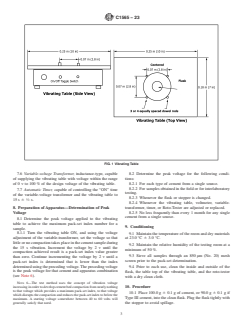
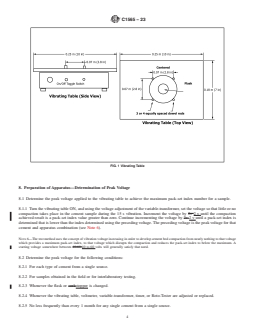
7.3 Vibrating Table, (see Fig. 1), capable of generating electromagnetic vibrations at the frequency of 60 Hz, having a wooden
or phenolic resin top with dowel pins installed equidistant from each other on the circumference of the circle centered on the table,
with a radius slightly great
...