

ASTM F1186-18
(Classification)Standard Classification System for Chemicals According to Functional Groups
General Information
- Abstract
SIGNIFICANCE AND USE
2.1 In many situations where chemicals are interacting with other chemicals or materials, the interaction is strongly dependent and often correlated with the functional group(s) present. These interactions include chemical reaction, dissolution, and swelling/permeation of polymeric materials. For this reason, it is useful to have a standard means for classifying chemicals.
2.2 One application for this classification system is in the selection of chemical protective clothing based on the chemical resistance of the clothing materials.3,4,5 Chemical resistance data are available for only a very small fraction of the chemicals for which protective clothing is used. However, for chemicals for which no data are available, a knowledge of the chemical class sometimes can give insight into the resistance of a prospective clothing material.
Note 1: The present state of knowledge precludes reliable estimates from chemical class alone.
2.3 The classification system also facilitates the development of predictive methodology by researchers in a variety of fields, in addition to protective clothing.
SCOPE
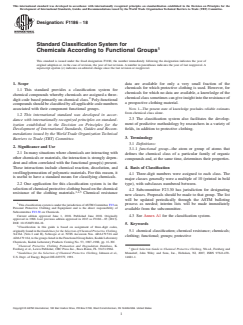
1.1 This standard provides a classification system for chemical compounds whereby chemicals are assigned a three-digit code based primarily on chemical class.2 Poly-functional compounds should be classified by all applicable code numbers associated with their component functional groups.
1.2 This international standard was developed in accordance with internationally recognized principles on standardization established in the Decision on Principles for the Development of International Standards, Guides and Recommendations issued by the World Trade Organization Technical Barriers to Trade (TBT) Committee.
- Status
- Published
- Publication Date
- 31-May-2018
- Technical Committee
- F23 - Personal Protective Clothing and Equipment
- Drafting Committee
- F23.30 - Chemicals


Overview
ASTM F1186-18: Standard Classification System for Chemicals According to Functional Groups is an international standard developed by ASTM International. This standard establishes a systematic classification of chemical compounds based on their functional groups, using a three-digit numerical code to categorize chemicals primarily by their chemical class. Functional groups, as defined, are atoms or clusters of atoms within molecules that determine the chemical behavior and properties of those molecules.
By providing a structured approach for chemical classification, this standard is particularly valuable in industries and research domains where chemical interactions are crucial, such as chemical safety, materials compatibility, and the selection of protective equipment.
Key Topics
- Functional Group Classification: Chemicals are categorized according to their major functional groups, enabling clear identification and comparison among different compounds.
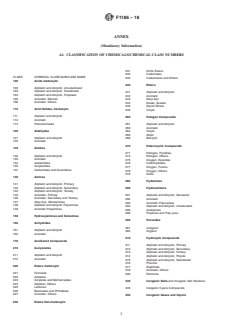
- Three-Digit Coding System: Each chemical class and subclass is assigned a unique three-digit code, streamlining documentation and referencing.
- Poly-Functional Compounds: Chemicals containing multiple functional groups receive all applicable codes, reflecting their complex nature.
- Standardization Principles: Developed under internationally recognized principles, ensuring global applicability and alignment with the WTO Technical Barriers to Trade (TBT) Committee decisions.
- Periodic Updates: The classification system is maintained by ASTM Subcommittee F23.30, ensuring the list is regularly reviewed and updated for relevance.
Applications
The ASTM F1186-18 standard finds practical value in several key areas:
- Chemical Protective Clothing Selection: Enables better-informed choices in personal protective equipment (PPE) selection when specific chemical resistance data is unavailable. Understanding a chemical's functional group can offer insights into material compatibility.
- Chemical Safety and Risk Assessment: Provides a framework for hazard analysis based on functional group reactivity and compatibility.
- Research and Predictive Modeling: Assists researchers in developing predictive methodologies for the interaction of chemicals with various materials, including polymers and composites.
- Regulatory Compliance: Supports documentation and reporting requirements that demand clear classification of chemical substances.
- Material Science and Engineering: Facilitates material selection and compatibility studies in polymer manufacturing, coatings, adhesives, and other applications where chemical-material interactions are significant.
Related Standards
To enhance effectiveness and ensure comprehensive safety and compatibility assessments, the following related standards and resources can be referenced alongside ASTM F1186-18:
- Chemical Protective Clothing Permeation and Degradation Database
- Guidelines for the Selection of Chemical Protective Clothing
- Quick Selection Guide to Chemical Protective Clothing
- ASTM F739 – Standard Test Method for Permeation of Liquids and Gases through Protective Clothing Materials
- ASTM F1001 – Standard Guide for Selection of Chemicals to Evaluate Protective Clothing Materials
By using ASTM F1186-18 in conjunction with these resources, organizations can optimize chemical management, enhance worker safety, and maintain compliance with international best practices.
Keywords: chemical classification, functional groups, ASTM F1186-18, chemical resistance, protective clothing, PPE, chemical safety, material compatibility, standardization, chemical class, predictive modeling, chemical protective equipment.
Relations
- Replaces
ASTM F1186-03(2013) - Standard Classification System for Chemicals According to Functional Groups - Effective Date
- 01-Jun-2018
- Effective Date
- 01-Jun-2018
Frequently Asked Questions
ASTM F1186-18 is a standard published by ASTM International. Its full title is "Standard Classification System for Chemicals According to Functional Groups". This standard covers: SIGNIFICANCE AND USE 2.1 In many situations where chemicals are interacting with other chemicals or materials, the interaction is strongly dependent and often correlated with the functional group(s) present. These interactions include chemical reaction, dissolution, and swelling/permeation of polymeric materials. For this reason, it is useful to have a standard means for classifying chemicals. 2.2 One application for this classification system is in the selection of chemical protective clothing based on the chemical resistance of the clothing materials.3,4,5 Chemical resistance data are available for only a very small fraction of the chemicals for which protective clothing is used. However, for chemicals for which no data are available, a knowledge of the chemical class sometimes can give insight into the resistance of a prospective clothing material. Note 1: The present state of knowledge precludes reliable estimates from chemical class alone. 2.3 The classification system also facilitates the development of predictive methodology by researchers in a variety of fields, in addition to protective clothing. SCOPE 1.1 This standard provides a classification system for chemical compounds whereby chemicals are assigned a three-digit code based primarily on chemical class.2 Poly-functional compounds should be classified by all applicable code numbers associated with their component functional groups. 1.2 This international standard was developed in accordance with internationally recognized principles on standardization established in the Decision on Principles for the Development of International Standards, Guides and Recommendations issued by the World Trade Organization Technical Barriers to Trade (TBT) Committee.
SIGNIFICANCE AND USE 2.1 In many situations where chemicals are interacting with other chemicals or materials, the interaction is strongly dependent and often correlated with the functional group(s) present. These interactions include chemical reaction, dissolution, and swelling/permeation of polymeric materials. For this reason, it is useful to have a standard means for classifying chemicals. 2.2 One application for this classification system is in the selection of chemical protective clothing based on the chemical resistance of the clothing materials.3,4,5 Chemical resistance data are available for only a very small fraction of the chemicals for which protective clothing is used. However, for chemicals for which no data are available, a knowledge of the chemical class sometimes can give insight into the resistance of a prospective clothing material. Note 1: The present state of knowledge precludes reliable estimates from chemical class alone. 2.3 The classification system also facilitates the development of predictive methodology by researchers in a variety of fields, in addition to protective clothing. SCOPE 1.1 This standard provides a classification system for chemical compounds whereby chemicals are assigned a three-digit code based primarily on chemical class.2 Poly-functional compounds should be classified by all applicable code numbers associated with their component functional groups. 1.2 This international standard was developed in accordance with internationally recognized principles on standardization established in the Decision on Principles for the Development of International Standards, Guides and Recommendations issued by the World Trade Organization Technical Barriers to Trade (TBT) Committee.
ASTM F1186-18 is classified under the following ICS (International Classification for Standards) categories: 07.030 - Physics. Chemistry. The ICS classification helps identify the subject area and facilitates finding related standards.
ASTM F1186-18 has the following relationships with other standards: It is inter standard links to ASTM F1186-03(2013), ASTM F1296-08(2023). Understanding these relationships helps ensure you are using the most current and applicable version of the standard.
ASTM F1186-18 is available in PDF format for immediate download after purchase. The document can be added to your cart and obtained through the secure checkout process. Digital delivery ensures instant access to the complete standard document.
Standards Content (Sample)
This international standard was developed in accordance with internationally recognized principles on standardization established in the Decision on Principles for the
Development of International Standards, Guides and Recommendations issued by the World Trade Organization Technical Barriers to Trade (TBT) Committee.
Designation:F1186 −18
Standard Classification System for
Chemicals According to Functional Groups
This standard is issued under the fixed designation F1186; the number immediately following the designation indicates the year of
original adoption or, in the case of revision, the year of last revision. A number in parentheses indicates the year of last reapproval. A
superscript epsilon (´) indicates an editorial change since the last revision or reapproval.
1. Scope data are available for only a very small fraction of the
chemicals for which protective clothing is used. However, for
1.1 This standard provides a classification system for
chemicals for which no data are available, a knowledge of the
chemical compounds whereby chemicals are assigned a three-
2 chemicalclasssometimescangiveinsightintotheresistanceof
digit code based primarily on chemical class. Poly-functional
a prospective clothing material.
compoundsshouldbeclassifiedbyallapplicablecodenumbers
associated with their component functional groups.
NOTE 1—The present state of knowledge precludes reliable estimates
from chemical class alone.
1.2 This international standard was developed in accor-
2.3 The classification system also facilitates the develop-
dance with internationally recognized principles on standard-
ment of predictive methodology by researchers in a variety of
ization established in the Decision on Principles for the
fields, in addition to protective clothing.
Development of International Standards, Guides and Recom-
mendations issued by the World Trade Organization Technical
3. Terminology
Barriers to Trade (TBT) Committee.
3.1 Definitions:
2. Significance and Use
3.1.1 functional group—the atom or group of atoms that
2.1 In many situations where chemicals are interacting with
defines the chemical class of a particular family of organic
other chemicals or materials, the interaction is strongly depen-
compounds and, at the same time, determines their properties.
dent and often correlated with the functional group(s) present.
4. Basis of Classification
These interactions include chemical reaction, dissolution, and
swelling/permeation of polymeric materials. For this reason, it
4.1 Three-digit numbers were assigned to each class. The
is useful to have a standard means for classifying chemicals.
major classes generally were a multiple of 10 (printed in bold
type), with subclasses numbered between.
2.2 One application for this classification system is in the
selectionofchemicalprotectiveclothingbasedonthechemical
4.2 Subcommittee F23.30 has jurisdiction for designating
3,4,5
resistance of the clothing materials. Chemical resistance
new classes. Proposals should be made to that group. The list
will be updated periodically through the ASTM balloting
process as needed; interim lists will be made immediately
This classification system is under the jurisdiction ofASTM Committee F23 on
Personal Protective Clothing and Equipment and is the direct responsibility of
available from the subcommittee.
Subcommittee F23.30 on Chemicals.
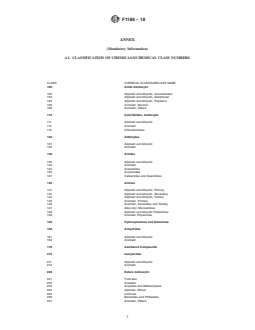
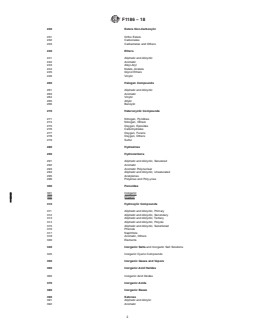
4.3 See Annex A1 for the classification system.
Current edition approved June 1, 2018. Published June 2018. Originally
approved in 1988. Last previous edition approved in 2013 as F1186 – 03 (2013).
DOI: 10.1520/F1186-18.
5. Keywords
Classification in this guide is based on assignment of three-digit codes,
originallyfoundinthe Guidelines for the Selection of Chemical Protective Clothing, 5.1 chemical classification; chemical resistance; chemicals;
3rd Ed. (Vols I and II), Schwope et al. NTIS Accession Nos. ADA179 516 and
clothing; functional; groups; protective
ADA179 164, to the groupslistedintheFunctionalGroupIndex,KodakLaboratory
Chemicals, Kodak Laboratory Products Catalog No. 53, 1987–1988, pp. 1f–30f.
Chemical Protective Clothing Permeation and Degradation Database,K.
Forsberg et al., Lewis Publisher, CRC Press Inc., Boca Raton, FL 33431-9964. Quick Selection Guide to Chemical Protective Clothing, 5th ed., Forsberg and
Guidelines for the Selection of Chemical Protective Clothing, Johnson et al., Mansdorf, John Wiley and Sons, Inc., Hoboken, NJ, 2007, ISBN 978-0-470-
U.S. Dept. of Energy Report DE-02357T, 1991. 14681-1.
Copyright © ASTM International, 100 Barr Harbor Drive, PO Box C700, West Conshohocken, PA 19428-2959. United States
...
This document is not an ASTM standard and is intended only to provide the user of an ASTM standard an indication of what changes have been made to the previous version. Because
it may not be technically possible to adequately depict all changes accurately, ASTM recommends that users consult prior editions as appropriate. In all cases only the current version
of the standard as published by ASTM is to be considered the official document.
Designation: F1186 − 03 (Reapproved 2013) F1186 − 18
Standard Classification System for
Chemicals According to Functional Groups
This standard is issued under the fixed designation F1186; the number immediately following the designation indicates the year of
original adoption or, in the case of revision, the year of last revision. A number in parentheses indicates the year of last reapproval. A
superscript epsilon (´) indicates an editorial change since the last revision or reapproval.
1. Scope
1.1 This standard provides a classification system for chemical compounds whereby chemicals are assigned a 3-digitthree-digit
code based primarily on chemical class. Poly-functional compounds should be classified by all applicable code numbers
associated with their component functional groups.
1.2 This international standard was developed in accordance with internationally recognized principles on standardization
established in the Decision on Principles for the Development of International Standards, Guides and Recommendations issued
by the World Trade Organization Technical Barriers to Trade (TBT) Committee.
2. Significance and Use
2.1 In many situations where chemicals are interacting with other chemicals or materials, the interaction is strongly dependent
and often correlated with the functional group(s) present. These interactions include chemical reaction, dissolution, and
swelling/permeation of polymeric materials. For this reason, it is useful to have a standard means for classifying chemicals.
2.2 One application for this classification system is in the selection of chemical protective clothing based on the chemical
3,4,5
resistance of the clothing materials. Chemical resistance data are available for only a very small fraction of the chemicals for
which protective clothing is used. However, for chemicals for which no data are available, a knowledge of the chemical class
sometimes can give insight into the resistance of a prospective clothing material.
NOTE 1—The present state of knowledge precludes reliable estimates from chemical class alone.
2.3 The classification system also facilitates the development of predictive methodology by researchers in a variety of fields,
in addition to protective clothing.
3. Terminology
3.1 Definitions:
3.1.1 functional group—the atom or group of atoms that defines the chemical class of a particular family of organic compounds
and, at the same time, determines their properties.
3. Terminology
3.1 Definitions:
3.1.1 functional group—the atom or group of atoms that defines the chemical class of a particular family of organic compounds
and, at the same time, determines their properties.
4. Basis of Classification
4.1 Three-digit numbers were assigned to each class. The major classes generally were a multiple of 10 (printed in bold type),
with subclasses numbered between.
This classification system is under the jurisdiction of ASTM Committee F23 on Personal Protective Clothing and Equipment and is the direct responsibility of
Subcommittee F23.30 on Chemicals.
Current edition approved Feb. 1, 2013June 1, 2018. Published February 2013June 2018. Originally approved in 1988. Last previous edition approved in 20082013 as
ε1
F1186 – 03(2008)F1186 – 03 (2013). . DOI: 10.1520/F1186-03R13.10.1520/F1186-18.
Classification in this guide is based on assignment of 3-digitthree-digit codes, originally found in the Guidelines for the Selection of Chemical Protective Clothing, 3rd
Ed. (Vols I and II), Schwope et al. NTIS Accession Nos. ADA179 516 and ADA179 164, to the groups listed in the Functional Group Index, Kodak Laboratory Chemicals,
Kodak Laboratory Products Catalog No. 53, 1987–1988, ppp. 1f–30f.
Chemical Protective Clothing Permeation and Degradation Database, K. Forsberg et al., Lewis Publisher, CRC Press Inc., 2000 Corporate Blvd., N.W., Boca Raton,
FL 33431-9964.
Guidelines for the Selection of Chemical Protective Clothing, Johnson et al., U.S. Dept. of Energy Report DE-02357T, 1991.
th
Quick Selection Guide to Chemical Protective Clothing, 55th ed., Forsberg and Mansdorf, John Wiley and Sons, Inc., Hoboken, NJ (2007)NJ, 2007, ISBN
978-0-470-14681-1.
Copyright © ASTM International, 100 Barr Harbor Drive, PO Box C700, West Conshohocken, PA 19428-2959. United States
F1186 − 18
4.2 Subcommittee F23.30 has jurisdiction for designating new classes. Proposals should be made to that group. The list will be
updated periodically through the ASTM balloting process as needed; interim lists will be made immediately available fro
...