

ASTM F37-06(2019)
(Test Method)Standard Test Methods for Sealability of Gasket Materials
General Information
- Abstract
SIGNIFICANCE AND USE
4.1 These test methods are designed to compare gasket materials under controlled conditions and to provide a precise measure of leakage rate.
4.2 These test methods are suitable for measuring leakage rates as high as 6 L/h and as low as 0.3 mL/h. In many cases, “zero” leakage may not be attainable.
4.3 These test methods evaluate leakage rates after time periods that are typically 5 to 30 min under load. Holding a gasket material under load for extended time periods may give different results.
4.4 If the fluid being used in the test causes changes, such as swelling, in the gasket material, then unpredictable results may be obtained.
SCOPE
1.1 These test methods provide a means of evaluating the sealing properties of sheet and solid form-in-place gasket materials at room temperature. Test Method A is restricted to liquid leakage measurements, whereas Test Method B may be used for both liquid and gas leakage measurements.
1.2 These test methods are suitable for evaluating the sealing characteristics of a gasket material under different compressive flange loads. The test method may be used as an acceptance test when the producer and user have agreed to specific test conditions for the following parameters: test medium, internal pressure on medium, and flange load on gasket specimens.
1.3 These test methods use a small-diameter narrow-width gasket as the test specimen under relatively low gasket loads and relatively low pressures. Test Method F2378 is another sealability test method that uses a larger gasket specimen and higher internal pressures and flange loads.
1.4 The values stated in SI units are to be regarded as the standard. The values in parentheses are for information only.
1.5 This standard does not purport to address all of the safety concerns, if any, associated with its use. It is the responsibility of the user of this standard to establish appropriate safety, health, and environmental practices and determine the applicability of regulatory limitations prior to use. (For specific hazard or warning statements, or both, see 5.2.11, Section 6, 6.3, 8.2.4, 11.3.2, and 11.4.2.)
1.6 This international standard was developed in accordance with internationally recognized principles on standardization established in the Decision on Principles for the Development of International Standards, Guides and Recommendations issued by the World Trade Organization Technical Barriers to Trade (TBT) Committee.
- Status
- Published
- Publication Date
- 30-Apr-2019
- Technical Committee
- F03 - Gaskets
- Drafting Committee
- F03.10 - Composite Gaskets
Overview
ASTM F37-06(2019): Standard Test Methods for Sealability of Gasket Materials establishes standardized procedures for evaluating the sealability-or leak resistance-of sheet and solid form-in-place gasket materials at room temperature. Published by ASTM International, this standard is widely used to compare and qualify gasket materials for industrial applications where fluid and gas sealing is critical. The test methods covered enable precise measurement of leakage rates, helping industries to ensure reliable performance of gasket materials in diverse operational conditions.
Key Topics
- Leakage Measurement: ASTM F37 provides two test methods:
- Test Method A: Focuses on liquid leakage measurement.
- Test Method B: Suitable for both liquid and gas leakage measurement.
- Controlled Testing Conditions: Procedures are conducted under set compressive flange loads and internal pressures to simulate real-world application.
- Leakage Rate Range: These test methods can quantify leakage rates from as high as 6 L/h down to as low as 0.3 mL/h, allowing assessment of materials with very tight sealing requirements.
- Specimen Design: Small-diameter, narrow-width gaskets are used as test specimens, facilitating reproducible and comparative results under relatively low loads and pressures.
- Time Periods: Measurements are normally taken 5 to 30 minutes after loading, although extended loads may affect outcomes.
- Practical Limitations: Testing may not always yield “zero” leakage, and chemical interactions between test fluids and gasket materials could affect results.
Applications
- Quality Control and Product Comparison: The standard supports producers and end users in directly comparing gasket sealing properties for quality assurance and material selection.
- Acceptance Testing: ASTM F37 is frequently used as an acceptance test when suppliers and users have agreed upon specific media, pressures, and loads for their gasket applications.
- Industrial Sealing Systems: Industries such as automotive, petrochemical, power generation, and manufacturing use these test methods to verify the suitability of gasket materials for preventing leaks in flanged joints and other critical equipment.
- Material Evaluation: Enables a standardized approach to evaluate new material formulations or manufacturing processes for gaskets.
- Regulatory and Specification Compliance: Contributes to meeting international and industry safety and reliability standards for pressurized systems.
Related Standards
Users of ASTM F37-06(2019) may also reference or require compliance with the following related standards and classifications for gasket testing and materials:
- ASTM F2378: Alternative sealability test method for larger specimens and higher pressures.
- ASTM F38: Test methods for the creep relaxation of gasket materials.
- ASTM F104: Classification system for nonmetallic gasket materials.
- ASTM D471: Rubber property-effect of liquids.
- ASTM D2000: Classification system for rubber products in automotive applications.
- ANSI B57.1: Specifications for compressed gas cylinder valve outlet and inlet connections.
Practical Value
Implementing ASTM F37-06(2019) in material evaluation and product qualification processes ensures consistent, objective measurement of gasket sealability. This leads to:
- Improved safety and reliability in fluid and gas containment systems.
- Enhanced quality control in manufacturing and supply chains.
- Better material selection for challenging industrial environments where leaks can be costly, hazardous, or environmentally damaging.
- Simplified product certification for global markets, thanks to alignment with World Trade Organization Technical Barriers to Trade (TBT) principles.
Choosing gasket materials that meet ASTM F37 sealability standards supports long-term performance, reduces maintenance costs, and minimizes the risk of operational disruptions due to leaks.
Relations
- Effective Date
- 01-May-2019
- Effective Date
- 01-Aug-2018
- Effective Date
- 01-Mar-2014
- Effective Date
- 01-May-2013
- Effective Date
- 01-Nov-2011
- Effective Date
- 01-May-2011
- Effective Date
- 01-Apr-2011
- Effective Date
- 01-Oct-2009
- Effective Date
- 01-Oct-2008
- Effective Date
- 01-Oct-2006
- Effective Date
- 01-Nov-2005
- Effective Date
- 01-Apr-2005
- Effective Date
- 10-Apr-2003
- Effective Date
- 10-Oct-2002
- Effective Date
- 10-Oct-2000
Get Certified
Connect with accredited certification bodies for this standard

Bureau Veritas Chile
Bureau Veritas certification services in Chile.
Bureau Veritas Peru
Bureau Veritas certification services in Peru.
BVQI Peru
Bureau Veritas certification in Peru.
Sponsored listings
Frequently Asked Questions
ASTM F37-06(2019) is a standard published by ASTM International. Its full title is "Standard Test Methods for Sealability of Gasket Materials". This standard covers: SIGNIFICANCE AND USE 4.1 These test methods are designed to compare gasket materials under controlled conditions and to provide a precise measure of leakage rate. 4.2 These test methods are suitable for measuring leakage rates as high as 6 L/h and as low as 0.3 mL/h. In many cases, “zero” leakage may not be attainable. 4.3 These test methods evaluate leakage rates after time periods that are typically 5 to 30 min under load. Holding a gasket material under load for extended time periods may give different results. 4.4 If the fluid being used in the test causes changes, such as swelling, in the gasket material, then unpredictable results may be obtained. SCOPE 1.1 These test methods provide a means of evaluating the sealing properties of sheet and solid form-in-place gasket materials at room temperature. Test Method A is restricted to liquid leakage measurements, whereas Test Method B may be used for both liquid and gas leakage measurements. 1.2 These test methods are suitable for evaluating the sealing characteristics of a gasket material under different compressive flange loads. The test method may be used as an acceptance test when the producer and user have agreed to specific test conditions for the following parameters: test medium, internal pressure on medium, and flange load on gasket specimens. 1.3 These test methods use a small-diameter narrow-width gasket as the test specimen under relatively low gasket loads and relatively low pressures. Test Method F2378 is another sealability test method that uses a larger gasket specimen and higher internal pressures and flange loads. 1.4 The values stated in SI units are to be regarded as the standard. The values in parentheses are for information only. 1.5 This standard does not purport to address all of the safety concerns, if any, associated with its use. It is the responsibility of the user of this standard to establish appropriate safety, health, and environmental practices and determine the applicability of regulatory limitations prior to use. (For specific hazard or warning statements, or both, see 5.2.11, Section 6, 6.3, 8.2.4, 11.3.2, and 11.4.2.) 1.6 This international standard was developed in accordance with internationally recognized principles on standardization established in the Decision on Principles for the Development of International Standards, Guides and Recommendations issued by the World Trade Organization Technical Barriers to Trade (TBT) Committee.
SIGNIFICANCE AND USE 4.1 These test methods are designed to compare gasket materials under controlled conditions and to provide a precise measure of leakage rate. 4.2 These test methods are suitable for measuring leakage rates as high as 6 L/h and as low as 0.3 mL/h. In many cases, “zero” leakage may not be attainable. 4.3 These test methods evaluate leakage rates after time periods that are typically 5 to 30 min under load. Holding a gasket material under load for extended time periods may give different results. 4.4 If the fluid being used in the test causes changes, such as swelling, in the gasket material, then unpredictable results may be obtained. SCOPE 1.1 These test methods provide a means of evaluating the sealing properties of sheet and solid form-in-place gasket materials at room temperature. Test Method A is restricted to liquid leakage measurements, whereas Test Method B may be used for both liquid and gas leakage measurements. 1.2 These test methods are suitable for evaluating the sealing characteristics of a gasket material under different compressive flange loads. The test method may be used as an acceptance test when the producer and user have agreed to specific test conditions for the following parameters: test medium, internal pressure on medium, and flange load on gasket specimens. 1.3 These test methods use a small-diameter narrow-width gasket as the test specimen under relatively low gasket loads and relatively low pressures. Test Method F2378 is another sealability test method that uses a larger gasket specimen and higher internal pressures and flange loads. 1.4 The values stated in SI units are to be regarded as the standard. The values in parentheses are for information only. 1.5 This standard does not purport to address all of the safety concerns, if any, associated with its use. It is the responsibility of the user of this standard to establish appropriate safety, health, and environmental practices and determine the applicability of regulatory limitations prior to use. (For specific hazard or warning statements, or both, see 5.2.11, Section 6, 6.3, 8.2.4, 11.3.2, and 11.4.2.) 1.6 This international standard was developed in accordance with internationally recognized principles on standardization established in the Decision on Principles for the Development of International Standards, Guides and Recommendations issued by the World Trade Organization Technical Barriers to Trade (TBT) Committee.
ASTM F37-06(2019) is classified under the following ICS (International Classification for Standards) categories: 23.100.60 - Filters, seals and contamination of fluids; 73.080 - Non-metalliferous minerals. The ICS classification helps identify the subject area and facilitates finding related standards.
ASTM F37-06(2019) has the following relationships with other standards: It is inter standard links to ASTM F37-06(2013), ASTM F38-18, ASTM F38-00(2014), ASTM E691-13, ASTM E691-11, ASTM F2378-05(2011), ASTM F104-11, ASTM F104-03(2009), ASTM E691-08, ASTM F38-00(2006), ASTM E691-05, ASTM F2378-05, ASTM F104-03, ASTM F104-02e1, ASTM F104-00. Understanding these relationships helps ensure you are using the most current and applicable version of the standard.
ASTM F37-06(2019) is available in PDF format for immediate download after purchase. The document can be added to your cart and obtained through the secure checkout process. Digital delivery ensures instant access to the complete standard document.
Standards Content (Sample)
This international standard was developed in accordance with internationally recognized principles on standardization established in the Decision on Principles for the
Development of International Standards, Guides and Recommendations issued by the World Trade Organization Technical Barriers to Trade (TBT) Committee.
Designation: F37 − 06 (Reapproved 2019)
Standard Test Methods for
Sealability of Gasket Materials
This standard is issued under the fixed designation F37; the number immediately following the designation indicates the year of original
adoption or, in the case of revision, the year of last revision.Anumber in parentheses indicates the year of last reapproval.Asuperscript
epsilon (´) indicates an editorial change since the last revision or reapproval.
This standard has been approved for use by agencies of the U.S. Department of Defense.
1. Scope 2. Referenced Documents
2.1 ASTM Standards:
1.1 These test methods provide a means of evaluating the
D471 Test Method for Rubber Property—Effect of Liquids
sealing properties of sheet and solid form-in-place gasket
D2000 Classification System for Rubber Products in Auto-
materials at room temperature. Test Method A is restricted to
motive Applications
liquid leakage measurements, whereas Test Method B may be
E691 Practice for Conducting an Interlaboratory Study to
used for both liquid and gas leakage measurements.
Determine the Precision of a Test Method
1.2 These test methods are suitable for evaluating the
F38 Test Methods for Creep Relaxation of a Gasket Material
sealing characteristics of a gasket material under different
F104 Classification System for Nonmetallic Gasket Materi-
compressive flange loads. The test method may be used as an
als
acceptance test when the producer and user have agreed to
F2378 Test Method for Sealability of Sheet, Composite, and
specific test conditions for the following parameters: test
Solid Form-in-Place Gasket Materials
medium, internal pressure on medium, and flange load on
2.2 ANSI Standard:
gasket specimens.
B57.1 Compressed Gas Cylinder Valve Outlet and Inlet
Connections
1.3 These test methods use a small-diameter narrow-width
2.3 ASTM Adjuncts:
gasket as the test specimen under relatively low gasket loads
Leakage Test Fixtures
and relatively low pressures. Test Method F2378 is another
sealability test method that uses a larger gasket specimen and
3. Summary of Test Methods
higher internal pressures and flange loads.
3.1 Both test methods utilize a test specimen compressed
1.4 The values stated in SI units are to be regarded as the
betweenthesurfacesoftwosmoothsteelflangefaces.Afterthe
standard. The values in parentheses are for information only.
specified flange load is applied, the test medium is introduced
into the center of the annular gasket compressed between the
1.5 This standard does not purport to address all of the
flangesandthespecifiedpressureisappliedtothemedium.For
safety concerns, if any, associated with its use. It is the
liquid sealability tests (Test MethodsAand B), Reference Fuel
responsibility of the user of this standard to establish appro-
A (see Test Method D471, Motor Fuel Section of Annex) is
priate safety, health, and environmental practices and deter-
recommended and the leakage rate is measured by a change in
mine the applicability of regulatory limitations prior to use.
the level of a sight-glass located in the line upstream from the
(For specific hazard or warning statements, or both, see 5.2.11,
gasket testing fixture. Nitrogen is the recommended gas for the
Section 6, 6.3, 8.2.4, 11.3.2, and 11.4.2.)
gas sealability test (Test Method B) and the leakage rate is
1.6 This international standard was developed in accor-
measured by a change in the level of a water manometer
dance with internationally recognized principles on standard-
located in the line upstream from the gasket testing fixture.
ization established in the Decision on Principles for the
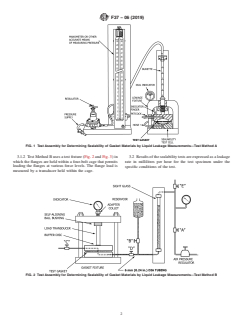
3.1.1 Test MethodAuses a test fixture (Fig. 1) by which an
Development of International Standards, Guides and Recom-
external load is transferred into the fixture to produce a
mendations issued by the World Trade Organization Technical
compressive force on the gasket specimen.
Barriers to Trade (TBT) Committee.
For referenced ASTM standards, visit the ASTM website, www.astm.org, or
contact ASTM Customer Service at service@astm.org. For Annual Book of ASTM
These test methods are under the jurisdiction of ASTM Committee F03 on Standards volume information, refer to the standard’s Document Summary page on
Gaskets and are the direct responsibility of Subcommittee F03.10 on Composite the ASTM website.
Gaskets. Available from American National Standards Institute, 11 W. 42nd St., 13th
Current edition approved May 1, 2019. Published June 2019. Originally Floor, New York, NY 10036.
approved in 1962. Last previous edition approved in 2013 as F37 – 06 (2013). DOI: Available from ASTM International Headquarters. Order Adjunct No.
10.1520/F0037-06R19. ADJF0037. Original adjunct produced in 1962.
Copyright ©ASTM International, 100 Barr Harbor Drive, PO Box C700, West Conshohocken, PA19428-2959. United States
F37 − 06 (2019)
FIG. 1 Test Assembly for Determining Sealability of Gasket Materials by Liquid Leakage Measurements—Test Method A
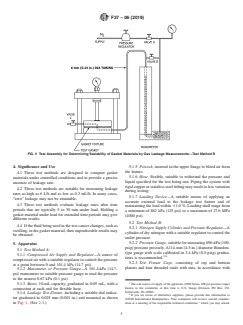
3.1.2 Test Method B uses a test fixture (Fig. 2 and Fig. 3)in 3.2 Resultsofthesealabilitytestsareexpressedasaleakage
which the flanges are held within a four-bolt cage that permits rate in millilitres per hour for the test specimen under the
loading the flanges at various force levels. The flange load is
specific conditions of the test.
measured by a transducer held within the cage.
FIG. 2 Test Assembly for Determining Sealability of Gasket Materials by Liquid Leakage Measurements—Test Method B
F37 − 06 (2019)
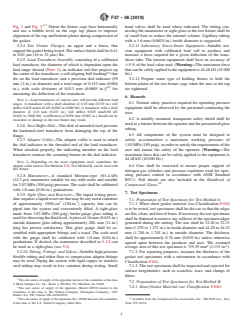
FIG. 3 Test Assembly for Determining Sealability of Gasket Materials by Gas Leakage Measurements—Test Method B
4. Significance and Use 5.1.5 Petcock, inserted in the upper flange to bleed air from
the fixture.
4.1 These test methods are designed to compare gasket
5.1.6 Hose, flexible, suitable to withstand the pressure and
materials under controlled conditions and to provide a precise
liquid specified for the test being run. Piping the system with
measure of leakage rate.
rigidcopperorstainlesssteeltubingmayresultinlessvariation
4.2 These test methods are suitable for measuring leakage
during testing.
rates as high as 6 L/h and as low as 0.3 mL/h. In many cases,
5.1.7 Loading Device—A suitable means of applying an
“zero” leakage may not be attainable.
accurate external load to the leakage test fixture and of
4.3 These test methods evaluate leakage rates after time
maintaining the load within 61.0 %. Loading shall range from
periods that are typically 5 to 30 min under load. Holding a
a minimum of 862 kPa (125 psi) to a maximum of 27.6 MPa
gasket material under load for extended time periods may give
(4000 psi).
different results.
5.2 Test Method B:
4.4 Ifthefluidbeing used in the test causes changes,suchas
5.2.1 Nitrogen Supply Cylinder and Pressure Regulator—A
swelling, in the gasket material, then unpredictable results may
cylinder of dry nitrogen with a suitable regulator to control the
be obtained.
outlet pressure.
5.2.2 Pressure Gauge,suitableformeasuring 690-kPa(100-
5. Apparatus
psig) pressure precisely.A114-mm (4.5-in.) diameter Bourdon-
5.1 Test Method A:
type gauge with scale calibrated in 3.4-kPa (0.5-psig) gradua-
5.1.1 Compressed Air Supply and Regulator—A source of
5,6
tions is recommended.
compressed air with a suitable regulator to control the pressure
5.2.3 Test Fixture Cage, consisting of top and bottom
at a point between 0 and 101.4 kPa (14.7 psi).
platens and four threaded studs with nuts, in accordance with
5.1.2 Manometer or Pressure Gauge—A 101.4-kPa (14.7-
psi) manometer or suitable pressure gauge to read the pressure
to the nearest 0.67 kPa (0.1 psi).
5.1.3 Buret, 10-mL capacity, graduated in 0.05 mL, with a
Thesolesourceofsupplyoftheapparatus(1900Series,200psipressurerange)
known to the committee at this time is U.S. Gauge Division, PO Box 152,
connection at each end for flexible hose.
Sellersville, PA 18960.
5.1.4 Leakage Test Fixture, including a suitable dial indica-
If you are aware of alternative suppliers, please provide this information to
tor graduated in 0.025 mm (0.001 in.) and mounted as shown
ASTM International Headquarters. Your comments will receive careful consider-
in Fig. 1. (See 2.3.) ation at a meeting of the responsible technical committee, which you may attend.
F37 − 06 (2019)
6,7
Fig. 2 and Fig. 3. Orient the fixture cage base horizontally hand valves shall be used where indicated. The tubing con-
and use a bubble level on the cage top platen to improve necting the manometer or sight-glass to the test fixture shall be
alignment of the top and bottom platen during compression of of small bore to reduce the internal volume. Capillary tubing
the gasket. with a 1.6-mm (0.0625-in.) inside diameter is suggested.
5.2.4 Test Fixture Flanges, an upper and a lower, that 5.2.11 Laboratory Stress-Strain Equipment—Suitable ten-
support the gasket being tested.The surface finish shall be 0.41 sion equipment with calibrated load cell to produce and
to 0.82 µm (16 to 32 µin.) Ra. measure a force required for a given deflection of the trans-
5.2.5 Load Transducer Assembly, consisting of a calibrated ducer tube. The tension equipment shall have an accuracy of
load transducer, the diameter of which is dependent upon the 65 % of the load value read. (Warning—The maximum force
load range desired (Note 1); an indicator rod that projects up that can be safely applied to the equipment is 44.48 kN (10 000
6,8
the center of the transducer; a self-aligning ball bushing that lb).)
fits on the load transducer; and a precision dial indicator (50 5.2.12 Prepare some type of holding fixture to hold the
mm (2 in.) in diameter and a total range of 0.152 mm (0.006 bottom platen of the test fixture cage when the nuts at the top
6,9
in.), with scale divisions of 0.013 mm (0.0005 in.)) for are tightened.
measuring the deflection of the transducer.
6. Hazards
NOTE 1—Load transducers of various sizes will provide different load
6.1 Normal safety practices required for operating pressure
ranges. A transducer with a shaft diameter of 8.10 mm (0.319 in.) will
deflect 0.025 mm/4.45 kN (0.001 in./1000 lbf). A transducer with a shaft equipment shall be observed by the personnel conducting the
diameter of 11.0 mm (0.433 in.) will deflect 0.025 mm/8.90 kN
tests.
(0.001 in.⁄2000 lbf). A deflection of 0.076 mm (0.003 in.) should not be
6.2 A suitably mounted, transparent safety shield shall be
exceeded, or damage to the test fixture may result.
usedasabarrierbetweentheoperatorandthepressurizedglass
5.2.6 Steel Buffer Disk—Thisdiskofannealedsteelprevents
tubing.
the hardened-steel transducer from damaging the top of the
flange. 6.3 All components of the system must be designed to
safely accommodate a maximum working pressure of
5.2.7 Adapter Collet—The adapter collet is used to attach
the dial indicator to the threaded end of the load transducer. 1.03 MPa (150 psig), in order to satisfy the requirements of the
user and ensure the safety of the operator. (Warning—The
When attached properly, the indicating member on the load
transducer contacts the actuating button on the dial indicator. maximum force that can be safely applied to the equipment is
44.48 kN (10 000 lb).)
NOTE 2—Depending on the exact equipment used, sometimes the
adapter collet used in Test Methods F38, Test Method B, can be used with
6.4 Care shall be exercised to ensure proper support of
this fixture.
nitrogen gas cylinders and pressure regulators used for oper-
5.2.8 Manometer—A standard Meriam-type 101.4-kPa ating pressure control in accordance with ANSI Standard
B57.1. Full details are also included in the Handbook of
(14.7-psi) manometer suitable for use with water and suitable
Compressed Gases.
for 2.07-MPa (300-psig) pressure.The scale shall be calibrated
with 1.0-mm (0.04-in.) graduations.
7. Test Specimens
5.2.9 Sight Glass and Reservoir—The liquid testing proce-
durerequiresaliquidreservoirthatmaybeanymetalcontainer
7.1 Preparation of Test Specimens for Test Method A:
3 3
of approximately 1500-cm (100-in. ) capacity that can be 7.1.1 When sheet gasket material (see Classification F104)
piped into the system and conveniently filled. A sight-glass
is to be tested, test specimens shall be die-cut so that the edges
made from 2.07-MPa (300-psig) boiler-gauge glass tubing is are flat, clean, and free of burrs. If necessary the test specimens
usedforobservingthefluidlevel.Apieceof16-mm(0.625-in.)
shall be flattened to remove any rollover of the specimen edges
outside diameter glass tubing approximately 280- mm (11-in.) generated during die cutting. The size shall be 32.26 to 32.31
long has proven satisfactory. This glass gauge shall be as-
mm (1.270 to 1.272 in.) in inside diameter and 44.20 to 44.32
sembled with appropriate fittings and a stand. The scale used mm (1.740 to 1.745 in.) in outside diameter. The thickness
with the gauge shall be calibrated with 1.0-mm (0.04-in.)
shall be approximately 0.76 mm (0.030 in.) unless otherwise
graduations. If desired, the manometer described in 5.2.8 can agreed upon between the producer and user. The assumed
2 2
be used as a sight-glass (see 9.2).
average area of this test specimen is 719.35 mm (1.115 in. ).
5.2.10 Tubing, Fittings, and Valves—Suitable high-pressure 7.1.2 For reporting purposes, measure the thickness of the
flexible tubing and either flare or compression adapter fittings
gasket test specimens with a micrometer in accordance with
may be used. Piping the system with rigid copper or stainless Classification F104.
steel tubing may result in less variation during testing. Small
7.1.3 The test specimens shall be inspected and rejected for
surface irregularities, such as scratches, tears, and clumps of
fibers.
The sole source of supply of the apparatus known to the committee at this time
7.2 Preparation of Test Specimens for Test Method B:
is Metal Samples Co., Inc., Route 1, PO Box 152, Munford, AL 36268.
7.2.1 Sheet Gasket Material (see Classification F104):
The sole source of supply of the apparatus (Model 6SF10) known to the
committee at this time is The Timken Company (Torrington Company), 1835
Dueber Ave. SW, Canton, OH 44706-0932.
9 10
Thesolesourceofsupplyoftheapparatus(No.25209)knowntothecommittee Available from the Compressed Gas Association, Inc., 500 Fifth Ave., New
at this time is The L.S. Starrett Company, Athol, MA. York, NY 10110.
F37 − 06 (2019)
7.2.1.1 Test specimens shall be die-cut so that the edges are (Warning—The maximum force that can be safely applied to
flat, clean, and free of burrs. If necessary the test specimens the equipment is 44.48 kN (10 000 lb).)
shall be flattened to remove any rollover of the specimen edges
8.2.5 For Test Method B, check the setup for leakage as
generated during die cutting. They shall be of circular con-
follows: Disconnect the line leading to the gasket test fixture
struction having concentric inside and outside diameters such
and plug it. This will permit running an initial leak test on the
that they fit the sealability test cell. The thickness shall be
valves, manometer, and tubing section of the equipment by
approximately 0.76 mm (0.030 in.) unless otherwise agreed
pressurizing only them. Then, assemble the equipment in the
upon between the producer and user.
normal manner, and run a final leak test using a rubber gasket
7.2.1.2 For reporting purposes, measure the thickness of the cut from an approximately 3.2-mm (0.12-in.) thick rubber
gasket specimens with a micrometer in accordance with compound conforming to Grade BG 515 in accordance with
Classification F104. Classification D2000 and a flange load in excess of 6.984 MPa
(1000 psi). This condition should give essentially no leakage
7.2.2 Types 4 and 5 Form-In-Place Gasket Material (see
(less than 0.005 mL/min). Run the equipment leakage check
Classification F104)—A 122-mm (4.8-in.) long piece of stan-
for several hours so that a highly precise leakage measurement
dard size material, between 4.76 and 6.35-mm (0.1875 and
can be obtained in subsequent measurements.
0.250-in.) nominal size or width, shall be formed into a circle
of 38-mm (1.5-in.) mean diameter. The ends of the Type 4
material shall be so laid as to have a 6.35 6 1.59-mm (0.25 6 9. Calibration of Equipment—Test Method B
0.0625-in.) overlap to complete the seal. The Type 5 material
9.1 Calibrate the transducer assembly using appropriate
shallhaveanoverlapof1.59 60.79mm(0.0625 60.0313in.)
laboratory stress-strain equipment to measure the amount of
to complete th
...