


ASTM D5470-17
(Test Method)Standard Test Method for Thermal Transmission Properties of Thermally Conductive Electrical Insulation Materials
Standard Test Method for Thermal Transmission Properties of Thermally Conductive Electrical Insulation Materials
SIGNIFICANCE AND USE
5.1 This standard measures the steady state thermal impedance of electrical insulating materials used to enhance heat transfer in electrical and electronic applications. This standard is especially useful for measuring thermal transmission properties of specimens that are either too thin or have insufficient mechanical stability to allow placement of temperature sensors in the specimen as in Test Method E1225.
5.2 This standard imposes an idealized heat flow pattern and specifies an average specimen test temperature. The thermal impedances thus measured cannot be directly applied to most practical applications where these required uniform, parallel heat conduction conditions do not exist.
5.3 This standard is useful for measuring the thermal impedance of the following material types.
5.3.1 Type I—Viscous liquids that exhibit unlimited deformation when a stress is applied. These include liquid compounds such as greases, pastes, and phase change materials. These materials exhibit no evidence of elastic behavior or the tendency to return to initial shape after deflection stresses are removed.
5.3.2 Type II—Viscoelastic solids where stresses of deformation are ultimately balanced by internal material stresses thus limiting further deformation. Examples include gels, soft, and hard rubbers. These materials exhibit linear elastic properties with significant deflection relative to material thickness.
5.3.3 Type III—Elastic solids which exhibit negligible deflection. Examples include ceramics, metals, and some types of plastics.
5.4 The apparent thermal conductivity of a specimen is able to be calculated from the measured thermal impedance and measured specimen thickness if the interfacial thermal resistance is insignificantly small (nominally less than 1 %) compared to the thermal resistance of the specimen.
5.4.1 The apparent thermal conductivity of a sample material is able to be accurately determined by excluding the interfacial thermal resistance. ...
SCOPE
1.1 This standard covers a test method for measurement of thermal impedance and calculation of an apparent thermal conductivity for thermally conductive electrical insulation materials ranging from liquid compounds to hard solid materials.
1.2 The term “thermal conductivity” applies only to homogeneous materials. Thermally conductive electrical insulating materials are usually heterogeneous and to avoid confusion this test method uses “apparent thermal conductivity” for determining thermal transmission properties of both homogeneous and heterogeneous materials.
1.3 The values stated in SI units are to be regarded as standard.
1.4 This standard does not purport to address all of the safety concerns, if any, associated with its use. It is the responsibility of the user of this standard to establish appropriate safety, health, and environmental practices and determine the applicability of regulatory limitations prior to use.
1.5 This international standard was developed in accordance with internationally recognized principles on standardization established in the Decision on Principles for the Development of International Standards, Guides and Recommendations issued by the World Trade Organization Technical Barriers to Trade (TBT) Committee.
General Information
- Status
- Published
- Publication Date
- 31-Oct-2017
- Technical Committee
- D09 - Electrical and Electronic Insulating Materials
- Drafting Committee
- D09.01 - Electrical Insulating Products
Relations
- Effective Date
- 01-Nov-2017
- Effective Date
- 01-May-2013
- Effective Date
- 01-Nov-2011
- Effective Date
- 15-Mar-2009
- Effective Date
- 01-Oct-2008
- Effective Date
- 01-Nov-2005
- Effective Date
- 01-May-2004
- Effective Date
- 10-May-1999
- Effective Date
- 10-Mar-1999
- Effective Date
- 10-Mar-1999
- Effective Date
- 10-Mar-1999
- Effective Date
- 01-Nov-2017
Overview
ASTM D5470-17 is the internationally recognized standard test method for measuring the thermal transmission properties of thermally conductive electrical insulation materials. Issued by ASTM International, this standard is crucial for analyzing materials used to enhance heat transfer in electrical and electronic applications. It provides a steady-state method to determine the thermal impedance and calculate the apparent thermal conductivity of a broad range of electrical insulation materials, from viscous liquids such as greases and pastes to rigid solids like ceramics and metals.
This standard is especially valuable for evaluating thin or mechanically unstable specimens where traditional sensor placement is not feasible. The method is applicable to both homogeneous and heterogeneous materials but emphasizes the use of "apparent thermal conductivity" due to the common non-homogeneous nature of insulation materials.
Key Topics
- Thermal Impedance Measurement: ASTM D5470-17 defines a methodology to measure the total opposition (impedance) that an insulating assembly presents to heat flow.
- Apparent Thermal Conductivity Calculation: The standard guides users in calculating the apparent thermal conductivity from measured impedance and thickness, helping to characterize thermal performance.
- Material Types:
- Type I: Viscous liquids (e.g., greases, pastes, phase change materials) with unlimited deformation under stress.
- Type II: Viscoelastic solids like gels and rubbers that deform significantly but have some elastic recovery.
- Type III: Elastic solids such as ceramics, metals, and certain plastics, exhibiting negligible deflection.
- Steady-State Testing: All measurements are conducted under steady-state heat flow conditions between two parallel, isothermal surfaces.
- Interfacial Resistance Consideration: The method accounts for and distinguishes the interfacial resistance at specimen boundaries, which is critical to accurate results.
- Test Apparatus and Procedure: Describes apparatus requirements, sample preparation, test procedures for different material types, and reporting protocols.
Applications
ASTM D5470-17 is widely used in the development, quality control, and research of thermally conductive electrical insulation materials, such as:
- Thermal Interface Materials (TIMs): Used in electronics to improve heat transfer between components and heat sinks (e.g., CPUs, power devices).
- Insulating Coatings and Films: Employed in electric motors, transformers, and circuit boards to provide electrical insulation while facilitating thermal management.
- Advanced Electronic Packaging: For evaluating new polymer composites, gels, and phase change materials in emerging high-power density devices.
- Automotive and Aerospace Electronics: Assesses thermal insulation materials to ensure reliability of control modules and power electronics in harsh environments.
Accurate measurement and understanding of a material’s thermal transmission properties play a crucial role in preventing overheating, increasing lifespan, and enabling higher performance in electronic and electrical systems.
Related Standards
- ASTM D374: Test Methods for Thickness of Solid Electrical Insulation
- ASTM E1225: Test Method for Thermal Conductivity of Solids Using the Guarded-Comparative-Longitudinal Heat Flow Technique
- ASTM E691: Practice for Conducting an Interlaboratory Study to Determine the Precision of a Test Method
These related ASTM standards provide guidance on specimen measurement, alternative thermal conductivity measurement techniques, and ensure consistency and reliability across laboratories.
Keywords: ASTM D5470-17, thermal transmission, apparent thermal conductivity, thermal impedance, electrical insulation materials, thermal interface materials, steady-state thermal testing, electronic thermal management, interfacial thermal resistance, standard test method.
Buy Documents
ASTM D5470-17 - Standard Test Method for Thermal Transmission Properties of Thermally Conductive Electrical Insulation Materials
REDLINE ASTM D5470-17 - Standard Test Method for Thermal Transmission Properties of Thermally Conductive Electrical Insulation Materials
Get Certified
Connect with accredited certification bodies for this standard

Intertek Testing Services NA Inc.
Intertek certification services in North America.

UL Solutions
Global safety science company with testing, inspection and certification.

ANCE
Mexican certification and testing association.
Sponsored listings
Frequently Asked Questions
ASTM D5470-17 is a standard published by ASTM International. Its full title is "Standard Test Method for Thermal Transmission Properties of Thermally Conductive Electrical Insulation Materials". This standard covers: SIGNIFICANCE AND USE 5.1 This standard measures the steady state thermal impedance of electrical insulating materials used to enhance heat transfer in electrical and electronic applications. This standard is especially useful for measuring thermal transmission properties of specimens that are either too thin or have insufficient mechanical stability to allow placement of temperature sensors in the specimen as in Test Method E1225. 5.2 This standard imposes an idealized heat flow pattern and specifies an average specimen test temperature. The thermal impedances thus measured cannot be directly applied to most practical applications where these required uniform, parallel heat conduction conditions do not exist. 5.3 This standard is useful for measuring the thermal impedance of the following material types. 5.3.1 Type I—Viscous liquids that exhibit unlimited deformation when a stress is applied. These include liquid compounds such as greases, pastes, and phase change materials. These materials exhibit no evidence of elastic behavior or the tendency to return to initial shape after deflection stresses are removed. 5.3.2 Type II—Viscoelastic solids where stresses of deformation are ultimately balanced by internal material stresses thus limiting further deformation. Examples include gels, soft, and hard rubbers. These materials exhibit linear elastic properties with significant deflection relative to material thickness. 5.3.3 Type III—Elastic solids which exhibit negligible deflection. Examples include ceramics, metals, and some types of plastics. 5.4 The apparent thermal conductivity of a specimen is able to be calculated from the measured thermal impedance and measured specimen thickness if the interfacial thermal resistance is insignificantly small (nominally less than 1 %) compared to the thermal resistance of the specimen. 5.4.1 The apparent thermal conductivity of a sample material is able to be accurately determined by excluding the interfacial thermal resistance. ... SCOPE 1.1 This standard covers a test method for measurement of thermal impedance and calculation of an apparent thermal conductivity for thermally conductive electrical insulation materials ranging from liquid compounds to hard solid materials. 1.2 The term “thermal conductivity” applies only to homogeneous materials. Thermally conductive electrical insulating materials are usually heterogeneous and to avoid confusion this test method uses “apparent thermal conductivity” for determining thermal transmission properties of both homogeneous and heterogeneous materials. 1.3 The values stated in SI units are to be regarded as standard. 1.4 This standard does not purport to address all of the safety concerns, if any, associated with its use. It is the responsibility of the user of this standard to establish appropriate safety, health, and environmental practices and determine the applicability of regulatory limitations prior to use. 1.5 This international standard was developed in accordance with internationally recognized principles on standardization established in the Decision on Principles for the Development of International Standards, Guides and Recommendations issued by the World Trade Organization Technical Barriers to Trade (TBT) Committee.
SIGNIFICANCE AND USE 5.1 This standard measures the steady state thermal impedance of electrical insulating materials used to enhance heat transfer in electrical and electronic applications. This standard is especially useful for measuring thermal transmission properties of specimens that are either too thin or have insufficient mechanical stability to allow placement of temperature sensors in the specimen as in Test Method E1225. 5.2 This standard imposes an idealized heat flow pattern and specifies an average specimen test temperature. The thermal impedances thus measured cannot be directly applied to most practical applications where these required uniform, parallel heat conduction conditions do not exist. 5.3 This standard is useful for measuring the thermal impedance of the following material types. 5.3.1 Type I—Viscous liquids that exhibit unlimited deformation when a stress is applied. These include liquid compounds such as greases, pastes, and phase change materials. These materials exhibit no evidence of elastic behavior or the tendency to return to initial shape after deflection stresses are removed. 5.3.2 Type II—Viscoelastic solids where stresses of deformation are ultimately balanced by internal material stresses thus limiting further deformation. Examples include gels, soft, and hard rubbers. These materials exhibit linear elastic properties with significant deflection relative to material thickness. 5.3.3 Type III—Elastic solids which exhibit negligible deflection. Examples include ceramics, metals, and some types of plastics. 5.4 The apparent thermal conductivity of a specimen is able to be calculated from the measured thermal impedance and measured specimen thickness if the interfacial thermal resistance is insignificantly small (nominally less than 1 %) compared to the thermal resistance of the specimen. 5.4.1 The apparent thermal conductivity of a sample material is able to be accurately determined by excluding the interfacial thermal resistance. ... SCOPE 1.1 This standard covers a test method for measurement of thermal impedance and calculation of an apparent thermal conductivity for thermally conductive electrical insulation materials ranging from liquid compounds to hard solid materials. 1.2 The term “thermal conductivity” applies only to homogeneous materials. Thermally conductive electrical insulating materials are usually heterogeneous and to avoid confusion this test method uses “apparent thermal conductivity” for determining thermal transmission properties of both homogeneous and heterogeneous materials. 1.3 The values stated in SI units are to be regarded as standard. 1.4 This standard does not purport to address all of the safety concerns, if any, associated with its use. It is the responsibility of the user of this standard to establish appropriate safety, health, and environmental practices and determine the applicability of regulatory limitations prior to use. 1.5 This international standard was developed in accordance with internationally recognized principles on standardization established in the Decision on Principles for the Development of International Standards, Guides and Recommendations issued by the World Trade Organization Technical Barriers to Trade (TBT) Committee.
ASTM D5470-17 is classified under the following ICS (International Classification for Standards) categories: 29.035.01 - Insulating materials in general. The ICS classification helps identify the subject area and facilitates finding related standards.
ASTM D5470-17 has the following relationships with other standards: It is inter standard links to ASTM D5470-12, ASTM E691-13, ASTM E691-11, ASTM E1225-09, ASTM E691-08, ASTM E691-05, ASTM E1225-04, ASTM E691-99, ASTM D374-99(2004), ASTM E1225-99, ASTM D374-99, ASTM D6343-14(2018). Understanding these relationships helps ensure you are using the most current and applicable version of the standard.
ASTM D5470-17 is available in PDF format for immediate download after purchase. The document can be added to your cart and obtained through the secure checkout process. Digital delivery ensures instant access to the complete standard document.
Standards Content (Sample)
This international standard was developed in accordance with internationally recognized principles on standardization established in the Decision on Principles for the
Development of International Standards, Guides and Recommendations issued by the World Trade Organization Technical Barriers to Trade (TBT) Committee.
Designation: D5470 − 17
Standard Test Method for
Thermal Transmission Properties of Thermally Conductive
Electrical Insulation Materials
This standard is issued under the fixed designation D5470; the number immediately following the designation indicates the year of
original adoption or, in the case of revision, the year of last revision. A number in parentheses indicates the year of last reapproval. A
superscript epsilon (´) indicates an editorial change since the last revision or reapproval.
This standard has been approved for use by agencies of the U.S. Department of Defense.
1. Scope* E691 Practice for Conducting an Interlaboratory Study to
Determine the Precision of a Test Method
1.1 This standard covers a test method for measurement of
E1225 Test Method for Thermal Conductivity of Solids
thermal impedance and calculation of an apparent thermal
Using the Guarded-Comparative-Longitudinal Heat Flow
conductivity for thermally conductive electrical insulation
Technique
materials ranging from liquid compounds to hard solid mate-
rials.
3. Terminology
1.2 The term “thermal conductivity” applies only to homo-
3.1 Definitions of Terms Specific to This Standard:
geneous materials. Thermally conductive electrical insulating
3.1.1 apparent thermal conductivity (λ), n—the time rate of
materialsareusuallyheterogeneousandtoavoidconfusionthis
heat flow, under steady conditions, through unit area of a
testmethoduses“apparentthermalconductivity”fordetermin-
heterogeneous material, per unit temperature gradient in the
ing thermal transmission properties of both homogeneous and
direction perpendicular to the area.
heterogeneous materials.
3.1.2 average temperature (of a surface), n—the area-
1.3 The values stated in SI units are to be regarded as
weighted mean temperature.
standard.
3.1.3 composite, n—a material made up of distinct parts
1.4 This standard does not purport to address all of the
whichcontribute,eitherproportionallyorsynergistically,tothe
safety concerns, if any, associated with its use. It is the
properties of the combination.
responsibility of the user of this standard to establish appro-
priate safety, health, and environmental practices and deter- 3.1.4 homogeneous material, n—a material in which rel-
mine the applicability of regulatory limitations prior to use. evant properties are not a function of the position within the
1.5 This international standard was developed in accor- material.
dance with internationally recognized principles on standard-
3.1.5 thermal impedance (θ), n—the total opposition that an
ization established in the Decision on Principles for the
assembly (material, material interfaces) presents to the flow of
Development of International Standards, Guides and Recom-
heat.
mendations issued by the World Trade Organization Technical
3.1.6 thermal interfacial resistance (contact resistance),
Barriers to Trade (TBT) Committee.
n—thetemperaturedifferencerequiredtoproduceaunitofheat
flux at the contact planes between the specimen surfaces and
2. Referenced Documents
the hot and cold surfaces in contact with the specimen under
2.1 ASTM Standards:
test. The symbol for contact resistance is R .
I
D374 Test Methods for Thickness of Solid Electrical Insu-
3.1.7 thermal resistivity, n—the reciprocal of thermal con-
lation (Metric) D0374_D0374M
ductivity. Under steady-state conditions, the temperature
gradient, in the direction perpendicular to the isothermal
surface per unit of heat flux.
This test method is under the jurisdiction of ASTM Committee D09 on
Electrical and Electronic Insulating Materials and is the direct responsibility of
3.2 Symbols Used in This Standard:
Subcommittee D09.01 on Electrical Insulating Products.
3.2.1 λ = apparent thermal conductivity, W/m·K.
Current edition approved Nov. 1, 2017. Published November 2017. Originally
3.2.2 A = area of a specimen, m .
approved in 1993. Last previous edition approved in 2012 as D5470 – 12. DOI:
10.1520/D5470-17.
3.2.3 d = thickness of specimen, m.
For referenced ASTM standards, visit the ASTM website, www.astm.org, or
3.2.4 Q = time rate of heat flow, W or J/s.
contact ASTM Customer Service at service@astm.org. For Annual Book of ASTM
3.2.5 q = heat flux, or time rate of heat flow per unit area,
Standards volume information, refer to the standard’s Document Summary page on
the ASTM website. W/m .
*A Summary of Changes section appears at the end of this standard
Copyright © ASTM International, 100 Barr Harbor Drive, PO Box C700, West Conshohocken, PA 19428-2959. United States
D5470 − 17
3.2.6 θ = thermal impedance, temperature difference per 5. Significance and Use
unit of heat flux, (K·m )/W.
5.1 This standard measures the steady state thermal imped-
ance of electrical insulating materials used to enhance heat
4. Summary of Test Method
transfer in electrical and electronic applications. This standard
is especially useful for measuring thermal transmission prop-
4.1 This standard is based on idealized heat conduction
between two parallel, isothermal surfaces separated by a test erties of specimens that are either too thin or have insufficient
mechanical stability to allow placement of temperature sensors
specimen of uniform thickness. The thermal gradient imposed
on the specimen by the temperature difference between the two in the specimen as in Test Method E1225.
contacting surfaces causes the heat flow through the specimen.
5.2 Thisstandardimposesanidealizedheatflowpatternand
This heat flow is perpendicular to the test surfaces and is
specifies an average specimen test temperature. The thermal
uniform across the surfaces with no lateral heat spreading.
impedances thus measured cannot be directly applied to most
4.2 The measurements required by this standard when using practical applications where these required uniform, parallel
two meter bars are: heat conduction conditions do not exist.
T = hotter temperature of the hot meter bar, K,
5.3 This standard is useful for measuring the thermal
T = colder temperature of the hot meter bar, K,
impedance of the following material types.
T = hotter temperature of the cold meter bar, K,
5.3.1 Type I—Viscous liquids that exhibit unlimited defor-
T = colder temperature of the cold meter bar, K,
mation when a stress is applied. These include liquid com-
A = area of the test surfaces, m , and
pounds such as greases, pastes, and phase change materials.
d = specimen thickness, m.
These materials exhibit no evidence of elastic behavior or the
tendency to return to initial shape after deflection stresses are
4.3 Based on the idealized test configuration, measurements
are taken to compute the following parameters: removed.
5.3.2 Type II—Viscoelastic solids where stresses of defor-
T = the temperature of the hotter isothermal surface, K,
H
T = the temperature of the colder isothermal surface, K, mation are ultimately balanced by internal material stresses
C
thus limiting further deformation. Examples include gels, soft,
Q = the heat flow rate between the two isothermal surfaces,
W, and hard rubbers. These materials exhibit linear elastic prop-
erties with significant deflection relative to material thickness.
thermal impedance = the temperature difference between the
two isothermal surfaces divided by the heat flux through them, 5.3.3 Type III—Elastic solids which exhibit negligible de-
flection.Examplesincludeceramics,metals,andsometypesof
K·m /W, and
apparent thermal conductivity = calculated from a plot of plastics.
specimen thermal impedance versus thickness, W/m·K.
5.4 The apparent thermal conductivity of a specimen is able
4.4 Interfacial thermal resistance exists between the speci- to be calculated from the measured thermal impedance and
measured specimen thickness if the interfacial thermal resis-
men and the test surfaces. These contact resistances are
tance is insignificantly small (nominally less than 1 %) com-
included in the specimen thermal impedance computation.
pared to the thermal resistance of the specimen.
Contactresistancevarieswidelydependingonthenatureofthe
5.4.1 The apparent thermal conductivity of a sample mate-
specimen surface and the mechanical pressure applied to the
rial is able to be accurately determined by excluding the
specimen by the test surfaces. Measure and record the clamp-
interfacial thermal resistance.This is accomplished by measur-
ing pressure applied to the specimen as a secondary measure-
ing the thermal impedance of different thicknesses of the
ment required for the method except in the case of fluidic
material under test and plotting thermal impedance versus
samples (Type I, see section 5.3.1) where the applied pressure
thickness. The inverse of the slope of the resulting straight line
is insignificant. The computation for thermal impedance is
is the apparent thermal conductivity. The intercept at zero
comprised of the sum of the specimen thermal resistance plus
thickness is the sum of the contact resistances at the two
the interfacial thermal resistance.
surfaces.
4.5 Calculationofapparentthermalconductivityrequiresan
5.4.2 The contact resistance is able to be reduced by
accurate determination of the specimen thickness under test.
applying thermal grease or oil to the test surfaces of rigid test
Different means are able to be used to control, monitor, and
specimens (Type III).
measure the test specimen thickness depending on the material
type.
TEST METHOD
4.5.1 The test specimen thickness under test is able to be
controlled with shims or mechanical stops if the dimension of
6. Apparatus
the specimen can change during the test.
6.1 The general features of an apparatus that meets the
4.5.2 The test specimen thickness is able to be monitored
requirements of this method are shown in Figs. 1 and 2. This
under test with an in situ thickness measurement if the
apparatus imposes the required test conditions and accom-
dimension of the specimen change during the test.
plishes the required measurements. It is one possible engineer-
4.5.3 The test specimen thickness is able to be measured as
ing solution, not a uniquely exclusive implementation.
manufactured at room temperature in accordance with Test
Methods D374 Test Method C if it exhibits negligible com- 6.2 The test surfaces are to be smooth within 0.4 microns
pression deflection. and parallel to within 5 microns.
D5470 − 17
FIG. 2 Guarded Heater Test Stack
FIG. 1 Test Stack Using Meter Bars as Calorimeters
environment. Guard heaters are insulated from the heat source
and maintained at a temperature within 60.2 K of the heater.
This effectively reduces the heat leakage from the primary
6.3 Theheatsourcesareeitherelectricalheatersortempera-
heater by nullifying the temperature difference across the
ture controlled fluid circulators. Typical electrical heaters are
insulation. Insulation between the guard heater and the heat
made by embedding wire wound cartridge heaters in a highly
sourcewillbeatleasttheequivalentofone5mmlayerofFR-4
conductive metal block. Circulated fluid heaters consist of a
epoxy material.
metal block heat exchanger through which a controlled tem-
6.4.4 Iftheheatflowmeterbarsareusedonboththehotand
perature fluid is circulated to provide the required heat flow as
cold surfaces, guard heaters and thermal insulation is not
well as temperature control.
required and the heat flow through the test specimen is
6.4 Heat flow through the specimen is able to be measured
computed as the average heat flow through both meter bars.
with meter bars regardless of the type of heater used.
6.5 Meter bars are able to also be used to determine the
6.4.1 Electrical heaters offer convenient measurement of the
temperature of the test surfaces by extrapolating the linear
heating power generated but must be combined with a guard
arrayofmeterbartemperaturestothetestsurfaces.Thisisable
heater and high quality insulation to limit heat leakage away
to be done for both the hot side and cold side meter bars.
from the primary flow through the specimen.
Surface temperatures are able to be measured with thermo-
6.4.2 Heat flow meter bars are able to be constructed from
couples that are located in extreme proximity to the surfaces
high conductivity materials with well documented thermal
although this can be mechanically difficult to achieve. Meter
conductivity within the temperature range of interest. The
bars are able to be used for both heat flow and surface
temperature sensitivity of thermal conductivity must be con-
temper
...
This document is not an ASTM standard and is intended only to provide the user of an ASTM standard an indication of what changes have been made to the previous version. Because
it may not be technically possible to adequately depict all changes accurately, ASTM recommends that users consult prior editions as appropriate. In all cases only the current version
of the standard as published by ASTM is to be considered the official document.
Designation: D5470 − 12 D5470 − 17
Standard Test Method for
Thermal Transmission Properties of Thermally Conductive
Electrical Insulation Materials
This standard is issued under the fixed designation D5470; the number immediately following the designation indicates the year of
original adoption or, in the case of revision, the year of last revision. A number in parentheses indicates the year of last reapproval. A
superscript epsilon (´) indicates an editorial change since the last revision or reapproval.
This standard has been approved for use by agencies of the U.S. Department of Defense.
1. Scope*
1.1 This standard covers a test method for measurement of thermal impedance and calculation of an apparent thermal
conductivity for thermally conductive electrical insulation materials ranging from liquid compounds to hard solid materials.
1.2 The term “thermal conductivity” applies only to homogeneous materials. Thermally conductive electrical insulating
materials are usually heterogeneous and to avoid confusion this test method uses “apparent thermal conductivity” for determining
thermal transmission properties of both homogeneous and heterogeneous materials.
1.3 The values stated in SI units are to be regarded as standard.
1.4 This standard does not purport to address all of the safety concerns, if any, associated with its use. It is the responsibility
of the user of this standard to establish appropriate safety safety, health, and healthenvironmental practices and determine the
applicability of regulatory limitations prior to use.
1.5 This international standard was developed in accordance with internationally recognized principles on standardization
established in the Decision on Principles for the Development of International Standards, Guides and Recommendations issued
by the World Trade Organization Technical Barriers to Trade (TBT) Committee.
2. Referenced Documents
2.1 ASTM Standards:
D374 Test Methods for Thickness of Solid Electrical Insulation (Metric) D0374_D0374M
E691 Practice for Conducting an Interlaboratory Study to Determine the Precision of a Test Method
E1225 Test Method for Thermal Conductivity of Solids Using the Guarded-Comparative-Longitudinal Heat Flow Technique
3. Terminology
3.1 Definitions of Terms Specific to This Standard:
3.1.1 apparent thermal conductivity (λ), n—the time rate of heat flow, under steady conditions, through unit area of a
heterogeneous material, per unit temperature gradient in the direction perpendicular to the area.
3.1.2 average temperature (of a surface), n—the area-weighted mean temperature.
3.1.3 composite, n—a material made up of distinct parts which contribute, either proportionally or synergistically, to the
properties of the combination.
3.1.4 homogeneous material, n—a material in which relevant properties are not a function of the position within the material.
3.1.5 thermal impedance (θ), n—the total opposition that an assembly (material, material interfaces) presents to the flow of heat.
3.1.6 thermal interfacial resistance (contact resistance), n—the temperature difference required to produce a unit of heat flux
at the contact planes between the specimen surfaces and the hot and cold surfaces in contact with the specimen under test. The
symbol for contact resistance is R .
I
This test method is under the jurisdiction of ASTM Committee D09 on Electrical and Electronic Insulating Materials and is the direct responsibility of Subcommittee
D09.01 on Electrical Insulating Products.
Current edition approved Jan. 1, 2012Nov. 1, 2017. Published February 2012November 2017. Originally approved in 1993. Last previous edition approved in 20112012
as D5470 – 11.D5470 – 12. DOI: 10.1520/D5470-12.10.1520/D5470-17.
For referenced ASTM standards, visit the ASTM website, www.astm.org, or contact ASTM Customer Service at service@astm.org. For Annual Book of ASTM Standards
volume information, refer to the standard’s Document Summary page on the ASTM website.
*A Summary of Changes section appears at the end of this standard
Copyright © ASTM International, 100 Barr Harbor Drive, PO Box C700, West Conshohocken, PA 19428-2959. United States
D5470 − 17
3.1.7 thermal resistivity, n—the reciprocal of thermal conductivity. Under steady-state conditions, the temperature gradient, in
the direction perpendicular to the isothermal surface per unit of heat flux.
3.2 Symbols Used in This Standard:
3.2.1 λ = apparent thermal conductivity, W/m·K.
3.2.2 A = area of a specimen, m .
3.2.3 d = thickness of specimen, m.
3.2.4 Q = time rate of heat flow, W or J/s.
3.2.5 q = heat flux, or time rate of heat flow per unit area, W/m .
3.2.6 θ = thermal impedance, temperature difference per unit of heat flux, (K·m )/W.
4. Summary of Test Method
4.1 This standard is based on idealized heat conduction between two parallel, isothermal surfaces separated by a test specimen
of uniform thickness. The thermal gradient imposed on the specimen by the temperature difference between the two contacting
surfaces causes the heat flow through the specimen. This heat flow is perpendicular to the test surfaces and is uniform across the
surfaces with no lateral heat spreading.
4.2 The measurements required by this standard when using two meter bars are:
T = hotter temperature of the hot meter bar, K,
T = colder temperature of the hot meter bar, K,
T = hotter temperature of the cold meter bar, K,
T = colder temperature of the cold meter bar, K,
A = area of the test surfaces, m , and
d = specimen thickness, m.
4.3 Based on the idealized test configuration, measurements are taken to compute the following parameters:
T = the temperature of the hotter isothermal surface, K,
H
T = the temperature of the colder isothermal surface, K,
C
Q = the heat flow rate between the two isothermal surfaces, W,
thermal impedance = the temperature difference between the two isothermal surfaces divided by the heat flux through them,
K·m /W, and
apparent thermal conductivity = calculated from a plot of specimen thermal impedance versus thickness, W/m·K.
4.4 Interfacial thermal resistance exists between the specimen and the test surfaces. These contact resistances are included in
the specimen thermal impedance computation. Contact resistance varies widely depending on the nature of the specimen surface
and the mechanical pressure applied to the specimen by the test surfaces. The Measure and record the clamping pressure applied
to the specimen should therefore be measured and recorded as a secondary measurement required for the method except in the case
of fluidic samples (Type I, see section 5.3.1) where the applied pressure is insignificant. The computation for thermal impedance
is comprised of the sum of the specimen thermal resistance plus the interfacial thermal resistance.
4.5 Calculation of apparent thermal conductivity requires an accurate determination of the specimen thickness under test.
Different means can are able to be used to control, monitor, and measure the test specimen thickness depending on the material
type.
4.5.1 The test specimen thickness under test can is able to be controlled with shims or mechanical stops if the dimension of the
specimen can change during the test.
4.5.2 The test specimen thickness can is able to be monitored under test with an in situ thickness measurement if the dimension
of the specimen can change during the test.
4.5.3 The test specimen thickness can is able to be measured as manufactured at room temperature in accordance with Test
Methods D374 Test Method C if it exhibits negligible compression deflection.
5. Significance and Use
5.1 This standard measures the steady state thermal impedance of electrical insulating materials used to enhance heat transfer
in electrical and electronic applications. This standard is especially useful for measuring thermal transmission properties of
specimens that are either too thin or have insufficient mechanical stability to allow placement of temperature sensors in the
specimen as in Test Method E1225.
5.2 This standard imposes an idealized heat flow pattern and specifies an average specimen test temperature. The thermal
impedances thus measured cannot be directly applied to most practical applications where these required uniform, parallel heat
conduction conditions do not exist.
5.3 This standard is useful for measuring the thermal impedance of the following material types.
D5470 − 17
5.3.1 Type I—Viscous liquids that exhibit unlimited deformation when a stress is applied. These include liquid compounds such
as greases, pastes, and phase change materials. These materials exhibit no evidence of elastic behavior or the tendency to return
to initial shape after deflection stresses are removed.
5.3.2 Type II—Viscoelastic solids where stresses of deformation are ultimately balanced by internal material stresses thus
limiting further deformation. Examples include gels, soft, and hard rubbers. These materials exhibit linear elastic properties with
significant deflection relative to material thickness.
5.3.3 Type III—Elastic solids which exhibit negligible deflection. Examples include ceramics, metals, and some types of
plastics.
5.4 The apparent thermal conductivity of a specimen can is able to be calculated from the measured thermal impedance and
measured specimen thickness if the interfacial thermal resistance is insignificantly small (nominally less than 1 %) compared to
the thermal resistance of the specimen.
5.4.1 The apparent thermal conductivity of a sample material can is able to be accurately determined by excluding the interfacial
thermal resistance. This is accomplished by measuring the thermal impedance of different thicknesses of the material under test
and plotting thermal impedance versus thickness. The inverse of the slope of the resulting straight line is the apparent thermal
conductivity. The intercept at zero thickness is the sum of the contact resistances at the two surfaces.
5.4.2 The contact resistance can is able to be reduced by applying thermal grease or oil to the test surfaces of rigid test
specimens (Type III).
TEST METHOD
6. Apparatus
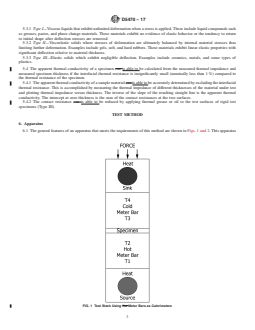
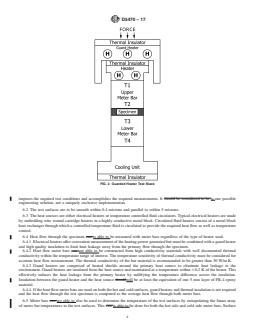
6.1 The general features of an apparatus that meets the requirements of this method are shown in Figs. 1 and 2. This apparatus
FIG. 1 Test Stack Using the Meter Bars as Calorimeters
D5470 − 17
FIG. 2 Guarded Heater Test Stack
imposes the required test conditions and accomplishes the required measurements. It should be considered to be is one possible
engineering solution, not a uniquely exclusive implementation.
6.2 The test surfaces are to be smooth within 0.4 microns and parallel to within 5 microns.
6.3 The heat sources are either electrical heaters or temperature controlled fluid circulators. Typical electrical heaters are made
by embedding wire wound cartridge heaters in a highly conductive metal block. Circulated fluid heaters consist of a metal block
heat exchanger through which a controlled temperature fluid is circulated to provide the required heat flow as well as temperature
control.
6.4 Heat flow through the specimen can is able to be measured with meter bars regardless of the type of heater used.
6.4.1 Electrical heaters offer convenient measurement of the heating power generated but must be combined with a guard heater
and high quality insulation to limit heat leakage away from the primary flow through the specimen.
6.4.2 Heat flow meter bars can are able to be constructed from high conductivity materials with well documented thermal
conductivity within the temperature range of interest. The temperature sensitivity of thermal conductivity must be considered for
accurate heat flow measurement. The thermal conductivity of the bar material is recommended to be greater than 50 W/m·K.
6.4.3 Guard heaters are comprised of heated shields around the primary heat source to eliminate heat leakage to the
environment. Guard heaters are insulated from the heat source and maintained at a temperature within 60.2 K of the heater. This
effectively reduces the heat leakage from the primary heater by nullifying the temperature difference across the insulation.
Insulation between the guard heater and the heat source shouldwill be at least the equivalent of one 5 mm layer of FR-4 epoxy
material.
6.4.4 If the heat flow meter bars are used on both the hot and cold surfaces, guard heaters and thermal insulation is not required
and the heat flow through the test specimen is computed as the average heat flow through both meter bars.
6.5 Meter bars can are able to also be used to determine the temperature of the test surfaces by extrapolating the linear array
of meter bar temperatures to the test surfaces. This can is able to be done for both the hot side and cold side meter bars. Surface
-----
...
Questions, Comments and Discussion
Ask us and Technical Secretary will try to provide an answer. You can facilitate discussion about the standard in here.
Loading comments...