

ASTM D5534-94(2018)
(Test Method)Standard Test Method for Vapor-Phase Rust-Preventing Characteristics of Hydraulic Fluids
General Information
- Abstract
SIGNIFICANCE AND USE
4.1 Procedures such as Test Methods D665 and D3603 assess the ability of new or unused hydraulic fluid to prevent rusting on wetted steel surfaces but do not address the prevention of rusting in the vapor space above the fluid. This procedure addresses the latter question under one set of test conditions and need not be applicable to some service conditions. Since used fluids have not been cooperatively tested in this procedure, its utility for in-service monitoring has not been established.
SCOPE
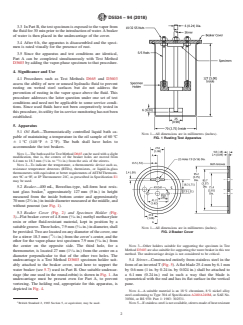
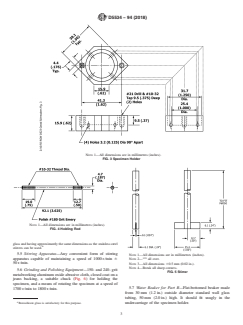
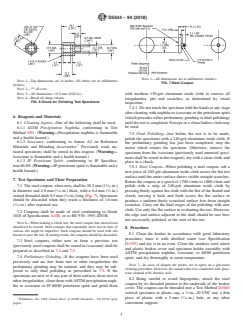
1.1 This test method covers the ability of hydraulic fluids to prevent the rusting of steel in the vapor phase over the hydraulic fluid and water.
1.2 The values stated in SI units are to be regarded as standard. The values given in parentheses after SI units are provided for information only and are not considered standard.
1.3 WARNING—Mercury has been designated by many regulatory agencies as a hazardous material that can cause central nervous system, kidney and liver damage. Mercury, or its vapor, may be hazardous to health and corrosive to materials. Caution should be taken when handling mercury and mercury containing products. See the applicable product Material Safety Data Sheet (MSDS) for details and EPA’s website—http://www.epa.gov/mercury/faq.htm—for additional information. Users should be aware that selling mercury and/or mercury containing products into your state or country may be prohibited by law.
1.4 This standard does not purport to address all of the safety concerns, if any, associated with its use. It is the responsibility of the user of this standard to establish appropriate safety, health, and environmental practices and determine the applicability of regulatory limitations prior to use.
1.5 This international standard was developed in accordance with internationally recognized principles on standardization established in the Decision on Principles for the Development of International Standards, Guides and Recommendations issued by the World Trade Organization Technical Barriers to Trade (TBT) Committee.
- Status
- Published
- Publication Date
- 31-Mar-2018
- Technical Committee
- D02 - Petroleum Products, Liquid Fuels, and Lubricants
- Drafting Committee
- D02.N0 - Hydraulic Fluids
Overview
The ASTM D5534-94(2018) standard, titled Standard Test Method for Vapor-Phase Rust-Preventing Characteristics of Hydraulic Fluids, defines a laboratory procedure to assess the ability of hydraulic fluids to protect against rusting in the vapor phase above the fluid and water interface. Unlike previous methods, such as ASTM D665 and D3603, which evaluate rust-prevention only on wetted steel surfaces, ASTM D5534 specifically focuses on the vapor space, a critical factor in many hydraulic system environments. Developed under internationally recognized guidelines, this test method is a key resource for fluid formulators, quality control laboratories, and manufacturers seeking enhanced corrosion protection in hydraulic systems.
Key Topics
Vapor-Phase Corrosion Protection:
- Evaluates the effectiveness of new or unused hydraulic fluids in preventing rust formation on steel surfaces suspended in the vapor phase above the fluid.
- The utility for monitoring in-service or used fluids has not yet been established.
Test Procedures:
- Part A: Applied to water-continuous fluids such as water-glycol and high-water-content hydraulic fluids (not suitable for invert emulsions).
- Part B: Suitable for water-containing and water-free fluids, including petroleum-based hydraulic fluids; utilizes an added water source to create a corrosive vapor phase.
Safety Guidance:
- Emphasizes proper handling of hazardous materials, such as mercury, and the need for users to adhere to relevant health, safety, and environmental practices.
Result Interpretation:
- Fluids are categorized as "pass" or "fail" based on the presence or absence of visible rust on steel coupons exposed to the vapor phase.
Applications
ASTM D5534-94(2018) is essential for:
Hydraulic Fluid Development:
- Assists manufacturers in formulating hydraulic fluids with robust vapor-phase rust-inhibiting characteristics, ensuring better protection of system components above the fluid line.
Quality Assurance and Testing:
- Enables laboratories and quality control departments to rigorously compare corrosion resistance performance between different hydraulic fluid formulations.
Specification Compliance:
- Provides a reliable, standardized method for fluid purchasers and end-users (such as those in industrial or mobile hydraulic equipment sectors) to confirm supplier claims regarding corrosion protection above the fluid level.
Corrosion Research:
- Used in research settings to explore and compare new anti-corrosion additives and technologies in hydraulic fluids.
This standard method is particularly valuable in industries where hydraulic systems frequently cycle, are exposed to humid environments, or have components at risk of condensation-driven vapor-phase corrosion.
Related Standards
For comprehensive evaluation of hydraulic fluid corrosion protection, the following related ASTM and international standards are referenced and are often used in conjunction:
- ASTM D665: Rust-Preventing Characteristics of Inhibited Mineral Oil in the Presence of Water
- ASTM D3603: Rust-Preventing Characteristics of Steam Turbine Oil in the Presence of Water (Horizontal Disk Method)
- ASTM D91: Precipitation Number of Lubricating Oils
- ASTM D1193: Specification for Reagent Water
- ASTM A108 / ASTM A240: Specifications for Steel Materials Used in Test Coupons
- IP 60/80: Specification for Petroleum Spirit
Keywords: vapor-phase rust prevention, hydraulic fluid corrosion, ASTM D5534, steel coupon test, hydraulic oil testing, water-glycol hydraulic fluid, corrosion inhibitor, rust test method, fluid quality assurance.
By implementing ASTM D5534-94(2018), users can ensure hydraulic fluids offer superior protection against rust in both liquid and vapor phases, supporting long-term equipment reliability and reduced maintenance costs.
Relations
- Effective Date
- 01-Apr-2018
- Effective Date
- 01-Mar-2024
- Effective Date
- 01-Dec-2023
- Effective Date
- 01-Nov-2023
- Effective Date
- 01-Dec-2019
- Effective Date
- 01-Nov-2018
- Effective Date
- 01-Nov-2017
- Effective Date
- 01-Jul-2017
- Effective Date
- 01-Dec-2016
- Effective Date
- 01-May-2016
- Effective Date
- 01-Nov-2015
- Effective Date
- 01-Mar-2015
- Effective Date
- 01-Jan-2015
- Effective Date
- 01-Oct-2014
- Effective Date
- 01-May-2014
Get Certified
Connect with accredited certification bodies for this standard

Element Materials Technology
Materials testing and product certification.

ABS Group Brazil
ABS Group certification services in Brazil.

ABS Quality Evaluations Inc.
American Bureau of Shipping quality certification.
Sponsored listings
Frequently Asked Questions
ASTM D5534-94(2018) is a standard published by ASTM International. Its full title is "Standard Test Method for Vapor-Phase Rust-Preventing Characteristics of Hydraulic Fluids". This standard covers: SIGNIFICANCE AND USE 4.1 Procedures such as Test Methods D665 and D3603 assess the ability of new or unused hydraulic fluid to prevent rusting on wetted steel surfaces but do not address the prevention of rusting in the vapor space above the fluid. This procedure addresses the latter question under one set of test conditions and need not be applicable to some service conditions. Since used fluids have not been cooperatively tested in this procedure, its utility for in-service monitoring has not been established. SCOPE 1.1 This test method covers the ability of hydraulic fluids to prevent the rusting of steel in the vapor phase over the hydraulic fluid and water. 1.2 The values stated in SI units are to be regarded as standard. The values given in parentheses after SI units are provided for information only and are not considered standard. 1.3 WARNING—Mercury has been designated by many regulatory agencies as a hazardous material that can cause central nervous system, kidney and liver damage. Mercury, or its vapor, may be hazardous to health and corrosive to materials. Caution should be taken when handling mercury and mercury containing products. See the applicable product Material Safety Data Sheet (MSDS) for details and EPA’s website—http://www.epa.gov/mercury/faq.htm—for additional information. Users should be aware that selling mercury and/or mercury containing products into your state or country may be prohibited by law. 1.4 This standard does not purport to address all of the safety concerns, if any, associated with its use. It is the responsibility of the user of this standard to establish appropriate safety, health, and environmental practices and determine the applicability of regulatory limitations prior to use. 1.5 This international standard was developed in accordance with internationally recognized principles on standardization established in the Decision on Principles for the Development of International Standards, Guides and Recommendations issued by the World Trade Organization Technical Barriers to Trade (TBT) Committee.
SIGNIFICANCE AND USE 4.1 Procedures such as Test Methods D665 and D3603 assess the ability of new or unused hydraulic fluid to prevent rusting on wetted steel surfaces but do not address the prevention of rusting in the vapor space above the fluid. This procedure addresses the latter question under one set of test conditions and need not be applicable to some service conditions. Since used fluids have not been cooperatively tested in this procedure, its utility for in-service monitoring has not been established. SCOPE 1.1 This test method covers the ability of hydraulic fluids to prevent the rusting of steel in the vapor phase over the hydraulic fluid and water. 1.2 The values stated in SI units are to be regarded as standard. The values given in parentheses after SI units are provided for information only and are not considered standard. 1.3 WARNING—Mercury has been designated by many regulatory agencies as a hazardous material that can cause central nervous system, kidney and liver damage. Mercury, or its vapor, may be hazardous to health and corrosive to materials. Caution should be taken when handling mercury and mercury containing products. See the applicable product Material Safety Data Sheet (MSDS) for details and EPA’s website—http://www.epa.gov/mercury/faq.htm—for additional information. Users should be aware that selling mercury and/or mercury containing products into your state or country may be prohibited by law. 1.4 This standard does not purport to address all of the safety concerns, if any, associated with its use. It is the responsibility of the user of this standard to establish appropriate safety, health, and environmental practices and determine the applicability of regulatory limitations prior to use. 1.5 This international standard was developed in accordance with internationally recognized principles on standardization established in the Decision on Principles for the Development of International Standards, Guides and Recommendations issued by the World Trade Organization Technical Barriers to Trade (TBT) Committee.
ASTM D5534-94(2018) is classified under the following ICS (International Classification for Standards) categories: 75.120 - Hydraulic fluids. The ICS classification helps identify the subject area and facilitates finding related standards.
ASTM D5534-94(2018) has the following relationships with other standards: It is inter standard links to ASTM D5534-94(2011)e1, ASTM A108-24, ASTM D665-23, ASTM A240/A240M-23a, ASTM D665-19, ASTM A108-18, ASTM A240/A240M-17, ASTM D91-02(2017), ASTM A240/A240M-16a, ASTM A240/A240M-16, ASTM A240/A240M-15b, ASTM A240/A240M-15a, ASTM A240/A240M-15, ASTM D665-14, ASTM A240/A240M-14. Understanding these relationships helps ensure you are using the most current and applicable version of the standard.
ASTM D5534-94(2018) is available in PDF format for immediate download after purchase. The document can be added to your cart and obtained through the secure checkout process. Digital delivery ensures instant access to the complete standard document.
Standards Content (Sample)
This international standard was developed in accordance with internationally recognized principles on standardization established in the Decision on Principles for the
Development of International Standards, Guides and Recommendations issued by the World Trade Organization Technical Barriers to Trade (TBT) Committee.
Designation: D5534 − 94 (Reapproved 2018)
Standard Test Method for
Vapor-Phase Rust-Preventing Characteristics of Hydraulic
Fluids
This standard is issued under the fixed designation D5534; the number immediately following the designation indicates the year of
original adoption or, in the case of revision, the year of last revision. A number in parentheses indicates the year of last reapproval. A
superscript epsilon (´) indicates an editorial change since the last revision or reapproval.
1. Scope A108 Specification for Steel Bar, Carbon and Alloy, Cold-
Finished
1.1 This test method covers the ability of hydraulic fluids to
A240/A240M Specification for Chromium and Chromium-
prevent the rusting of steel in the vapor phase over the
Nickel Stainless Steel Plate, Sheet, and Strip for Pressure
hydraulic fluid and water.
Vessels and for General Applications
1.2 The values stated in SI units are to be regarded as
D91 Test Method for Precipitation Number of Lubricating
standard. The values given in parentheses after SI units are
Oils
provided for information only and are not considered standard.
D665 Test Method for Rust-Preventing Characteristics of
1.3 WARNING—Mercury has been designated by many Inhibited Mineral Oil in the Presence of Water
D1193 Specification for Reagent Water
regulatory agencies as a hazardous material that can cause
central nervous system, kidney and liver damage. Mercury, or D3603 Test Method for Rust-Preventing Characteristics of
Steam Turbine Oil in the Presence of Water (Horizontal
its vapor, may be hazardous to health and corrosive to
materials. Caution should be taken when handling mercury and Disk Method)
E1 Specification for ASTM Liquid-in-Glass Thermometers
mercury containing products. See the applicable product Ma-
terial Safety Data Sheet (MSDS) for details and EPA’s
2.2 Other Standards:
website—http://www.epa.gov/mercury/faq.htm—for addi-
IP 60/80 Specification for Petroleum Spirit
tional information. Users should be aware that selling mercury
BS 970: 1955–EN3B Specification for wrought steels
and/or mercury containing products into your state or country
may be prohibited by law.
3. Summary of Test Method
1.4 This standard does not purport to address all of the
3.1 This test method is divided into two parts:
safety concerns, if any, associated with its use. It is the
3.1.1 Part A—Used only for fluids where water is the
responsibility of the user of this standard to establish appro-
continuous phase. Examples of such fluids include water-
priate safety, health, and environmental practices and deter-
glycol hydraulic fluids and high-water-content hydraulic fluids.
mine the applicability of regulatory limitations prior to use.
Do not use PartAto evaluate invert emulsion hydraulic fluids.
1.5 This international standard was developed in accor-
3.1.2 Part B—Used for both water-containing fluids and
dance with internationally recognized principles on standard-
completely water-free fluids such as petroleum based hydraulic
ization established in the Decision on Principles for the
fluids, except phosphate esters. In Part B a small beaker of
Development of International Standards, Guides and Recom-
water is present to provide water vapor to cause corrosion in
mendations issued by the World Trade Organization Technical
the absence of a vapor-phase inhibitor in the fluid. Part B is the
Barriers to Trade (TBT) Committee.
appropriate procedure for evaluating invert emulsion hydraulic
fluids.
2. Referenced Documents
3.2 In both Part A and Part B, a steel specimen is attached
2.1 ASTM Standards:
to the underside of the cover of a beaker containing the fluid
undertest.Theapparatusandspecimenareidenticaltothoseof
This test method is under the jurisdiction of ASTM Committee D02 on
Test Method D3603. The fluid is brought to a test temperature
Petroleum Products, Liquid Fuels, and Lubricants and is the direct responsibility of
of 60 °C (140 °F).
Subcommittee D02.N0 on Hydraulic Fluids.
Current edition approved April 1, 2018. Published June 2018. Originally
ɛ1
approved in 1994. Last previous edition approved in 2011 as D5534 – 94 (2011) .
DOI: 10.1520/D5534-94R18.
2 3
For referenced ASTM standards, visit the ASTM website, www.astm.org, or Available from Energy Institute, 61 New Cavendish St., London, WIG 7AR,
contact ASTM Customer Service at service@astm.org. For Annual Book of ASTM U.K., http://www.energyinst.org.
Standards volume information, refer to the standard’s Document Summary page on Available from IHS, 15 Inverness Way East, Englewood, CO 80112, http://
the ASTM website. www.global.ihs.com.
Copyright © ASTM International, 100 Barr Harbor Drive, PO Box C700, West Conshohocken, PA 19428-2959. United States
D5534 − 94 (2018)
3.3 InPartB,thetestspecimenisexposedtothevaporfrom
the fluid for 30 min prior to the introduction of water.Abeaker
of water is then placed in the undercarriage of the cover.
3.4 After 6 h, the apparatus is disassembled and the speci-
men is rated visually for the presence of rust.
3.5 Since the apparatus and test conditions are identical,
Part A can be completed simultaneously with Test Method
D3603 by adding the vapor-phase specimen to that procedure.
4. Significance and Use
4.1 Procedures such as Test Methods D665 and D3603
assess the ability of new or unused hydraulic fluid to prevent
rusting on wetted steel surfaces but do not address the
prevention of rusting in the vapor space above the fluid. This
procedure addresses the latter question under one set of test
conditions and need not be applicable to some service condi-
tions. Since used fluids have not been cooperatively tested in
thisprocedure,itsutilityforin-servicemonitoringhasnotbeen
established.
5. Apparatus
5.1 Oil Bath—Thermostatically controlled liquid bath ca-
NOTE 1—All dimensions are in millimetres (inches).
pable of maintaining a temperature in the oil sample of 60 °C
FIG. 1 Rusting Test Apparatus
6 1 °C (140 °F 6 2 °F). The bath shall have holes to
accommodate the test beakers.
NOTE 1—The bath used forTest Method D665 can be used with a slight
modification, that is, the centers of the beaker holes are moved from
1 23
6.4 mm to 18.3 mm ( ⁄4 in. to ⁄32 in.) from the axis of the stirrers.
NOTE 2—To indicate the temperature, a thermometric device such as,
resistance temperature detectors (RTDs), thermistors, or liquid-in-glass
thermometers with equivalent or better requirements ofASTM Thermom-
eter 9C or 9F, or IP Thermometer 21C, as prescribed in Specification E1
may be used.
5.2 Beaker—400 mL, Berzelius-type, tall-form heat resis-
tant glass beaker, approximately 127 mm (5 in.) in height
measured from the inside bottom center and approximately
70 mm (2 ⁄4 in.) in inside diameter measured at the middle, and
without pourout (see Fig. 1).
5.3 Beaker Cover (Fig. 2) and Specimen Holder (Fig.
3)—Flat beaker cover of 4.8 mm ( ⁄16 in.) methyl methacrylate
resin or other fluid-resistant material, kept in position by a
suitablegroove.Threeholes,7.9 mm( ⁄16 in.)indiameter,shall
NOTE 1—All dimensions are in millimetres (inches).
be provided.Two are located on any diameter of the cover, one
FIG. 2 Beaker Cover
for a stirrer 18.3 mm ( ⁄32 in.) from the cover’s center, and the
other for the vapor-phase test specimen 7.9 mm ( ⁄16 in.) from
the center on the opposite side. The third hole, for a NOTE 3—Other holders suitable for supporting the specimen in Test
MethodD3603arealsosuitableforsupportingthewaterbeakerinthistest
thermometer, is located 27 mm (1 ⁄16 in.) from the center on a
method. The undercarriage design is not considered to be critical.
diameter perpendicular to that of the other two holes. The
undercarriage is a Test Method D3603 specimen holder suit- 5.4 Stirrer—Constructed entirely from stainless steel in the
form of an invertedT(Fig. 5).Aflat blade 25.4 mm by 6.1 mm
ably attached to the beaker cover, used here to support the
water beaker (see 5.7) used in Part B. One suitable undercar- by 0.6 mm (1 in. by 0.24 in. by 0.024 in.) shall be attached to
riage (the one used in the round-robin) is shown in Fig. 1.An a 6.1 mm (0.24 in.) rod in such a way that the blade is
undercarriage must be present even for Part A, to prevent symmetrical with the rod and has its flat surface in the vertical
vortexing. The holding rod, appropriate for this apparatus, is pane.
depicted in Fig. 4.
NOTE 4—A suitable material is an 18 % chromium, 8 % nickel alloy
steel conforming to Type 304 of Specification A240/A240M, or SAE No.
30304, or BS 970: Part 1: 1983: 302531.
British Standard 2, 1965 Section 5, or equivalent, may be used. NOTE5—Ifstainlesssteelisnotavailable,stirrersmadeofheatresistant
D5534 − 94 (2018)
NOTE 1—All dimensions are in millimetres (inches).
FIG. 3 Specimen Holder
NOTE 1—All dimensions are in millimetres (inches).
FIG. 4 Holding Rod
glass and having approximately the same dimensions as the stainless steel
stirrers can be used.
5.5 Stirring Apparatus—Any convenient form of stirring
NOTE 1—All dimensions are in millimetres (inches).
apparatus capable of maintaining a speed of 1000 r⁄min 6
NOTE 2— all over.
50 r⁄min. NOTE 3—All dimensions 60.5 mm (0.02 in.).
NOTE 4—Break all sharp corners.
5.6 Grinding and Polishing Equipment—150- and 240- grit
FIG. 5 Stirrer
metalworking aluminum oxide abrasive cloth, closed coat on a
jeans backing, a suitable chuck (Fig. 6) for holding the
specimen, and a means of rotating the specimen at a speed of
5.7 Water Beaker for Part B—Flat-bottomed beaker made
1700 r⁄min to 1800 r⁄min.
from 30 mm (1.2 in.) outside diameter standard wall glass
tubing, 50 mm (2.0 in.) high. It should
...