


ASTM A841/A841M-17
(Specification)Standard Specification for Steel Plates for Pressure Vessels, Produced by Thermo-Mechanical Control Process (TMCP)
Standard Specification for Steel Plates for Pressure Vessels, Produced by Thermo-Mechanical Control Process (TMCP)
ABSTRACT
This specification covers steel plates produced by the thermo-mechanical control process (TMCP). The plates are intended primarily for use in welded pressure vessels. The steel shall be killed and shall conform to specified fine austenitic grain size and chemical composition requirements. If the plates are to be subjected to warm forming or post-weld heat treatment, the test coupons shall be subjected to heat treatment to simulate such fabrication operations. The tension test and notch toughness test requirements are presented in details. Two tension tests shall be made from each plate-as-rolled. One test coupon shall be taken from a corner of the plate on each end.
SCOPE
1.1 This specification2 covers steel plates produced by the thermo-mechanical control process (TMCP). The plates are intended primarily for use in welded pressure vessels. A description of the TMCP method is given in Appendix X1.
1.2 Due to the inherent characteristics of the TMCP method, the plates cannot be formed at elevated temperatures without sustaining significant losses in strength and toughness. Except for Grade G, the plates may be formed and post-weld heat-treated at temperatures not exceeding 1200°F [650°C], providing the requirements of 6.1 are met. Grade G plates may be formed at temperatures not exceeding 985°F [530°C] provided the requirements of 6.1 are met.
1.3 The maximum permitted nominal thickness of plates furnished to this specification is 4 in. [100 mm] for Grades A, B, and C; 1.5 in. [40 mm] for Grades D,3 E, and F; and 2 in. [50 mm] for Grade G.
1.4 Grade G is susceptible to magnetization. Use of magnets in handling after heat treatment should be avoided if residual magnetism would be detrimental to subsequent fabrication or service.
1.5 The values stated in either inch-pound units or SI units are to be regarded separately as standard. Within the text, the SI units are shown in brackets. The values stated in each system are not exact equivalents. Therefore, each system must be used independently of the other. Combining values from the two systems may result in nonconformance with this specification.
1.6 This international standard was developed in accordance with internationally recognized principles on standardization established in the Decision on Principles for the Development of International Standards, Guides and Recommendations issued by the World Trade Organization Technical Barriers to Trade (TBT) Committee.
General Information
- Status
- Published
- Publication Date
- 31-Oct-2017
- Technical Committee
- A01 - Steel, Stainless Steel and Related Alloys
- Drafting Committee
- A01.11 - Steel Plates for Boilers and Pressure Vessels
Relations
- Effective Date
- 01-Nov-2017
- Effective Date
- 01-Nov-2023
- Effective Date
- 01-Nov-2023
- Effective Date
- 01-Nov-2023
- Effective Date
- 01-Mar-2018
- Effective Date
- 15-Nov-2017
- Effective Date
- 01-Nov-2017
- Effective Date
- 01-Nov-2015
- Effective Date
- 01-Oct-2014
- Effective Date
- 01-Oct-2013
- Effective Date
- 01-Mar-2012
- Effective Date
- 01-Mar-2012
- Effective Date
- 01-Mar-2012
- Effective Date
- 01-Nov-2011
- Effective Date
- 01-Oct-2010
Overview
ASTM A841/A841M-17 is the standard specification established by ASTM International for steel plates produced via the Thermo-Mechanical Control Process (TMCP). These steel plates are used chiefly in the construction of pressure vessels that require reliable mechanical properties and weldability. This standard sets forth the chemical composition, mechanical property requirements, and supplemental testing procedures to ensure the quality, durability, and performance of TMCP steel plates in demanding pressure vessel applications.
Key Topics
- Thermo-Mechanical Control Process (TMCP): TMCP is an advanced steel manufacturing process that manages chemical composition and precise thermal and mechanical treatments during production. This results in steel plates with fine austenitic grain structure and improved toughness suitable for pressure vessel use.
- Intended Application: Primarily for welded pressure vessels where superior strength and notch toughness are critical.
- Material Grades and Thickness Limits:
- Grades A, B, C: Up to 4 inches (100 mm)
- Grades D, E, F: Up to 1.5 inches (40 mm)
- Grade G: Up to 2 inches (50 mm)
- Heat Treatment and Forming Restrictions:
- Due to TMCP characteristics, plates should not be formed at high temperatures to avoid loss of mechanical properties.
- Specified temperature maximums for warm forming and post-weld heat treatment vary by grade.
- Testing Requirements:
- Tensile Tests: Two per plate, one from each corner.
- Notch Toughness Tests: Required, with specifics varying by grade.
- Supplementary Requirements: Optional additions to testing and analysis, including vacuum treatment, ultrasonic examination, and impact testing, to meet specific service or quality conditions.
Applications
ASTM A841/A841M-17 TMCP steel plates are widely used in industries where superior mechanical strength, toughness, and weldability are vital. Typical applications include:
- Pressure Vessels: Boilers, storage tanks, and other equipment operating under high pressure.
- Energy Sector: Components for petrochemical plants, refineries, and power generation where safety under pressure is essential.
- Industrial Manufacturing: Parts for heavy machinery and large welded structures.
- Transportation: Vessels and containers used in the shipping and transport of pressurized gases or liquids.
The use of TMCP steel plates as specified in ASTM A841/A841M-17 supports cost-effective fabrication by allowing for higher strength at thinner cross sections and reducing the need for additional heat treatments.
Related Standards
ASTM A841/A841M-17 is related to several other important ASTM and industry standards that address the requirements and testing of steel plates and pressure vessels, including:
- ASTM A20/A20M: General requirements for steel plates used in pressure vessels.
- ASTM A435/A435M: Specification for straight-beam ultrasonic examination of steel plates.
- ASTM A577/A577M and ASTM A578/A578M: Specifications for ultrasonic testing methods for rolled steel plates.
- ASME SA-841/SA-841M: Parallel specification for use under the ASME Boiler and Pressure Vessel Code.
Practical Value
- Quality Assurance: Adherence to ASTM A841/A841M-17 ensures consistent steel plate performance, crucial for the safe design, fabrication, and operation of pressure vessels.
- Versatility: The standard’s grades and supplementary requirements allow industry professionals to select steel plates optimized for specific end-uses and service environments.
- International Compliance: Developed under globally recognized standardization principles, facilitating global sourcing and manufacturing.
Keywords
Steel plates, pressure vessels, TMCP, thermo-mechanical control process, ASTM A841, welded pressure vessel steel, mechanical properties, toughness, fabrication, industrial standards.
Buy Documents
ASTM A841/A841M-17 - Standard Specification for Steel Plates for Pressure Vessels, Produced by Thermo-Mechanical Control Process (TMCP)
REDLINE ASTM A841/A841M-17 - Standard Specification for Steel Plates for Pressure Vessels, Produced by Thermo-Mechanical Control Process (TMCP)
Get Certified
Connect with accredited certification bodies for this standard

Element Materials Technology
Materials testing and product certification.

Inštitut za kovinske materiale in tehnologije
Institute of Metals and Technology. Materials testing, metallurgical analysis, NDT.
Sponsored listings
Frequently Asked Questions
ASTM A841/A841M-17 is a technical specification published by ASTM International. Its full title is "Standard Specification for Steel Plates for Pressure Vessels, Produced by Thermo-Mechanical Control Process (TMCP)". This standard covers: ABSTRACT This specification covers steel plates produced by the thermo-mechanical control process (TMCP). The plates are intended primarily for use in welded pressure vessels. The steel shall be killed and shall conform to specified fine austenitic grain size and chemical composition requirements. If the plates are to be subjected to warm forming or post-weld heat treatment, the test coupons shall be subjected to heat treatment to simulate such fabrication operations. The tension test and notch toughness test requirements are presented in details. Two tension tests shall be made from each plate-as-rolled. One test coupon shall be taken from a corner of the plate on each end. SCOPE 1.1 This specification2 covers steel plates produced by the thermo-mechanical control process (TMCP). The plates are intended primarily for use in welded pressure vessels. A description of the TMCP method is given in Appendix X1. 1.2 Due to the inherent characteristics of the TMCP method, the plates cannot be formed at elevated temperatures without sustaining significant losses in strength and toughness. Except for Grade G, the plates may be formed and post-weld heat-treated at temperatures not exceeding 1200°F [650°C], providing the requirements of 6.1 are met. Grade G plates may be formed at temperatures not exceeding 985°F [530°C] provided the requirements of 6.1 are met. 1.3 The maximum permitted nominal thickness of plates furnished to this specification is 4 in. [100 mm] for Grades A, B, and C; 1.5 in. [40 mm] for Grades D,3 E, and F; and 2 in. [50 mm] for Grade G. 1.4 Grade G is susceptible to magnetization. Use of magnets in handling after heat treatment should be avoided if residual magnetism would be detrimental to subsequent fabrication or service. 1.5 The values stated in either inch-pound units or SI units are to be regarded separately as standard. Within the text, the SI units are shown in brackets. The values stated in each system are not exact equivalents. Therefore, each system must be used independently of the other. Combining values from the two systems may result in nonconformance with this specification. 1.6 This international standard was developed in accordance with internationally recognized principles on standardization established in the Decision on Principles for the Development of International Standards, Guides and Recommendations issued by the World Trade Organization Technical Barriers to Trade (TBT) Committee.
ABSTRACT This specification covers steel plates produced by the thermo-mechanical control process (TMCP). The plates are intended primarily for use in welded pressure vessels. The steel shall be killed and shall conform to specified fine austenitic grain size and chemical composition requirements. If the plates are to be subjected to warm forming or post-weld heat treatment, the test coupons shall be subjected to heat treatment to simulate such fabrication operations. The tension test and notch toughness test requirements are presented in details. Two tension tests shall be made from each plate-as-rolled. One test coupon shall be taken from a corner of the plate on each end. SCOPE 1.1 This specification2 covers steel plates produced by the thermo-mechanical control process (TMCP). The plates are intended primarily for use in welded pressure vessels. A description of the TMCP method is given in Appendix X1. 1.2 Due to the inherent characteristics of the TMCP method, the plates cannot be formed at elevated temperatures without sustaining significant losses in strength and toughness. Except for Grade G, the plates may be formed and post-weld heat-treated at temperatures not exceeding 1200°F [650°C], providing the requirements of 6.1 are met. Grade G plates may be formed at temperatures not exceeding 985°F [530°C] provided the requirements of 6.1 are met. 1.3 The maximum permitted nominal thickness of plates furnished to this specification is 4 in. [100 mm] for Grades A, B, and C; 1.5 in. [40 mm] for Grades D,3 E, and F; and 2 in. [50 mm] for Grade G. 1.4 Grade G is susceptible to magnetization. Use of magnets in handling after heat treatment should be avoided if residual magnetism would be detrimental to subsequent fabrication or service. 1.5 The values stated in either inch-pound units or SI units are to be regarded separately as standard. Within the text, the SI units are shown in brackets. The values stated in each system are not exact equivalents. Therefore, each system must be used independently of the other. Combining values from the two systems may result in nonconformance with this specification. 1.6 This international standard was developed in accordance with internationally recognized principles on standardization established in the Decision on Principles for the Development of International Standards, Guides and Recommendations issued by the World Trade Organization Technical Barriers to Trade (TBT) Committee.
ASTM A841/A841M-17 is classified under the following ICS (International Classification for Standards) categories: 77.140.50 - Flat steel products and semi-products. The ICS classification helps identify the subject area and facilitates finding related standards.
ASTM A841/A841M-17 has the following relationships with other standards: It is inter standard links to ASTM A841/A841M-13, ASTM A577/A577M-17(2023), ASTM A435/A435M-17(2023), ASTM A578/A578M-17(2023), ASTM A20/A20M-18, ASTM A20/A20M-17, ASTM A578/A578M-17, ASTM A20/A20M-15, ASTM A20/A20M-14, ASTM A20/A20M-13, ASTM A578/A578M-07(2012), ASTM A577/A577M-90(2012), ASTM A435/A435M-90(2012), ASTM A20/A20M-11, ASTM A20/A20M-10. Understanding these relationships helps ensure you are using the most current and applicable version of the standard.
ASTM A841/A841M-17 is available in PDF format for immediate download after purchase. The document can be added to your cart and obtained through the secure checkout process. Digital delivery ensures instant access to the complete standard document.
Standards Content (Sample)
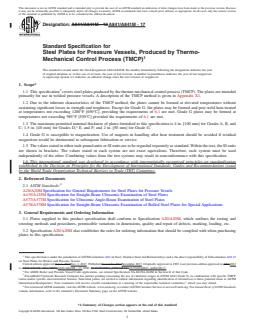
This international standard was developed in accordance with internationally recognized principles on standardization established in the Decision on Principles for the
Development of International Standards, Guides and Recommendations issued by the World Trade Organization Technical Barriers to Trade (TBT) Committee.
Designation: A841/A841M −17
Standard Specification for
Steel Plates for Pressure Vessels, Produced by Thermo-
Mechanical Control Process (TMCP)
This standard is issued under the fixed designationA841/A841M; the number immediately following the designation indicates the year
of original adoption or, in the case of revision, the year of last revision. A number in parentheses indicates the year of last reapproval.
A superscript epsilon (´) indicates an editorial change since the last revision or reapproval.
1. Scope* 1.6 This international standard was developed in accor-
2 dance with internationally recognized principles on standard-
1.1 This specification covers steel plates produced by the
ization established in the Decision on Principles for the
thermo-mechanical control process (TMCP). The plates are
Development of International Standards, Guides and Recom-
intended primarily for use in welded pressure vessels. A
mendations issued by the World Trade Organization Technical
description of the TMCP method is given in Appendix X1.
Barriers to Trade (TBT) Committee.
1.2 DuetotheinherentcharacteristicsoftheTMCPmethod,
the plates cannot be formed at elevated temperatures without
2. Referenced Documents
sustaining significant losses in strength and toughness. Except
2.1 ASTM Standards:
for Grade G, the plates may be formed and post-weld heat-
A20/A20M SpecificationforGeneralRequirementsforSteel
treated at temperatures not exceeding 1200°F [650°C], provid-
Plates for Pressure Vessels
ing the requirements of 6.1 are met. Grade G plates may be
A435/A435M Specification for Straight-Beam Ultrasonic
formed at temperatures not exceeding 985°F [530°C] provided
Examination of Steel Plates
the requirements of 6.1 are met.
A577/A577M Specification for Ultrasonic Angle-Beam Ex-
1.3 The maximum permitted nominal thickness of plates
amination of Steel Plates
furnished to this specification is 4 in. [100 mm] for Grades A,
A578/A578M Specification for Straight-Beam Ultrasonic
B, and C; 1.5 in. [40 mm] for Grades D, E, and F; and 2 in.
Examination of Rolled Steel Plates for Special Applica-
[50 mm] for Grade G.
tions
1.4 GradeGissusceptibletomagnetization.Useofmagnets
3. General Requirements and Ordering Information
in handling after heat treatment should be avoided if residual
3.1 Plates supplied to this product specification shall con-
magnetism would be detrimental to subsequent fabrication or
form to Specification A20/A20M, which outlines the testing
service.
and retesting methods and procedures, permissible variations
1.5 The values stated in either inch-pound units or SI units
in dimensions, quality and repair of defects, marking, loading,
are to be regarded separately as standard. Within the text, the
etc.
SI units are shown in brackets. The values stated in each
3.2 Specification A20/A20M also establishes the rules for
system are not exact equivalents. Therefore, each system must
ordering information that should be complied with when
be used independently of the other. Combining values from the
purchasing plates to this specification.
two systems may result in nonconformance with this specifi-
3.2.1 If the plates are to be subjected to warm forming or
cation.
post-weld heat treatment, the order must indicate the tempera-
tures and times-at-temperature that will be utilized in such
operations.(See6.1andSpecificationA20/A20M,Supplemen-
This specification is under the jurisdiction of ASTM Committee A01 on Steel,
Stainless Steel and Related Alloys and is the direct responsibility of Subcommittee
tary Requirement S3.)
A01.11 on Steel Plates for Boilers and Pressure Vessels.
3.3 In addition to the basic requirements of this
Current edition approved Nov. 1, 2017. Published November 2017. Originally
approved in 1985. Last previous edition approved in 2013 as A841/A841M – 13.
specification, certain supplementary requirements are available
DOI: 10.1520/A0841_A0841M-17.
when additional control, testing, or examination is required to
For ASME Boiler and Pressure Vessel Code applications, see related Specifi-
meet end use requirements. These include:
cation SA-841/SA-841M in Section II of that Code.
ExxonMobil Upstream Research Company has patents pending concerning the
use of chemistry ranges in ASTM A841 Grade D, in combination with specific
TMCP routes and/or specific microstructural features. Interested parties are invited For referenced ASTM standards, visit the ASTM website, www.astm.org, or
to submit information regarding identification of alternatives to these patented items contact ASTM Customer Service at service@astm.org. For Annual Book of ASTM
to ASTM International Headquarters. Your comments will receive careful consid- Standards volume information, refer to the standard’s Document Summary page on
eration at a meeting of the responsible technical committee, which you may attend. the ASTM website.
*A Summary of Changes section appears at the end of this standard
Copyright © ASTM International, 100 Barr Harbor Drive, PO Box C700, West Conshohocken, PA 19428-2959. United States
A841/A841M − 17
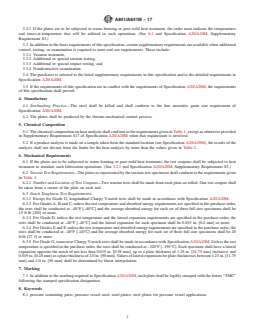
3.3.1 Vacuum treatment, 6.2.1 Number and Location of Test Coupons—Two tension
3.3.2 Additional or special tension testing, tests shall be made from each plate-as-rolled. One test coupon
3.3.3 Additional or special impact testing, and shall be taken from a corner of the plate on each end.
3.3.4 Nondestructive examination.
6.3 Notch Toughness Test Requirements:
6.3.1 Except for Grade G, longitudinal CharpyV-notch tests
3.4 The purchaser is referred to the listed supplementary
shall be made in accordance with Specification A20/A20M.
requirements in this specification and to the detailed require-
6.3.2 ForGradesA,BandC,unlessthetesttemperatureand
ments in Specification A20/A20M.
absorbed energy requirements are specified in the purchase
3.5 If the requirements of this specification are in conflict
order, the tests shall be conducted at –40°F [–40°C] and the
with the requirements of Specification A20/A20M, the require-
average absorbed energy for each set of three full size
ments of this specification shall prevail.
specimens shall be 15 ft·lb [20J] or more.
6.3.3 For Grade D, unless the test temperature and the
4. Manufacture
lateral expansion requirements are specified in the purchase
4.1 Steelmaking Practice—The steel shall be killed and
order, the tests shall be conducted at –40°F [–40°C] and the
shall conform to the fine austenitic grain size requirement of
lateralexpansionforeachspecimenshallbe0.015in.[0.4mm]
Specification A20/A20M.
or more.
6.3.4 For Grades E and F, unless the test temperature and
4.2 The plates shall be produced by the thermo-mechanical
absorbed energy requirements are specified in the purchase
control process.
order, the tests shall be conducted at –40°F [–40°C] and the
average absorbed energy for each set of three full size
5. Chemical Composition
specimens shall be 20 ft·lb [27 J] or more.
5.1 The chemical composition on heat analysis shall con-
6.3.5 For Grade G, transverse Charpy V-notch tests shall be
form to the requirements given in Table 1, except as otherwise
made in accordance with Specification A20/A20M. Unless the
provided in Supplementary Requirement S17 of Specification
test temperature is specified in the purchase order, the tests
A20/A20M when that requirement is involved.
shall be conducted at –320°F [–195°C]. Each specimen shall
5.2 If a product analysis is made on a sample taken from the
have a lateral expansion opposite the notch of not less than
standard location (see Specification A20/A20M), the results of
0.015 in. [0.38 mm], up to a plate thickness of 1.25 in. [31.75
the analysis shall not deviate from the limits for the heat
mm] inclusive; and 0.019 in. [0.48 mm] at a plate thickness of
analysis by more than the values given in Table 2.
2.0 in. [50 mm]. Values of lateral expansion for plate thick-
nesses between 1.25 in. [31.75 mm] and 2.0 in. [50 mm] shall
6. Mechanical Requirements
be determined by linear interpolation.
6.1 If the plates are to be subjected to warm forming or
7. Marking
post-weld heat treatment, the test coupons shall be subjected to
7.1 In addition to the marking required in Specification
heat treatment to simulate such fabrication operations. (See
A20/A20M, each plate shall be legibly stamped with the letters
3.2.1 and Specification A20/A20M, Supplementary Require-
“TMC” following the stamped specification designation.
ment S3.)
8. Keywords
6.2 Tension Test Requirements—The plates as represented
by the tension-test specimens shall conform to the require- 8.1 pressure containing parts; pressure vessel steel; steel
ments given in Table 3. plates; steel plates for pressure vessel applications
A841/A841M − 17
A
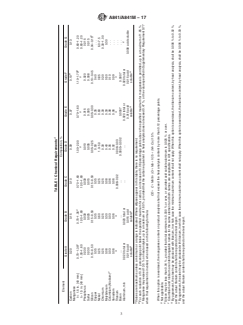
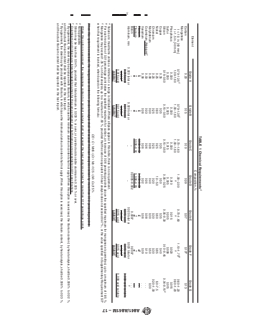
TABLE 1 Chemical Requirements
Composition, %
Element
Grade A Grade B Grade C Grade D Grade E Grade F Grade G
B
Carbon 0.20 0.15 0.10 0.09 0.07 0.10 0.13
Manganese
C C B
t # 1.5 in. [40 mm] 0.70–1.35 0.70–1.35 0.70–1.60 1.00–2.00 0.70–1.60 1.10–1.70 0.60–1.20
DDD
t > 1.5 in. [40 mm] 1.00–1.60 1.00–1.60 1.00–1.60 0.60–1.20
Phosphorus 0.030 0.030 0.030 0.010 0.015 0.020 0.015
Sulfur 0.030 0.025 0.015 0.005 0.005 0.008 0.015
E
Silicon 0.15–0.50 0.15–0.50 0.15–0.50 0.05–0.25 0.05–0.30 0.10–0.45 0.04–0.15
Copper 0.35 0.35 0.35 0.50 0.35 0.40 . . .
Nickel 0.25 0.60 0.25 1.0–5.0 0.60 0.85 6.0–7.5
Chromium 0.25 0.25 0.25 0.30 0.30 0.30 0.30–1.00
Molybdenum 0.08 0.30 0.08 0.40 0.30 0.50 0.30
F
Columbium (Niobium) 0.03 0.03 0.06 0.05 0.08 0.10 . . .
Vanadium 0.06 0.06 0.06 0.02 0.06 0.09 . . .
GG GH
Titanium 0.006–0.02 0.006–0.03 .
Boron . . . 0.0005–0.002 0.0007 0.0007 . . .
E
Aluminum, min 0.020 total or 0.020 total or . . 0.020 total or 0.020 total or
0.015 acid 0.015 acid 0.015 acid 0.015 acid 0.008 acid soluble
G G G H
soluble soluble soluble soluble
A
Values are maximums unless a minimum or a range is indicated. Where ellipses appear in this table, there is no requirement.
B
For each reduction of 0.01 percentage point below the specified maximum for carbon, an increase of 0.06 percentage points above the specified maximum for manganese is permitted, up to a maximum of 1.85 %.
C
Manganese may exceed 1.35 % on heat analysis, up to a maximum of 1.60 %, provided that the carbon equivalent on heat analysis does not exceed 0.47 %, or the value specified in Supplementary Requirement S77
when that requirement is invoked, when based on the following formula:
CE5 C1Mn/61sCr1Mo1Vd/51sNi1Cud/15%
When this option is exercised, the manganese content on product analysis shall not exceed the heat analysis content by more than 0.12 percentage points.
D
Not applicable.
E
Silicon may be less than 0.04 %, provided that total aluminum is 0.030 % or over, or provided acid soluble aluminum is 0.025 % or over.
F
Columbium and niobium are interchangeable names for the same element and both names are acceptable in A01 specifications.
G
By agreement, the steel may be produced with titanium, in which case the minimum aluminum content shall not apply. When this option is exercised, the titanium content, by heat analysis, shall be 0.006 % to 0.02 %,
and the actual titanium content shall be reported on the test report.
H
By agreement, the steel may be produced with titanium, in which case the minimum aluminum content shall not apply. When this option is exercised, the titanium content, by heat analysis, shall be 0.006 % to 0.03 %,
and the actual titanium content shall be reported on the test report.
A841/A841M − 17
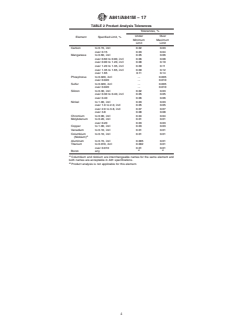
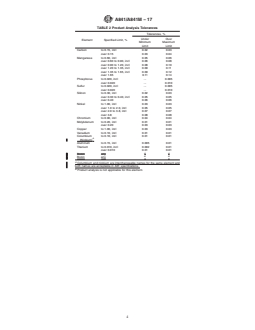
TABLE 2 Product Analysis Tolerances
Tolerances, %
Under Over
Element Specified Limit, %
Minimum Maximum
Limit Limit
Carbon to 0.15, incl 0.02 0.03
over 0.15 0.03 0.04
Manganese to 0.60, incl 0.05 0.06
over 0.60 to 0.90, incl 0.06 0.08
over 0.90 to 1.20, incl 0.08 0.10
over 1.20 to 1.35, incl 0.09 0.11
over 1.35 to 1.65, incl 0.09 0.12
over 1.65 0.11 0.14
Phosphorus to 0.020, incl . 0.005
over 0.020 . 0.010
Sulfur to 0.020, incl . 0.005
over 0.020 . 0.010
Silicon to 0.30, incl 0.02 0.03
over 0.30 to 0.40, incl 0.05 0.05
over 0.40 0.06 0.06
Nickel to 1.00, incl 0.03 0.03
over 1.0 to 2.0, incl 0.05 0.05
over 2.0 to 3.8, incl 0.07
...
This document is not an ASTM standard and is intended only to provide the user of an ASTM standard an indication of what changes have been made to the previous version. Because
it may not be technically possible to adequately depict all changes accurately, ASTM recommends that users consult prior editions as appropriate. In all cases only the current version
of the standard as published by ASTM is to be considered the official document.
Designation: A841/A841M − 13 A841/A841M − 17
Standard Specification for
Steel Plates for Pressure Vessels, Produced by Thermo-
Mechanical Control Process (TMCP)
This standard is issued under the fixed designation A841/A841M; the number immediately following the designation indicates the year
of original adoption or, in the case of revision, the year of last revision. A number in parentheses indicates the year of last reapproval.
A superscript epsilon (´) indicates an editorial change since the last revision or reapproval.
1. Scope*
1.1 This specification covers steel plates produced by the thermo-mechanical control process (TMCP). The plates are intended
primarily for use in welded pressure vessels. A description of the TMCP method is given in Appendix X1.
1.2 Due to the inherent characteristics of the TMCP method, the plates cannot be formed at elevated temperatures without
sustaining significant losses in strength and toughness. Except for Grade G, the plates may be formed and post-weld heat-treated
at temperatures not exceeding 1200°F [650°C], providing the requirements of 6.1 are met. Grade G plates may be formed at
temperatures not exceeding 985°F [530°C] provided the requirements of 6.1 are met.
1.3 The maximum permitted nominal thickness of plates furnished to this specification is 4 in. [100 mm] for Grades A, B, and
C; 1.5 in. [40 mm] for Grades D, E, and F; and 2 in. [50 mm] for Grade G.
1.4 Grade G is susceptible to magnetization. Use of magnets in handling after heat treatment should be avoided if residual
magnetism would be detrimental to subsequent fabrication or service.
1.5 The values stated in either inch-pound units or SI units are to be regarded separately as standard. Within the text, the SI units
are shown in brackets. The values stated in each system are not exact equivalents. Therefore, each system must be used
independently of the other. Combining values from the two systems may result in nonconformance with this specification.
1.6 This international standard was developed in accordance with internationally recognized principles on standardization
established in the Decision on Principles for the Development of International Standards, Guides and Recommendations issued
by the World Trade Organization Technical Barriers to Trade (TBT) Committee.
2. Referenced Documents
2.1 ASTM Standards:
A20/A20M Specification for General Requirements for Steel Plates for Pressure Vessels
A435/A435M Specification for Straight-Beam Ultrasonic Examination of Steel Plates
A577/A577M Specification for Ultrasonic Angle-Beam Examination of Steel Plates
A578/A578M Specification for Straight-Beam Ultrasonic Examination of Rolled Steel Plates for Special Applications
3. General Requirements and Ordering Information
3.1 Plates supplied to this product specification shall conform to Specification A20/A20M, which outlines the testing and
retesting methods and procedures, permissible variations in dimensions, quality and repair of defects, marking, loading, etc.
3.2 Specification A20/A20M also establishes the rules for ordering information that should be complied with when purchasing
plates to this specification.
This specification is under the jurisdiction of ASTM Committee A01 on Steel, Stainless Steel and Related Alloys and is the direct responsibility of Subcommittee A01.11
on Steel Plates for Boilers and Pressure Vessels.
Current edition approved Oct. 1, 2013Nov. 1, 2017. Published November 2013November 2017. Originally approved in 1985. Last previous edition approved in 20072013
as A841/A841M – 03a (2007).A841/A841M – 13. DOI: 10.1520/A0841_A0841M-13. 10.1520/A0841_A0841M-17.
For ASME Boiler and Pressure Vessel Code applications, see related Specification SA-841/SA-841M in Section II of that Code.
ExxonMobil Upstream Research Company has patents pending concerning the use of chemistry ranges in ASTM A841 Grade D, in combination with specific TMCP
routes and/or specific microstructural features. Interested parties are invited to submit information regarding identification of alternatives to these patented items to ASTM
International Headquarters. Your comments will receive careful consideration at a meeting of the responsible technical committee, which you may attend.
For referenced ASTM standards, visit the ASTM website, www.astm.org, or contact ASTM Customer Service at service@astm.org. For Annual Book of ASTM Standards
volume information, refer to the standard’s Document Summary page on the ASTM website.
*A Summary of Changes section appears at the end of this standard
Copyright © ASTM International, 100 Barr Harbor Drive, PO Box C700, West Conshohocken, PA 19428-2959. United States
A841/A841M − 17
3.2.1 If the plates are to be subjected to warm forming or post-weld heat treatment, the order must indicate the temperatures
and times-at-temperature that will be utilized in such operations. (See 6.1 and Specification A20/A20M, Supplementary
Requirement S3.)
3.3 In addition to the basic requirements of this specification, certain supplementary requirements are available when additional
control, testing, or examination is required to meet end use requirements. These include:
3.3.1 Vacuum treatment,
3.3.2 Additional or special tension testing,
3.3.3 Additional or special impact testing, and
3.3.4 Nondestructive examination.
3.4 The purchaser is referred to the listed supplementary requirements in this specification and to the detailed requirements in
Specification A20/A20M.
3.5 If the requirements of this specification are in conflict with the requirements of Specification A20/A20M, the requirements
of this specification shall prevail.
4. Manufacture
4.1 Steelmaking Practice—The steel shall be killed and shall conform to the fine austenitic grain size requirement of
Specification A20/A20M.
4.2 The plates shall be produced by the thermo-mechanical control process.
5. Chemical Composition
5.1 The chemical composition on heat analysis shall conform to the requirements given in Table 1, except as otherwise provided
in Supplementary Requirement S17 of Specification A20/A20M when that requirement is involved.
5.2 If a product analysis is made on a sample taken from the standard location (see Specification A20/A20M), the results of the
analysis shall not deviate from the limits for the heat analysis by more than the values given in Table 2.
6. Mechanical Requirements
6.1 If the plates are to be subjected to warm forming or post-weld heat treatment, the test coupons shall be subjected to heat
treatment to simulate such fabrication operations. (See 3.2.1 and Specification A20/A20M, Supplementary Requirement S3.)
6.2 Tension Test Requirements—The plates as represented by the tension-test specimens shall conform to the requirements given
in Table 3.
6.2.1 Number and Location of Test Coupons—Two tension tests shall be made from each plate-as-rolled. One test coupon shall
be taken from a corner of the plate on each end.
6.3 Notch Toughness Test Requirements:
6.3.1 Except for Grade G, longitudinal Charpy V-notch tests shall be made in accordance with Specification A20/A20M.
6.3.2 For Grades A, B and C, unless the test temperature and absorbed energy requirements are specified in the purchase order,
the tests shall be conducted at –40°F [–40°C] and the average absorbed energy for each set of three full size specimens shall be
15 ft·lb [20J] or more.
6.3.3 For Grade D, unless the test temperature and the lateral expansion requirements are specified in the purchase order, the
tests shall be conducted at –40°F [–40°C] and the lateral expansion for each specimen shall be 0.015 in. [0.4 mm] or more.
6.3.4 For Grades E and F, unless the test temperature and absorbed energy requirements are specified in the purchase order, the
tests shall be conducted at –40°F [–40°C] and the average absorbed energy for each set of three full size specimens shall be 20
ft·lb [27 J] or more.
6.3.5 For Grade G, transverse Charpy V-notch tests shall be made in accordance with Specification A20/A20M. Unless the test
temperature is specified in the purchase order, the tests shall be conducted at –320°F [–195°C]. Each specimen shall have a lateral
expansion opposite the notch of not less than 0.015 in. [0.38 mm], up to a plate thickness of 1.25 in. [31.75 mm] inclusive; and
0.019 in. [0.48 mm] at a plate thickness of 2.0 in. [50 mm]. Values of lateral expansion for plate thicknesses between 1.25 in. [31.75
mm] and 2.0 in. [50 mm] shall be determined by linear interpolation.
7. Marking
7.1 In addition to the marking required in Specification A20/A20M, each plate shall be legibly stamped with the letters “TMC”
following the stamped specification designation.
8. Keywords
8.1 pressure containing parts; pressure vessel steel; steel plates; steel plates for pressure vessel applications
A841/A841M − 17
A
TABLE 1 Chemical Requirements
Composition, %
Element
Grade A Grade B Grade C Grade D Grade E Grade F Grade G
B
Carbon 0.20 0.15 0.10 0.09 0.07 0.10 0.13
Manganese
C C B
t # 1.5 in. [40 mm] 0.70–1.35 0.70–1.35 0.70–1.60 1.00–2.00 0.70–1.60 1.10–1.70 0.60–1.20
D D D
t > 1.5 in. [40 mm] 1.00–1.60 1.00–1.60 1.00–1.60 0.60–1.20
Phosphorus 0.030 0.030 0.030 0.010 0.015 0.020 0.015
Sulfur 0.030 0.025 0.015 0.005 0.005 0.008 0.015
E
Silicon 0.15–0.50 0.15–0.50 0.15–0.50 0.05–0.25 0.05–0.30 0.10–0.45 0.04–0.15
Copper 0.35 0.35 0.35 0.50 0.35 0.40 . . .
Nickel 0.25 0.60 0.25 1.0–5.0 0.60 0.85 6.0–7.5
Chromium 0.25 0.25 0.25 0.30 0.30 0.30 0.30–1.00
Molybdenum 0.08 0.30 0.08 0.40 0.30 0.50 0.30
F
Columbium (Niobium) 0.03 0.03 0.06 0.05 0.08 0.10 . . .
Vanadium 0.06 0.06 0.06 0.02 0.06 0.09 . . .
F F F G
Titanium 0.006–0.02 0.006–0.03 . . .
G G G H
Titanium 0.006–0.02 0.006–0.03 . . .
Boron . . . 0.0005–0.002 0.0007 0.0007 . . .
E
Aluminum, min 0.020 total or 0.020 total or . . 0.020 total or 0.020 total or
0.015 acid 0.015 acid 0.015 acid 0.015 acid 0.008 acid soluble
F F F G
soluble soluble soluble soluble
0.015 acid 0.015 acid 0.015 acid 0.015 acid 0.008 acid soluble
G G G H
soluble soluble soluble soluble
A
Values are maximums unless a minimum or a range is indicated. Where ellipses appear in this table, there is no requirement.
B
For each reduction of 0.01 percentage point below the specified maximum for carbon, an increase of 0.06 percentage points above the specified maximum for manganese is permitted, up to a maximum of 1.85 %.
C
Manganese may exceed 1.35 % on heat analysis, up to a maximum of 1.60 %, provided that the carbon equivalent on heat analysis does not exceed 0.47 %, or the value specified in Supplementary Requirement S77
when that requirement is invoked, when based on the following formula:
CE 5C1Mn/61 Cr1Mo1V /51 Ni1Cu /15 %
s d s d
When this option is exercised, the manganese content on product analysis shall not exceed the heat analysis content by more than 0.12 percentage points.
When this option is exercised, the manganese content on product analysis shall not exceed the heat analysis content by more than 0.12 percentage points.
D
Not applicable.
E
Silicon may be less than 0.04 %, provided that total aluminum is 0.030 % or over, or provided acid soluble aluminum is 0.025 % or over.
F
Columbium and niobium are interchangeable names for the same element and both names are acceptable in A01 specifications.
G
By agreement, the steel may be produced with titanium, in which case the minimum aluminum content shall not apply. When this option is exercised, the titanium content, by heat analysis, shall be 0.006 % to 0.02 %,
and the actual titanium content shall be reported on the test report.
H
By agreement, the steel may be produced with titanium, in which case the minimum aluminum content shall not apply. When this option is exercised, the titanium content, by heat analysis, shall be 0.006 % to 0.03 %,
and the actual titanium content shall be reported on the test report.
A841/A841M − 17
TABLE 2 Product Analysis Tolerances
Tolerances, %
Under Over
Element Specified Limit, %
Minimum Maximum
Limit Limit
Carbon to 0.15, incl 0.02 0.03
over 0.15 0.03 0.04
Manganese to 0.60, incl 0.05 0.06
over 0.60 to 0.90, incl 0.06 0.08
over 0.90 to 1.20, incl 0.08 0.10
over 1.20 to 1.35, incl 0.09 0.11
over 1.35 to 1.65, incl 0.09 0.12
over 1.65 0.11 0.14
Phosphorus to 0.020, incl . 0.005
over 0.020 . 0.010
Sulfur to 0.020, incl . 0.005
over 0.020 . 0.010
Silicon to 0.30, incl 0.02 0.03
over 0.30 to 0.40, incl 0.05 0.05
over 0.40 0.06 0.06
Nickel to 1.00, incl 0.03 0.03
over 1.0 to 2.0, incl 0.05 0.05
over 2.0 to 3.8, incl 0.07 0.07
over 3.8 0.08 0.08
Chromium to 0.90, incl 0.04 0.04
Molybdenum to 0.20, incl 0.01 0.01
over 0.20 0.03 0.03
Copper to 1.00, incl 0.03 0.03
Vanadium to 0.10, incl 0.01 0.01
Columbium to 0.10, incl 0.01 0.01
A
(Niobium)
Aluminum to 0.15, incl
...
Questions, Comments and Discussion
Ask us and Technical Secretary will try to provide an answer. You can facilitate discussion about the standard in here.
Loading comments...