

ASTM A693-22
(Specification)Standard Specification for Precipitation-Hardening Stainless and Heat-Resisting Steel Plate, Sheet, and Strip
General Information
- Abstract
ABSTRACT
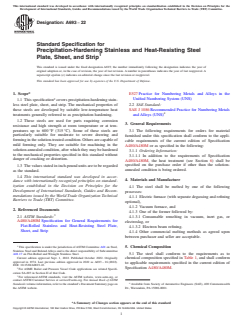
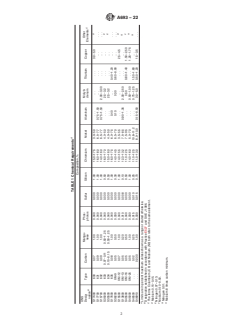
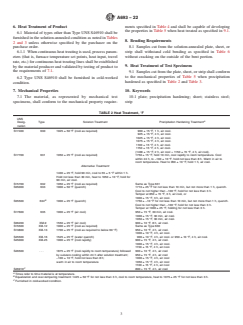
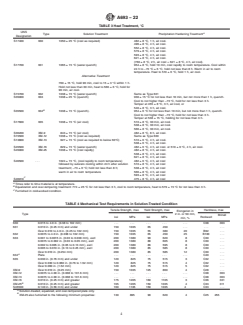
This guide covers standard specification for precipitation-hardening stainless steel plate, sheet, and strip. The mechanical properties of these steels shall be developed by suitable low-temperature heat treatments or precipitation hardening. The steel shall conform to the required chemical composition for carbon, manganese, phosphorus, sulfur, silicon, chromium, nickel, aluminum, molybdenum, titanium, copper, and other elements. Material of types other than Type UNS S46910 shall be furnished in solution-annealed condition while Type UNS S46910 shall be furnished in cold-worked condition. The steel shall conform to the required mechanical properties such as tensile strength, yield strength, elongation, and hardness. Samples cut from the solution-annealed plate, sheet, or strip shall withstand cold bending without cracking on the outside of the bent portion. Samples cut from the solution-annealed plate, sheet, or strip shall conform to the specified mechanical properties when precipitation hardened.
SCOPE
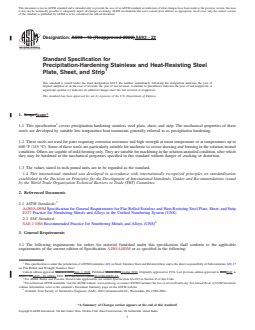
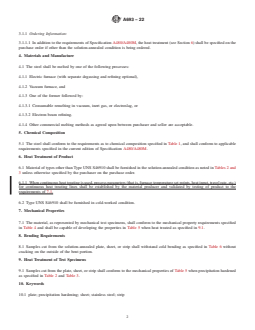
1.1 This specification2 covers precipitation-hardening stainless steel plate, sheet, and strip. The mechanical properties of these steels are developed by suitable low-temperature heat treatments generally referred to as precipitation hardening.
1.2 These steels are used for parts requiring corrosion resistance and high strength at room temperature or at temperatures up to 600 °F (315 °C). Some of these steels are particularly suitable for moderate to severe drawing and forming in the solution-treated condition. Others are capable of mild forming only. They are suitable for machining in the solution-annealed condition, after which they may be hardened to the mechanical properties specified in this standard without danger of cracking or distortion.
1.3 The values stated in inch-pound units are to be regarded as the standard.
1.4 This international standard was developed in accordance with internationally recognized principles on standardization established in the Decision on Principles for the Development of International Standards, Guides and Recommendations issued by the World Trade Organization Technical Barriers to Trade (TBT) Committee.
- Status
- Published
- Publication Date
- 31-Aug-2022
- Technical Committee
- A01 - Steel, Stainless Steel and Related Alloys
- Drafting Committee
- A01.17 - Flat-Rolled and Wrought Stainless Steel
Buy Documents
ASTM A693-22 - Standard Specification for Precipitation-Hardening Stainless and Heat-Resisting Steel Plate, Sheet, and Strip
REDLINE ASTM A693-22 - Standard Specification for Precipitation-Hardening Stainless and Heat-Resisting Steel Plate, Sheet, and Strip
Overview
ASTM A693-22 is the internationally recognized standard specification for precipitation-hardening stainless and heat-resisting steel plate, sheet, and strip. Published by ASTM International, this standard defines requirements for chemical composition, mechanical properties, heat treatment processes, and product forms. Precipitation-hardening stainless steels covered by ASTM A693-22 are engineered to develop enhanced mechanical properties such as tensile strength, yield strength, and hardness through controlled low-temperature heat treatments. These alloys provide a combination of high strength and corrosion resistance, making them suitable for demanding applications in aerospace, energy, and industrial sectors.
Key Topics
- Scope and Coverage
- Applies to flat-rolled products: plate, sheet, and strip made from precipitation-hardening stainless and heat-resisting steels.
- Covers multiple grades with specific chemical and mechanical requirements.
- Mechanical properties are established through solution-annealing and precipitation-hardening treatments, or cold working (for specific grades).
- Chemical Composition
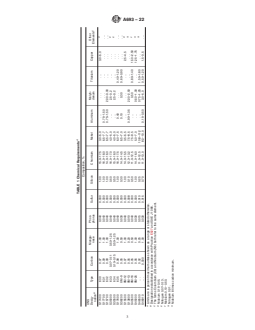
- Specifies allowable limits and ranges for key elements including carbon, manganese, phosphorus, sulfur, silicon, chromium, nickel, aluminum, molybdenum, titanium, copper, and others.
- Heat Treatment
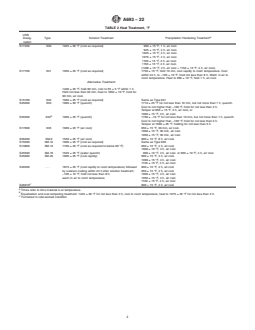
- Solution annealing and precipitation hardening are required for development of specified mechanical properties.
- Special requirements for certain grades, such as being furnished in the cold-worked condition.
- Mechanical Properties
- Defines minimum requirements for tensile strength, yield strength, elongation, and hardness (Rockwell or Brinell scales).
- Includes mandatory bend tests to ensure satisfactory forming and ductility.
- Manufacturing Processes
- Steel may be produced by electric or vacuum furnaces and can include further refining or re-melting steps.
- Continuous heat treating is permitted, with validation required by mechanical testing.
Applications
ASTM A693-22 precipitation-hardening stainless steels are used in parts that require:
- High strength: Maintained at room temperature and up to 600°F (315°C), suitable for load-bearing and structural components.
- Corrosion resistance: Ideal for environments where resistance to oxidation and corrosive agents is critical.
- Forming and Machining: Some grades are particularly well-suited for moderate to severe forming in the solution-treated condition, and can be machined before final precipitation hardening.
- Aerospace and Defense: Widely used for fasteners, springs, and structural elements in the aerospace industry due to their excellent strength-to-weight ratio and reliability.
- Industrial and Chemical Processing: Utilized for valves, pump components, and processing equipment where both mechanical integrity and corrosion performance are required.
- Energy Sector: Used in power plant equipment and oil & gas applications for their durability and resistance to high temperatures.
Related Standards
- ASTM A480/A480M: General requirements for flat-rolled stainless and heat-resisting steel plate, sheet, and strip.
- ASTM E527: Practice for numbering metals and alloys in the Unified Numbering System (UNS).
- SAE J 1086: Recommended practice for numbering metals and alloys.
- ASME SA-693: Parallel specification for boiler and pressure vessel code applications.
Practical Value
Compliance with ASTM A693-22 ensures manufacturers and users receive precipitation-hardening stainless steel products that meet rigorous international quality, strength, and durability criteria. Organizations implementing this standard benefit from improved product performance, reduced risk of failure in demanding environments, and efficient qualification for global supply chains and regulated industries. This specification is essential for engineers, procurement specialists, fabricators, and quality control professionals working with advanced stainless and heat-resistant steel alloys.
Relations
- Effective Date
- 01-Nov-2023
- Effective Date
- 01-Sep-2019
- Effective Date
- 01-Sep-2018
- Effective Date
- 01-Nov-2017
- Effective Date
- 01-Dec-2016
- Effective Date
- 15-Apr-2016
- Effective Date
- 01-Feb-2016
- Effective Date
- 01-Sep-2015
- Effective Date
- 01-May-2014
- Effective Date
- 01-Mar-2014
- Effective Date
- 01-Nov-2013
- Effective Date
- 01-Oct-2013
- Effective Date
- 01-May-2013
- Effective Date
- 01-Apr-2012
- Effective Date
- 01-Dec-2011
Buy Documents
ASTM A693-22 - Standard Specification for Precipitation-Hardening Stainless and Heat-Resisting Steel Plate, Sheet, and Strip
REDLINE ASTM A693-22 - Standard Specification for Precipitation-Hardening Stainless and Heat-Resisting Steel Plate, Sheet, and Strip
Get Certified
Connect with accredited certification bodies for this standard

Element Materials Technology
Materials testing and product certification.

Inštitut za kovinske materiale in tehnologije
Institute of Metals and Technology. Materials testing, metallurgical analysis, NDT.
Sponsored listings
Frequently Asked Questions
ASTM A693-22 is a technical specification published by ASTM International. Its full title is "Standard Specification for Precipitation-Hardening Stainless and Heat-Resisting Steel Plate, Sheet, and Strip". This standard covers: ABSTRACT This guide covers standard specification for precipitation-hardening stainless steel plate, sheet, and strip. The mechanical properties of these steels shall be developed by suitable low-temperature heat treatments or precipitation hardening. The steel shall conform to the required chemical composition for carbon, manganese, phosphorus, sulfur, silicon, chromium, nickel, aluminum, molybdenum, titanium, copper, and other elements. Material of types other than Type UNS S46910 shall be furnished in solution-annealed condition while Type UNS S46910 shall be furnished in cold-worked condition. The steel shall conform to the required mechanical properties such as tensile strength, yield strength, elongation, and hardness. Samples cut from the solution-annealed plate, sheet, or strip shall withstand cold bending without cracking on the outside of the bent portion. Samples cut from the solution-annealed plate, sheet, or strip shall conform to the specified mechanical properties when precipitation hardened. SCOPE 1.1 This specification2 covers precipitation-hardening stainless steel plate, sheet, and strip. The mechanical properties of these steels are developed by suitable low-temperature heat treatments generally referred to as precipitation hardening. 1.2 These steels are used for parts requiring corrosion resistance and high strength at room temperature or at temperatures up to 600 °F (315 °C). Some of these steels are particularly suitable for moderate to severe drawing and forming in the solution-treated condition. Others are capable of mild forming only. They are suitable for machining in the solution-annealed condition, after which they may be hardened to the mechanical properties specified in this standard without danger of cracking or distortion. 1.3 The values stated in inch-pound units are to be regarded as the standard. 1.4 This international standard was developed in accordance with internationally recognized principles on standardization established in the Decision on Principles for the Development of International Standards, Guides and Recommendations issued by the World Trade Organization Technical Barriers to Trade (TBT) Committee.
ABSTRACT This guide covers standard specification for precipitation-hardening stainless steel plate, sheet, and strip. The mechanical properties of these steels shall be developed by suitable low-temperature heat treatments or precipitation hardening. The steel shall conform to the required chemical composition for carbon, manganese, phosphorus, sulfur, silicon, chromium, nickel, aluminum, molybdenum, titanium, copper, and other elements. Material of types other than Type UNS S46910 shall be furnished in solution-annealed condition while Type UNS S46910 shall be furnished in cold-worked condition. The steel shall conform to the required mechanical properties such as tensile strength, yield strength, elongation, and hardness. Samples cut from the solution-annealed plate, sheet, or strip shall withstand cold bending without cracking on the outside of the bent portion. Samples cut from the solution-annealed plate, sheet, or strip shall conform to the specified mechanical properties when precipitation hardened. SCOPE 1.1 This specification2 covers precipitation-hardening stainless steel plate, sheet, and strip. The mechanical properties of these steels are developed by suitable low-temperature heat treatments generally referred to as precipitation hardening. 1.2 These steels are used for parts requiring corrosion resistance and high strength at room temperature or at temperatures up to 600 °F (315 °C). Some of these steels are particularly suitable for moderate to severe drawing and forming in the solution-treated condition. Others are capable of mild forming only. They are suitable for machining in the solution-annealed condition, after which they may be hardened to the mechanical properties specified in this standard without danger of cracking or distortion. 1.3 The values stated in inch-pound units are to be regarded as the standard. 1.4 This international standard was developed in accordance with internationally recognized principles on standardization established in the Decision on Principles for the Development of International Standards, Guides and Recommendations issued by the World Trade Organization Technical Barriers to Trade (TBT) Committee.
ASTM A693-22 is classified under the following ICS (International Classification for Standards) categories: 77.140.20 - Stainless steels; 77.140.50 - Flat steel products and semi-products. The ICS classification helps identify the subject area and facilitates finding related standards.
ASTM A693-22 has the following relationships with other standards: It is inter standard links to ASTM A480/A480M-23b, ASTM A480/A480M-19, ASTM A480/A480M-18, ASTM A480/A480M-17, ASTM A480/A480M-16b, ASTM A480/A480M-16a, ASTM A480/A480M-16, ASTM A480/A480M-15, ASTM A480/A480M-14a, ASTM A480/A480M-14, ASTM A480/A480M-13b, ASTM A480/A480M-13a, ASTM A480/A480M-13, ASTM A480/A480M-12, ASTM A480/A480M-11b. Understanding these relationships helps ensure you are using the most current and applicable version of the standard.
ASTM A693-22 is available in PDF format for immediate download after purchase. The document can be added to your cart and obtained through the secure checkout process. Digital delivery ensures instant access to the complete standard document.
Standards Content (Sample)
This international standard was developed in accordance with internationally recognized principles on standardization established in the Decision on Principles for the
Development of International Standards, Guides and Recommendations issued by the World Trade Organization Technical Barriers to Trade (TBT) Committee.
Designation:A693 −22
Standard Specification for
Precipitation-Hardening Stainless and Heat-Resisting Steel
Plate, Sheet, and Strip
This standard is issued under the fixed designation A693; the number immediately following the designation indicates the year of
original adoption or, in the case of revision, the year of last revision. A number in parentheses indicates the year of last reapproval. A
superscript epsilon (´) indicates an editorial change since the last revision or reapproval.
This standard has been approved for use by agencies of the U.S. Department of Defense.
1. Scope* E527 Practice for Numbering Metals and Alloys in the
2 Unified Numbering System (UNS)
1.1 This specification covers precipitation-hardening stain-
less steel plate, sheet, and strip. The mechanical properties of 2.2 SAE Standard:
these steels are developed by suitable low-temperature heat SAE J 1086 Recommended Practice for Numbering Metals
treatments generally referred to as precipitation hardening. and Alloys (UNS)
1.2 These steels are used for parts requiring corrosion
3. General Requirements
resistance and high strength at room temperature or at tem-
peratures up to 600 °F (315 °C). Some of these steels are
3.1 The following requirements for orders for material
particularly suitable for moderate to severe drawing and
furnished under this specification shall conform to the appli-
forming in the solution-treated condition. Others are capable of
cable requirements of the current edition of Specification
mild forming only. They are suitable for machining in the
A480/A480M or as specified in the following:
solution-annealed condition, after which they may be hardened
3.1.1 Ordering Information:
to the mechanical properties specified in this standard without
3.1.1.1 In addition to the requirements of Specification
danger of cracking or distortion.
A480/A480M, the heat treatment (see Section 6) shall be
specified on the purchase order if other than the solution-
1.3 The values stated in inch-pound units are to be regarded
annealed condition is being ordered.
as the standard.
1.4 This international standard was developed in accor-
4. Materials and Manufacture
dance with internationally recognized principles on standard-
ization established in the Decision on Principles for the
4.1 The steel shall be melted by one of the following
Development of International Standards, Guides and Recom-
processes:
mendations issued by the World Trade Organization Technical
4.1.1 Electric furnace (with separate degassing and refining
Barriers to Trade (TBT) Committee.
optional),
4.1.2 Vacuum furnace, and
2. Referenced Documents
4.1.3 One of the former followed by:
2.1 ASTM Standards:
4.1.3.1 Consumable remelting in vacuum, inert gas, or
A480/A480M Specification for General Requirements for
electroslag, or
Flat-Rolled Stainless and Heat-Resisting Steel Plate,
4.1.3.2 Electron beam refining.
Sheet, and Strip
4.1.4 Other commercial melting methods as agreed upon
between purchaser and seller are acceptable.
This specification is under the jurisdiction of ASTM Committee A01 on Steel, 5. Chemical Composition
Stainless Steel and Related Alloys and is the direct responsibility of Subcommittee
5.1 The steel shall conform to the requirements as to
A01.17 on Flat-Rolled and Wrought Stainless Steel.
Current edition approved Sept. 1, 2022. Published October 2022. Originally
chemical composition specified in Table 1, and shall conform
approved in 1974. Last previous edition approved in 2022 as A693 – 16 (2022).
to applicable requirements specified in the current edition of
DOI: 10.1520/A0693-22.
Specification A480/A480M.
For ASME Boiler and Pressure Vessel Code applications see related Specifi-
cation SA-693 in Section II of that Code.
For referenced ASTM standards, visit the ASTM website, www.astm.org, or
contact ASTM Customer Service at service@astm.org. For Annual Book of ASTM
Standards volume information, refer to the standard’s Document Summary page on Available from Society of Automotive Engineers (SAE), 400 Commonwealth
the ASTM website. Dr., Warrendale, PA 15096-0001.
*A Summary of Changes section appears at the end of this standard
Copyright © ASTM International, 100 Barr Harbor Drive, PO Box C700, West Conshohocken, PA 19428-2959. United States
A693−22
A
TABLE 1 Chemical Requirements
Composition, %
UNS
Manga- Phos- Molyb- Other
Desig- Type Carbon Sulfur Silicon Chromium Nickel Aluminum Titanium Copper
C
nese phorus denum Elements
B
nation
D
S17400 630 0.07 1.00 0.040 0.030 1.00 15.0–17.5 3.0–5.0 . . . . . . . . . 3.0–5.0
S17700 631 0.09 1.00 0.040 0.030 1.00 16.0–18.0 6.5–7.7 0.75–1.50 . . . . . . . . . . . .
S15700 632 0.09 1.00 0.040 0.030 1.00 14.0–16.0 6.5–7.7 0.75–1.50 2.00–3.00 . . . . . . . . .
E
S35000 633 0.07–0.11 0.50–1.25 0.040 0.030 0.50 16.0–17.0 4.0–5.0 . . . 2.5–3.2 . . . . . .
E
S35500 634 0.10–0.15 0.50–1.25 0.040 0.030 0.50 15.0–16.0 4.0–5.0 . . . 2.5–3.2 . . . . . .
S17600 635 0.08 1.00 0.040 0.030 1.00 16.0–17.5 6.0–7.5 0.40 . . . 0.40–1.20 . . . . . .
S36200 XM-9 0.05 0.50 0.030 0.030 0.30 14.0–14.5 6.5–7.0 0.10 0.30 0.60–0.90 . . . . . .
D
S15500 XM-12 0.07 1.00 0.040 0.030 1.00 14.0–15.5 3.5–5.5 . . . . . . . . . 2.5–4.5
G
S13800 XM-13 0.05 0.20 0.010 0.008 0.10 12.3–13.2 7.5–8.5 0.90–1.35 2.00–2.50 . . . . . .
F
S45500 XM-16 0.05 0.50 0.040 0.030 0.50 11.0–12.5 7.5–9.5 . . . 0.50 0.80–1.40 1.50–2.50
H
S45000 XM-25 0.05 1.00 0.030 0.030 1.00 14.0–16.0 5.0–7.0 . . . 0.50–1.00 . . . 1.25–1.75
G
S46500 . . . 0.02 0.25 0.015 0.010 0.25 11.0–12.5 10.8–11.2 . . . 0.75–1.25 1.50–1.80 . . .
S46910 . . . 0.030 1.00 0.030 0.015 0.70 11.0–13.0 8.0–10.0 0.15–0.50 3.0–5.0 0.50–1.20 1.5–3.5 . . .
A
Limits are in percent maximum unless shown as a range or stated otherwise.
B
Designation established in accordance with Practice E527 and SAE J 1086.
C
The terms Columbium (Cb) and Niobium (Nb) both refer to the same element.
D
Niobium 0.15–0.45.
E
Nitrogen 0.07–0.13.
F
Niobium 0.10–0.50.
G
Nitrogen 0.01.
H
Niobium 8 times carbon minimum.
A693−22
6. Heat Treatment of Product ments specified in Table 4 and shall be capable of developing
the properties in Table 5 when heat treated as specified in 9.1.
6.1 Material of types other than Type UNS S46910 shall be
furnished in the solution-annealed condition as noted in Tables
8. Bending Requirements
2 and 3 unless otherwise specified by the purchaser on the
8.1 Samples cut from the solution-annealed plate, sheet, or
purchase order.
strip shall withstand cold bending as specified in Table 6
6.1.1 When continuous heat treating is used, process param-
without cracking on the outside of the bent portion.
eters (that is, furnace temperature set points, heat input, travel
rate, etc.) for continuous heat treating lines shall be established
9. Heat Treatment of Test Specimens
by the material producer and validated by testing of product to
the requirements of 7.1.
9.1 Samples cut from the plate, sheet, or strip shall conform
to the mechanical properties of Table 5 when precipitation
6.2 Type UNS S46910 shall be furnished in cold-worked
hardened as specified in Table 2 and Table 3.
condition.
7. Mechanical Properties 10. Keywords
7.1 The material, as represented by mechanical test 10.1 plate; precipitation hardening; sheet; stainless steel;
specimens, shall conform to the mechanical property require- strip
TABLE 2 Heat Treatment, °F
UNS
A
Desig- Type Solution Treatment Precipitation Hardening Treatment
nation
S17400 630 1925 ± 50 °F (cool as required) 900 ± 15 °F, 1 h, air cool.
925 ± 15 °F, 4 h, air cool.
1025 ± 15 °F, 4 h, air cool.
1075 ± 15 °F, 4 h, air cool.
1100 ± 15 °F, 4 h, air cool.
1150 ± 15 °F, 4 h, air cool.
(1400 ± 15 °F, 2 h, air cool + 1150 ± 15 °F, 4 h, air cool).
S17700 631 1950 ± 25 °F (cool as required) 1750 ± 15 °F, hold 10 min, cool rapidly to room temperature. Cool
within 24 h, to −100 ± 10 °F, hold not less than 8 h. Warm in air to
room temperature. Heat to 950 ± 10 °F, hold 1 h, air cool.
Alternative Treatment:
1400 ± 25 °F, hold 90 min, cool to 55 ± 5 °F within 1 h.
Hold not less than 30 min, heat to 1050 ± 10 °F, hold for
90 min, air cool.
S15700 632 1950 ± 25 °F (cool as required) Same as Type 631
S35000 633 1900 ± 50 °F (quench) 1710 ± 25 °F for not less than 10 min, but not more than 1 h, quench.
Cool to not higher than –100 °F, hold for not less than 3 h.
Temper at 850 ± 15 °F, 3 h, air cool, or
1000 ± 15 °F, 3 h, air cool.
B
S35500 634 1900 ± 25 °F (quench) 1750 ± −10 °F for not less than 10 min, but not more than 1 h, quench.
Cool to not higher than −100 °F, hold for not less than 3 h.
Temper at 1000 ± 25 °F, holding for not less than 3 h.
S17600 635 1900 ± 25 °F (air cool) 950 ± 15 °F, 30 min, air cool.
1000 ± 15 °F, 30 min, air cool.
1050 ± 15 °F, 30 min, air cool.
S36200 XM-9 1550 ± 25 °F (air cool) 900 ± 10 °F, 8 h, air cool.
S15500 XM-12 1900 ± 25 °F (cool as required) Same as Type 630
S13800 XM-13 1700 ± 25 °F (cool as required to below 60 °F) 950 ± 10 °F, 4 h, air cool.
1000 ± 10 °F, 4 h, air cool.
S45500 XM-16 1525 ± 25 °F (water quench) 900 ± 10 °F, 4 h, air cool. or 950 ± 10 °F, 4 h, air cool.
S45000 XM-25 1900 ± 25 °F (cool rapidly) 900 ± 15 °F, 4 h, air cool.
1000 ± 15 °F, 4 h, air cool.
1150 ± 15 °F, 4 h, air cool.
S46500 . . . 1875 ± 25 °F (cool rapidly to room temperature) followed 900 ± 10 °F, 4 h, air cool
by subzero cooling within 24 h after solution treatment; 950 ± 15 °F, 4 h, air cool
–100 ± 10 °F, hold not less than 8 h; 1000 ± 15 °F, 4 h, air cool
warm in air to room temperature 1050 ± 15 °F, 4 h, air cool
1100 ± 15 °F, 4 h, air cool
C
S46910 890 + 15 °F, 4 h, air cool
A
Times refer to time material is at temperature.
B
Equalization and over-tempering treatment: 1425 ± 50 °F for not less than 3 h, cool to room temperature, heat to 1075 ± 25 °F for not less than 3 h.
C
Furnished in cold-worked condition.
A693−22
TABLE 3 Heat Treatment, °C
UNS
A
Type Solution Treatment Precipitation Hardening Treatment
Designation
S17400 630 1050 ± 25 °C (cool as required) 482 ± 8 °C, 1 h, air cool.
496 ± 8 °C, 4 h, air cool.
552 ± 8 °C, 4 h, air cool.
579 ± 8 °C, 4 h, air cool.
593 ± 8 °C, 4 h, air cool.
621 ± 8 °C, 4 h, air cool.
(760 ± 8 °C, 2 h, air cool + 621 ± 8 °C, 4 h, air cool).
S17700 631 1065 ± 15 °C (water quench) 954 ± 8 °C, hold 10 min, cool rapidly to room temperature. Cool within
24 h to −73 °C ± 6 °C, hold not less than 8 h. Warm in air to room
temperature. Heat to 510 ± 6 °C, hold 1 h, air cool.
Alternative Treatment
760 ± 15 °C, hold 90 min, cool to 15 ± 3 °C within 1 h.
Hold not less than 30 min, heat to 566 ± 6 °C, hold for
90 min, air cool.
S15700 632 1038 ± 15 °C (water quench) Same as Type 631
S35000 633 1038 ± 25 °C (quench) 930 ± 15 °C for not less than 10 min, but not more than 1 h, quench.
Cool to not higher than –73 °C, hold for not less than 3 h.
Temper at 455 ± 8 °C, 3 h, air cool, or
540 ± 8 °C, 3 h, air cool.
B
S35500 634 1038 ± 15 °C (quench). 954 ± 6 °C for not less than 10 min, but not more than 1 h, quench.
Cool to not higher than −73 °C, hold for not less than 3 h.
Temper at 538 ± 15 °C, holding for not less than 3 h.
S17600 635 1038 ± 15 °C (air cool) 510 ± 8 °C, 30 min, air cool.
538 ± 8 °C, 30 min, air cool.
566 ± 8 °C, 30 min, air cool.
S36200 XM-9 843 ± 15 °C (air cool) 482 ± 8 °C, 8 h, air cool.
S15500 XM-12 1038 ± 15 °C (cool as required) Same as Type 630
S13800 XM-13 927 ± 15 °C (cool as required to below 60°C) 510 ± 6 °C, 4 h, air cool.
538 ± 6 °C, 4 h, air cool.
S45500 XM-16 829 ± 15 °C (water quench) 482 ± 6 °C, 4 h, air cool. or 510 ± 6 °C, 4 h, air cool.
S45000 XM-25 1038 ± 15 °C (cool rapidly) 482 ± 8 °C, 4 h, air cool.
538 ± 8 °C, 4 h, air cool.
621 ± 8 °C, 4 h, air cool.
S46500 . . . 1024 ± 15 °C, (cool rapidly to room temperature) 482 ± 6 °C, 4 h, air cool
followed by subzero cooling within 24 h after solution 510 ± 8 °C, 4 h, air cool
treatment; –73 ± 6 °C; hold not less than 8 h; 538 ± 8 °C, 4 h, air cool
warm in air to room temperature 566 ± 8 °C, 4 h, air cool
593 ± 8 °C, 4 h, air cool
C
S46910 475 + 8 °C, 4 h, air cool
A
Times refer to time material is at temperature.
B
Equalization and over-tempering treatment: 774 ± 25 °C for not less than 3 h, cool to room temperature, heat to 579 ± 15 °C for not less than 3 h.
C
Furnished in cold-worked condition.
TABLE 4 Mechanical Test Requirements in Solution-Treated Condition
Tensile Strength, max Yield Strength, max Hardness, max
Elongation in
Type 2 in. or 50 mm,
Brinell
ksi MPa ksi MPa Rockwell
min, %
630 0.015 to 4.0 in. (0.38 to 102 mm) . . . . . . . . . . . . . . . C38 363
631 0.010 in. (0.25 mm) and under 150 1035 65 450 . . .
Over 0.010 to 4.0 in. (0.25 to 102 mm) 150 1035 55 380 20 B92 .
632 0.0015 to 4.0 in. (0.038 to 102 mm) 150 1035 65 450 25 B100 . . .
633 0.001 to 0.0015 in. (0.03 to 0.038 mm), excl 200 1380 90 620 8 C30 . . .
0.0015 to 0.002 in. (0.03 to 0.05 mm), excl 20
...
This document is not an ASTM standard and is intended only to provide the user of an ASTM standard an indication of what changes have been made to the previous version. Because
it may not be technically possible to adequately depict all changes accurately, ASTM recommends that users consult prior editions as appropriate. In all cases only the current version
of the standard as published by ASTM is to be considered the official document.
Designation: A693 − 16 (Reapproved 2022) A693 − 22
Standard Specification for
Precipitation-Hardening Stainless and Heat-Resisting Steel
Plate, Sheet, and Strip
This standard is issued under the fixed designation A693; the number immediately following the designation indicates the year of
original adoption or, in the case of revision, the year of last revision. A number in parentheses indicates the year of last reapproval. A
superscript epsilon (´) indicates an editorial change since the last revision or reapproval.
This standard has been approved for use by agencies of the U.S. Department of Defense.
1. Scope Scope*
1.1 This specification covers precipitation-hardening stainless steel plate, sheet, and strip. The mechanical properties of these
steels are developed by suitable low-temperature heat treatments generally referred to as precipitation hardening.
1.2 These steels are used for parts requiring corrosion resistance and high strength at room temperature or at temperatures up to
600 °F (315 °C). Some of these steels are particularly suitable for moderate to severe drawing and forming in the solution-treated
condition. Others are capable of mild forming only. They are suitable for machining in the solution-annealed condition, after which
they may be hardened to the mechanical properties specified in this standard without danger of cracking or distortion.
1.3 The values stated in inch-pound units are to be regarded as the standard.
1.4 This international standard was developed in accordance with internationally recognized principles on standardization
established in the Decision on Principles for the Development of International Standards, Guides and Recommendations issued
by the World Trade Organization Technical Barriers to Trade (TBT) Committee.
2. Referenced Documents
2.1 ASTM Standards:
A480/A480M Specification for General Requirements for Flat-Rolled Stainless and Heat-Resisting Steel Plate, Sheet, and Strip
E527 Practice for Numbering Metals and Alloys in the Unified Numbering System (UNS)
2.2 SAE Standard:
SAE J 1086 Recommended Practice for Numbering Metals and Alloys (UNS)
3. General Requirements
3.1 The following requirements for orders for material furnished under this specification shall conform to the applicable
requirements of the current edition of Specification A480/A480M or as specified in the following:
This specification is under the jurisdiction of ASTM Committee A01 on Steel, Stainless Steel and Related Alloys and is the direct responsibility of Subcommittee A01.17
on Flat-Rolled and Wrought Stainless Steel.
Current edition approved March 1, 2022Sept. 1, 2022. Published March 2022October 2022. Originally approved in 1974. Last previous edition approved in 20162022 as
A693 – 16.A693 – 16 (2022). DOI: 10.1520/A0693-16R22.10.1520/A0693-22.
For ASME Boiler and Pressure Vessel Code applications see related Specification SA-693 in Section II of that Code.
For referenced ASTM standards, visit the ASTM website, www.astm.org, or contact ASTM Customer Service at service@astm.org. For Annual Book of ASTM Standards
volume information, refer to the standard’s Document Summary page on the ASTM website.
Available from Society of Automotive Engineers (SAE), 400 Commonwealth Dr., Warrendale, PA 15096-0001.
*A Summary of Changes section appears at the end of this standard
Copyright © ASTM International, 100 Barr Harbor Drive, PO Box C700, West Conshohocken, PA 19428-2959. United States
A693 − 22
3.1.1 Ordering Information:
3.1.1.1 In addition to the requirements of Specification A480/A480M, the heat treatment (see Section 6) shall be specified on the
purchase order if other than the solution-annealed condition is being ordered.
4. Materials and Manufacture
4.1 The steel shall be melted by one of the following processes:
4.1.1 Electric furnace (with separate degassing and refining optional),
4.1.2 Vacuum furnace, and
4.1.3 One of the former followed by:
4.1.3.1 Consumable remelting in vacuum, inert gas, or electroslag, or
4.1.3.2 Electron beam refining.
4.1.4 Other commercial melting methods as agreed upon between purchaser and seller are acceptable.
5. Chemical Composition
5.1 The steel shall conform to the requirements as to chemical composition specified in Table 1, and shall conform to applicable
requirements specified in the current edition of Specification A480/A480M.
6. Heat Treatment of Product
6.1 Material of types other than Type UNS S46910 shall be furnished in the solution-annealed condition as noted in Tables 2 and
3 unless otherwise specified by the purchaser on the purchase order.
6.1.1 When continuous heat treating is used, process parameters (that is, furnace temperature set points, heat input, travel rate, etc.)
for continuous heat treating lines shall be established by the material producer and validated by testing of product to the
requirements of 7.1.
6.2 Type UNS S46910 shall be furnished in cold-worked condition.
7. Mechanical Properties
7.1 The material, as represented by mechanical test specimens, shall conform to the mechanical property requirements specified
in Table 4 and shall be capable of developing the properties in Table 5 when heat treated as specified in 9.1.
8. Bending Requirements
8.1 Samples cut from the solution-annealed plate, sheet, or strip shall withstand cold bending as specified in Table 6 without
cracking on the outside of the bent portion.
9. Heat Treatment of Test Specimens
9.1 Samples cut from the plate, sheet, or strip shall conform to the mechanical properties of Table 5 when precipitation hardened
as specified in Table 2 and Table 3.
10. Keywords
10.1 plate; precipitation hardening; sheet; stainless steel; strip
A693 − 22
A
TABLE 1 Chemical Requirements
Composition, %
UNS
Manga- Phos- Molyb- Other
Desig- Type Carbon Sulfur Silicon Chromium Nickel Aluminum Titanium Copper
C
nese phorus denum Elements
B
nation
D
S17400 630 0.07 1.00 0.040 0.030 1.00 15.0–17.5 3.0–5.0 . . . . . . . . . 3.0–5.0
S17700 631 0.09 1.00 0.040 0.030 1.00 16.0–18.0 6.5–7.7 0.75–1.50 . . . . . . . . . . . .
S15700 632 0.09 1.00 0.040 0.030 1.00 14.0–16.0 6.5–7.7 0.75–1.50 2.00–3.00 . . . . . . . . .
E
S35000 633 0.07–0.11 0.50–1.25 0.040 0.030 0.50 16.0–17.0 4.0–5.0 . . . 2.5–3.2 . . . . . .
E
S35500 634 0.10–0.15 0.50–1.25 0.040 0.030 0.50 15.0–16.0 4.0–5.0 . . . 2.5–3.2 . . . . . .
S17600 635 0.08 1.00 0.040 0.030 1.00 16.0–17.5 6.0–7.5 0.40 . . . 0.40–1.20 . . . . . .
S36200 XM-9 0.05 0.50 0.030 0.030 0.30 14.0–14.5 6.5–7.0 0.10 0.30 0.60–0.90 . . . . . .
D
S15500 XM-12 0.07 1.00 0.040 0.030 1.00 14.0–15.5 3.5–5.5 . . . . . . . . . 2.5–4.5
G
S13800 XM-13 0.05 0.20 0.010 0.008 0.10 12.3–13.2 7.5–8.5 0.90–1.35 2.00–2.50 . . . . . .
F
S45500 XM-16 0.05 0.50 0.040 0.030 0.50 11.0–12.5 7.5–9.5 . . . 0.50 0.80–1.40 1.50–2.50
H
S45000 XM-25 0.05 1.00 0.030 0.030 1.00 14.0–16.0 5.0–7.0 . . . 0.50–1.00 . . . 1.25–1.75
G
S46500 . . . 0.02 0.25 0.015 0.010 0.25 11.0–12.5 10.8–11.2 . . . 0.75–1.25 1.50–1.80 . . .
S46910 . . . 0.030 1.00 0.030 0.015 0.70 11.0–13.0 8.0–10.0 0.15–0.50 3.0–5.0 0.50–1.20 1.5–3.5 . . .
A
Limits are in percent maximum unless shown as a range or stated otherwise.
B
Designation established in accordance with Practice E527 and SAE J 1086.
C
The terms Columbium (Cb) and Niobium (Nb) both refer to the same element.
D
Niobium 0.15–0.45.
E
Nitrogen 0.07–0.13.
F
Niobium 0.10–0.50.
G
Nitrogen 0.01.
H
Niobium 8 times carbon minimum.
A693 − 22
TABLE 2 Heat Treatment, °F
UNS
A
Desig- Type Solution Treatment Precipitation Hardening Treatment
nation
S17400 630 1925 ± 50 °F (cool as required) 900 ± 15 °F, 1 h, air cool.
925 ± 15 °F, 4 h, air cool.
1025 ± 15 °F, 4 h, air cool.
1075 ± 15 °F, 4 h, air cool.
1100 ± 15 °F, 4 h, air cool.
1150 ± 15 °F, 4 h, air cool.
(1400 ± 15 °F, 2 h, air cool + 1150 ± 15 °F, 4 h, air cool).
S17700 631 1950 ± 25 °F (cool as required) 1750 ± 15 °F, hold 10 min, cool rapidly to room temperature. Cool
within 24 h, to −100 ± 10 °F, hold not less than 8 h. Warm in air to
room temperature. Heat to 950 ± 10 °F, hold 1 h, air cool.
Alternative Treatment:
1400 ± 25 °F, hold 90 min, cool to 55 ± 5 °F within 1 h.
Hold not less than 30 min, heat to 1050 ± 10 °F, hold for
90 min, air cool.
S15700 632 1950 ± 25 °F (cool as required) Same as Type 631
S35000 633 1900 ± 50 °F (quench) 1710 ± 25 °F for not less than 10 min, but not more than 1 h, quench.
Cool to not higher than –100 °F, hold for not less than 3 h.
Temper at 850 ± 15 °F, 3 h, air cool, or
1000 ± 15 °F, 3 h, air cool.
B
S35500 634 1900 ± 25 °F (quench) 1750 ± −10 °F for not less than 10 min, but not more than 1 h, quench.
Cool to not higher than −100 °F, hold for not less than 3 h.
Temper at 1000 ± 25 °F, holding for not less than 3 h.
S17600 635 1900 ± 25 °F (air cool) 950 ± 15 °F, 30 min, air cool.
1000 ± 15 °F, 30 min, air cool.
1050 ± 15 °F, 30 min, air cool.
S36200 XM-9 1550 ± 25 °F (air cool) 900 ± 10 °F, 8 h, air cool.
S15500 XM-12 1900 ± 25 °F (cool as required) Same as Type 630
S13800 XM-13 1700 ± 25 °F (cool as required to below 60 °F) 950 ± 10 °F, 4 h, air cool.
1000 ± 10 °F, 4 h, air cool.
S45500 XM-16 1525 ± 25 °F (water quench) 900 ± 10 °F, 4 h, air cool. or 950 ± 10 °F, 4 h, air cool.
S45000 XM-25 1900 ± 25 °F (cool rapidly) 900 ± 15 °F, 4 h, air cool.
1000 ± 15 °F, 4 h, air cool.
1150 ± 15 °F, 4 h, air cool.
S46500 . . . 1875 ± 25 °F (cool rapidly to room temperature) followed 900 ± 10 °F, 4 h, air cool
by subzero cooling within 24 h after solution treatment; 950 ± 15 °F, 4 h, air cool
–100 ± 10 °F, hold not less than 8 h; 1000 ± 15 °F, 4 h, air cool
warm in air to room temperature 1050 ± 15 °F, 4 h, air cool
1100 ± 15 °F, 4 h, air cool
C
S46910 890 + 15 °F, 4 h, air cool
A
Times refer to time material is at temperature.
B
Equalization and over-tempering treatment: 1425 ± 50 °F for not less than 3 h, cool to room temperature, heat to 1075 ± 25 °F for not less than 3 h.
C
Furnished in cold-worked condition.
A693 − 22
TABLE 3 Heat Treatment, °C
UNS
A
Type Solution Treatment Precipitation Hardening Treatment
Designation
S17400 630 1050 ± 25 °C (cool as required) 482 ± 8 °C, 1 h, air cool.
496 ± 8 °C, 4 h, air cool.
552 ± 8 °C, 4 h, air cool.
579 ± 8 °C, 4 h, air cool.
593 ± 8 °C, 4 h, air cool.
621 ± 8 °C, 4 h, air cool.
(760 ± 8 °C, 2 h, air cool + 621 ± 8 °C, 4 h, air cool).
S17700 631 1065 ± 15 °C (water quench) 954 ± 8 °C, hold 10 min, cool rapidly to room temperature. Cool within
24 h to −73 °C ± 6 °C, hold not less than 8 h. Warm in air to room
temperature. Heat to 510 ± 6 °C, hold 1 h, air cool.
Alternative Treatment
760 ± 15 °C, hold 90 min, cool to 15 ± 3 °C within 1 h.
Hold not less than 30 min, heat to 566 ± 6 °C, hold for
90 min, air cool.
S15700 632 1038 ± 15 °C (water quench) Same as Type 631
S35000 633 1038 ± 25 °C (quench) 930 ± 15 °C for not less than 10 min, but not more than 1 h, quench.
Cool to not higher than –73 °C, hold for not less than 3 h.
Temper at 455 ± 8 °C, 3 h, air cool, or
540 ± 8 °C, 3 h, air cool.
B
S35500 634 1038 ± 15 °C (quench). 954 ± 6 °C for not less than 10 min, but not more than 1 h, quench.
Cool to not higher than −73 °C, hold for not less than 3 h.
Temper at 538 ± 15 °C, holding for not less than 3 h.
S17600 635 1038 ± 15 °C (air cool) 510 ± 8 °C, 30 min, air cool.
538 ± 8 °C, 30 min, air cool.
566 ± 8 °C, 30 min, air cool.
S36200 XM-9 843 ± 15 °C (air cool) 482 ± 8 °C, 8 h, air cool.
S15500 XM-12 1038 ± 15 °C (cool as required) Same as Type 630
S13800 XM-13 927 ± 15 °C (cool as required to below 60°C) 510 ± 6 °C, 4 h, air cool.
538 ± 6 °C, 4 h, air cool.
S45500 XM-16 829 ± 15 °C (water quench) 482 ± 6 °C, 4 h, air cool. or 510 ± 6 °C, 4 h, air cool.
S45000 XM-25 1038 ± 15 °C (cool rapidly) 482 ± 8 °C, 4 h, air cool.
538 ± 8 °C, 4 h, air cool.
621 ± 8 °C, 4 h, air cool.
S46500 . . . 1024 ± 15 °C, (cool rapidly to room temperature) 482 ± 6 °C, 4 h, air cool
followed by subzero cooling within 24 h after solution 510 ± 8 °C, 4 h, air cool
treatment; –73 ± 6 °C; hold not less than 8 h; 538 ± 8 °C, 4 h, air cool
warm in air to room temperature 566 ± 8 °C, 4 h, air cool
593 ± 8 °C, 4 h, air cool
C
S46910 475 + 8 °C, 4 h, air cool
A
Times refer to time material is at temperature.
B
Equalization and over-tempering treatment: 774 ± 25 °C for not less than 3 h, cool to room temperature, heat to 579 ± 15 °C for not less than 3 h.
C
Furnished in cold-worked condition.
TABLE 4 Mechanical Test Requirements in Solution-Treated Condition
Tensile Strength, max Yield Strength, max Hardness, max
Elongation in
Type 2 in. or 50 mm,
Brinell
ksi MPa ksi MPa Rockwell
min, %
630 0.015 to 4.0 in. (0.38 to 102 mm) . . . . . . . . . . . . . . . C38 363
631 0.010 in. (0.25 mm) and under 150 1035 65 450 . . . . . . . . .
Over 0.010 to 4.0 in. (0.25 to 102 mm) 150 1035 55 380 20 B92 . . .
632 0.0015 to 4.0 in. (0.038 to 102 mm) 150 1035 65 450 25 B100 . . .
633 0.001 to 0.0015 in. (0.03 to 0.038 mm), excl 200 1380 90 620 8 C30 . . .
0.0015 to 0.002 in. (0.03 to 0.05 mm), excl 2
...