

ASTM D7739-11(2020)
(Practice)Standard Practice for Thermal Oxidative Stability Measurement via Quartz Crystal Microbalance
General Information
- Abstract
SIGNIFICANCE AND USE
3.1 The tendency of a jet fuel to resist the formation of deposits at elevated temperature is indicative of its oxidative thermal stability. This practice provides a technique for the simultaneous determination of deposit formation and oxygen consumption during the thermal oxidation of jet fuels and other hydrocarbon liquids. The practice can be used to evaluate the thermal stability of fuels and to determine the efficacy of additives in inhibiting deposition or slowing oxidation, or both. A test temperature of 140 °C and run length up to 16 h has been found to be effective for the relative evaluation of fuels and fuel additives. This practice has also been employed for other hydrocarbon liquids, such as gasoline and diesel fuels, but additional safety issues may need to be addressed by the user.
SCOPE
1.1 This laboratory practice covers the quantitative determination of surface deposits produced during the thermal oxidation of gas turbine fuels by monitoring the oscillation frequency of a quartz crystal during thermal exposure. In this practice, “thermal oxidative stability” refers to the tendency of a fuel to resist surface deposit formation during heating.
1.2 The values stated in SI units are to be regarded as the standard. The values given in parentheses are for information only.
1.3 This standard does not purport to address all of the safety concerns, if any, associated with its use. It is the responsibility of the user of this standard to establish appropriate safety, health, and environmental practices and determine the applicability of regulatory limitations prior to use.
1.4 This international standard was developed in accordance with internationally recognized principles on standardization established in the Decision on Principles for the Development of International Standards, Guides and Recommendations issued by the World Trade Organization Technical Barriers to Trade (TBT) Committee.
- Status
- Published
- Publication Date
- 30-Nov-2020
- Technical Committee
- D02 - Petroleum Products, Liquid Fuels, and Lubricants
- Drafting Committee
- D02.J0.03 - Combustion and Thermal Properties
Overview
ASTM D7739-11(2020) is the international standard practice for measuring the thermal oxidative stability of aviation turbine (jet) fuels and other hydrocarbon liquids using a quartz crystal microbalance (QCM) technique. Developed by ASTM International, this method is essential for quantitatively determining the formation of surface deposits during the thermal oxidation process. By monitoring the oscillation frequency of a quartz crystal immersed in the test fuel at elevated temperatures, this standard provides critical insights into fuel stability, additive effectiveness, and deposit tendencies under operational stress.
Key Topics
- Thermal Oxidative Stability Assessment: The ability of a fuel to resist deposit formation at high temperatures, indicative of its oxidative thermal stability.
- Quartz Crystal Microbalance (QCM) Method: This practice uses a quartz crystal fitted with electrodes immersed in the fuel. As deposits form, the crystal's frequency shifts, allowing for real-time, quantitative deposit measurement.
- Simultaneous Measurement: Enables concurrent determination of deposit accumulation and oxygen consumption during oxidation, offering a comprehensive evaluation.
- Test Parameters: Typical evaluations are performed at a temperature of 140 °C for a run duration of up to 16 hours.
- Applicability to Various Fuels: While primarily designed for jet fuels, the procedure can also be used for gasoline and diesel with suitable safety precautions.
Applications
- Fuel Quality Control: Helps fuel producers and suppliers assess the thermal stability of jet fuels and other hydrocarbons, ensuring compliance and performance in demanding conditions.
- Additive Evaluation: Allows manufacturers and researchers to determine the effectiveness of anti-oxidant and detergency additives in inhibiting deposit formation or slowing oxidation.
- Comparative Analysis: Supports the comparison of different fuel formulations or additive packages to optimize thermal oxidative stability.
- Research and Development: Useful in laboratories developing next-generation fuels or refining processes where understanding thermal stability is crucial.
- Regulatory Compliance: Assists in meeting international safety, health, and environmental practices regarding high-temperature fuel testing.
Related Standards
- ASTM D3241 - Standard Test Method for Thermal Oxidation Stability of Aviation Turbine Fuels (JFTOT Method).
- ASTM D525 - Standard Test Method for Oxidation Stability of Gasoline (Induction Period Method).
- ASTM D2274 - Standard Test Method for Oxidation Stability of Distillate Fuel Oil (Accelerated Method).
- ASTM D4057 - Standard Practice for Manual Sampling of Petroleum and Petroleum Products.
Practical Value
By adopting the ASTM D7739-11(2020) standard, organizations gain a reliable and reproducible method for quantifying fuel deposit tendencies under oxidative stress. This standard plays a key role in maintaining engine performance, extending component life, and preventing operational problems caused by fuel instability. Safe handling and adherence to laboratory best practices are stressed to mitigate risks during testing, especially under high oxygen and temperature conditions.
Keywords: ASTM D7739, thermal oxidative stability, jet fuel, quartz crystal microbalance, fuel additives, deposit formation, fuel testing, oxidative stability, international fuel standards
Get Certified
Connect with accredited certification bodies for this standard

Element Materials Technology
Materials testing and product certification.

ABS Group Brazil
ABS Group certification services in Brazil.

ABS Quality Evaluations Inc.
American Bureau of Shipping quality certification.
Sponsored listings
Frequently Asked Questions
ASTM D7739-11(2020) is a standard published by ASTM International. Its full title is "Standard Practice for Thermal Oxidative Stability Measurement via Quartz Crystal Microbalance". This standard covers: SIGNIFICANCE AND USE 3.1 The tendency of a jet fuel to resist the formation of deposits at elevated temperature is indicative of its oxidative thermal stability. This practice provides a technique for the simultaneous determination of deposit formation and oxygen consumption during the thermal oxidation of jet fuels and other hydrocarbon liquids. The practice can be used to evaluate the thermal stability of fuels and to determine the efficacy of additives in inhibiting deposition or slowing oxidation, or both. A test temperature of 140 °C and run length up to 16 h has been found to be effective for the relative evaluation of fuels and fuel additives. This practice has also been employed for other hydrocarbon liquids, such as gasoline and diesel fuels, but additional safety issues may need to be addressed by the user. SCOPE 1.1 This laboratory practice covers the quantitative determination of surface deposits produced during the thermal oxidation of gas turbine fuels by monitoring the oscillation frequency of a quartz crystal during thermal exposure. In this practice, “thermal oxidative stability” refers to the tendency of a fuel to resist surface deposit formation during heating. 1.2 The values stated in SI units are to be regarded as the standard. The values given in parentheses are for information only. 1.3 This standard does not purport to address all of the safety concerns, if any, associated with its use. It is the responsibility of the user of this standard to establish appropriate safety, health, and environmental practices and determine the applicability of regulatory limitations prior to use. 1.4 This international standard was developed in accordance with internationally recognized principles on standardization established in the Decision on Principles for the Development of International Standards, Guides and Recommendations issued by the World Trade Organization Technical Barriers to Trade (TBT) Committee.
SIGNIFICANCE AND USE 3.1 The tendency of a jet fuel to resist the formation of deposits at elevated temperature is indicative of its oxidative thermal stability. This practice provides a technique for the simultaneous determination of deposit formation and oxygen consumption during the thermal oxidation of jet fuels and other hydrocarbon liquids. The practice can be used to evaluate the thermal stability of fuels and to determine the efficacy of additives in inhibiting deposition or slowing oxidation, or both. A test temperature of 140 °C and run length up to 16 h has been found to be effective for the relative evaluation of fuels and fuel additives. This practice has also been employed for other hydrocarbon liquids, such as gasoline and diesel fuels, but additional safety issues may need to be addressed by the user. SCOPE 1.1 This laboratory practice covers the quantitative determination of surface deposits produced during the thermal oxidation of gas turbine fuels by monitoring the oscillation frequency of a quartz crystal during thermal exposure. In this practice, “thermal oxidative stability” refers to the tendency of a fuel to resist surface deposit formation during heating. 1.2 The values stated in SI units are to be regarded as the standard. The values given in parentheses are for information only. 1.3 This standard does not purport to address all of the safety concerns, if any, associated with its use. It is the responsibility of the user of this standard to establish appropriate safety, health, and environmental practices and determine the applicability of regulatory limitations prior to use. 1.4 This international standard was developed in accordance with internationally recognized principles on standardization established in the Decision on Principles for the Development of International Standards, Guides and Recommendations issued by the World Trade Organization Technical Barriers to Trade (TBT) Committee.
ASTM D7739-11(2020) is classified under the following ICS (International Classification for Standards) categories: 75.160.20 - Liquid fuels. The ICS classification helps identify the subject area and facilitates finding related standards.
ASTM D7739-11(2020) is available in PDF format for immediate download after purchase. The document can be added to your cart and obtained through the secure checkout process. Digital delivery ensures instant access to the complete standard document.
Standards Content (Sample)
This international standard was developed in accordance with internationally recognized principles on standardization established in the Decision on Principles for the
Development of International Standards, Guides and Recommendations issued by the World Trade Organization Technical Barriers to Trade (TBT) Committee.
Designation: D7739 − 11 (Reapproved 2020)
Standard Practice for
Thermal Oxidative Stability Measurement via Quartz Crystal
Microbalance
This standard is issued under the fixed designation D7739; the number immediately following the designation indicates the year of
original adoption or, in the case of revision, the year of last revision. A number in parentheses indicates the year of last reapproval. A
superscript epsilon (´) indicates an editorial change since the last revision or reapproval.
1. Scope crystal frequency decreases. The shift in resonance frequency
can be quantitatively related, in real time, to surface deposit
1.1 This laboratory practice covers the quantitative determi-
accumulation via a variation of the Sauerbrey equation.
nation of surface deposits produced during the thermal oxida-
tion of gas turbine fuels by monitoring the oscillation fre-
3. Significance and Use
quency of a quartz crystal during thermal exposure. In this
3.1 The tendency of a jet fuel to resist the formation of
practice, “thermal oxidative stability” refers to the tendency of
deposits at elevated temperature is indicative of its oxidative
a fuel to resist surface deposit formation during heating.
thermal stability. This practice provides a technique for the
1.2 The values stated in SI units are to be regarded as the
simultaneous determination of deposit formation and oxygen
standard. The values given in parentheses are for information
consumptionduringthethermaloxidationofjetfuelsandother
only.
hydrocarbon liquids. The practice can be used to evaluate the
1.3 This standard does not purport to address all of the
thermal stability of fuels and to determine the efficacy of
safety concerns, if any, associated with its use. It is the
additivesininhibitingdepositionorslowingoxidation,orboth.
responsibility of the user of this standard to establish appro-
Atesttemperatureof140 °Candrunlengthupto16 hhasbeen
priate safety, health, and environmental practices and deter-
found to be effective for the relative evaluation of fuels and
mine the applicability of regulatory limitations prior to use.
fuel additives. This practice has also been employed for other
1.4 This international standard was developed in accor-
hydrocarbon liquids, such as gasoline and diesel fuels, but
dance with internationally recognized principles on standard-
additional safety issues may need to be addressed by the user.
ization established in the Decision on Principles for the
Development of International Standards, Guides and Recom-
4. Apparatus
mendations issued by the World Trade Organization Technical
4.1 All dimensions without tolerance limits are nominal
Barriers to Trade (TBT) Committee.
values.
4.2 Reactor—A T316, 100 mL stainless steel reactor cylin-
2. Summary of Practice
der with an internal diameter of 5.23 cm (2.06 in.) and a depth
2.1 A quartz crystal, fitted with gold electrodes, is fully
3,4
of 4.93 cm (1.94 in.). A T316 stainless steel reactor head
immersed in test fuel contained within a reactor. An oscillator
with several openings (for example, gas inlet via dip tube, gas
circuit, connected to the crystal, supplies energy to excite the
release fitted with a dial gauge or pressure transducer,
quartz crystal and monitors its resonant frequency (nominally
thermocouple, safety rupture disk, frequency signal
5 MHz) over time via a computer interface. The reactor is
connection, sleeve for oxygen concentration probe). A
equipped with a magnetic stir bar, pressure gauge/transducer,
0.952 cm( ⁄8 in.)holeisdrilledinthecenterofthereactorhead
oxygen sensor (not recommended for certain test conditions,
to accommodate the frequency signal connectors. This hole
see 4.11), and thermocouple to monitor and control test
shall have a 0.952 cm ( ⁄8 in.) clearance from any adjacent
conditions. Prior to testing, the fuel is bubbled with the test gas
opening.
for 30 min to equilibrate.After equilibration, the reactor vessel
is isolated and raised to test temperature and pressure. As
deposits accumulate on the crystal surface during the run, the
Klavetter, E. A., Martin, S. J., and Wessendorf, K. O., “Monitoring Jet Fuel
Thermal Stability Using a Quartz Crystal Microbalance,” Energy & Fuels, Vol 3,
1993, pp. 582-588.
1 3
This practice is under the jurisdiction of ASTM Committee D02 on Petroleum The sole source of supply of the apparatus (Parr Instrument cylinder model
Products, Liquid Fuels, and Lubricants and is the direct responsibility of Subcom- #452HC8 (100 mL)) known to the committee at this time is Parr Instrument
mittee D02.J0.03 on Combustion and Thermal Properties. Company, 211 Fifty-Third St., Moline, IL 61265-1770.
Current edition approved Dec. 1, 2020. Published December 2020. Originally If you are aware of alternative suppliers, please provide this information to
approved in 2011. Last previous edition approved in 2016 as D7739 – 11 (2016). ASTM International Headquarters. Your comments will receive careful consider-
DOI: 10.1520/D7739-11R20. ation at a meeting of the responsible technical committee, which you may attend.
Copyright © ASTM International, 100 Barr Harbor Drive, PO Box C700, West Conshohocken, PA 19428-2959. United States
D7739 − 11 (2020)
FIG. 1 SMA Coaxial Connector Assembly
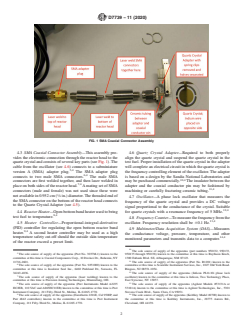
4.3 SMA Coaxial Connector Assembly—This assembly pro- 4.6 Quartz Crystal Adapter—Required to both properly
vides the electronic connection through the reactor head to the align the quartz crystal and suspend the quartz crystal in the
quartzcrystalandconsistsofseveralkeyparts(seeFig.1).The test fuel. Proper installation of the quartz crystal in the adapter
cable from the oscillator (see 4.6) connects to a subminiature will complete an electrical circuit in which the quartz crystal is
5,4
version A (SMA) adapter plug. The SMA adapter plug the frequency controlling element of the oscillator.The adapter
6,4
connects to two male SMA connectors. The male SMA is based on a design by the Sandia National Laboratories and
10,4
connectors are first welded together, and then laser welded in may be purchased commercially. The insulator between the
7,4
place on both sides of the reactor head. Amating set of SMA adapter and the coaxial conductor pin may be fashioned by
11,4
connectors (male and female) was not used since these were machining or carefully fracturing ceramic tubing.
notavailablein0.952 cm( ⁄8 in.)diameter.Thethreadedendof
4.7 Oscillator—A phase lock oscillator that measures the
the SMAconnector on the bottom of the reactor head connects
frequency of the quartz crystal and provides a DC voltage
to the Quartz Crystal Adapter (see 4.5).
signal proportional to the conductance of the crystal. Suitable
12,4
4.4 ReactorHeater—Openbottombandheaterusedtobring for quartz crystals with a resonance frequency of 5 MHz.
8,4
test fuel to temperature.
4.8 FrequencyCounter—Tomeasurethefrequencyfromthe
13,4
4.5 Heater Controller—Proportional-integral-derivative oscillator. Frequency resolution shall be 60.1 Hz.
(PID) controller for regulating the open bottom reactor band
4.9 Multimeter/Data Acquisition System (DAS)—Measures
9,4
heater. A second heater controller may be used as a high
the conductance voltage, pressure, temperature, and other
14,4
temperature safety cut-off should the outside skin temperature
monitored parameters and transmits data to a computer.
of the reactor exceed a preset limit.
The sole source of supply of the apparatus (part numbers 950132, 950133,
The sole source of supply of the apparatus (Part No. 3037M-1) known to the 950135 through 950138) known to the committee at this time is Raytheon Ktech,
committee at this time is Coaxial Components Corp., 10 Davinci Dr., Bohemia, NY 1300 Eubank Blvd. SE, Albuquerque, NM 87123.
11716-2601. The sole source of supply of the apparatus (Part No. R1201) known to the
The sole source of supply of the apparatus (Part No. 9251000) known to the committee at this time is Scientific Instrument Services, Inc., 1027 Old York Road.
committee at this time is Insulator Seal Inc., 6460 Parkland Dr., Sarasota, FL Ringoes, NJ 08551-1054.
34243-4036. The sole source of supply of the apparatus (Inficon PLO-10i phase lock
The sole source of supply of the apparatus (laser welding) known to the oscillator) known to the committee at this time is Inficon, Two Technology Place,
committee at this time is Precision Joining Technologies, Miamisburg, OH. East Syracuse, NY 13057.
8 13
The sole source of supply of the apparatus (Parr Instruments Model A2235 The sole source of supply of the apparatus (Agilent Models #53131A or
HC2EB, 110 VAC and A865HC11EB) known to the committee at this time is Parr 53181A) known to the committee at this time is Agilent Technologies, Inc., 5301
Instrument Company, 211 Fifty-Third St., Moline, IL 61265-1770. Stevens Creek Blvd., Santa Clara, CA 95051.
9 14
The sole source of supply of the apparatus (Eurotherm 2216E, Cal 9500P, and The sole source of supply of the apparatus (Keithley Model #2700) known to
Parr 4842 controllers) known to the committee at this time is Parr Instrument the committee at this time is Keithley Instruments, Inc., 28775 Aurora Rd.,
Company, 211 Fifty-Third St., Moline, IL 61265-1770. Cleveland, OH 44139.
D7739 − 11 (2020)
4.10 Thermocouples—K-type used to measure test fuel
temperature and outside reactor skin temperature (if so
equipped).
4.11 MagneticStirPlateandStirBar—To maintain test fuel
temperature homogeneity. The stir bar is polytetrafluoroethyl-
ene (PTFE) coated with the following dimensions, 3 mm
15,4
diameter by 12.7 mm long.
4.12 Oxygen Concentration Sensor and Transmitter—To
monitor and record the consumption of oxygen throughout the
16,4
run. The use of an oxygen concentration sensor and
transmitter is not recommended when operating with a test gas
containing more than 25 % by volume oxygen. Oxygen opera-
tion presents the possibility of detonation and this equipment
may not withstand this sudden increase in pressure.
4.13 Pressure Transducer—A pressure transducer can be
17,4
used in place of a dial gauge. When operating with oxygen
or a test gas containing more than 25 % by volume oxygen
extra caution is needed. Oxygen operation presents the possi-
bility of detonation and the pressure transducer may not
withstand this sudden increase in pressure.
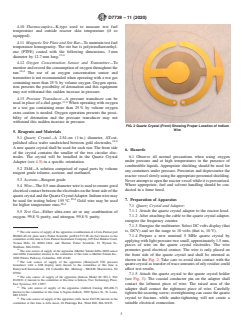
FIG. 2 Quartz Crystal (Front) Showing Proper Location of Indium
Wire
5. Reagents and Materials
5.1 Quartz Crystal—A 2.54 cm (1 in.) diameter, AT-cut,
18,4
polished silica wafer sandwiched between gold electrodes.
Anew quartz crystal shall be used for each run. The front side
...