

ASTM B330-20
(Test Method)Standard Test Methods for Estimating Average Particle Size of Metal Powders and Related Compounds Using Air Permeability
General Information
- Abstract
SIGNIFICANCE AND USE
4.1 These test methods provide procedures for determining the envelope-specific surface area of powders, from which is calculated an “average” particle diameter, assuming the particles are monosize, smooth surface, nonporous, spherical particles. For this reason, values obtained by these test methods will be reported as an average particle size or Fisher Number. The degree of correlation between the results of these test methods and the quality of powders in use will vary with each particular application and has not been fully determined.
4.2 These test methods are generally applicable to all metal powders and related compounds, including carbides, nitrides, and oxides, for particles having diameters between 0.2 and 75 μm (MIC SAS) or between 0.5 and 50 μm (FSSS). They should not be used for powders composed of particles whose shape is too far from equiaxed - that is, flakes or fibers. In these cases, it is permissible to use the test methods described only by agreement between the parties concerned. These test methods shall not be used for mixtures of different powders, nor for powders containing binders or lubricants. When the powder contains agglomerates, the measured surface area may be affected by the degree of agglomeration. Methods of de-agglomeration such as that specified in Practice B859 may be used if agreed upon between the parties concerned.
4.3 When an “average” particle size of powders is determined either the MIC SAS or the FSSS, it should be clearly kept in mind that this average size is derived from the determination of the specific surface area of the powder using a relationship that is true only for powders of uniform size and spherical shape. Thus, the results of these methods are only estimates of average particle size.
SCOPE
1.1 These test methods use air permeability to determine an envelope-specific surface area and its associated average equivalent spherical diameter (from 0.2 to 75μm) of metal powders and related compounds. The powders may be analyzed in their “as-supplied” (shipped, received, or processed) condition or after they have been de-agglomerated or milled by a laboratory procedure (“lab milled”) such as that specified in Practice B859. The values obtained are not intended to be absolute but are generally useful on a relative basis for control purposes.
1.2 Units—With the exception of the values for density and the mass used to determine density, for which the use of the gram per cubic centimetre (g/cm3) and gram (g) units is the longstanding industry practice; and the units for pressure, cm H2O - also long-standing practice; the values in SI units are to be regarded as standard.
1.3 This standard does not purport to address all of the safety concerns, if any, associated with its use. It is the responsibility of the user of this standard to establish appropriate safety, health, and environmental practices and determine the applicability of regulatory limitations prior to use.
1.4 This international standard was developed in accordance with internationally recognized principles on standardization established in the Decision on Principles for the Development of International Standards, Guides and Recommendations issued by the World Trade Organization Technical Barriers to Trade (TBT) Committee.
- Status
- Published
- Publication Date
- 30-Sep-2020
- Technical Committee
- B09 - Metal Powders and Metal Powder Products
- Drafting Committee
- B09.03 - Refractory Metal Powders
Buy Documents
ASTM B330-20 - Standard Test Methods for Estimating Average Particle Size of Metal Powders and Related Compounds Using Air Permeability
REDLINE ASTM B330-20 - Standard Test Methods for Estimating Average Particle Size of Metal Powders and Related Compounds Using Air Permeability
Overview
ASTM B330-20: Standard Test Methods for Estimating Average Particle Size of Metal Powders and Related Compounds Using Air Permeability provides procedures for determining the envelope-specific surface area of powders and calculating an “average” particle diameter, often called the Fisher Number. The standard employs air permeability techniques to estimate the average particle size of metal powders and related compounds including carbides, nitrides, and oxides. Results are most meaningful for powders that are monosize, smooth, nonporous, and spherical in shape.
This standard is widely recognized in the powder metallurgy industry for quality control, process optimization, and product development. ASTM B330-20 is applicable to powders with particle diameters ranging from 0.2 to 75 μm (using MIC Sub-Sieve AutoSizer, MIC SAS) or 0.5 to 50 μm (using Fisher Sub-Sieve Sizer, FSSS).
Key Topics
- Air Permeability Testing: The main test methods rely on measuring the resistance to airflow through a packed bed of powder, from which the specific surface area is determined.
- Average Particle Size Calculation: The “average” particle size calculated assumes all particles are monosized spheres, providing a comparative, not absolute, measure.
- Instrumentation:
- MIC Sub-Sieve AutoSizer (MIC SAS): Used for particle size determination from 0.2 to 75 μm using automated measurement and calculation.
- Fisher Sub-Sieve Sizer (FSSS): Applicable to particle sizes from 0.5 to 50 μm, although it is no longer commercially available; still in use in some laboratories.
- Applicability: The methods are suitable for most metal powders and related compounds except those with non-equiaxed shapes (such as flakes or fibers), powders with binders or lubricants, powder mixtures, or powders with significant agglomeration unless de-agglomeration is agreed upon by involved parties.
- Data Reporting: Results are reported as Fisher Number or average particle size, along with porosity and relevant test details such as sample preparation method.
Applications
Using ASTM B330-20 is particularly valuable for:
- Quality Control in Powder Metallurgy: Ensures consistent particle size distribution, impacting the mechanical properties and density of finished products.
- Research and Development: Facilitates comparison and replication of research findings related to powder characteristics.
- Process Optimization: Helps manufacturers adjust milling, atomization, or classification processes based on specific surface area or average particle size trends.
- Purchasing and Specification Compliance: Enables suppliers and users to communicate and verify particle size characteristics using standardized methods.
Industries that benefit include:
- Powder metallurgy (PM) and additive manufacturing
- Hard metal, carbide, and refractory material production
- Catalysis and ceramics
- Electronics manufacturing
Related Standards
- ASTM B243: Terminology of Powder Metallurgy
- ASTM B859: Practice for De-Agglomeration of Refractory Metal Powders and Their Compounds Prior to Particle Size Analysis
- ASTM E29: Practice for Using Significant Digits in Test Data to Determine Conformance with Specifications
- ASTM E456: Terminology Relating to Quality and Statistics
- ASTM E691: Practice for Conducting an Interlaboratory Study to Determine the Precision of a Test Method
- ISO 10070: Metallic Powders - Determination of Envelope-Specific Surface Area from Measurements of Permeability to Air
Practical Value
ASTM B330-20 delivers a reliable, standardized framework for estimating and reporting average particle size and specific surface area in metal powders. While absolute accuracy is affected by particle shape, agglomeration, and porosity, the test methods provide critical comparative data for process control and specification adherence. This standard plays a central role in supporting high-quality, consistent powder production for demanding technical applications.
Keywords: air permeability, average particle size, envelope-specific surface area, Fisher Number, metal powder, MIC SAS, FSSS, powder metallurgy, particle size distribution, ASTM B330.
Relations
- Effective Date
- 01-Apr-2022
- Effective Date
- 01-Oct-2018
- Effective Date
- 01-Oct-2017
- Effective Date
- 01-Oct-2017
- Effective Date
- 01-Jul-2016
- Effective Date
- 15-Nov-2013
- Effective Date
- 15-Nov-2013
- Effective Date
- 15-Nov-2013
- Effective Date
- 15-Nov-2013
- Effective Date
- 01-Nov-2013
- Effective Date
- 01-Oct-2013
- Effective Date
- 15-Aug-2013
- Effective Date
- 01-May-2013
- Effective Date
- 15-Jul-2012
- Effective Date
- 01-May-2012
Buy Documents
ASTM B330-20 - Standard Test Methods for Estimating Average Particle Size of Metal Powders and Related Compounds Using Air Permeability
REDLINE ASTM B330-20 - Standard Test Methods for Estimating Average Particle Size of Metal Powders and Related Compounds Using Air Permeability
Get Certified
Connect with accredited certification bodies for this standard

Element Materials Technology
Materials testing and product certification.

Inštitut za kovinske materiale in tehnologije
Institute of Metals and Technology. Materials testing, metallurgical analysis, NDT.
Sponsored listings
Frequently Asked Questions
ASTM B330-20 is a standard published by ASTM International. Its full title is "Standard Test Methods for Estimating Average Particle Size of Metal Powders and Related Compounds Using Air Permeability". This standard covers: SIGNIFICANCE AND USE 4.1 These test methods provide procedures for determining the envelope-specific surface area of powders, from which is calculated an “average” particle diameter, assuming the particles are monosize, smooth surface, nonporous, spherical particles. For this reason, values obtained by these test methods will be reported as an average particle size or Fisher Number. The degree of correlation between the results of these test methods and the quality of powders in use will vary with each particular application and has not been fully determined. 4.2 These test methods are generally applicable to all metal powders and related compounds, including carbides, nitrides, and oxides, for particles having diameters between 0.2 and 75 μm (MIC SAS) or between 0.5 and 50 μm (FSSS). They should not be used for powders composed of particles whose shape is too far from equiaxed - that is, flakes or fibers. In these cases, it is permissible to use the test methods described only by agreement between the parties concerned. These test methods shall not be used for mixtures of different powders, nor for powders containing binders or lubricants. When the powder contains agglomerates, the measured surface area may be affected by the degree of agglomeration. Methods of de-agglomeration such as that specified in Practice B859 may be used if agreed upon between the parties concerned. 4.3 When an “average” particle size of powders is determined either the MIC SAS or the FSSS, it should be clearly kept in mind that this average size is derived from the determination of the specific surface area of the powder using a relationship that is true only for powders of uniform size and spherical shape. Thus, the results of these methods are only estimates of average particle size. SCOPE 1.1 These test methods use air permeability to determine an envelope-specific surface area and its associated average equivalent spherical diameter (from 0.2 to 75μm) of metal powders and related compounds. The powders may be analyzed in their “as-supplied” (shipped, received, or processed) condition or after they have been de-agglomerated or milled by a laboratory procedure (“lab milled”) such as that specified in Practice B859. The values obtained are not intended to be absolute but are generally useful on a relative basis for control purposes. 1.2 Units—With the exception of the values for density and the mass used to determine density, for which the use of the gram per cubic centimetre (g/cm3) and gram (g) units is the longstanding industry practice; and the units for pressure, cm H2O - also long-standing practice; the values in SI units are to be regarded as standard. 1.3 This standard does not purport to address all of the safety concerns, if any, associated with its use. It is the responsibility of the user of this standard to establish appropriate safety, health, and environmental practices and determine the applicability of regulatory limitations prior to use. 1.4 This international standard was developed in accordance with internationally recognized principles on standardization established in the Decision on Principles for the Development of International Standards, Guides and Recommendations issued by the World Trade Organization Technical Barriers to Trade (TBT) Committee.
SIGNIFICANCE AND USE 4.1 These test methods provide procedures for determining the envelope-specific surface area of powders, from which is calculated an “average” particle diameter, assuming the particles are monosize, smooth surface, nonporous, spherical particles. For this reason, values obtained by these test methods will be reported as an average particle size or Fisher Number. The degree of correlation between the results of these test methods and the quality of powders in use will vary with each particular application and has not been fully determined. 4.2 These test methods are generally applicable to all metal powders and related compounds, including carbides, nitrides, and oxides, for particles having diameters between 0.2 and 75 μm (MIC SAS) or between 0.5 and 50 μm (FSSS). They should not be used for powders composed of particles whose shape is too far from equiaxed - that is, flakes or fibers. In these cases, it is permissible to use the test methods described only by agreement between the parties concerned. These test methods shall not be used for mixtures of different powders, nor for powders containing binders or lubricants. When the powder contains agglomerates, the measured surface area may be affected by the degree of agglomeration. Methods of de-agglomeration such as that specified in Practice B859 may be used if agreed upon between the parties concerned. 4.3 When an “average” particle size of powders is determined either the MIC SAS or the FSSS, it should be clearly kept in mind that this average size is derived from the determination of the specific surface area of the powder using a relationship that is true only for powders of uniform size and spherical shape. Thus, the results of these methods are only estimates of average particle size. SCOPE 1.1 These test methods use air permeability to determine an envelope-specific surface area and its associated average equivalent spherical diameter (from 0.2 to 75μm) of metal powders and related compounds. The powders may be analyzed in their “as-supplied” (shipped, received, or processed) condition or after they have been de-agglomerated or milled by a laboratory procedure (“lab milled”) such as that specified in Practice B859. The values obtained are not intended to be absolute but are generally useful on a relative basis for control purposes. 1.2 Units—With the exception of the values for density and the mass used to determine density, for which the use of the gram per cubic centimetre (g/cm3) and gram (g) units is the longstanding industry practice; and the units for pressure, cm H2O - also long-standing practice; the values in SI units are to be regarded as standard. 1.3 This standard does not purport to address all of the safety concerns, if any, associated with its use. It is the responsibility of the user of this standard to establish appropriate safety, health, and environmental practices and determine the applicability of regulatory limitations prior to use. 1.4 This international standard was developed in accordance with internationally recognized principles on standardization established in the Decision on Principles for the Development of International Standards, Guides and Recommendations issued by the World Trade Organization Technical Barriers to Trade (TBT) Committee.
ASTM B330-20 is classified under the following ICS (International Classification for Standards) categories: 77.160 - Powder metallurgy. The ICS classification helps identify the subject area and facilitates finding related standards.
ASTM B330-20 has the following relationships with other standards: It is inter standard links to ASTM E456-13a(2022)e1, ASTM B243-18, ASTM E456-13A(2017)e1, ASTM E456-13A(2017)e3, ASTM B243-16, ASTM E456-13a, ASTM E456-13ae2, ASTM E456-13ae1, ASTM E456-13ae3, ASTM B243-13, ASTM B859-13, ASTM E456-13, ASTM E691-13, ASTM B243-12, ASTM E456-12. Understanding these relationships helps ensure you are using the most current and applicable version of the standard.
ASTM B330-20 is available in PDF format for immediate download after purchase. The document can be added to your cart and obtained through the secure checkout process. Digital delivery ensures instant access to the complete standard document.
Standards Content (Sample)
This international standard was developed in accordance with internationally recognized principles on standardization established in the Decision on Principles for the
Development of International Standards, Guides and Recommendations issued by the World Trade Organization Technical Barriers to Trade (TBT) Committee.
Designation: B330 − 20
Standard Test Methods for
Estimating Average Particle Size of Metal Powders and
Related Compounds Using Air Permeability
This standard is issued under the fixed designation B330; the number immediately following the designation indicates the year of
original adoption or, in the case of revision, the year of last revision. A number in parentheses indicates the year of last reapproval. A
superscript epsilon (´) indicates an editorial change since the last revision or reapproval.
This standard has been approved for use by agencies of the U.S. Department of Defense.
1. Scope* B859 Practice for De-Agglomeration of Refractory Metal
Powders and Their Compounds Prior to Particle Size
1.1 These test methods use air permeability to determine an
Analysis
envelope-specific surface area and its associated average
E29 Practice for Using Significant Digits in Test Data to
equivalent spherical diameter (from 0.2 to 75µm) of metal
Determine Conformance with Specifications
powders and related compounds. The powders may be ana-
E456 Terminology Relating to Quality and Statistics
lyzed in their “as-supplied” (shipped, received, or processed)
E691 Practice for Conducting an Interlaboratory Study to
conditionoraftertheyhavebeende-agglomeratedormilledby
Determine the Precision of a Test Method
a laboratory procedure (“lab milled”) such as that specified in
2.2 ISO/DIS Document:
Practice B859. The values obtained are not intended to be
ISO/DIS 10070 Metallic Powders: Determinations of
absolute but are generally useful on a relative basis for control
Envelope-Specific Surface Area from Measurements of
purposes.
the Permeability to Air of a Powder Bed Under Steady-
1.2 Units—With the exception of the values for density and
State Flow Conditions
the mass used to determine density, for which the use of the
gram per cubic centimetre (g/cm ) and gram (g) units is the
3. Terminology
longstanding industry practice; and the units for pressure, cm
3.1 Definitions—Many terms used in these test methods are
H O - also long-standing practice; the values in SI units are to
defined in Terminology B243.
be regarded as standard.
3.2 Definitions of Terms Specific to This Standard:
1.3 This standard does not purport to address all of the
3.2.1 agglomerate, n—several particles adhering together.
safety concerns, if any, associated with its use. It is the
responsibility of the user of this standard to establish appro-
3.2.2 air permeability, n—measurement of air pressure drop
priate safety, health, and environmental practices and deter-
across a packed bed of powder.
mine the applicability of regulatory limitations prior to use.
3.2.3 average particle size, n—(for the purposes of these
1.4 This international standard was developed in accor-
test methods only) – an estimate of the equivalent average
dance with internationally recognized principles on standard-
spherical particle diameter, calculated from the measured
ization established in the Decision on Principles for the
envelope-specific surface area, assuming that all the powder
Development of International Standards, Guides and Recom-
particles are spherical and that all are exactly the same size.
mendations issued by the World Trade Organization Technical
3.2.4 de-agglomeration, n—process used to break up ag-
Barriers to Trade (TBT) Committee.
glomerates of particles.
2. Referenced Documents
3.2.5 envelope-specific surface area, n—specific surface
2.1 ASTM Standards:
area of a powder as determined by gas permeametry in
B243 Terminology of Powder Metallurgy
accordance with ISO/DIS 10070.
3.2.6 Fisher calibrator tube, n—jewel with a precision
These test methods are under the jurisdiction of ASTM Committee B09 on
orifice mounted in a tube similar to a sample tube.
Metal Powders and Metal Powder Products and are the direct responsibility of
3.2.6.1 Discussion—The calibrator tube value is directly
Subcommittee B09.03 on Refractory Metal Powders.
Current edition approved Oct. 1, 2020. Published November 2020. Originally
traceable to the master tube maintained byASTM International
approved in 1958. Last previous edition approved in 2015 as B330 – 15. DOI:
Subcommittee B09.03 on Refractory Metal Powders.
10.1520/B0330-20.
For referenced ASTM standards, visit the ASTM website, www.astm.org, or
contact ASTM Customer Service at service@astm.org. For Annual Book of ASTM
Standards volume information, refer to the standard’s Document Summary page on Available fromAmerican National Standards Institute (ANSI), 25 W. 43rd St.,
the ASTM website. 4th Floor, New York, NY 10036, http://www.ansi.org.
*A Summary of Changes section appears at the end of this standard
Copyright © ASTM International, 100 Barr Harbor Drive, PO Box C700, West Conshohocken, PA 19428-2959. United States
B330 − 20
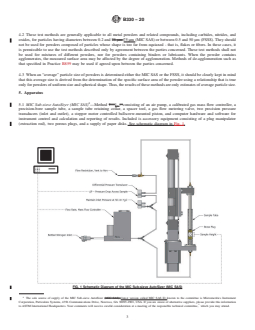
3.2.7 Fisher Number, n—calculated value equated to an precision-bore sample tube, a sample tube retaining collar, a
average particle diameter, assuming all the particles are spheri- spacer tool, a gas flow metering valve, two precision pressure
cal and of uniform size. transducers (inlet and outlet), a stepper motor controlled
ballscrew-mounted piston, and computer hardware and soft-
3.2.8 Fisher Sub-Sieve Sizer (FSSS), n—a commercially
ware for instrument control and calculation and reporting of
available permeability instrument for measuring envelope-
results. Included is accessory equipment consisting of a plug
specific surface area and estimating average particle size
manipulator(extractionrod),twoporousplugs,andasupplyof
(Fisher Number) from 0.5 to 50 µm.
paper disks. See schematic diagram in Fig. 1.
3.2.9 MIC Sub-sieve AutoSizer (MIC SAS), n—a commer-
NOTE 1—When homing the piston, adjust the sample packing assembly
cially available permeability instrument for measuring
(1) as described in the manufacturer’s directions, with the plugs and paper
envelope-specific surface area and estimating average particle
disks stacked together and placed on the fixed anvil spigot, or (2) using a
size from 0.2 to 75 µm.
specially designed baseline (homing) gauge instead of the plugs and paper
disks.This baseline gauge shall have a height of 20.30 6 0.10 mm. Check
3.2.10 porosity of a bed of powder, n—ratioofthevolumeof
all plug heights when new plugs are purchased and periodically thereafter
the void space in the powder bed to the that of the overall
to make sure all are equal in height.
volume of the powder bed.
5.1.1 Powder Funnel, stainless steel, with spout outside
4. Significance and Use
diameter slightly smaller than the sample tube inside diameter.
5.1.2 The manufacturer provides instructions which should
4.1 These test methods provide procedures for determining
be followed, using the “Inorganics Test” procedure when
the envelope-specific surface area of powders, from which is
testing metal powders and related compounds. Particular atten-
calculated an “average” particle diameter, assuming the par-
tion should be given to proper maintenance of the instrument
ticles are monosize, smooth surface, nonporous, spherical
with special reference to the instructions on (1) “homing” the
particles.Forthisreason,valuesobtainedbythesetestmethods
pistonwhenturningonfromanunpoweredstate,(2)settingthe
will be reported as an average particle size or Fisher Number.
pressureandperiodiccheckingofthepressure,(3)conditionof
The degree of correlation between the results of these test
O-rings on the piston and sample spigot, and (4) the sample
methods and the quality of powders in use will vary with each
packing assembly (plugs and paper disks).
particular application and has not been fully determined.
5.2 Fisher Sub-Sieve Sizer (FSSS) — Method 2, consisting
4.2 These test methods are generally applicable to all metal
of an air pump, an air-pressure regulating device, a precision-
powders and related compounds, including carbides, nitrides,
bore sample tube, a standardized double-range air flowmeter,
and oxides, for particles having diameters between 0.2 and
and a calculator chart. Included is accessory equipment con-
75 µm (MIC SAS) or between 0.5 and 50 µm (FSSS). They
sistingofaplugmanipulator,powderfunnel,twoporousplugs,
should not be used for powders composed of particles whose
a supply of paper disks, and a rubber tube support stand.
shapeistoofarfromequiaxed-thatis,flakesorfibers.Inthese
cases, it is permissible to use the test methods described only
NOTE 2—Necessary replacement parts should be obtained from the
by agreement between the parties concerned. These test meth-
manufacturer, especially in the case of the precision manometer which is
a part of the air flowmeter.
ods shall not be used for mixtures of different powders, nor for
powders containing binders or lubricants. When the powder
5.2.1 The manufacturer has also furnished instructions
contains agglomerates, the measured surface area may be
which should be followed, except as amended as follows.
affected by the degree of agglomeration. Methods of de-
Particular attention should be given to proper maintenance of
agglomeration such as that specified in Practice B859 may be
the instrument with special reference to the instructions on (1)
used if agreed upon between the parties concerned.
periodic checking of the water level in the pressure regulator
standpipe, (2) manometer level before the sample tube is
4.3 When an “average” particle size of powders is deter-
inserted, and (3) the sample packing assembly.
mined either the MIC SAS or the FSSS, it should be clearly
5.2.2 Jewel Calibrator Tube —A tube to be used as a
kept in mind that this average size is derived from the
standard for average particle size measurement. It allows
determination of the specific surface area of the powder using
operators to relate their data to that of other analysts. Each
a relationship that is true only for powders of uniform size and
calibrator has been factory tested three times with the resulting
spherical shape. Thus, the results of these methods are only
readings and associated porosity recorded on the tube.
estimates of average particle size.
NOTE 3—Adjust the sample packing assembly (1) as described in the
5. Apparatus
manufacturer’s instructions with the exception that the plugs and paper
disks are not inserted in the sample tube, but are merely stacked together
5.1 MIC Sub-sieve AutoSizer (MIC SAS) —Method 1, con-
sisting of an air pump, a calibrated gas mass flow controller, a
The Fisher Sub-Sieve Sizer (FSSS) is no longer commercially available, nor is
The sole source of supply of the MIC Sub-sieve AutoSizer (latest version it supported with parts and service. It is included here as apparatus for Method 2
called MIC SAS II) known to the committee is Micromeritics Instrument because of several instruments still operating in the field. In-house repair or parts
Corporation, Particulate Systems, 4356 Communications Drive, Norcross, GA replacement is discouraged, as these are likely to detrimentally affect results and
30093-2901, USA. If you are aware of alternative suppliers, please provide this precision.
information to ASTM International Headquarters. Your comments will receive The Jewel Calibrator Tube is no longer commercially available. A “Master”
careful consideration at a meeting of the responsible technical committee, which Jewel Calibrator Tube is maintained byASTM International Subcommittee B09.03
you may attend. for calibration and traceability of currently existing in-house calibrator tubes.
B330 − 20
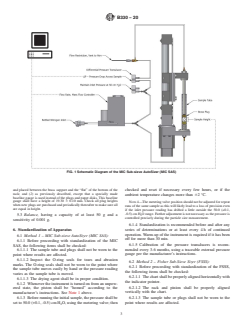
FIG. 1 Schematic Diagram of the MIC Sub-sieve AutoSizer (MIC SAS)
and placed between the brass support and the “flat” of the bottom of the
checked and reset if necessary every few hours, or if the
rack; and (2) as previously described, except that a specially made
ambient temperature changes more than 62 °C.
baseline gauge is used instead of the plugs and paper disks. This baseline
gauge shall have a height of 19.30 6 0.10 mm. Check all plug heights
NOTE 4—The metering valve position should not be adjusted for repeat
when new plugs are purchased and periodically thereafter to make sure all
runs of the same sample as this will likely lead to a loss of precision even
are equal in height.
if the inlet pressure reading has drifted a little outside the 50.0 (+0.1,
-0.5) cm H O range. Further adjustment is not necessary as the pressure is
5.3 Balance, having a capacity of at least 50 g and a
controlled precisely during the particle size measurement.
sensitivity of 0.001 g.
6.1.4 Standardization is recommended before and after any
6. Standardization of Apparatus series of determinations or at least every 4 h of continued
operation. Warm-up of the instrument is required if it has been
6.1 Method 1 – MIC Sub-sieve AutoSizer (MIC SAS):
off for more than 30 min.
6.1.1 Before proceeding with standardization of the MIC
6.1.5 Calibration of the pressure transducers is recom-
SAS, the following items shall be checked:
mended every 3-6 months, using a traceable external pressure
6.1.1.1 The sample tube and plugs shall not be worn to the
gauge per the manufacturer’s instructions.
point where results are affected.
6.1.1.2 Inspect the O-ring seals for tears and abrasion
6.2 Method 2 – Fisher Sub-Sieve Sizer (FSSS):
marks. The O-ring seals shall not be worn to the point where
6.2.1 Before proceeding with standardization of the FSSS,
the sample tube moves easily by hand or the pressure reading
the following items shall be checked:
varies as the sample tube is moved.
6.2.1.1 Thechartshallbeproperlyalignedhorizontallywith
6.1.1.3 The drying agent shall be in proper condition.
the indicator pointer.
6.1.2 Whenever the instrument is turned on from an unpow-
6.2.1.2 The rack and pinion shall be properly aligned
ered state, the piston shall be “homed” according to the
vertically with the chart.
manufacturer’s instructions. See Note 1 above.
6.1.3 Beforerunningtheinitialsample,thepressureshallbe 6.2.1.3 The sample tube or plugs shall not be worn to the
set to 50.0 (+0.1, -0.5) cm H O, using the metering valve; then point where results are affected.
B330 − 20
6.2.1.4 The manometer and air resistors shall be free of 6.2.3.7 Because only one flowmeter is used for the low (0.5
visible contamination. to 15.0 µm) Fisher Number range while both flowmeters are
used for the high (15.0 to 50.0 µm) Fisher Number range, the
6.2.1.5 The rubber sample tube seals shall not be worn to
the point where leakage occurs. low range should be standardized first. After the low range is
standardized, the high range is then standardized, making
6.2.1.6 The sample packing post shall be properly adjusted.
adjustments only to the one flowmeter opened up by the
6.2.1.7 The drying agent shall be in proper condition.
range-control knob.
6.2.1.8 The manometer and standpipe levels shall be
6.2.3.8 Standardization with the jewel calibrator tube is
checked.
recommended before and after any series of determinations or
6.2.1.9 Adjust the manometer only when the machine is not
at least every 4 h of continued operation. Warm-up of the
operating and with the pressure released for minimum of 5 min
machine is required if it has been off for more than 30 min.
to allow the manometer tube to drain completely.
6.2.2 The standardization of the Fisher Sub-Sieve Sizer
7. Procedure
shall be made using the Fisher jewel calibrator tube (jewel
orifice tube) as the primary standard. Specification shall be
7.1 Method 1 – MIC Sub-sieve AutoSizer (MIC SAS) – 0.2 to
madeatbothrangesofthemachine.TheFisherjewelcalibrator
75 µm:
tube used for standardization shall be checked under a micro-
7.1.1 Temperature of Test—Make average particle size de-
scope at least once a month to determine the condition and
terminations within 62 °C of the temperature at which stan-
cleanliness of the orifice. If the orifice is not clean, clean as
dardization of the MIC Sub-sieve AutoSizer was made. Reset
described in the Fisher Sub-Sieve Sizer instruction manual.
the pressure if the temperature of the test varies more than
6.2.3 With the sub-sieve sizer properly adjusted and set to
62 °C.
the proper range, proceed as follows:
7.1.2 Size of Test Sample—The mass of sample used for
6.2.3.1 Mount the Fisher jewel calibrator tube between the
tests shall be equal in grams (within 65 %) to the true
rubber seal supports just to the right of the brass post. Clamp
(pore-free) density (in g/cm )
...
This document is not an ASTM standard and is intended only to provide the user of an ASTM standard an indication of what changes have been made to the previous version. Because
it may not be technically possible to adequately depict all changes accurately, ASTM recommends that users consult prior editions as appropriate. In all cases only the current version
of the standard as published by ASTM is to be considered the official document.
Designation: B330 − 15 B330 − 20
Standard Test Methods for
Estimating Average Particle Size of Metal Powders and
Related Compounds Using Air Permeability
This standard is issued under the fixed designation B330; the number immediately following the designation indicates the year of
original adoption or, in the case of revision, the year of last revision. A number in parentheses indicates the year of last reapproval. A
superscript epsilon (´) indicates an editorial change since the last revision or reapproval.
This standard has been approved for use by agencies of the U.S. Department of Defense.
1. Scope*
1.1 These test methods use air permeability to determine an envelope-specific surface area and its associated average equivalent
spherical diameter (from 0.2 to 75μm) of metal powders and related compounds. The powders may be analyzed in their
“as-supplied” (shipped, received, or processed) condition or after they have been de-agglomerated or milled by a laboratory
procedure (“lab milled”) such as that specified in Practice B859. The values obtained are not intended to be absolute but are
generally useful on a relative basis for control purposes.
1.2 Units—With the exception of the values for density and the mass used to determine density, for which the use of the gram per
cubic centimetre (g/cm ) and gram (g) units is the longstanding industry practice; and the units for pressure, cm H O - also
long-standing practice; the values in SI units are to be regarded as standard.
1.3 This standard does not purport to address all of the safety concerns, if any, associated with its use. It is the responsibility
of the user of this standard to establish appropriate safety safety, health, and healthenvironmental practices and determine the
applicability of regulatory limitations prior to use.
1.4 This international standard was developed in accordance with internationally recognized principles on standardization
established in the Decision on Principles for the Development of International Standards, Guides and Recommendations issued
by the World Trade Organization Technical Barriers to Trade (TBT) Committee.
2. Referenced Documents
2.1 ASTM Standards:
B243 Terminology of Powder Metallurgy
B859 Practice for De-Agglomeration of Refractory Metal Powders and Their Compounds Prior to Particle Size Analysis
E29 Practice for Using Significant Digits in Test Data to Determine Conformance with Specifications
E456 Terminology Relating to Quality and Statistics
E691 Practice for Conducting an Interlaboratory Study to Determine the Precision of a Test Method
2.2 ISO/DIS Document:
ISO/DIS 10070 Metallic Powders: Determinations of Envelope-Specific Surface Area from Measurements of the Permeability
to Air of a Powder Bed Under Steady-State Flow Conditions
These test methods are under the jurisdiction of ASTM Committee B09 on Metal Powders and Metal Powder Products and are the direct responsibility of Subcommittee
B09.03 on Refractory Metal Powders.
Current edition approved Oct. 1, 2015Oct. 1, 2020. Published October 2015November 2020. Originally approved in 1958. Last previous edition approved in 20122015
as B330B330 – 15. -12. DOI: 10.1520/B0330-15.10.1520/B0330-20.
For referenced ASTM standards, visit the ASTM website, www.astm.org, or contact ASTM Customer Service at service@astm.org. For Annual Book of ASTM Standards
volume information, refer to the standard’s Document Summary page on the ASTM website.
Available from American National Standards Institute (ANSI), 25 W. 43rd St., 4th Floor, New York, NY 10036, http://www.ansi.org.
*A Summary of Changes section appears at the end of this standard
Copyright © ASTM International, 100 Barr Harbor Drive, PO Box C700, West Conshohocken, PA 19428-2959. United States
B330 − 20
3. Terminology
3.1 Definitions—Many terms used in thisthese test methodmethods are defined in Terminology B243.
3.2 Definitions of Terms Specific to This Standard:
3.2.1 MIC Sub-sieve AutoSizer (MIC SAS), agglomerate, n—a commercially available permeability instrument for measuring
envelopespecific surface area and estimating average particle size from 0.2 to 75μm.several particles adhering together.
3.2.2 air permeability, n—measurement of air pressure drop across a packed bed of powder.
3.2.3 Fisher Sub-Sieve Sizer (FSSS), average particle size, n—a commercially available permeability instrument for measuring
envelope-specific surface area and estimating average particle size (Fisher Number) from 0.5 to 50 μm.(for the purposes of these
test methods only) – an estimate of the equivalent average spherical particle diameter, calculated from the measured
envelope-specific surface area, assuming that all the powder particles are spherical and that all are exactly the same size.
3.2.4 de-agglomeration, n—process used to break up agglomerates of particles.
3.2.5 envelope-specific surface area, n—specific surface area of a powder as determined by gas permeametry in accordance with
ISO/DIS 10070.
3.2.6 air permeability, Fisher calibrator tube, n—measurement of air pressure drop across a packed bed of powder.jewel with a
precision orifice mounted in a tube similar to a sample tube.
3.2.6.1 Discussion—
The calibrator tube value is directly traceable to the master tube maintained by ASTM International Subcommittee B09.03 on
Refractory Metal Powders.
3.2.5 de-agglomeration, n—process used to break up agglomerates of particles.
3.2.7 Fisher Number, n—calculated value equated to an average particle diameter, assuming all the particles are spherical and of
uniform size.
3.2.8 Fisher calibrator tube, Sub-Sieve Sizer (FSSS), n—jewel with a precision orifice mounted in a tube similar to a sample tube.
The calibrator tube value is directly traceable to the master tube maintained by ASTM International Subcommittee B09.03 on
Refractory Metal Powders. a commercially available permeability instrument for measuring envelope-specific surface area and
estimating average particle size (Fisher Number) from 0.5 to 50 μm.
3.2.9 MIC Sub-sieve AutoSizer (MIC SAS), n—a commercially available permeability instrument for measuring envelope-specific
surface area and estimating average particle size from 0.2 to 75 μm.
3.2.10 porosity of a bed of powder, n—ratio of the volume of the void space in the powder bed to the that of the overall volume
of the powder bed.
3.2.9 agglomerate, n—several particles adhering together.
3.2.10 average particle size, n—(for the purposes of these test methods only) – an estimate of the equivalent average spherical
particle diameter, calculated from the measured envelope-specific surface area, assuming that all the powder particles are spherical
and that all are exactly the same size.
4. Significance and Use
4.1 These test methods provide procedures for determining the envelope-specific surface area of powders, from which is
calculated an “average” particle diameter, assuming the particles are monosize, smooth surface, nonporous, spherical particles. For
this reason, values obtained by these test methods will be reported as an average particle size or Fisher Number. The degree of
correlation between the results of these test methods and the quality of powders in use will vary with each particular application
and has not been fully determined.
B330 − 20
4.2 These test methods are generally applicable to all metal powders and related compounds, including carbides, nitrides, and
oxides, for particles having diameters between 0.2 and 75 μm 75 μm (MIC SAS) or between 0.5 and 50 μm (FSSS). They should
not be used for powders composed of particles whose shape is too far from equiaxed - that is, flakes or fibers. In these cases, it
is permissible to use the test methods described only by agreement between the parties concerned. These test methods shall not
be used for mixtures of different powders, nor for powders containing binders or lubricants. When the powder contains
agglomerates, the measured surface area may be affected by the degree of agglomeration. Methods of de-agglomeration such as
that specified in Practice B859 may be used if agreed upon between the parties concerned.
4.3 When an “average” particle size of powders is determined either the MIC SAS or the FSSS, it should be clearly kept in mind
that this average size is derived from the determination of the specific surface area of the powder using a relationship that is true
only for powders of uniform size and spherical shape. Thus, the results of these methods are only estimates of average particle size.
5. Apparatus
5.1 MIC Sub-sieve AutoSizer (MIC SAS) —Method 1—1, – consisting of an air pump, a calibrated gas mass flow controller, a
precision-bore sample tube, a sample tube retaining collar, a spacer tool, a gas flow metering valve, two precision pressure
transducers (inlet and outlet), a stepper motor controlled ballscrew-mounted piston, and computer hardware and software for
instrument control and calculation and reporting of results. Included is accessory equipment consisting of a plug manipulator
(extraction rod), two porous plugs, and a supply of paper disks. See schematic diagram in Fig. 1.
FIG. 1 Schematic Diagram of the MIC Sub-sieve AutoSizer (MIC SAS)
The sole source of supply of the MIC Sub-sieve AutoSizer (MIC SAS) (latest version called MIC SAS II) known to the committee is Micromeritics Instrument
Corporation, Particulate Systems, 4356 Communications Drive, Norcross, GA 30093-2901, USA. If you are aware of alternative suppliers, please provide this information
to ASTM International Headquarters. Your comments will receive careful consideration at a meeting of the responsible technical committee, which you may attend.
B330 − 20
NOTE 1—When homing the piston, adjust the sample packing assembly (1)(1) as described in the manufacturer’s directions, with the plugs and paper disks
stacked together and placed on the fixed anvil spigot, or (2)(2) using a specially designed baseline (homing) gauge instead of the plugs and paper disks.
This baseline gauge shall have a height of 20.30 6 0.10 mm. Check all plug heights when new plugs are purchased and periodically thereafter to make
sure all are equal in height.
5.1.1 Powder funnel—Funnel, stainless steel, with spout outside diameter slightly smaller than the sample tube inside diameter.
5.1.2 The manufacturer provides instructions which should be followed, using the “Inorganics Test” procedure when testing metal
powders and related compounds. Particular attention should be given to proper maintenance of the instrument with special
reference to the instructions on (1)(1) “homing” the piston when turning on from an unpowered state, (2)(2) setting the pressure
and periodic checking of the pressure, (3)(3) condition of O-rings on the piston and sample spigot, and (4)(4) the sample packing
assembly (plugs and paper disks).
5.2 Fisher Sub-Sieve Sizer (FSSS) — Method 2—2, consisting of an air pump, an air-pressure regulating device, a precision-bore
sample tube, a standardized double-range air flowmeter, and a calculator chart. Included is accessory equipment consisting of a
plug manipulator, powder funnel, two porous plugs, a supply of paper disks, and a rubber tube support stand.
NOTE 2—Necessary replacement parts should be obtained from the manufacturer, especially in the case of the precision manometer which is a part of
the air flowmeter.
5.2.1 The manufacturer has also furnished instructions which should be followed, except as amended as follows. Particular
attention should be given to proper maintenance of the instrument with special reference to the instructions on (1) periodic
checking of the water level in the pressure regulator standpipe, (2) manometer level before the sample tube is inserted, and (3) the
sample packing assembly.
5.2.2 Jewel Calibrator Tube —aA tube to be used as a standard for average particle size measurement. It allows operators to relate
their data to that of other analysts. Each calibrator has been factory tested three times with the resulting readings and associated
porosity recorded on the tube.
NOTE 3—Adjust the sample packing assembly (1) as described in the manufacturer’s instructions with the exception that the plugs and paper disks are
not inserted in the sample tube, but are merely stacked together and placed between the brass support and the “flat” of the bottom of the rack,rack; and
(2) as previously described, except that a specially made baseline gauge is used instead of the plugs and paper disks. This baseline gauge shall have a
height of 19.30 6 0.10 mm. Check all plug heights when new plugs are purchased and periodically thereafter to make sure all are equal in height.
5.3 Balance—Balance, having a capacity of at least 50 g and a sensitivity of 0.001 g.
6. Standardization of Apparatus
6.1 Method 1 – MIC Sub-sieve AutoSizer (MIC SAS):
6.1.1 Before proceeding with standardization of the MIC SAS, the following items shall be checked:
6.1.1.1 The sample tube and plugs shall not be worn to the point where results are affected.
6.1.1.2 Inspect the O-ring seals for tears and abrasion marks. The O-ring seals shall not be worn to the point where the sample
tube moves easily by hand or the pressure reading varies as the sample tube is moved.
6.1.1.3 The drying agent shall be in proper condition.
6.1.2 Whenever the instrument is turned on from an unpowered state, the piston shall be “homed” according to the manufacturer’s
instructions. See Note 1 above.
6.1.3 Before running the initial sample, the pressure shall be set to 50.0 (+0.1, -0.5) cm H O, using the metering valve; then
checked and reset if necessary every few hours, or if the ambient temperature changes more than 62°C.62 °C.
The Fisher Sub-Sieve Sizer (FSSS) is no longer commercially available, nor is it supported with parts and service. It is included here as apparatus for Method 2 because
of several instruments still operating in the field. In-house repair or parts replacement is discouraged, as these are likely to detrimentally affect results and precision.
The Jewel Calibrator Tube is no longer commercially available. A “Master” Jewel Calibrator Tube is maintained by ASTM International Subcommittee B09.03 for
calibration and traceability of currently existing in-house calibrator tubes.
B330 − 20
NOTE 4—The metering valve position should not be adjusted for repeat runs of the same sample as this will likely lead to a loss of precision even if the
inlet pressure reading has drifted a little outside the 50.0 (+0.1, -0.5) cm-0.5) cm H H2O O range. Further adjustment is not necessary as the pressure
is controlled precisely during the particle size measurement.
6.1.4 Standardization is recommended before and after any series of determinations or at least every 4 hours 4 h of continued
operation. Warm-up of the instrument is required if it has been off for more than 30 minutes.30 min.
6.1.5 Calibration of the pressure transducers is recommended every 3-6 months, using a traceable external pressure gauge per the
manufacturer’s instructions.
6.2 Method 2 – Fisher Sub-Sieve Sizer (FSSS):
6.2.1 Before proceeding with standardization of the FSSS, the following items shall be checked:
6.2.1.1 The chart shall be properly aligned horizontally with the indicator pointer.
6.2.1.2 The rack and pinion shall be properly aligned vertically with the chart.
6.2.1.3 The sample tube or plugs shall not be worn to the point where results are affected.
6.2.1.4 The manometer and air resistors shall be free of visible contamination.
6.2.1.5 The rubber sample tube seals shall not be worn to the point where leakage occurs.
6.2.1.6 The sample packing post shall be properly adjusted.
6.2.1.7 The drying agent shall be in proper condition.
6.2.1.8 The manometer and standpipe levels shall be checked.
6.2.1.9 Adjust the manometer only when the machine is not operating and with the pressure released for minimum of 5 min to
allow the manometer tube to drain completely.
6.2.2 The standardization of the Fisher Sub-Sieve Sizer shall be made using the Fisher jewel calibrator tube (jewel orifice tube)
as the primary standard. Specification shall be made at both ranges of the machine. The Fisher jewel calibrator tube used for
standardization shall be checked under a microscope at least once a month to determine the condition and cleanliness of the orifice.
If the orifice is not clean, clean as described in the Fisher sub-sieve sizerSub-Sieve Sizer instruction manual.
6.2.3 With the sub-sieve sizer properly adjusted and set to the proper range, proceed as follows:
6.2.3.1 Mount the Fisher jewel calibrator tube between the rubber seal supports just to the right of the brass post. Clamp the upper
cap down onto the tube so that an airtight seal is obtained at both ends.
6.2.3.2 Adjust the calculator chart so that the porosity reading corresponds to the value indicated on the jewel calibrator tube.
6.2.3.3 Switch on the instrument and allow it to warm up for a minimum of 20 minutes.min. Adjust the pressure-control knob,
located near the bubble observation window at the lower left of the panel, until the bubbles rise in the standpipe at the rate of two
to three bubbles per second. This will cause the water line to rise above the calibration mark on the upper end of the standpipe.
This is normal and does not mean the calibration is in error.
6.2.3.4 The liquid level in the manometer tube will rise slowly until it reaches a maximum. Allow at least 5 minutesmin for this
to happen. At the end of this period, using care not to disturb the chart, turn the rack up until the upper edge of the crossbar
coincides with the bottom of the liquid meniscus in the manometer. The Fisher Number is indicated by the location of the pointer
tip in relation to the curves on the calculator chart. Record the ambient temperature to the nearest 1°C.1 °C. Release the clamp on
the upper end of the tube slowly so the manometer returns to its zero position slowly with very little overshoot. This limits the
formation of liquid droplets on the inside of the manometer tube.
B330 − 20
6.2.3.5 The value obtained in this manner must correspond to the Fisher Number indicated on the jewel calibrator tube within
61%.61 %.
6.2.3.6 If the Fisher Number value as indicated on the chart does not correspond to 61%
...