

ASTM D6584-21
(Test Method)Standard Test Method for Determination of Total Monoglycerides, Total Diglycerides, Total Triglycerides, and Free and Total Glycerin in B-100 Biodiesel Methyl Esters by Gas Chromatography
General Information
- Abstract
SIGNIFICANCE AND USE
5.1 Free and bonded glycerin content reflects the quality of biodiesel. A high content of free glycerin may cause problems during storage, or in the fuel system, due to separation of the glycerin. A high total glycerin content can lead to injector fouling and may also contribute to the formation of deposits at injection nozzles, pistons, and valves.
SCOPE
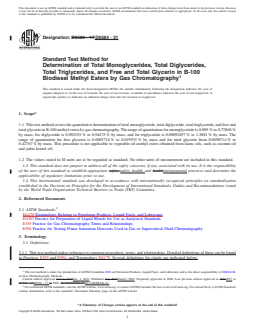
1.1 This test method covers the quantitative determination of total monoglyceride, total diglyceride, total triglyceride, and free and total glycerin in B-100 methyl esters by gas chromatography. The range of quantitation for monoglyceride is 0.009 % to 0.77860 % by mass, for diglyceride is 0.092353 % to 0.54475 % by mass, and for triglyceride is 0.00092857 % to 1.3881 % by mass. The range of quantitation for free glycerin is 0.0005714 % to 0.019533 % by mass and for total glycerin from 0.0090714 % to 0.42767 % by mass. This procedure is not applicable to vegetable oil methyl esters obtained from lauric oils, such as coconut oil and palm kernel oil.
1.2 The values stated in SI units are to be regarded as standard. No other units of measurement are included in this standard.
1.3 This standard does not purport to address all of the safety concerns, if any, associated with its use. It is the responsibility of the user of this standard to establish appropriate safety, health, and environmental practices and determine the applicability of regulatory limitations prior to use.
1.4 This international standard was developed in accordance with internationally recognized principles on standardization established in the Decision on Principles for the Development of International Standards, Guides and Recommendations issued by the World Trade Organization Technical Barriers to Trade (TBT) Committee.
- Status
- Published
- Publication Date
- 30-Nov-2021
- Technical Committee
- D02 - Petroleum Products, Liquid Fuels, and Lubricants
- Drafting Committee
- D02.04.0L - Gas Chromatography Methods
Buy Documents
ASTM D6584-21 - Standard Test Method for Determination of Total Monoglycerides, Total Diglycerides, Total Triglycerides, and Free and Total Glycerin in B-100 Biodiesel Methyl Esters by Gas Chromatography
REDLINE ASTM D6584-21 - Standard Test Method for Determination of Total Monoglycerides, Total Diglycerides, Total Triglycerides, and Free and Total Glycerin in B-100 Biodiesel Methyl Esters by Gas Chromatography
Overview
ASTM D6584-21 is a standardized test method published by ASTM International for the determination of total monoglycerides, total diglycerides, total triglycerides, and free and total glycerin in B-100 biodiesel methyl esters using gas chromatography. Monitoring these components is critical for assessing biodiesel quality, as excessive glycerin and glyceride content can negatively impact performance and storage. This standard outlines procedures to identify and measure these compounds with precision, supporting the production and certification of biodiesel fuels.
Key Topics
- Scope: The method applies to B-100 methyl esters derived from vegetable oils or animal fats, except for those produced from lauric oils like coconut or palm kernel oil. It utilizes gas chromatography with specific calibration and operating conditions.
- Quantitative Ranges:
- Monoglycerides: 0.009% – 0.77860% by mass
- Diglycerides: 0.092353% – 0.54475% by mass
- Triglycerides: 0.00092857% – 1.3881% by mass
- Free Glycerin: 0.0005714% – 0.019533% by mass
- Total Glycerin: 0.0090714% – 0.42767% by mass
- Gas Chromatography: The test method specifies analytical parameters, including use of a cool on-column injection, detection by flame ionization, and the application of internal standards for calibration.
- Significance:
- High free glycerin may cause separation or storage issues in biodiesel.
- High total glycerin contributes to injector fouling and deposit formation in fuel systems.
Applications
The ASTM D6584-21 standard is widely used in the biodiesel industry for:
- Quality Assurance: Ensuring biodiesel (B-100) meets regulatory and industrial purity standards regarding glycerin and glyceride levels.
- Production Control: Monitoring process efficiency in transesterification and post-processing steps by quantifying residual glycerides and glycerin.
- Product Certification: Supporting compliance with national and international biodiesel fuel specifications by providing traceable analysis.
- Troubleshooting: Identifying contamination or production faults that lead to excessive glycerin or glyceride levels, which can result in injector clogging, incomplete combustion, or deposit build-up in engines.
- Research and Development: Assisting in the evaluation of new production methods, feedstocks, or additives and their impact on the purity of biodiesel.
Related Standards
The following standards are often referenced in conjunction with ASTM D6584-21 for a comprehensive approach to biodiesel analysis:
- ASTM D4175 - Terminology Relating to Petroleum Products, Liquid Fuels, and Lubricants
- ASTM D4307 - Practice for Preparation of Liquid Blends for Use as Analytical Standards
- ASTM E355 - Practice for Gas Chromatography Terms and Relationships
- ASTM E594 - Practice for Testing Flame Ionization Detectors Used in Gas or Supercritical Fluid Chromatography
These documents provide essential terminology, calibration guidelines, and technical practices for laboratories performing biodiesel analysis.
Keywords: ASTM D6584-21, biodiesel quality, monoglycerides, diglycerides, triglycerides, free glycerin, total glycerin, gas chromatography, B-100 biodiesel, biodiesel methyl esters, fuel system deposits, quality control, biodiesel standards.
Relations
- Refers
ASTM D4175-23a - Standard Terminology Relating to Petroleum Products, Liquid Fuels, and Lubricants - Effective Date
- 15-Dec-2023
- Refers
ASTM D4175-23e1 - Standard Terminology Relating to Petroleum Products, Liquid Fuels, and Lubricants - Effective Date
- 01-Jul-2023
- Effective Date
- 01-Sep-2019
- Effective Date
- 01-Oct-2015
- Effective Date
- 01-Nov-2011
- Effective Date
- 01-May-2010
- Effective Date
- 01-Mar-2007
- Effective Date
- 01-Mar-2006
- Effective Date
- 01-May-2004
- Effective Date
- 01-Jan-2001
- Effective Date
- 01-Jan-2001
- Effective Date
- 01-Jan-2001
- Effective Date
- 01-Jan-2001
- Refers
ASTM D4307-99 - Standard Practice for Preparation of Liquid Blends for Use as Analytical Standards - Effective Date
- 10-Nov-1999
Buy Documents
ASTM D6584-21 - Standard Test Method for Determination of Total Monoglycerides, Total Diglycerides, Total Triglycerides, and Free and Total Glycerin in B-100 Biodiesel Methyl Esters by Gas Chromatography
REDLINE ASTM D6584-21 - Standard Test Method for Determination of Total Monoglycerides, Total Diglycerides, Total Triglycerides, and Free and Total Glycerin in B-100 Biodiesel Methyl Esters by Gas Chromatography
Get Certified
Connect with accredited certification bodies for this standard

Element Materials Technology
Materials testing and product certification.

ABS Group Brazil
ABS Group certification services in Brazil.

ABS Quality Evaluations Inc.
American Bureau of Shipping quality certification.
Sponsored listings
Frequently Asked Questions
ASTM D6584-21 is a standard published by ASTM International. Its full title is "Standard Test Method for Determination of Total Monoglycerides, Total Diglycerides, Total Triglycerides, and Free and Total Glycerin in B-100 Biodiesel Methyl Esters by Gas Chromatography". This standard covers: SIGNIFICANCE AND USE 5.1 Free and bonded glycerin content reflects the quality of biodiesel. A high content of free glycerin may cause problems during storage, or in the fuel system, due to separation of the glycerin. A high total glycerin content can lead to injector fouling and may also contribute to the formation of deposits at injection nozzles, pistons, and valves. SCOPE 1.1 This test method covers the quantitative determination of total monoglyceride, total diglyceride, total triglyceride, and free and total glycerin in B-100 methyl esters by gas chromatography. The range of quantitation for monoglyceride is 0.009 % to 0.77860 % by mass, for diglyceride is 0.092353 % to 0.54475 % by mass, and for triglyceride is 0.00092857 % to 1.3881 % by mass. The range of quantitation for free glycerin is 0.0005714 % to 0.019533 % by mass and for total glycerin from 0.0090714 % to 0.42767 % by mass. This procedure is not applicable to vegetable oil methyl esters obtained from lauric oils, such as coconut oil and palm kernel oil. 1.2 The values stated in SI units are to be regarded as standard. No other units of measurement are included in this standard. 1.3 This standard does not purport to address all of the safety concerns, if any, associated with its use. It is the responsibility of the user of this standard to establish appropriate safety, health, and environmental practices and determine the applicability of regulatory limitations prior to use. 1.4 This international standard was developed in accordance with internationally recognized principles on standardization established in the Decision on Principles for the Development of International Standards, Guides and Recommendations issued by the World Trade Organization Technical Barriers to Trade (TBT) Committee.
SIGNIFICANCE AND USE 5.1 Free and bonded glycerin content reflects the quality of biodiesel. A high content of free glycerin may cause problems during storage, or in the fuel system, due to separation of the glycerin. A high total glycerin content can lead to injector fouling and may also contribute to the formation of deposits at injection nozzles, pistons, and valves. SCOPE 1.1 This test method covers the quantitative determination of total monoglyceride, total diglyceride, total triglyceride, and free and total glycerin in B-100 methyl esters by gas chromatography. The range of quantitation for monoglyceride is 0.009 % to 0.77860 % by mass, for diglyceride is 0.092353 % to 0.54475 % by mass, and for triglyceride is 0.00092857 % to 1.3881 % by mass. The range of quantitation for free glycerin is 0.0005714 % to 0.019533 % by mass and for total glycerin from 0.0090714 % to 0.42767 % by mass. This procedure is not applicable to vegetable oil methyl esters obtained from lauric oils, such as coconut oil and palm kernel oil. 1.2 The values stated in SI units are to be regarded as standard. No other units of measurement are included in this standard. 1.3 This standard does not purport to address all of the safety concerns, if any, associated with its use. It is the responsibility of the user of this standard to establish appropriate safety, health, and environmental practices and determine the applicability of regulatory limitations prior to use. 1.4 This international standard was developed in accordance with internationally recognized principles on standardization established in the Decision on Principles for the Development of International Standards, Guides and Recommendations issued by the World Trade Organization Technical Barriers to Trade (TBT) Committee.
ASTM D6584-21 is classified under the following ICS (International Classification for Standards) categories: 75.160.20 - Liquid fuels. The ICS classification helps identify the subject area and facilitates finding related standards.
ASTM D6584-21 has the following relationships with other standards: It is inter standard links to ASTM D4175-23a, ASTM D4175-23e1, ASTM E594-96(2019), ASTM D4307-99(2015), ASTM E594-96(2011), ASTM D4307-99(2010), ASTM E355-96(2007), ASTM E594-96(2006), ASTM D4307-99(2004), ASTM E594-96, ASTM E594-96(2001), ASTM E355-96, ASTM E355-96(2001), ASTM D4307-99. Understanding these relationships helps ensure you are using the most current and applicable version of the standard.
ASTM D6584-21 is available in PDF format for immediate download after purchase. The document can be added to your cart and obtained through the secure checkout process. Digital delivery ensures instant access to the complete standard document.
Standards Content (Sample)
This international standard was developed in accordance with internationally recognized principles on standardization established in the Decision on Principles for the
Development of International Standards, Guides and Recommendations issued by the World Trade Organization Technical Barriers to Trade (TBT) Committee.
Designation: D6584 − 21
Standard Test Method for
Determination of Total Monoglycerides, Total Diglycerides,
Total Triglycerides, and Free and Total Glycerin in B-100
Biodiesel Methyl Esters by Gas Chromatography
This standard is issued under the fixed designation D6584; the number immediately following the designation indicates the year of
original adoption or, in the case of revision, the year of last revision.Anumber in parentheses indicates the year of last reapproval.A
superscript epsilon (´) indicates an editorial change since the last revision or reapproval.
1. Scope* D4307Practice for Preparation of Liquid Blends for Use as
Analytical Standards
1.1 This test method covers the quantitative determination
E355PracticeforGasChromatographyTermsandRelation-
oftotalmonoglyceride,totaldiglyceride,totaltriglyceride,and
ships
free and total glycerin in B-100 methyl esters by gas chroma-
E594Practice for Testing Flame Ionization Detectors Used
tography. The range of quantitation for monoglyceride is
in Gas or Supercritical Fluid Chromatography
0.009% to 0.77860% by mass, for diglyceride is 0.092353 %
to 0.54475% by mass, and for triglyceride is 0.00092857% to
3. Terminology
1.3881% by mass. The range of quantitation for free glycerin
is 0.0005714% to 0.019533% by mass and for total glycerin
3.1 Definitions:
from 0.0090714% to 0.42767% by mass. This procedure is
3.1.1 This test method makes reference to common
not applicable to vegetable oil methyl esters obtained from
procedures, terms, and relationships. Detailed definitions of
lauric oils, such as coconut oil and palm kernel oil.
these can be found in Practices E355 and E594, andTerminol-
1.2 The values stated in SI units are to be regarded as
ogy D4175. Several definitions for clarity are indicated below:
standard. No other units of measurement are included in this
3.1.2 biodiesel (B-100), n—fuel comprised of mono-alkyl
standard.
esters of long chain fatty acids derived from vegetable oils or
1.3 This standard does not purport to address all of the
animal fats.
safety concerns, if any, associated with its use. It is the
3.1.3 bonded glycerin, n—glycerin portion of the mono-,
responsibility of the user of this standard to establish appro-
di-, and triglyceride molecules.
priate safety, health, and environmental practices and deter-
mine the applicability of regulatory limitations prior to use. 3.2 Definitions of Terms Specific to This Standard:
1.4 This international standard was developed in accor-
3.2.1 total glycerin, n—sum of free and bonded glycerin.
dance with internationally recognized principles on standard-
ization established in the Decision on Principles for the
4. Summary of Test Method
Development of International Standards, Guides and Recom-
4.1 The sample is analyzed by gas chromatography, after
mendations issued by the World Trade Organization Technical
silyating with N-methyl-N-trimethylsilyltrifluoracetamide
Barriers to Trade (TBT) Committee.
(MSTFA). Calibration is achieved by the use of two internal
2. Referenced Documents
standardsandfourreferencematerials.Mono-,di-,andtriglyc-
eride are determined by comparing to monoolein, diolein, and
2.1 ASTM Standards:
triolein standards respectively. Average conversion factors are
D4175Terminology Relating to Petroleum Products, Liquid
appliedtomono-,di-,andtriglyceridestocalculatethebonded
Fuels, and Lubricants
glycerin content of the sample.
This test method is under the jurisdiction of ASTM Committee D02 on
5. Significance and Use
Petroleum Products, Liquid Fuels, and Lubricants and is the direct responsibility of
D02.04.0L on Gas Chromatography Methods.
5.1 Free and bonded glycerin content reflects the quality of
Current edition approved Dec. 1, 2021. Published January 2022. Originally
biodiesel.Ahigh content of free glycerin may cause problems
approved in 2000. Last previous edition approved in 2017 as D6584–17. DOI:
10.1520/D6584-21.
during storage, or in the fuel system, due to separation of the
For referenced ASTM standards, visit the ASTM website, www.astm.org, or
glycerin. A high total glycerin content can lead to injector
contact ASTM Customer Service at service@astm.org. For Annual Book of ASTM
fouling and may also contribute to the formation of deposits at
Standards volume information, refer to the standard’s Document Summary page on
the ASTM website. injection nozzles, pistons, and valves.
*A Summary of Changes section appears at the end of this standard
Copyright © ASTM International, 100 Barr Harbor Drive, PO Box C700, West Conshohocken, PA 19428-2959. United States
D6584 − 21
TABLE 1 Operating Conditions TABLE 2 Stock Solutions
Injector Approximate Volumetric
Cool on column injection Compound CAS No. Mass (mg) Flask Size
Sample size 1 µL (mL)
Column Temperature Program Glycerin 56-81-5 25 50
Initial temperature 50 °C hold 1 min 1-Mono [cis-9-octadecenoyl]-rac- 111-03-5 50 10
glycerol (monoolein)
Rate 1 15 °C / min to 180 °C
Rate 2 7 °C / min to 230 °C 1,3-Di [cis-octadecenoyl]glycerol 2465-32-9 50 10
(diolein)
Rate 3 30 °C / min 380 °C hold 10 min
Defector 1,2,3-Tri [cis-octadecenoyl]glycerol 122-32-7 50 10
(triolein)
Type Flame ionization
Temperature 380 °C (S) - (-) -1,2,4-Butanetriol - (Internal 42890-76-6 25 25
Carrier Gas Standard 1)
1,2,3-Tridecanolylglycerol (tricaprin) - 621-71-6 80 10
Type Hydrogen or helium measured at
50 °C (Internal Standard 2)
Flow rate 3 mL/min
7.3 N-Methyl-N-trimethylsilyltrifluoroacetamide (MSTFA),
6. Apparatus
reagent grade.
6.1 Chromatographic System—See Practice E355 for spe-
7.4 Pyridine, reagent grade.
cific designations and definitions.
6.1.1 Gas Chromatograph (GC)—The system must be ca-
7.5 Carrier Gas, hydrogen or helium of high purity. Addi-
pable of operating at the conditions given in Table 1.
tional purification is recommended by the use of molecular
6.1.2 Column, open tubular column with a 5% phenylpo-
sieves or other suitable agents to remove water, oxygen, and
lydimethylsiloxane bonded and cross linked phase internal
hydrocarbons.Availablepressuremustbesufficienttoensurea
coating.Thecolumnshouldhaveanuppertemperaturelimitof
constant carrier gas flow rate.
at least 400°C. Columns, either 10m or 15m in length, with
7.6 Microlitre Syringes, 100µL and 250µL capacity.
a 0.32mm internal diameter, and a 0.1µm film thickness have
7.7 Screw Cap Vials, with polytetrafluoroethylene (PTFE)-
been found satisfactory.Any column with better or equivalent
faced septa, 10mL capacity.
chromatographic efficiency and selectivity can be used. It is
recommended that a 2m to 5m-0.53mm high temperature
8. Preparation of Apparatus
guard column be installed from the injector to the analytical
column.Thisallowstheuseofautoinjectorsandalsoincreases
8.1 Install and condition the column in accordance with
column life.
manufacturer or supplier’s instructions. After conditioning,
attach column outlet to flame ionization detector inlet and
6.2 Electronic Data Acquisition System:
check for leaks throughout the system. If leaks are found,
6.2.1 IntegratororComputer,capableofprovidingrealtime
tightenorreplacefittingsandrecheckforleaksbeforeproceed-
graphic and digital presentation of the chromatographic data is
ing.
recommended for use. Peak areas and retention times shall be
measured by computer or electronic integration.
9. Calibration and Standardization
6.2.2 This device must be capable of performing multilevel
internal-standard-type calibrations and be able to calculate the
9.1 Preparation of Calibration Standards—Prepare stan-
correlation coefficient (r ) and internal standard calculations
dards using fresh compounds listed in Table 2 according to
for each data set.
Practice D4307. Weigh the components directly into the
volumetric flasks specified and record the mass to the nearest
7. Reagents and Materials
0.1 mg. Dilute the volumetric flasks to mark with pyridine.
Storethecalibrationstandardsinarefrigeratorwhennotinuse.
7.1 Purity of Reagents—Reagent grade chemicals shall be
used in all tests. Unless otherwise indicated, it is intended that
9.2 Standard Solutions—Prepare the five standard solutions
all reagents conform to the specifications of the Committee on
in Table 3 by transferring the specified volumes by means of
Analytical Reagents of theAmerican Chemical Society where
microlitresyringesto10mLseptavials.Addtoeachofthefive
such specifications are available. Other grades may be used
standardsolutions100µLofMSTFA.Closethevialandshake.
provided it is first ascertained that the reagent is of sufficient
Allow the vial to stand for 15min to 20min at room tempera-
purity to permit its use without lessening the accuracy of the
ture.Addapproximately8mLn-Heptanetothevialandshake.
determination.
9.3 Chromatographic Analysis—If using an automatic
7.2 n-Heptane, reagent grade.
sampler, transfer an aliquot of the solution into a glass GC vial
and seal with a TFE-fluorocarbonlined cap.
9.4 Standardization—Analyze the calibration standards un-
ACS Reagent Chemicals, Specifications and Procedures for Reagents and
Standard-Grade Reference Materials, American Chemical Society, Washington,
der the same operating conditions as the sample solutions.
DC. For suggestions on the testing of reagents not listed by theAmerican Chemical
Inject 1µL of the reaction mixture into the cool on-column
Society, see Analar Standards for Laboratory Chemicals, BDH Ltd., Poole, Dorset,
injection port and start the analysis. Obtain a chromatogram
U.K., and the United States Pharmacopeia and National Formulary, U.S. Pharma-
copeial Convention, Inc. (USPC), Rockville, MD. and peak integration report. For each reference substance,
D6584 − 21
TABLE 3 Standard Solutions TABLE 4 Approximate Relative Retention Times
Standard Solution Number 1 2 3 4 5 Component Use Internal Relative Retention
µL of glycerin stock solution 10 30 50 70 100 Standard Time
µL of monoolein stock solution 20 50 100 150 200
Glycerin 1 0.85
µL of diolein stock solution 10 20 40 70 100
1,2,4 Butanetriol 1.00
µL of triolein stock solution 10 20 40 70 100
Internal Standard 1
µL of butanetriol stock solution 100 100 100 100 100
Monopalmitin 2 0.76
µL of tricaprin stock solution 100 100 100 100 100
Monoolein, monolinolein 2 0.83-0.86
monolinolenin, and monostearin
Tricaprin 1.00
Internal Standard 2
Diglycerides 2 1.05-1.09
determine the response ratio (rsp) and amount ratio (amt) for
i i
Triglycerides 2 1.16-1.31
each component using Eq 1 and 2.
rsp 5 A /A (1)
~ !
i i s
where:
Using microlitre syringes, add exactly 100µL of each internal
A = area of reference substance, and
i
standard and MSTFA. Shake the vials, and allow to set for
A = area of internal standard.
s
15min to 20min at room temperature. Add approximately
amt 5 ~W /W ! (2)
8mL of n-Heptane to the vial and shake.
i i s
where: 10.2 Inject 1µL of the reaction mixture into the cool
on-column injection port and start the analysis. Obtain a
W = mass of reference substance, and
i
chromatogram and peak integration report.
W = mass of internal standard.
s
10.3 Peak Identification—Identify peaks by comparison of
9.4.1 Prepare a calibration curve for each reference compo-
retentiontimestothestandards.Foridentificationofadditional
nent by plotting the response ratios (rsp), as the y-axis, versus
i
peaks, use the relative retention times given in Table 4 and the
the amount ratios (amt), as the x-axis.
i
reference chromatograms given in Fig. 1. Mono-, di-, and
9.5 Calculate the correlation coefficient r value for each
triglycerides are separated according to carbon numbers (CN).
reference component in the calibration set using Eq 3. The r
10.4 Monoglyceride consists of the four overlapping peaks
valueshouldbeatleast0.99orgreater.Iftheabovecriteriafor
with relative retention times (RRT) of 0.76 and 0.83 to 0.86
r are not met, rerun the calibration or check instrument
with respect to the internal standard tricaprin.Apair of peaks,
parameters and hardware.
methyl esters with a carbon number of 24, may appear with
~ xy!
(
2 RRT of 0.80 to 0.82, and should not be included in the
r 5 (3)
2 2
~ x !~ y !
( ( calculation of monoglyceride.
where:
10.5 Diglyceride is also primarily separated according to
carbon number, but due to varying double bonds in the
x 5 X 2 x¯ (4)
i
molecules,baselineresolutionofthepeaksdoesnotoccur.The
y 5 Y 2 y¯ (5)
i
grouping of 3 to 4 peaks with RRTof 1.05 to 1.09 (CN 34, 36,
and: and 38) shall be attributed to diglyceride. Carbon number also
separates triglyceride. Peaks with RRTof 1.16 to 1.31 (CN 52,
X = amt ratio data point,
i i
54, 56, and 58) should be included in the calculation.
x¯ = average values for all amt data points
i
Y = corresponding rsp data points,
i i
11. Calculation a
...
This document is not an ASTM standard and is intended only to provide the user of an ASTM standard an indication of what changes have been made to the previous version. Because
it may not be technically possible to adequately depict all changes accurately, ASTM recommends that users consult prior editions as appropriate. In all cases only the current version
of the standard as published by ASTM is to be considered the official document.
Designation: D6584 − 17 D6584 − 21
Standard Test Method for
Determination of Total Monoglycerides, Total Diglycerides,
Total Triglycerides, and Free and Total Glycerin in B-100
Biodiesel Methyl Esters by Gas Chromatography
This standard is issued under the fixed designation D6584; the number immediately following the designation indicates the year of
original adoption or, in the case of revision, the year of last revision. A number in parentheses indicates the year of last reapproval. A
superscript epsilon (´) indicates an editorial change since the last revision or reapproval.
1. Scope*
1.1 This test method covers the quantitative determination of total monoglyceride, total diglyceride, total triglyceride, and free and
total glycerin in B-100 methyl esters by gas chromatography. The range of quantitation for monoglyceride is 0.009 % to 0.77860 %
by mass, for diglyceride is 0.092353 % to 0.54475 % by mass, and for triglyceride is 0.00092857 % to 1.3881 % by mass. The
range of quantitation for free glycerin is 0.0005714 % to 0.019533 % by mass and for total glycerin from 0.0090714 % to
0.42767 % by mass. This procedure is not applicable to vegetable oil methyl esters obtained from lauric oils, such as coconut oil
and palm kernel oil.
1.2 The values stated in SI units are to be regarded as standard. No other units of measurement are included in this standard.
1.3 This standard does not purport to address all of the safety concerns, if any, associated with its use. It is the responsibility
of the user of this standard to establish appropriate safety safety, health, and healthenvironmental practices and determine the
applicability of regulatory limitations prior to use.
1.4 This international standard was developed in accordance with internationally recognized principles on standardization
established in the Decision on Principles for the Development of International Standards, Guides and Recommendations issued
by the World Trade Organization Technical Barriers to Trade (TBT) Committee.
2. Referenced Documents
2.1 ASTM Standards:
D4175 Terminology Relating to Petroleum Products, Liquid Fuels, and Lubricants
D4307 Practice for Preparation of Liquid Blends for Use as Analytical Standards
E355 Practice for Gas Chromatography Terms and Relationships
E594 Practice for Testing Flame Ionization Detectors Used in Gas or Supercritical Fluid Chromatography
3. Terminology
3.1 Definitions:
3.1.1 This test method makes reference to common procedures, terms, and relationships. Detailed definitions of these can be found
in Practices E355 and E594, and Terminology D4175. Several definitions for clarity are indicated below:
This test method is under the jurisdiction of ASTM Committee D02 on Petroleum Products, Liquid Fuels, and Lubricants and is the direct responsibility of D02.04.0L
on Gas Chromatography Methods.
Current edition approved June 1, 2017Dec. 1, 2021. Published July 2017January 2022. Originally approved in 2000. Last previous edition approved in 20132017 as
ε1
D6584 – 13D6584 – 17. . DOI: 10.1520/D6584-17.10.1520/D6584-21.
For referenced ASTM standards, visit the ASTM website, www.astm.org, or contact ASTM Customer Service at service@astm.org. For Annual Book of ASTM Standards
volume information, refer to the standard’s Document Summary page on the ASTM website.
*A Summary of Changes section appears at the end of this standard
Copyright © ASTM International, 100 Barr Harbor Drive, PO Box C700, West Conshohocken, PA 19428-2959. United States
D6584 − 21
TABLE 1 Operating Conditions
Injector
Cool on column injection
Sample size 1 μL
Column Temperature Program
Initial temperature 50 °C hold 1 min
Rate 1 15 °C / min to 180 °C
Rate 2 7 °C / min to 230 °C
Rate 3 30 °C / min 380 °C hold 10 min
Defector
Type Flame ionization
Temperature 380 °C
Carrier Gas
Type Hydrogen or helium measured at
50 °C
Flow rate 3 mL/min
3.1.2 biodiesel (B-100), n—fuel comprised of mono-alkyl esters of long chain fatty acids derived from vegetable oils or animal
fats.
3.1.3 bonded glycerin, n—glycerin portion of the mono-, di-, and triglyceride molecules.
3.2 Definitions of Terms Specific to This Standard:
3.2.1 total glycerin, n—sum of free and bonded glycerin.
3.3 This test method makes reference to many common gas chromatographic procedures, terms, and relationships. Detailed
definitions can be found in Practices E355 and E594.
4. Summary of Test Method
4.1 The sample is analyzed by gas chromatography, after silyating with N-methyl-N-trimethylsilyltrifluoracetamide (MSTFA).
Calibration is achieved by the use of two internal standards and four reference materials. Mono-, di-, and triglyceride are
determined by comparing to monoolein, diolein, and triolein standards respectively. Average conversion factors are applied to
mono-, di-, and triglycerides to calculate the bonded glycerin content of the sample.
5. Significance and Use
5.1 Free and bonded glycerin content reflects the quality of biodiesel. A high content of free glycerin may cause problems during
storage, or in the fuel system, due to separation of the glycerin. A high total glycerin content can lead to injector fouling and may
also contribute to the formation of deposits at injection nozzles, pistons, and valves.
6. Apparatus
6.1 Chromatographic System—See Practice E355 for specific designations and definitions.
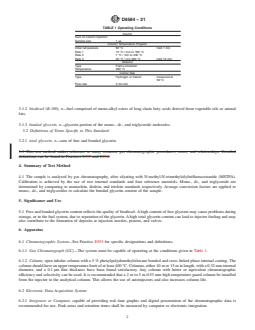
6.1.1 Gas Chromatograph (GC)—The system must be capable of operating at the conditions given in Table 1.
6.1.2 Column, open tubular column with a 5 % phenylpolydimethylsiloxane bonded and cross linked phase internal coating. The
column should have an upper temperature limit of at least 400 °C. Columns, either 10 m or 15 m in length, with a 0.32 mm internal
diameter, and a 0.1 μm film thickness have been found satisfactory. Any column with better or equivalent chromatographic
efficiency and selectivity can be used. It is recommended that a 2 m to 5 m-0.53 mm high temperature guard column be installed
from the injector to the analytical column. This allows the use of autoinjectors and also increases column life.
6.2 Electronic Data Acquisition System:
6.2.1 Integrator or Computer, capable of providing real time graphic and digital presentation of the chromatographic data is
recommended for use. Peak areas and retention times shall be measured by computer or electronic integration.
D6584 − 21
TABLE 2 Stock Solutions
Approximate Volumetric
Compound CAS No. Mass (mg) Flask Size
(mL)
Glycerin 56-81-5 25 50
1-Mono [cis-9-octadecenoyl]-rac- 111-03-5 50 10
glycerol (monoolein)
1,3-Di [cis-octadecenoyl]glycerol 2465-32-9 50 10
(diolein)
1,2,3-Tri [cis-octadecenoyl]glycerol 122-32-7 50 10
(triolein)
(S) - (-) -1,2,4-Butanetriol - (Internal 42890-76-6 25 25
Standard 1)
1,2,3-Tridecanolylglycerol (tricaprin) - 621-71-6 80 10
(Internal Standard 2)
6.2.2 This device must be capable of performing multilevel internal-standard-type calibrations and be able to calculate the
correlation coefficient (r ) and internal standard calculations for each data set.
7. Reagents and Materials
7.1 Purity of Reagents—Reagent grade chemicals shall be used in all tests. Unless otherwise indicated, it is intended that all
reagents conform to the specifications of the Committee on Analytical Reagents of the American Chemical Society where such
specifications are available. Other grades may be used provided it is first ascertained that the reagent is of sufficient purity to
permit its use without lessening the accuracy of the determination.
7.2 n-Heptane, reagent grade.
7.3 N-Methyl-N-trimethylsilyltrifluoroacetamide (MSTFA), reagent grade.
7.4 Pyridine, reagent grade.
7.5 Carrier Gas, hydrogen or helium of high purity. Additional purification is recommended by the use of molecular sieves or
other suitable agents to remove water, oxygen, and hydrocarbons. Available pressure must be sufficient to ensure a constant carrier
gas flow rate.
7.6 Microlitre Syringes, 100 μL and 250 μL capacity.
7.7 Screw Cap Vials, with polytetrafluoroethylene (PTFE)-faced septa, 10 mL capacity.
8. Preparation of Apparatus
8.1 Install and condition the column in accordance with manufacturer or supplier’s instructions. After conditioning, attach column
outlet to flame ionization detector inlet and check for leaks throughout the system. If leaks are found, tighten or replace fittings
and recheck for leaks before proceeding.
9. Calibration and Standardization
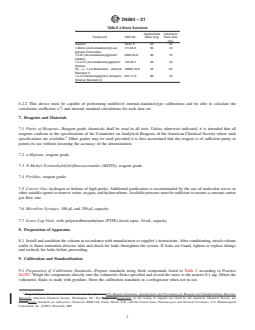
9.1 Preparation of Calibration Standards—Prepare standards using fresh compounds listed in Table 2 according to Practice
D4307. Weigh the components directly into the volumetric flasks specified and record the mass to the nearest 0.1 mg. Dilute the
volumetric flasks to mark with pyridine. Store the calibration standards in a refrigerator when not in use.
Reagent Chemicals, American Chemical Society Specifications,ACS Reagent Chemicals, Specifications and Procedures for Reagents and Standard-Grade Reference
Materials, American Chemical Society, Washington, DC. For Suggestionssuggestions on the testing of reagents not listed by the American Chemical Society, see
AnnualAnalar Standards for Laboratory Chemicals, BDH Ltd., Poole, Dorset, U.K., and the United States Pharmacopeia and National Formulary, U.S. Pharmacopeial
Convention, Inc. (USPC), Rockville, MD.
D6584 − 21
TABLE 3 Standard Solutions
Standard Solution Number 1 2 3 4 5
μL of glycerin stock solution 10 30 50 70 100
μL of monoolein stock solution 20 50 100 150 200
μL of diolein stock solution 10 20 40 70 100
μL of triolein stock solution 10 20 40 70 100
μL of butanetriol stock solution 100 100 100 100 100
μL of tricaprin stock solution 100 100 100 100 100
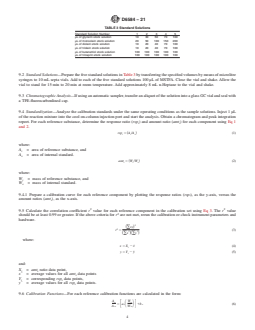
9.2 Standard Solutions—Prepare the five standard solutions in Table 3 by transferring the specified volumes by means of microlitre
syringes to 10 mL septa vials. Add to each of the five standard solutions 100 μL of MSTFA. Close the vial and shake. Allow the
vial to stand for 15 min to 20 min at room temperature. Add approximately 8 mL n-Heptane to the vial and shake.
9.3 Chromatographic Analysis—If using an automatic sampler, transfer an aliquot of the solution into a glass GC vial and seal with
a TFE-fluorocarbonlined cap.
9.4 Standardization—Analyze the calibration standards under the same operating conditions as the sample solutions. Inject 1 μL
of the reaction mixture into the cool on-column injection port and start the analysis. Obtain a chromatogram and peak integration
report. For each reference substance, determine the response ratio (rsp ) and amount ratio (amt ) for each component using Eq 1
i i
and 2.
rsp 5 ~A /A ! (1)
i i s
where:
A = area of reference substance, and
i
A = area of internal standard.
s
amt 5 ~W /W ! (2)
i i s
where:
W = mass of reference substance, and
i
W = mass of internal standard.
s
9.4.1 Prepare a calibration curve for each reference component by plotting the response ratios (rsp ), as the y-axis, versus the
i
amount ratios (amt ), as the x-axis.
i
2 2
9.5 Calculate the correlation coefficient r value for each reference component in the calibration set using Eq 3. The r value
should be at least 0.99 or greater. If the above criteria for r are not met, rerun the calibration or check instrument parameters and
hardware.
~ xy!
(
r 5 (3)
2 2
~ x !~ y !
( (
where:
x 5 X 2 x¯ (4)
i
y 5 Y 2 y¯ (5)
i
and:
X = amt ratio data point,
i i
x¯ = average values for all amt data points
i
Y = corresponding rsp data points,
i i
y¯ = average values for all rsp data points.
i
9.6 Calibration Functions—For each reference calibration functions are calculated in the form:
A W
x x
5 a 1b (6)
F S DG
x x
A W
is is
D6584 − 21
TABLE 4 Approximate Relative Retention Times
Component Use Internal Relative Retention
Standard Time
Glycerin 1 0.85
1,2,4 Butanetriol 1.00
Internal Standard 1
Monopalmitin 2 0.76
Monoolein, monolinolein 2 0.83-0.86
monolinolenin, and monostearin
Tricaprin 1.00
Internal Standard 2
Diglycerides 2 1.05-1.09
Triglycerides 2 1.16-1.31
where:
W = mass of reference substance, mg,
x
W = mass of internal standard, mg,
is
A = peak area of reference substance,
x
A = peak area of internal standard,
is
a = slope of the calibration function, and
x
b = intercept of the calibration function.
x
10. Procedure
10.1 Set the instrument operating variables to the values specified in Table 1. Weigh to the nearest 0.1 mg approximately 100 mg
of sample directly into a 10 mL septa vial. Using microlitre syringes, add exactly 100 μL of each internal standard and MSTFA.
Shake the vials, and allow to set for 15 min to 20 min at room temperature. Add approximately 8 mL of n-Heptane to the vial and
shake.
10.2 Inject 1 μL of the reaction mixture into the cool on-column injection port and start the analysis. Obtain a chromatogram and
peak integration report.
10.3 Peak Identification—Identify peaks by comparison of retention times to the standards. For identification of additional peaks,
use the relative retention times given in Table 4 and the reference chromatograms given in Fig. 1. Mono-, di-, and
...