

ASTM A763-15(2021)
(Practice)Standard Practices for Detecting Susceptibility to Intergranular Attack in Ferritic Stainless Steels
General Information
- Abstract
ABSTRACT
This practices covers the detecting susceptibility to intergranular attack in ferritic stainless steel. Different method of preparing steel test specimens are presented. Four practices, including Practice W, X, Y, and Z, are used for determining susceptibility to intergranular attack in ferritic stainless steel. These practices cover the following tests; oxalic acid etch test, ferritic sulphate-sulfuric acid test, copper-copper sulphate-50% sulfuric acid test, and copper-copper sulphate-16% sulfuric acid test. Test specimens shall be examined for the ferritic sulphate-sulfuric acid test and copper-copper sulphate-50% sulphuric acid test under a binocular microscope at 40x magnification. The bend test evaluations for the steel test specimens are presented.
SCOPE
1.1 These practices cover the following four tests:
1.1.1 Practice W—Oxalic acid etch test for detecting susceptibility to intergranular attack in stabilized ferritic stainless steels by classification of the etching structures (see Sections 3 – 10).
1.1.2 Practice X—Ferric sulfate-sulfuric acid test for detecting susceptibility to intergranular attack in ferritic stainless steels (Sections 11 – 16).
1.1.3 Practice Y—Copper-copper sulfate-50 % sulfuric acid test for detecting susceptibility to intergranular attack in ferritic stainless steels (Sections 17 – 22).
1.1.4 Practice Z—Copper-copper sulfate-16 % sulfuric acid test for detecting susceptibility to intergranular attack in ferritic stainless steels (Sections 23 – 29).
1.2 The following factors govern the application of these practices (1-6):2
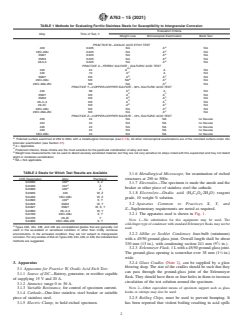
1.2.1 Practice W, oxalic acid test, is a rapid method of identifying, by simple electrolytic etching, those specimens of certain ferritic alloys that are not susceptible to intergranular corrosion associated with chromium carbide precipitation. Practice W is used as a screening test to avoid the necessity, for acceptable specimens, of more extensive testing required by Practices X, Y, and Z. See Table 1 for a listing of alloys for which Practice W is appropriate.
1.2.2 Practices X, Y, and Z can be used to detect the susceptibility of certain ferritic alloys to intergranular attack associated with the precipitation of chromium carbides or nitrides.
1.2.3 Practices W, X, Y, and Z can also be used to evaluate the effect of heat treatment or of fusion welding on susceptibility to intergranular corrosion.
1.2.4 Table 2 lists the identification ferritic stainless steels for which data on the application of at least one of the standard practices is available.
1.2.5 Some stabilized ferritic stainless steels may show high rates when tested by Practice X because of metallurgical factors not associated with chromium carbide or nitride precipitation. This possibility must be considered in selecting the test method. Combinations of alloys and test methods for which successful experience is available are shown in Table 1. Application of these standard tests to the other ferritic stainless steels will be by specific agreement between producer and user.
1.3 Depending on the test and alloy, evaluations may be accomplished by weight loss determination, microscopical examination, or bend test (Sections 30 and 31). The choices are listed in Table 1.
1.4 This standard does not purport to address all of the safety concerns, if any, associated with its use. It is the responsibility of the user of this standard to establish appropriate safety, health, and environmental practices and determine the applicability of regulatory limitations prior to use. For specific safety precautionary statements, see 3.2.5, Section 7, 13.1, and 19.1.
1.5 This international standard was developed in accordance with internationally recognized principles on standardization established in the Decision on Principles for the Development of International Standards, Guides and Recommendations issued by the World Trade Organization Technical Barriers to Trade...
- Status
- Published
- Publication Date
- 31-Aug-2021
- Technical Committee
- A01 - Steel, Stainless Steel and Related Alloys
- Drafting Committee
- A01.14 - Methods of Corrosion Testing
Overview
ASTM A763-15(2021) sets the standard practices for detecting susceptibility to intergranular attack in ferritic stainless steels. Developed by ASTM, this standard covers four established test methods used to assess the resistance of ferritic stainless steels to intergranular corrosion-a critical concern in quality assurance, manufacturing, and material selection within industries such as construction, automotive, chemical processing, and power generation.
Each test evaluates the effect of heat treatments, welding, and alloy composition on the potential for intergranular corrosion, a localized form of corrosion along grain boundaries typically caused by chromium carbide or nitride precipitation. Ensuring the integrity of stainless steel components using these standardized methods enables manufacturers and users to mitigate premature failures and extend the service life of critical assets.
Key Topics
ASTM A763-15(2021) encompasses four primary test practices:
Practice W - Oxalic Acid Etch Test
- A rapid screening test for stabilized ferritic stainless steels.
- Utilizes electrolytic etching to classify microstructures and identify susceptibility to intergranular corrosion related to chromium carbide precipitation.
- Effective for alloys listed as suitable in the standard.
Practice X - Ferric Sulfate-Sulfuric Acid Test
- Evaluates susceptibility to intergranular attack associated with chromium carbide or nitride precipitation.
- Suitable for both stabilized and unstabilized stainless steels.
Practice Y - Copper-Copper Sulfate-50% Sulfuric Acid Test
- Assesses susceptibility to intergranular attack, especially useful for certain high-purity and stabilized ferritic stainless steels.
Practice Z - Copper-Copper Sulfate-16% Sulfuric Acid Test
- Measures susceptibility in a variety of ferritic stainless steels, including assessment of heat treatments and weld zones.
Evaluation methods:
- Weight loss determination
- Microscopical examination (including grain dropping and structure classification)
- Bend test (detection of fissures indicating intergranular attack)
The choice of method depends on the type of alloy, fabrication process, and end-use requirement.
Applications
ASTM A763-15(2021) is widely used in various sectors where ferritic stainless steels are selected for corrosion resistance and structural durability:
- Quality Control: Manufacturers employ these practices to verify the corrosion resistance of incoming material or finished components.
- Weld Evaluation: Assess the impact of welding procedures on susceptibility to intergranular attack in fabricated parts.
- Heat Treatment Verification: Evaluate the effectiveness of heat treating and stabilization processes in minimizing intergranular corrosion risks.
- Product Certification: Ensure compliance with industry requirements for corrosion performance, especially in critical infrastructure or pressure-containing equipment.
- Failure Analysis: Aid in the investigation of component failures suspected to be associated with intergranular attack.
Adhering to ASTM A763 allows suppliers and end-users to reduce the risk of premature material degradation, maintain system reliability, and comply with material standards.
Related Standards
For comprehensive corrosion testing and material qualification, the following related standards are also relevant:
- ASTM A370: Test Methods and Definitions for Mechanical Testing of Steel Products
- ASTM A262: Standard Practices for Detecting Susceptibility to Intergranular Attack in Austenitic Stainless Steels
- EN ISO 3651-2: Ferritic, austenitic, and duplex stainless steels - Determination of resistance to intergranular corrosion
- ASTM G28: Standard Test Methods for Detecting Susceptibility to Intergranular Corrosion in Wrought, Nickel-Rich, Chromium-Bearing Alloys
By referencing and implementing these internationally recognized standards, organizations ensure robust testing protocols, global compliance, and enhanced material performance in corrosive environments.
Relations
- Effective Date
- 01-Mar-2024
- Effective Date
- 01-Jul-2019
- Refers
ASTM A370-17a - Standard Test Methods and Definitions for Mechanical Testing of Steel Products - Effective Date
- 15-Nov-2017
- Effective Date
- 01-Jan-2017
- Effective Date
- 01-Nov-2015
- Effective Date
- 15-May-2014
- Effective Date
- 15-Nov-2013
- Refers
ASTM A370-12a - Standard Test Methods and Definitions for Mechanical Testing of Steel Products - Effective Date
- 15-Oct-2012
- Effective Date
- 15-Mar-2012
- Refers
ASTM A370-11a - Standard Test Methods and Definitions for Mechanical Testing of Steel Products - Effective Date
- 15-Nov-2011
- Effective Date
- 15-Jun-2010
- Refers
ASTM A370-09a - Standard Test Methods and Definitions for Mechanical Testing of Steel Products - Effective Date
- 01-Jun-2009
- Refers
ASTM A370-09ae1 - Standard Test Methods and Definitions for Mechanical Testing of Steel Products - Effective Date
- 01-Jun-2009
- Effective Date
- 01-Jan-2009
- Refers
ASTM A370-08b - Standard Test Methods and Definitions for Mechanical Testing of Steel Products - Effective Date
- 15-Oct-2008
Get Certified
Connect with accredited certification bodies for this standard

Element Materials Technology
Materials testing and product certification.

Inštitut za kovinske materiale in tehnologije
Institute of Metals and Technology. Materials testing, metallurgical analysis, NDT.
Sponsored listings
Frequently Asked Questions
ASTM A763-15(2021) is a standard published by ASTM International. Its full title is "Standard Practices for Detecting Susceptibility to Intergranular Attack in Ferritic Stainless Steels". This standard covers: ABSTRACT This practices covers the detecting susceptibility to intergranular attack in ferritic stainless steel. Different method of preparing steel test specimens are presented. Four practices, including Practice W, X, Y, and Z, are used for determining susceptibility to intergranular attack in ferritic stainless steel. These practices cover the following tests; oxalic acid etch test, ferritic sulphate-sulfuric acid test, copper-copper sulphate-50% sulfuric acid test, and copper-copper sulphate-16% sulfuric acid test. Test specimens shall be examined for the ferritic sulphate-sulfuric acid test and copper-copper sulphate-50% sulphuric acid test under a binocular microscope at 40x magnification. The bend test evaluations for the steel test specimens are presented. SCOPE 1.1 These practices cover the following four tests: 1.1.1 Practice W—Oxalic acid etch test for detecting susceptibility to intergranular attack in stabilized ferritic stainless steels by classification of the etching structures (see Sections 3 – 10). 1.1.2 Practice X—Ferric sulfate-sulfuric acid test for detecting susceptibility to intergranular attack in ferritic stainless steels (Sections 11 – 16). 1.1.3 Practice Y—Copper-copper sulfate-50 % sulfuric acid test for detecting susceptibility to intergranular attack in ferritic stainless steels (Sections 17 – 22). 1.1.4 Practice Z—Copper-copper sulfate-16 % sulfuric acid test for detecting susceptibility to intergranular attack in ferritic stainless steels (Sections 23 – 29). 1.2 The following factors govern the application of these practices (1-6):2 1.2.1 Practice W, oxalic acid test, is a rapid method of identifying, by simple electrolytic etching, those specimens of certain ferritic alloys that are not susceptible to intergranular corrosion associated with chromium carbide precipitation. Practice W is used as a screening test to avoid the necessity, for acceptable specimens, of more extensive testing required by Practices X, Y, and Z. See Table 1 for a listing of alloys for which Practice W is appropriate. 1.2.2 Practices X, Y, and Z can be used to detect the susceptibility of certain ferritic alloys to intergranular attack associated with the precipitation of chromium carbides or nitrides. 1.2.3 Practices W, X, Y, and Z can also be used to evaluate the effect of heat treatment or of fusion welding on susceptibility to intergranular corrosion. 1.2.4 Table 2 lists the identification ferritic stainless steels for which data on the application of at least one of the standard practices is available. 1.2.5 Some stabilized ferritic stainless steels may show high rates when tested by Practice X because of metallurgical factors not associated with chromium carbide or nitride precipitation. This possibility must be considered in selecting the test method. Combinations of alloys and test methods for which successful experience is available are shown in Table 1. Application of these standard tests to the other ferritic stainless steels will be by specific agreement between producer and user. 1.3 Depending on the test and alloy, evaluations may be accomplished by weight loss determination, microscopical examination, or bend test (Sections 30 and 31). The choices are listed in Table 1. 1.4 This standard does not purport to address all of the safety concerns, if any, associated with its use. It is the responsibility of the user of this standard to establish appropriate safety, health, and environmental practices and determine the applicability of regulatory limitations prior to use. For specific safety precautionary statements, see 3.2.5, Section 7, 13.1, and 19.1. 1.5 This international standard was developed in accordance with internationally recognized principles on standardization established in the Decision on Principles for the Development of International Standards, Guides and Recommendations issued by the World Trade Organization Technical Barriers to Trade...
ABSTRACT This practices covers the detecting susceptibility to intergranular attack in ferritic stainless steel. Different method of preparing steel test specimens are presented. Four practices, including Practice W, X, Y, and Z, are used for determining susceptibility to intergranular attack in ferritic stainless steel. These practices cover the following tests; oxalic acid etch test, ferritic sulphate-sulfuric acid test, copper-copper sulphate-50% sulfuric acid test, and copper-copper sulphate-16% sulfuric acid test. Test specimens shall be examined for the ferritic sulphate-sulfuric acid test and copper-copper sulphate-50% sulphuric acid test under a binocular microscope at 40x magnification. The bend test evaluations for the steel test specimens are presented. SCOPE 1.1 These practices cover the following four tests: 1.1.1 Practice W—Oxalic acid etch test for detecting susceptibility to intergranular attack in stabilized ferritic stainless steels by classification of the etching structures (see Sections 3 – 10). 1.1.2 Practice X—Ferric sulfate-sulfuric acid test for detecting susceptibility to intergranular attack in ferritic stainless steels (Sections 11 – 16). 1.1.3 Practice Y—Copper-copper sulfate-50 % sulfuric acid test for detecting susceptibility to intergranular attack in ferritic stainless steels (Sections 17 – 22). 1.1.4 Practice Z—Copper-copper sulfate-16 % sulfuric acid test for detecting susceptibility to intergranular attack in ferritic stainless steels (Sections 23 – 29). 1.2 The following factors govern the application of these practices (1-6):2 1.2.1 Practice W, oxalic acid test, is a rapid method of identifying, by simple electrolytic etching, those specimens of certain ferritic alloys that are not susceptible to intergranular corrosion associated with chromium carbide precipitation. Practice W is used as a screening test to avoid the necessity, for acceptable specimens, of more extensive testing required by Practices X, Y, and Z. See Table 1 for a listing of alloys for which Practice W is appropriate. 1.2.2 Practices X, Y, and Z can be used to detect the susceptibility of certain ferritic alloys to intergranular attack associated with the precipitation of chromium carbides or nitrides. 1.2.3 Practices W, X, Y, and Z can also be used to evaluate the effect of heat treatment or of fusion welding on susceptibility to intergranular corrosion. 1.2.4 Table 2 lists the identification ferritic stainless steels for which data on the application of at least one of the standard practices is available. 1.2.5 Some stabilized ferritic stainless steels may show high rates when tested by Practice X because of metallurgical factors not associated with chromium carbide or nitride precipitation. This possibility must be considered in selecting the test method. Combinations of alloys and test methods for which successful experience is available are shown in Table 1. Application of these standard tests to the other ferritic stainless steels will be by specific agreement between producer and user. 1.3 Depending on the test and alloy, evaluations may be accomplished by weight loss determination, microscopical examination, or bend test (Sections 30 and 31). The choices are listed in Table 1. 1.4 This standard does not purport to address all of the safety concerns, if any, associated with its use. It is the responsibility of the user of this standard to establish appropriate safety, health, and environmental practices and determine the applicability of regulatory limitations prior to use. For specific safety precautionary statements, see 3.2.5, Section 7, 13.1, and 19.1. 1.5 This international standard was developed in accordance with internationally recognized principles on standardization established in the Decision on Principles for the Development of International Standards, Guides and Recommendations issued by the World Trade Organization Technical Barriers to Trade...
ASTM A763-15(2021) is classified under the following ICS (International Classification for Standards) categories: 77.140.20 - Stainless steels. The ICS classification helps identify the subject area and facilitates finding related standards.
ASTM A763-15(2021) has the following relationships with other standards: It is inter standard links to ASTM A370-24, ASTM A370-19, ASTM A370-17a, ASTM A370-17, ASTM A370-15, ASTM A370-14, ASTM A370-13, ASTM A370-12a, ASTM A370-12, ASTM A370-11a, ASTM A370-10, ASTM A370-09a, ASTM A370-09ae1, ASTM A370-09, ASTM A370-08b. Understanding these relationships helps ensure you are using the most current and applicable version of the standard.
ASTM A763-15(2021) is available in PDF format for immediate download after purchase. The document can be added to your cart and obtained through the secure checkout process. Digital delivery ensures instant access to the complete standard document.
Standards Content (Sample)
This international standard was developed in accordance with internationally recognized principles on standardization established in the Decision on Principles for the
Development of International Standards, Guides and Recommendations issued by the World Trade Organization Technical Barriers to Trade (TBT) Committee.
Designation: A763 − 15 (Reapproved 2021)
Standard Practices for
Detecting Susceptibility to Intergranular Attack in Ferritic
Stainless Steels
This standard is issued under the fixed designation A763; the number immediately following the designation indicates the year of
original adoption or, in the case of revision, the year of last revision.Anumber in parentheses indicates the year of last reapproval.A
superscript epsilon (´) indicates an editorial change since the last revision or reapproval.
1. Scope 1.2.4 Table 2 lists the identification ferritic stainless steels
forwhichdataontheapplicationofatleastoneofthestandard
1.1 These practices cover the following four tests:
practices is available.
1.1.1 Practice W—Oxalic acid etch test for detecting sus-
1.2.5 Somestabilizedferriticstainlesssteelsmayshowhigh
ceptibility to intergranular attack in stabilized ferritic stainless
rates when tested by Practice X because of metallurgical
steels by classification of the etching structures (see Sections 3
factors not associated with chromium carbide or nitride pre-
–10).
cipitation. This possibility must be considered in selecting the
1.1.2 PracticeX—Ferricsulfate-sulfuricacidtestfordetect-
test method. Combinations of alloys and test methods for
ing susceptibility to intergranular attack in ferritic stainless
which successful experience is available are shown in Table 1.
steels (Sections11–16).
Applicationofthesestandardteststotheotherferriticstainless
1.1.3 Practice Y—Copper-copper sulfate-50% sulfuric acid
steelswillbebyspecificagreementbetweenproduceranduser.
testfordetectingsusceptibilitytointergranularattackinferritic
stainless steels (Sections17–22).
1.3 Depending on the test and alloy, evaluations may be
1.1.4 Practice Z—Copper-copper sulfate-16% sulfuric acid
accomplished by weight loss determination, microscopical
testfordetectingsusceptibilitytointergranularattackinferritic
examination,orbendtest(Sections30and31).Thechoicesare
stainless steels (Sections23–29).
listed in Table 1.
1.2 The following factors govern the application of these
1.4 This standard does not purport to address all of the
practices (1-6):
safety concerns, if any, associated with its use. It is the
1.2.1 Practice W, oxalic acid test, is a rapid method of
responsibility of the user of this standard to establish appro-
identifying, by simple electrolytic etching, those specimens of
priate safety, health, and environmental practices and deter-
certain ferritic alloys that are not susceptible to intergranular
mine the applicability of regulatory limitations prior to use.
corrosion associated with chromium carbide precipitation.
For specific safety precautionary statements, see 3.2.5, Section
PracticeWisusedasascreeningtesttoavoidthenecessity,for
7, 13.1, and 19.1.
acceptable specimens, of more extensive testing required by
1.5 This international standard was developed in accor-
Practices X, Y, and Z. See Table 1 for a listing of alloys for
dance with internationally recognized principles on standard-
which Practice W is appropriate.
ization established in the Decision on Principles for the
1.2.2 Practices X, Y, and Z can be used to detect the
Development of International Standards, Guides and Recom-
susceptibility of certain ferritic alloys to intergranular attack
mendations issued by the World Trade Organization Technical
associated with the precipitation of chromium carbides or
Barriers to Trade (TBT) Committee.
nitrides.
1.2.3 Practices W, X, Y, and Z can also be used to evaluate
2. Referenced Documents
the effect of heat treatment or of fusion welding on suscepti-
bility to intergranular corrosion. 2.1 ASTM Standards:
A370Test Methods and Definitions for Mechanical Testing
1 of Steel Products
These practices are under the jurisdiction of ASTM Committee A01 on Steel,
StainlessSteelandRelatedAlloysandarethedirectresponsibilityofSubcommittee
A01.14 on Methods of Corrosion Testing.
Current edition approved Sept. 1, 2021. Published September 2021. Originally
approved in 1979. Last previous edition approved in 2015 as A763–15. DOI: For referenced ASTM standards, visit the ASTM website, www.astm.org, or
10.1520/A0763-15R21. contact ASTM Customer Service at service@astm.org. For Annual Book of ASTM
The boldface numbers in parentheses refer to the list of references appended to Standards volume information, refer to the standard’s Document Summary page on
these practices. the ASTM website.
Copyright © ASTM International, 100 Barr Harbor Drive, PO Box C700, West Conshohocken, PA 19428-2959. United States
A763 − 15 (2021)
TABLE 1 Methods for Evaluating Ferritic Stainless Steels for Susceptibility to Intergranular Corrosion
Evaluation Criteria
Alloy Time of Test, h
Weight Loss Microscopical Examination Bend Test
PRACTICE W—OXALIC ACID ETCH TEST
A
439 0.025 NA A NA
A
18Cr-2Mo 0.025 NA A NA
A
XM27 0.025 NA A NA
A
XM33 0.025 NA A NA
A
26-3-3 0.025 NA A NA
PRACTICE X—FERRIC SULFATE - SULFURIC ACID TEST
B,C
430 24 A ANA
C
446 72 A ANA
D C
XM27 120 A A NA
E C
29Cr-4Mo 120 NA A NA
C
29Cr-4Mo-2Ni 120 NA A NA
PRACTICE Y—COPPER-COPPER SULFATE - 50% SULFURIC ACID TEST
C
446 96 A ANA
D C
XM27 120 A A NA
D C
XM33 120 A A NA
D C
26–3–3 120 A A NA
D C
29-4C 120 A A NA
C
29Cr-4Mo 120 NA A NA
C
29Cr-4Mo-2Ni 120 NA A NA
PRACTICE Z—COPPER-COPPER SULFATE - 16% SULFURIC ACID TEST
430 24 NA NA no fissures
434 24 NA NA no fissures
436 24 NA NA no fissures
439 24 NA NA no fissures
18Cr-2Mo 24 NA NA no fissures
A
Polished surface examined at 250 to 500× with a metallurgical microscope (see 3.1.6). All other microscopical examinations are of the corroded surface under 40×
binocular examination (see Section 27).
B
A = Applicable.
C
Preferred criterion, these criteria are the most sensitive for the particular combination of alloy and test.
D
Weight loss measurements can be used to detect severely sensitized material, but they are not very sensitive for alloys noted with this superscript and may not detect
slight or moderate sensitization.
E
NA = Not applicable.
TABLE 2 Steels for Which Test Results are Available
3.1.6 Metallurgical Microscope, for examination of etched
UNS Designation Alloy Practice(s) structures at 250 to 500×.
A
S43000 430 X, Z
3.1.7 Electrodes—The specimen is made the anode and the
A
S43400 434 Z
A beaker or other piece of stainless steel the cathode.
S43600 436 Z
S43035 439 W, Z 3.1.8 Electrolyte—Oxalic acid (H C O ·2H O) reagent
2 2 4 2
S44400 18Cr-2Mo W, Z
grade, 10 weight% solution.
A
S44600 446 X, Y
S44626 XM33 W, Y
3.2 Aparatus Common to Practices X, Y, and
S44627 XM27 W, X, Y
Z—Suplementary requirements are noted as required.
S44660 26–3–3 W, Y
3.2.1 The apparatus used is shown in Fig. 1.
S44700 29Cr-4Mo X, Y
S44735 29-4C Y
NOTE 1—No substitution for this equipment may be used. The
S44800 29Cr-4Mo-2NI X, Y
cold-finger type of condenser with standard Erlenmeyer flasks may not be
A
Types 430, 434, 436, and 446 are nonstabilized grades that are generally not
used.
used in the as-welded or sensitized condition in other than mildly corrosive
environments. In the annealed condition, they are not subject to intergranular
3.2.2 Allihn or Soxhlet Condenser, four-bulb (minimum)
corrosion. For any studies of IGA on Types 430, 434, 436, or 446, the indicated test
with a 45/50 ground-glass joint. Overall length shall be about
methods are suggested.
330 mm (13 in.), with condensing section 241 mm (9 ⁄2 in.).
3.2.3 ErlenmeyerFlask,1Lwitha45/50ground-glassjoint.
The ground-glass opening is somewhat over 38 mm (1 ⁄2in.)
wide.
3.2.4 Glass Cradles (Note 2), can be supplied by a glass
3. Apparatus
blowing shop. The size of the cradles should be such that they
3.1 Apparatus for Practice W, Oxalic Acid Etch Test:
can pass through the ground-glass joint of the Erlenmeyer
3.1.1 Source of DC—Battery, generator, or rectifier capable
flask.They should have three or four holes in them to increase
of supplying 15 V and 20 A.
circulation of the test solution around the specimen.
3.1.2 Ammeter, range 0 to 30 A.
NOTE 2—Other equivalent means of specimen support such as glass
3.1.3 Variable Resistance, for control of specimen current.
hooks or stirrups may also be used.
3.1.4 Cathode—One-litre stainless steel beaker or suitable
piece of stainless steel. 3.2.5 Boiling Chips, must be used to prevent bumping. It
3.1.5 Electric Clamp, to hold etched specimen. has been reported that violent boiling resulting in acid spills
A763 − 15 (2021)
preparedtorepresenttheappropriatesurfacewhilemaintaining
reasonable specimen size for convenience in testing.
Ordinarily, removal of more material than necessary will have
little influence on the test results. However, in the special case
of surface carburization (sometimes encountered, for instance,
in tubing when carbonaceous lubricants are employed) it may
be possible by heavy grinding or machining to remove the
carburized layer completely. Such treatment of test specimens
is not permissible, except in tests undertaken to demonstrate
such surface effects.
4.4 Sensitization of Test Specimens:
4.4.1 Specimensfrommaterialthatisgoingtobeusedinthe
as-received condition without additional welding or heat treat-
ment may be tested in the as-received condition without any
sensitizing treatment.
4.4.2 Specimensfrommaterialthatisgoingtobeweldedor
heat treated should be welded or heat treated in as nearly the
same manner as the material will experience in service.
4.4.3 The specific sensitizing or welding treatment, or both,
should be agreed upon between the supplier and the purchaser.
4.5 For Practice W, a cross section of the sample including
materialatbothsurfacesandacrosssectionofanyweldandits
heat affected zones should be prepared. If the sample is too
thick, multiple specimens should be used. Grind the cross
section on wet or dry 80- or 120-grit abrasive paper followed
by successively finer papers until a number 400 or 3/0 finish is
obtained. Avoid excessive heat when dry-grinding.
4.6 For Practices X, Y, and Z, all surfaces of the specimen
FIG. 1 Test Apparatus
includingedgesshouldbegroundonwetordry80-or120-grit
abrasive paper. Avoid excessive heat when dry-grinding. Do
not use sand- or grit-blasting.All traces of oxide scale formed
can occur. It is important to ensure that the concentration of
during heat treatment must be removed. To avoid scale
acid does not become more concentrated and that an adequate
entrapment, stamp specimens for identification after heat
number of boiling chips (which are resistant to attack by the
treatment and grinding.
test solution) are present.
4.7 Degrease and dry the sample using suitable nonchlori-
NOTE 3—Amphoteric alundum granules, Hengar Granules, from the
nated agents.
Hengar Company, Philadelphia, PA have been found satisfactory for this
purpose.
PRACTICE W—OXALIC ACID ETCH TEST FOR
3.2.6 Silicone Grease,isrecommendedfortheground-glass
DETECTING SUSCEPTIBILITY TO
joint.
INTERGRANULAR ATTACK BY CLASSIFICATION
3.2.7 Electrically Heated Hot Plate, or other device to
OF MICROSTRUCTURE FOR SCREENING OF
provide heat for continuous boiling of the solution.
CERTAIN FERRITIC STAINLESS STEELS
4. Preparation of Test Specimens
5. Scope
4.1 The preparation of test specimens is common among
5.1 Theoxalicacidetchtestisintendedandmaybeusedfor
PracticesX,Y,andZ.Additionalrequirementsarenotedwhere
screening of certain ferritic stainless steels to precede or
necessary.
precludetheneedforcorrosiontestingasdescribedinPractices
X, Y, or Z. Specimens with unacceptable microstructures
4.2 Aspecimen having a total surface area of 5 to 20 cm is
recommended for Practices X,Y, and Z.As-welded specimens should be subjected to Practices X,Y, or Z to better determine
their susceptibility to intergranular attack. See Table 1 for a
should be cut so that no more than 13 mm ( ⁄2in.) width of
unaffectedbasemetalisincludedoneithersideoftheweldand listing of alloys for which Practice W is appropriate.
heat-affected zone.
6. Etching Conditions
4.3 Theintentistotestaspecimenrepresentingasnearlyas
possible the surface of the material as used in service. Only 6.1 Thepolishedspecimensshouldbeetchedat1A/cm for
such surface finishing should be performed as is required to 1.5 min. This may be accomplished with the apparatus pre-
remove foreign material and obtain a standard, uniform finish scribed in 3.1 by adjusting the variable resistance until the
as specified. For very heavy sections, specimens should be ammeter reading in amperes equals the immersed specimen
A763 − 15 (2021)
areainsquarecentimetres.Immersionofthespecimen-holding 11.3 This procedure may be used on ferritic stainless steels
clamp in the etching solution should be avoided. after an appropriate sensitizing heat treatment or welding
procedure as agreed upon between the supplier and the
7. Etching Precautions
purchaser.
7.1 Etching should be carried out under a ventilating hood.
12. Apparatus
Gas evolved at the electrodes with entrained oxalic acid is
12.1 The basic apparatus is described in Section 3. Also
poisonous and irritating. The temperature of the etching
needed are:
solution,whichincreasesduringetching,shouldbekeptbelow
12.1.1 For weight loss determination, an analytical balance
50 °C by using two beakers of acid, one of which may be
capable of weighing to at least the nearest 0.001 g.
cooled while the other is in use.
12.1.2 For microscopical examination, a microscope with
magnification to at least 40×.
8. Rinsing Prior to Examination
13. Ferric Sulfate-Sulfuric Acid Test Solution
8.1 Following etching, the specimen should be rinsed in hot
water then acetone or alcohol to avoid oxalic acid crystalliza-
13.1 Prepare 600 mL of test solution as follows.
tion on the etched surface during forced air-drying.
(Warning—Protect the eyes and use rubber gloves and apron
for handling acid. Place the test flask under a hood.)
9. Examination
13.1.1 First, measure 400.0 mL of distilled water in a 500
9.1 Examine etched specimens on a metallurgical micro-
mL graduate and pour into the Erlenmeyer flask.
scope at 250 to 500× as appropriate for classification of etched 13.1.2 Then measure 236.0 mL of reagent grade sulfuric
microstructure type as defined in Section 10.
acid of a concentration that must be in the range from 95.0 to
98.0 weight% in at 250 mL graduate. Add the acid slowly to
10. Classification of Etched Structures the water in the Erlenmeyer flask to avoid boiling by the heat
evolved.
10.1 Acceptable structures indicating resistance to chro-
mium carbide-type intergranular attack:
NOTE 4—Loss of vapor results in concentration of the acid.
10.1.1 Step Structure—Steps only between grains—no
13.1.3 Weigh 25 g of reagent grade ferric sulfate (contains
ditches at grain boundaries (see Fig. 2).
about 75% Fe (SO ) ) and add to the sulfuric acid solution.A
2 4 3
10.1.2 Dual Structure—Some ditches at grain boundaries in
trip balance may be used.
additiontosteps,butnosinglegraincompletelysurroundedby
13.1.4 Drop boiling chips into the flask.
ditches (see Fig. 3).
13.1.5 Lubricatetheground-glassjointwithsiliconegrease.
10.2 Unacceptable structures requiring additional testing
13.1.6 Cover the flask with the condenser and circulate
(Practices X, Y, or Z):
cooling water.
10.2.1 Ditch Structure—One or more grains completely
13.1.7 Boil the solution until all the ferric sulfate is dis-
surrounded by ditches (see Fig. 4).
solved.
PRACTICE X—FERRIC SULFATE-SULFURIC ACID 14. Preparation of Test Specimens
TEST FOR DETECTING SUSCEPTIBILITY TO
14.1 Prepare test specimens as described in Section 4.
INTERGRANULAR ATTACK IN FERRITIC
15. Procedure
STAINLESS STEELS
15.1 When weight loss is to be determined, measure the
11. Scope
sample prior to final cleaning and then weigh.
15.1.1 Measure the sample including the inner surfaces of
11.1 This practice describes the procedure for conducting
the boiling ferric sulfate-sulfuric acid test which measures the any holes, and calculate the total exposed surface area.
susceptibility of ferritic stainless steels to intergranular attack. 15.1.2 Degrease and dry the sample using suitable nonchlo-
This test detects susceptibility to intergranular attack associ- rinated agents, and then weigh to the nearest 0.001 g.
atedwiththeprecipitationofchromiumcarbidesandnitridesin
15.2 Place the specimen in a glass cradle and immerse in
stabilized and unstabilized ferric stainless steels. It may also
boiling solution.
detect the presence of chi or sigma phase in these steels. The
15.3 Mark the liquid level on the flask with wax crayon to
testwillnotdifferentiatebetweenintergranularattackresulting
provide a check on vapor loss which would result in concen-
from carbides and that due to intermetallic phases. The ferric
tration of acid. If there is an appreciable change in the level,
sulfate-sulfuric acid solution may also selectively attack tita-
repeat the test with fresh solution and a reground specimen.
nium carbides and nitrides in stabilized steels. The alloys on
whichthetesthasbeensuccessfullyappliedareshowninTable 15.4 Continue immersion of the specimen for the time
1. showninTable1,thenremovethespecimen,rinseinwaterand
acetone, and dry. Times for steels not listed in Table 1 are
11.2 This test may be used to evaluate the susceptibility of
subject to agreement between the supplier and the purchaser.
as-received material to intergranular corrosion caused by
chromium carbide or nitride precipitation. It may be applied to 15.5 Forwe
...