

ASTM D6459-19
(Test Method)Standard Test Method for Determination of Rolled Erosion Control Product (RECP) Performance in Protecting Hillslopes from Rainfall-Induced Erosion
General Information
- Abstract
SIGNIFICANCE AND USE
5.1 This test method evaluates RECPs and their means of installation to:
5.1.1 Reduce soil loss and sediment concentrations in stormwater runoff under conditions of varying rainfall intensity and soil type, and;
5.1.2 Improve water quality exiting the area disturbed by earthwork activity by reducing suspended solids.
5.2 This test method models and examines conditions typically found on construction sites involving earthwork activities including: highway and roads; airports; residential, commercial and industrial developments; pipelines, mines, and landfills; golf courses; etc.
5.3 This test method is a performance test, but can be used for quality control to determine product conformance to project specifications. Caution is advised since information regarding laboratory specific precision is incomplete. For project specific conformance, unique project-specific conditions should be taken into consideration.
Note 1: The quality of the result produced by this standard is dependent on the competence of the personnel performing it, and the suitability of the equipment and facilities used. Agencies that meet the criteria of Practice D3740 are generally considered capable of competent and objective testing/sampling/inspections/etc. Users of this standard are cautioned that compliance with Practice D3740 does not itself assure reliable results. Reliable results depend on many factors; Practice D3740 provides a means of evaluating some of those factors.
SCOPE
1.1 This test method covers the guidelines, requirements and procedures for evaluating the ability of Rolled Erosion Control Products (RECPs) to protect hillslopes from rainfall-induced erosion. Critical elements of this protection are the ability of the RECP to:
1.1.1 Absorb the impact force of raindrops, thereby reducing soil particle loosening through “splash” mechanisms;
1.1.2 Slow runoff and encourage infiltration, thereby reducing soil particle displacement and transport through “overland flow” mechanisms;
1.1.3 Absorb shear forces of overland flow; and,
1.1.4 Trap soil particles beneath.
1.2 This test method utilizes full-scale testing procedures, rather than reduced-scale (bench-scale) simulation, and is patterned after conditions typically found on construction sites at the conclusion of earthwork operations, but prior to the start of revegetation work. Therefore this considers only unvegetated conditions.
1.3 This test method provides a comparative evaluation of an RECP-to baseline bare soil conditions under controlled and documented conditions.
1.4 The values stated in SI units are to be regarded as standard. The values given in parentheses are mathematical conversions to inch-pound units, which are provided for information only and are not considered standard.
1.5 All observed and calculated values shall conform to the guidelines for significant digits and rounding established in Practice D6026, unless superseded by this standard.
1.5.1 The procedures used to specify how data are collected/recorded or calculated, in this standard are regarded as the industry standard. In addition, they are representative of the significant digits that generally should be retained. The procedures used do not consider material variation, purpose for obtaining the data, special purpose studies, or any considerations for the user's objectives; and it is common practice to increase or reduce significant digits of reported data to be commensurate with these considerations. It is beyond the scope of this standard to consider significant digits used in analytical methods for engineering design.
1.6 This standard does not purport to address all of the safety concerns, if any, associated with its use. It is the responsibility of the user of this standard to establish appropriate safety, health, and environmental practices and determine the applicability of regulatory limitations prior to use. Also, the user must c...
- Status
- Published
- Publication Date
- 14-Jul-2019
- Technical Committee
- D18 - Soil and Rock
- Drafting Committee
- D18.25 - Erosion and Sediment Control Technology
Buy Documents
ASTM D6459-19 - Standard Test Method for Determination of Rolled Erosion Control Product (RECP) Performance in Protecting Hillslopes from Rainfall-Induced Erosion
REDLINE ASTM D6459-19 - Standard Test Method for Determination of Rolled Erosion Control Product (RECP) Performance in Protecting Hillslopes from Rainfall-Induced Erosion
Overview
ASTM D6459-19 is the Standard Test Method for Determination of Rolled Erosion Control Product (RECP) Performance in Protecting Hillslopes from Rainfall-Induced Erosion. Published by ASTM International, this standard provides a comprehensive protocol for evaluating the effectiveness of RECPs in mitigating soil loss and controlling sediment in stormwater runoff on slopes subject to simulated rainfall. Widely referenced in environmental engineering and construction, ASTM D6459-19 helps ensure quality control and supports regulatory compliance in erosion and sediment control practices.
Key Topics
RECP Evaluation: The standard outlines full-scale testing procedures to determine an RECP’s ability to protect unvegetated hillslopes by:
- Absorbing raindrop impact to minimize soil particle loosening
- Slowing surface runoff and promoting infiltration
- Absorbing shear forces from overland flow
- Trapping soil particles beneath the product
Simulated Rainfall Protocols: ASTM D6459-19 specifies the use of rainfall simulators to replicate real-world rainfall events, allowing the collection of quantitative data on runoff and sediment yield under controlled and repeatable conditions.
Performance Comparison: The method enables comparative assessment between RECP-protected slopes and baseline bare soil controls, providing documented performance data relevant for selection and specification.
Test Procedures and Quality Control: The standard covers calibration of testing equipment, preparation and installation of test plots and products, thorough documentation, and reporting. It includes guidelines for significant digits and data precision in line with ASTM D6026.
Factors Addressed: Testing is tailored to conditions commonly found on construction sites post-earthwork and pre-revegetation, such as highways, airports, landfills, and residential or commercial developments.
Applications
ASTM D6459-19 is a critical resource for:
- Product Manufacturers: Demonstrating RECP performance to meet regulatory requirements or project specifications.
- Civil and Environmental Engineers: Selecting, specifying, and verifying erosion control solutions on construction and infrastructure projects.
- Quality Control and Compliance: Supporting decision-making for stormwater pollution prevention by documenting reductions in soil loss and suspended solids in runoff.
- Regulatory and Project Oversight: Providing standardized methods recognized by agencies and owners for product approval and conformance testing.
- Research and Development: Facilitating comparative studies of new erosion control technologies under realistic conditions.
Projects and sectors benefiting from this standard include:
- Transportation infrastructure (roads, railways, airports)
- Residential, commercial, and industrial developments
- Mining and pipeline installations
- Land reclamation and landfill management
- Golf courses and other community landscapes
Related Standards
To support comprehensive erosion and sediment control programs, the following ASTM standards and practices are often referenced alongside ASTM D6459-19:
- ASTM D653: Terminology Relating to Soil, Rock, and Contained Fluids
- ASTM D698: Test Methods for Laboratory Compaction Characteristics of Soil
- ASTM D3740: Requirements for Agencies Engaged in Testing and/or Inspection of Soil and Rock
- ASTM D6026: Practice for Using Significant Digits in Geotechnical Data
- ASTM D6475/D6525/D6566/D6567/D6818: Methods for measuring properties of erosion control blankets, turf reinforcement mats, and related products
- ASTM E691: Conducting Interlaboratory Study to Determine the Precision of a Test Method
Practical Value
Adoption of ASTM D6459-19:
- Ensures consistent testing and reporting of RECP effectiveness
- Improves water quality by promoting best management practices for erosion control
- Reduces construction site environmental impact through data-driven product selection
- Supports compliance with local and federal environmental regulations
By following ASTM D6459-19, stakeholders can confidently assess, specify, and compare erosion control solutions, enhancing sustainability and performance on challenging hillslope applications.
Relations
- Effective Date
- 15-Jul-2019
- Effective Date
- 01-Nov-2023
- Effective Date
- 01-Nov-2023
- Effective Date
- 01-Oct-2019
- Effective Date
- 01-Jun-2018
- Effective Date
- 01-Feb-2018
- Effective Date
- 01-Jul-2017
- Refers
ASTM D6475-17 - Standard Test Method for Measuring Mass per Unit Area of Erosion Control Blankets - Effective Date
- 15-Feb-2017
- Refers
ASTM D6566-17 - Standard Test Method for Measuring Mass per Unit Area of Turf Reinforcement Mats - Effective Date
- 01-Jan-2017
- Effective Date
- 01-Jan-2017
- Effective Date
- 01-Aug-2014
- Effective Date
- 01-May-2014
- Effective Date
- 01-May-2014
- Refers
ASTM D6566-14 - Standard Test Method for Measuring Mass per Unit Area of Turf Reinforcement Mats - Effective Date
- 01-May-2014
- Effective Date
- 01-May-2014
Buy Documents
ASTM D6459-19 - Standard Test Method for Determination of Rolled Erosion Control Product (RECP) Performance in Protecting Hillslopes from Rainfall-Induced Erosion
REDLINE ASTM D6459-19 - Standard Test Method for Determination of Rolled Erosion Control Product (RECP) Performance in Protecting Hillslopes from Rainfall-Induced Erosion
Get Certified
Connect with accredited certification bodies for this standard

CIS Institut d.o.o.
Personal Protective Equipment (PPE) certification body. Notified Body NB-2890 for EU Regulation 2016/425 PPE.

Kiwa BDA Testing
Building and construction product certification.
Kmetijski inštitut Slovenije
Agricultural Institute of Slovenia. Soil testing, plant health, agricultural product analysis.
Sponsored listings
Frequently Asked Questions
ASTM D6459-19 is a standard published by ASTM International. Its full title is "Standard Test Method for Determination of Rolled Erosion Control Product (RECP) Performance in Protecting Hillslopes from Rainfall-Induced Erosion". This standard covers: SIGNIFICANCE AND USE 5.1 This test method evaluates RECPs and their means of installation to: 5.1.1 Reduce soil loss and sediment concentrations in stormwater runoff under conditions of varying rainfall intensity and soil type, and; 5.1.2 Improve water quality exiting the area disturbed by earthwork activity by reducing suspended solids. 5.2 This test method models and examines conditions typically found on construction sites involving earthwork activities including: highway and roads; airports; residential, commercial and industrial developments; pipelines, mines, and landfills; golf courses; etc. 5.3 This test method is a performance test, but can be used for quality control to determine product conformance to project specifications. Caution is advised since information regarding laboratory specific precision is incomplete. For project specific conformance, unique project-specific conditions should be taken into consideration. Note 1: The quality of the result produced by this standard is dependent on the competence of the personnel performing it, and the suitability of the equipment and facilities used. Agencies that meet the criteria of Practice D3740 are generally considered capable of competent and objective testing/sampling/inspections/etc. Users of this standard are cautioned that compliance with Practice D3740 does not itself assure reliable results. Reliable results depend on many factors; Practice D3740 provides a means of evaluating some of those factors. SCOPE 1.1 This test method covers the guidelines, requirements and procedures for evaluating the ability of Rolled Erosion Control Products (RECPs) to protect hillslopes from rainfall-induced erosion. Critical elements of this protection are the ability of the RECP to: 1.1.1 Absorb the impact force of raindrops, thereby reducing soil particle loosening through “splash” mechanisms; 1.1.2 Slow runoff and encourage infiltration, thereby reducing soil particle displacement and transport through “overland flow” mechanisms; 1.1.3 Absorb shear forces of overland flow; and, 1.1.4 Trap soil particles beneath. 1.2 This test method utilizes full-scale testing procedures, rather than reduced-scale (bench-scale) simulation, and is patterned after conditions typically found on construction sites at the conclusion of earthwork operations, but prior to the start of revegetation work. Therefore this considers only unvegetated conditions. 1.3 This test method provides a comparative evaluation of an RECP-to baseline bare soil conditions under controlled and documented conditions. 1.4 The values stated in SI units are to be regarded as standard. The values given in parentheses are mathematical conversions to inch-pound units, which are provided for information only and are not considered standard. 1.5 All observed and calculated values shall conform to the guidelines for significant digits and rounding established in Practice D6026, unless superseded by this standard. 1.5.1 The procedures used to specify how data are collected/recorded or calculated, in this standard are regarded as the industry standard. In addition, they are representative of the significant digits that generally should be retained. The procedures used do not consider material variation, purpose for obtaining the data, special purpose studies, or any considerations for the user's objectives; and it is common practice to increase or reduce significant digits of reported data to be commensurate with these considerations. It is beyond the scope of this standard to consider significant digits used in analytical methods for engineering design. 1.6 This standard does not purport to address all of the safety concerns, if any, associated with its use. It is the responsibility of the user of this standard to establish appropriate safety, health, and environmental practices and determine the applicability of regulatory limitations prior to use. Also, the user must c...
SIGNIFICANCE AND USE 5.1 This test method evaluates RECPs and their means of installation to: 5.1.1 Reduce soil loss and sediment concentrations in stormwater runoff under conditions of varying rainfall intensity and soil type, and; 5.1.2 Improve water quality exiting the area disturbed by earthwork activity by reducing suspended solids. 5.2 This test method models and examines conditions typically found on construction sites involving earthwork activities including: highway and roads; airports; residential, commercial and industrial developments; pipelines, mines, and landfills; golf courses; etc. 5.3 This test method is a performance test, but can be used for quality control to determine product conformance to project specifications. Caution is advised since information regarding laboratory specific precision is incomplete. For project specific conformance, unique project-specific conditions should be taken into consideration. Note 1: The quality of the result produced by this standard is dependent on the competence of the personnel performing it, and the suitability of the equipment and facilities used. Agencies that meet the criteria of Practice D3740 are generally considered capable of competent and objective testing/sampling/inspections/etc. Users of this standard are cautioned that compliance with Practice D3740 does not itself assure reliable results. Reliable results depend on many factors; Practice D3740 provides a means of evaluating some of those factors. SCOPE 1.1 This test method covers the guidelines, requirements and procedures for evaluating the ability of Rolled Erosion Control Products (RECPs) to protect hillslopes from rainfall-induced erosion. Critical elements of this protection are the ability of the RECP to: 1.1.1 Absorb the impact force of raindrops, thereby reducing soil particle loosening through “splash” mechanisms; 1.1.2 Slow runoff and encourage infiltration, thereby reducing soil particle displacement and transport through “overland flow” mechanisms; 1.1.3 Absorb shear forces of overland flow; and, 1.1.4 Trap soil particles beneath. 1.2 This test method utilizes full-scale testing procedures, rather than reduced-scale (bench-scale) simulation, and is patterned after conditions typically found on construction sites at the conclusion of earthwork operations, but prior to the start of revegetation work. Therefore this considers only unvegetated conditions. 1.3 This test method provides a comparative evaluation of an RECP-to baseline bare soil conditions under controlled and documented conditions. 1.4 The values stated in SI units are to be regarded as standard. The values given in parentheses are mathematical conversions to inch-pound units, which are provided for information only and are not considered standard. 1.5 All observed and calculated values shall conform to the guidelines for significant digits and rounding established in Practice D6026, unless superseded by this standard. 1.5.1 The procedures used to specify how data are collected/recorded or calculated, in this standard are regarded as the industry standard. In addition, they are representative of the significant digits that generally should be retained. The procedures used do not consider material variation, purpose for obtaining the data, special purpose studies, or any considerations for the user's objectives; and it is common practice to increase or reduce significant digits of reported data to be commensurate with these considerations. It is beyond the scope of this standard to consider significant digits used in analytical methods for engineering design. 1.6 This standard does not purport to address all of the safety concerns, if any, associated with its use. It is the responsibility of the user of this standard to establish appropriate safety, health, and environmental practices and determine the applicability of regulatory limitations prior to use. Also, the user must c...
ASTM D6459-19 is classified under the following ICS (International Classification for Standards) categories: 13.080.01 - Soil quality and pedology in general. The ICS classification helps identify the subject area and facilitates finding related standards.
ASTM D6459-19 has the following relationships with other standards: It is inter standard links to ASTM D6459-15, ASTM D3740-23, ASTM D6567-23, ASTM D3740-19, ASTM D6567-18, ASTM D6818-18, ASTM D6567-17, ASTM D6475-17, ASTM D6566-17, ASTM D6818-17, ASTM D653-14, ASTM D6818-14, ASTM E177-14, ASTM D6566-14, ASTM D6567-14. Understanding these relationships helps ensure you are using the most current and applicable version of the standard.
ASTM D6459-19 is available in PDF format for immediate download after purchase. The document can be added to your cart and obtained through the secure checkout process. Digital delivery ensures instant access to the complete standard document.
Standards Content (Sample)
This international standard was developed in accordance with internationally recognized principles on standardization established in the Decision on Principles for the
Development of International Standards, Guides and Recommendations issued by the World Trade Organization Technical Barriers to Trade (TBT) Committee.
Designation: D6459 − 19
Standard Test Method for
Determination of Rolled Erosion Control Product (RECP)
Performance in Protecting Hillslopes from Rainfall-Induced
Erosion
This standard is issued under the fixed designation D6459; the number immediately following the designation indicates the year of
original adoption or, in the case of revision, the year of last revision. A number in parentheses indicates the year of last reapproval. A
superscript epsilon (´) indicates an editorial change since the last revision or reapproval.
1. Scope* dures used do not consider material variation, purpose for
obtaining the data, special purpose studies, or any consider-
1.1 This test method covers the guidelines, requirements
ations for the user’s objectives; and it is common practice to
and procedures for evaluating the ability of Rolled Erosion
increase or reduce significant digits of reported data to be
Control Products (RECPs) to protect hillslopes from rainfall-
commensuratewiththeseconsiderations.Itisbeyondthescope
induced erosion. Critical elements of this protection are the
of this standard to consider significant digits used in analytical
ability of the RECP to:
methods for engineering design.
1.1.1 Absorb the impact force of raindrops, thereby reduc-
1.6 This standard does not purport to address all of the
ing soil particle loosening through “splash” mechanisms;
safety concerns, if any, associated with its use. It is the
1.1.2 Slow runoff and encourage infiltration, thereby reduc-
responsibility of the user of this standard to establish appro-
ing soil particle displacement and transport through “overland
priate safety, health, and environmental practices and deter-
flow” mechanisms;
mine the applicability of regulatory limitations prior to use.
1.1.3 Absorb shear forces of overland flow; and,
Also, the user must comply with prevalent regulatory codes,
1.1.4 Trap soil particles beneath.
such as OSHA (Occupational Health and Safety Administra-
1.2 This test method utilizes full-scale testing procedures,
tion) guidelines, while using the test method.
rather than reduced-scale (bench-scale) simulation, and is
1.7 This international standard was developed in accor-
patterned after conditions typically found on construction sites
dance with internationally recognized principles on standard-
at the conclusion of earthwork operations, but prior to the start
ization established in the Decision on Principles for the
of revegetation work. Therefore this considers only unveg-
Development of International Standards, Guides and Recom-
etated conditions.
mendations issued by the World Trade Organization Technical
1.3 This test method provides a comparative evaluation of
Barriers to Trade (TBT) Committee.
an RECP-to baseline bare soil conditions under controlled and
documented conditions. 2. Referenced Documents
1.4 The values stated in SI units are to be regarded as
2.1 ASTM Standards:
standard. The values given in parentheses are mathematical D653 Terminology Relating to Soil, Rock, and Contained
conversions to inch-pound units, which are provided for
Fluids
information only and are not considered standard. D698 Test Methods for Laboratory Compaction Character-
istics of Soil Using Standard Effort (12,400 ft-lbf/ft (600
1.5 All observed and calculated values shall conform to the
kN-m/m ))
guidelines for significant digits and rounding established in
D3740 Practice for Minimum Requirements for Agencies
Practice D6026, unless superseded by this standard.
Engaged in Testing and/or Inspection of Soil and Rock as
1.5.1 Theproceduresusedtospecifyhowdataarecollected/
Used in Engineering Design and Construction
recorded or calculated, in this standard are regarded as the
D6026 Practice for Using Significant Digits in Geotechnical
industry standard. In addition, they are representative of the
Data
significant digits that generally should be retained. The proce-
D6475 Test Method for Measuring Mass per Unit Area of
Erosion Control Blankets
ThistestmethodisunderthejurisdictionofASTMCommitteeD18onSoiland
Rock; Subcommittee D18.25 on Erosion and Sediment Control Technology; and is
the direct responsibility of Section .02 on Erosion Control Blankets (ECBs). For referenced ASTM standards, visit the ASTM website, www.astm.org, or
Current edition approved July 15, 2019. Published August 2019. Originally contact ASTM Customer Service at service@astm.org. For Annual Book of ASTM
approved in 1999. Last previous edition approved in 2015 as D6459–15. DOI: Standards volume information, refer to the standard’s Document Summary page on
10.1520/D6459-19. the ASTM website.
*A Summary of Changes section appears at the end of this standard
Copyright © ASTM International, 100 Barr Harbor Drive, PO Box C700, West Conshohocken, PA 19428-2959. United States
D6459 − 19
D6525 Test Method for Measuring Nominal Thickness of 5.1.2 Improve water quality exiting the area disturbed by
Rolled Erosion Control Products earthwork activity by reducing suspended solids.
D6566 Test Method for Measuring Mass Per Unit Area of
5.2 This test method models and examines conditions typi-
Turf Reinforcement Mats
cally found on construction sites involving earthwork activities
D6567 Test Method for Measuring the Light Penetration of
including:highwayandroads;airports;residential,commercial
a Rolled Erosion Control Product (RECP)
and industrial developments; pipelines, mines, and landfills;
D6818 Test Method for Ultimate Tensile Properties of
golf courses; etc.
Rolled Erosion Control Products
E177 Practice for Use of the Terms Precision and Bias in 5.3 This test method is a performance test, but can be used
ASTM Test Methods forqualitycontroltodetermineproductconformancetoproject
E691 Practice for Conducting an Interlaboratory Study to specifications. Caution is advised since information regarding
Determine the Precision of a Test Method laboratory specific precision is incomplete. For project specific
conformance, unique project-specific conditions should be
3. Terminology
taken into consideration.
NOTE 1—The quality of the result produced by this standard is
3.1 For common definitions of terms in this standard, refer
dependent on the competence of the personnel performing it, and the
to Terminology D653.
suitability of the equipment and facilities used. Agencies that meet the
3.2 Definitions of Terms Specific to This Standard: criteria of Practice D3740 are generally considered capable of competent
and objective testing/sampling/inspections/etc. Users of this standard are
3.2.1 erosioncontrolblanket(ECB)inerosioncontrol,n—a
cautioned that compliance with Practice D3740 does not itself assure
degradable material, composed primarily of processed natural
reliable results. Reliable results depend on many factors; Practice D3740
organic materials, manufactured or fabricated into rolls de-
provides a means of evaluating some of those factors.
signed to reduce soil erosion and assist in the growth, estab-
lishment and protection of vegetation.
6. Apparatus
3.2.2 rolled erosion control product (RECP) in erosion
6.1 Rainfall Simulators—Rainfall simulators shall include
control, n—a temporary degradable or long-term non-
sprinkler heads, sprinkler risers, valves and pressure gauges.
degradable material manufactured or fabricated into rolls
Thesprinklerheadsshouldbeselectedontheirabilitytomodel
designed to reduce soil erosion and assist in the growth,
natural raindrop size and distribution (no more than 10 %
establishment, and protection of vegetation.
greater than 6 mm (0.24 in.) and no more than 10 % smaller
3.2.3 turfreinforcementmat(TRM),inerosioncontrol,n—a
than 1 mm (0.04 in.)). To approximate the kinetic energy of
non-degradable geosynthetic or geocomposite processed into a
natural rainfall, the sprinkler riser shall be constructed to
matrix sufficient to increase the stability threshold of otherwise
position the sprinkler heads to achieve a minimum fall height
unreinforced established vegetation.
(peak vertical trajectory) of 4.3 m (14 ft).Aflow control valve
3.2.3.1 Discussion—Products in this category may incorpo-
and a pressure gauge capable of maintaining a uniform
rate ancillary degradable components to enhance the germina-
operating pressure shall be located on each riser. Fig. 1 shows
tion and establishment of vegetation.
an example of a rainfall simulator.
6.2 Water Source—Any water source shall be suitable for
4. Summary of Test Method
this use provided that it does not contain deleterious materials
4.1 The performance of a rolled erosion control product in
which could impair the operation of the rainfall simulators.
reducing rainfall-induced erosion is determined by subjecting
the material to simulated rainfall in a controlled and docu-
6.3 RunoffandSedimentCollectionSystem—The runoff and
mented environment. sediment collection system includes flashing, collection appa-
ratus and a holding tank. Flashing shall be fabricated to direct
4.2 Key elements of the testing process include:
runoff from the plot into the collection apparatus. Once the
4.2.1 Calibration of the rainfall simulation equipment;
runoff is on the flashing, it may be desirable to divert the flow
4.2.2 Preparation of the test plot;
to a single collection point. The flashing shall be continuous
4.2.3 Documentation of the RECP to be tested;
across the entire bottom edge of the plot. A holding tank(s)
4.2.4 Installation of the RECP;
capable of temporarily containing all runoff shall be connected
4.2.5 Performance of the test;
to the collection apparatus.
4.2.6 Collection of runoff and associated sediment yield
data;
6.4 Vegetative Stand Quantification Equipment—A cali-
4.2.7 Analysis of the resultant data, and;
brated template used to ensure height of vegetation and
4.2.8 Reporting.
counting box are necessary for vegetated testing. Vegetation is
cut to a specific, uniform stand height by placing a template on
5. Significance and Use
the soil surface and trimming blades/stems at the top of the
5.1 This test method evaluates RECPs and their means of template. An open, square box is used to count vegetation
installation to: stems and blades to determine stand density. The box may be
5.1.1 Reduce soil loss and sediment concentrations in constructedofmetalorwoodwithaninternalopeningmeasure
stormwaterrunoffunderconditionsofvaryingrainfallintensity 76.2 mm (3 in.) square and 25.4 to 50.8 mm (1 to 2 in.) in
and soil type, and; height.
D6459 − 19
FIG. 1 Typical Rainfall Simulator
6.5 Miscellaneous—Other miscellaneous equipment in- sizes and plasticity indices are included in Fig. 3. Place the
cludes: rain gauges (20), pie pans (3), sieve set (standard US veneer in 15 cm (6 in.) lifts and compact to 90 6 3% of
sieves), evaporating dishes, a drying oven or microwave oven, standard Proctor density in accordance with Test Method
balances, meteorological equipment (wind speed, temperature, D698.
precipitation),asurveyor’srod,samplebottlesandbags,cooler
7.1.3 Locate test plots on the embankment using a plot size
and camera or video recorder.
of 2.4 m (8 ft) in width (cross-slope) and of 12 m (40 ft) in
length (downslope). Separate the test plots such that overspray
7. Procedure
from the rainfall simulators does not impact adjacent plots.
7.1 Test Plot Preparation:
NOTE 3—The slope width, length and steepness were selected as being
7.1.1 Construct an earthen embankment using conventional
representativeofconditionstypicallyfoundonconstructionsites.Thistest
earthwork placement techniques. Perform compaction of the
plot configuration was chosen to assure uniformity and consistence of
embankment to create a geotechnically (structurally) stable
testing activities.
embankment with a surface slope of 3H:1V having a slope
7.1.4 Isolate the top edge and sides of each test plot by a
length of 12 m (40 ft). Fig. 2 shows a typical embankment
water barrier which forms the boundary of the test plot. Bury
cross-section.
the bottom edge of the barrier approximately 10 cm (4 in.) to
NOTE2—Theeffectofvariationsintestplotwidth,length,gradient,and
divert surface flow such that no intrusion of outside surface
drainage conditions are currently being evaluated.
water onto the test plot (“run-on”) occurs. The barrier shall be
7.1.2 Plate the top surface of the embarkment with a continuous such that joints do not allow outside flow to enter
minimum30cm(12in.)thickveneerofsoil.Generalsoiltypes the plot. Commercially available lawn edging is suitable for
tobeusedfortestingshallbeloam,clay,andsand.Targetgrain this purpose.
FIG. 2 Typical Embankment Cross Section
D6459 − 19
FIG. 3 Typical Grain Sizes and Plasticity Indices
7.1.5 Loosen the soil veneer to a depth of approximately 10 15 min, recorded to the nearest second. Perform calibrations at
cm (4 in.) using a tiller or other appropriate tools. Rake the uniform pressure for each intensity.Adjust riser locations until
tilled plot smooth with a steel hand rake and lightly compact an acceptable uniform rainfall distribution pattern is achieved,
using a turf roller. Repair depressions, voids, soft, or uncom-
as defined in Section 8.
pactedareasbeforetestingcommences.Also,freetheplotfrom
7.2.6 Calculate the rainfall intensity uniformity using the
obstruction or protrusions, such as roots, large stones, or other
Christiansen uniformity coefficient (see Section 8).
foreign material. Soil preparation methods for bare soil testing
7.2.7 Tomeasuredropsizedistribution,completelyfillthree
utilized as a baseline, control plots for product or vegetated
labeled pie pans with sifted flour, struck off with a ruler to
testing shall be identical to soil preparation methods for the
produce a smooth, uncompacted surface. Locate three supports
protected scenario.
approximately 20-cm (8-in.) high (for example, 1-gal cans)
NOTE 4—Standarized, quantified soil compaction rate is being evalu-
along the vertical centerline of the test plot, and at the
ated.
horizontal quarter points. Place the filled pie pans on the
7.1.6 If the plots have been used for previous test series,
supports (horizontal, not parallel to the ground) and cover. At
discard the soil carried of the plot and obliterate any rills and thedesiredtestintensity,removethecoverbrieflysothatdrops
gullies. Spread new soil of the same type across the plot and
impinge on the flour to form pellets. Recover the pans after
blend(rakeortill)intothesurface.Ifthesoillossofthecontrol
only a few seconds and before the drops start to touch each
plot differs significantly from the base line calibration test
other. Repeat this procedure at each desired intensity. Air-dry
reevaluate the soil properties.
the flour pellets for a minimum of 12 h. Screen each sample of
these semi-dry pellets by emptying the entire contents of the
7.2 Calibration:
pan onto a 70 mesh sieve to carefully remove as much loose
7.2.1 Calibration of the rainfall simulation equipment in-
flour as possible. Then transfer the remaining pellets to
cludes:
evaporating dishes and heat in an oven at approximately 43°C
7.2.1.1 Rainfall intensity;
(110°F) for 2 h. Record the total weight of the hard flour
7.2.1.2 Uniformity of rainfall application across the plot,
pellets. Sieve the pellets through standard soil sieves by
and;
shakingthestackfor2min.Cullforeignmatterandanydouble
7.2.1.3 Drop size distribution for each intensity.
pellets from each sieve and record the total weight and pellet
7.2.2 To ensure uniform raindrop distribution, do not con-
count for each size (1).
duct calibration or testing when the wind velocity is greater
than 1.6 km/h (1 mph).
7.2.8 Repeat the raindrop size calibration procedure (7.2.7)
7.2.3 At a minimum, conduct calibration annually or fol-
three times for each desired intensity.
lowing equipment maintenance work. Conduct one intensity/
7.2.9 Determine raindrop fall height by measuring the
uniformity check every 90 days, or after no more than four test
average height of the raindrop trajectory using a surveyor’s
series, whichever comes first.
rod. Hold the rod vertically in the spray of a single riser and
7.2.4 Place sprinkler risers around the perimeter of the test
measure the wetted height. Repeat the height measurement for
plottoprovideuniformdistribution.Thepreciselocationofthe
each desired intensity.
risers to provide uniform rainfall distribution will be deter-
7.3 Pre-Test Documentation:
mined by the calibration process and the nuances of any given
simulator system (see Fig. 4 for typical sprinkler riser configu-
ration).
7.2.5 Place the rain gauges on the plot surface following the
The boldface numbers given in parentheses refer to a list of references at the
patternshowninFig.4.Durationofthecalibrationtestshallbe end of the text.
D6459 − 19
FIG. 4 Typical Sprinkler Riser Configuration
7.3.1 Maintain a test folder for each test cycle, including trafficontheplot,oncetheRECPhasbeeninstalled.Document
information on: site conditions; geotechnical and soil condi- the installation methodology for the ECB including: orienta-
tions;meteorologicaldata;RECPproducttype,descriptionand tion on the slope (longitudinal or lateral); placement (which
installation procedure, and; photo and/or video documentation. side faces up); termination details; joint details, and; anchor
7.3.2 Include the following subjective site information: type and installation pattern. Place the RECP so that no gaps
general visual conditions of the plot to be tested; general are present along the perimeter barrier and be cut to fit, as
meteorological information; plot treatment; photographs or necessary, to cover the plot.
videotape, or both, and any supplemental information that is 7.4.3 Take photographs or videotapes, or both of the cov-
not included in the following sections but is felt to be of ered plot prior to testing.
interest to the test.
NOTE 5—If testing an ECB or unvegetated TRM, proceed to 7.5.If
7.3.3 Include the following geotechnical and soils informa-
testing a vegetated TRM, continue with 7.4.4.
tion: soil classification [Unified Soil Classification System
7.4.4 It is desirable to know the performance capabilities of
(USCS) and USDA classification system.]; standard proctor
TRMs under both unvegetated and vegetated conditions be-
moisture-density relationship; “K” factor; and; gradation (in-
cause they are permanent products and their function continues
cluding hydrometer test for the P fraction).
after the establishment of vegetation. For vegetatedTRM tests,
7.3.4 Include the following meteorological information: all
prepare seed bed, apply seed as desired, and install TRM as
datafromtheon-siteweatherstationatthetimeofthetest(that
described in 7.4.2. Provide water and fertilizer or other
is, ambient air temperature, wind speed and precipitation).
additives as required to establish vegetation. Record seed type,
7.3.5 Include the following product type and description
preparation methodology, watering schedule, fertilizer and
information: manufacturer name; product name; description;
additives used, and climatic variables over the entirety of the
specifications; size; a sample of the material, if practical, and;
maturation period. Photograph test plot weekly. Include pho-
the followi
...
This document is not an ASTM standard and is intended only to provide the user of an ASTM standard an indication of what changes have been made to the previous version. Because
it may not be technically possible to adequately depict all changes accurately, ASTM recommends that users consult prior editions as appropriate. In all cases only the current version
of the standard as published by ASTM is to be considered the official document.
Designation: D6459 − 15 D6459 − 19
Standard Test Method for
Determination of Rolled Erosion Control Product (RECP)
Performance in Protecting Hillslopes from Rainfall-Induced
Erosion
This standard is issued under the fixed designation D6459; the number immediately following the designation indicates the year of
original adoption or, in the case of revision, the year of last revision. A number in parentheses indicates the year of last reapproval. A
superscript epsilon (´) indicates an editorial change since the last revision or reapproval.
1. Scope*
1.1 This test method covers the guidelines, requirements and procedures for evaluating the ability of Rolled Erosion Control
Products (RECPs) to protect hillslopes from rainfall-induced erosion. Critical elements of this protection are the ability of the
RECP to:
1.1.1 Absorb the impact force of raindrops, thereby reducing soil particle loosening through “splash” mechanisms;
1.1.2 Slow runoff and encourage infiltration, thereby reducing soil particle displacement and transport through “overland flow”
mechanisms;
1.1.3 Absorb shear forces of overland flow; and,
1.1.4 Trap soil particles beneath.
1.2 This test method utilizes full-scale testing procedures, rather than reduced-scale (bench-scale) simulation, and is patterned
after conditions typically found on construction sites at the conclusion of earthwork operations, but prior to the start of revegetation
work. Therefore this considers only unvegetated conditions.
1.3 This test method provides a comparative evaluation of an RECP-to baseline bare soil conditions under controlled and
documented conditions.
1.4 The values stated in SI units are to be regarded as standard. The values given in parentheses are mathematical conversions
to inch-pound units, which are provided for information only and are not considered standard.
1.5 All observed and calculated values shall conform to the guidelines for significant digits and rounding established in Practice
D6026, unless superseded by this standard.
1.5.1 The procedures used to specify how data are collected/recorded or calculated, in this standard are regarded as the industry
standard. In addition, they are representative of the significant digits that generally should be retained. The procedures used do not
consider material variation, purpose for obtaining the data, special purpose studies, or any considerations for the user’s objectives;
and it is common practice to increase or reduce significant digits of reported data to be commensurate with these considerations.
It is beyond the scope of this standard to consider significant digits used in analytical methods for engineering design.
1.6 This standard does not purport to address all of the safety concerns, if any, associated with its use. It is the responsibility
of the user of this standard to establish appropriate safety safety, health, and healthenvironmental practices and determine the
applicability of regulatory limitations prior to use. Also, the user must comply with prevalent regulatory codes, such as OSHA
(Occupational Health and Safety Administration) guidelines, while using the test method.
1.7 This international standard was developed in accordance with internationally recognized principles on standardization
established in the Decision on Principles for the Development of International Standards, Guides and Recommendations issued
by the World Trade Organization Technical Barriers to Trade (TBT) Committee.
2. Referenced Documents
2.1 ASTM Standards:
D653 Terminology Relating to Soil, Rock, and Contained Fluids
This test method is under the jurisdiction of ASTM Committee D18 on Soil and Rock; Subcommittee D18.25 on Erosion and Sediment Control Technology; and is the
direct responsibility of Section .02 on Erosion Control Blankets (ECBs).
Current edition approved Nov. 1, 2015July 15, 2019. Published November 2015August 2019. Originally approved in 1999. Last previous edition approved in 20112015
as D6459–11.–15. DOI: 10.1520/D6459-15.10.1520/D6459-19.
For referenced ASTM standards, visit the ASTM website, www.astm.org, or contact ASTM Customer Service at service@astm.org. For Annual Book of ASTM Standards
volume information, refer to the standard’s Document Summary page on the ASTM website.
*A Summary of Changes section appears at the end of this standard
Copyright © ASTM International, 100 Barr Harbor Drive, PO Box C700, West Conshohocken, PA 19428-2959. United States
D6459 − 19
3 3
D698 Test Methods for Laboratory Compaction Characteristics of Soil Using Standard Effort (12,400 ft-lbf/ft (600 kN-m/m ))
D3740 Practice for Minimum Requirements for Agencies Engaged in Testing and/or Inspection of Soil and Rock as Used in
Engineering Design and Construction
D6026 Practice for Using Significant Digits in Geotechnical Data
D6475 Test Method for Measuring Mass per Unit Area of Erosion Control Blankets
D6525 Test Method for Measuring Nominal Thickness of Rolled Erosion Control Products
D6566 Test Method for Measuring Mass Per Unit Area of Turf Reinforcement Mats
D6567 Test Method for Measuring the Light Penetration of a Rolled Erosion Control Product (RECP)
D6818 Test Method for Ultimate Tensile Properties of Rolled Erosion Control Products
E177 Practice for Use of the Terms Precision and Bias in ASTM Test Methods
E691 Practice for Conducting an Interlaboratory Study to Determine the Precision of a Test Method
3. Terminology
3.1 For common definitions of terms in this standard, refer to Terminology D653.
3.2 Definitions of Terms Specific to This Standard:
3.2.1 erosion control blanket (ECB) in erosion control, n—a degradable material, composed primarily of processed natural
organic materials, manufactured or fabricated into rolls designed to reduce soil erosion and assist in the growth, establishment and
protection of vegetation.
3.2.2 rolled erosion control product (RECP) in erosion control, n—a temporary degradable or long-term non-degradable
material manufactured or fabricated into rolls designed to reduce soil erosion and assist in the growth, establishment, and
protection of vegetation.
3.2.3 turf reinforcement mat (TRM), in erosion control, n—a non-degradable geosynthetic or geocomposite processed into a
matrix sufficient to increase the stability threshold of otherwise unreinforced established vegetation.
3.2.3.1 Discussion—
Products in this category may incorporate ancillary degradable components to enhance the germination and establishment of
vegetation.
4. Summary of Test Method
4.1 The performance of a rolled erosion control product in reducing rainfall-induced erosion is determined by subjecting the
material to simulated rainfall in a controlled and documented environment.
4.2 Key elements of the testing process include:
4.2.1 Calibration of the rainfall simulation equipment;
4.2.2 Preparation of the test plot;
4.2.3 Documentation of the RECP to be tested;
4.2.4 Installation of the RECP;
4.2.5 Performance of the test;
4.2.6 Collection of runoff and associated sediment yield data;
4.2.7 Analysis of the resultant data, and;
4.2.8 Reporting.
5. Significance and Use
5.1 This test method evaluates RECPs and their means of installation to:
5.1.1 Reduce soil loss and sediment concentrations in stormwater runoff under conditions of varying rainfall intensity and soil
type, and;
5.1.2 Improve water quality exiting the area disturbed by earthwork activity by reducing suspended solids.
5.2 This test method models and examines conditions typically found on construction sites involving earthwork activities
including: highway and roads; airports; residential, commercial and industrial developments; pipelines, mines, and landfills; golf
courses; etc.
5.3 This test method is a performance test, but can be used for quality control to determine product conformance to project
specifications. Caution is advised since information regarding laboratory specific precision is incomplete. For project specific
conformance, unique project-specific conditions should be taken into consideration.
NOTE 1—The quality of the result produced by this standard is dependent on the competence of the personnel performing it, and the suitability of the
equipment and facilities used. Agencies that meet the criteria of Practice D3740 are generally considered capable of competent and objective
testing/sampling/inspections/etc. Users of this standard are cautioned that compliance with Practice D3740 does not itself assure reliable results. Reliable
results depend on many factors; Practice D3740 provides a means of evaluating some of those factors.
D6459 − 19
6. Apparatus
6.1 Rainfall Simulators—Rainfall simulators shall include sprinkler heads, sprinkler risers, valves and pressure gauges. The
sprinkler heads should be selected on their ability to model natural raindrop size and distribution (no more than 10 % greater than
6 mm (0.24 in.) and no more than 10 % smaller than 1 mm (0.04 in.)). To approximate the kinetic energy of natural rainfall, the
sprinkler riser shall be constructed to position the sprinkler heads to achieve a minimum fall height (peak vertical trajectory) of
4.3 m (14 ft). A flow control valve and a pressure gauge capable of maintaining a uniform operating pressure shall be located on
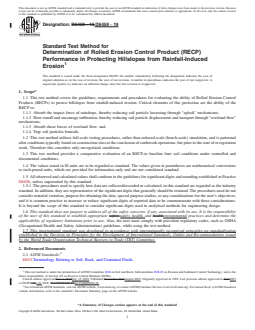
each riser. Fig. 1 shows an example of a rainfall simulator.
6.2 Water Source—Any water source shall be suitable for this use provided that it does not contain deleterious materials which
could impair the operation of the rainfall simulators.
6.3 Runoff and Sediment Collection System—The runoff and sediment collection system includes flashing, collection apparatus
and a holding tank. Flashing shall be fabricated to direct runoff from the plot into the collection apparatus. Once the runoff is on
the flashing, it may be desirable to divert the flow to a single collection point. The flashing shall be continuous across the entire
bottom edge of the plot. A holding tank(s) capable of temporarily containing all runoff shall be connected to the collection
apparatus.
6.4 Vegetative Stand Quantification Equipment—A calibrated template used to ensure height of vegetation and counting box are
necessary for vegetated testing. Vegetation is cut to a specific, uniform stand height by placing a template on the soil surface and
trimming blades/stems at the top of the template. An open, square box is used to count vegetation stems and blades to determine
stand density. The box may be constructed of metal or wood with an internal opening measure 76.2 mm (3 in.) square and 25.4
to 50.8 mm (1 to 2 in.) in height.
6.5 Miscellaneous—Other miscellaneous equipment includes: rain gauges (20), pie pans (3), sieve set (standard US sieves),
evaporating dishes, a drying oven or microwave oven, balances, meteorological equipment (wind speed, temperature,
precipitation), a surveyor’s rod, sample bottles and bags, cooler and camera or video recorder.
7. Procedure
7.1 Test Plot Preparation:
7.1.1 Construct an earthen embankment using conventional earthwork placement techniques. Perform compaction of the
embankment to create a geotechnically (structurally) stable embankment with a surface slope of 3H:1V having a slope length of
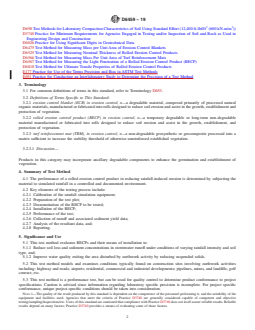
12 m (40 ft). Fig. 2 shows a typical embankment cross-section.
NOTE 2—The effect of variations in test plot width, length, gradient, and drainage conditions are currently being evaluated.
FIG. 1 Typical Rainfall Simulator
D6459 − 19
FIG. 2 Typical Embankment Cross Section
7.1.2 Plate the top surface of the embarkment with a minimum 30 cm (12 in.) thick veneer of soil. General soil types to be
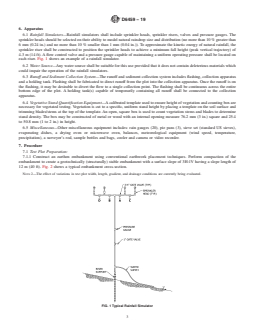
used for testing shall be loam, clay, and sand. Target grain sizes and plasticity indices are included in Fig. 3. Place the veneer in
15 cm (6 in.) lifts and compact to 90 6 3 % of standard Proctor density in accordance with Test Method D698.
7.1.3 Locate test plots on the embankment using a plot size of 2.4 m (8 ft) in width (cross-slope) and of 12 m (40 ft) in length
(downslope). Separate the test plots such that overspray from the rainfall simulators does not impact adjacent plots.
NOTE 3—The slope width, length and steepness were selected as being representative of conditions typically found on construction sites. This test plot
configuration was chosen to assure uniformity and consistence of testing activities.
7.1.4 Isolate the top edge and sides of each test plot by a water barrier which forms the boundary of the test plot. Bury the
bottom edge of the barrier approximately 10 cm (4 in.) to divert surface flow such that no intrusion of outside surface water onto
the test plot (“run-on”) occurs. The barrier shall be continuous such that joints do not allow outside flow to enter the plot.
Commercially available lawn edging is suitable for this purpose.
7.1.5 Loosen the soil veneer to a depth of approximately 10 cm (4 in.) using a tiller or other appropriate tools. Rake the tilled
plot smooth with a steel hand rake and lightly compact using a turf roller. Repair depressions, voids, soft, or uncompacted areas
before testing commences. Also, free the plot from obstruction or protrusions, such as roots, large stones, or other foreign material.
Soil preparation methods for bare soil testing utilized as a baseline, control plots for product or vegetated testing shall be identical
to soil preparation methods for the protected scenario.
NOTE 4—Standarized, quantified soil compaction rate is being evaluated.
7.1.6 If the plots have been used for previous test series, discard the soil carried of the plot and obliterate any rills and gullies.
Spread new soil of the same type across the plot and blend (rake or till) into the surface. If the soil loss of the control plot differs
significantly from the base line calibration test reevaluate the soil properties.
7.2 Calibration:
7.2.1 Calibration of the rainfall simulation equipment includes:
7.2.1.1 Rainfall intensity;
7.2.1.2 Uniformity of rainfall application across the plot, and;
7.2.1.3 Drop size distribution for each intensity.
7.2.2 To ensure uniform raindrop distribution, do not conduct calibration or testing when the wind velocity is greater than 1.6
km/h (1 mph).
FIG. 3 Typical Grain Sizes and Plasticity Indices
D6459 − 19
7.2.3 At a minimum, conduct calibration annually or following equipment maintenance work. Conduct one intensity/uniformity
check every 90 days, or after no more than four test series, whichever comes first.
7.2.4 Place sprinkler risers around the perimeter of the test plot to provide uniform distribution. The precise location of the risers
to provide uniform rainfall distribution will be determined by the calibration process and the nuances of any given simulator system
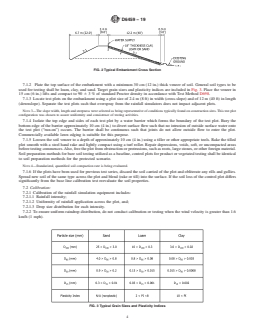
(see Fig. 4 for typical sprinkler riser configuration).
7.2.5 Place the rain gauges on the plot surface following the pattern shown in Fig. 4. Duration of the calibration test shall be
15 min, recorded to the nearest second. Perform calibrations at uniform pressure for each intensity. Adjust riser locations until an
acceptable uniform rainfall distribution pattern is achieved, as defined in Section 8.
7.2.6 Calculate the rainfall intensity uniformity using the Christiansen uniformity coefficient (see Section 8).
7.2.7 To measure drop size distribution, completely fill three labeled pie pans with sifted flour, struck off with a ruler to produce
a smooth, uncompacted surface. Locate three supports approximately 20-cm (8-in.) high (for example, 1-gal cans) along the
vertical centerline of the test plot, and at the horizontal quarter points. Place the filled pie pans on the supports (horizontal, not
parallel to the ground) and cover. At the desired test intensity, remove the cover briefly so that drops impinge on the flour to form
pellets. Recover the pans after only a few seconds and before the drops start to touch each other. Repeat this procedure at each
desired intensity. Air-dry the flour pellets for a minimum of 12 h. Screen each sample of these semi-dry pellets by emptying the
entire contents of the pan onto a 70 mesh sieve to carefully remove as much loose flour as possible. Then transfer the remaining
pellets to evaporating dishes and heat in an oven at approximately 43°C (110°F) for 2 h. Record the total weight of the hard flour
pellets. Sieve the pellets through standard soil sieves by shaking the stack for 2 min. Cull foreign matter and any double pellets
from each sieve and record the total weight and pellet count for each size (1).
7.2.8 Repeat the raindrop size calibration procedure (7.2.7) three times for each desired intensity.
7.2.9 Determine raindrop fall height by measuring the average height of the raindrop trajectory using a surveyor’s rod. Hold
the rod vertically in the spray of a single riser and measure the wetted height. Repeat the height measurement for each desired
intensity.
7.3 Pre-Test Documentation:
7.3.1 Maintain a test folder for each test cycle, including information on: site conditions; geotechnical and soil conditions;
meteorological data; RECP product type, description and installation procedure, and; photo and/or video documentation.
7.3.2 Include the following subjective site information: general visual conditions of the plot to be tested; general meteorological
information; plot treatment; photographs or videotape, or both, and any supplemental information that is not included in the
following sections but is felt to be of interest to the test.
7.3.3 Include the following geotechnical and soils information: soil classification [Unified Soil Classification System (USCS)
and USDA classification system.]; standard proctor moisture-density relationship; “K” factor; and; gradation (including
hydrometer test for the P fraction).
FIG. 4 Typical Sprinkler Riser Configuration
The boldface numbers given in parentheses refer to a list of references at the end of the text.
D6459 − 19
7.3.4 Include the following meteorological information: all data from the on-site weather station at the time of the test (that is,
ambient air temperature, wind speed and precipitation).
7.3.5 Include the following product type and description information: manufacturer name; product name; description;
specifications; size; a sample of the material, if practical, and; the following index test results from subsamples of the products
tested (if product test): Thickness (Test Method D6525), Mass per Unit Area (Test Method D6475 for ECBs; Test Method D6566
for TRMs), Tensile Strength (Test Method D6818), and Light Penetration (Test Method D6567).
7.4 Test Set-Up
7.4.1 Determine the optimum moisture content for the soil type on the given plot. Wet the plot using the rainfall simulation
system until the soil reaches the optimum moisture content plus or minus 4 %. Take soil sample to determine the pretest soil
moisture content within 1 h prior to the test.
7.4.2 Install the RECP on the plot after calibration has been completed and the test plot has been prepared. Permit no foot traffic
on the plot, once the RECP has been installed. Document the installation methodology for the ECB including: orientation on the
slope (longitudinal or lateral); placement (which side faces up); termination details; joint details, and; anchor type and installation
pattern. Place the RECP so that no gaps are present along the perimeter barrier and be cut to fit, as necessary, to cover the plot.
7.4.3 Take photographs or videotapes, or both of the covered plot prior to testing.
NOTE 5—If testing an ECB or unvegetated TRM, proceed to 7.5. If testing a vegetated TRM, continue with 7.4.4.
7.4.4 It is desirable to know the performance
...