

ASTM D5541-24
(Practice)Standard Practice for Developing a Stage-Discharge Relation for Open Channel Flow
General Information
- Abstract
SIGNIFICANCE AND USE
5.1 This practice is particularly useful for determining the discharge at a gauging station or a location where discharge information is repeatedly needed.
5.2 This practice is applicable only for open-channel flow conditions where channel hydraulics permit a stable relation between stage and discharge.
SCOPE
1.1 This practice covers the development of a curve relating stage (elevation) to discharge. Standard test methods have been documented for measuring discharge and for measuring stage (see Practice D3858, and Test Methods D5129, D5130, D5243, D5388, and D5413). This practice takes the discharge and stage determined by each respective test method and shows a relation between them using a curved line. This curved line is called a stage-discharge relation or rating curve.
1.2 The procedures described in this practice are used commonly by those responsible for investigations of streamflow, for example, the U.S. Geological Survey, Army Corps of Engineers, Bureau of Reclamation, and U.S Agriculture Research Service. For the most part, these procedures are adapted from reports of the U.S. Geological Survey.2,3
1.3 The procedures described in this practice apply only to simple freely flowing open-channel flow. Ratings for complex hydraulic conditions of extremely low slope channels using multiple-stage inputs, channels affected by man-induced regulation, or tidal conditions are not described. These types of ratings are described in detail in the documents listed in Footnotes 2 and 3.2,3
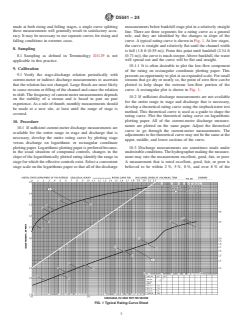
1.4 This practice uses the results of current-meter discharge measurements or indirect discharge measurements and the corresponding measured stage to define as much of the stage-discharge relation curve as possible. A theoretical curve is developed for the full range of stage and discharge to shape the curve.
1.5 The values stated in inch-pound units are to be regarded as standard. The values given in parentheses are mathematical conversions to SI units that are provided for information only and are not considered standard.
1.6 This standard does not purport to address all of the safety concerns, if any, associated with its use. It is the responsibility of the user of this standard to establish appropriate safety, health, and environmental practices and determine the applicability of regulatory limitations prior to use.
1.7 This international standard was developed in accordance with internationally recognized principles on standardization established in the Decision on Principles for the Development of International Standards, Guides and Recommendations issued by the World Trade Organization Technical Barriers to Trade (TBT) Committee.
- Status
- Published
- Publication Date
- 31-Mar-2024
- Technical Committee
- D19 - Water
- Drafting Committee
- D19.07 - Sediments, Geomorphology, and Open-Channel Flow

Overview
ASTM D5541-24: Standard Practice for Developing a Stage-Discharge Relation for Open Channel Flow provides a standardized methodology for establishing the relationship between water stage (elevation) and discharge (flow rate) in open channel environments. This practice is vital wherever consistent and repeatable discharge measurements are needed, such as at gauging stations used for monitoring streamflow. The standard emphasizes its use in conditions where a stable hydraulic relationship exists and specifically addresses scenarios with simple, freely flowing open-channel flow, making it essential for water resource investigations.
Key Topics
- Stage-Discharge Relation (Rating Curve): Defines the correlation between water level and discharge, typically displayed as a curved line on a graph.
- Development Techniques: Incorporates both direct measurements (e.g., current-meter discharge) and indirect methods (theoretical curves using standardized test methods such as those in ASTM D5388).
- Channel Hydraulics and Controls:
- Section Controls: Natural or artificial features (like rock ledges or weirs) that influence stage-discharge at specific channel cross-sections.
- Channel Controls: Extended reaches downstream that impact the stage-discharge relationship, especially relevant in flatter channels.
- Combination Controls and Transition Zones: Situations where multiple controls influence the curve, often requiring expert interpretation.
- Interferences and Adjustments:
- Sedimentation, aquatic growth, ice, debris, and hysteresis (flow changes due to rising or falling water levels) can all affect the relationship.
- Regular calibration is necessary following major hydrologic events or when permanent changes in channel geometry or condition are detected.
- Plotting and Documentation: Guidelines for graphically developing rating curves, using both logarithmic and rectangular coordinate systems, and incorporating both measured and theoretical data.
Applications
The main practical applications of ASTM D5541-24 include:
- Streamflow Monitoring: Widely used by agencies like the U.S. Geological Survey, Army Corps of Engineers, and Bureau of Reclamation for developing, reviewing, and maintaining stage-discharge relations at gauging sites.
- Water Resource Management: Essential for long-term hydrological studies, flood forecasting, irrigation management, and water rights administration where repeatable and traceable discharge data are required.
- Engineering and Environmental Projects: Used in designing hydraulic structures, assessing environmental impact, and maintaining compliance for open-channel water systems.
- Floodplain Analysis and Culvert Design: Provides a foundation for evaluating the hydraulic capacity of channels and structures during varying flow conditions.
- Hydrological Research: Supports accurate data collection for academic or technical research in open channel hydraulics, hydrology, and related fields.
Related Standards
Professionals applying ASTM D5541-24 often reference these important documents for supporting measurements and procedures:
- ASTM D1129: Terminology Relating to Water, for consistent vocabulary.
- ASTM D3858: (Withdrawn 2023) Test Method for Open-Channel Flow Measurement by Velocity-Area Method.
- ASTM D5130: (Withdrawn 2023) Open-Channel Flow Measurement by Slope-Area Method.
- ASTM D5243: Flow Measurement of Water Indirectly at Culverts.
- ASTM D5388: Step-Backwater Method for Indirect Discharge Measurement.
- ASTM D5413: Measurement of Water Levels in Open-Water Bodies.
- ISO 1100-2: Liquid Flow Measurement in Open Channels - Determination of Stage-Discharge Relation.
Practical Value
By adhering to ASTM D5541-24, practitioners ensure standardized, reliable development of rating curves required for accurate discharge estimation in open channel systems. This practice enhances the consistency of hydrologic data across projects and agencies, improving the quality of decisions related to water management, engineering, and environmental stewardship.
Relations
- Effective Date
- 01-Apr-2024
- Effective Date
- 01-Apr-2024
Frequently Asked Questions
ASTM D5541-24 is a standard published by ASTM International. Its full title is "Standard Practice for Developing a Stage-Discharge Relation for Open Channel Flow". This standard covers: SIGNIFICANCE AND USE 5.1 This practice is particularly useful for determining the discharge at a gauging station or a location where discharge information is repeatedly needed. 5.2 This practice is applicable only for open-channel flow conditions where channel hydraulics permit a stable relation between stage and discharge. SCOPE 1.1 This practice covers the development of a curve relating stage (elevation) to discharge. Standard test methods have been documented for measuring discharge and for measuring stage (see Practice D3858, and Test Methods D5129, D5130, D5243, D5388, and D5413). This practice takes the discharge and stage determined by each respective test method and shows a relation between them using a curved line. This curved line is called a stage-discharge relation or rating curve. 1.2 The procedures described in this practice are used commonly by those responsible for investigations of streamflow, for example, the U.S. Geological Survey, Army Corps of Engineers, Bureau of Reclamation, and U.S Agriculture Research Service. For the most part, these procedures are adapted from reports of the U.S. Geological Survey.2,3 1.3 The procedures described in this practice apply only to simple freely flowing open-channel flow. Ratings for complex hydraulic conditions of extremely low slope channels using multiple-stage inputs, channels affected by man-induced regulation, or tidal conditions are not described. These types of ratings are described in detail in the documents listed in Footnotes 2 and 3.2,3 1.4 This practice uses the results of current-meter discharge measurements or indirect discharge measurements and the corresponding measured stage to define as much of the stage-discharge relation curve as possible. A theoretical curve is developed for the full range of stage and discharge to shape the curve. 1.5 The values stated in inch-pound units are to be regarded as standard. The values given in parentheses are mathematical conversions to SI units that are provided for information only and are not considered standard. 1.6 This standard does not purport to address all of the safety concerns, if any, associated with its use. It is the responsibility of the user of this standard to establish appropriate safety, health, and environmental practices and determine the applicability of regulatory limitations prior to use. 1.7 This international standard was developed in accordance with internationally recognized principles on standardization established in the Decision on Principles for the Development of International Standards, Guides and Recommendations issued by the World Trade Organization Technical Barriers to Trade (TBT) Committee.
SIGNIFICANCE AND USE 5.1 This practice is particularly useful for determining the discharge at a gauging station or a location where discharge information is repeatedly needed. 5.2 This practice is applicable only for open-channel flow conditions where channel hydraulics permit a stable relation between stage and discharge. SCOPE 1.1 This practice covers the development of a curve relating stage (elevation) to discharge. Standard test methods have been documented for measuring discharge and for measuring stage (see Practice D3858, and Test Methods D5129, D5130, D5243, D5388, and D5413). This practice takes the discharge and stage determined by each respective test method and shows a relation between them using a curved line. This curved line is called a stage-discharge relation or rating curve. 1.2 The procedures described in this practice are used commonly by those responsible for investigations of streamflow, for example, the U.S. Geological Survey, Army Corps of Engineers, Bureau of Reclamation, and U.S Agriculture Research Service. For the most part, these procedures are adapted from reports of the U.S. Geological Survey.2,3 1.3 The procedures described in this practice apply only to simple freely flowing open-channel flow. Ratings for complex hydraulic conditions of extremely low slope channels using multiple-stage inputs, channels affected by man-induced regulation, or tidal conditions are not described. These types of ratings are described in detail in the documents listed in Footnotes 2 and 3.2,3 1.4 This practice uses the results of current-meter discharge measurements or indirect discharge measurements and the corresponding measured stage to define as much of the stage-discharge relation curve as possible. A theoretical curve is developed for the full range of stage and discharge to shape the curve. 1.5 The values stated in inch-pound units are to be regarded as standard. The values given in parentheses are mathematical conversions to SI units that are provided for information only and are not considered standard. 1.6 This standard does not purport to address all of the safety concerns, if any, associated with its use. It is the responsibility of the user of this standard to establish appropriate safety, health, and environmental practices and determine the applicability of regulatory limitations prior to use. 1.7 This international standard was developed in accordance with internationally recognized principles on standardization established in the Decision on Principles for the Development of International Standards, Guides and Recommendations issued by the World Trade Organization Technical Barriers to Trade (TBT) Committee.
ASTM D5541-24 has the following relationships with other standards: It is inter standard links to ASTM D5541-94(2014), ASTM D5674-22. Understanding these relationships helps ensure you are using the most current and applicable version of the standard.
ASTM D5541-24 is available in PDF format for immediate download after purchase. The document can be added to your cart and obtained through the secure checkout process. Digital delivery ensures instant access to the complete standard document.
Standards Content (Sample)
This international standard was developed in accordance with internationally recognized principles on standardization established in the Decision on Principles for the
Development of International Standards, Guides and Recommendations issued by the World Trade Organization Technical Barriers to Trade (TBT) Committee.
Designation: D5541 − 24
Standard Practice for
Developing a Stage-Discharge Relation for Open Channel
Flow
This standard is issued under the fixed designation D5541; the number immediately following the designation indicates the year of
original adoption or, in the case of revision, the year of last revision. A number in parentheses indicates the year of last reapproval. A
superscript epsilon (´) indicates an editorial change since the last revision or reapproval.
1. Scope conversions to SI units that are provided for information only
and are not considered standard.
1.1 This practice covers the development of a curve relating
1.6 This standard does not purport to address all of the
stage (elevation) to discharge. Standard test methods have been
safety concerns, if any, associated with its use. It is the
documented for measuring discharge and for measuring stage
responsibility of the user of this standard to establish appro-
(see Practice D3858, and Test Methods D5129, D5130, D5243,
priate safety, health, and environmental practices and deter-
D5388, and D5413). This practice takes the discharge and
stage determined by each respective test method and shows a mine the applicability of regulatory limitations prior to use.
1.7 This international standard was developed in accor-
relation between them using a curved line. This curved line is
called a stage-discharge relation or rating curve. dance with internationally recognized principles on standard-
ization established in the Decision on Principles for the
1.2 The procedures described in this practice are used
Development of International Standards, Guides and Recom-
commonly by those responsible for investigations of
mendations issued by the World Trade Organization Technical
streamflow, for example, the U.S. Geological Survey, Army
Barriers to Trade (TBT) Committee.
Corps of Engineers, Bureau of Reclamation, and U.S Agricul-
ture Research Service. For the most part, these procedures are
2. Referenced Documents
2,3
adapted from reports of the U.S. Geological Survey.
2.1 ASTM Standards:
1.3 The procedures described in this practice apply only to
D1129 Terminology Relating to Water
simple freely flowing open-channel flow. Ratings for complex
D3858 Test Method for Open-Channel Flow Measurement
hydraulic conditions of extremely low slope channels using
of Water by Velocity-Area Method (Withdrawn 2023)
multiple-stage inputs, channels affected by man-induced
D5129 Test Method for Open Channel Flow Measurement
regulation, or tidal conditions are not described. These types of
of Water Indirectly by Using Width Contractions (With-
ratings are described in detail in the documents listed in
drawn 2023)
2,3
Footnotes 2 and 3.
D5130 Test Method for Open-Channel Flow Measurement
1.4 This practice uses the results of current-meter discharge
of Water Indirectly by Slope-Area Method (Withdrawn
measurements or indirect discharge measurements and the
2023)
corresponding measured stage to define as much of the
D5243 Test Method for Open-Channel Flow Measurement
stage-discharge relation curve as possible. A theoretical curve
of Water Indirectly at Culverts
is developed for the full range of stage and discharge to shape
D5388 Test Method for Indirect Measurements of Discharge
the curve.
by Step-Backwater Method
D5413 Test Methods for Measurement of Water Levels in
1.5 The values stated in inch-pound units are to be regarded
Open-Water Bodies
as standard. The values given in parentheses are mathematical
2.2 ISO Standard:
This practice is under the jurisdiction of ASTM Committee D19 on Water and ISO 1100/2 Liquid Flow Measurement in Open Channels—
is the direct responsibility of Subcommittee D19.07 on Sediments, Geomorphology,
Part 2, Determination of Stage-Discharge Relation
and Open-Channel Flow.
Current edition approved April 1, 2024. Published April 2024. Originally
approved in 1994. Last previous edition approved in 2014 as D5541 – 94 (2014)
which was withdrawn July 2023 and reinstated in April 2024. DOI: 10.1520/D5541- For referenced ASTM standards, visit the ASTM website, www.astm.org, or
24. contact ASTM Customer Service at service@astm.org. For Annual Book of ASTM
Kennedy, E. J., “Discharge Ratings at Gaging Stations: U.S. Geological Standards volume information, refer to the standard’s Document Summary page on
Survey,” Techniques of Water-Resource Investigations , Book 3, Chapt. A10, 1984, the ASTM website.
p. 59. The last approved version of this historical standard is referenced on
Rantz, S. E., et al., Measurement and Computation of Streamflow: Vol 2, www.astm.org.
Computation of Discharge, U.S. Geological Survey, Water-Supply Paper No. 2175, Available from American National Standards Institute (ANSI), 25 W. 43rd St.,
1982, p. 631. 4th Floor, New York, NY 10036, http://www.ansi.org.
Copyright © ASTM International, 100 Barr Harbor Drive, PO Box C700, West Conshohocken, PA 19428-2959. United States
D5541 − 24
3. Terminology 6.1.2 Channel Controls—A channel control consists of a
combination of features throughout a reach downstream from a
3.1 Definitions—For definitions of terms used in this
gauge. These features include channel size, shape, curvature,
practice, refer to Terminology D1129.
slope, and roughness. The length of channel reach that controls
3.2 Symbols:
a stage-discharge relation varies. The stage-discharge relation
3.2.1 GH—gauge height or stage, ft (m).
for relatively steep channels may be controlled by a relatively
3 3
3.2.2 Q—discharge, ft /s (m /s). short channel reach, whereas the relation for a relatively flat
channel may be controlled by a much longer channel reach. In
4. Summary of Practice
addition, the length of a channel control will vary depending on
the magnitude of flow. Precise definition of the length of a
4.1 The stage-discharge relation is developed by plotting
channel-control reach is usually not possible or necessary.
stage versus discharge from discharge measurements or other
6.1.3 Combination Controls—The stage-discharge relation
determinations of flow, either manually or through the use of
may be governed by a combination of section and channel
computer programs and fitting a curve to these points. The
controls. This usually occurs for a short range in stage between
stage should be determined at a single gauge datum for the
a section-controlled segment of the rating and a channel-
entire range in stage. Stages determined in stilling wells, at
controlled segment of the rating. This part of the rating is
outside gauges, and at bridge abutments can be significantly
commonly referred to as a transition zone of the rating and
different and should not be interchanged. Discharge measure-
represents the change from section control to channel control.
ments may not be available for the entire range in stage of the
In other instances, a combination control may consist of two
stage-discharge relation. A theoretical rating curve should be
section controls, where each has partial controlling effect.
developed for the entire range in stage using Test Method
Combination controls or transition zones, or both, occur for
D5388. This theoretical curve is used as a guide to shape the
very limited parts of a stage-discharge relation and can usually
stage-discharge relation at places where discharge measure-
be defined by plotting procedures. In particular, transition
ments are not available.
zones represent changes in the slope or shape of a stage-
5. Significance and Use
discharge relation.
5.1 This practice is particularly useful for determining the 6.2 Low flows are usually controlled by a section control,
discharge at a gauging station or a location where discharge
whereas high flows are usually controlled by a channel control.
information is repeatedly needed. Medium flows may be controlled by either type of control. A
combination of section and channel control may occur at some
5.2 This practice is applicable only for open-channel flow
stages. These are general rules, and exceptions can and do
conditions where channel hydraulics permit a stable relation
occur.
between stage and discharge.
7. Interferences
6. Channel Hydraulics
7.1 The stage-discharge relation may be affected by the
6.1 The stage-discharge relation for open-channel flow at a
deposition or removal of stream bed or bank material by
gauging station or other stage reference point is governed by
flowing water, usually at high flow condi
...