

ASTM D5207-20
(Practice)Standard Practice for Confirmation of 20-mm (50-W) and 125-mm (500-W) Test Flames for Small-Scale Burning Tests on Plastic Materials
General Information
- Abstract
SIGNIFICANCE AND USE
5.1 The flame height and color (indicative of air-to-gas ratio) for a test flame have traditionally been specified in the individual test method. The energy content of the flame has also been addressed by reference to a specific supply gas. It has been determined that the supply-gas back pressure and flow rate can be varied without affecting the height and color of the flame. However, the energy content of the flame is affected. This practice provides the back pressure and flow rate of the supply gas for a 20-mm (50-W) and a 125-mm (500-W) test flame, and a procedure for confirming the heat-evolution profile of the test flame.
5.2 Information is provided for test flames using methane, propane, or butane. Using this information, these supply gases have the capability to be used interchangeably with a standardized burner to produce essentially the same test flame.
SCOPE
1.1 This practice covers the confirmation of test flames for small-scale burning tests on plastic materials using the laboratory burner described in Specification D5025. Back pressures and flow rates for methane, propane, and butane supply gases are given for specific test flames. This practice describes a procedure to confirm the heat evolution of the test flame.
1.2 The values stated in SI units are to be regarded as the standard.
1.3 This standard is used to measure and describe the response of materials, products, or assemblies to heat and flame under controlled conditions, but does not by itself incorporate all factors required for fire hazard or fire risk assessment of the materials, products, or assemblies under actual fire conditions.
Note 1: There is no similar ISO standard. This practice is equivalent in technical content to, but not fully corresponding in presentation with, the confirmatory procedures of IEC/TS 60695-11-3, Method A and IEC/TS 60695-11-4, Method A.
1.4 Fire testing is inherently hazardous. Adequate safeguards for personnel and property shall be employed in conducting these tests.
1.5 This standard does not purport to address all of the safety concerns, if any, associated with its use. It is the responsibility of the user of this standard to establish appropriate safety, health, and environmental practices and determine the applicability of regulatory limitations prior to use.
1.6 This international standard was developed in accordance with internationally recognized principles on standardization established in the Decision on Principles for the Development of International Standards, Guides and Recommendations issued by the World Trade Organization Technical Barriers to Trade (TBT) Committee.
- Status
- Published
- Publication Date
- 30-Nov-2020
- Technical Committee
- D20 - Plastics
- Drafting Committee
- D20.30 - Thermal Properties
Buy Documents

ASTM D5207-20 - Standard Practice for Confirmation of 20-mm (50-W) and 125-mm (500-W) Test Flames for Small-Scale Burning Tests on Plastic Materials
REDLINE ASTM D5207-20 - Standard Practice for Confirmation of 20-mm (50-W) and 125-mm (500-W) Test Flames for Small-Scale Burning Tests on Plastic Materials
Overview
ASTM D5207-20 is the international standard practice for the confirmation of 20-mm (50-W) and 125-mm (500-W) test flames used in small-scale burning tests on plastic materials. Developed by ASTM Committee D20 on Plastics, this standard specifies procedures for verifying standardized test flames based on flame height, color, and most critically, energy content. This confirmation process is vital to ensuring the reliability and repeatability of tests assessing the flammability of plastic materials.
The practice is specifically designed to be used with laboratory burners conforming to ASTM D5025 and provides parameters for the use of methane, propane, and butane as supply gases. By establishing standard methods to confirm test flame characteristics, ASTM D5207-20 supports fire testing laboratories in producing consistent and accurate test results under controlled conditions.
Key Topics
- Test Flame Confirmation: Outlines methods for confirming both the physical dimensions (height, color) and energy content (heat evolution profile) of laboratory test flames.
- Supply Gas Parameters: Details back pressure and flow rates for methane, propane, and butane to ensure interchangeability and equivalency between different labs and burners.
- Heat Evolution Profile: Specifies the measurement and confirmation of the heat produced by the flame using a standardized thermal sensor procedure.
- Safety Practices: Emphasizes the need for adequate safety, health, and environmental measures when conducting small-scale burning tests.
- Standardization Benefits: Ensures harmonization of testing practices for plastics, enabling more reliable material comparisons and fire performance assessments.
Applications
The practical value of ASTM D5207-20 lies in its application within fire testing and quality control environments, where precise simulation and measurement of flame exposure are crucial:
- Small-Scale Burning Tests on Plastics: Used in conjunction with standardized test methods to evaluate the flammability characteristics of plastic materials, products, or assemblies.
- Regulatory Compliance: Assists manufacturers and testing labs in preparing data to support compliance with fire safety regulations and product certification processes.
- Material Development and Quality Assurance: Supports material scientists and engineers by providing a repeatable framework for assessing new plastic formulations or changes in supplier material.
- Interlaboratory Comparability: Promotes consistent flame calibration, aiding in correlation between test data from different laboratories worldwide.
It is important to note that while ASTM D5207-20 is essential for confirming test conditions and promoting standardized results, it does not cover a complete fire risk or hazard assessment under real-world fire conditions.
Related Standards
ASTM D5207-20 is complemented and supported by several other standards and technical specifications:
- ASTM D5025 - Specification for Laboratory Burner Used for Small-Scale Burning Tests on Plastic Materials
- ASTM D883 - Terminology Relating to Plastics
- ASTM D3195 - Practice for Rotameter Calibration
- ASTM E176 - Terminology of Fire Standards
- ASTM E220 / E230 / E608 - Relevant thermocouple standards and calibration techniques for accurate temperature measurement during flame confirmation
- IEC 60695-11-3 and IEC 60695-11-4 - International equivalents focusing on confirmation procedures for test flames, though not fully corresponding to the format of ASTM D5207-20
Keywords: ASTM D5207-20, flammability testing, plastics, laboratory burner, test flame confirmation, small-scale burning, heat evolution, methane, propane, butane, material response to flame, standardization, fire safety testing.
By following ASTM D5207-20, laboratories and manufacturers can ensure their burning tests are accurately calibrated-enabling consistent, reliable assessment of plastic material flammability across various industries.
Relations
- Effective Date
- 01-Feb-2024
- Effective Date
- 01-Jan-2024
- Effective Date
- 01-Nov-2023
- Effective Date
- 01-Mar-2020
- Effective Date
- 01-Feb-2020
- Effective Date
- 01-Jan-2020
- Effective Date
- 01-Aug-2019
- Effective Date
- 15-Apr-2019
- Effective Date
- 01-Feb-2019
- Effective Date
- 15-Dec-2018
- Effective Date
- 01-Dec-2018
- Effective Date
- 01-Nov-2018
- Effective Date
- 01-Mar-2018
- Effective Date
- 15-Aug-2017
- Effective Date
- 01-Aug-2015
Buy Documents
ASTM D5207-20 - Standard Practice for Confirmation of 20-mm (50-W) and 125-mm (500-W) Test Flames for Small-Scale Burning Tests on Plastic Materials
REDLINE ASTM D5207-20 - Standard Practice for Confirmation of 20-mm (50-W) and 125-mm (500-W) Test Flames for Small-Scale Burning Tests on Plastic Materials
Get Certified
Connect with accredited certification bodies for this standard

DIN CERTCO
DIN Group product certification.

Smithers Quality Assessments
US management systems and product certification.
Sponsored listings
Frequently Asked Questions
ASTM D5207-20 is a standard published by ASTM International. Its full title is "Standard Practice for Confirmation of 20-mm (50-W) and 125-mm (500-W) Test Flames for Small-Scale Burning Tests on Plastic Materials". This standard covers: SIGNIFICANCE AND USE 5.1 The flame height and color (indicative of air-to-gas ratio) for a test flame have traditionally been specified in the individual test method. The energy content of the flame has also been addressed by reference to a specific supply gas. It has been determined that the supply-gas back pressure and flow rate can be varied without affecting the height and color of the flame. However, the energy content of the flame is affected. This practice provides the back pressure and flow rate of the supply gas for a 20-mm (50-W) and a 125-mm (500-W) test flame, and a procedure for confirming the heat-evolution profile of the test flame. 5.2 Information is provided for test flames using methane, propane, or butane. Using this information, these supply gases have the capability to be used interchangeably with a standardized burner to produce essentially the same test flame. SCOPE 1.1 This practice covers the confirmation of test flames for small-scale burning tests on plastic materials using the laboratory burner described in Specification D5025. Back pressures and flow rates for methane, propane, and butane supply gases are given for specific test flames. This practice describes a procedure to confirm the heat evolution of the test flame. 1.2 The values stated in SI units are to be regarded as the standard. 1.3 This standard is used to measure and describe the response of materials, products, or assemblies to heat and flame under controlled conditions, but does not by itself incorporate all factors required for fire hazard or fire risk assessment of the materials, products, or assemblies under actual fire conditions. Note 1: There is no similar ISO standard. This practice is equivalent in technical content to, but not fully corresponding in presentation with, the confirmatory procedures of IEC/TS 60695-11-3, Method A and IEC/TS 60695-11-4, Method A. 1.4 Fire testing is inherently hazardous. Adequate safeguards for personnel and property shall be employed in conducting these tests. 1.5 This standard does not purport to address all of the safety concerns, if any, associated with its use. It is the responsibility of the user of this standard to establish appropriate safety, health, and environmental practices and determine the applicability of regulatory limitations prior to use. 1.6 This international standard was developed in accordance with internationally recognized principles on standardization established in the Decision on Principles for the Development of International Standards, Guides and Recommendations issued by the World Trade Organization Technical Barriers to Trade (TBT) Committee.
SIGNIFICANCE AND USE 5.1 The flame height and color (indicative of air-to-gas ratio) for a test flame have traditionally been specified in the individual test method. The energy content of the flame has also been addressed by reference to a specific supply gas. It has been determined that the supply-gas back pressure and flow rate can be varied without affecting the height and color of the flame. However, the energy content of the flame is affected. This practice provides the back pressure and flow rate of the supply gas for a 20-mm (50-W) and a 125-mm (500-W) test flame, and a procedure for confirming the heat-evolution profile of the test flame. 5.2 Information is provided for test flames using methane, propane, or butane. Using this information, these supply gases have the capability to be used interchangeably with a standardized burner to produce essentially the same test flame. SCOPE 1.1 This practice covers the confirmation of test flames for small-scale burning tests on plastic materials using the laboratory burner described in Specification D5025. Back pressures and flow rates for methane, propane, and butane supply gases are given for specific test flames. This practice describes a procedure to confirm the heat evolution of the test flame. 1.2 The values stated in SI units are to be regarded as the standard. 1.3 This standard is used to measure and describe the response of materials, products, or assemblies to heat and flame under controlled conditions, but does not by itself incorporate all factors required for fire hazard or fire risk assessment of the materials, products, or assemblies under actual fire conditions. Note 1: There is no similar ISO standard. This practice is equivalent in technical content to, but not fully corresponding in presentation with, the confirmatory procedures of IEC/TS 60695-11-3, Method A and IEC/TS 60695-11-4, Method A. 1.4 Fire testing is inherently hazardous. Adequate safeguards for personnel and property shall be employed in conducting these tests. 1.5 This standard does not purport to address all of the safety concerns, if any, associated with its use. It is the responsibility of the user of this standard to establish appropriate safety, health, and environmental practices and determine the applicability of regulatory limitations prior to use. 1.6 This international standard was developed in accordance with internationally recognized principles on standardization established in the Decision on Principles for the Development of International Standards, Guides and Recommendations issued by the World Trade Organization Technical Barriers to Trade (TBT) Committee.
ASTM D5207-20 is classified under the following ICS (International Classification for Standards) categories: 83.080.01 - Plastics in general; 83.140.01 - Rubber and plastics products in general. The ICS classification helps identify the subject area and facilitates finding related standards.
ASTM D5207-20 has the following relationships with other standards: It is inter standard links to ASTM D883-24, ASTM E176-24, ASTM D883-23, ASTM D5025-20a, ASTM D5025-20, ASTM D883-20, ASTM D883-19c, ASTM D883-19a, ASTM D883-19, ASTM E176-18a, ASTM D883-18a, ASTM D883-18, ASTM E176-18, ASTM D883-17, ASTM E176-15a. Understanding these relationships helps ensure you are using the most current and applicable version of the standard.
ASTM D5207-20 is available in PDF format for immediate download after purchase. The document can be added to your cart and obtained through the secure checkout process. Digital delivery ensures instant access to the complete standard document.
Standards Content (Sample)
This international standard was developed in accordance with internationally recognized principles on standardization established in the Decision on Principles for the
Development of International Standards, Guides and Recommendations issued by the World Trade Organization Technical Barriers to Trade (TBT) Committee.
Designation:D5207 −20
Standard Practice for
Confirmation of 20-mm (50-W) and 125-mm (500-W) Test
Flames for Small-Scale Burning Tests on Plastic Materials
This standard is issued under the fixed designation D5207; the number immediately following the designation indicates the year of
original adoption or, in the case of revision, the year of last revision. A number in parentheses indicates the year of last reapproval. A
superscript epsilon (´) indicates an editorial change since the last revision or reapproval.
1. Scope* 2. Referenced Documents
2.1 ASTM Standards:
1.1 This practice covers the confirmation of test flames for
D883 Terminology Relating to Plastics
small-scale burning tests on plastic materials using the labora-
D3195 Practice for Rotameter Calibration
tory burner described in Specification D5025. Back pressures
D5025 Specification for Laboratory Burner Used for Small-
and flow rates for methane, propane, and butane supply gases
Scale Burning Tests on Plastic Materials
are given for specific test flames. This practice describes a
E176 Terminology of Fire Standards
procedure to confirm the heat evolution of the test flame.
E220 Test Method for Calibration of Thermocouples By
1.2 The values stated in SI units are to be regarded as the
Comparison Techniques
standard.
E230 Specification for Temperature-Electromotive Force
(emf) Tables for Standardized Thermocouples
1.3 This standard is used to measure and describe the
E608 Specification for Mineral-Insulated, Metal-Sheathed
response of materials, products, or assemblies to heat and
Base Metal Thermocouples
flame under controlled conditions, but does not by itself
2.2 IEC Standards:
incorporate all factors required for fire hazard or fire risk
IEC 60695-11-3 Fire Hazard Testing – Part 11-3: Test
assessment of the materials, products, or assemblies under
Flames – 500 W Flames – Apparatus and Confirmational
actual fire conditions.
Test Methods
NOTE 1—There is no similar ISO standard. This practice is equivalent IEC 60695-11-4 Fire Hazard Testing – Part 11-4: Test
in technical content to, but not fully corresponding in presentation with,
Flames – 50 W Flame – Apparatus and Confirmational
the confirmatory procedures of IEC/TS 60695-11-3, Method A and IEC/
Test Methods
TS 60695-11-4, Method A.
3. Terminology
1.4 Fire testing is inherently hazardous. Adequate safe-
guards for personnel and property shall be employed in
3.1 Definitions of Terms:
conducting these tests.
3.1.1 For definitions of terms related to plastics used in this
test method, refer to Terminology D883. For definitions of
1.5 This standard does not purport to address all of the
terms related to fire used in this test method, refer to Termi-
safety concerns, if any, associated with its use. It is the
nology E176.
responsibility of the user of this standard to establish appro-
priate safety, health, and environmental practices and deter-
4. Summary of Practice
mine the applicability of regulatory limitations prior to use.
4.1 A test flame of specified height and color is obtained
1.6 This international standard was developed in accor-
with gas supplied at a suggested back pressure and flow rate.A
dance with internationally recognized principles on standard-
thermal sensor is then positioned over the flame, and the time
ization established in the Decision on Principles for the
forthetemperatureofthesensortoincreasefrom100to700°C
Development of International Standards, Guides and Recom-
is determined. The time is used to confirm the heat-evolution
mendations issued by the World Trade Organization Technical
profile of the test flame.
Barriers to Trade (TBT) Committee.
For referenced ASTM standards, visit the ASTM website, www.astm.org, or
This practice is under the jurisdiction ofASTM Committee D20 on Plastics and contact ASTM Customer Service at service@astm.org. For Annual Book of ASTM
is the direct responsibility of Subcommittee D20.30 on Thermal Properties. Standards volume information, refer to the standard’s Document Summary page on
Current edition approved Dec. 1, 2020. Published December 2020. Originally the ASTM website.
approved in 1991. Last previous edition approved in 2014 as D5207 – 14. DOI: Available from American National Standards Institute (ANSI), 25 W. 43rd St.,
10.1520/D5207-20. 4th Floor, New York, NY 10036, http://www.ansi.org.
*A Summary of Changes section appears at the end of this standard
Copyright © ASTM International, 100 Barr Harbor Drive, PO Box C700, West Conshohocken, PA 19428-2959. United States
D5207−20
5. Significance and Use 6.4 Flow Meter—Arotameter calibrated in accordance with
PracticeD3195,withcorrelationcurvesappropriateforthegas,
5.1 The flame height and color (indicative of air-to-gas
or a mass flow meter with at least 2 % accuracy.
ratio) for a test flame have traditionally been specified in the
individual test method. The energy content of the flame has
6.5 Thermal Sensor (Copper Slug and Thermocouple)—A
alsobeenaddressedbyreferencetoaspecificsupplygas.Ithas
slugconstructedofhighconductivity(electrolytic)copperwith
been determined that the supply-gas back pressure and flow
dimensionsasshowninFig.1.A1.76 6 0.01-gslugisusedfor
rate can be varied without affecting the height and color of the
the 20-mm (50-W) flame, and a 10.0 6 0.05-g slug is used for
flame. However, the energy content of the flame is affected.
the 125-mm (500-W) flame. A Type K thermocouple with a
This practice provides the back pressure and flow rate of the
0.5-mm diameter stainless steel sheath constructed in accor-
supply gas for a 20-mm (50-W) and a 125-mm (500-W) test
dance with Specification E608 shall be peened into the top of
flame, and a procedure for confirming the heat-evolution
the slug.
profile of the test flame.
6.6 Temperature Indicator—Apotentiometerortemperature
5.2 Information is provided for test flames using methane,
indicator for Type K thermocouples capable of reading to
propane, or butane. Using this information, these supply gases
800°C. Calibrate the combination thermal sensor and tempera-
have the capability to be used interchangeably with a standard-
ture indicator in accordance with the general procedures
ized burner to produce essentially the same test flame.
outlined in Method E220. The initial calibration tolerance is
defined in Tables E230.
6. Apparatus
6.7 Ring Stand, with a clamp or equivalent device, adjust-
6.1 Test Chamber, enclosure or laboratory hood, free of
able for positioning of the thermal sensor.
induced or forced draft, having an internal volume of at least
3 3
0.5 m forthe20-mm(50-W)flameor0.75 m forthe125-mm
6.8 Timer,stopwatch
...
This document is not an ASTM standard and is intended only to provide the user of an ASTM standard an indication of what changes have been made to the previous version. Because
it may not be technically possible to adequately depict all changes accurately, ASTM recommends that users consult prior editions as appropriate. In all cases only the current version
of the standard as published by ASTM is to be considered the official document.
Designation: D5207 − 14 D5207 − 20
Standard Practice for
Confirmation of 20–mm (50–W) and 125–mm (500–W)20-mm
(50-W) and 125-mm (500-W) Test Flames for Small-Scale
Burning Tests on Plastic Materials
This standard is issued under the fixed designation D5207; the number immediately following the designation indicates the year of
original adoption or, in the case of revision, the year of last revision. A number in parentheses indicates the year of last reapproval. A
superscript epsilon (´) indicates an editorial change since the last revision or reapproval.
1. Scope*
1.1 This practice covers the confirmation of test flames for small-scale burning tests on plastic materials using the laboratory
burner described in Specification D5025. Back pressures and flow rates for methane, propane, and butane supply gases are given
for specific test flames. This practice describes a procedure to confirm the heat evolution of the test flame.
1.2 The values stated in SI units are to be regarded as the standard.
1.3 This standard is used to measure and describe the response of materials, products, or assemblies to heat and flame under
controlled conditions, but does not by itself incorporate all factors required for fire hazard or fire risk assessment of the materials,
products, or assemblies under actual fire conditions.
NOTE 1—There is no similar ISO standard. This practice is equivalent in technical content to, but not fully corresponding in presentation with, the
confirmatory procedures of IEC/TS 60695-11-3, Method A and IEC/TS 60695-11-4, Method A.
1.4 Fire testing is inherently hazardous. Adequate safeguards for personnel and property shall be employed in conducting these
tests.
1.5 This standard does not purport to address all of the safety concerns, if any, associated with its use. It is the responsibility of
the user of this standard to establish appropriate safety and health practices and determine the applicability of regulatory
limitations prior to use.
1.5 This standard does not purport to address all of the safety concerns, if any, associated with its use. It is the responsibility
of the user of this standard to establish appropriate safety, health, and environmental practices and determine the applicability of
regulatory limitations prior to use.
1.6 This international standard was developed in accordance with internationally recognized principles on standardization
established in the Decision on Principles for the Development of International Standards, Guides and Recommendations issued
by the World Trade Organization Technical Barriers to Trade (TBT) Committee.
This practice is under the jurisdiction of ASTM Committee D20 on Plastics and is the direct responsibility of Subcommittee D20.30 on Thermal Properties.
Current edition approved May 1, 2014Dec. 1, 2020. Published May 2014December 2020. Originally approved in 1991. Last previous edition approved in 20092014 as
D5207 – 09.D5207 – 14. DOI: 10.1520/D5207-14.10.1520/D5207-20.
*A Summary of Changes section appears at the end of this standard
Copyright © ASTM International, 100 Barr Harbor Drive, PO Box C700, West Conshohocken, PA 19428-2959. United States
D5207 − 20
2. Referenced Documents
2.1 ASTM Standards:
D883 Terminology Relating to Plastics
D3195 Practice for Rotameter Calibration
D5025 Specification for Laboratory Burner Used for Small-Scale Burning Tests on Plastic Materials
E176 Terminology of Fire Standards
E220 Test Method for Calibration of Thermocouples By Comparison Techniques
E230 Specification for Temperature-Electromotive Force (emf) Tables for Standardized Thermocouples
E608 Specification for Mineral-Insulated, Metal-Sheathed Base Metal Thermocouples
2.2 IEC Standards:
IEC/TS 60695-11-3IEC 60695-11-3 Ed. 1: Fire Hazard Testing-Part 11: Test Flames-Section 3: 500 W Flames: Testing – Part
11-3: Test Flames – 500 W Flames – Apparatus and Confirmational Test Methods
IEC/TS 60695-11-4IEC 60695-11-4 Ed. 2: Fire Hazard Testing-Part 11: Test Flames-Section 4: 50 W Flame: Testing – Part 11-4:
Test Flames – 50 W Flame – Apparatus and Confirmational Test Methods
3. Terminology
3.1 Definitions of Terms:
3.1.1 For definitions of terms related to plastics used in this test method, refer to Terminology D883. For definitions of terms
related to fire used in this test method, refer to Terminology E176.
4. Summary of Practice
4.1 A test flame of specified height and color is obtained with gas supplied at a suggested back pressure and flow rate. A thermal
sensor is then positioned over the flame, and the time for the temperature of the sensor to increase from 100 to 700°C is determined.
The time is used to confirm the heat-evolution profile of the test flame.
5. Significance and Use
5.1 The flame height and color (indicative of air-to-gas ratio) for a test flame have traditionally been specified in the individual
test method. The energy content of the flame has also been addressed by reference to a specific supply gas. It has been determined
that the supply-gas back pressure and flow rate can be varied without affecting the height and color of the flame. However, the
energy content of the flame is affected. This practice provides the back pressure and flow rate of the supply gas for a 20-mm
(50–W)(50-W) and a 125-mm (500–W)(500-W) test flame, and a procedure for confirming the heat-evolution profile of the test
flame.
5.2 Information is provided for test flames using methane, propane, or butane. Using this information, these supply gases can have
the capability to be used interchangeably with a standardized burner to produce essentially the same test flame.
6. Apparatus
6.1 Test Chamber, enclosure or laboratory hood, free of induced or forced draft, having an internal volume of at least 0.5 m0.5 m
for the 20–mm (50–W)20-mm (50-W) flame or 0.75 m0.75 m for the 125–mm (500–W)125-mm (500-W) flame.
6.2 Laboratory Burner, constructed in accordance with Specification D5025.
6.3 Manometer/Pressure Gauge, capable of measuring towith a resolution of 5 mm H 800 mm of water, with increments of 5
mm.O or less.
6.4 Flow Meter—A rotameter calibrated in accordance with Practice D3195, with correlation curves appropriate for the gas, or
a mass flow meter with at least 2 % accuracy.
For referenced ASTM standards, visit the ASTM website, www.astm.org, or contact ASTM Customer Service at service@astm.org. For Annual Book of ASTM Standards
volume information, refer to the standard’s Document Summary page on the ASTM website.
Available from American National Standards Institute (ANSI), 25 W. 43rd St., 4th Floor, New York, NY 10036, http://www.ansi.org.
D5207 − 20
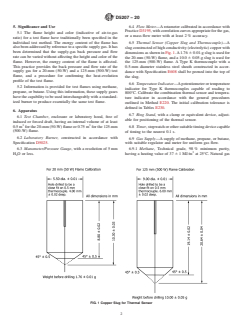
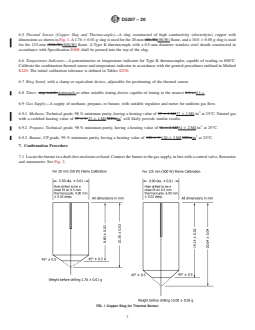
6.5 Thermal Sensor (Copper Slug and Thermocouple)—A slug constructed of high conductivity (electrolytic) copper with
dimensions as shown in Fig. 1. A 1.76 6 0.01-g slug is used for the 20-mm (50–W)(50-W) flame, and a 10.0 6 0.05-g slug is used
for the 125-mm (500–W)(500-W) flame. A Type K thermocouple with a 0.5-mm diameter stainless steel sheath constructed in
accordance with Specification E608 shall be peened into the top of the slug.
6.6 Temperature Indicator—A potentiometer or temperature indicator for Type K thermocouples capable of reading to 800°C.
Calibrate the combinat
...