

ASTM F806-99a(2017)
(Test Method)Standard Test Method for Compressibility and Recovery of Laminated Composite Gasket Materials
General Information
- Abstract
SIGNIFICANCE AND USE
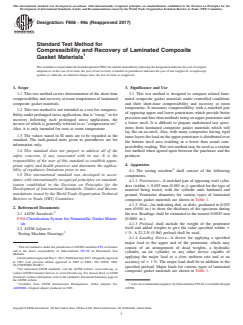
3.1 This test method is designed to compare related laminated composite gasket materials under controlled conditions and their short-time compressibility and recovery at room temperature. It measures compressibility with a matched pair of opposing upper and lower penetrators which provide better precision and bias than methods using an upper penetrator and a lower anvil. It is difficult to prepare undistorted test specimens from laminated composite gasket materials which will lay flat on an anvil. Also, with many composites having rigid inner layers the load on the upper penetrator is distributed over the bottom anvil area resulting in a lower than actual compressibility reading. This test method may be used as a routine test method when agreed upon between the purchaser and the producer.
SCOPE
1.1 This test method covers determination of the short-time compressibility and recovery at room temperature of laminated composite gasket materials.
1.2 This test method is not intended as a test for compressibility under prolonged stress application, that is “creep,” or for recovery following such prolonged stress application, the inverse of which is generally referred to as “compression set.” Also, it is only intended for tests at room temperature.
1.3 The values stated in SI units are to be regarded as the standard. The inch-pound units given in parentheses are for information only.
1.4 This standard does not purport to address all of the safety concerns, if any, associated with its use. It is the responsibility of the user of this standard to establish appropriate safety and health practices and determine the applicability of regulatory limitations prior to use.
1.5 This international standard was developed in accordance with internationally recognized principles on standardization established in the Decision on Principles for the Development of International Standards, Guides and Recommendations issued by the World Trade Organization Technical Barriers to Trade (TBT) Committee.
- Status
- Published
- Publication Date
- 30-Apr-2017
- Technical Committee
- F03 - Gaskets
- Drafting Committee
- F03.20 - Mechanical Test Methods


Overview
ASTM F806-99a(2017) is a standard test method developed by ASTM International aimed at determining the short-time compressibility and recovery of laminated composite gasket materials at room temperature. This test provides precise and repeatable measurements using a matched pair of opposing upper and lower penetrators, which improves accuracy over traditional methods. The method is especially vital for comparing different gasket material composites under controlled laboratory conditions to aid in material specification, selection, and quality assurance processes.
Key Topics
Scope and Limitations
- The standard is applicable for short-time compressibility and recovery tests conducted only at room temperature (21 to 30°C / 70 to 85°F).
- It is not designed to measure long-term compressibility such as creep or compression set.
- Results are stated in SI units, with inch-pound conversions provided for reference.
Testing Methodology
- Utilizes a matched pair of hardened steel penetrators for precise measurement.
- Specimens must be carefully prepared to lay flat and correspond with the contact points of the penetrators to avoid distortion and bias in results.
- The procedure specifies preload and major load application, with direct reading dials to monitor specimen thickness throughout the test.
Conditioning Requirements
- Laminated composites are conditioned according to the type of nonmetallic layers they contain, following specified humidity and temperature guidelines.
- When different nonmetallic layers are present, a standardized 22-hour controlled-humidity conditioning is used unless otherwise agreed.
Test Calculations
- Compressibility and recovery are calculated as percentages based on measured thickness under preload, total load, and after recovery.
- Multiple specimens (minimum three) are tested, with results averaged for reporting.
Precision and Repeatability
- This method provides a high level of repeatability and reproducibility, making it valuable for routine comparative testing between producers and purchasers.
Applications
ASTM F806-99a(2017) plays a crucial role in the gasket manufacturing and industrial sealing industries, where understanding the compressibility and recovery characteristics of laminated composite gasket materials is essential. Its primary uses include:
- Material Comparison and Selection
- Enables engineers to compare various laminated composite gasket materials for compressibility and recovery performance at room temperature.
- Quality Control
- Serves as a routine quality assurance test during production, ensuring materials meet specified performance criteria before use in critical applications.
- Supplier and Purchaser Agreements
- Offers a standard basis for agreements between manufacturers and buyers about product performance.
These applications are vital in industries such as automotive, chemical processing, oil and gas, energy, and wherever reliable gasket sealing is required.
Related Standards
- ASTM F104: Classification System for Nonmetallic Gasket Materials - referenced within ASTM F806 for material classification.
- Other mechanical and physical property standards for gasket materials by ASTM and ISO may complement this test method for a more comprehensive assessment of material suitability.
Keywords: ASTM F806, gasket material composites, laminated composite gasket, compressibility test, recovery test, room temperature, material comparison, quality control, ASTM standards, gasket resiliency, test method.
Relations
- Effective Date
- 01-May-2017
- Effective Date
- 01-Jan-2020
- Effective Date
- 01-Apr-2011
- Effective Date
- 01-Oct-2009
- Effective Date
- 10-Apr-2003
- Effective Date
- 10-Oct-2002
- Effective Date
- 10-Oct-2000
Frequently Asked Questions
ASTM F806-99a(2017) is a standard published by ASTM International. Its full title is "Standard Test Method for Compressibility and Recovery of Laminated Composite Gasket Materials". This standard covers: SIGNIFICANCE AND USE 3.1 This test method is designed to compare related laminated composite gasket materials under controlled conditions and their short-time compressibility and recovery at room temperature. It measures compressibility with a matched pair of opposing upper and lower penetrators which provide better precision and bias than methods using an upper penetrator and a lower anvil. It is difficult to prepare undistorted test specimens from laminated composite gasket materials which will lay flat on an anvil. Also, with many composites having rigid inner layers the load on the upper penetrator is distributed over the bottom anvil area resulting in a lower than actual compressibility reading. This test method may be used as a routine test method when agreed upon between the purchaser and the producer. SCOPE 1.1 This test method covers determination of the short-time compressibility and recovery at room temperature of laminated composite gasket materials. 1.2 This test method is not intended as a test for compressibility under prolonged stress application, that is “creep,” or for recovery following such prolonged stress application, the inverse of which is generally referred to as “compression set.” Also, it is only intended for tests at room temperature. 1.3 The values stated in SI units are to be regarded as the standard. The inch-pound units given in parentheses are for information only. 1.4 This standard does not purport to address all of the safety concerns, if any, associated with its use. It is the responsibility of the user of this standard to establish appropriate safety and health practices and determine the applicability of regulatory limitations prior to use. 1.5 This international standard was developed in accordance with internationally recognized principles on standardization established in the Decision on Principles for the Development of International Standards, Guides and Recommendations issued by the World Trade Organization Technical Barriers to Trade (TBT) Committee.
SIGNIFICANCE AND USE 3.1 This test method is designed to compare related laminated composite gasket materials under controlled conditions and their short-time compressibility and recovery at room temperature. It measures compressibility with a matched pair of opposing upper and lower penetrators which provide better precision and bias than methods using an upper penetrator and a lower anvil. It is difficult to prepare undistorted test specimens from laminated composite gasket materials which will lay flat on an anvil. Also, with many composites having rigid inner layers the load on the upper penetrator is distributed over the bottom anvil area resulting in a lower than actual compressibility reading. This test method may be used as a routine test method when agreed upon between the purchaser and the producer. SCOPE 1.1 This test method covers determination of the short-time compressibility and recovery at room temperature of laminated composite gasket materials. 1.2 This test method is not intended as a test for compressibility under prolonged stress application, that is “creep,” or for recovery following such prolonged stress application, the inverse of which is generally referred to as “compression set.” Also, it is only intended for tests at room temperature. 1.3 The values stated in SI units are to be regarded as the standard. The inch-pound units given in parentheses are for information only. 1.4 This standard does not purport to address all of the safety concerns, if any, associated with its use. It is the responsibility of the user of this standard to establish appropriate safety and health practices and determine the applicability of regulatory limitations prior to use. 1.5 This international standard was developed in accordance with internationally recognized principles on standardization established in the Decision on Principles for the Development of International Standards, Guides and Recommendations issued by the World Trade Organization Technical Barriers to Trade (TBT) Committee.
ASTM F806-99a(2017) is classified under the following ICS (International Classification for Standards) categories: 21.140 - Seals, glands. The ICS classification helps identify the subject area and facilitates finding related standards.
ASTM F806-99a(2017) has the following relationships with other standards: It is inter standard links to ASTM F806-99a(2009), ASTM F104-11(2020), ASTM F104-11, ASTM F104-03(2009), ASTM F104-03, ASTM F104-02e1, ASTM F104-00. Understanding these relationships helps ensure you are using the most current and applicable version of the standard.
ASTM F806-99a(2017) is available in PDF format for immediate download after purchase. The document can be added to your cart and obtained through the secure checkout process. Digital delivery ensures instant access to the complete standard document.
Standards Content (Sample)
This international standard was developed in accordance with internationally recognized principles on standardization established in the Decision on Principles for the
Development of International Standards, Guides and Recommendations issued by the World Trade Organization Technical Barriers to Trade (TBT) Committee.
Designation: F806 − 99a (Reapproved 2017)
Standard Test Method for
Compressibility and Recovery of Laminated Composite
Gasket Materials
ThisstandardisissuedunderthefixeddesignationF806;thenumberimmediatelyfollowingthedesignationindicatestheyearoforiginal
adoption or, in the case of revision, the year of last revision.Anumber in parentheses indicates the year of last reapproval.Asuperscript
epsilon (´) indicates an editorial change since the last revision or reapproval.
1. Scope 3. Significance and Use
1.1 This test method covers determination of the short-time 3.1 This test method is designed to compare related lami-
compressibility and recovery at room temperature of laminated nated composite gasket materials under controlled conditions
composite gasket materials. and their short-time compressibility and recovery at room
temperature. It measures compressibility with a matched pair
1.2 This test method is not intended as a test for compress-
of opposing upper and lower penetrators which provide better
ibilityunderprolongedstressapplication,thatis“creep,”orfor
precision and bias than methods using an upper penetrator and
recovery following such prolonged stress application, the
a lower anvil. It is difficult to prepare undistorted test speci-
inverse of which is generally referred to as “compression set.”
mens from laminated composite gasket materials which will
Also, it is only intended for tests at room temperature.
lay flat on an anvil. Also, with many composites having rigid
1.3 The values stated in SI units are to be regarded as the
inner layers the load on the upper penetrator is distributed over
standard. The inch-pound units given in parentheses are for
the bottom anvil area resulting in a lower than actual com-
information only.
pressibility reading. This test method may be used as a routine
1.4 This standard does not purport to address all of the test method when agreed upon between the purchaser and the
safety concerns, if any, associated with its use. It is the
producer.
responsibility of the user of this standard to establish appro-
4. Apparatus
priate safety and health practices and determine the applica-
bility of regulatory limitations prior to use.
4.1 The testing machine shall consist of the following
1.5 This international standard was developed in accor-
components.
dance with internationally recognized principles on standard-
4.1.1 Penetrators—A matched pair of opposing steel cylin-
ization established in the Decision on Principles for the
ders (within 6 0.025 mm (0.001 in.)) specified for the type of
Development of International Standards, Guides and Recom-
material being tested, with the cylinder ends hardened and
mendations issued by the World Trade Organization Technical
ground. Penetrator diameters for various types of laminated
Barriers to Trade (TBT) Committee.
composite gasket materials are shown in Table 1.
4.1.2 Dial—An indicating dial, or dials, graduated in 0.025
2. Referenced Documents
mm (0.001 in.) to show the thickness of the specimen during
2.1 ASTM Standards: the test. Readings shall be estimated to the nearest 0.0025 mm
F104 Classification System for Nonmetallic Gasket Materi- (0.0001 in.).
als 4.1.3 Preload, shall include the weight of the penetrator
itself and added weights to give the value specified within 6
2.2 ASTM Adjuncts:
1 %. A 22.2-N (5-lbf) preload shall be used.
Testing Machine Drawings
4.1.4 Loading Device—A device for applying a specified
major load to the upper end of the penetrator, which may
This test method is under the jurisdiction ofASTM Committee F03 on Gaskets
consist of an arrangement of dead weights, a hydraulic
and is the direct responsibility of Subcommittee F03.20 on Mechanical Test
cylinder, an air cylinder, or any other device capable of
Methods.
applying the major load at a slow uniform rate and to an
CurrenteditionapprovedMay1,2017.PublishedJuly2017.Originallyapproved
in 1983. Last previous edition approved in 2009 as F806 – 99a (2009). DOI:
accuracy of 6 1 %. The major load shall be in addition to the
10.1520/F0806-99AR17.
specified preload. Major loads for various types of laminated
For referenced ASTM standards, visit the ASTM website, www.astm.org, or
composite gasket materials are shown in Table 1.
contact ASTM Customer Service at service@astm.org. For Annual Book of ASTM
Standards volume information, refer to the standard’s Document Summary page on
the ASTM website.
3 4
Available from ASTM International Headquarters. Order Adjunct No. Alistofrecommendedsuppliers,bySubcommitteeF03.20,isavailablethrough
ADJF0806. Original adjunct produced in 1983. ASTM.
Copyright © ASTM International, 100 Barr Harbor Drive, PO Box C700, West Conshohocken, PA 19428-2959. United States
F806 − 99a (2017)
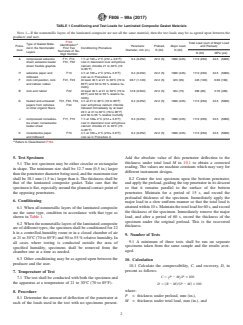
TABLE 1 Conditioning and Test Loads for Laminated Composite Gasket Materials
NOTE 1—If the nonmetallic layers of the laminated composite are not all the same material, then the test loads may be as agreed upon between the
producer and user.
F104
Total Load (sum of Major Load
A
Type of Gasket Mate-
Identification
Proce- Penetrator Preload, Major Load,
and Preload)
rial in the Nonmetallic Conditioning Procedure
First Two
dure Diameter, mm (in.) N (lbf) N (lbf)
Numerals of Six-
Layers
N (lbf) MPa (psi)
Digit Number
A compressed asbestos F11, F12, 1hat100±2°C(212±3.6°F); 6.4 (0.252) 22.2 (5) 1090 (245) 1112 (250) 34.5 (5000)
sheet; asbestos beater F51, F52 cool in desiccator over anhydrous
sheet; flexible graphite calcium chloride 21 to 30°C (70
to 85°F)
H asbestos paper and F13 4 h at 100 ± 2°C (212± 3.6°F); 6.4 (0.252) 22.2 (5) 1090 (245) 1112 (250) 34.5 (5000)
millboard cool as in Procedure A
F cork composition, cork F21, F23 At least 46 h at 21 to 30°C (
...