

ASTM B299/B299M-18
(Specification)Standard Specification for Titanium Sponge
General Information
- Abstract
ABSTRACT
This specification covers virgin titanium metal melting stock. This virgin metal is commonly designated as sponge titanium because it is most commonly porous and spongelike in texture, although metal produced electrolytically is granular and is essentially nonporous. Sponge titanium is usually prepared by reduction of titanium tetrachloride and gets its spongelike character from the processes involved in production. This spongy characteristic, however, is not considered essential and may be expected to vary greatly with manufacturing methods. For example, virgin titanium produced electrolytically is crystalline or granular in character and is essentially nonporous. The metal is usually supplied in lump or granular form. The virgin titanium shall be free of scrap, intentionally added contaminants and shall be in uniform, well-mixed blends. The titanium metal shall conform to the chemical composition and Brinell hardness requirements prescribed.
SCOPE
1.1 This specification covers the purchase of virgin titanium sponge metal. This virgin metal is commonly designated as titanium sponge because it is most commonly porous and sponge-like in texture, although metal produced electrolytically is granular and is essentially nonporous.
1.2 The values stated in either SI units or inch-pound units are to be regarded separately as standard. The values stated in each system may not be exact equivalents; therefore, each system shall be used independently of the other. Combining values from the two systems may result in non-conformance with the standard.
1.3 This international standard was developed in accordance with internationally recognized principles on standardization established in the Decision on Principles for the Development of International Standards, Guides and Recommendations issued by the World Trade Organization Technical Barriers to Trade (TBT) Committee.
- Status
- Published
- Publication Date
- 30-Sep-2018
- Technical Committee
- B10 - Reactive and Refractory Metals and Alloys
- Drafting Committee
- B10.01 - Titanium




Overview
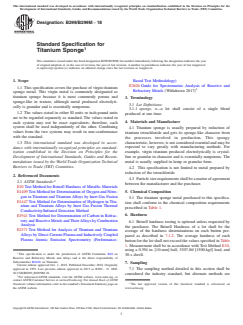
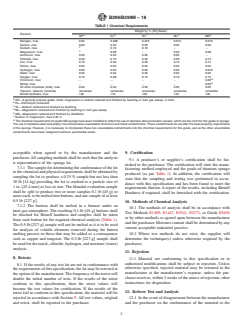
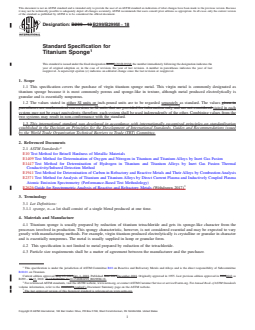
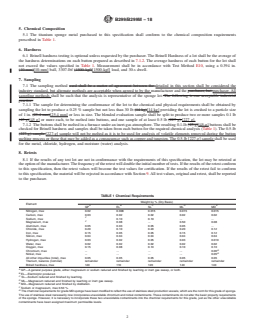
ASTM B299/B299M-18 - Standard Specification for Titanium Sponge defines the requirements and guidelines for the purchase and quality assessment of virgin titanium sponge metal. As established by ASTM International, this specification covers titanium sponge used primarily as melting stock in the production of titanium metal and titanium alloys. The term "titanium sponge" refers mainly to a porous, spongelike form produced by reduction of titanium tetrachloride; however, it also includes nonporous, granular metal produced by electrolytic methods. Both forms are supplied in lump or granular form and must be free of scrap and intentionally added contaminants.
Key Topics
Material Purity and Uniformity
Titanium sponge specified under ASTM B299/B299M-18 must be virgin material, free from scrap and intentionally added contaminants. It is delivered in uniform, well-mixed blends to ensure quality and consistency across batches.Chemical Composition Requirements
The specification lists strict chemical composition limits for standard elements including nitrogen, carbon, sodium, magnesium, aluminum, chloride, iron, silicon, hydrogen, water, oxygen, and permissible levels of unavoidable impurities such as chromium and nickel.Physical Properties
- Texture and Form: Titanium sponge may vary from spongelike porous material to crystalline or granular forms, depending on the production method.
- Hardness: Brinell hardness testing, performed as per ASTM E10, is optional but is required upon purchaser request. Each grade has a maximum Brinell hardness value.
Sampling and Testing
Methods of sampling and chemical analysis are clearly defined to ensure representative and accurate test results. Testing methods include inert gas fusion, combustion analysis, and plasma atomic emission spectrometry (referencing ASTM E1409, E1447, E1941, E2371).Packaging and Marking
Packaging methods are determined by agreement between supplier and purchaser, with considerations given to fire hazards and prolonged storage. Air-tight, moisture-proof containers are recommended to prevent deterioration.
Applications
Titanium Metal Production
Titanium sponge produced per this ASTM standard serves as the fundamental raw material for the melting processes in titanium metal and alloy production. Its high purity and controlled composition are critical for aerospace, medical, and industrial titanium products.Aerospace and Defense
Quality-regulated titanium sponge is a key source for producing high-performance titanium alloys used in engine components, airframes, and military hardware where strength-to-weight ratio and material purity are paramount.Industrial Uses
Industries such as chemical processing, power generation, and marine engineering rely on titanium sponge meeting ASTM B299/B299M-18 for corrosion-resistant and high-strength titanium alloys.
Related Standards
- ASTM E10 - Test Method for Brinell Hardness of Metallic Materials
- ASTM E1409 - Determination of Oxygen and Nitrogen in Titanium and Titanium Alloys by Inert Gas Fusion
- ASTM E1447 - Determination of Hydrogen in Titanium and Titanium Alloys
- ASTM E1941 - Determination of Carbon in Refractory and Reactive Metals and Their Alloys by Combustion Analysis
- ASTM E2371 - Analysis of Titanium and Titanium Alloys by Plasma Atomic Emission Spectrometry
Practical Value
Adherence to ASTM B299/B299M-18 ensures that titanium sponge meets stringent chemical and physical requirements, supporting reliable supply chains for critical industries. By following this standard, manufacturers and purchasers can be confident in the uniformity, quality, and suitability of titanium sponge for advanced metal and alloy production. Use of certified titanium sponge helps maintain product quality, performance, and safety across diverse engineering applications.
Relations
- Effective Date
- 01-Oct-2018
- Effective Date
- 01-May-2014
- Effective Date
- 01-Jan-2012
- Effective Date
- 01-Dec-2010
- Effective Date
- 01-Jun-2010
- Effective Date
- 01-Mar-2009
- Effective Date
- 01-Dec-2008
- Effective Date
- 15-Jun-2008
- Effective Date
- 15-Jun-2008
- Effective Date
- 15-Jun-2008
- Effective Date
- 01-Apr-2007
- Effective Date
- 01-Jan-2007
- Effective Date
- 01-Jan-2007
- Effective Date
- 01-May-2005
- Effective Date
- 01-May-2005
Get Certified
Connect with accredited certification bodies for this standard

Element Materials Technology
Materials testing and product certification.

Inštitut za kovinske materiale in tehnologije
Institute of Metals and Technology. Materials testing, metallurgical analysis, NDT.
Sponsored listings
Frequently Asked Questions
ASTM B299/B299M-18 is a technical specification published by ASTM International. Its full title is "Standard Specification for Titanium Sponge". This standard covers: ABSTRACT This specification covers virgin titanium metal melting stock. This virgin metal is commonly designated as sponge titanium because it is most commonly porous and spongelike in texture, although metal produced electrolytically is granular and is essentially nonporous. Sponge titanium is usually prepared by reduction of titanium tetrachloride and gets its spongelike character from the processes involved in production. This spongy characteristic, however, is not considered essential and may be expected to vary greatly with manufacturing methods. For example, virgin titanium produced electrolytically is crystalline or granular in character and is essentially nonporous. The metal is usually supplied in lump or granular form. The virgin titanium shall be free of scrap, intentionally added contaminants and shall be in uniform, well-mixed blends. The titanium metal shall conform to the chemical composition and Brinell hardness requirements prescribed. SCOPE 1.1 This specification covers the purchase of virgin titanium sponge metal. This virgin metal is commonly designated as titanium sponge because it is most commonly porous and sponge-like in texture, although metal produced electrolytically is granular and is essentially nonporous. 1.2 The values stated in either SI units or inch-pound units are to be regarded separately as standard. The values stated in each system may not be exact equivalents; therefore, each system shall be used independently of the other. Combining values from the two systems may result in non-conformance with the standard. 1.3 This international standard was developed in accordance with internationally recognized principles on standardization established in the Decision on Principles for the Development of International Standards, Guides and Recommendations issued by the World Trade Organization Technical Barriers to Trade (TBT) Committee.
ABSTRACT This specification covers virgin titanium metal melting stock. This virgin metal is commonly designated as sponge titanium because it is most commonly porous and spongelike in texture, although metal produced electrolytically is granular and is essentially nonporous. Sponge titanium is usually prepared by reduction of titanium tetrachloride and gets its spongelike character from the processes involved in production. This spongy characteristic, however, is not considered essential and may be expected to vary greatly with manufacturing methods. For example, virgin titanium produced electrolytically is crystalline or granular in character and is essentially nonporous. The metal is usually supplied in lump or granular form. The virgin titanium shall be free of scrap, intentionally added contaminants and shall be in uniform, well-mixed blends. The titanium metal shall conform to the chemical composition and Brinell hardness requirements prescribed. SCOPE 1.1 This specification covers the purchase of virgin titanium sponge metal. This virgin metal is commonly designated as titanium sponge because it is most commonly porous and sponge-like in texture, although metal produced electrolytically is granular and is essentially nonporous. 1.2 The values stated in either SI units or inch-pound units are to be regarded separately as standard. The values stated in each system may not be exact equivalents; therefore, each system shall be used independently of the other. Combining values from the two systems may result in non-conformance with the standard. 1.3 This international standard was developed in accordance with internationally recognized principles on standardization established in the Decision on Principles for the Development of International Standards, Guides and Recommendations issued by the World Trade Organization Technical Barriers to Trade (TBT) Committee.
ASTM B299/B299M-18 is classified under the following ICS (International Classification for Standards) categories: 77.150.50 - Titanium products. The ICS classification helps identify the subject area and facilitates finding related standards.
ASTM B299/B299M-18 has the following relationships with other standards: It is inter standard links to ASTM B299-13, ASTM E10-14, ASTM E10-12, ASTM E1941-10, ASTM E10-10, ASTM E1447-09, ASTM E10-08, ASTM E2626-08, ASTM E1409-08, ASTM E2626-08e1, ASTM E10-07a, ASTM E10-07, ASTM E10-07e1, ASTM E1447-05, ASTM E1409-05. Understanding these relationships helps ensure you are using the most current and applicable version of the standard.
ASTM B299/B299M-18 is available in PDF format for immediate download after purchase. The document can be added to your cart and obtained through the secure checkout process. Digital delivery ensures instant access to the complete standard document.
Standards Content (Sample)
This international standard was developed in accordance with internationally recognized principles on standardization established in the Decision on Principles for the
Development of International Standards, Guides and Recommendations issued by the World Trade Organization Technical Barriers to Trade (TBT) Committee.
Designation:B299/B299M −18
Standard Specification for
Titanium Sponge
This standard is issued under the fixed designation B299/B299M; the number immediately following the designation indicates the year
of original adoption or, in the case of revision, the year of last revision. A number in parentheses indicates the year of last reapproval.
A superscript epsilon (´) indicates an editorial change since the last revision or reapproval.
1. Scope Based Test Methodology)
E2626 Guide for Spectrometric Analysis of Reactive and
1.1 This specification covers the purchase of virgin titanium
Refractory Metals (Withdrawn 2017)
sponge metal. This virgin metal is commonly designated as
titanium sponge because it is most commonly porous and
3. Terminology
sponge-like in texture, although metal produced electrolyti-
3.1 Lot Definitions:
cally is granular and is essentially nonporous.
3.1.1 sponge, n—a lot shall consist of a single blend
1.2 The values stated in either SI units or inch-pound units
produced at one time.
are to be regarded separately as standard. The values stated in
4. Materials and Manufacture
each system may not be exact equivalents; therefore, each
system shall be used independently of the other. Combining
4.1 Titanium sponge is usually prepared by reduction of
values from the two systems may result in non-conformance
titanium tetrachloride and gets its sponge-like character from
with the standard.
the processes involved in production. This spongy
characteristic, however, is not considered essential and may be
1.3 This international standard was developed in accor-
dance with internationally recognized principles on standard- expected to vary greatly with manufacturing methods. For
example, virgin titanium produced electrolytically is crystal-
ization established in the Decision on Principles for the
line or granular in character and is essentially nonporous. The
Development of International Standards, Guides and Recom-
metal is usually supplied in lump or granular form.
mendations issued by the World Trade Organization Technical
Barriers to Trade (TBT) Committee.
4.2 This specification is not limited to metal prepared by
reduction of the tetrachloride.
2. Referenced Documents
4.3 Particlesizerequirementsshallbeamatterofagreement
2.1 ASTM Standards:
between the manufacturer and the purchaser.
E10 Test Method for Brinell Hardness of Metallic Materials
5. Chemical Composition
E1409 Test Method for Determination of Oxygen and Nitro-
gen in Titanium and Titanium Alloys by Inert Gas Fusion
5.1 The titanium sponge metal purchased to this specifica-
E1447 Test Method for Determination of Hydrogen in Tita-
tion shall conform to the chemical composition requirements
nium and Titanium Alloys by Inert Gas Fusion Thermal
prescribed in Table 1.
Conductivity/Infrared Detection Method
6. Hardness
E1941 Test Method for Determination of Carbon in Refrac-
tory and Reactive Metals andTheirAlloys by Combustion
6.1 Brinell hardness testing is optional unless requested by
Analysis
the purchaser. The Brinell Hardness of a lot shall be the
E2371 Test Method for Analysis of Titanium and Titanium
average of the hardness determinations on each button pre-
Alloys by Direct Current Plasma and Inductively Coupled
pared as described in 7.1.2. The average hardness of each
Plasma Atomic Emission Spectrometry (Performance-
button for the lot shall not exceed the values specified in Table
1. Measurement shall be in accordance with Test Method E10,
using a 0.394 in. [10-mm] ball, 3307-lbf [1500-kgf] load, and
This specification is under the jurisdiction of ASTM Committee B10 on
30-s dwell.
Reactive and Refractory Metals and Alloys and is the direct responsibility of
Subcommittee B10.01 on Titanium.
7. Sampling
Current edition approved Oct. 1, 2018. Published December 2018. Originally
approved in 1955. Last previous edition approved in 2013 as B299 – 13. DOI: 7.1 The sampling method detailed in this section shall be
10.1520/B0299_B0299M-18.
considered the industry standard, but alternate methods are
For referenced ASTM standards, visit the ASTM website, www.astm.org, or
contact ASTM Customer Service at service@astm.org. For Annual Book of ASTM
Standards volume information, refer to the standard’s Document Summary page on The last approved version of this historical standard is referenced on
the ASTM website. www.astm.org.
Copyright © ASTM International, 100 Barr Harbor Drive, PO Box C700, West Conshohocken, PA 19428-2959. United States
B299/B299M−18
TABLE 1 Chemical Requirements
Weight by % (Dry Basis)
Element
A B C D E
GP EL SL ML MD
Nitrogen, max 0.02 0.008 0.015 0.015 0.015
Carbon, max 0.03 0.02 0.02 0.02 0.02
F
Sodium, max 0.10 0.19 . .
F
Magnesium, max 0.08 . 0.50 0.08
Aluminum, max 0.05 0.03 0.05 0.05 .
Chloride, max 0.20 0.10 0.20 0.20 0.12
Iron, max 0.15 0.05 0.05 0.15 0.12
Silicon, max 0.04 0.04 0.04 0.04 0.04
Hydrogen, max 0.03 0.02 0.05 0.03 0.010
Water, max 0.02 0.02 0.02 0.02 0.02
Oxygen, max 0.15 0.08 0.10 0.10 0.10
G
Chromium, max . . . . 0.06
G
Nickel, max . . . . 0.05
All other impurities (total), max 0.05 0.05 0.05 0.05 0.05
Titanium, balance (nominal) remainder remainder remainder remainder remainder
Brinell hardness, max 140 110 120 140 140
A
GP—A general purpose grade, either magnesium or sodium reduced and finished by leaching or inert gas sweep, or both.
B
EL—Electrolytic produced.
C
SL—Sodium reduced and finished by leaching.
D
ML—Magnesium reduced and finished by leaching or inert gas sweep.
E
MD—Magnesium reduced and finished by distillation.
F
Sodium or magnesium, max 0.50 %.
G
The chemical requirements for grade MD sponge have been modified to reflect the use of stainless steel production vessels, which a
...
This document is not an ASTM standard and is intended only to provide the user of an ASTM standard an indication of what changes have been made to the previous version. Because
it may not be technically possible to adequately depict all changes accurately, ASTM recommends that users consult prior editions as appropriate. In all cases only the current version
of the standard as published by ASTM is to be considered the official document.
Designation: B299 − 13 B299/B299M − 18
Standard Specification for
Titanium Sponge
This standard is issued under the fixed designation B299;B299/B299M; the number immediately following the designation indicates the
year of original adoption or, in the case of revision, the year of last revision. A number in parentheses indicates the year of last
reapproval. A superscript epsilon (´) indicates an editorial change since the last revision or reapproval.
1. Scope
1.1 This specification covers the purchase of virgin titanium sponge metal. This virgin metal is commonly designated as
titanium sponge because it is most commonly porous and sponge-like in texture, although metal produced electrolytically is
granular and is essentially nonporous.
1.2 The values stated in either SI units or inch-pound units are to be regarded separately as standard. The values given in
parentheses are mathematical conversions to SI units that are provided for information only and are not considered stated in each
system may not be exact equivalents; therefore, each system shall be used independently of the other. Combining values from the
two systems may result in non-conformance with the standard.
1.3 This international standard was developed in accordance with internationally recognized principles on standardization
established in the Decision on Principles for the Development of International Standards, Guides and Recommendations issued
by the World Trade Organization Technical Barriers to Trade (TBT) Committee.
2. Referenced Documents
2.1 ASTM Standards:
E10 Test Method for Brinell Hardness of Metallic Materials
E1409 Test Method for Determination of Oxygen and Nitrogen in Titanium and Titanium Alloys by Inert Gas Fusion
E1447 Test Method for Determination of Hydrogen in Titanium and Titanium Alloys by Inert Gas Fusion Thermal
Conductivity/Infrared Detection Method
E1941 Test Method for Determination of Carbon in Refractory and Reactive Metals and Their Alloys by Combustion Analysis
E2371 Test Method for Analysis of Titanium and Titanium Alloys by Direct Current Plasma and Inductively Coupled Plasma
Atomic Emission Spectrometry (Performance-Based Test Methodology)
E2626 Guide for Spectrometric Analysis of Reactive and Refractory Metals (Withdrawn 2017)
3. Terminology
3.1 Lot Definitions:
3.1.1 sponge, n—a lot shall consist of a single blend produced at one time.
4. Materials and Manufacture
4.1 Titanium sponge is usually prepared by reduction of titanium tetrachloride and gets its sponge-like character from the
processes involved in production. This spongy characteristic, however, is not considered essential and may be expected to vary
greatly with manufacturing methods. For example, virgin titanium produced electrolytically is crystalline or granular in character
and is essentially nonporous. The metal is usually supplied in lump or granular form.
4.2 This specification is not limited to metal prepared by reduction of the tetrachloride.
4.3 Particle size requirements shall be a matter of agreement between the manufacturer and the purchaser.
This specification is under the jurisdiction of ASTM Committee B10 on Reactive and Refractory Metals and Alloys and is the direct responsibility of Subcommittee
B10.01 on Titanium.
Current edition approved May 15, 2013Oct. 1, 2018. Published June 2013December 2018. Originally approved in 1955. Last previous edition approved in 20082013 as
B299 – 08.13. DOI: 10.1520/B0299-13.10.1520/B0299_B0299M-18.
For referenced ASTM standards, visit the ASTM website, www.astm.org, or contact ASTM Customer Service at service@astm.org. For Annual Book of ASTM Standards
volume information, refer to the standard’sstandard’s Document Summary page on the ASTM website.
The last approved version of this historical standard is referenced on www.astm.org.
Copyright © ASTM International, 100 Barr Harbor Drive, PO Box C700, West Conshohocken, PA 19428-2959. United States
B299/B299M − 18
5. Chemical Composition
5.1 The titanium sponge metal purchased to this specification shall conform to the chemical composition requirements
prescribed in Table 1.
6. Hardness
6.1 Brinell hardness testing is optional unless requested by the purchaser. The Brinell Hardness of a lot shall be the average of
the hardness determinations on each button prepared as described in 7.1.2. The average hardness of each button for the lot shall
not exceed the values specified in Table 1. Measurement shall be in accordance with Test Method E10, using a 0.394 in.
(10-mm)[10-mm] ball, 3307-lbf (1500-kgf)[1500-kgf] load, and 30-s dwell.
7. Sampling
7.1 The sampling method used shall be a matter of agreement between the detailed in this section shall be considered the
industry standard, but alternate methods are acceptable when agreed to by the manufacturer and the purchaser, but purchaser. All
sampling methods shall be such that the analysis is representative of the sponge lot. The following is one acceptable industrial
practice:
7.1.1 The sample for determining the conformance of the lot to the chemical and physical requirements shall be obtained by
sampling the lot to produce a 0.25 % sample but not less than 30 lb (14 kg)[14 kg] providing the lot is crushed to a particle size
of 1 in. (25.4 mm)[25.4 mm] or less in size. The blended evaluation sample shall be split to produce two or more samples 0.1 lb
(45 g)[45 g] or more each, to be melted into buttons, and one sample of at least 0.5 lb (227 g).[227 g].
7.1.2 The buttons shall be melted in a furnace under an inert-gas atmosphere. The resulting 0.1-lb (45-g)[45-g] buttons shall be
checked for Brinell hardness and samples shall be taken from each button for the required chemical analysis (Table 1). The 0.5-lb
(227-g) sample [227-g] sample will not be melted as it is to be used for analysis of volatile elements removed during the button
melting process or those tha
...