

CEN/TR 17024:2017
(Main)Natural stones - Guidance for use of natural stones
- Abstract
This Technical Report applies to natural stone products intended for masonry elements, wall coverings (including tiles), interior floor and stair finishes (including tiles) and exterior floor and stair finishes (including paving), as well as massive stone elements. It provides guidance for the application and the use of natural stone products in accordance with European product standards. This document does not deal with coatings or staining problems, and does not take into account treatments which may modify the performance characteristics of the materials. This document does not apply to agglomerated stones and aggregates.
- Status
- Published
- Publication Date
- 17-Jan-2017
- Technical Committee
- CEN/TC 246 - Natural stones
- Drafting Committee
- CEN/TC 246/WG 3 - Product specifications
- Current Stage
- 6060 - Definitive text made available (DAV) - Publishing
- Start Date
- 18-Jan-2017
- Due Date
- 20-Feb-2017
- Completion Date
- 18-Jan-2017

Overview
CEN/TR 17024:2017 - "Natural stones - Guidance for use of natural stones" is a CEN Technical Report that provides practical guidance for the selection, testing and application of natural stone products in compliance with European product standards. It covers stone used in masonry elements, wall coverings (including tiles), internal and external floors and stairs (including paving), and massive stone elements. The report clarifies characterization, performance and durability testing, and the delivery acceptance process. Note: it does not address coatings, staining problems, agglomerated stones or treatments that change material performance.
Key topics and technical requirements
- Scope & definitions: clear definitions for order, delivery, batch, contractual sample and packaging unit to support procurement and QA.
- Characterization tests: requirements for identification and material properties, including origin, petrographic analysis, macroscopic reference samples, apparent density, open porosity and water absorption.
- Mechanical properties: guidance on relevant tests such as uniaxial compressive strength, flexural strength and modulus of elasticity to assess suitability for structural applications.
- Performance-in-use tests: practical tests that replicate service conditions - resistance to breaking load at dowel holes, rupture energy, slip resistance, and sensitivity to staining.
- Durability tests: recommended evaluations including frost resistance, abrasion resistance and thermal shock / ageing tests to predict long-term behaviour.
- Dimensional tolerances & geometric checks: procedures for verifying finished product dimensions and tolerances against product standards.
- Delivery acceptance: step-by-step guidance for acceptance at delivery - sampling, testing of material nature, geometric checks, verification against contractual samples, and handling visual/dimensional non‑conformities.
Practical applications
- Selecting suitable natural stone types for façades, cladding, interior and exterior flooring, stairs, kerbs and paving.
- Defining test programs to demonstrate compliance with European product standards before placing stone products on the market.
- Creating characterization sheets and contractual samples for procurement and quality control.
- Assessing durability for projects exposed to frost, pedestrian traffic or thermal cycling.
Who should use this standard
- Architects and specifiers selecting natural stone finishes
- Stone producers, fabricators and suppliers preparing characterization sheets and deliveries
- Laboratory and QA personnel performing material testing
- Contractors, façade engineers and facility managers responsible for acceptance and long‑term performance
Related standards
Key referenced standards include EN 12407, EN 12440, EN 1936, EN 12371, EN 14157, EN 13364, EN 12058 and CEN/TS 16165 among others - all forming the normative framework for testing and product requirements under CEN/TR 17024:2017.
Relations
- Effective Date
- 28-Jan-2026
- Effective Date
- 28-Jan-2026
- Effective Date
- 28-Jan-2026
- Effective Date
- 28-Jan-2026
- Refers
EN 16165:2021 - Determination of slip resistance of pedestrian surfaces - Methods of evaluation - Effective Date
- 28-Jan-2026
- Effective Date
- 28-Jan-2026
- Effective Date
- 28-Jan-2026
- Effective Date
- 28-Jan-2026
- Effective Date
- 28-Jan-2026
- Effective Date
- 28-Jan-2026
- Effective Date
- 28-Jan-2026
- Effective Date
- 28-Jan-2026
- Effective Date
- 28-Jan-2026
- Effective Date
- 28-Jan-2026
- Effective Date
- 28-Jan-2026
Get Certified
Connect with accredited certification bodies for this standard

DIBt (Deutsches Institut für Bautechnik)
German Institute for Building Technology.
DIN CERTCO
DIN Group product certification.

Aboma Certification B.V.
Specialized in construction, metal, and transport sectors.
Sponsored listings
Frequently Asked Questions
CEN/TR 17024:2017 is a technical report published by the European Committee for Standardization (CEN). Its full title is "Natural stones - Guidance for use of natural stones". This standard covers: This Technical Report applies to natural stone products intended for masonry elements, wall coverings (including tiles), interior floor and stair finishes (including tiles) and exterior floor and stair finishes (including paving), as well as massive stone elements. It provides guidance for the application and the use of natural stone products in accordance with European product standards. This document does not deal with coatings or staining problems, and does not take into account treatments which may modify the performance characteristics of the materials. This document does not apply to agglomerated stones and aggregates.
This Technical Report applies to natural stone products intended for masonry elements, wall coverings (including tiles), interior floor and stair finishes (including tiles) and exterior floor and stair finishes (including paving), as well as massive stone elements. It provides guidance for the application and the use of natural stone products in accordance with European product standards. This document does not deal with coatings or staining problems, and does not take into account treatments which may modify the performance characteristics of the materials. This document does not apply to agglomerated stones and aggregates.
CEN/TR 17024:2017 is classified under the following ICS (International Classification for Standards) categories: 91.100.15 - Mineral materials and products. The ICS classification helps identify the subject area and facilitates finding related standards.
CEN/TR 17024:2017 has the following relationships with other standards: It is inter standard links to EN 14158:2004, EN 1469:2015, EN 14579:2004, EN 16140:2019, EN 16165:2021, EN 1343:2012, EN 12407:2019, EN 12058:2015, EN 771-6:2011+A1:2015, EN 14146:2004, EN 16306:2022, EN 13755:2008, EN 12670:2019, EN 13364:2001, EN 12059:2008+A1:2011. Understanding these relationships helps ensure you are using the most current and applicable version of the standard.
CEN/TR 17024:2017 is available in PDF format for immediate download after purchase. The document can be added to your cart and obtained through the secure checkout process. Digital delivery ensures instant access to the complete standard document.
Standards Content (Sample)
SLOVENSKI STANDARD
01-marec-2017
Naravni kamen - Navodila za uporabo naravnega kamna
Natural stones - Guidance for use of natural stones
Naturstein - Leitfaden für die Anwendung von Natursteinen
Pierres naturelles - Guide d'emploi des pierres naturelles
Ta slovenski standard je istoveten z: CEN/TR 17024:2017
ICS:
91.100.15 Mineralni materiali in izdelki Mineral materials and
products
2003-01.Slovenski inštitut za standardizacijo. Razmnoževanje celote ali delov tega standarda ni dovoljeno.
CEN/TR 17024
TECHNICAL REPORT
RAPPORT TECHNIQUE
January 2017
TECHNISCHER BERICHT
ICS 91.100.15
English Version
Natural stones - Guidance for use of natural stones
Pierres naturelles - Guide d'emploi des pierres Naturstein - Leitfaden für die Anwendung von
naturelles Natursteinen
This Technical Report was approved by CEN on 13 September 2016. It has been drawn up by the Technical Committee CEN/TC
246.
CEN members are the national standards bodies of Austria, Belgium, Bulgaria, Croatia, Cyprus, Czech Republic, Denmark, Estonia,
Finland, Former Yugoslav Republic of Macedonia, France, Germany, Greece, Hungary, Iceland, Ireland, Italy, Latvia, Lithuania,
Luxembourg, Malta, Netherlands, Norway, Poland, Portugal, Romania, Serbia, Slovakia, Slovenia, Spain, Sweden, Switzerland,
Turkey and United Kingdom.
EUROPEAN COMMITTEE FOR STANDARDIZATION
COMITÉ EUROPÉEN DE NORMALISATION
EUROPÄISCHES KOMITEE FÜR NORMUNG
CEN-CENELEC Management Centre: Avenue Marnix 17, B-1000 Brussels
© 2017 CEN All rights of exploitation in any form and by any means reserved Ref. No. CEN/TR 17024:2017 E
worldwide for CEN national Members.
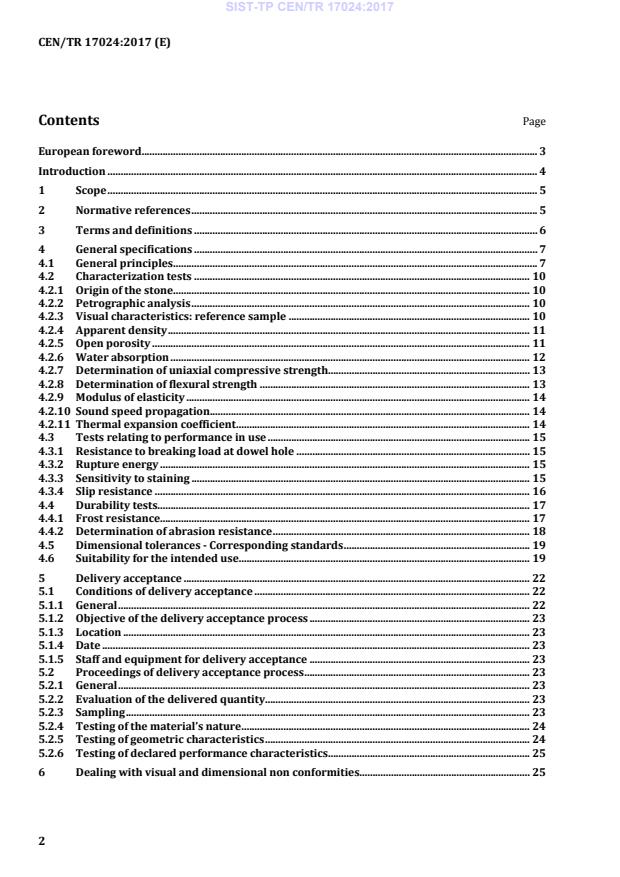
Contents Page
European foreword . 3
Introduction . 4
1 Scope . 5
2 Normative references . 5
3 Terms and definitions . 6
4 General specifications . 7
4.1 General principles . 7
4.2 Characterization tests . 10
4.2.1 Origin of the stone . 10
4.2.2 Petrographic analysis . 10
4.2.3 Visual characteristics: reference sample . 10
4.2.4 Apparent density . 11
4.2.5 Open porosity . 11
4.2.6 Water absorption . 12
4.2.7 Determination of uniaxial compressive strength. 13
4.2.8 Determination of flexural strength . 13
4.2.9 Modulus of elasticity . 14
4.2.10 Sound speed propagation. 14
4.2.11 Thermal expansion coefficient . 14
4.3 Tests relating to performance in use . 15
4.3.1 Resistance to breaking load at dowel hole . 15
4.3.2 Rupture energy . 15
4.3.3 Sensitivity to staining . 15
4.3.4 Slip resistance . 16
4.4 Durability tests. 17
4.4.1 Frost resistance. 17
4.4.2 Determination of abrasion resistance . 18
4.5 Dimensional tolerances - Corresponding standards . 19
4.6 Suitability for the intended use . 19
5 Delivery acceptance . 22
5.1 Conditions of delivery acceptance . 22
5.1.1 General . 22
5.1.2 Objective of the delivery acceptance process . 23
5.1.3 Location . 23
5.1.4 Date . 23
5.1.5 Staff and equipment for delivery acceptance . 23
5.2 Proceedings of delivery acceptance process . 23
5.2.1 General . 23
5.2.2 Evaluation of the delivered quantity. 23
5.2.3 Sampling . 23
5.2.4 Testing of the material’s nature . 24
5.2.5 Testing of geometric characteristics . 24
5.2.6 Testing of declared performance characteristics. 25
6 Dealing with visual and dimensional non conformities. 25
European foreword
This document (CEN/TR 17024:2017) has been prepared by Technical Committee CEN/TC 246
“Natural stones”, the secretariat of which is held by UNI.
Attention is drawn to the possibility that some of the elements of this document may be the subject of
patent rights. CEN shall not be held responsible for identifying any or all such patent rights.
Introduction
Product standards for natural stone are issued by the European committee for standardization and deal
with stone masonry, tiles and slabs for cladding, flooring and stairs.
Producers in countries outside the European Union might not be familiar with these product standards.
Therefore, the scope of this document is to inform and assist the user in order to provide
recommendations for the proper use of natural stone and the requirements of the product standards
regulating their being placed on the market within the countries comprising the European Union.
1 Scope
This Technical Report applies to natural stone products intended for masonry elements, wall coverings
(including tiles), internal floor and stair finishes (including tiles) and exterior floor and stair finishes
(including paving), as well as massive stone elements.
It provides guidance for the application and use of natural stone products in accordance with European
product standards.
This Technical Report does not deal with coatings or staining problems, and does not take into account
treatments that could modify the performance characteristics of the materials.
This Technical Report does not apply to agglomerated stones and aggregates.
2 Normative references
The following documents, in whole or in part, are normatively referenced in this document and are
indispensable for its application. For dated references, only the edition cited applies. For undated
references, the latest edition of the referenced document (including any amendments) applies.
EN 771-6, Specification for masonry units — Part 6: Natural stone masonry units
EN 772-1, Test methods for masonry units — Part 1: Determination of compressive strength
EN 772-11, Methods of test for masonry units - Part 11: Determination of water absorption of aggregate
concrete, autoclaved aerated concrete, manufactured stone and natural stone masonry units due to
capillary action and the initial rate of water absorption of clay masonry units
EN 1341, Slabs of natural stone for external paving - Requirements and test methods
EN 1342, Setts of natural stone for external paving - Requirements and test methods
EN 1343, Kerbs of natural stone for external paving - Requirements and test methods
EN 1467, Natural stone - Rough blocks - Requirements
EN 1468, Natural stone - Rough slabs - Requirements
EN 1469, Natural stone products - Slabs for cladding - Requirements
EN 1925, Natural stone test methods - Determination of water absorption coefficient by capillarity
EN 1926, Natural stone test methods - Determination of uniaxial compressive strength
EN 1936, Natural stone test methods - Determination of real density and apparent density, and of total
and open porosity
EN 12057, Natural stone products - Modular tiles - Requirements
EN 12058, Natural stone products - Slabs for floors and stairs - Requirements
EN 12059, Natural stone — Finished products, dimensional stone work Requirements
EN 12371, Natural stone test methods - Determination of frost resistance
EN 12372, Natural stone test methods - Determination of flexural strength under concentrated load
EN 12407, Natural stone test methods - Petrographic examination
EN 12440, Natural stone - Denomination criteria
EN 12670, Natural stone - Terminology
EN 13364, Natural stone test methods - Determination of the breaking load at dowel hole
EN 13373, Natural stone test methods - Determination of geometric characteristics on units
EN 13755, Natural stone test methods - Determination of water absorption at atmospheric pressure
EN 14066, Natural stone test methods - Determination of resistance to ageing by thermal shock
EN 14146, Natural stone test methods - Determination of the dynamic modulus of elasticity (by measuring
the fundamental resonance frequency)
EN 14157, Natural stone test methods - Determination of the abrasion resistance
EN 14158, Natural stone test methods - Determination of rupture energy
EN 14579, Natural stone test methods - Determination of sound speed propagation
EN 14581, Natural stone test methods - Determination of linear thermal expansion coefficient
EN 16140, Natural stone test methods - Determination of sensitivity to changes in appearance produced
by thermal cycles
EN 16306, Natural stone test methods - Determination of resistance of marble to thermal and moisture
cycles
CEN/TS 16165, Determination of slip resistance of pedestrian surfaces - Methods of evaluation
3 Terms and definitions
For the purposes of this document, the following terms and definitions apply.
3.1
order
all products to be delivered on the basis of the contract
3.2
order item
one of a set of products corresponding to one single order
3.3
contractual sample
reference sample which forms part of the contract
3.4
delivery
part or all of the order arriving at the same time and at the same place, and giving rise to a delivery
order
Note 1 to entry: In addition to the requirements of CE marking, the documents accompanying the delivery shall
state the following:
— reference of the order;
— name and address of the supplier;
— nature and type of the delivered order items;
— date of collection and place of delivery;
— total weight of the load;
— quantity of delivered order items;
— weight of materials packaged in bulk (per packaging unit).
3.5
delivery acceptance
series of operations to verify compliance of the delivery with the contract specification (quantity,
tolerance specifications, appearance, mechanical properties, contractual samples, etc.)
3.6
packaging unit
term that designates for instance a pallet, a crate, a bag, a box
Note 1 to entry: Each packaging unit shall carry a marking or label allowing the identification of the batch to
which it derives.
3.7
batch
set of packaging units containing one order item in one delivery
Note 1 to entry: A batch necessarily corresponds to a single characterization sheet.
Note 2 to entry: A delivery may include one or several batches.
4 General specifications
4.1 General principles
To assess whether a stone type is suitable for a particular application, a specific testing program is
described as mentioned in Table 1. Table 1 contains a detailed overview of the most useful tests, in
particular:
— characterization tests (or identification tests): they are used to determine the intrinsic material
properties, independent of its transformation into a finished product and the environment in which
it will be used;
— tests relating to performance in use: these tests evaluate the performance of the finished product
after manufacturing. Therefore, these tests should as nearly as possible reproduce the physical
forces and effects of weathering and contamination that act upon the element in service (taking into
account dimensions and surface conditions);
— durability tests: these tests are used to analyse the behaviour of the stone over time and thus make
it possible to evaluate the stability of the intrinsic material properties and of the initial performance
data after a period of time.
Additionally it is relevant to consider the performance of the same stone type in existing examples of its
use under similar climatic conditions.
Table 1 — Examples of stones used in structural applications and related tests
Product Structural application Test of performance in Test standard
standard use
Masonry EN 771–6 Element in elevation, with Capillarity EN 772–11
no possibility of splash
Frost resistance EN 12371
back
Compressive strength EN 772–1
Splash course
Window sill
Handrail
String course
Cornice
Pinnacles
Gargoyle
Massive slab for balcony
Plinth
Wall EN 1469 Internal cladding
cladding
Mechanically fastened Resistance to breaking EN 13364
cladding at dowel hole
Flexural strength EN 12372
(EN 13161)
External cladding
Mechanically fastened Frost resistance EN 12371
cladding
Resistance to breaking EN 13364
Elevation
at dowel hole
String course
Flexural strength EN 12372
Balcony sill
(EN 13161)
Window sill
Resistance of marble to EN 16306
Plinth
thermal and moisture
Horizontal covering
cycles
Thermal shock EN 14066
resistance
Wall EN 1469 Internal cladding
cladding
EN 12057
Glued cladding Apparent density EN 1936
EN 12059
Open porosity
External cladding
Glued cladding and tiling Apparent density EN 1936
Elevation Open porosity
String course
Frost resistance EN 12371
Balcony sill
Thermal shock EN 14066
Window sill
resistance
Plinth
Horizontal covering
Floor EN 12058 Interior floors and stairs Abrasion resistance EN 14157
covering
EN 12057
Flexural strength EN 12372
(EN 13161)
Exterior floors and stairs Abrasion resistance EN 14157
Slip resistance CEN/TS 16165
Flexural strength EN 12372
(EN 13161)
Frost resistance EN 12371
External EN 1341 Slabs Abrasion resistance EN 14157
Paving
Flexural strength EN 12372
(EN 13161)
Slip and skip resistance EN 14231
Frost resistance EN 12371
EN 1342 Setts Abrasion resistance EN 14157
Compressive strength EN 1926
Slip and skid resistance EN 14231
Frost resistance EN 12371
EN 1343 Kerbs Abrasion resistance EN 14157
— Flexural strength EN 12372
— Frost resistance EN 12371
4.2 Characterization tests
4.2.1 Origin of the stone
The part of the characterization record/sheet reserved to the origin of the stone shall mention,
according to EN 12440:
— the name and the address of the supplier of the stone product;
— the commercial name of the stone;
— the petrographic nature of the stone according to the standards EN 12407 and EN 12670;
— the place of origin (as precise as possible, e.g. country, city, GPS data);
— the macroscopic description of the appearance (colour, texture, etc.).
4.2.2 Petrographic analysis
Petrographic characterization (see EN 12407) allows the determination of the mineralogical
composition of the natural stone. Based on this information, the correct geological name of the stone
can be deduced. According to EN 12440, the name of the stone should state the place of origin, the
(geological) type and the colour of the stone. In this context, correct petrographic identification of the
stone is important and should prevent the use of misleading names. Besides these geological features, a
petrographic analysis can also provide useful information concerning the sensitivity of stone in specific
conditions (micro cracking, formation of expansive minerals, oxidation of metallic minerals, etc.).
4.2.3 Visual characteristics: reference sample
Stone is a natural material; its colour, veining and texture can vary. Therefore, the general visual
characteristics should be defined by means of a reference sample.
A reference sample shall comprise an adequate number of pieces of natural stone of sufficient size to
indicate the general appearance of the finished work. The dimensions of individual pieces shall be at
2 2
least 0,01 m (typical values are between 0,01 and 0,25 m in plan area but may be more), and shall
indicate the range of appearance regarding the colouring, the vein pattern, the physical structure and
the surface finish. In particular the reference sample shall show specific characteristics of the stone,
such as holes for travertine, worm holes for marble, glass seams, spots, crystalline veins and rusty spots.
The reference sample does not imply strict uniformity between the sample itself and the actual supply;
natural variations may always occur.
If the processing of the stone involves the use of patching, fillers or other similar products for natural
holes, faults or cracks, then the reference sample shall similarly display the visual impact of the same on
the finished surface.
All the characteristics as shown by the reference sample shall be considered typical of the stone and not
as flaws, therefore they shall not become a reason for rejection, unless their concentration becomes
excessive and the typical character of the stone is lost.
The reference sample should come with a characterization record/sheet (see 4.2.1).
The following information should be given on each specimen comprising the sample:
— name of the supplier;
— commercial name of the stone;
— signatures of the contracting parties;
— date of signing.
4.2.4 Apparent density
The apparent density (see EN 1936) is a property commonly measured for natural stone. It reflects the
degree of compactness of the material and allows an assessment of the mass of a given volume. It is
expressed in kg/m . This characteristic may be used to calculate the approximate weight of a stone unit
for manual handling, for thermal and sound insulation purposes and for assumed load. For typical
values, see Table 2.
Table 2 — Example of apparent densities
Apparent density
kg/m
(EN 1936)
Compact Limestone > 2 500
Other Limestone < 2 500
Sandstone 1 900 to 2 700
Slate – Shale – Schist 2 600 to 3 000
Marble 2 600 to 2 900
Gneiss 2 400 to 2 700
Granite 2 400 to 3 000
Basalt 2 550 to 3 000
4.2.5 Open porosity
The open porosity of a stone (see EN 1936) is determined by the ratio of the voids (pores) in the stone,
which are interconnected and thus accessible to water. Usually, it is expressed in percentage of volume
and it represents the volume of open pores in proportion to the total volume of the stone. For typical
values, see Table 3.
Table 3 — Example of open porosities
Open porosity
vol.%
(EN 1936)
Compact Limestone 0,3 to 2
Other Limestone 2 to 48
Sandstone 0,4 to 25
Slate – Shale – Schist 0,1 to 6
Marble 0,1 to 2
Gneiss 0,1 to 2
Granite 0,1 to 2
Basalt 0,1 to 6
Open porosity should not be confused with water absorption, which is expressed as percentage of mass.
If the water absorption is determined by impregnation under full vacuum (as the open porosity), the
open porosity and the water absorption can be compared using a multiplication coefficient: namely the
apparent compactness of the material (i.e. its apparent density divided by 1 000). Open porosity is
calculated using Formula (1).
()A×ρ
b b
p= (1)
1 000
where
p is the open porosity, expressed
...