

prEN 14731
(Main)Execution of special geotechnical works - Ground treatment by deep vibration
- Abstract
This document establishes general principles for the execution of soil treatment by deep vibration.
The following types of treatment are covered by this document:
- deep vibratory compaction to densify the ground as mentioned in EN 1997 3:2025, Annex I, Table I.1;
- vibrated columns formed by inserted granular material laterally/radially compacted against the surrounding ground to form a stiff composite column-soil structure (vibrated compacted granular columns) as mentioned in EN 1997 3:2025, Annex I, Table I.2;
- vibrated columns formed by inserted material developing unconfined compressive strength comprising a composite of binder and granular material (rigid columns) as mentioned in EN 1997 3:2025, Annex I, Table I.2.
The following treatment methods are covered by this document:
- methods in which depth vibrators, containing oscillating weights which cause horizontal vibrations, are inserted into the ground;
- methods in which compaction probes are inserted into the ground using a vibrator, which remains above ground surface, and which oscillates in a vertical mode.
Treatment methods are outlined in Annexes A, B, C and D.
The following treatment methods, among others, are not included in this document:
- dynamic compaction, dynamic replacement and other methods in which some form of treatment is applied to the ground surface;
- uncompacted granular columns primarily used as drains;
- explosive compaction.
- Status
- Not Published
- Publication Date
- 20-Dec-2027
- Technical Committee
- CEN/TC 288 - Execution of special geotechnical works
- Drafting Committee
- CEN/TC 288/WG 23 - Ground treatment
- Current Stage
- 4020 - Submission to enquiry - Enquiry
- Start Date
- 27-Aug-2026
- Due Date
- 08-Sep-2026
- Completion Date
- 27-Aug-2026

prEN 14731 is a CEN draft European Standard for the execution of special geotechnical works by deep vibration. It sets general principles for treating soil by deep vibratory compaction, vibrated compacted granular columns and rigid columns, and it is aimed at people who design, execute, supervise and verify ground improvement works.
What does prEN 14731 specify?
prEN 14731 specifies how to plan and execute soil treatment by deep vibration. It covers both the treatment types and the installation methods, so the reader can see whether the document fits a project that uses deep vibrators or compaction probes.
The scope includes:
- deep vibratory compaction to densify ground
- vibrated compacted granular columns
- rigid columns formed with binder and granular material
- methods using depth vibrators with horizontal vibration at depth
- methods using compaction probes driven by a top vibrator that stays above ground
The document is organized into clauses on information needed, geotechnical investigation, materials, design, execution, supervision, records and special requirements, followed by informative annexes.
| Annex | What it covers |
|---|---|
| Annex A | Overview of ground treatment methods by deep vibration and the tools used |
| Annex B | Deep vibratory compaction, including compactability and spacing guidance |
| Annex C | Installation of vibrated compacted granular columns, including top-feed and bottom-feed processes |
| Annex D | Installation of vibrated rigid columns, including semi-dry and pumped mixtures |
| Annex E | Daily report example |
The scope excludes dynamic compaction, dynamic replacement, surface-applied treatment methods, uncompacted granular columns used mainly as drains, and explosive compaction.
What are the key requirements of prEN 14731?
prEN 14731 ties execution back to the project design, the ground model and the actual site conditions. In practice, that means the contractor and designer need enough information before work starts, clear methods during construction, and records that show what was actually installed.
Before the works start
Clause 4 requires all necessary information to be available before execution. This includes legal restrictions, site geometry, nearby structures and services, access, storage space, underground obstructions, contaminants, unexploded ordnance, weather impacts, headroom limits and other site constraints.
That matters because deep vibration works can be blocked or affected by existing utilities, confined access, groundwater, nearby structures and environmental restrictions. Clause 4 also requires the specific project objectives and any water supply or slurry disposal constraints needed for wet processes.
Investigation and material suitability
Clause 5 requires geotechnical investigation to cover the full treatment zone and its zone of influence. It asks for ground layers, groundwater levels, obstructions, hard layers, sensitive strata, liquefaction potential, ongoing consolidation or creep, and contaminants.
The method-specific parts matter in practice:
- deep vibratory compaction needs confirmation that the soil is compactable and not blocked by clay, silt or organic layers
- vibrated compacted granular columns need soil data such as compressibility, plasticity, shear parameters, sensitivity and hydraulic conductivity
- rigid columns need attention to groundwater flow, cavities, soft compressible soils, chemistry, and bearing strata
Clause 6 requires all materials to match the design. Granular fill for columns must be durable, chemically stable, correctly graded and able to flow through the chosen feed system. Materials for rigid columns must deliver the required strength, stiffness and durability and suit the environmental exposure class.
Design and installation controls
Clause 7 requires the design to follow the EN 1990 and EN 1997 series and to define the treatment objectives, target soil properties, treatment depth and extent, and the indicators used to judge success. It also requires designers to consider settlement, heave, changes in surface profile, the effects of water used during treatment, and possible impacts on adjacent structures.
Clause 7 also gives method-selection guidance. For example, top-feed granular columns are only used where the hole remains open, while bottom-feed is used when it does not. The clause also sets applicability checks for certain soil conditions and points to field tests or comparable experience where the soil is borderline.
Clause 8 requires a method statement, approved execution plan, trained personnel, safe site preparation, a suitable working platform, accurate setting out, and control of treatment sequence and spacing. It also gives construction tolerances for plan position and verticality and requires action if column length, diameter or obstructions deviate from the plan.
Quality control, monitoring and records
Clause 9 requires supervision, inspection and monitoring plans, and it expects continuous recording of critical parameters. It also links the work to testing, including in situ tests, load tests and material tests, depending on the treatment type.
For deep vibratory compaction, the document points to tests such as cone penetration tests (CPT and CPTU), dilatometer tests (DMT), dynamic probing (DP), pressuremeter tests (PMT) and standard penetration tests (SPT). For vibrated compacted granular columns, it requires zone testing and checks on the material and installation records. For rigid columns, it requires monitoring of pumping, depth, withdrawal rate, pressure and flow, plus checks for indicators such as heave, displacement or seepage.
Clause 10 requires daily records and element records. That is the practical proof of what was installed, where, how deep, with what materials and under what conditions.
What terms does prEN 14731 define?
- deep vibratory compaction - ground treatment used mainly to increase the relative density of soil, especially coarse-grained soil.
- vibrated compacted granular columns - continuous compacted granular columns that create a stiffer column-soil composite.
- rigid columns - continuous columns with unconfined compressive strength made from a binder and granular material or concrete.
- vibrating tool - equipment inserted into the ground to create vibration at depth.
- depth vibrator - a vibrating tool inserted into the ground that vibrates horizontally by rotating eccentric weight.
- top vibrator - a vibrator that stays above ground and is connected to a compaction probe.
- compaction probe - the tool inserted into the ground to transmit vibrations from a top vibrator.
- top-feed process - a column construction method where granular material is placed into the open hole from the surface in stages.
- bottom-feed process - a column construction method where material is delivered to the base of the vibrating tool through a feed pipe or hollow probe.
Who uses prEN 14731?
prEN 14731 is used by geotechnical designers, specialist ground improvement contractors, site supervisors, inspectors and quality managers. It is also relevant to clients and buyers who need to specify execution requirements for foundation support, densification, liquefaction mitigation or column-based soil improvement.
The document is most relevant to infrastructure, civil engineering and foundation works where soil treatment by deep vibration is planned, checked and recorded.
What changed in prEN 14731 from the previous edition?
prEN 14731 will supersede EN 14731:2005. The European foreword states these significant technical changes:
- the code was amended to reflect current practice and evolved equipment
- the code was amended to align with the 2nd generation of the EN 1997 series
- rigid columns installed with deep vibration technology and equipment were introduced
Which standards are used with prEN 14731?
- EN 206 (all parts) - used for concrete specification, performance, production and conformity where cementitious materials are used for rigid columns.
- EN 1990 (all parts) - provides the basis for structural and geotechnical design used in the design approach.
- EN 1997 (all parts) and EN 1997-1:2024 - provide the geotechnical design framework, supervision, inspection and monitoring structure.
- EN 1997-2:2024 - supports site investigation, testing and field/laboratory test procedures.
- EN 1997-3:2025 - is referenced for treatment categories, class BII ground improvement and load test guidance.
- EN 16228 (all parts) - provides safety requirements for drilling and foundation equipment.
- EN ISO 22476-9 - is used for vane shear testing where rigid columns need verification in sensitive soils.
- EN 1097-1 and EN 1097-2 - support aggregate testing for granular materials used in columns.
- EN 12390-2 and EN 12390-3 - support sampling, storage and compressive strength testing of fresh material for rigid columns.
- EN 12504-1 - applies when rigid-column samples are obtained by core drilling.
- EN 15237 - is cited for uncompacted granular columns used as drains, which are outside this document.
What does the prEN 14731 document contain?
prEN 14731 contains the full execution framework for deep vibration ground treatment, from preconstruction information and investigation through design, installation, supervision, testing and records. It also includes method descriptions and figures in Annexes A to D, and a daily report example in Annex E.
Annex B gives compactability assessment approaches, including grading curves, a suitability number formula and CPT-based classification. Annex C explains both top-feed and bottom-feed installation of vibrated compacted granular columns. Annex D shows semi-dry and pumped rigid-column installation arrangements. Clause 9 adds tables for critical parameters, inspection and monitoring measures, and testing options used for control and validation.
Relations
- Effective Date
- 25-Jun-2025
Get Certified
Connect with accredited certification bodies for this standard

Zavod za gradbeništvo Slovenije (ZAG) - Inšpekcija
ZAG inspection body for construction products, structures, and materials.
Sponsored listings
Frequently Asked Questions
prEN 14731 is a draft published by the European Committee for Standardization (CEN). Its full title is "Execution of special geotechnical works - Ground treatment by deep vibration". This standard covers: This document establishes general principles for the execution of soil treatment by deep vibration. The following types of treatment are covered by this document: - deep vibratory compaction to densify the ground as mentioned in EN 1997 3:2025, Annex I, Table I.1; - vibrated columns formed by inserted granular material laterally/radially compacted against the surrounding ground to form a stiff composite column-soil structure (vibrated compacted granular columns) as mentioned in EN 1997 3:2025, Annex I, Table I.2; - vibrated columns formed by inserted material developing unconfined compressive strength comprising a composite of binder and granular material (rigid columns) as mentioned in EN 1997 3:2025, Annex I, Table I.2. The following treatment methods are covered by this document: - methods in which depth vibrators, containing oscillating weights which cause horizontal vibrations, are inserted into the ground; - methods in which compaction probes are inserted into the ground using a vibrator, which remains above ground surface, and which oscillates in a vertical mode. Treatment methods are outlined in Annexes A, B, C and D. The following treatment methods, among others, are not included in this document: - dynamic compaction, dynamic replacement and other methods in which some form of treatment is applied to the ground surface; - uncompacted granular columns primarily used as drains; - explosive compaction.
This document establishes general principles for the execution of soil treatment by deep vibration. The following types of treatment are covered by this document: - deep vibratory compaction to densify the ground as mentioned in EN 1997 3:2025, Annex I, Table I.1; - vibrated columns formed by inserted granular material laterally/radially compacted against the surrounding ground to form a stiff composite column-soil structure (vibrated compacted granular columns) as mentioned in EN 1997 3:2025, Annex I, Table I.2; - vibrated columns formed by inserted material developing unconfined compressive strength comprising a composite of binder and granular material (rigid columns) as mentioned in EN 1997 3:2025, Annex I, Table I.2. The following treatment methods are covered by this document: - methods in which depth vibrators, containing oscillating weights which cause horizontal vibrations, are inserted into the ground; - methods in which compaction probes are inserted into the ground using a vibrator, which remains above ground surface, and which oscillates in a vertical mode. Treatment methods are outlined in Annexes A, B, C and D. The following treatment methods, among others, are not included in this document: - dynamic compaction, dynamic replacement and other methods in which some form of treatment is applied to the ground surface; - uncompacted granular columns primarily used as drains; - explosive compaction.
prEN 14731 is classified under the following ICS (International Classification for Standards) categories: 93.020 - Earthworks. Excavations. Foundation construction. Underground works. The ICS classification helps identify the subject area and facilitates finding related standards.
prEN 14731 has the following relationships with other standards: It is inter standard links to EN 14731:2005. Understanding these relationships helps ensure you are using the most current and applicable version of the standard.
prEN 14731 is available in PDF format for immediate download after purchase. The document can be added to your cart and obtained through the secure checkout process. Digital delivery ensures instant access to the complete standard document.
Standards Content (Sample)
SLOVENSKI STANDARD
01-november-2026
Izvedba posebnih geotehničnih del - Temeljenje z globinsko vibracijo
Execution of special geotechnical works - Ground treatment by deep vibration
Ausfürung von besonderen geotechnischen Arbeiten (Spezialtiefbau) -
Baugrundverbesserung durch Tiefenrüttelverfahren
Exécution de travaux géotechniques spéciaux - Amélioration de sol par vibration en
profondeur
Ta slovenski standard je istoveten z: prEN 14731
ICS:
93.020 Zemeljska dela. Izkopavanja. Earthworks. Excavations.
Gradnja temeljev. Dela pod Foundation construction.
zemljo Underground works
2003-01.Slovenski inštitut za standardizacijo. Razmnoževanje celote ali delov tega standarda ni dovoljeno.
DRAFT
EUROPEAN STANDARD
NORME EUROPÉENNE
EUROPÄISCHE NORM
August 2026
ICS 93.020 Will supersede EN 14731:2005
English Version
Execution of special geotechnical works - Ground
treatment by deep vibration
Exécution de travaux géotechniques spéciaux - Ausfürung von besonderen geotechnischen Arbeiten
Amélioration des massifs de sol par vibration (Spezialtiefbau) - Baugrundverbesserung durch
Tiefenrüttelverfahren
This draft European Standard is submitted to CEN members for enquiry. It has been drawn up by the Technical Committee
CEN/TC 288.
If this draft becomes a European Standard, CEN members are bound to comply with the CEN/CENELEC Internal Regulations
which stipulate the conditions for giving this European Standard the status of a national standard without any alteration.
This draft European Standard was established by CEN in three official versions (English, French, German). A version in any other
language made by translation under the responsibility of a CEN member into its own language and notified to the CEN-CENELEC
Management Centre has the same status as the official versions.
CEN members are the national standards bodies of Austria, Belgium, Bulgaria, Croatia, Cyprus, Czech Republic, Denmark, Estonia,
Finland, France, Germany, Greece, Hungary, Iceland, Ireland, Italy, Latvia, Lithuania, Luxembourg, Malta, Netherlands, Norway,
Poland, Portugal, Republic of North Macedonia, Romania, Serbia, Slovakia, Slovenia, Spain, Sweden, Switzerland, Türkiye and
United Kingdom.
Recipients of this draft are invited to submit, with their comments, notification of any relevant patent rights of which they are
aware and to provide supporting documentation.
Warning : This document is not a European Standard. It is distributed for review and comments. It is subject to change without
notice and shall not be referred to as a European Standard.
EUROPEAN COMMITTEE FOR STANDARDIZATION
COMITÉ EUROPÉEN DE NORMALISATION
EUROPÄISCHES KOMITEE FÜR NORMUNG
CEN-CENELEC Management Centre: Rue de la Science 23, B-1040 Brussels
© 2026 CEN All rights of exploitation in any form and by any means reserved Ref. No. prEN 14731:2026 E
worldwide for CEN national Members.
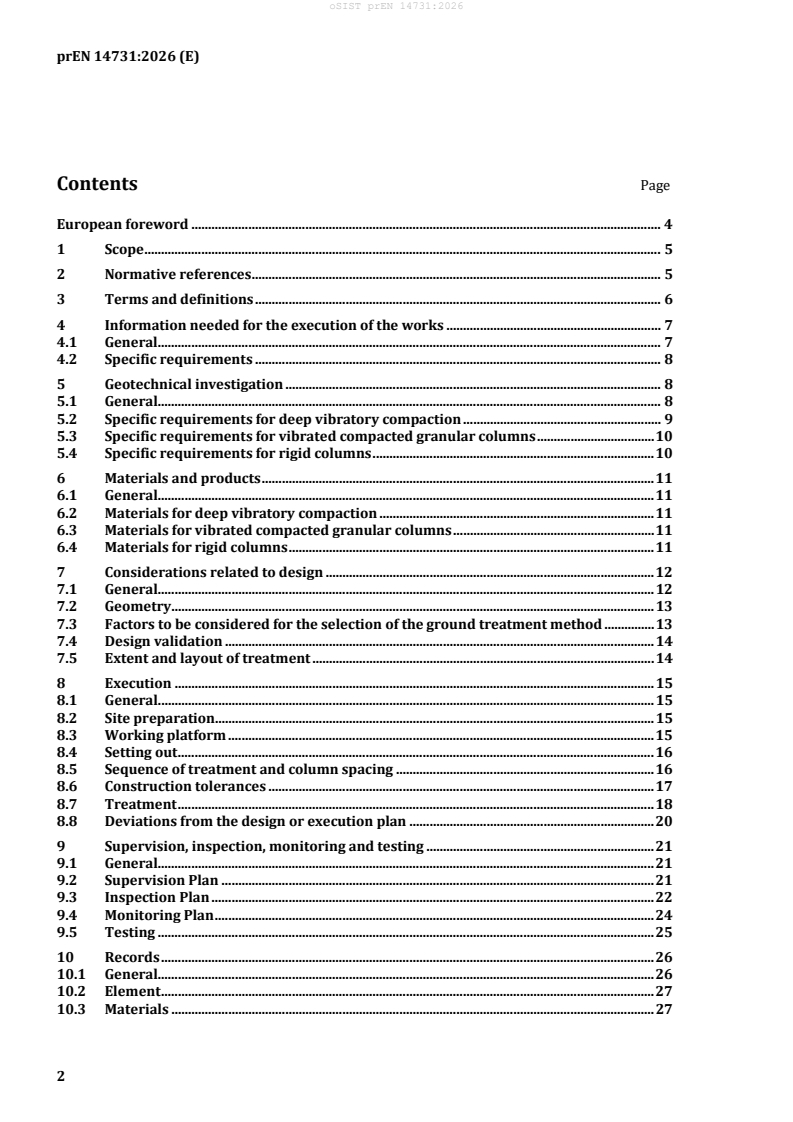
Contents Page
European foreword . 4
1 Scope . 5
2 Normative references . 5
3 Terms and definitions . 6
4 Information needed for the execution of the works . 7
4.1 General. 7
4.2 Specific requirements . 8
5 Geotechnical investigation . 8
5.1 General. 8
5.2 Specific requirements for deep vibratory compaction . 9
5.3 Specific requirements for vibrated compacted granular columns . 10
5.4 Specific requirements for rigid columns . 10
6 Materials and products . 11
6.1 General. 11
6.2 Materials for deep vibratory compaction . 11
6.3 Materials for vibrated compacted granular columns . 11
6.4 Materials for rigid columns . 11
7 Considerations related to design . 12
7.1 General. 12
7.2 Geometry . 13
7.3 Factors to be considered for the selection of the ground treatment method . 13
7.4 Design validation . 14
7.5 Extent and layout of treatment . 14
8 Execution . 15
8.1 General. 15
8.2 Site preparation. 15
8.3 Working platform . 15
8.4 Setting out . 16
8.5 Sequence of treatment and column spacing . 16
8.6 Construction tolerances . 17
8.7 Treatment . 18
8.8 Deviations from the design or execution plan . 20
9 Supervision, inspection, monitoring and testing . 21
9.1 General. 21
9.2 Supervision Plan . 21
9.3 Inspection Plan . 22
9.4 Monitoring Plan . 24
9.5 Testing . 25
10 Records . 26
10.1 General. 26
10.2 Element . 27
10.3 Materials . 27
10.4 Subsequent works . 28
11 Special requirements . 28
11.1 General . 28
11.2 Safety . 28
11.3 Environmental protection . 28
11.4 Sustainability . 28
Annex A (informative)Methods of ground treatment by deep vibration . 29
A.1 Ground treatment methods . 29
A.2 Tools for Vibro Techniques . 29
Annex B (informative) Deep vibratory compaction . 30
Annex C (informative) Installation of vibrated, compacted granular columns . 36
C.1 General . 36
C.2 Top-feed process . 36
C.3 Bottom-feed process . 37
Annex D (informative) In Installation of vibrated rigid columns . 40
Annex E (informative) Daily report example . 44
Bibliography . 45
European foreword
This document (prEN 14731:2026) has been prepared by Technical Committee CEN/TC 288 “Execution
of special geotechnical works”, the secretariat of which is held by AFNOR.
This document is currently submitted to the CEN Enquiry.
This document will supersede EN 14731:2005.
This document includes the following significant technical changes with respect to EN 14731:2005:
— amendment of the code reflecting current practice and evolved equipment;
— amendment of the code in line with the 2nd generation of the EN 1997 series;
— introduction of rigid columns, installed with deep vibration technology and equipment.
1 Scope
This document establishes general principles for the execution of soil treatment by deep vibration.
The following types of treatment are covered by this document:
— deep vibratory compaction to densify the ground as mentioned in EN 1997-3:2025, Annex I, Table I.1;
— vibrated columns formed by inserted granular material laterally/radially compacted against the
surrounding ground to form a stiff composite column-soil structure (vibrated compacted granular
columns) as mentioned in EN 1997-3:2025, Annex I, Table I.2;
— vibrated columns formed by inserted material developing unconfined compressive strength
comprising a composite of binder and granular material (rigid columns) as mentioned in
EN 1997-3:2025, Annex I, Table I.2.
The following treatment methods are covered by this document:
— methods in which depth vibrators, containing oscillating weights which cause horizontal vibrations,
are inserted into the ground;
— methods in which compaction probes are inserted into the ground using a vibrator, which remains
above ground surface, and which oscillates in a vertical mode.
Treatment methods are outlined in Annexes A, B, C and D.
The following treatment methods, among others, are not included in this document:
— dynamic compaction, dynamic replacement and other methods in which some form of treatment is
applied to the ground surface;
— uncompacted granular columns primarily used as drains;
— explosive compaction.
2 Normative references
The following documents are referred to in the text in such a way that some or all of their content
constitutes requirements of this document. For dated references, only the edition cited applies. For
undated references, the latest edition of the referenced document (including any amendments) applies.
EN 206 (all parts), Concrete — Specification, performance, production and conformity
EN 1990 (all parts), Eurocode — Basis of structural and geotechnical design
EN 1997 (all parts), Eurocode 7 — Geotechnical design
EN 1997-1:2024, Eurocode 7 — Geotechnical design - Part 1: General rules
EN 16228 (all parts), Drilling and foundation equipment — Safety
3 Terms and definitions
For the purposes of this document, the following terms and definitions apply.
ISO and IEC maintain terminology databases for use in standardization at the following addresses:
— ISO Online browsing platform: available at https://www.iso.org/obp/
— IEC Electropedia: available at https://www.electropedia.org/
3.1
deep vibratory compaction
type of ground treatment by deep vibration in which the main purpose is to increase the soil’s relative
density
Note 1 to entry: The treatment is applicable mainly to coarse grained and normally results in increased strength
and stiffness, reduced permeability and reduced susceptibility to liquefaction.
Note 2 to entry: Deep vibratory compaction is also termed as vibro floatation, vibro compaction or vibro
densification.
3.2
vibrated compacted granular columns
type of soil treatment by deep vibration in which a vibrating tool is used to form continuous compacted
granular columns from the maximum depth of penetration up to the top of the treatment zone, forming a
composite column-soil structure with an increased composite stiffness compared to the untreated state
Note 1 to entry: Depending on the inserted material, vibrated compacted granular columns are also termed stone
columns, gravel columns or sand columns.
Note 2 to entry: The treatment is applicable to a wide range of soils and in coarse grained materials some
densification may also be achieved. Two installation processes, the top-feed process and the bottom-feed process
are described in Annex C.
Note 3 to entry: Uncompacted granular columns primarily used as drains are covered in EN 15237 and not in this
document.
3.3
rigid columns
type of soil treatment by deep vibration in which a vibrating tool is used to form continuous columns with
an unconfined compressive strength comprising a composite of binder and granular material or concrete
Note 1 to entry: Rigid columns can be designed as class BII ground improvement according to EN 1997-3.
3.4
vibrating tool
item of equipment which is inserted into the ground to cause vibration at depth; commonly a depth
vibrator containing oscillating weights or a compaction probe inserted into the ground using a top
vibrator which remains above ground surface
3.5
depth vibrator
ground treatment equipment used in the installation of vibrated columns and for vibro compaction,
which vibrates horizontally by means of an eccentric weight rotating around its longitudinal axis, and is
inserted into the ground, which can be assisted by air or water flushing
Note 1 to entry: Penetration can also be preceded by predrilling.
3.6
top vibrator
vibrator which remains above the ground surface and is connected to a compaction probe
3.7
compaction probe
tool for installation of vibrated columns and vibro compaction, which is inserted into the ground to
transmit vibrations from a top vibrator which remains above the ground surface; wings, drainage or
water flushing can be provided to facilitate the compaction process
3.8
top-feed process
method of constructing vibrated compacted granular columns in which the hole formed by the vibrating
tool remains open and allows specified granular material to be fed directly into the top of the hole and
which is then compacted by the vibrator or the compaction probe in stages
Note 1 to entry: The penetration can be assisted by flushing with air and/or water and/or pre-drilling.
Note 2 to entry: The process is described in Annex C.
3.9
bottom-feed process
method of constructing vibrated compacted granular columns in which specified granular material is
delivered directly to the base of the vibrating tool via a feed pipe attached to the depth vibrator or through
the hollow compaction probe, the vibrating tool remains in the soil during the construction of the column
to maintain the stability of the hole and to compact the inserted material
Note 1 to entry: The penetration can be assisted by flushing with air and/or water and/or pre-drilling.
Note 2 to entry: The process is described in Annex C.
4 Information needed for the execution of the works
4.1 General
4.1.1 Prior to the execution of the work, all necessary information shall be made available.
4.1.2 The information shall include but is not limited to:
— any legal or statutory restrictions;
— location of main grid lines or reference points for setting out treatment or column positions;
— location and condition of structures, roads, services, etc. on or adjacent to the works, including any
necessary surveys;
— minimum requirements for a quality management system, including supervision, inspection and
monitoring;
— site geometry (boundaries, topography, access points, slopes, etc.);
— available space for storage of materials, treatment and/or disposal of spoil or waste materials;
— location of existing underground structures, services and archaeological constraints, known
contaminants and potential presence of unexploded ordnance and its location;
— site constraints (environmental restrictions including noise, vibration, displacements, pollution) and
potential seasonal weather impacts (e.g. frozen surface layers, storms or flooding);
— above ground lines, services and headroom restrictions.
— future or ongoing activities such as dewatering, tunnelling, deep excavations and raising of site levels.
4.2 Specific requirements
The information required in relation to the practical aspects of the execution of ground treatment shall
include:
— specific project design objectives which the execution of the ground treatment is intended to meet;
NOTE These objectives typically include provisions of increased bearing capacity, reduced
compressibility, reduced liquefaction potential, reduced collapse potential; change of hydraulic conductivity or
other requirements;
— water supply and slurry disposal constraints for the wet process of installing vibrated compacted
granular columns or deep vibratory compaction.
5 Geotechnical investigation
5.1 General
5.1.1 All site and ground investigation shall be executed in accordance with the EN 1997 series and the
design requirements of the project.
5.1.2 Ground level at any point of investigation or testing shall be given relative to the recognized
national datum or to a fixed reference chart datum or agreed project site datum.
5.1.3 The extent and depth of the site and ground investigation shall cover the full treatment zone and
its zone of influence and shall be sufficient to determine the characteristic ground conditions and
topography of the site and to identify and locate all ground formations, layers for the definition of
geotechnical units, other geological features and ground water levels affecting the execution of the works.
5.1.4 All information from site investigations shall be made available in accordance with the
requirements of Clause 4.
5.1.5 Some existing or planned man-made fills may be heterogeneous, and further examination may be
required to determine representative geotechnical descriptions.
5.1.6 Obstructions, hard layers, cobbles and boulders within the ground which could influence or
prevent the insertion of the vibrating tool should be identified.
5.1.7 The presence of ground conditions which could affect the performance of treatment shall be
identified including, but not limited to:
— very stiff, very dense or cemented layers;
— very soft, very loose layers or singular local areas;
— presence, extent and thickness of any strata that might be sensitive to water infiltration or to change
of their stress state caused by vibrating tools;
— soils with potential for collapse or excessive settlement; soils with liquefaction potential;
— layers currently subject to ongoing or future consolidation and/or creep movements;
— presence of pre-treated soil, which might have an adverse effect during penetration;
— mining beneath the site;
— site stability problems (e.g. slope stability).
5.1.8 Piezometric levels of all water-tables and permeability of the soils.
5.1.9 Particular attention shall be paid to artesian conditions.
5.1.10 Any contaminants and pollutants in the soil or the groundwater should be identified.
5.2 Specific requirements for deep vibratory compaction
5.2.1 Special consideration shall be given to the geometric extent of compactable granular soils and the
location and extent of any layers restricting the efficiency of the treatment process or preventing it
outright like clay, silt and organic layers and layers impeding drainage.
NOTE Some methods of field investigation might produce data that result in an inconclusive determination of
boundaries between geotechnical units under certain conditions like highly laminated soil or dense layers above
very soft layers.
5.2.2 Where clay, silt or organic soils are present, some or all of the properties mentioned in 5.2.3 may
require clarification.
5.2.3 The following geotechnical properties of coarse-grained soils are relevant to the design and
execution of ground treatment by deep vibratory compaction:
— Type of grain material (silica, carbonite, volcanic, etc.);
— particle size distribution and fines content (silt and clay);
— in situ density index (relative density);
— drained and undrained shear parameters;
— compactibility;
— hydraulic conductivity;
— hardness of the grain and carbonate content;
— inter-particle bonding caused by cementation, suction or cohesion.
5.3 Specific requirements for vibrated compacted granular columns
5.3.1 Particular attention shall be given to the determination of physical and geotechnical ground
properties required for the design and execution of the ground treatment by vibrated compacted
granular columns, for example:
— compressibility;
— compactibility;
— consistency limits;
— plasticity;
— drained and undrained shear parameters;
— sensitivity;
— hydraulic conductivity.
5.3.2 Certain ground conditions that may result in a loss of lateral support need particular
consideration, including, but not limited to:
— presence and extent of peat and organic soil;
— presence of biodegradable fill including domestic waste;
— insufficient shear strength.
5.4 Specific requirements for rigid columns
5.4.1 Particular attention shall be paid to the following aspects, which are relevant to the execution of
rigid columns:
— presence of coarse, highly permeable soils or cavities (natural or artificial), which can cause a sudden
loss of concrete, mortar or grout during placement, and thus can require special measures;
— presence, strength and deformation characteristics of soft highly compressible soils, such as very low
strength clay or peat, which can cause problems during the extraction of the tool and the placing of
concrete or other mixtures (deformation or instability);
— underground strata with the potential for high groundwater flows or seepages;
— unfavourable chemistry of groundwater and ground and water temperatures, if required;
— detrimental chemistry of waste materials;
— thickness and characteristics of bearing strata.
5.4.2 The piezometric levels of all water-tables within the zone of influence shall be monitored
separately and over a sufficient period of time to estimate the highest piezometric levels which can occur
during construction of the rigid columns following the requirements of the EN 1997 series.
5.4.3 When rigid columns are required to reach bedrock, the rock surface level shall be determined.
6 Materials and products
6.1 General
6.1.1 Imported materials may be naturally occurring sands and gravels, crushed rock or appropriate
recycled materials. Quality control testing for selected materials is described in 9.5.4.
6.1.2 The properties of all materials shall be in accordance with the design specifications.
6.1.3 When checking the availability of materials, the impact of transportation on sustainability should
be considered.
6.2 Materials for deep vibratory compaction
6.2.1 Material may be added during deep vibratory compaction. This may be site won or imported
natural granular material.
6.2.2 Added materials shall be sufficiently stable and chemically inert during the treatment process and
subsequent working life in the anticipated soil and groundwater conditions to achieve the specified
requirements of the treated soil volume.
6.3 Materials for vibrated compacted granular columns
Material used to form vibrated compacted granular columns shall be:
— hard, robust, durable and chemically inert to remain sufficiently stable during column installation
and throughout the subsequent working life of the ground treatment;
— graded appropriately to aid compaction to form a dense column fully interlocked with the
surrounding ground and in compliance with any other requirements such as drainage;
— compatible with the ground improvement plant used and able to flow freely within the hole for top-
feed or through the delivery feed systems for bottom-feed systems without arching or blocking;
— containing minimal fines content, to avoid installation and compaction problems during construction
and the service life.
6.4 Materials for rigid columns
6.4.1 The mix design and resulting properties shall provide sufficient strength, stiffness and durability
to meet the project requirements.
6.4.2 All materials shall be suitable for the environmental exposure class.
6.4.3 All materials shall be suitable for installation.
6.4.4 Cementitious materials may conform to the EN 206 series.
NOTE For rigid columns with semi-dry compacted mixtures, materials typically do not conform to the EN 206
series.
6.4.5 Other materials can be used if they are suitable for installation and their performance conforms
to the design requirements. Suitability of those mixtures should be verified by testing, comparable
experience or other regulatory approvals.
7 Considerations related to design
7.1 General
7.1.1 The design of ground treatment by deep vibration shall be in accordance with the EN 1990 series
and the EN 1997 series.
7.1.2 The information on ground conditions shall be assessed to determine the suitability for treatment
by deep vibration.
7.1.3 The following shall be defined by the design of the ground treatment:
a) objectives of the ground treatment
NOTE These typically include provisions of increased bearing capacity, reduced compressibility; reduced
liquefaction potential, reduced collapse potential; change of hydraulic conductivity or other requirements.
b) required geotechnical properties of the treated soil (e.g. shear strength, stiffness, or hydraulic
conductivity);
— for diffused soil treatment, the representative soil properties should be assumed considering
their variation over the treated volume;
— for discrete soil treatment, the properties of soil and column after treatment should be considered
as separate representative values;
c) criteria for determining the treatment depth and extent;
d) target performance and the measurable indicators and parameters for the assessment of the
treatment to meet the design criteria;
e) particular warnings where filling or excavation subsequent to treatment takes place, proposals for
re-compaction, if necessary.
7.1.4 Due to the variable nature of the ground, variations in performance are to be expected even after
treatment and this should be considered.
7.1.5 Heave or settlement will occur during treatment should be anticipated and allowed for in the
design.
7.1.6 Settlements subsequent to treatment (e.g. from consolidation or creep of the ground) should be
assessed and the effect this may have on the performance of the ground treatment should be evaluated.
7.1.7 Changes to the surface profile after treatment may occur and should be assessed to determine the
effect this may have on the performance of the treatment.
NOTE Post-treatment changes to the original design (e.g. excavation depth, fill heights or foundation levels)
can represent a change in the loading conditions and their effect needs to be assessed.
7.1.8 Some deep vibration processes require the use of large quantities of water. The effects, if any, of
inserting water into the ground in the treatment zone and the surrounding ground shall be assessed in
the design.
7.1.9 The possibility of adverse effects on existing adjacent structures arising from ground movements,
pore water pressure changes or vibrations induced by the treatment shall be reviewed during the design.
7.1.10 In cases where adverse effects on adjacent structures cannot be excluded, a pre-condition survey
may need to be carried out as described in 11.4.
7.1.11 Where vibrated compacted granular columns are also required to function as drains, adequate
provision should be made for surface drainage. If the existing topsoil is not adequate a surface drainage
blanket should be provided. Attention should be given to the drainage properties of the working platform.
7.2 Geometry
7.2.1 Geometrical construction tolerances given in 8.5 shall be considered in the design.
7.2.2 If the specified geometrical tolerances are exceeded, the potential overloading of a rigid column
shall be considered and suitable measures shall be taken as necessary.
7.3 Factors to be considered for the selection of the ground treatment method
7.3.1 The selected method, plant and equipment for execution of the ground treatment works shall be
chosen to suit for the existing soil conditions and the design requirements. Descriptions of various
treatment processes are given in Annexes A, B, C and D.
NOTE This can often be established on the basis of previous comparable experience.
7.3.2 Deep vibratory compaction.
7.3.2.1 For assessment of the compactibility of the ground, refer to Annex B.
7.3.2.2 A minimum treatment depth is required for the selected method to be effective which in turn
is dependent on the plant, equipment and required performance criteria.
7.3.3 Vibrated compacted granular columns.
7.3.3.1 If the undrained shear strength of organic or cohesive soils is 5 ≤ S ≤ 10 kN/m , applicability
u
shall be established through field tests or comparable experience.
7.3.3.2 The top-feed process shall only be used where the hole formed by the vibrating tool remains
open. Otherwise, the bottom-feed process shall be used.
7.3.4 Rigid columns with semi-dry compacted mixtures
If the undrained shear strength of organic or cohesive soils is 5 ≤ S ≤ 10 kN/m and the thickness of these
u
layers is greater than 1 m, applicability shall be established through
a) field tests or comparable experience; or
b) by meeting the following conditions:
— The base of a column shall not be founded on any strata layers with an undrained shear strength
less than 15 kN/m .
— Installation of the rigid column shall only be permitted if the highly compressible very low
strength fine grained soil has been pre-treated with vertical drainage elements (e.g. pre-
fabricated vertical drains or vibrated compacted granular columns) in case the excessive built-up
of pore water pressure is to be expected.
7.3.5 Rigid columns with pumped mixtures.
7.3.5.1 The undrained shear strength of organic or cohesive soils shall be S ≥ 15 kN/m .
u
Intermediate layers with an undrained shear strength of 5 ≤ S ≤ 15 kN/m are acceptable in case their
u
thickness does not exceed 1 m.
7.3.5.2 In organic or cohesive layers with an undrained shear strength 5 ≤ S ≤ 15 kN/m with a
u
thickness of more than 1 m, rigid columns can be used, if:
a) field tests or comparable experience sufficiently prove the applicability of the treatment method; or
b) the meeting of the following conditions:
— Vane shear tests according to EN ISO 22476-9 shall be conducted in the field. The measured
sensitivity from this test shall be less than 8 to avoid liquefaction of the soil during execution.
— Layers with an undrained shear strength S ≤ 15 kN/m shall not be present within the zone of
u
influence below column toe level.
— Prior to the installation of the rigid column, the soil shall be pre-treated with drain elements (e.g.
pre-fabricated vertical drains or vibrated compacted granular columns) in case the excessive
built-up of pore water pressure is to be expected.
— For S < 10 kN/m , the total thickness of the organic layer shall not exceed 4 m. For
u
2 2
10 kN/m ≤ S < 15 kN/m the total thickness of the organic layer shall not exceed 8 m.
u
2 2
— For soils with an undrained shear strength 10 kN/m ≤ S < 15 kN/m and a thickness of less than
u
4 m, drain elements can be omitted in case continuous electronic recording and documentation
ensures that the material is discharged continuously through the vibrating tool.
7.3.4.3 The amount and extent of reinforcement needs to be specified in the design for permanent
and temporary verification cases as well as installation effects.
7.4 Design validation
7.4.1 It shall be validated that the treatment objectives as set out in the design have been achieved.
7.4.2 Suitable means of validation of the specified treatment objectives should be defined prior to
commencement of soil treatment.
7.4.3 Appropriate methods of testing are described in 9.5.
7.4.4 The type and frequency of testing compatible with the requirements for quality control and
performance of the treatment shall be specified in the design. In addition to or instead of testing, other
methods of validation may be applied.
7.4.5 The evaluation of monitoring records and production data shall be part of the supervision,
inspection and monitoring process.
7.5 Extent and layout of treatment
7.5.1 The execution design shall define the treatment area and location of treatment points, and the
upper and lower levels of the treatment zone.
7.5.2 Each treatment point shall be identified by a reference number and its plan location shall be
related to fixed datum points, grid lines or given in absolute or relative coordinates.
7.5.3 If natural or artificial obstructions are encountered, their impact on the performance of the
treatment needs to be assessed and adequate measures need to be considered and implemented.
7.5.4 The treatment may need to extend beyond the footprint of a structure to be built on the treated
ground. This is the case where, for example, a primary objective of treatment is to reduce the
susceptibility to liquefaction in case of an earthquake.
7.5.5 For foundation support, the depth of treatment shall be specified as follows:
— in full-depth treatment, the depth vibrator or compaction probe shall reach the competent layer
identified in the ground model or specified in the geotechnical design model;
NOTE The column lengths can vary due the geological variability (geometry and properties).
— in partial-depth treatment, the depth of the treatment shall be adequate to improve the depth of
ground within the zone of influence of a particular foundation system to meet the specified stability
and serviceability criteria.
7.5.6 Deformations below treatment depths shall be assessed.
8 Execution
8.1 General
8.1.1 The ground improvement works shall be carried out according to a method statement. The
method of treatment and equipment employed shall be chosen to achieve the depth of treatment and the
design objectives in the prevailing ground conditions. Account shall be taken of concurrent site activities
and all equipment movement necessary to properly carry out the ground treatment. Suitably trained and
experienced personnel shall be in charge of the execution works.
8.1.2 Before starting the work a plan of execution describing the equipment, the installation method
and a global sequence of installation should be available and approved.
8.2 Site preparation
8.2.1 The site shall be prepared in such a way that operations can be carried out safely and efficiently.
Prior to commencement of ground treatment, services in the ground and overhead shall be identified and
clearly marked on site or relocated.
8.2.2 Any near-surface natural or artificial obstructions shall be identified prior to the commencement
of ground treatment and removed with any resulting excavations or voids filled with well compacted
granular material. As an alternative, the layout of the treatment shall be altered to accommodate the
obstructions.
8.3 Working platform
8.3.1 A working platform shall be constructed suitable for the safe operation of heavy ground treatment
plant and equipment and any activities.
8.3.2 The working platform shall be of sufficient size, above the water table and levelled horizontally.
8.3.3 Working platform requirements shall be specified, including a functional drainage system,
considering national provisions, where relevant.
8.3.4 The material used for the construction and maintenance of the working platform shall comply
with the specified requirements and be specified.
8.3.5 The stability of the working platform should be verified according to the EN 1997 series and
EN 16228-1:2014+A1:2021, Annex F – Ground pressure calculation for crawler mounted drilling and
foundation equipment.
NOTE Guidance for stability and the design of working platform can be found in the EFFC/DFI Guide to
Working Platforms or other national guidance.
8.3.6 The working platform and the access ramps shall be maintained such that they remain functional
at all times during the construction period.
8.3.7 Special considerations are required when working over water.
8.4 Setting out
8.4.1 All treatment points shall be either set out within the specified tolerances or the rig shall be
positioned within the specified tolerances with adequate measurement devices (e.g. GPS-system).
8.4.2 The levels of the working platform relative to the specified upper and lower treatment levels shall
be checked.
8.5 Sequence of treatment and column spacing
8.5.1 The sequence of treatment at individual treatment points and the general direction of treatment
across large areas should be considered with regard to the effectiveness of the treatment and the
presence of adjacent, buried or overhead structures and services and specified in the execution plan.
8.5.2 Compacted granular columns should not generally be installed closer than 2 diameters centre to
centre of adjacent columns.
NOTE This spacing can be reduced if based on comparable experience or testing for small treatment areas is
carried out.
8.5.3 For large treatment areas a greater spacing may be required.
8.5.4 When planning the sequence of installation of rigid columns, the following additional potential
effects should be considered:
— Necking:
Soil movement or slumping causing a localized diameter reduction of a column which has not chieved
the initial set.
— Breaking or damage to the shaft:
Soil movement causing overloading of a column which has taken initial set.
— Displacement:
Soil movements causing a lateral displacement of a hardened column.
— Excess pore water pressure:
Excess pore water pressure can cause a reduction or loss of shear strength of the surrounding
ground.
Table 1 — Possible countermeasures
Possible countermeasures
Increase Installation Installation Decrease Low Re- Drain
design fresh next to fresh next to column plasticity inforce- elements
Effect spacing hard fresh diameter material ment
Necking X X X X X
Breaking X X X X X
Displacement X X X
Excess pore
X X X X
water pressure
8.5.5 Local or comparable experience can influence the proposed sequence of installation.
8.5.6 If the minimum spacing for rigid columns according to Figure 1 are maintained, the execution
risks according to Table 1 are minimized.
Key
X column spacing = X x Diameter (centre to centre)
semi-dry mixtures
pumped mixture
Figure 1 — Recommended spacing for rigid columns for reduced execution risks
8.5.7 The spacing of rigid columns can be reduced below the recommendations of Figure 1 based on
comparable experience, testing or application of suitable countermeasures according to Table 1.
8.6 Construction tolerances
8.6.1 Unless otherwise specified, treatment points shall be installed within the following construction
tolerances:
8.6.1.1 Plan location measured at the working platform level:
— ≤ 0,15 m for non-rigid columns;
— ≤ 0,10 m for rigid columns.
8.6.1.2 Verticality tolerances for rigid columns ≤ 0,05 m/m. In case of unguided systems without
leaders, the verticality shall be measured
...