

EN 1052-4:2000
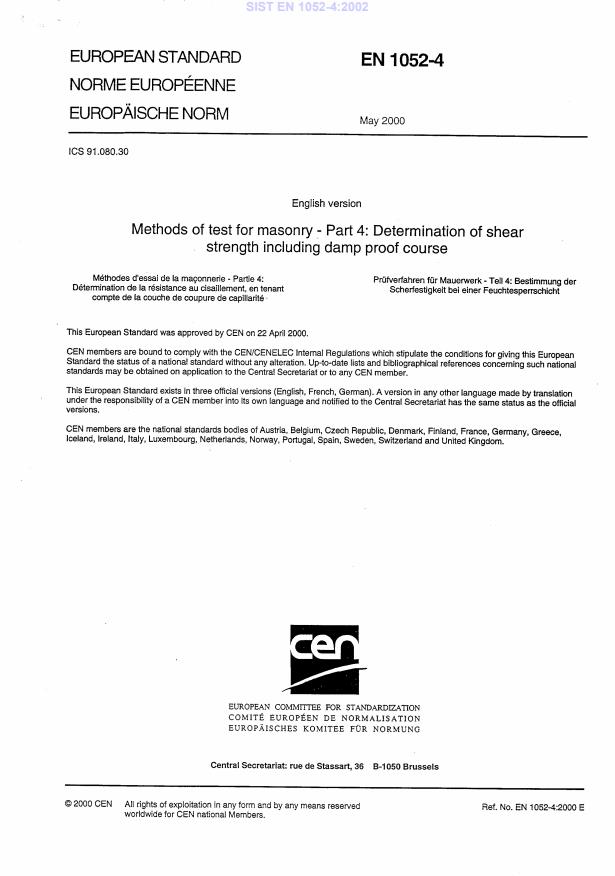
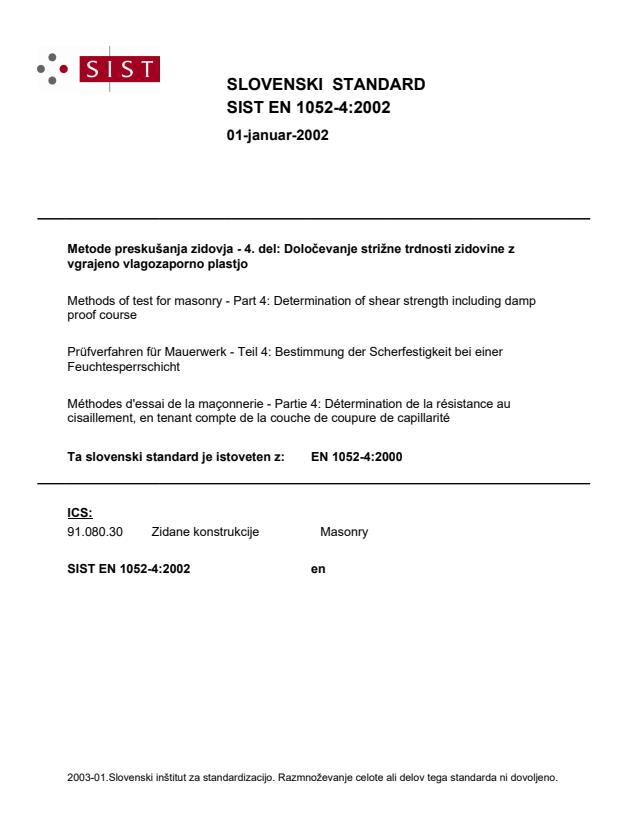
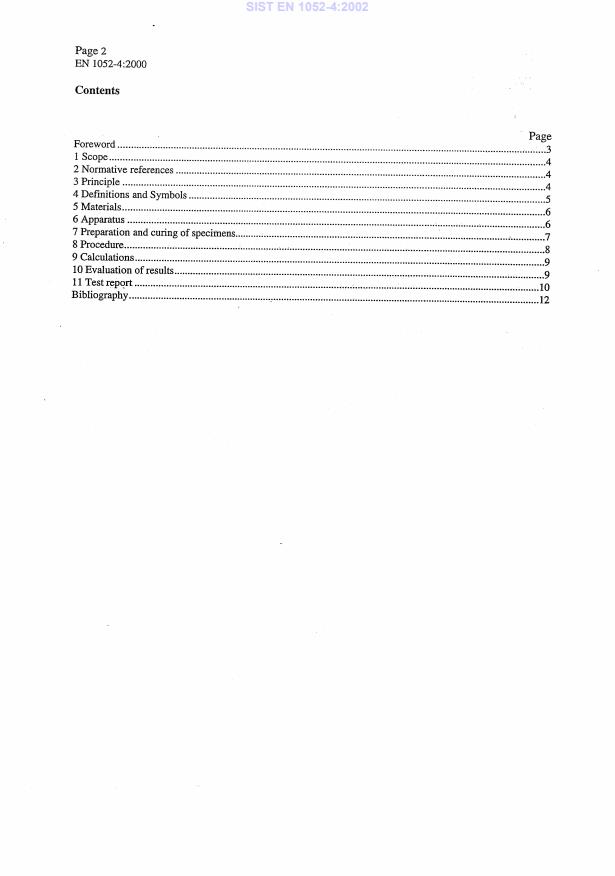
(Main)Methods of test for masonry - Part 4: Determination of shear strength including damp proof course
General Information
- Abstract
This European Standard specifies a method for determining the in plane shear strength of horizontal bed joints in masonry incorporating sheet damp proof course material using a specimen tested in double shear with load applied perpendicular to the bed joints. Guidance is given on the preparation of the specimens, the conditioning required before testing, the testing machine, the method of test, the method of calculation and the contents of the test report.
- Status
- Published
- Publication Date
- 23-May-2000
- Technical Committee
- CEN/TC 125 - Masonry
- Drafting Committee
- CEN/TC 125/WG 4 - Test methods
- Current Stage
- 9093 - Decision to confirm - Review Enquiry
- Start Date
- 23-Jan-2025
- Completion Date
- 23-Sep-2026

Overview
EN 1052-4:2000 (CEN) defines a standardized test method for determining the in-plane shear strength of horizontal bed joints in masonry that incorporate a sheet damp proof course (DPC). The method uses a specimen loaded in double shear with the load applied perpendicular to the bed joints. The standard covers specimen preparation, conditioning, test equipment, test procedure, calculation rules and required contents of the test report. National adoption (for example SIST EN 1052-4:2002) reflects its use across Europe.
Key topics and requirements
- Scope and applicability
- Test applies to masonry bed joints containing sheet damp proof course material and aims to measure shear resistance along the joint plane.
- Specimen preparation
- Requirements for specimen geometry and construction so results are reproducible and comparable.
- Conditioning before testing
- Controlled conditioning of specimens (e.g., moisture/environment) to reflect realistic test conditions.
- Test machine and loading
- Use of a suitable testing machine; load applied perpendicular to bed joints in a double-shear arrangement.
- Test method and measurement
- Step-by-step procedures for applying load, recording shear displacement and failure modes.
- Calculation and reporting
- Defined calculation formulas for shear strength and detailed content required in the test report (test conditions, specimen data, results and observations).
Practical applications
- Structural design and verification
- Engineers use EN 1052-4 test results to assess shear capacity of masonry joints where DPC materials are included, informing safe design and structural assessments.
- Product evaluation
- Manufacturers of masonry materials, mortars and damp proof courses use the standard to demonstrate performance and compliance.
- Quality control and certification
- Test laboratories and certification bodies apply the method for routine quality testing and product approval.
- Forensic and research use
- Researchers and failure investigators use standardized shear tests to compare materials, joint treatments and construction techniques.
Who should use this standard
- Structural and geotechnical engineers
- Masonry product manufacturers and suppliers
- Construction material testing laboratories
- Certification and conformity assessment bodies
- Academic and R&D teams studying masonry behavior
Related standards
- Other parts of the EN 1052 series (masonry test methods) and national adoptions (e.g., SIST EN 1052-4:2002) should be consulted for complementary test methods and broader masonry testing practice.
Keywords: EN 1052-4, masonry shear strength testing, damp proof course, bed joints, double shear test, masonry testing standard, CEN.
Relations
- Effective Date
- 28-Jan-2026
- Effective Date
- 28-Jan-2026
- Effective Date
- 28-Jan-2026
- Effective Date
- 28-Jan-2026
- Effective Date
- 28-Jan-2026
- Effective Date
- 28-Jan-2026
- Effective Date
- 28-Jan-2026
- Effective Date
- 28-Jan-2026
Get Certified
Connect with accredited certification bodies for this standard

DIBt (Deutsches Institut für Bautechnik)
German Institute for Building Technology.
DIN CERTCO
DIN Group product certification.

Aboma Certification B.V.
Specialized in construction, metal, and transport sectors.
Sponsored listings
Frequently Asked Questions
EN 1052-4:2000 is a standard published by the European Committee for Standardization (CEN). Its full title is "Methods of test for masonry - Part 4: Determination of shear strength including damp proof course". This standard covers: This European Standard specifies a method for determining the in plane shear strength of horizontal bed joints in masonry incorporating sheet damp proof course material using a specimen tested in double shear with load applied perpendicular to the bed joints. Guidance is given on the preparation of the specimens, the conditioning required before testing, the testing machine, the method of test, the method of calculation and the contents of the test report.
This European Standard specifies a method for determining the in plane shear strength of horizontal bed joints in masonry incorporating sheet damp proof course material using a specimen tested in double shear with load applied perpendicular to the bed joints. Guidance is given on the preparation of the specimens, the conditioning required before testing, the testing machine, the method of test, the method of calculation and the contents of the test report.
EN 1052-4:2000 is classified under the following ICS (International Classification for Standards) categories: 91.080.30 - Masonry. The ICS classification helps identify the subject area and facilitates finding related standards.
EN 1052-4:2000 has the following relationships with other standards: It is inter standard links to EN 772-1:2011+A1:2015, EN 998-2:2016, EN 1015-7:1998, EN 772-10:1999, EN 1015-11:2019, EN 1015-3:1999, EN 1996-1-1:2005+A1:2012, EN 1996-2:2006. Understanding these relationships helps ensure you are using the most current and applicable version of the standard.
EN 1052-4:2000 is associated with the following European legislation: EU Directives/Regulations: 305/2011, 89/106/EEC; Standardization Mandates: M/BC/CEN/87/12. When a standard is cited in the Official Journal of the European Union, products manufactured in conformity with it benefit from a presumption of conformity with the essential requirements of the corresponding EU directive or regulation.
EN 1052-4:2000 is available in PDF format for immediate download after purchase. The document can be added to your cart and obtained through the secure checkout process. Digital delivery ensures instant access to the complete standard document.
Standards Content (Sample)
2003-01.Slovenski inštitut za standardizacijo. Razmnoževanje celote ali delov tega standarda ni dovoljeno.Prüfverfahren für Mauerwerk - Teil 4: Bestimmung der Scherfestigkeit bei einer FeuchtesperrschichtMéthodes d'essai de la maçonnerie - Partie 4: Détermination de la résistance au cisaillement, en tenant compte de la couche de coupure de capillaritéMethods of test for masonry - Part 4: Determination of shear strength including damp proof course91.0
...