


EN 12201-5:2024
(Main)Plastics piping systems for water supply, and for drains and sewers under pressure - Polyethylene (PE) - Part 5: Fitness for purpose of the system
General Information
- Abstract
This document specifies the requirements of fitness for purpose of assembled polyethylene (PE) piping systems intended for the conveyance of water intended for human consumption, raw water prior to treatment, drains and sewers under pressure, vacuum sewer systems, and water for other purposes, with the exception of industrial application.
It specifies the requirements for electrofusion, socket fusion, butt fusion and mechanical joints.
It specifies the method of preparation of test piece joints, and the tests to be carried out on these joints for assessing the fitness for purpose of the system under normal and extreme conditions.
NOTE 1 For PE components intended for the conveyance of water for human consumption and raw water prior to treatment attention is drawn to the introduction of this document. Components manufactured for water for other purposes, drains and sewers, and vacuum systems, are possibly not suitable for water supply for human consumption.
NOTE 2 Industrial application is covered by EN ISO 15494 [2].
The intended use includes sea outfalls, laid in water and pipes suspended below bridges.
It also specifies the test parameters for the test methods referred to in this document.
This document is intended to only be used by the product manufacturer to assess the performance of components in accordance with EN 12201 2, EN 12201 3, or EN 12201 4 when joined together under normal and extreme conditions in accordance with this document. It is not intended for on-site testing of pipe systems.
In conjunction with EN 12201-1, EN 12201 2, EN 12201 3 and EN 12201 4 this document is applicable to PE pipes, fittings and valves, their joints and joints with components of PE and other materials intended to be used under the following conditions:
a) allowable operating pressure, PFA, up to 25 bar ;
b) an operating temperature of 20 °C as a reference temperature for design purposes.
NOTE 3 For applications operating at constant temperatures greater than 20 °C up to and including 50 °C, see EN 12201-1:2024, Annex A.
The EN 12201 series covers a range of allowable operating pressures and gives requirements concerning colours.
NOTE 4 It is the responsibility of the purchaser or specifier to make the appropriate selections from these aspects, taking into account their particular requirements and any relevant national guidance or regulations and installation practices or codes.
- Status
- Published
- Publication Date
- 30-Jan-2024
- Technical Committee
- CEN/TC 155 - Plastics piping systems and ducting systems
- Current Stage
- 6060 - Definitive text made available (DAV) - Publishing
- Start Date
- 31-Jan-2024
- Due Date
- 15-Mar-2023
- Completion Date
- 31-Jan-2024

Overview
EN 12201-5:2024 (CEN) defines the fitness for purpose requirements for assembled polyethylene (PE) piping systems used to convey water (including drinking water and raw water prior to treatment), drains and sewers under pressure, vacuum sewer systems and other non‑industrial water applications. The part addresses how components perform when joined into a system and the tests and preparation methods required to assess system performance under normal and extreme conditions. It supersedes EN 12201-5:2011 and adds coverage for PE 100-RC materials.
Key topics and technical requirements
- Scope of applicability
- PE pipes, fittings and valves joined into systems with allowable operating pressures (PFA) up to 25 bar and a reference design temperature of 20 °C (see EN 12201‑1:2024 Annex A for constant temperatures >20 °C up to 50 °C).
- Intended uses include sea outfalls, pipes laid in water and pipes suspended beneath bridges. Industrial applications are excluded.
- Jointing methods covered
- Electrofusion, socket fusion, butt fusion and mechanical joints.
- Material compatibility: butt/electrofusion applicable to PE 100, PE 100‑RC, PE 80; PE 40 is limited to mechanical fittings.
- Testing and preparation
- Specifies methods for preparation of test-piece assemblies and the tests to assess fitness for purpose (pressure tests, decohesion/tensile tests, leak/negative pressure tests referenced via ISO/EN test methods).
- Distinguishes procedures and acceptance requirements for normal vs extreme conditions.
- Intended for manufacturer and laboratory assessment of component combinations - not intended for on‑site system testing.
- Performance limits and responsibilities
- The purchaser/specifier is responsible for selecting appropriate pressure classes, colours and any national/regulatory requirements for drinking water contact.
Practical applications
- Design validation and type‑testing of PE piping systems for:
- Drinking water distribution and raw water conveyance
- Pressure sewers, vacuum sewers and other pressurised drainage
- Marine outfalls and suspended pipeline installations
- Use cases include system development, product certification, and pre‑qualification of jointing methods and component compatibility.
Who should use this standard
- PE pipe, fitting and valve manufacturers
- Materials and component testing laboratories
- Product conformity and certification bodies
- System designers, specifiers and purchasers needing to verify system performance and joint integrity
- Standards committees and regulators referencing system-level fitness-for-purpose criteria
Related standards
- EN 12201‑1, ‑2, ‑3, ‑4 (system and component requirements)
- ISO/EN test method standards cited for joint preparation and testing (e.g., ISO 11413, ISO 11414, ISO 1167 series)
Keywords: EN 12201-5:2024, polyethylene piping, PE piping systems, fitness for purpose, electrofusion, butt fusion, socket fusion, mechanical joints, water supply standard, CEN.
Relations
- Effective Date
- 18-Jan-2023
- Effective Date
- 08-Apr-2026
- Effective Date
- 08-Apr-2026
- Effective Date
- 08-Apr-2026
- Effective Date
- 08-Apr-2026
- Effective Date
- 09-Feb-2026
- Effective Date
- 09-Feb-2026
- Effective Date
- 09-Feb-2026
- Effective Date
- 28-Jan-2026
- Effective Date
- 28-Jan-2026
- Effective Date
- 28-Jan-2026
- Effective Date
- 28-Jan-2026
- Effective Date
- 28-Jan-2026
- Effective Date
- 28-Jan-2026
- Effective Date
- 28-Jan-2026
Get Certified
Connect with accredited certification bodies for this standard

Institut za varilstvo d.o.o. (Welding Institute)
Slovenia's leading welding institute since 1952. ISO 3834, EN 1090, pressure equipment certification, NDT personnel, welder qualification. Only IIW Au
Sponsored listings
Frequently Asked Questions
EN 12201-5:2024 is a standard published by the European Committee for Standardization (CEN). Its full title is "Plastics piping systems for water supply, and for drains and sewers under pressure - Polyethylene (PE) - Part 5: Fitness for purpose of the system". This standard covers: This document specifies the requirements of fitness for purpose of assembled polyethylene (PE) piping systems intended for the conveyance of water intended for human consumption, raw water prior to treatment, drains and sewers under pressure, vacuum sewer systems, and water for other purposes, with the exception of industrial application. It specifies the requirements for electrofusion, socket fusion, butt fusion and mechanical joints. It specifies the method of preparation of test piece joints, and the tests to be carried out on these joints for assessing the fitness for purpose of the system under normal and extreme conditions. NOTE 1 For PE components intended for the conveyance of water for human consumption and raw water prior to treatment attention is drawn to the introduction of this document. Components manufactured for water for other purposes, drains and sewers, and vacuum systems, are possibly not suitable for water supply for human consumption. NOTE 2 Industrial application is covered by EN ISO 15494 [2]. The intended use includes sea outfalls, laid in water and pipes suspended below bridges. It also specifies the test parameters for the test methods referred to in this document. This document is intended to only be used by the product manufacturer to assess the performance of components in accordance with EN 12201 2, EN 12201 3, or EN 12201 4 when joined together under normal and extreme conditions in accordance with this document. It is not intended for on-site testing of pipe systems. In conjunction with EN 12201-1, EN 12201 2, EN 12201 3 and EN 12201 4 this document is applicable to PE pipes, fittings and valves, their joints and joints with components of PE and other materials intended to be used under the following conditions: a) allowable operating pressure, PFA, up to 25 bar ; b) an operating temperature of 20 °C as a reference temperature for design purposes. NOTE 3 For applications operating at constant temperatures greater than 20 °C up to and including 50 °C, see EN 12201-1:2024, Annex A. The EN 12201 series covers a range of allowable operating pressures and gives requirements concerning colours. NOTE 4 It is the responsibility of the purchaser or specifier to make the appropriate selections from these aspects, taking into account their particular requirements and any relevant national guidance or regulations and installation practices or codes.
This document specifies the requirements of fitness for purpose of assembled polyethylene (PE) piping systems intended for the conveyance of water intended for human consumption, raw water prior to treatment, drains and sewers under pressure, vacuum sewer systems, and water for other purposes, with the exception of industrial application. It specifies the requirements for electrofusion, socket fusion, butt fusion and mechanical joints. It specifies the method of preparation of test piece joints, and the tests to be carried out on these joints for assessing the fitness for purpose of the system under normal and extreme conditions. NOTE 1 For PE components intended for the conveyance of water for human consumption and raw water prior to treatment attention is drawn to the introduction of this document. Components manufactured for water for other purposes, drains and sewers, and vacuum systems, are possibly not suitable for water supply for human consumption. NOTE 2 Industrial application is covered by EN ISO 15494 [2]. The intended use includes sea outfalls, laid in water and pipes suspended below bridges. It also specifies the test parameters for the test methods referred to in this document. This document is intended to only be used by the product manufacturer to assess the performance of components in accordance with EN 12201 2, EN 12201 3, or EN 12201 4 when joined together under normal and extreme conditions in accordance with this document. It is not intended for on-site testing of pipe systems. In conjunction with EN 12201-1, EN 12201 2, EN 12201 3 and EN 12201 4 this document is applicable to PE pipes, fittings and valves, their joints and joints with components of PE and other materials intended to be used under the following conditions: a) allowable operating pressure, PFA, up to 25 bar ; b) an operating temperature of 20 °C as a reference temperature for design purposes. NOTE 3 For applications operating at constant temperatures greater than 20 °C up to and including 50 °C, see EN 12201-1:2024, Annex A. The EN 12201 series covers a range of allowable operating pressures and gives requirements concerning colours. NOTE 4 It is the responsibility of the purchaser or specifier to make the appropriate selections from these aspects, taking into account their particular requirements and any relevant national guidance or regulations and installation practices or codes.
EN 12201-5:2024 is classified under the following ICS (International Classification for Standards) categories: 23.040.20 - Plastics pipes. The ICS classification helps identify the subject area and facilitates finding related standards.
EN 12201-5:2024 has the following relationships with other standards: It is inter standard links to EN 12201-5:2011, ISO 13955:1997, ISO 17885:2021, ISO 13954:1997, ISO 11413:2019, ISO 11414:2009, ISO 13956:2010, ISO 13953:2001, EN 12201-1:2024, EN ISO 1167-1:2006, EN ISO 3501:2022, EN ISO 3458:2015, EN 17722:2024, EN ISO 1167-4:2007, EN 16905-3:2024. Understanding these relationships helps ensure you are using the most current and applicable version of the standard.
EN 12201-5:2024 is available in PDF format for immediate download after purchase. The document can be added to your cart and obtained through the secure checkout process. Digital delivery ensures instant access to the complete standard document.
Standards Content (Sample)
SLOVENSKI STANDARD
01-april-2024
Nadomešča:
SIST EN 12201-5:2011
Cevni sistemi iz polimernih materialov za oskrbo z vodo in za odvodnjavanje in
kanalizacijo pod tlakom - Polietilen (PE) - 5. del: Ustrezanje zahtevam za
uporabnost sistema
Plastics piping systems for water supply, and for drains and sewers under pressure -
Polyethylene (PE) - Part 5: Fitness for purpose of the system
Kunststoff-Rohrleitungssysteme für die Wasserversorgung und für Entwässerungs- und
Abwasserdruckleitungen - Polyethylen (PE) - Teil 5: Gebrauchstauglichkeit des Systems
Systèmes de canalisations en plastique pour l'alimentation en eau et pour les
branchements et les collecteurs d'assainissement avec pression - Polyéthylène (PE) -
Partie 5 : Aptitude à l'emploi du système
Ta slovenski standard je istoveten z: EN 12201-5:2024
ICS:
23.040.05 Cevovodi za zunanje Pipeline and its parts for
sisteme za odpadno vodo in external sewage systems
njihovi deli
91.140.60 Sistemi za oskrbo z vodo Water supply systems
93.030 Zunanji sistemi za odpadno External sewage systems
vodo
2003-01.Slovenski inštitut za standardizacijo. Razmnoževanje celote ali delov tega standarda ni dovoljeno.
EN 12201-5
EUROPEAN STANDARD
NORME EUROPÉENNE
January 2024
EUROPÄISCHE NORM
ICS 23.040.20 Supersedes EN 12201-5:2011
English Version
Plastics piping systems for water supply, and for drains
and sewers under pressure - Polyethylene (PE) - Part 5:
Fitness for purpose of the system
Systèmes de canalisations en plastique pour Kunststoff-Rohrleitungssysteme für die
l'alimentation en eau et pour les branchements et les Wasserversorgung und für Entwässerungs- und
collecteurs d'assainissement avec pression - Abwasserdruckleitungen - Polyethylen (PE) - Teil 5:
Polyéthylène (PE) - Partie 5 : Aptitude à l'emploi du Gebrauchstauglichkeit des Systems
système
This European Standard was approved by CEN on 10 December 2023.
CEN members are bound to comply with the CEN/CENELEC Internal Regulations which stipulate the conditions for giving this
European Standard the status of a national standard without any alteration. Up-to-date lists and bibliographical references
concerning such national standards may be obtained on application to the CEN-CENELEC Management Centre or to any CEN
member.
This European Standard exists in three official versions (English, French, German). A version in any other language made by
translation under the responsibility of a CEN member into its own language and notified to the CEN-CENELEC Management
Centre has the same status as the official versions.
CEN members are the national standards bodies of Austria, Belgium, Bulgaria, Croatia, Cyprus, Czech Republic, Denmark, Estonia,
Finland, France, Germany, Greece, Hungary, Iceland, Ireland, Italy, Latvia, Lithuania, Luxembourg, Malta, Netherlands, Norway,
Poland, Portugal, Republic of North Macedonia, Romania, Serbia, Slovakia, Slovenia, Spain, Sweden, Switzerland, Türkiye and
United Kingdom.
EUROPEAN COMMITTEE FOR STANDARDIZATION
COMITÉ EUROPÉEN DE NORMALISATION
EUROPÄISCHES KOMITEE FÜR NORMUNG
CEN-CENELEC Management Centre: Rue de la Science 23, B-1040 Brussels
© 2024 CEN All rights of exploitation in any form and by any means reserved Ref. No. EN 12201-5:2024 E
worldwide for CEN national Members.
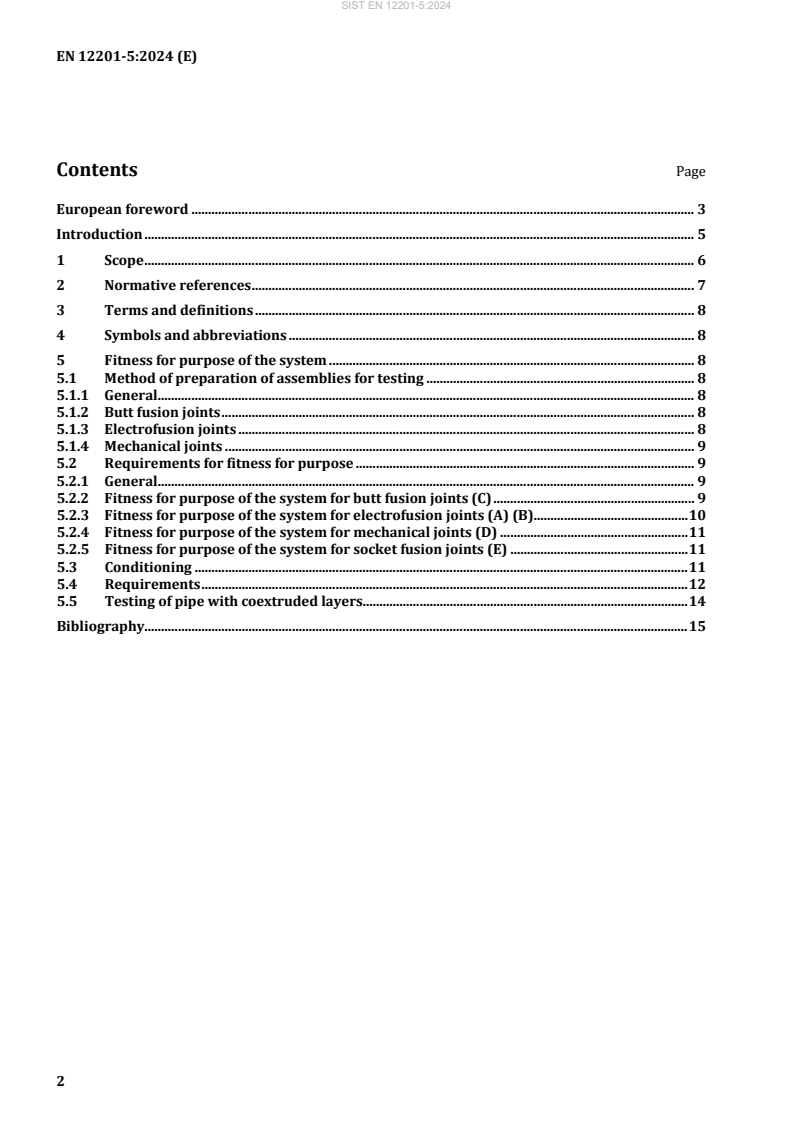
Contents Page
European foreword . 3
Introduction . 5
1 Scope . 6
2 Normative references . 7
3 Terms and definitions . 8
4 Symbols and abbreviations . 8
5 Fitness for purpose of the system . 8
5.1 Method of preparation of assemblies for testing . 8
5.1.1 General . 8
5.1.2 Butt fusion joints . 8
5.1.3 Electrofusion joints . 8
5.1.4 Mechanical joints . 9
5.2 Requirements for fitness for purpose . 9
5.2.1 General . 9
5.2.2 Fitness for purpose of the system for butt fusion joints (C) . 9
5.2.3 Fitness for purpose of the system for electrofusion joints (A) (B). 10
5.2.4 Fitness for purpose of the system for mechanical joints (D) . 11
5.2.5 Fitness for purpose of the system for socket fusion joints (E) . 11
5.3 Conditioning . 11
5.4 Requirements . 12
5.5 Testing of pipe with coextruded layers. 14
Bibliography. 15
European foreword
This document (EN 12201-5:2024) has been prepared by Technical Committee CEN/TC 155 “Plastics
piping systems and ducting systems”, the secretariat of which is held by NEN.
This European Standard shall be given the status of a national standard, either by publication of an
identical text or by endorsement, at the latest by July 2024, and conflicting national standards shall be
withdrawn at the latest by July 2024.
Attention is drawn to the possibility that some of the elements of this document may be the subject of
patent rights. CEN shall not be held responsible for identifying any or all such patent rights.
This document supersedes EN 12201-5:2011.
System Standards are based on the results of the work being undertaken in ISO/TC 138 “Plastics pipes,
fittings and valves for the transport of fluids”, which is a Technical Committee of the International
Organization for Standardization (ISO).
They are supported by separate standards on test methods to which references are made throughout the
System Standard.
The System Standards are consistent with general standards on functional requirements and on
recommended practice for installation.
EN 12201 consists of the following parts:
— EN 12201-1, Plastics piping systems for water supply, and for drains and sewers under pressure —
Polyethylene (PE) — Part 1: General;
— EN 12201-2, Plastics piping systems for water supply, and for drains and sewers under pressure —
Polyethylene (PE) — Part 2: Pipes;
— EN 12201-3, Plastics piping systems for water supply, and for drains and sewers under pressure —
Polyethylene (PE) — Part 3: Fittings;
— EN 12201-4, Plastics piping systems for water supply, and for drains and sewers under pressure —
Polyethylene (PE) — Part 4: Valves for water supply systems;
— EN 12201-5, Plastics piping systems for water supply, and for drains and sewers under pressure —
Polyethylene (PE) — Part 5: Fitness for purpose of the system (this document).
In addition, the following document provides guidance on the assessment of conformity:
— CEN/TS 12201-7, Plastics piping systems for water supply, and for drainage and sewerage under
pressure — Polyethylene (PE) — Part 7: Guidance for the assessment of conformity.
The revision of this System Standard has been carried out principally to add the PE 100-RC type materials
with enhanced resistance to slow crack growth. EN 12201-1:2024, Annex C discusses the performance of
this type of material and gives additional information for non-conventional installation techniques. In
addition, test methods have been updated.
Any feedback and questions on this document should be directed to the users’ national standards body.
A complete listing of these bodies can be found on the CEN website.
According to the CEN-CENELEC Internal Regulations, the national standards organisations of the
following countries are bound to implement this European Standard: Austria, Belgium, Bulgaria, Croatia,
Cyprus, Czech Republic, Denmark, Estonia, Finland, France, Germany, Greece, Hungary, Iceland, Ireland,
Italy, Latvia, Lithuania, Luxembourg, Malta, Netherlands, Norway, Poland, Portugal, Republic of North
Macedonia, Romania, Serbia, Slovakia, Slovenia, Spain, Sweden, Switzerland, Türkiye and the United
Kingdom.
Introduction
This document specifies the requirements for a piping system and its components made from
polyethylene (PE). The piping system is intended to be used for water supply intended for human
consumption, including the conveyance of raw water prior to treatment, drains and sewers under
pressure, vacuum sewer systems, and water for other purposes.
In respect of potential adverse effects on the quality of water intended for human consumption, caused
by the product covered by the EN 12201 series:
— this document provides no information as to whether the products may be used without restriction
in any of the Member States of the EU or EFTA;
NOTE Attention is drawn to the presence of national regulations and testing arrangements in relation to
products intended for use in water supply to ensure fitness for contact with drinking water.
Requirements and test methods for components of the piping system are specified in EN 12201-1,
EN 12201-2, EN 12201-3 and EN 12201-4. CEN/TS 12201-7 [1] gives guidance for assessment of
conformity.
This part of EN 12201 covers the characteristics of the fitness for purpose of the system.
1 Scope
This document specifies the requirements of fitness for purpose of assembled polyethylene (PE) piping
systems intended for the conveyance of water intended for human consumption, raw water prior to
treatment, drains and sewers under pressure, vacuum sewer systems, and water for other purposes, with
the exception of industrial application.
It specifies the requirements for electrofusion, socket fusion, butt fusion and mechanical joints.
It specifies the method of preparation of test piece joints, and the tests to be carried out on these joints
for assessing the fitness for purpose of the system under normal and extreme conditions.
NOTE 1 For PE components intended for the conveyance of water for human consumption and raw water prior
to treatment attention is drawn to the introduction of this document. Components manufactured for water for other
purposes, drains and sewers, and vacuum systems, are possibly not suitable for water supply for human
consumption.
NOTE 2 Industrial application is covered by EN ISO 15494 [2].
The intended use includes sea outfalls, laid in water and pipes suspended below bridges.
It also specifies the test parameters for the test methods referred to in this document.
This document is intended to only be used by the product manufacturer to assess the performance of
components in accordance with EN 12201-2, EN 12201-3, or EN 12201-4 when joined together under
normal and extreme conditions in accordance with this document. It is not intended for on-site testing of
pipe systems.
In conjunction with EN 12201-1, EN 12201-2, EN 12201-3 and EN 12201-4 this document is applicable
to PE pipes, fittings and valves, their joints and joints with components of PE and other materials intended
to be used under the following conditions:
a) allowable operating pressure, PFA, up to 25 bar ;
b) an operating temperature of 20 °C as a reference temperature for design purposes.
NOTE 3 For applications operating at constant temperatures greater than 20 °C up to and including 50 °C, see
EN 12201-1:2024, Annex A.
The EN 12201 series covers a range of allowable operating pressures and gives requirements concerning
colours.
NOTE 4 It is the responsibility of the purchaser or specifier to make the appropriate selections from these
aspects, taking into account their particular requirements and any relevant national guidance or regulations and
installation practices or codes.
1 5 2
1 bar = 0,1 MPa. = 10 Pa; 1 MPa = 1 N/mm
2 Normative references
The following documents are referred to in the text in such a way that some or all of their content
constitutes requirements of this document. For dated references, only the edition cited applies. For
undated references, the latest edition of the referenced document (including any amendments) applies.
EN 12201-1, Plastics piping systems for water supply, and for drains and sewers under pressure —
Polyethylene (PE) — Part 1: General
EN 12201-2, Plastics piping systems for water supply, and for drains and sewers under pressure —
Polyethylene (PE) — Part 2: Pipes
EN 12201-3, Plastics piping systems for water supply, and for drains and sewers under pressure —
Polyethylene (PE) — Part 3: Fittings
EN 12201-4, Plastics piping systems for water supply, and for drains and sewers under pressure —
Polyethylene (PE) — Part 4: Valves for water supply systems
EN ISO 3501, Plastics piping systems — Mechanical joints between fittings and pressure pipes — Test
method for resistance to pull-out under constant longitudinal force (ISO 3501)
EN ISO 3503, Plastics piping systems — Mechanical joints between fittings and pressure pipes — Test
method for leaktightness under internal pressure of assemblies subjected to bending (ISO 3503)
EN ISO 3458, Plastics piping systems — Mechanical joints between fittings and pressure pipes — Test
method for leaktightness under internal pressure (ISO 3458)
EN ISO 3459:2022, Plastic piping systems — Mechanical joints between fittings and pressure pipes — Test
method for leaktightness under negative pressure (ISO 3459:2022)
EN ISO 1167-1:2006, Thermoplastics pipes, fittings and assemblies for the conveyance of fluids —
Determination of the resistance to internal pressure — Part 1: General method (ISO 1167-1:2006)
EN ISO 1167-2, Thermoplastics pipes, fittings and assemblies for the conveyance of fluids — Determination
of the resistance to internal pressure — Part 2: Preparation of pipe test pieces (ISO 1167-2)
EN ISO 1167-4, Thermoplastics pipes, fittings and assemblies for the conveyance of fluids — Determination
of the resistance to internal pressure — Part 4: Preparation of assemblies (ISO 1167-4)
ISO 11413:2019, Plastics pipes and fittings — Preparation of test piece assemblies between a polyethylene
(PE) pipe and an electrofusion fitting
ISO 11414:2009, Plastics pipes and fittings — Preparation of polyethylene (PE) pipe/pipe or pipe/fitting
test piece assemblies by butt fus
...