

EN 71-13:2021
(Main)Safety of toys - Part 13: Olfactory board games, cosmetic kits and gustative games
- Abstract
This document applies to olfactory board games, cosmetic kits, gustative games and supplementary sets. It specifies requirements on the use of substances and mixtures and in some cases on their amount and concentration in olfactory board games, cosmetic kits, gustative games and supplementary sets to such games or kits.
These substances and mixtures are:
- those classified as hazardous by the EC-legislation applying to hazardous substances [13] and hazardous mixtures [13];
- substances and mixtures which in excessive amounts could harm the health of the children using them and which are not classified as hazardous by the above-mentioned legislation; and
- any other chemical substance(s) and mixture(s) delivered with the set.
Furthermore, this document specifies allergenic fragrances which are prohibited in toys, marking requirements, in particular regarding allergenic fragrances, and requirements on a contents list, instructions for use, the equipment intended to be used during the activity and the use of highly flammable liquids.
This document does not apply to cosmetic toys such as play cosmetics for dolls.
NOTE The terms "substance" and "mixture" are defined in the REACH regulation (EC) No. 1907/2006 [14] and in the CLP regulation (EC) No. 1272/2008 [13].
- Status
- Withdrawn
- Publication Date
- 20-Apr-2021
- Withdrawal Date
- 13-Oct-2026
- Technical Committee
- CEN/TC 52 - Safety of toys
- Drafting Committee
- CEN/TC 52/WG 5 - Safety of toys - Chemical toys
- Current Stage
- 9960 - Withdrawal effective - Withdrawal
- Start Date
- 04-May-2022
- Completion Date
- 14-Oct-2026
- Directive
- 2009/48/EC - DIRECTIVE 2009/48/EC OF THE EUROPEAN PARLIAMENT AND OF THE COUNCIL of 18 June 2009 on the Safety of ToysOJ Ref: L, L 405 OJ Date: 16-Nov-2021

Relations
- Replaces
EN 71-13:2014 - Safety of toys - Part 13: Olfactory board games, cosmetic kits and gustative games - Effective Date
- 28-Apr-2021
- Effective Date
- 23-Feb-2022
- Effective Date
- 28-Jan-2026
- Effective Date
- 28-Jan-2026
- Effective Date
- 10-Feb-2026
- Effective Date
- 07-Jul-2021
Frequently Asked Questions
EN 71-13:2021 is a standard published by the European Committee for Standardization (CEN). Its full title is "Safety of toys - Part 13: Olfactory board games, cosmetic kits and gustative games". This standard covers: This document applies to olfactory board games, cosmetic kits, gustative games and supplementary sets. It specifies requirements on the use of substances and mixtures and in some cases on their amount and concentration in olfactory board games, cosmetic kits, gustative games and supplementary sets to such games or kits. These substances and mixtures are: - those classified as hazardous by the EC-legislation applying to hazardous substances [13] and hazardous mixtures [13]; - substances and mixtures which in excessive amounts could harm the health of the children using them and which are not classified as hazardous by the above-mentioned legislation; and - any other chemical substance(s) and mixture(s) delivered with the set. Furthermore, this document specifies allergenic fragrances which are prohibited in toys, marking requirements, in particular regarding allergenic fragrances, and requirements on a contents list, instructions for use, the equipment intended to be used during the activity and the use of highly flammable liquids. This document does not apply to cosmetic toys such as play cosmetics for dolls. NOTE The terms "substance" and "mixture" are defined in the REACH regulation (EC) No. 1907/2006 [14] and in the CLP regulation (EC) No. 1272/2008 [13].
This document applies to olfactory board games, cosmetic kits, gustative games and supplementary sets. It specifies requirements on the use of substances and mixtures and in some cases on their amount and concentration in olfactory board games, cosmetic kits, gustative games and supplementary sets to such games or kits. These substances and mixtures are: - those classified as hazardous by the EC-legislation applying to hazardous substances [13] and hazardous mixtures [13]; - substances and mixtures which in excessive amounts could harm the health of the children using them and which are not classified as hazardous by the above-mentioned legislation; and - any other chemical substance(s) and mixture(s) delivered with the set. Furthermore, this document specifies allergenic fragrances which are prohibited in toys, marking requirements, in particular regarding allergenic fragrances, and requirements on a contents list, instructions for use, the equipment intended to be used during the activity and the use of highly flammable liquids. This document does not apply to cosmetic toys such as play cosmetics for dolls. NOTE The terms "substance" and "mixture" are defined in the REACH regulation (EC) No. 1907/2006 [14] and in the CLP regulation (EC) No. 1272/2008 [13].
EN 71-13:2021 is classified under the following ICS (International Classification for Standards) categories: 97.200.50 - Toys. The ICS classification helps identify the subject area and facilitates finding related standards.
EN 71-13:2021 has the following relationships with other standards: It is inter standard links to EN 71-13:2014, EN 71-13:2021+A1:2022, EN ISO 8317:2015, EN 71-1:2014+A1:2018, CEN/CLC Guide 14:2009, EN 71-13:2021/prA1. Understanding these relationships helps ensure you are using the most current and applicable version of the standard.
EN 71-13:2021 is associated with the following European legislation: EU Directives/Regulations: 2009/48/EC; Standardization Mandates: M/445. When a standard is cited in the Official Journal of the European Union, products manufactured in conformity with it benefit from a presumption of conformity with the essential requirements of the corresponding EU directive or regulation.
EN 71-13:2021 is available in PDF format for immediate download after purchase. The document can be added to your cart and obtained through the secure checkout process. Digital delivery ensures instant access to the complete standard document.
Standards Content (Sample)
SLOVENSKI STANDARD
01-julij-2021
Nadomešča:
SIST EN 71-13:2014
Varnost igrač - 13. del: Vohalne igralne plošče, kozmetični seti in okušalne igre
Safety of toys - Part 13: Olfactory board games, cosmetic kits and gustative games
Sicherheit von Spielzeug - Teil 13: Brettspiele für den Geruchsinn, Kosmetikkoffer und
Spiele für den Geschmacksinn
Sécurité des jouets - Partie 13: Jeux de table olfactifs, ensembles cosmétiques et jeux
gustatifs
Ta slovenski standard je istoveten z: EN 71-13:2021
ICS:
97.200.50 Igrače Toys
2003-01.Slovenski inštitut za standardizacijo. Razmnoževanje celote ali delov tega standarda ni dovoljeno.
EN 71-13
EUROPEAN STANDARD
NORME EUROPÉENNE
April 2021
EUROPÄISCHE NORM
ICS 97.200.50 Supersedes EN 71-13:2014
English Version
Safety of toys - Part 13: Olfactory board games, cosmetic
kits and gustative games
Sécurité des jouets - Partie 13 : Jeux de table olfactifs, Sicherheit von Spielzeug - Teil 13: Brettspiele für den
ensembles cosmétiques et jeux gustatifs Geruchsinn, Kosmetikkoffer und Spiele für den
Geschmacksinn
This European Standard was approved by CEN on 19 March 2021.
CEN members are bound to comply with the CEN/CENELEC Internal Regulations which stipulate the conditions for giving this
European Standard the status of a national standard without any alteration. Up-to-date lists and bibliographical references
concerning such national standards may be obtained on application to the CEN-CENELEC Management Centre or to any CEN
member.
This European Standard exists in three official versions (English, French, German). A version in any other language made by
translation under the responsibility of a CEN member into its own language and notified to the CEN-CENELEC Management
Centre has the same status as the official versions.
CEN members are the national standards bodies of Austria, Belgium, Bulgaria, Croatia, Cyprus, Czech Republic, Denmark, Estonia,
Finland, France, Germany, Greece, Hungary, Iceland, Ireland, Italy, Latvia, Lithuania, Luxembourg, Malta, Netherlands, Norway,
Poland, Portugal, Republic of North Macedonia, Romania, Serbia, Slovakia, Slovenia, Spain, Sweden, Switzerland, Turkey and
United Kingdom.
EUROPEAN COMMITTEE FOR STANDARDIZATION
COMITÉ EUROPÉEN DE NORMALISATION
EUROPÄISCHES KOMITEE FÜR NORMUNG
CEN-CENELEC Management Centre: Rue de la Science 23, B-1040 Brussels
© 2021 CEN All rights of exploitation in any form and by any means reserved Ref. No. EN 71-13:2021 E
worldwide for CEN national Members.
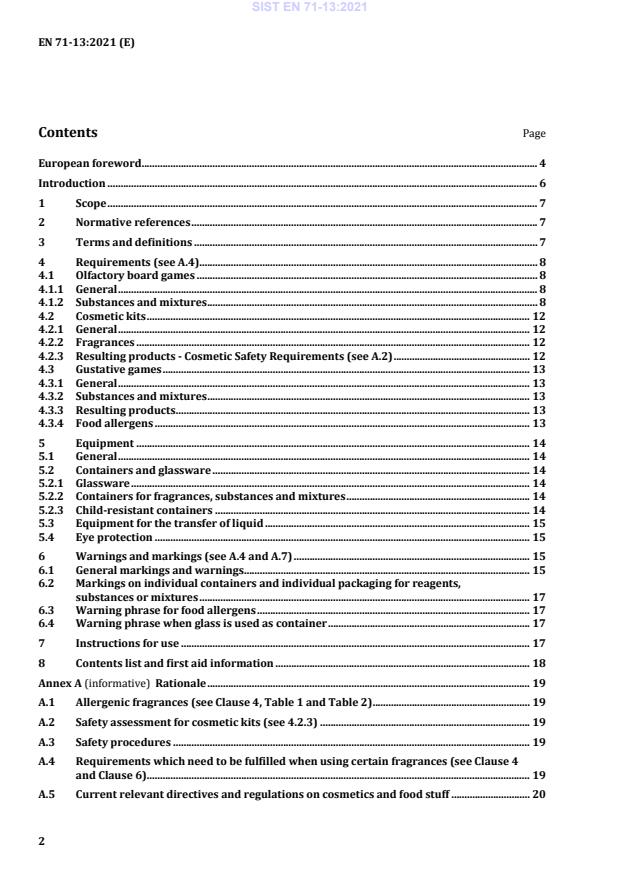
Contents Page
European foreword . 4
Introduction . 6
1 Scope . 7
2 Normative references . 7
3 Terms and definitions . 7
4 Requirements (see A.4). 8
4.1 Olfactory board games . 8
4.1.1 General . 8
4.1.2 Substances and mixtures . 8
4.2 Cosmetic kits . 12
4.2.1 General . 12
4.2.2 Fragrances . 12
4.2.3 Resulting products - Cosmetic Safety Requirements (see A.2) . 12
4.3 Gustative games . 13
4.3.1 General . 13
4.3.2 Substances and mixtures . 13
4.3.3 Resulting products . 13
4.3.4 Food allergens . 13
5 Equipment . 14
5.1 General . 14
5.2 Containers and glassware . 14
5.2.1 Glassware . 14
5.2.2 Containers for fragrances, substances and mixtures . 14
5.2.3 Child-resistant containers . 14
5.3 Equipment for the transfer of liquid . 15
5.4 Eye protection . 15
6 Warnings and markings (see A.4 and A.7) . 15
6.1 General markings and warnings. 15
6.2 Markings on individual containers and individual packaging for reagents,
substances or mixtures . 17
6.3 Warning phrase for food allergens . 17
6.4 Warning phrase when glass is used as container . 17
7 Instructions for use . 17
8 Contents list and first aid information . 18
Annex A (informative) Rationale . 19
A.1 Allergenic fragrances (see Clause 4, Table 1 and Table 2) . 19
A.2 Safety assessment for cosmetic kits (see 4.2.3) . 19
A.3 Safety procedures . 19
A.4 Requirements which need to be fulfilled when using certain fragrances (see Clause 4
and Clause 6) . 19
A.5 Current relevant directives and regulations on cosmetics and food stuff . 20
A.6 Explanations of regulations relevant to this document . 20
A.7 Markings, labelling and warnings . 20
Annex B (normative) Test method for identification of borosilicate glass . 21
B.1 General . 21
B.2 Apparatus . 21
B.3 Procedure . 21
Annex C (informative) Environmental considerations . 23
Annex D (informative) Significant technical changes between this document and the
previous version . 24
Annex ZA (informative) Relationship between this European Standard and the essential
requirements of Directive 2009/48/EC aimed to be covered . 25
Bibliography . 26
European foreword
This document (EN 71-13:2021) has been prepared by Technical Committee CEN/TC 52 “Safety of toys”,
the secretariat of which is held by DS.
This European Standard shall be given the status of a national standard, either by publication of an
identical text or by endorsement, at the latest by October 2021, and conflicting national standards shall
be withdrawn at the latest by April 2022.
Attention is drawn to the possibility that some of the elements of this document may be the subject of
patent rights. CEN shall not be held responsible for identifying any or all such patent rights.
This document supersedes EN 71-13:2014.
This document has been prepared under a standardization request given to CEN by the European
Commission and the European Free Trade Association, and supports essential requirements of
EU Directive(s).
For relationship with EU Directive 2009/48/EC, see informative Annex ZA, which is an integral part of
this document.
Additional information on the rationale for various requirements is given in Annex A.
The significant changes from the previous edition of this standard are detailed in Annex D.
This document constitutes the thirteenth part of the EN 71 series of standards on safety of toys.
EN 71, Safety of toys consists of the following parts:
— Part 1: Mechanical and physical properties;
— Part 2: Flammability;
— Part 3: Migration of certain elements;
— Part 4: Experimental sets for chemistry and related activities;
— Part 5: Chemical toys (sets) other than experimental sets;
— Part 7: Finger paints — Requirements and test methods;
— Part 8: Activity toys for domestic use;
— Part 9: Organic chemical compounds — Requirements;
— Part 10: Organic chemical compounds — Sample preparation and extraction;
— Part 11: Organic chemical compounds — Methods of analysis;
— Part 12: N-nitrosamines and N-nitrosatable substances;
— Part 13: Olfactory board games, cosmetic kits and gustative games;
— Part 14: Trampolines for domestic use.
It is up to the user of the standard to determine whether or not a toy is included in the scope of several of
the above parts of the EN 71-series, and to apply each applicable standard accordingly. Normative
references from one part of the EN 71-series to another, are therefore normally not provided in the
individual parts.
NOTE 1 In addition to the above parts of EN 71, the following technical reports have been published:
— CEN/TR 15071, Safety of toys — National translations of warnings and instructions for use in EN 71, and
— CEN/TR 15371 (parts 1 and 2), Safety of toys — Interpretations;
— CEN/TR 16918, Safety of toys — Children’s mouthing behaviour in contact with toys;
— CEN ISO/TR 8124-8, Safety of toys — Part 8: Age determination guidelines.
NOTE 2 Words in italics (apart from document titles) are defined in Clause 3 (Terms and definitions).
According to the CEN-CENELEC Internal Regulations, the national standards organisations of the
following countries are bound to implement this European Standard: Austria, Belgium, Bulgaria, Croatia,
Cyprus, Czech Republic, Denmark, Estonia, Finland, France, Germany, Greece, Hungary, Iceland, Ireland,
Italy, Latvia, Lithuania, Luxembourg, Malta, Netherlands, Norway, Poland, Portugal, Republic of North
Macedonia, Romania, Serbia, Slovakia, Slovenia, Spain, Sweden, Switzerland, Turkey and the United
Kingdom.
Introduction
This document EN 71-13 is intended to reduce the risks and health hazards to a child when olfactory
board games, cosmetic kits and gustative games are used as intended or in a foreseeable way, bearing in
mind the behaviour of children.
During use of these toys, the hazards should be kept to a minimum by the provision of appropriate
information to make the play safe and controllable. Therefore, this document specifies warning phrases
and instructions for use for these toys.
As a general rule, toys are designed and manufactured for particular ages of children. Their
characteristics are related to the age and stage of development of the children, and their use presupposes
certain aptitudes. Therefore, age requirements are given.
The requirements of this document do not release parents or carers from their responsibility of watching
over the child while he or she is playing. On the contrary, the use of these sets requires close supervision
by adults.
1 Scope
This document applies to olfactory board games, cosmetic kits, gustative games and supplementary sets. It
specifies requirements on the use of substances and mixtures and in some cases on their amount and
concentration in olfactory board games, cosmetic kits, gustative games and supplementary sets to such
games or kits.
These substances and mixtures are:
— those classified as hazardous by the EC-legislation applying to hazardous substances [13] and
hazardous mixtures [13];
— substances and mixtures which in excessive amounts could harm the health of the children using
them and which are not classified as hazardous by the above-mentioned legislation; and
— any other chemical substance(s) and mixture(s) delivered with the set.
Furthermore, this document specifies allergenic fragrances which are prohibited in toys, marking
requirements, in particular regarding allergenic fragrances, and requirements on a contents list,
instructions for use, the equipment intended to be used during the activity and the use of highly
flammable liquids.
This document does not apply to cosmetic toys such as play cosmetics for dolls.
NOTE The terms “substance” and “mixture” are defined in the REACH regulation (EC) No. 1907/2006 [14] and
in the CLP regulation (EC) No. 1272/2008 [13].
2 Normative references
The following documents are referred to in the text in such a way that some or all of their content
constitutes requirements of this document. For dated references, only the edition cited applies. For
undated references, the latest edition of the referenced document (including any amendments) applies.
EN 71-1:2014+A1:2018, Safety of toys - Part 1: Mechanical and physical properties
EN ISO 8317:2015, Child-resistant packaging - Requirements and testing procedures for reclosable
packages (ISO 8317:2015)
3 Terms and definitions
For the purposes of this document, the following terms and definitions apply.
ISO and IEC maintain terminological databases for use in standardization at the following addresses:
— IEC Electropedia: available at http://www.electropedia.org/
— ISO Online browsing platform: available at https://www.iso.org/obp
3.1
olfactory board game
toy, the purpose of which is to assist a child to learn to recognize different odours or flavours
Note 1 to entry: Olfactory board games include activities of smelling and/or tasting as olfactive recognition can
be done by retro-olfaction.
3.2
cosmetic kit
toy, the purpose of which is to assist a child to learn to make products such as fragrances, soaps, creams,
shampoos, bath foams, glosses, lipsticks, other make-up, toothpaste and conditioners
3.3
gustative game
toy, the purpose of which is to allow children to make sweets or dishes which involve the use of food
ingredients such as sweets, liquids, powders and aromas
Note 1 to entry: Commonly used terms for gustative game are “gustative kit” and “food kit”.
3.4
supplementary set
incomplete olfactory board game, cosmetic kit or gustative game which is intended to be used with a
complete game or kit
3.5
packaging
material accompanying the toy when purchased but having no intended play function
4 Requirements (see A.4)
4.1 Olfactory board games
4.1.1 General
Olfactory board games shall be supplied with instructions for use (see Clause 7) and first aid information
if applicable (see Clause 8).
4.1.2 Substances and mixtures
4.1.2.1 Olfactory board games using substances and mixtures recognized as food flavours or food
ingredients
Only substances and mixtures recognized as food flavours and food ingredients shall be used.
NOTE Food flavours and other food ingredients are subject to the relevant food legislation, e.g. Regulation (EC)
No 178/2002 [7] (“general food law”), Regulation (EC) No 1334/2008 [6] (flavours), and Regulation (EC) No
1333/2008 [5] and Commission Regulation (EU) No 231/2012 [19] (food additives) and Regulation (EU) No
1169/2011 [8] (food information to consumers).
4.1.2.2 Olfactory board games using not only substances and mixtures recognized as food
flavours or food ingredients
NOTE 1 With regard to the following requirements it is important to consider Regulation (EC) No. 1272/2008
[13].
Besides substances and mixtures recognized as food flavours and food ingredients also substances or
mixtures which have been assessed to pose no risk under normal conditions of use taking into account
the behaviour of children may be used.
NOTE 2 As an example, a substance classified as skin sensitizing which cannot come into contact with the skin
may be acceptable.
NOTE 3 Food ingredients are subject to the relevant food legislation, e.g. Regulation (EC) No 178/2002 [7]
(“general food law”), Regulation (EC) No 1334/2008 [6] (flavours), Regulation (EC) No 1333/2008 [5] and
Commission Regulation (EU) No 231/2012 [19] (food additives) and Regulation (EU) No 1169/2011 [8] (food
information to consumers).
4.1.2.3 Further requirements for all types of olfactory board games
Only preservatives which under intended and foreseeable use conditions have been assessed as having
no risk taking into account the behaviour of children shall be used in olfactory board games and
supplementary sets for olfactory board games.
NOTE 1 Regulation (EC) No 1223/2009 [2] and Regulation (EC) No 1333/2008 [5] contain requirements on the
use of preservatives. It is important to consider these requirements in the assessment.
Olfactory board games and supplementary sets for olfactory board games for children below 36 months
shall not contain any fragrance listed in Table 1. Other olfactory board games and supplementary sets for
olfactory board games may contain the fragrances listed in Table 1. Olfactory board games and
supplementary sets for olfactory board games involving tasting shall only contain substances allowed by
food legislation, taking into account all legal requirements, especially specific limits given there.
NOTE 2 Certain substances, e.g. “coumarin”, are restricted/not permitted in Regulation (EC) No 1334/2008 [6].
If any of the fragrances specified in Table 1 are supplied in the olfactory board game or supplementary set,
specific warning requirements apply (see 6.1 and 6.3).
Olfactory board games and supplementary sets for olfactory board games shall not contain the allergenic
fragrances listed in Table 2. However, the presence of traces of these fragrances is permitted provided
that such presence is technically unavoidable under good manufacturing practice and does not exceed
100 mg/kg per fragrance.
NOTE 3 The lists of allergenic fragrances in Table 1 and Table 2 originate from Directive 2009/48/EC [1] (see
A.1). The lists in Directive 2009/48/EC [1] are subject to change.
Table 1 — Allergenic fragrances which require a warning
Name of the allergenic fragrance CAS number
Amyl cinnamal 122–40–7
Amylcinnamyl alcohol 101–85–9
Benzyl alcohol 100–51–6
Benzyl salicylate 118–58–1
Cinnamyl alcohol 104–54–1
Cinnamal 104–55–2
Citral 5392–40–5
Coumarin 91–64–5
Eugenol 97–53–0
Geraniol 106–24–1
Hydroxy-citronellal 107–75–5
Hydroxy-methylpentylcyclohexenecarboxaldehyde 31906–04–4
Isoeugenol 97–54–1
Oakmoss extracts 90028–68–5
Treemoss extracts 90028–67–4
Anisyl alcohol 105–13–5
Benzyl benzoate 120–51–4
Benzyl cinnamate 103–41–3
Citronellol 106–22–9
Farnesol 4602–84–0
Hexyl cinnamaldehyde 101–86–0
Lilial 80–54–6
d-Limonene 5989–27–5
Linalool 78–70–6
Methyl heptine carbonate 111–12–6
3-methyl-4-(2,6,6-trimethyl-2-cyclohexen-1-yl)-3-buten-2-one 127–51–5
Table 2 — Allergenic fragrances which shall not be supplied in toys covered by this document
Name of the allergenic fragrance CAS number
Alanroot oil (Inula helenium) 97676–35–2
Allylisothiocyanate 57–06–7
Benzyl cyanide 140–29–4
4 tert-Butylphenol 98–54–4
Chenopodium oil 8006–99–3
Cyclamen alcohol 4756–19–8
Diethyl maleate 141–05–9
Dihydrocoumarin 119–84–6
2,4-Dihydroxy-3-methylbenzaldehyde 6248–20–0
3,7-Dimethyl-2-octen-1-ol (6,7-Dihydrogeraniol) 40607–48–5
4,6-Dimethyl-8-tert-butylcoumarin 17874–34–9
Dimethyl citraconate 617–54–9
7,11-Dimethyldodeca-4,6,10-trien-3-one 26651–96–7
6,10-Dimethylundeca-3,5,9-trien-2-one 141–10–6
Diphenylamine 122–39–4
Ethyl acrylate 140–88–5
Fig leaf, fresh and preparations 68916–52–9
trans-2-Heptenal 18829–55–5
trans-2-Hexenal diethyl acetal 67746–30–9
trans-2-Hexenal dimethyl acetal 18318–83–7
Hydroabietyl alcohol 13393–93–6
4-Ethoxy-phenol 622–62–8
6-lsopropyl-2-decahydronaphthalenol 34131–99–2
7-Methoxycoumarin 531–59–9
4-Methoxyphenol 150–76–5
4-(p-Methoxyphenyl)-3-butene-2-one 943–88–4
1-(p-Methoxyphenyl)-1-penten-3-one 104–27–8
Methyl trans-2-butenoate 623–43–8
6-Methylcoumarin 92–48–8
7-Methylcoumarin 2445–83–2
5-Methyl-2,3-hexanedione 13706–86–0
Costus root oil (Saussurea lappa Clarke) 8023–88–9
7-Ethoxy-4-methylcoumarin 87–05–8
Name of the allergenic fragrance CAS number
Hexahydrocoumarin 700–82–3
Peru balsam, crude (Exudation of Myroxylon pereirae (Royle) Klotzsch) 8007–00–9
2-Pentylidene-cyclohexanone 25677–40–1
3,6,10-Trimethylundeca-3,5,9-trien-2-one 1117–41–5
Verbena oil (Lippia citriodora Kunth) 8024–12–2
Musk ambrette (4-tert-Butyl-3-methoxy-2,6-dinitrotoluene) 83–66–9
4-Phenyl-3-buten-2-one 122–57–6
4.2 Cosmetic kits
4.2.1 General
Cosmetic kits (as multi-component cosmetic products) and its individual components to be mixed based
on clear instructions, are for the purpose of this document considered as cosmetic products, e.g. soap
chips to be mixed with a colouring mixture and a fragrance mixture, or a cream base to be mixed with a
perfuming mixture.
NOTE Therefore, the European cosmetic products regulation (including marking and labelling) applies to
cosmetic kits and individual components which are cosmetic products. See cosmetics borderline manual [20] for
more information on how to address cosmetic kits according to the cosmetic products regulation.
Cosmetic kits shall be supplied with instructions for use (see Clause 7).
The use of denatured alcohol (ethanol) or substances that are not classified as hazardous substances or
mixtures that are not classified as hazardous mixtures [13] (e.g. drinking water, salt, sugar or honey) not
supplied with the cosmetic kit may be suggested in the instructions for use.
Cosmetic kits shall be supplied with a contents list, warnings and first aid information (see Clause 8). The
first aid information and the instructions for use can be on the packaging and/or the instruction sheet.
Cosmetic kits shall be supplied with an ingredient list visible from outside the packaging. For marking
requirement see Clause 6.
4.2.2 Fragrances
Cosmetic kits and supplementary sets for cosmetic kits may contain the substances listed in Table 1. If any
of the fragrances specified in Table 1 are supplied in the cosmetic kit specific warning requirements apply
(see 6.1).
The intended and possible reactions between all fragrances and other components of cosmetic kits shall
be checked by the manufacturer in order to evaluate that no reaction products or mixtures could be
formed, which could harm the health of children (including skin reaction etc.) using the kit.
Cosmetic kits and supplementary sets for cosmetic kits shall not contain any of the allergenic fragrances
listed in Table 2. However, the presence of traces of these fragrances is permitted provided that such
presence is technically unavoidable under good manufacturing practice and does not exceed 100 mg/kg
per fragrance.
4.2.3 Resulting products - Cosmetic Safety Requirements (see A.2)
The resulting product(s) made by a child using a cosmetic kit in accordance with the instructions for use
are considered as cosmetic products and therefore must comply with the relevant requirements of
relevant legislation on cosmetics, i.e. Regulation (EC) No 1223/2009 [2].
4.3 Gustative games
4.3.1 General
Gustative games shall be supplied with instructions for use (see Clause 7).
Gustative games shall be supplied with a contents list, warnings and first aid information (see Clause 8).
The first aid information and the instructions for use can be on the packaging and/or the instruction
sheet.
The use of food ingredients (e.g. drinking water, salt, sugar or honey) not supplied with the gustative
game may be suggested in the instructions for use.
Gustative games shall be supplied with an ingredient list visible from outside the packaging. For marking
requirement see Clause 6.
4.3.2 Substances and mixtures
Substances and mixtures recognized as food flavours and other food ingredients shall be used.
NOTE Food flavours and food ingredients are subject to the relevant food legislation, e.g. Regulation (EC) No
1334/2008 [6] (flavours), Regulation (EC) No 1333/2008 [5] and Regulation (EU) No 231/2012 [19] (food
additives), Regulation (EC) No 178/2002 [7] (“general food law”) and Regulation (EU) No 1169/2011 [8] (food
information to consumers).
The intended and possible reactions between all substances and mixtures of gustative games shall be
assessed by the manufacturer in order to ascertain that no reaction products or mixtures could be formed
that could harm the health of the children using the kit.
Besides substances and mixtures recognized as food flavours and other food ingredients, gustative games
and supplementary sets for gustative games may only contain
...