

prEN 10048
(Main)Hot-rolled narrow steel strip - Tolerances on dimensions and shape
- Abstract
This document specifies tolerances on dimensions and shape for hot rolled uncoated narrow strip and cut lengths of non-alloy and alloy steel grades in accordance with Table 1.
It is usually produced in thickness of 0,8 mm up to and including 16 mm and generally has a rolled width less than 600 mm but is also produced in rolled widths up to and including 720 mm.
Hot-rolled narrow strip has a symmetrical thickness profile with tight crown tolerances and therefore cannot be compared to slit wide strip.
This document also applies to hot-rolled strip for cold rolling.
Table 1 — Field of application
[...table not represented...]
This document can also be used for other steels, e.g.: steels from standards not mentioned in Table 1.
This document does not apply to:
— continuously hot-rolled wide strip and plate/sheet cut from wide strip of non-alloy and alloy steels and narrow strip obtained by slitting wide strip (EN 10051);
— hot-rolled patterned steel strip and plate/sheet cut from wide strip (see EN 10363);
— uncoated or electrolytically coated cold rolled sheet and strip (see EN 10131);
— hot-dip coated steel sheet and strip (EN 10143).
- Status
- Not Published
- Publication Date
- 02-Jan-2028
- Technical Committee
- ECISS/TC 103 - Structural steels other than reinforcements
- Current Stage
- 4020 - Submission to enquiry - Enquiry
- Start Date
- 23-Jul-2026
- Due Date
- 15-Sep-2026
- Completion Date
- 23-Jul-2026

prEN 10048 is a CEN draft European Standard for hot-rolled narrow steel strip. It specifies tolerances on dimensions and shape for hot-rolled uncoated narrow strip and cut lengths of non-alloy and alloy steels, including strip intended for cold rolling, so purchasers, manufacturers, and inspectors can agree the acceptable product limits before delivery.
What does prEN 10048 specify?
prEN 10048 covers dimensional and shape tolerances for hot-rolled narrow strip and cut lengths made from non-alloy and alloy steel grades. It is aimed at strip that is usually between 0,8 mm and 16 mm thick, generally under 600 mm wide, but it also covers products rolled up to 720 mm wide.
The document also makes a practical distinction between hot-rolled narrow strip and slit wide strip. That matters because narrow strip has a symmetrical thickness profile and tight crown tolerances, so it is not treated the same way as material slit from wide strip.
The document is organized into clauses on scope, normative references, terms and definitions, purchaser information, delivery condition, tolerances on dimensions, tolerances on shape, measurements, and packaging. It also includes:
- Annex A, which assigns steel grades to hot forming resistance categories.
- Annex B, which gives methods for determining hot forming resistance at elevated temperatures.
| Annex | What it covers |
|---|---|
| Annex A | Categories of hot forming resistance at elevated temperatures and assignment of steels |
| Annex B | Methods for determining hot forming resistance at elevated temperatures |
What are the key requirements of prEN 10048?
prEN 10048 is built around two things: the steel’s hot forming resistance category and the product form ordered. Those two points drive the tolerance limits, so they need to be agreed clearly at enquiry and order stage.
Ordering information and product options
Clause 4 requires the purchaser to state the product designation, the number of this document, nominal thickness and width, edge condition, nominal length for cut lengths, surface finish, technical delivery condition, steel grade, and the hot forming resistance category. In practice, this is the information that prevents disputes later because the tolerance set depends on how the product is specified.
Clause 4 also allows options for one-sided or symmetrical tolerances, tighter width limits for trimmed edges, special treatment for strip intended for cold rolling, fine length tolerances for cut lengths, and coil diameter and weight. If these are not stated, the basic specification applies.
Delivery condition and surface condition
Clause 5 says the product may be delivered in coils or as cut lengths from coils. Strip is usually supplied with mill edges, while trimmed edges are by agreement. The standard also allows the product to be supplied as rolled, or by agreement mechanically or chemically descaled, oiled, and/or heat-treated. For buyers, this means the required surface and edge condition must be settled early because it affects downstream processing.
Hot forming resistance categories
Clause 6.1 introduces four categories, A to D, based on resistance to hot forming at elevated temperatures. Annex A assigns many common steel grades to these categories, and Annex B gives ways to assess grades that are not listed.
This matters because the thickness and width tolerances in the main tables are tied to these categories. If the steel grade is not already assigned, the category has to be agreed between the parties, so the tolerance band is still clear before production starts.
Thickness, crown, and width
Clause 6.2 gives thickness tolerances, including crown, and separates normal and fine tolerances. For strip intended for cold rolling, clause 6.3 adds tighter rules on thickness variation through one coil and on crown regularity and symmetry. In practice, this is the control that protects later cold rolling and helps keep the strip usable across the coil.
Clause 6.4 covers width tolerances and treats mill edges and trimmed edges differently. Mill-edge products use the category-based width tables, while trimmed-edge products use a separate table that depends mainly on thickness. Clause 6.4 also allows agreed one-sided or symmetrical width tolerances, and tighter limits for trimmed edges.
Length and shape
Clause 6.5 covers cut lengths. It allows normal or fine length tolerances for fixed lengths, with short lengths permitted only within the document’s limits unless the order says otherwise. Clause 7 then covers shape, mainly edge camber and squareness.
Edge camber is controlled against a 2 500 mm reference length, with proportional treatment for other lengths. Squareness is limited as a percentage of nominal width. For the user, that means the strip should run and fit properly in downstream handling, cutting, and forming equipment.
Measurement and packaging
Clause 8 explains how to measure thickness, width, and edge camber, including where on the strip or coil the measurements are taken and how end tongues are treated. Clause 9 gives packaging expectations: coils must be tightly wound, secure, and protected from damage and unwinding, and cut lengths must be packed to avoid damage in handling and storage. These clauses matter because acceptance depends on repeatable measurement and safe delivery condition.
What terms does prEN 10048 define?
- Narrow strip - Steel strip and cut lengths defined as narrow strip in EN 10079, with width under 600 mm, although some mills can produce up to 720 mm.
- Crown - The difference in thickness between an edge and the centre of a rolled product.
- Resistance to hot forming σdr at elevated temperature - The stress, in MPa, needed to produce a specified shape change at a specified temperature, strain, and strain rate.
- Mill edges (M) - The as-rolled edge condition supplied on strip unless trimmed edges are ordered.
- Trimmed edges (T) - Edges that have been trimmed, used where a more controlled width or edge condition is needed.
- Cut lengths - Lengths cut from narrow strip after decoiling.
- End tongues - The coil ends that are treated specially for certain measurements and may be removed for trimmed and/or pickled material.
Who uses prEN 10048?
prEN 10048 is used by steelmakers, rolling mills, processors, purchasers, and quality control teams that buy or supply hot-rolled narrow strip. It is also relevant to laboratories or technical staff who assess hot forming resistance for grades that are not already listed in Annex A.
In practice, these users apply the document when they:
- specify thickness, width, edge condition, and length on an order;
- choose normal or fine tolerances;
- agree whether strip is intended for cold rolling;
- inspect thickness, width, crown, camber, and squareness;
- document coil handling, packaging, and delivery condition.
What changed in prEN 10048 from the previous edition?
prEN 10048 is intended to supersede EN 10048:1996. The foreword lists these significant changes:
- introduction of the concept of deformation resistance at elevated temperatures;
- thickness tolerances presented as normal and fine tolerances;
- extension to include strip with rolled width up to and including 720 mm with finer tolerance requirements than EN 10051;
- editorial update.
Which standards are used with prEN 10048?
The document explicitly refers to these standards:
- EN 10020 - provides the definition and classification of grades of steel used in the terms and category assignment.
- EN 10079 - provides the definition of steel products used for the narrow strip terminology.
- DIN 50106 - forms the basis for the compression test extension described in Annex B.
The scope and annexes also name related standards for overlapping or excluded product families, including EN 10051, EN 10363, EN 10131, and EN 10143, and steel-grade standards such as EN ISO 683-1 to EN ISO 683-5, EN ISO 683-6, EN 10025-2 to EN 10025-6, EN 10028-2 to EN 10028-6, EN 10111, EN 10120, EN 10132, EN 10149-2, EN 10149-3, EN 10207, and EN 10338.
What does the prEN 10048 document contain?
prEN 10048 contains the scope, referenced standards, definitions, purchaser information, delivery condition, dimensional tolerances, shape tolerances, measurement rules, and packaging requirements. It also includes a figure for edge camber measurement and ordering examples that show how to write a specification using the document.
Annex A gives a steel-by-steel assignment to hot forming resistance categories A to D, which is central to choosing the right tolerance tables. Annex B describes practical methods for assessing hot forming resistance for grades not listed in Table A.1, including literature-based comparison and a compression test method extending DIN 50106.
For users, the document is mainly a specification and acceptance tool. It supports order writing, mill production control, receiving inspection, and laboratory assessment of hot forming resistance.
Relations
- Effective Date
- 22-Oct-2025
Get Certified
Connect with accredited certification bodies for this standard

Element Materials Technology
Materials testing and product certification.

Inštitut za kovinske materiale in tehnologije
Institute of Metals and Technology. Materials testing, metallurgical analysis, NDT.
Sponsored listings
Frequently Asked Questions
prEN 10048 is a draft published by the European Committee for Standardization (CEN). Its full title is "Hot-rolled narrow steel strip - Tolerances on dimensions and shape". This standard covers: This document specifies tolerances on dimensions and shape for hot rolled uncoated narrow strip and cut lengths of non-alloy and alloy steel grades in accordance with Table 1. It is usually produced in thickness of 0,8 mm up to and including 16 mm and generally has a rolled width less than 600 mm but is also produced in rolled widths up to and including 720 mm. Hot-rolled narrow strip has a symmetrical thickness profile with tight crown tolerances and therefore cannot be compared to slit wide strip. This document also applies to hot-rolled strip for cold rolling. Table 1 — Field of application [...table not represented...] This document can also be used for other steels, e.g.: steels from standards not mentioned in Table 1. This document does not apply to: — continuously hot-rolled wide strip and plate/sheet cut from wide strip of non-alloy and alloy steels and narrow strip obtained by slitting wide strip (EN 10051); — hot-rolled patterned steel strip and plate/sheet cut from wide strip (see EN 10363); — uncoated or electrolytically coated cold rolled sheet and strip (see EN 10131); — hot-dip coated steel sheet and strip (EN 10143).
This document specifies tolerances on dimensions and shape for hot rolled uncoated narrow strip and cut lengths of non-alloy and alloy steel grades in accordance with Table 1. It is usually produced in thickness of 0,8 mm up to and including 16 mm and generally has a rolled width less than 600 mm but is also produced in rolled widths up to and including 720 mm. Hot-rolled narrow strip has a symmetrical thickness profile with tight crown tolerances and therefore cannot be compared to slit wide strip. This document also applies to hot-rolled strip for cold rolling. Table 1 — Field of application [...table not represented...] This document can also be used for other steels, e.g.: steels from standards not mentioned in Table 1. This document does not apply to: — continuously hot-rolled wide strip and plate/sheet cut from wide strip of non-alloy and alloy steels and narrow strip obtained by slitting wide strip (EN 10051); — hot-rolled patterned steel strip and plate/sheet cut from wide strip (see EN 10363); — uncoated or electrolytically coated cold rolled sheet and strip (see EN 10131); — hot-dip coated steel sheet and strip (EN 10143).
prEN 10048 is classified under the following ICS (International Classification for Standards) categories: 77.140.45 - Non-alloyed steels; 77.140.50 - Flat steel products and semi-products. The ICS classification helps identify the subject area and facilitates finding related standards.
prEN 10048 has the following relationships with other standards: It is inter standard links to EN 10048:1996. Understanding these relationships helps ensure you are using the most current and applicable version of the standard.
prEN 10048 is associated with the following European legislation: Standardization Mandates: M/BC/CEN/89/10. When a standard is cited in the Official Journal of the European Union, products manufactured in conformity with it benefit from a presumption of conformity with the essential requirements of the corresponding EU directive or regulation.
prEN 10048 is available in PDF format for immediate download after purchase. The document can be added to your cart and obtained through the secure checkout process. Digital delivery ensures instant access to the complete standard document.
Standards Content (Sample)
SLOVENSKI STANDARD
01-oktober-2026
Vroče valjani ozki jekleni trakovi - Tolerance mer in oblike
Hot-rolled narrow steel strip - Tolerances on dimensions and shape
Warmgewalzter Bandstahl - Grenzabmaße und Formtoleranzen
Bandes étroites laminées à chaud - Tolérances de dimensions et de forme
Ta slovenski standard je istoveten z: prEN 10048
ICS:
77.140.45 Nelegirana jekla Non-alloyed steels
77.140.50 Ploščati jekleni izdelki in Flat steel products and semi-
polizdelki products
2003-01.Slovenski inštitut za standardizacijo. Razmnoževanje celote ali delov tega standarda ni dovoljeno.
DRAFT
EUROPEAN STANDARD
NORME EUROPÉENNE
EUROPÄISCHE NORM
July 2026
ICS 77.140.45 Will supersede EN 10048:1996
English Version
Hot-rolled narrow steel strip - Tolerances on dimensions
and shape
Bandes étroites laminées à chaud - Tolérances de Warmgewalzter Bandstahl - Grenzabmaße und
dimensions et de forme Formtoleranzen
This draft European Standard is submitted to CEN members for enquiry. It has been drawn up by the Technical Committee
CEN/TC 459/SC 3.
If this draft becomes a European Standard, CEN members are bound to comply with the CEN/CENELEC Internal Regulations
which stipulate the conditions for giving this European Standard the status of a national standard without any alteration.
This draft European Standard was established by CEN in three official versions (English, French, German). A version in any other
language made by translation under the responsibility of a CEN member into its own language and notified to the CEN-CENELEC
Management Centre has the same status as the official versions.
CEN members are the national standards bodies of Austria, Belgium, Bulgaria, Croatia, Cyprus, Czech Republic, Denmark, Estonia,
Finland, France, Germany, Greece, Hungary, Iceland, Ireland, Italy, Latvia, Lithuania, Luxembourg, Malta, Netherlands, Norway,
Poland, Portugal, Republic of North Macedonia, Romania, Serbia, Slovakia, Slovenia, Spain, Sweden, Switzerland, Türkiye and
United Kingdom.
Recipients of this draft are invited to submit, with their comments, notification of any relevant patent rights of which they are
aware and to provide supporting documentation.
Warning : This document is not a European Standard. It is distributed for review and comments. It is subject to change without
notice and shall not be referred to as a European Standard.
EUROPEAN COMMITTEE FOR STANDARDIZATION
COMITÉ EUROPÉEN DE NORMALISATION
EUROPÄISCHES KOMITEE FÜR NORMUNG
CEN-CENELEC Management Centre: Rue de la Science 23, B-1040 Brussels
© 2026 CEN All rights of exploitation in any form and by any means reserved Ref. No. prEN 10048:2026 E
worldwide for CEN national Members.
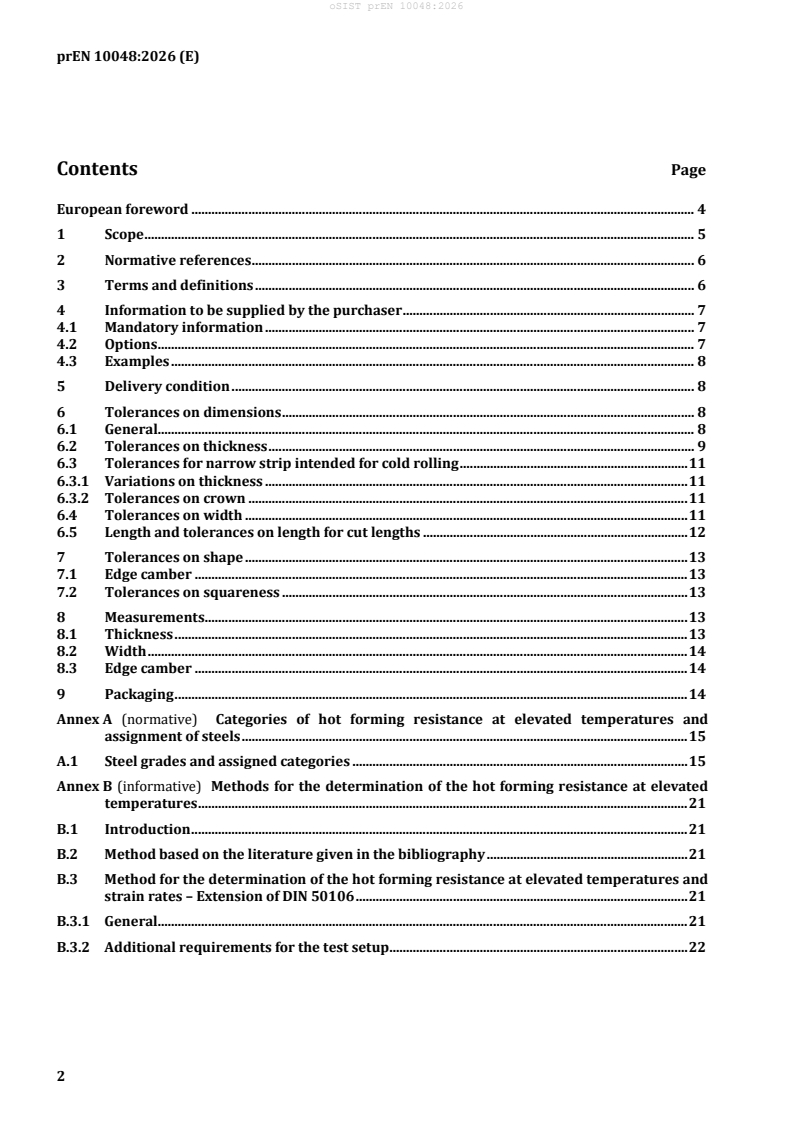
Contents Page
European foreword . 4
1 Scope . 5
2 Normative references . 6
3 Terms and definitions . 6
4 Information to be supplied by the purchaser . 7
4.1 Mandatory information . 7
4.2 Options . 7
4.3 Examples . 8
5 Delivery condition . 8
6 Tolerances on dimensions . 8
6.1 General. 8
6.2 Tolerances on thickness . 9
6.3 Tolerances for narrow strip intended for cold rolling . 11
6.3.1 Variations on thickness . 11
6.3.2 Tolerances on crown . 11
6.4 Tolerances on width . 11
6.5 Length and tolerances on length for cut lengths . 12
7 Tolerances on shape . 13
7.1 Edge camber . 13
7.2 Tolerances on squareness . 13
8 Measurements . 13
8.1 Thickness . 13
8.2 Width . 14
8.3 Edge camber . 14
9 Packaging . 14
Annex A (normative) Categories of hot forming resistance at elevated temperatures and
assignment of steels . 15
A.1 Steel grades and assigned categories . 15
Annex B (informative) Methods for the determination of the hot forming resistance at elevated
temperatures . 21
B.1 Introduction . 21
B.2 Method based on the literature given in the bibliography . 21
B.3 Method for the determination of the hot forming resistance at elevated temperatures and
strain rates – Extension of DIN 50106 . 21
B.3.1 General. 21
B.3.2 Additional requirements for the test setup . 22
B.3.3 Additional requirements for the test procedure . 23
B.3.4 Test report (additional information) . 24
Bibliography . 25
European foreword
This document (prEN 10048:2026) has been prepared by Technical Committee CEN/TC 459/SC 3
“Structural steels other than reinforcements”, the secretariat of which is held by DIN.
This document is currently submitted to the CEN Enquiry.
This document will supersede EN 10048:1996.
— introduction of concept of deformation resistance at elevated temperatures;
— tolerances on thickness are given in normal and fine tolerances;
— extension to include strip with rolled width up to and including 720 mm that has finer tolerance
requirements than specified in EN 10051;
— editorial update.
1 Scope
This document specifies tolerances on dimensions and shape for hot rolled uncoated narrow strip and
cut lengths of non-alloy and alloy steel grades in accordance with Table 1.
It is usually produced in thickness of 0,8 mm up to and including 16 mm and generally has a rolled width
less than 600 mm but is also produced in rolled widths up to and including 720 mm.
Hot-rolled narrow strip has a symmetrical thickness profile with tight crown tolerances and therefore
cannot be compared to slit wide strip.
This document also applies to hot-rolled strip for cold rolling.
Table 1 — Field of application
Steel grades according to:
Product
(but not limited to)
EN ISO 683-1 and
Steels for quenching and tempering
EN ISO 683–2
EN ISO 683-3 Case hardening steels
EN ISO 683-4 Free-cutting steels
EN ISO 683-5 Nitriding steels
EN ISO 683-17 Ball and roller bearing steels
EN ISO 4957 Tool steels
EN 10025-2 to EN 10025−6 Structural steels
Narrow strip
EN 10028-2 to EN 10028−6 Steels for pressure purposes
EN 10089/ISO 683-6 Hot rolled steels for quenched and tempered springs
EN 10111 Low carbon steel sheet and strip for cold forming
EN 10120 Steel sheet and strip for welded gas cylinders
EN 10132 Cold narrow steel strip for heat treatment
EN 10149-2 and EN 10149−3 High yield strength steels for cold forming
EN 10207 Steels for simple pressure vessels
EN 10338 Non-coated products of multiphase steels for cold forming
This document can also be used for other steels, e.g.: steels from standards not mentioned in Table 1.
This document does not apply to:
— continuously hot-rolled wide strip and plate/sheet cut from wide strip of non-alloy and alloy steels
and narrow strip obtained by slitting wide strip (EN 10051);
— hot-rolled patterned steel strip and plate/sheet cut from wide strip (see EN 10363);
— uncoated or electrolytically coated cold rolled sheet and strip (see EN 10131);
— hot-dip coated steel sheet and strip (EN 10143).
2 Normative references
The following documents are referred to in the text in such a way that some or all of their content
constitutes requirements of this document. For dated references, only the edition cited applies. For
undated references, the latest edition of the referenced document (including any amendments) applies.
EN 10020, Definition and classification of grades of steel
EN 10079, Definition of steel products
3 Terms and definitions
For the purposes of this document, the terms and definitions given in EN 10020 and EN 10079 and the
following apply.
ISO and IEC maintain terminology databases for use in standardization at the following addresses:
— ISO Online browsing platform: available at https://www.iso.org/obp/
— IEC Electropedia: available at https://www.electropedia.org/
3.1
non-alloy and alloy steels
steels, non-alloy and alloy, which follow the information and requirements outlined in EN 10020
3.2
narrow strip
steels in narrow strip and cut lengths, which follow the information, requirements and test methods
outlined in EN 10079
Note 1 to entry: This strip is defined in EN 10079 with width less than 600 mm. Some narrow strip mills have the
capability to produce strip with rolled widths up to and including 720 mm.
3.3
crown
difference in thickness between one of the edges and the centre of a rolled product
3.4
resistance to hot forming σ at elevated temperature
dr
is defined as the stress in MPa to cause a certain change in shape at a specified temperature, specified
strain φ and specified strain rate φ
pkt
Note 1 to entry: The hot forming resistance significantly influences the thickness, width and tolerances on crown
that can be technically achieved.
Note 2 to entry: For this document the specified temperature T = 900 °C, the specified strain φ = 0,2 and the
specified strain rate φpkt 10 s-1.
4 Information to be supplied by the purchaser
4.1 Mandatory information
The following information shall be supplied by the purchaser at the time of enquiry and order:
a) the quantity to be delivered;
b) designation of the product (narrow strip, cut length from narrow strip);
c) number of this dimensional document (EN 10048);
d) nominal thickness in mm with the letter N for normal tolerances or F for fine tolerances;
e) width in mm
in case of uncut strip with the letter M for mill edges and
in case of cut length with the letter T for trimmed edges or with the letter M for mill edges;
f) nominal length in mm for cut length from narrow strip;
g) the surface finish required, see 5.3;
h) the standard of the technical delivery condition, the steel grade and if necessary further properties of
the steel grade;
i) the category A, B, C or D of hot forming resistance according to Table A.1 and if the hot forming
resistance of the steel grade is not defined in Table A.1, an alternative category to Table A.1 must be
specified, the category shall be agreed at the time of enquiry and order.
4.2 Options
A number of options are specified in this document and listed below. If the purchaser does not indicate
his wish to implement any of these options, the supplier shall at least supply in accordance with the basic
specification of this document (see 4.1):
1. if the total thickness tolerances shall be all over or all under, see 6.2;
2. if the width tolerance shall be symmetrical or all minus, see 6.4; Table 8, footnote a and Table 9,
footnote a;
3. tighter tolerances on width for narrow strip with trimmed edges, see 6.4, Table 9, footnote b;
4. for strip if trimmed edges are required the letter T after the width;
5. if narrow strip is intended for cold rolling, see 6.3;
6. if cut lengths are required with fine length tolerances, see 6.5;
7. in case of narrow strip, diameter and weight of the coils, see 5.1.
4.3 Examples
Example 1: 50 t of hot rolled narrow strip in coils according to this document with nominal thickness of 2,5 mm,
normal thickness tolerances, nominal width of 500 mm, with mill edges (M) suitable for cold rolling (Option 5) of
steel S235JR (1.0038) as specified in EN 10025-2 with hot forming category A:
50 t strip EN 10048 – 2,5 N x 500 M – Option 5
steel EN 10025-2 – S235JR - A
Example 2: 1000 cut lengths of hot rolled narrow strip according to this document with nominal thickness of
2,0 mm, fine thickness tolerances, nominal width 450 mm, with trimmed edges (T) in length of 4 000 mm to fine
length tolerances (F) of steel 42CrMo4 (1.7227) as specified in EN ISO 683-2 with hot forming category C:
1 000 cut lengths EN 10048 – 2,0 F x 450 T x 4 000F
steel EN ISO 683-2 – 1.7227 - C
5 Delivery condition
5.1 Hot rolled narrow strip covered by this document may be delivered:
— in coils, the diameter and weight of which may be agreed at the time of ordering (see Option 7), or
— in cut lengths (when the coils have been decoiled and cut to lengths).
5.2 Hot-rolled narrow strip is usually supplied with mill edges (M). Delivery with trimmed edges (T)
shall be by special agreement (see Option 4).
Hot-rolled cut lengths are supplied with mill (M) or trimmed edges (T).
5.3 Products covered by this European Standard are usually supplied in the as rolled condition. By
agreement the products may also be supplied mechanically or chemically descaled (pickled), oiled and/or
heat-treated.
5.4 Hot rolled unpickled narrow strip is usually supplied with end tongues at the discretion of the
manufacturer but in case of trimmed and/or pickled material the end tongues are removed.
6 Tolerances on dimensions
6.1 General
This document specifies four different categories, which represent ranges of hot forming resistance at
elevated temperatures during the hot rolling process, see Table 2. For the most usual grades supplied as
narrow strip the assignment to the category of hot forming resistance is given in Annex A, Table A.1.
If a steel grade is not listed in Table A.1 or if another category than the one specified in Table A.1 is
required, the appropriate category of hot forming resistance shall be agreed at the time of enquiry and
order. Potential methods for assessing the hot forming resistance are provided in informative Annex B.
Table 2 — Tolerance categories (for information)
Description Resistance to hot forming σdr Categories
at elevated temperature of 900 °C,
strain rate φ 10 s-1, strain φ = 0,2
pkt
Steels with normal deformation σ ≤ 165 MPa A
dr
resistance at elevated
temperatures
Steels with increased 165 MPa < σ ≤ 180 MPa B
dr
deformation resistance at
elevated temperature
Steels with high deformation 180 MPa < σdr ≤ 200 MPa C
resistance at elevated
temperature
Steels with very high > 200 MPa D
σdr
deformation resistance at
elevated temperature
6.2 Tolerances on thickness
The tolerances on thickness, which include crown, are given in Tables 3 to 6. These tolerances are
assigned to the categories A, B, C and D according to Table 2.
Thickness tolerances can be either all plus or all minus tolerances (see option 1) by keeping the full range
of the tolerance from Tables 3 to 6 (disposition of tolerances) if agreed at the time of enquiry and order.
Table 3 — Tolerances on thickness for narrow strip and cut lengths of steels with normal
deformation resistance at elevated temperatures —category A
Dimensions in millimetres
Nominal Tolerances on thickness for nominal
thickness widths
t 10 ≤ w < 600 (≤720)
normal tolerances fine tolerances
0,80 < t ≤ 2,0 ±0,10 ±0,05
2,0 < t ≤ 6,0 ±0,13 ±0,07
6,0 < t ≤ 10,0 ±0,16 ±0,09
10,0 < t ≤ 16,0 ±0,18 ±0,12
Table 4 —Tolerances on thickness for narrow strip and cut lengths of steels with increased
deformation resistance at elevated temperature —category B
Dimensions in millimetres
Nominal Tolerances on thickness for nominal
thickness widths
t 10 ≤ w < 600 (≤720)
normal tolerances fine tolerances
0,80 < t ≤ 2,0 ±0,11 ±0,055
2,0 < t ≤ 6,0 ±0,14 ±0,08
6,0 < t ≤ 10,0 ±0,18 ±0,10
10,0 < t ≤ 16,0 ±0,20 ±0,13
Table 5 — Tolerances on thickness for narrow strip and cut lengths of steels with high
deformation resistance at elevated temperature — category C
Dimensions in millimetres
Nominal Tolerances on thickness for nominal widths
thickness
t 10 ≤ w < 600 (≤720)
normal tolerances fine tolerances
0,80 < t ≤ 2,0 ±0,12 ±0,06
2,0 < t ≤ 6,0 ±0,16 ±0,085
6,0 < t ≤ 10,0 ±0,19 ±0,11
10,0 < t ≤ 16,0 ±0,22 ±0,14
Table 6 — Tolerances on thickness for narrow strip and cut lengths of steels with very high
deformation resistance at elevated temperature — category D
Dimensions in millimetres
Nominal Tolerances on thickness for nominal widths
thickness
t 10 ≤ w < 600 (≤720)
normal tolerances fine tolerances
0,80 < t ≤ 2,0 ±0,13 ±0,065
2,0 < t ≤ 6,0 ±0,17 ±0,09
6,0 < t ≤ 10,0 ±0,21 ±0,12
10,0 < t ≤ 16,0 ±0,24 ±0,16
6.3 Tolerances for narrow strip intended for cold rolling
If narrow strip is intended for cold rolling this shall be agreed between the manufacturer and purchaser
at the time of enquiry and order, see Option 5.
6.3.1 Variations on thickness
For narrow strip intended for cold rolling, the difference in thickness throughout one coil shall not
exceed:
— 0,14 mm for nominal thickness t ≤ 4 mm;
— 0,17 mm for nominal thickness 4 < t ≤ 8 mm;
— 0,20 mm for nominal thickness t > 8 mm.
Variations on thickness shall be gradual and shall not occur irregularly.
6.3.2 Tolerances on crown
The tolerances for narrow strip intended for cold rolling are assigned to the categories A, B, C and D
according to Table 2. The crown, i.e. the increase in thickness of the strip between two measuring points,
respectively 15 mm from the edge and the middle of the strip (see 8.1), shall not exceed the values given
in Table 7.
Table 7 — Tolerances on crown for narrow strip intended for cold rolling
Dimensions in millimetres
Category Nominal width of the narrow Tolerances on
strip crown
A w < 600 (≤720) 0 to 0,08
B w < 600 (≤720) 0 to 0,09
C w < 600 (≤720) 0 to 0,10
D w < 600 (≤720) 0 to 0,11
The crown shall be as regular and symmetrical as possible relat
...