

CEN/TR 17245:2018
(Main)Water quality - Technical report for the routine sampling of benthic diatoms from rivers and lakes adapted for metabarcoding analyses
- Abstract
This technical report specifies a method for the field sampling of benthic diatoms which will be then analysed by subsequent metabarcoding techniques for ecological status and water quality assessments. Data produced by this method are suitable for production of taxonomical diatom lists.
- Status
- Published
- Publication Date
- 11-Sep-2018
- Technical Committee
- CEN/TC 230 - Water analysis
- Drafting Committee
- CEN/TC 230/WG 28 - DNA and eDNA methods
- Current Stage
- 6060 - Definitive text made available (DAV) - Publishing
- Start Date
- 12-Sep-2018
- Due Date
- 08-Nov-2018
- Completion Date
- 12-Sep-2018



Overview
CEN/TR 17245:2018 - "Water quality - Technical report for the routine sampling of benthic diatoms from rivers and lakes adapted for metabarcoding analyses" provides field-level guidance for collecting benthic diatom samples optimized for downstream metabarcoding (environmental DNA) workflows. It supplements EN 13946:2014 by adapting routine sampling, equipment cleanliness and preservation steps so that DNA integrity is maintained for molecular taxonomic lists and ecological status assessments.
Key topics and requirements
- Scope: Field sampling methods for benthic diatoms from submerged hard substrata, macrophytes, littoral zones of lakes and rivers, with procedures adapted for metabarcoding analyses. Data are suitable for producing taxonomical diatom lists.
- Cleanliness and contamination control: Sample bottles and reagents must be sterile and free of DNA traces. Tools (e.g., toothbrushes, knives) should be clean and dedicated or DNA-free to avoid cross-contamination.
- Preservation methods (critical for environmental DNA):
- Ethanol: Add immediately in the field to reach a final concentration of 70% in the sample bottle.
- Deep-freezing: Store in a cooling box (~7 °C) in the field, and deep-freeze at −20 °C or below within 4–5 hours.
- Commercial DNA/RNA preservation solutions: Allowed if validated for routine use and used per manufacturer guidance.
- Not suitable: Lugol’s iodine and formaldehyde do not adequately preserve environmental DNA and are not recommended.
- Sampling methods: Follow EN 13946 procedures for site selection, choice of substratum, sampling movable hard surfaces, vertical man-made surfaces, artificial substrata, submerged macrophytes and emergent macrophytes - with added DNA-centric steps (immediate preservation, sterile labeling).
- Definitions: Clarifies terms such as barcode, base pair, and environmental DNA to align sampling with molecular analysis needs.
- Limitations: Metabarcoding laboratory protocols (PCR, sequencing, bioinformatics) are not included and will be provided in separate standards/technical reports.
Applications and users
- Environmental monitoring agencies conducting water quality and ecological status assessments under WFD and other directives.
- Environmental laboratories and biomonitoring practitioners implementing metabarcoding-based diatom surveys.
- Researchers developing molecular biomonitoring protocols or building diatom reference libraries.
- Consulting firms performing river and lake biomonitoring, restoration assessments, or baseline biodiversity surveys.
Related standards
- EN 13946:2014 - Guidance for the routine sampling and preparation of benthic diatoms from rivers and lakes (CEN/TR 17245 is a supplement for metabarcoding-adapted sampling).
Keywords: water quality, benthic diatoms, metabarcoding, environmental DNA, field sampling, sample preservation, EN 13946, ecological status, biomonitoring.
Relations
- Effective Date
- 28-Jan-2026
Get Certified
Connect with accredited certification bodies for this standard

CIS Institut d.o.o.
Personal Protective Equipment (PPE) certification body. Notified Body NB-2890 for EU Regulation 2016/425 PPE.

Kiwa BDA Testing
Building and construction product certification.
Kmetijski inštitut Slovenije
Agricultural Institute of Slovenia. Soil testing, plant health, agricultural product analysis.
Sponsored listings
Frequently Asked Questions
CEN/TR 17245:2018 is a technical report published by the European Committee for Standardization (CEN). Its full title is "Water quality - Technical report for the routine sampling of benthic diatoms from rivers and lakes adapted for metabarcoding analyses". This standard covers: This technical report specifies a method for the field sampling of benthic diatoms which will be then analysed by subsequent metabarcoding techniques for ecological status and water quality assessments. Data produced by this method are suitable for production of taxonomical diatom lists.
This technical report specifies a method for the field sampling of benthic diatoms which will be then analysed by subsequent metabarcoding techniques for ecological status and water quality assessments. Data produced by this method are suitable for production of taxonomical diatom lists.
CEN/TR 17245:2018 is classified under the following ICS (International Classification for Standards) categories: 13.060.70 - Examination of biological properties of water. The ICS classification helps identify the subject area and facilitates finding related standards.
CEN/TR 17245:2018 has the following relationships with other standards: It is inter standard links to EN 13946:2014. Understanding these relationships helps ensure you are using the most current and applicable version of the standard.
CEN/TR 17245:2018 is available in PDF format for immediate download after purchase. The document can be added to your cart and obtained through the secure checkout process. Digital delivery ensures instant access to the complete standard document.
Standards Content (Sample)
SLOVENSKI STANDARD
01-julij-2019
Kakovost vode - Tehnično poročilo o rutinskem vzorčenju bentoških kremenastih
alg v rekah in jezerih, prilagojeno za analize metabarkodiranja
Water quality - Technical report for the routine sampling of benthic diatoms from rivers
and lakes adapted for metabarcoding analyses
Wasserbeschaffenheit - Technischer Bericht zur Routine-Probenahme von benthischen
Diatomeen in Flüssen und Seen für Metabarcode-Analysen
Qualité de l'eau - Rapport technique concernant l'échantillonnage de routine de
diatomées benthiques dans les rivières et les lacs adapté aux analyses reposant sur
l'utilisation de métacodes à barres d'ADN
Ta slovenski standard je istoveten z: CEN/TR 17245:2018
ICS:
13.060.10 Voda iz naravnih virov Water of natural resources
13.060.70 Preiskava bioloških lastnosti Examination of biological
vode properties of water
2003-01.Slovenski inštitut za standardizacijo. Razmnoževanje celote ali delov tega standarda ni dovoljeno.
CEN/TR 17245
TECHNICAL REPORT
RAPPORT TECHNIQUE
September 2018
TECHNISCHER BERICHT
ICS 13.060.70
English Version
Water quality - Technical report for the routine sampling
of benthic diatoms from rivers and lakes adapted for
metabarcoding analyses
Qualité de l'eau - Rapport technique pour Wasserbeschaffenheit - Technischer Bericht zur
l'échantillonnage en routine de diatomées benthiques routinemäßigen Beprobung benthischer Diatomeen
dans les rivières et les plans d'eau adapté pour les aus Fließgewässern und Seen angepasst für
analyses en metabarcoding Metabarcodinganalysen
This Technical Report was approved by CEN on 14 May 2018. It has been drawn up by the Technical Committee CEN/TC 230.
CEN members are the national standards bodies of Austria, Belgium, Bulgaria, Croatia, Cyprus, Czech Republic, Denmark, Estonia,
Finland, Former Yugoslav Republic of Macedonia, France, Germany, Greece, Hungary, Iceland, Ireland, Italy, Latvia, Lithuania,
Luxembourg, Malta, Netherlands, Norway, Poland, Portugal, Romania, Serbia, Slovakia, Slovenia, Spain, Sweden, Switzerland,
Turkey and United Kingdom.
EUROPEAN COMMITTEE FOR STANDARDIZATION
COMITÉ EUROPÉEN DE NORMALISATION
EUROPÄISCHES KOMITEE FÜR NORMUNG
CEN-CENELEC Management Centre: Rue de la Science 23, B-1040 Brussels
© 2018 CEN All rights of exploitation in any form and by any means reserved Ref. No. CEN/TR 17245:2018 E
worldwide for CEN national Members.
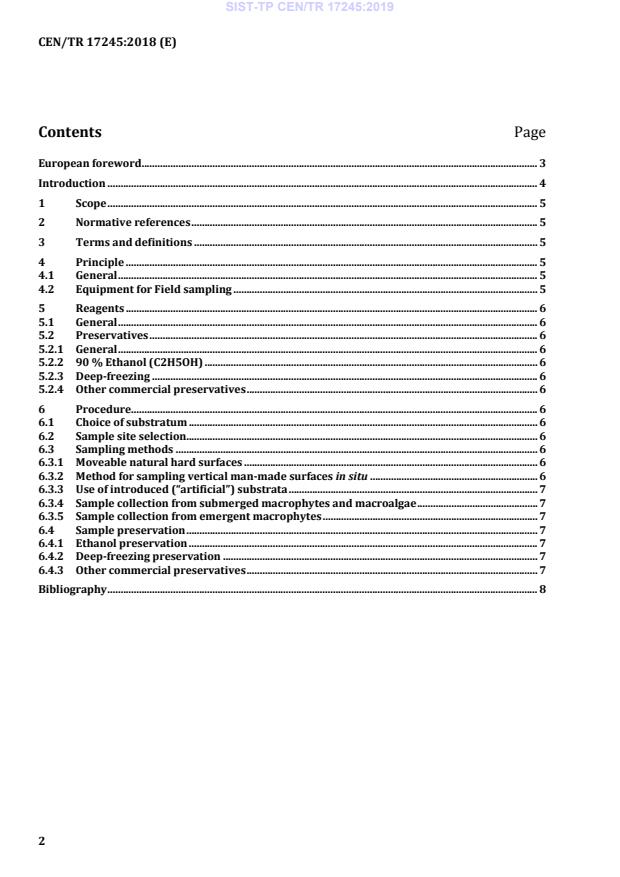
Contents Page
European foreword . 3
Introduction . 4
1 Scope . 5
2 Normative references . 5
3 Terms and definitions . 5
4 Principle . 5
4.1 General . 5
4.2 Equipment for Field sampling . 5
5 Reagents . 6
5.1 General . 6
5.2 Preservatives . 6
5.2.1 General . 6
5.2.2 90 % Ethanol (C2H5OH) . 6
5.2.3 Deep-freezing . 6
5.2.4 Other commercial preservatives . 6
6 Procedure. 6
6.1 Choice of substratum . 6
6.2 Sample site selection . 6
6.3 Sampling methods . 6
6.3.1 Moveable natural hard surfaces . 6
6.3.2 Method for sampling vertical man-made surfaces in situ . 6
6.3.3 Use of introduced (“artificial”) substrata . 7
6.3.4 Sample collection from submerged macrophytes and macroalgae . 7
6.3.5 Sample collection from emergent macrophytes . 7
6.4 Sample preservation . 7
6.4.1 Ethanol preservation . 7
6.4.2 Deep-freezing preservation . 7
6.4.3 Other commercial preservatives . 7
Bibliography . 8
European foreword
This document (CEN/TR 17245:2018) has been prepared by Technical Committee CEN/TC 230 “Water
analysis”, the secretariat of which is held by DIN.
Attention is drawn to the possibility that some of the elements of this document may be the subject of
patent rights. CEN shall not be held responsible for identifying any or all such patent rights.
Introduction
WARNING — Persons using this document should be familiar with normal laboratory practice. This
technical report does not purport to address all of the safety problems, if any, associated with its use. It
is the responsibility of the user to establish appropriate health and safety practices and to ensure
compliance with any national regulatory conditions.
Diatoms are unicellular microalgae present in all types of water bodies. They are an important
component of aquatic ecosystems and have been used widely for ecological assessment required by the
Water Framework Directive (2000/60/EC) and Urban Waste Water Treatment Directive (91/217/EEC)
in addition to other EU Directives and international agreements. The use of diatoms as indicators of
river and lake quality is based on observations that diatom taxa have distinct preferences for particular
environmental conditions such as nutrients, organic pollution and acidity. Polluted waters will tend to
support higher proportions of those taxa whose optima correspond with the levels of the pollutant in
question. Conversely, certain species are intolerant of elevated levels of one or more pollutants, whilst
others may occur in a wide range of water qualities.
Methods using diatoms to assess water quality and ecological status based on optical microscopy have
been developed in several European countries. Methods for sampling and preparation are similar [6],
[7] leading to the development of European Standards which, in turn, facilitated the harmonization of
ecological assessment approaches [2], [3]. More r
...