


EN 12184:2009
(Main)Electrically powered wheelchairs, scooters and their chargers - Requirements and test methods
Electrically powered wheelchairs, scooters and their chargers - Requirements and test methods
This European Standard specifies requirements and test methods for electrically powered wheelchairs with a maximum speed not exceeding 15 km/h intended to carry one person of mass not greater than 100 kg, which includes:
manual wheelchairs with add-on power kits used for propulsion,
electrically powered wheelchairs, and
electrically powered scooters with three or more wheels.
It also specifies requirements and test methods for battery chargers for wheelchairs and scooters.
This European Standard does not apply in total to:
- wheelchairs intended for special purposes, such as sports,
- custom made wheelchairs,
- handrim activated power assisted wheelchairs and
- powered office chairs.
NOTE 1 The application of this standard is limited to wheelchairs with a maximum occupant mass of 100 kg because the maximum mass of dummy specified in ISO 7176-11:1992 is 100 kg. Annex A (informative) provides guidance for construction of dummies of mass 125 kg and 150 kg. At the time of publication, a new edition of ISO 7176-11 was under development, including test dummies with masses above 100 kg.
NOTE 2 Requirements for manually propelled wheelchairs are specified in EN 12183.
Elektrorollstühle und -mobile und zugehörige Ladegeräte - Anforderungen und Prüfverfahren
Diese Europäische Norm legt Anforderungen und Prüfverfahren für Elektrorollstühle mit einer Höchstgeschwindigkeit
von 15 km/h fest, die für die Beförderung einer Person mit einem Höchstgewicht von 100 kg
bestimmt sind, einschließlich:
- Rollstühlen mit Muskelkraftantrieb und zusätzlich angebauten Antriebseinheiten;
- Elektrorollstühlen; und
- Elektromobilen mit drei oder mehr Rädern.
Sie legt auch Anforderungen und Prüfverfahren für Batterieladegeräte für Rollstühle und Elektromobile fest.
Die vorliegende Europäische Norm gilt nicht vollständig für:
- Rollstühle für besondere Zwecke, wie für die Verwendung beim Sport;
- kundenspezifisch angefertigte Rollstühle;
- mit Greifreifen betätigte Rollstühle mit elektrischer Zusatzeinrichtung; und
- Bürostühle mit Motorantrieb.
ANMERKUNG 1 Die Anwendung dieser Norm ist auf Rollstühle für Personen mit einem Höchstgewicht von 100 kg
begrenzt, da das Höchstgewicht der Prüfpuppe nach ISO 7176-11:1992 100 kg beträgt. Anhang A (informativ) enthält Leitlinien
für die Konstruktion von Prüfpuppen mit Massen von 125 kg bzw. 150 kg. Zum Zeitpunkt der Veröffentlichung
befand sich eine neue Ausgabe der ISO 7176-11 in Arbeit, die Prüfpuppen mit einem Gewicht über 100 kg einschließt.
ANMERKUNG 2 Die Anforderungen an Rollstühle mit Muskelkraftantrieb sind in EN 12183 festgelegt.
Fauteuils roulants électriques, scooters et leurs chargeurs - Exigences et méthodes d'essai
La présente Norme européenne spécifie les exigences et les méthodes d'essai relatives aux fauteuils roulants électriques dont la vitesse maximale ne dépasse pas 15 km/h et prévus pour accueillir une personne dont le poids n'excède pas 100 kg, à savoir :
- les fauteuils roulants à propulsion manuelle équipés de kits de motorisation utilisés pour la propulsion ;
- les fauteuils roulants électriques ; et
- les scooters électriques à trois roues ou plus.
Elle spécifie également les exigences et méthodes d'essais pour les chargeurs de batterie pour les fauteuils roulants et les scooters.
La présente Norme européenne ne s'applique pas en totalité aux :
- fauteuils roulants prévus pour des usages spéciaux, tels que le sport ;
- fauteuils sur mesure ;
- fauteuils roulants à propulsion manuelle munis d’un équipement électrique auxiliaire ; et
- fauteuils de bureau motorisés.
NOTE 1 L'application de la présente Norme européenne se limite aux fauteuils roulants dont le poids maximal de l'utilisateur est de 100 kg car le poids maximal du mannequin spécifié dans l'ISO 7176-11:1992 est de 100 kg. L'Annexe A (informative) donne des indications pour la construction de mannequins ayant un poids de 125 kg et 150 kg. Au moment de la publication de la présente Norme européenne, une nouvelle édition de l'ISO 7176-11 incluant des mannequins d'essai pesant plus de 100 kg était en préparation.
NOTE 2 Les exigences pour les fauteuils roulants à propulsion manuelle sont spécifiées dans l'EN 12183.
Invalidski vozički na električni pogon, skuterji in njihovi polnilniki - Zahteve in preskusne metode
Ta evropski standard določa zahteve in preskusne metode za invalidske vozičke na električni pogon z največjo hitrostjo, ki ne presega 15 km/h, namenjene prevažanju osebe s težo, ki ne presega 100 kg, in vključuje: - invalidske vozičke z ročnim upravljanjem z dodatnimi pogonskimi kompleti za pogon, - invalidske vozičke na električni pogon in – skuterje na električni pogon s tremi kolesi ali več. Določa tudi zahteve in preskusne metode za polnilnike baterij za invalidske vozičke in skuterje. Ta evropski standard ne velja v celoti za: - invalidske vozičke za posebne namene, kot je športni voziček; - po meri narejene invalidske vozičke; - invalidske vozičke s pogonom na pogonski obroč in pomožno silo in – gnane pisarniške stole.
General Information
- Status
- Withdrawn
- Publication Date
- 29-Sep-2009
- Withdrawal Date
- 25-Mar-2014
- Technical Committee
- CEN/TC 293 - Technical aids for disabled persons
- Drafting Committee
- CEN/TC 293/WG 9 - Wheelchairs - Revision of EN 12183 and EN 12184
- Current Stage
- 9960 - Withdrawal effective - Withdrawal
- Start Date
- 26-Mar-2014
- Completion Date
- 26-Mar-2014
- Directive
- 93/42/EEC - Medical devices
Relations
- Effective Date
- 08-Jun-2022
- Effective Date
- 12-Sep-2009
- Effective Date
- 09-Feb-2026
- Effective Date
- 09-Feb-2026
- Effective Date
- 09-Feb-2026
- Effective Date
- 09-Feb-2026
- Effective Date
- 09-Feb-2026
- Effective Date
- 09-Feb-2026
- Effective Date
- 09-Feb-2026
- Refers
EN ISO 21856:2022 - Assistive products - General requirements and test methods (ISO 21856:2022) - Effective Date
- 28-Jan-2026
- Effective Date
- 28-Jan-2026
- Effective Date
- 28-Jan-2026
- Effective Date
- 28-Jan-2026
- Effective Date
- 28-Jan-2026
- Effective Date
- 28-Jan-2026



Get Certified
Connect with accredited certification bodies for this standard

BSI Group
BSI (British Standards Institution) is the business standards company that helps organizations make excellence a habit.

TÜV Rheinland
TÜV Rheinland is a leading international provider of technical services.

TÜV SÜD
TÜV SÜD is a trusted partner of choice for safety, security and sustainability solutions.
Sponsored listings
Frequently Asked Questions
EN 12184:2009 is a standard published by the European Committee for Standardization (CEN). Its full title is "Electrically powered wheelchairs, scooters and their chargers - Requirements and test methods". This standard covers: This European Standard specifies requirements and test methods for electrically powered wheelchairs with a maximum speed not exceeding 15 km/h intended to carry one person of mass not greater than 100 kg, which includes: manual wheelchairs with add-on power kits used for propulsion, electrically powered wheelchairs, and electrically powered scooters with three or more wheels. It also specifies requirements and test methods for battery chargers for wheelchairs and scooters. This European Standard does not apply in total to: - wheelchairs intended for special purposes, such as sports, - custom made wheelchairs, - handrim activated power assisted wheelchairs and - powered office chairs. NOTE 1 The application of this standard is limited to wheelchairs with a maximum occupant mass of 100 kg because the maximum mass of dummy specified in ISO 7176-11:1992 is 100 kg. Annex A (informative) provides guidance for construction of dummies of mass 125 kg and 150 kg. At the time of publication, a new edition of ISO 7176-11 was under development, including test dummies with masses above 100 kg. NOTE 2 Requirements for manually propelled wheelchairs are specified in EN 12183.
This European Standard specifies requirements and test methods for electrically powered wheelchairs with a maximum speed not exceeding 15 km/h intended to carry one person of mass not greater than 100 kg, which includes: manual wheelchairs with add-on power kits used for propulsion, electrically powered wheelchairs, and electrically powered scooters with three or more wheels. It also specifies requirements and test methods for battery chargers for wheelchairs and scooters. This European Standard does not apply in total to: - wheelchairs intended for special purposes, such as sports, - custom made wheelchairs, - handrim activated power assisted wheelchairs and - powered office chairs. NOTE 1 The application of this standard is limited to wheelchairs with a maximum occupant mass of 100 kg because the maximum mass of dummy specified in ISO 7176-11:1992 is 100 kg. Annex A (informative) provides guidance for construction of dummies of mass 125 kg and 150 kg. At the time of publication, a new edition of ISO 7176-11 was under development, including test dummies with masses above 100 kg. NOTE 2 Requirements for manually propelled wheelchairs are specified in EN 12183.
EN 12184:2009 is classified under the following ICS (International Classification for Standards) categories: 11.180.10 - Aids and adaptation for moving. The ICS classification helps identify the subject area and facilitates finding related standards.
EN 12184:2009 has the following relationships with other standards: It is inter standard links to EN 12184:2006, EN 12184:2014, EN 61000-3-2:2006, EN 50272-3:2002, ISO 7176-10:2008, EN 60601-1:2006, EN 60335-1:2002, EN 60529:1991, ISO 7176-26:2007, EN ISO 21856:2022, EN 500-6:2006, EN 4641-105:2010, EN ISO 10321:2008, EN 1021-1:2006, EN 1212:2005. Understanding these relationships helps ensure you are using the most current and applicable version of the standard.
EN 12184:2009 is associated with the following European legislation: EU Directives/Regulations: 2007/47/EC, 2008/57/EC, 93/42/EEC; Standardization Mandates: M/275, M/295, M/334. When a standard is cited in the Official Journal of the European Union, products manufactured in conformity with it benefit from a presumption of conformity with the essential requirements of the corresponding EU directive or regulation.
EN 12184:2009 is available in PDF format for immediate download after purchase. The document can be added to your cart and obtained through the secure checkout process. Digital delivery ensures instant access to the complete standard document.
Standards Content (Sample)
2003-01.Slovenski inštitut za standardizacijo. Razmnoževanje celote ali delov tega standarda ni dovoljeno.Elektrorollstühle und -mobile und zugehörige Ladegeräte - Anforderungen und PrüfverfahrenFauteuils roulants électriques, scooters et leurs chargeurs - Exigences et méthodes d'essaiElectrically powered wheelchairs, scooters and their chargers - Requirements and test methods11.180.10JLEDQMHAids and adaptation for movingICS:Ta slovenski standard je istoveten z:EN 12184:2009SIST EN 12184:2010en,fr,de01-januar-2010SIST EN 12184:2010SLOVENSKI
STANDARDSIST EN 12184:20061DGRPHãþD
EUROPEAN STANDARD NORME EUROPÉENNE EUROPÄISCHE NORM
EN 12184
September 2009 ICS 11.180.10 Supersedes EN 12184:2006English Version
Electrically powered wheelchairs, scooters and their chargers - Requirements and test methods
Fauteuils roulants électriques, scooters et leurs chargeurs -Exigences et méthodes d'essai
Elektrorollstühle und -mobile und zugehörige Ladegeräte - Anforderungen und Prüfverfahren This European Standard was approved by CEN on 27 August 2009.
CEN members are bound to comply with the CEN/CENELEC Internal Regulations which stipulate the conditions for giving this European Standard the status of a national standard without any alteration. Up-to-date lists and bibliographical references concerning such national standards may be obtained on application to the CEN Management Centre or to any CEN member.
This European Standard exists in three official versions (English, French, German). A version in any other language made by translation under the responsibility of a CEN member into its own language and notified to the CEN Management Centre has the same status as the official versions.
CEN members are the national standards bodies of Austria, Belgium, Bulgaria, Cyprus, Czech Republic, Denmark, Estonia, Finland, France, Germany, Greece, Hungary, Iceland, Ireland, Italy, Latvia, Lithuania, Luxembourg, Malta, Netherlands, Norway, Poland, Portugal, Romania, Slovakia, Slovenia, Spain, Sweden, Switzerland and United Kingdom.
EUROPEAN COMMITTEE FOR STANDARDIZATION
COMITÉ EUROPÉEN DE NORMALISATION EUROPÄISCHES KOMITEE FÜR NORMUNG
Management Centre:
Avenue Marnix 17,
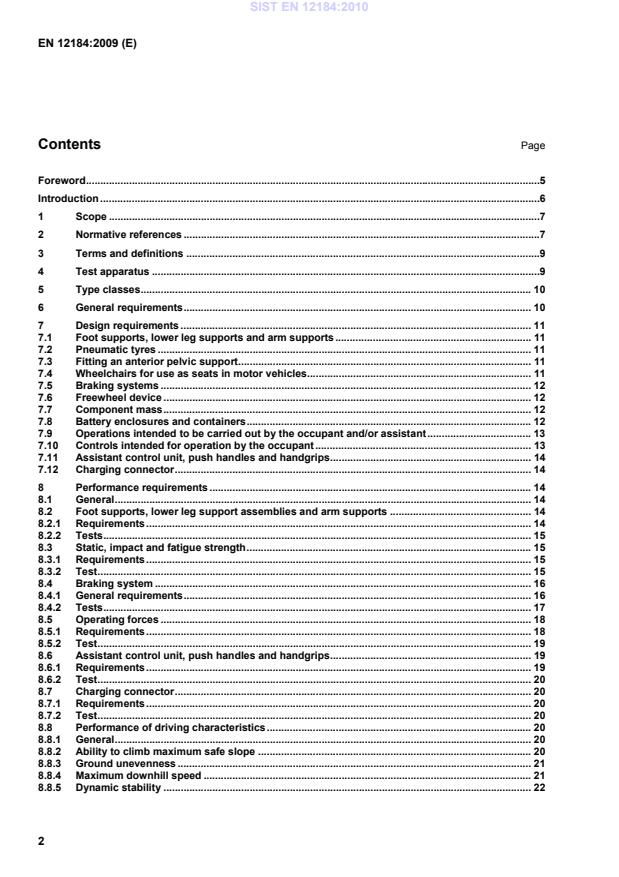
B-1000 Brussels © 2009 CEN All rights of exploitation in any form and by any means reserved worldwide for CEN national Members. Ref. No. EN 12184:2009: ESIST EN 12184:2010
Recommendations for test dummies of mass greater than 100 kg . 36A.1General . 36A.2Construction . 36A.3Accelerometer mounting . 36A.4Design aims . 37Annex B (informative)
Recommendations for dimensions and manoeuvring space of electrically powered wheelchairs . 45B.1Specific dimensions . 45B.1.1Dimensions when ready for use . 45B.1.2Push handle height . 45B.1.3Ground clearance . 45B.2Manoeuvring space . 45B.2.1Turning diameter . 45B.2.2Reversing width . 45B.3Speed settings . 45Annex C (informative)
Recommended design features . 47C.1Introduction . 47C.2General recommendations . 47C.2.1Anti-tip devices . 47C.2.2Component mass . 47C.2.3Fittings and tools . 47C.2.4Tyres . 47SIST EN 12184:2010
Recommended seating design . 50Annex E (informative)
Manoeuvring forces . 51E.1Recommendations . 51E.1.1Push handle force . 51E.1.2Handrim force . 51E.2Manoeuvring test for handrim-activated power-assisted wheelchairs . 51Annex F (informative)
Technical changes from previous editions of EN 12184 . 52F.1Technical changes between the first (1999) and second (2006) editions . 52F.2Technical changes from the second (2006) edition . 53Annex ZA (informative)
Relationship between this European Standard and the Essential Requirements of Council Directive 93/42/EEC of 14 June 1993 concerning medical devices . 55Bibliography . 59 SIST EN 12184:2010
1 Scope This European Standard specifies requirements and test methods for electrically powered wheelchairs with a maximum speed not exceeding 15 km/h intended to carry one person of mass not greater than 100 kg, which includes: manual wheelchairs with add-on power kits used for propulsion, electrically powered wheelchairs, and electrically powered scooters with three or more wheels. It also specifies requirements and test methods for battery chargers for wheelchairs and scooters. This European Standard does not apply in total to: wheelchairs intended for special purposes, such as sports, custom-made wheelchairs, handrim activated power assisted wheelchairs and powered office chairs. NOTE 1 The application of this standard is limited to wheelchairs with a maximum occupant mass of 100 kg because the maximum mass of dummy specified in ISO 7176-11:1992 is 100 kg. Annex A (informative) provides guidance for construction of dummies of mass 125 kg and 150 kg. At the time of publication, a new edition of ISO 7176-11 was under development, including test dummies with masses above 100 kg. NOTE 2 Requirements for manually propelled wheelchairs are specified in EN 12183. 2 Normative references The following referenced documents are indispensable for the application of this document. For dated references, only the edition cited applies. For undated references, the latest edition of the referenced document (including any amendments) applies. EN 1021-1:2006, Furniture — Assessment of the ignitability of upholstered furniture — Part 1: Ignition source smouldering cigarette EN 1021-2:2006, Furniture — Assessment of the ignitability of upholstered furniture — Part 2: Ignition source match flame equivalent EN 12182, Technical aids for disabled persons — General requirements and test methods EN 50272-3:2002, Safety requirements for secondary batteries and battery installations — Part 3: Traction batteries EN 60335-1:2002, Household and similar electrical appliances — Safety — Part 1: General requirements (IEC 60335-1:2001, modified) EN 60529:1991, Degrees of protection provided by enclosures (IP code) (IEC 60529:1989) SIST EN 12184:2010
(ISO 14971:2007, Corrected version 2007-10-01) ISO 7176-1:1999, Wheelchairs — Part 1: Determination of static stability ISO 7176-2:2001, Wheelchairs — Part 2: Determination of dynamic stability of electric wheelchairs ISO 7176-3:2003, Wheelchairs — Part 3: Determination of effectiveness of brakes ISO 7176-4:2008, Wheelchairs — Part 4: Energy consumption of electric wheelchairs and scooters for determination of theoretical distance range ISO 7176-6:2001, Wheelchairs — Part 6: Determination of maximum speed, acceleration and deceleration of electric wheelchairs ISO 7176-8:1998, Wheelchairs — Part 8: Requirements and test methods for static, impact and fatigue strengths ISO 7176-9:2001, Wheelchairs — Part 9: Climatic test for electric wheelchairs ISO 7176-10:2008, Wheelchairs — Part 10: Determination of obstacle-climbing ability of electrically powered wheelchairs ISO 7176-11:1992, Wheelchairs — Part 11: Test dummies ISO 7176-13:1989, Wheelchairs — Part 13: Determination of coefficient of friction of test surfaces ISO 7176-14:1997, Wheelchairs — Part 14: Power and control systems for electric wheelchairs — Requirements and test methods NOTE ISO 7176-14:1997 is used only for requirements and test methods for battery chargers. ISO 7176-14:2008, Wheelchairs — Part 14: Power and control systems for electrically powered wheelchairs and scooters — Requirements and test methods ISO 7176-15:1996, Wheelchairs — Part 15: Requirements for information disclosure, documentation and labelling ISO 7176-19:2001, Wheelchairs — Part 19: Wheeled mobility devices for use in motor vehicles ISO 7176-21:2003, Wheelchairs — Part 21: Requirements and test methods for electromagnetic compatibility of electrically powered wheelchairs and motorized scooters ISO 7176-22:2000, Wheelchairs — Part 22: Set-up procedures ISO 7176-26:2007, Wheelchairs — Part 26: Vocabulary ISO 10542-5:2004, Technical systems and aids for disabled or handicapped persons — Wheelchair tiedown and occupant-restraint systems — Part 5: Systems for specific wheelchairs SIST EN 12184:2010
NOTE 1 Definition is adapted from the definition given in the Global Medical Devices Nomenclature (GMDN). NOTE 2 A disabled occupant is a disabled person or a person not having the full capacity to walk unaided. NOTE 3 The definition includes scooters. 4 Test apparatus 4.1 Adjustable test plane, a flat, rigid plane having an adjustable slope, with a coefficient of friction as specified in ISO 7176-13:1989, of sufficient size to accommodate the wheelchair during the tests specified in 8.4 and 8.8, and such that the whole surface lies between two imaginary parallel planes 5 mm apart per
1 000 mm of extension in any direction and 25 mm apart per 6 000 mm of extension in any direction. 4.2 Horizontal test plane, a flat, rigid plane with a coefficient of friction as specified in ISO 7176-13:1989, of sufficient size to accommodate the wheelchair under test, and such that the whole surface lies between two imaginary horizontal planes 5 mm apart per 1 000 mm of extension in any direction and 25 mm apart per 6 000 mm of extension in any direction. SIST EN 12184:2010
NOTE Annex A gives guidance on construction of dummies with masses larger than those specified in
ISO 7176-11:1992. 4.10 Means to measure torque with an accuracy of ± 2 % in the range of 0,5 Nm to 10 Nm. 4.11 Means to measure angles to an accuracy of ± 0,1°. 4.12 Means to move a brake lever smoothly for 60 000 cycles at a frequency of not more than 0,5 Hz. 4.13 Means to measure elapsed time in the range 0 to 30 s with an accuracy of ± 1 s. 5 Type classes Wheelchairs shall be classified in one or more of the following three classes, dependent upon their intended use: Class A - compact, manoeuvrable wheelchairs not necessarily capable of negotiating outdoor obstacles; Class B - wheelchairs sufficiently compact and manoeuvrable for some indoor environments and capable of negotiating some outdoor obstacles; Class C - wheelchairs, usually large in size, not necessarily intended for indoor use but capable of travelling over longer distances and negotiating outdoor obstacles. NOTE Scooters are included within the classes above. 6 General requirements The wheelchair shall conform to the requirements specified in EN 12182 for the following: intended performance and technical documentation; aids that can be dismantled; single-use fasteners; SIST EN 12184:2010
ISO 7176-19:2001 with the exception of the horizontal excursion limits and the selection of the Anthropomorphic Test Device (ATD). The horizontal excursion limits specified in Table 1 of ISO 10542-5:2004 and the ATD selection specified in Table A.1 of ISO 10542-5:2004 shall apply. SIST EN 12184:2010
Wheelchairs shall be designed to facilitate ease of operation by the occupant and/or assistant as specified in the manufacturer’s instructions and meet the performance requirements of 8.2.1, 8.5, 8.6.1, 8.7.1, 8.9, 8.12.1, 9.2 and 9.3. In addition, brake levers shall meet the applicable requirements of 8.4.1. Examples include: operation of adjustable seating, use of detachable components, including removable arm supports, lower leg supports etc., to facilitate safe transfers into and out of the wheelchair, use of folding mechanisms, including folding frames etc., to facilitate storage and transportation of unoccupied wheelchairs, carrying out maintenance, including use of tools etc., use of manual steering controls, use of braking systems and freewheel devices, use of assistant controls, use of control devices. 7.10 Controls intended for operation by the occupant Controls intended to be operated by the occupant while seated shall be within the occupant reach as shown in Figure 2. The following controls, if fitted, are included: on/off switch or key, speed regulator, speed pre-setting, running brake, parking brake, audible warning device, direction indicator, direction switch, SIST EN 12184:2010
g is the acceleration due to gravity, 9,81 m/s². b) Apply the force for 5 s to 10 s. c) While the force is being applied measure the shortest distance between the foot supports. d) Record whether the foot supports met the requirements. 8.3 Static, impact and fatigue strength 8.3.1 Requirements The wheelchair shall conform to the requirements of ISO 7176-8:1998 with the exception that wheelchairs of Class A are not required to be tested as specified in 10.5 (drop test) of ISO 7176-8:1998. Arm supports and back supports shall conform to the static loading requirements of ISO 7176-8:1998 in all intended operating positions with the exception of the upward force on a push handle which shall be 880 N. NOTE The upward force is a correction of the value for upward force on push handles stated in Table 8 of
ISO 7176-8:1998. 8.3.2 Test Test the wheelchair in accordance with ISO 7176-8:1998. SIST EN 12184:2010
The maximum stopping distances of Table 2 do not apply when the wheelchair is in the freewheel mode. include an automatic brake, which operates independently of tyre wear and tyre inflation pressure and is operated by releasing the control device to achieve a zero speed command (e.g. spring loaded disc brake); include a parking brake which operates independently of tyre wear and tyre inflation pressure (e.g. drum brake in wheels, spring loaded disc) that shall 1) be operable when there is no power from the battery supplying the drive system,
2) be operable when the wheelchair is in freewheel mode, 3) meet the parking brake effectiveness requirement in Table 1 when tested according to 8.4.2.3 and, after testing a
...
Questions, Comments and Discussion
Ask us and Technical Secretary will try to provide an answer. You can facilitate discussion about the standard in here.
Loading comments...