

prEN 12350-1
(Main)Testing fresh concrete - Part 1: Sampling and common apparatus
- Abstract
This document specifies two procedures for sampling fresh concrete, by composite sampling and by spot sampling.
NOTE 1 The requirement for remixing the sample before tests on the fresh concrete, or before making test specimens, is included in the relevant standards.
When mixing and sampling concrete is done in a laboratory, different procedures may be required.
NOTE 2 In this case Clause 6, item g) applies.
Additionally, this standard lists common apparatus mentioned in two or more standards of EN 12350 series and EN 12390-2.
- Status
- Not Published
- Publication Date
- 10-Oct-2027
- Technical Committee
- CEN/TC 104 - Concrete ( performance, production, placing and compliance criteria )
- Drafting Committee
- CEN/TC 104/SC 1 - Revision of ENV 206
- Current Stage
- 4020 - Submission to enquiry - Enquiry
- Start Date
- 22-Oct-2026
- Due Date
- 14-Aug-2026
- Completion Date
- 22-Oct-2026

prEN 12350-1 is a CEN draft European Standard for testing fresh concrete. It specifies two sampling procedures - composite sampling and spot sampling - and lists common apparatus used across the EN 12350 series and EN 12390-2. It is written for people who take, test, or document fresh-concrete samples in production, site, or laboratory work.
What does prEN 12350-1 specify?
prEN 12350-1 specifies how to sample fresh concrete and how to equip the sampling and testing work. The document is organized into Scope, Normative references, Terms and definitions, Apparatus, Sampling, and Report of sampling.
The scope covers two sampling procedures:
- composite sampling, where several increments are combined and mixed
- spot sampling, where concrete is taken from a specific part of a batch or mass
prEN 12350-1 also lists common apparatus mentioned in two or more standards of the EN 12350 series and EN 12390-2. That matters because it gives a common equipment basis for fresh-concrete testing and for making strength-test specimens.
What are the key requirements of prEN 12350-1?
prEN 12350-1 gives the practical rules for choosing the sample type, taking the sample, handling it, and recording it. The main point is that the sample must represent the concrete in the condition needed for the intended test.
Sampling plan
Clause 5.1 requires the user to decide whether a spot sample or a composite sample is needed. prEN 12350-1 also requires taking at least 1.5 times the quantity estimated for the tests, and more when consistence retention testing is required. In practice, this avoids running short of material after the sample has been divided between tests or containers.
Composite sampling
Clause 5.2 requires clean apparatus and increments taken uniformly through the batch. When sampling from a stationary batch mixer or a ready-mixed concrete truck, the first and last parts of the load are disregarded. When sampling from a heap, the increments should be taken through the depth and over the surface at a minimum of five places; when sampling from a falling stream, the increments should represent the full width and thickness of the stream.
Spot sampling
Clause 5.3 uses the same basic handling rules, but the increments come from the required part of the batch or mass. This is the procedure to use when the test relates to a particular portion of concrete rather than the whole batch.
Temperature and handling
Clause 5.4 requires temperature measurement, when needed, after 30 s but no longer than 60 s after inserting the thermometer, at about 50 mm depth. Clause 5.5 requires protection against contamination, water loss or gain, and extreme temperature changes. For a reader, that means the sample has to be treated as a time-sensitive material, not as a static specimen.
Apparatus and measurement quality
Clause 4 specifies the common apparatus, including scoop, thermometer, container, remixing container or tray, sealed container, hollow cone, compacting means, rule, measuring tape, balance, and timer. Several items have stated size or uncertainty requirements, such as the thermometer and balance. In practice, the equipment has to meet these specifications before the sampling method is considered compliant.
Sampling report
Clause 6 requires a report with the standard reference, sample identification, sampling location, date and time, sample type, deviations from the method, and a declaration by the responsible person. That gives traceability if test results are later questioned.
What terms does prEN 12350-1 define?
prEN 12350-1 defines the terms used to describe the concrete being sampled and the way the sample is taken.
- Batch - the quantity of fresh concrete mixed in one cycle of a batch mixer, discharged during 1 min from a continuous mixer, or conveyed ready-mixed in a truck mixer under the stated conditions.
- Composite sample - a quantity of concrete made from several increments distributed through a batch or mass and thoroughly mixed together.
- Spot sample - a quantity of concrete taken from a particular part of a batch or mass, made up of one or more increments thoroughly mixed together.
- Increment - the quantity of concrete taken by one operation of a scoop or similar sampling device.
Who uses prEN 12350-1?
prEN 12350-1 is used by concrete testing laboratories, ready-mixed concrete producers, site quality control staff, and others who need representative fresh-concrete samples. It is also relevant when making test specimens for strength tests and when checking temperature or consistence retention.
In practice, these users apply the document when:
- taking samples from mixers, trucks, heaps, or falling streams
- preparing material for fresh-concrete tests
- documenting the origin and time of sampling
- handling samples so the test result reflects the concrete as delivered or as required for the test
What changed in prEN 12350-1 from the previous edition?
prEN 12350-1 will supersede EN 12350-1:2019. The foreword states two significant technical changes: editorial revisions and harmonization of maximum instrumental measurement uncertainty for the same mass across the EN 12350 series.
What does the prEN 12350-1 document contain?
prEN 12350-1 contains detailed apparatus descriptions and step-by-step sampling procedures rather than calculation formulas or worked examples. Clause 4 specifies the equipment used for sampling and related fresh-concrete tests, including the hollow cone and the compacting means.
Clause 5 sets out how to plan the sample, take composite or spot samples, measure temperature, and protect the concrete during transport and handling. Clause 6 provides the reporting checklist needed for traceability.
Relations
- Effective Date
- 28-Jan-2026
- Effective Date
- 12-Nov-2025
Get Certified
Connect with accredited certification bodies for this standard

DIBt (Deutsches Institut für Bautechnik)
German Institute for Building Technology.

DIN CERTCO
DIN Group product certification.

Aboma Certification B.V.
Specialized in construction, metal, and transport sectors.
Sponsored listings
Frequently Asked Questions
prEN 12350-1 is a draft published by the European Committee for Standardization (CEN). Its full title is "Testing fresh concrete - Part 1: Sampling and common apparatus". This standard covers: This document specifies two procedures for sampling fresh concrete, by composite sampling and by spot sampling. NOTE 1 The requirement for remixing the sample before tests on the fresh concrete, or before making test specimens, is included in the relevant standards. When mixing and sampling concrete is done in a laboratory, different procedures may be required. NOTE 2 In this case Clause 6, item g) applies. Additionally, this standard lists common apparatus mentioned in two or more standards of EN 12350 series and EN 12390-2.
This document specifies two procedures for sampling fresh concrete, by composite sampling and by spot sampling. NOTE 1 The requirement for remixing the sample before tests on the fresh concrete, or before making test specimens, is included in the relevant standards. When mixing and sampling concrete is done in a laboratory, different procedures may be required. NOTE 2 In this case Clause 6, item g) applies. Additionally, this standard lists common apparatus mentioned in two or more standards of EN 12350 series and EN 12390-2.
prEN 12350-1 is classified under the following ICS (International Classification for Standards) categories: 91.100.30 - Concrete and concrete products. The ICS classification helps identify the subject area and facilitates finding related standards.
prEN 12350-1 has the following relationships with other standards: It is inter standard links to EN ISO 14555:2025, EN 12350-1:2019. Understanding these relationships helps ensure you are using the most current and applicable version of the standard.
prEN 12350-1 is available in PDF format for immediate download after purchase. The document can be added to your cart and obtained through the secure checkout process. Digital delivery ensures instant access to the complete standard document.
Standards Content (Sample)
SLOVENSKI STANDARD
01-december-2026
Preskušanje svežega betona - 1. del: Vzorčenje in naprave za preskušanje
Testing fresh concrete - Part 1: Sampling and common apparatus
Prüfung von Frischbeton - Teil 1: Probenahme und Prüfgeräte
Essais pour béton frais - Partie 1 : Prélèvement et appareillage commun
Ta slovenski standard je istoveten z: prEN 12350-1
ICS:
91.100.30 Beton in betonski izdelki Concrete and concrete
products
2003-01.Slovenski inštitut za standardizacijo. Razmnoževanje celote ali delov tega standarda ni dovoljeno.
DRAFT
EUROPEAN STANDARD
NORME EUROPÉENNE
EUROPÄISCHE NORM
October 2026
ICS 91.100.30 Will supersede EN 12350-1:2019
English Version
Testing fresh concrete - Part 1: Sampling and common
apparatus
Essais pour béton frais - Partie 1 : Prélèvement et Prüfung von Frischbeton - Teil 1: Probenahme und
appareillage commun Prüfgeräte
This draft European Standard is submitted to CEN members for enquiry. It has been drawn up by the Technical Committee
CEN/TC 104.
If this draft becomes a European Standard, CEN members are bound to comply with the CEN/CENELEC Internal Regulations
which stipulate the conditions for giving this European Standard the status of a national standard without any alteration.
This draft European Standard was established by CEN in three official versions (English, French, German). A version in any other
language made by translation under the responsibility of a CEN member into its own language and notified to the CEN-CENELEC
Management Centre has the same status as the official versions.
CEN members are the national standards bodies of Austria, Belgium, Bulgaria, Croatia, Cyprus, Czech Republic, Denmark,
Estonia, Finland, France, Germany, Greece, Hungary, Iceland, Ireland, Italy, Latvia, Lithuania, Luxembourg, Malta, Netherlands,
Norway, Poland, Portugal, Republic of North Macedonia, Romania, Serbia, Slovakia, Slovenia, Spain, Sweden, Switzerland, Türkiye
and United Kingdom.
Recipients of this draft are invited to submit, with their comments, notification of any relevant patent rights of which they are
aware and to provide supporting documentation.
Warning : This document is not a European Standard. It is distributed for review and comments. It is subject to change without
notice and shall not be referred to as a European Standard.
EUROPEAN COMMITTEE FOR STANDARDIZATION
C O M I T É E U R O P É E N D E N O R M A L I S A T I O N
E U R O P Ä I S C H E S K O M I T E E F Ü R N O R M U N G
CEN-CENELEC Management Centre: Rue de la Science 23, B-1040 Brussels
© 2026 CEN All rights of exploitation in any form and by any means reserved Ref. No. prEN 12350-1:2026 E
worldwide for CEN national Members.
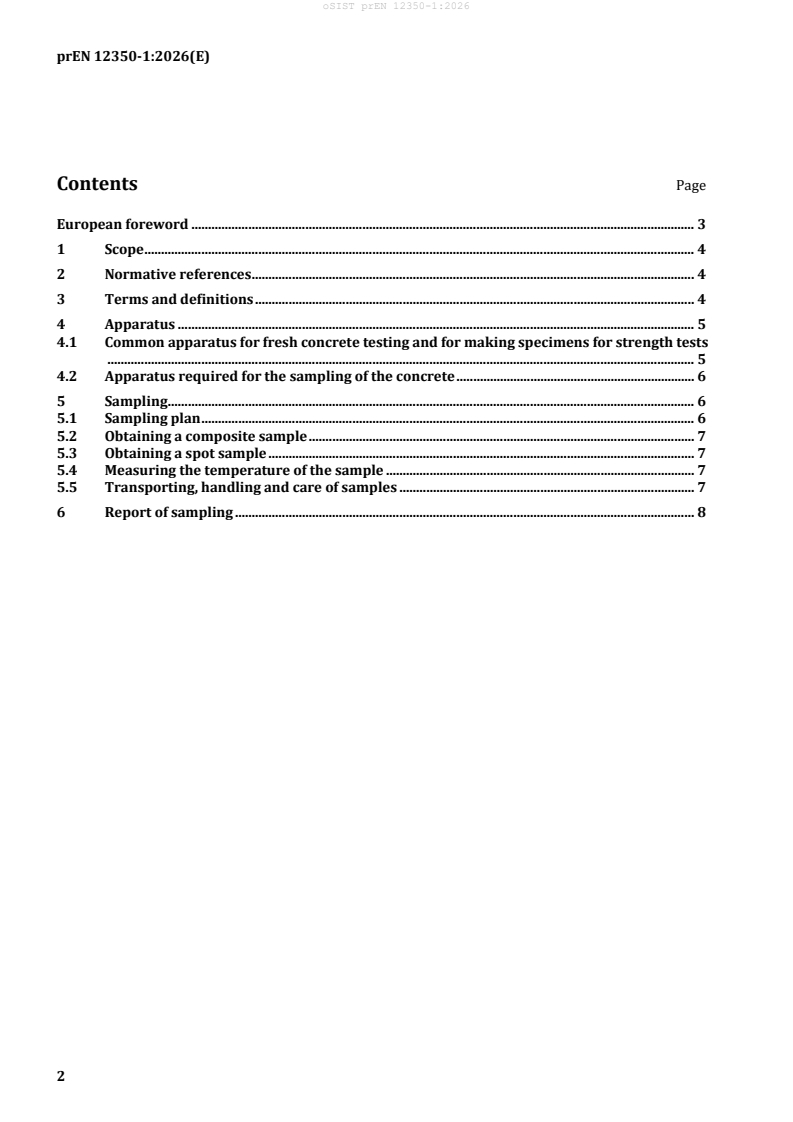
Contents Page
European foreword . 3
1 Scope . 4
2 Normative references . 4
3 Terms and definitions . 4
4 Apparatus . 5
4.1 Common apparatus for fresh concrete testing and for making specimens for strength tests
............................................................................................................................................................................... 5
4.2 Apparatus required for the sampling of the concrete . 6
5 Sampling . 6
5.1 Sampling plan . 6
5.2 Obtaining a composite sample . 7
5.3 Obtaining a spot sample . 7
5.4 Measuring the temperature of the sample . 7
5.5 Transporting, handling and care of samples . 7
6 Report of sampling . 8
European foreword
This document (prEN 12350-1:2026) has been prepared by Technical Committee CEN/TC 104 “Concrete
and related products”, the secretariat of which is held by SN.
This document is currently submitted to the CEN Enquiry.
This document will supersede EN 12350-1:2019.
EN 12350-1:2026 includes the following significant technical changes with respect to EN 12350-1:2019:
a) editorial revisions;
b) homogenization of maximum instrumental measurement uncertainty (EN 12350 series) for same
mass;
This document is one of a series on testing concrete.
EN 12350, Testing fresh concrete, consists in the following parts:
— Part 1: Sampling and common apparatus
— Part 2: Slump test
— Part 3: Vebe test
— Part 4: Degree of compactability
— Part 5: Flow table test
— Part 6: Density
— Part 7: Air content – Pressure methods
— Part 8: Self-compacting concrete – Slump-flow test
— Part 9: Self-compacting concrete – V-funnel test
— Part 10: Self-compacting concrete – L-box test
— Part 11: Self-compacting concrete – Sieve segregation test
— Part 12: Self-compacting concrete – J-ring test
— Part 13: Bleeding test – Static and pressure
— Part 14: Inverted cone flow time
— Part 15: Slump flow velocity
1 Scope
This document specifies two procedures for sampling fresh concrete, by composite sampling and by spot
sampling.
NOTE 1 The requirement for remixing the sample before tests on the fresh concrete, or before making test
specimens, is included in the relevant standards.
When mixing and sampling concrete is done in a laboratory, different procedures may be required.
NOTE 2 In this case Clause 6, item g) applies.
Additionally, this document lists common apparatus mentioned in two or more standards of
EN 12350 series and EN 12390-2.
2 Normative references
There are no normative references in this document.
3 Terms and definitions
For the purposes of this document, the following terms and definitions apply.
ISO and IEC maintain terminology databases for use in standardization at the following addresses:
— ISO Online browsing platform: available at https://www.iso.org/obp/
— IEC Electropedia: available at https://www.electropedia.org/
3.1
batch
quantity of fresh concrete which is:
— mixed in one cycle of operation of a batch mixer;
— discharged during 1 min from a continuous mixer; or
— conveyed ready-mixed in a truck mixer when the load requires more than one cycle of a batch mixer
or more than one minute of operation of a continuous mixer
3.2
composite sample
quantity of concrete consisting of a number of increments distributed through a batch or mass of concrete
thoroughly mixed together
3.3
spot sample
quantity of concrete taken from part of a batch or mass of concrete, consisting of one or more increments
thoroughly mixed together
3.4
increment
quantity of concrete taken by the single operation of a scoop or similar sampling device
4 Apparatus
4.1 Common apparatus for fresh concrete testing and for making specimens for strength
tests
4.1.1 Scoop, approximately 100 mm in width or similar sampling device, made from non-absorbent
material not readily attacked by cement paste, suitable for taking increments of concrete.
4.1.2 Thermometer, to measure the temperature of the fresh concrete with a maxim
...