

EN 12390-20:2026
(Main)Testing hardened concrete - Part 20: Determination of open porosity
- Abstract
This document describes the method for the determination of the open porosity (open pores) of hardened concrete on test specimens manufactured from moulded or cored specimens.
The test is suitable for specimens having a declared value of D of the coarsest fraction of aggregates used in concrete (Dmax) not greater than 40 mm.
The test method is not applicable for concrete containing lightweight aggregate.
- Status
- Published
- Publication Date
- 15-Sep-2026
- Technical Committee
- CEN/TC 104 - Concrete ( performance, production, placing and compliance criteria )
- Drafting Committee
- CEN/TC 104/SC 1 - Revision of ENV 206
- Current Stage
- 6060 - Definitive text made available (DAV) - Publishing
- Start Date
- 16-Sep-2026
- Due Date
- 02-Mar-2026
- Completion Date
- 16-Sep-2026

EN 12390-20:2026 is a CEN standard for testing hardened concrete. It specifies a laboratory method for determining open porosity from the masses of a saturated specimen in water, a saturated specimen in air, and an oven-dry specimen. The method is intended for moulded or cored concrete specimens with a declared Dmax not greater than 40 mm, and it is not for concrete containing lightweight aggregate.
What does EN 12390-20:2026 specify?
EN 12390-20:2026 specifies the method for measuring the porosity of hardened concrete as open pores accessible to water in this test. It is organized into Clauses 1 to 10, covering scope, normative references, terms and definitions, principle, apparatus, test specimens, procedures, expression of results, test report, and precision, followed by a bibliography.
The standard applies to moulded, cored, sawn, or otherwise representative specimens, provided the specimen is large enough and the concrete meets the aggregate-size limit. In practice, that means the document is aimed at comparable laboratory testing of hardened concrete, not at lightweight aggregate concrete.
What are the key requirements of EN 12390-20:2026?
Specimens and applicability
EN 12390-20:2026 requires at least three test specimens. The specimens may be moulded, cored, sawn, or other representative concrete specimens, and they should preferably come from the same batch or the same test location.
The smallest specimen dimension has to be at least three times the declared Dmax of the aggregate fraction actually used, and the specimen volume has to fall within the stated range. In practice, this controls representativeness and helps the vacuum saturation step work properly.
Storage and conditioning
EN 12390-20:2026 requires specimens to be stored under the specified curing conditions before test, and they must be at least 28 days old at the start of testing. Cores are stored according to EN 12504-1.
The test work, except drying, is carried out at controlled room temperature. That matters because the method depends on mass measurements, and temperature changes affect both water behaviour and weighing stability.
Apparatus and vacuum saturation
EN 12390-20:2026 uses common apparatus in accordance with EN 12350-1, plus a ventilated oven, balance, water tank, vacuum system, thermometer, desiccator, timer or clock, and calliper or rules. The balance and measuring tools need stated accuracy, because the result comes from small mass differences.
The specimen is saturated in a vacuum chamber, first under vacuum, then with water admitted while the vacuum is maintained. The chamber pressure has to stay at or below the specified vacuum level, and the water must cover the specimens by the stated depth before the longer saturation period begins.
Mass measurements and result calculation
EN 12390-20:2026 determines three masses: the mass in water, the mass in air of the saturated specimen, and the oven-dry mass. Drying continues until the mass change is below the stated limit, with cooling in a desiccator before each weighing.
Clause 8 gives the calculation for open porosity from those three masses and requires the mean of the three test results. For normal weight concrete according to EN 206, a spread greater than two percentage points triggers further examination before the results are accepted.
Test report and precision
EN 12390-20:2026 requires the report to identify the test date, specimens, ages, dimensions, curing history where relevant, all individual masses, individual porosity values, the mean porosity, any deviation from the method, and a responsibility declaration. Clause 10 also presents precision data from the PERFDUB project so users can judge repeatability and reproducibility.
What terms does EN 12390-20:2026 define?
- open pores - pores accessible to water in this test, including pores that connect to the surface directly or through other pores.
- closed pores - pores that water cannot reach in this test.
- porosity - the ratio of pore volume to apparent volume, expressed as a percentage.
- Dmax - the declared value of the coarsest aggregate fraction actually used in the concrete.
- Mw - the mass of the specimen measured in water.
- Mair - the mass of the saturated specimen measured in air after surface water is wiped off.
- Mdry - the oven-dry mass of the specimen after drying to constant mass.
Who uses EN 12390-20:2026?
EN 12390-20:2026 is used by laboratories and concrete specialists who need a repeatable way to measure open porosity in hardened concrete. It is relevant to routine testing, acceptance work, and evaluation of moulded, cored, or sawn specimens from concrete production or from existing structures.
The document is also useful for people who prepare test reports or compare different concretes, because it standardizes specimen conditioning, vacuum saturation, weighing, and result reporting. That makes the porosity result easier to compare between sites and between laboratories.
Which standards are used with EN 12390-20:2026?
- EN 12350-1 - provides the sampling and common apparatus rules used for the test equipment.
- EN 12390-1 - provides requirements for specimen shape, dimensions, and moulds.
- EN 12390-2 - provides the making and curing conditions for specimens used in the test.
- EN 12504-1 - provides requirements for cored specimens taken from structures.
- EN 12390-7 - is used as the reference point for the water tank immersion arrangement and is part of the related EN 12390 series.
- EN 206 - is used in Clause 8 to identify normal weight concrete when checking the spread of test results.
What does the EN 12390-20:2026 document contain?
EN 12390-20:2026 contains a step-by-step laboratory method, including the vacuum saturation sequence, the three required mass determinations, and the calculation of open porosity. Clause 5 describes the apparatus, Clause 6 sets specimen selection and size conditions, and Clause 7 gives the testing procedure.
The document also includes Figure 1 showing how test specimens may be sawn from cylinders, and Clause 8 gives the result expression. Table 1 in Clause 10 provides precision data for porosity measurement, while Clause 9 lists the items to include in the test report.
Relations
- Effective Date
- 07-Oct-2026
- Refers
EN 12390-2:2019 - Testing hardened concrete - Part 2: Making and curing specimens for strength tests - Effective Date
- 07-Oct-2026
- Effective Date
- 07-Oct-2026
- Referred By
EN 1926:2006 - Natural stone test methods - Determination of uniaxial compressive strength - Effective Date
- 17-Sep-2026
Get Certified
Connect with accredited certification bodies for this standard

DIBt (Deutsches Institut für Bautechnik)
German Institute for Building Technology.
DIN CERTCO
DIN Group product certification.

Aboma Certification B.V.
Specialized in construction, metal, and transport sectors.
Sponsored listings
Frequently Asked Questions
EN 12390-20:2026 is a draft published by the European Committee for Standardization (CEN). Its full title is "Testing hardened concrete - Part 20: Determination of open porosity". This standard covers: This document describes the method for the determination of the open porosity (open pores) of hardened concrete on test specimens manufactured from moulded or cored specimens. The test is suitable for specimens having a declared value of D of the coarsest fraction of aggregates used in concrete (Dmax) not greater than 40 mm. The test method is not applicable for concrete containing lightweight aggregate.
This document describes the method for the determination of the open porosity (open pores) of hardened concrete on test specimens manufactured from moulded or cored specimens. The test is suitable for specimens having a declared value of D of the coarsest fraction of aggregates used in concrete (Dmax) not greater than 40 mm. The test method is not applicable for concrete containing lightweight aggregate.
EN 12390-20:2026 is classified under the following ICS (International Classification for Standards) categories: 91.100.30 - Concrete and concrete products. The ICS classification helps identify the subject area and facilitates finding related standards.
EN 12390-20:2026 has the following relationships with other standards: It is inter standard links to EN 12504-1:2019, EN 12390-2:2019, EN 12350-1:2019, EN 1926:2006. Understanding these relationships helps ensure you are using the most current and applicable version of the standard.
EN 12390-20:2026 is available in PDF format for immediate download after purchase. The document can be added to your cart and obtained through the secure checkout process. Digital delivery ensures instant access to the complete standard document.
Standards Content (Sample)
SLOVENSKI STANDARD
oSIST prEN 12390-20:2025
01-april-2025
Preskušanje strjenega betona - 20. del: - Določanje poroznosti
Testing hardened concrete - Part 20: Determination of porosity
Prüfung von Festbeton - Teil 20: Bestimmung der Porosität
Essais pour béton durci - Partie 20 : Détermination de la porosité
Ta slovenski standard je istoveten z: prEN 12390-20
ICS:
91.100.30 Beton in betonski izdelki Concrete and concrete
products
oSIST prEN 12390-20:2025 en,fr,de
2003-01.Slovenski inštitut za standardizacijo. Razmnoževanje celote ali delov tega standarda ni dovoljeno.
oSIST prEN 12390-20:2025
oSIST prEN 12390-20:2025
DRAFT
EUROPEAN STANDARD
prEN 12390-20
NORME EUROPÉENNE
EUROPÄISCHE NORM
February 2025
ICS 91.100.30
English Version
Testing hardened concrete - Part 20: Determination of
porosity
Essais pour béton durci - Partie 20 : Détermination de Prüfung von Festbeton - Teil 20: Bestimmung der
la porosité Porosität
This draft European Standard is submitted to CEN members for enquiry. It has been drawn up by the Technical Committee
CEN/TC 104.
If this draft becomes a European Standard, CEN members are bound to comply with the CEN/CENELEC Internal Regulations
which stipulate the conditions for giving this European Standard the status of a national standard without any alteration.
This draft European Standard was established by CEN in three official versions (English, French, German). A version in any other
language made by translation under the responsibility of a CEN member into its own language and notified to the CEN-CENELEC
Management Centre has the same status as the official versions.
CEN members are the national standards bodies of Austria, Belgium, Bulgaria, Croatia, Cyprus, Czech Republic, Denmark, Estonia,
Finland, France, Germany, Greece, Hungary, Iceland, Ireland, Italy, Latvia, Lithuania, Luxembourg, Malta, Netherlands, Norway,
Poland, Portugal, Republic of North Macedonia, Romania, Serbia, Slovakia, Slovenia, Spain, Sweden, Switzerland, Türkiye and
United Kingdom.
Recipients of this draft are invited to submit, with their comments, notification of any relevant patent rights of which they are
aware and to provide supporting documentation.
Warning : This document is not a European Standard. It is distributed for review and comments. It is subject to change without
notice and shall not be referred to as a European Standard.
EUROPEAN COMMITTEE FOR STANDARDIZATION
COMITÉ EUROPÉEN DE NORMALISATION
EUROPÄISCHES KOMITEE FÜR NORMUNG
CEN-CENELEC Management Centre: Rue de la Science 23, B-1040 Brussels
© 2025 CEN All rights of exploitation in any form and by any means reserved Ref. No. prEN 12390-20:2025 E
worldwide for CEN national Members.
oSIST prEN 12390-20:2025
prEN 12390-20:2025 (E)
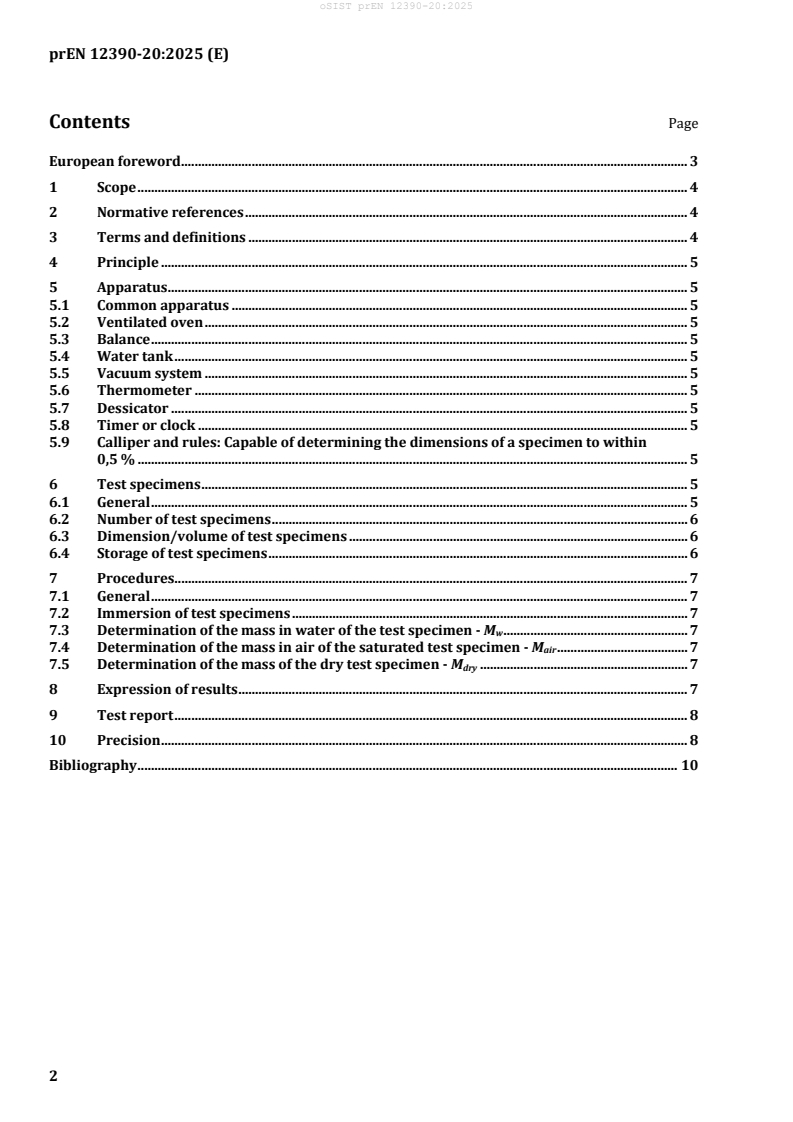
Contents Page
European foreword . 3
1 Scope . 4
2 Normative references . 4
3 Terms and definitions . 4
4 Principle . 5
5 Apparatus . 5
5.1 Common apparatus . 5
5.2 Ventilated oven . 5
5.3 Balance . 5
5.4 Water tank . 5
5.5 Vacuum system . 5
5.6 Thermometer . 5
5.7 Dessicator . 5
5.8 Timer or clock . 5
5.9 Calliper and rules: Capable of determining the dimensions of a specimen to within
0,5 % . 5
6 Test specimens . 5
6.1 General . 5
6.2 Number of test specimens . 6
6.3 Dimension/volume of test specimens . 6
6.4 Storage of test specimens . 6
7 Procedures. 7
7.1 General . 7
7.2 Immersion of test specimens . 7
7.3 Determination of the mass in water of the test specimen - M . 7
w
7.4 Determination of the mass in air of the saturated test specimen - M . 7
air
7.5 Determination of the mass of the dry test specimen - M . 7
dry
8 Expression of results . 7
9 Test report . 8
10 Precision . 8
Bibliography . 10
oSIST prEN 12390-20:2025
prEN 12390-20:2025 (E)
European foreword
This document (prEN 12390-20:2025) has been prepared by Technical Committee CEN/TC 104
“Concrete and related products”, the secretariat of which is held by SN.
This document is currently submitted to the CEN Enquiry.
It is based on the French Standard NF P 18-459 “Concrete — Testing hardened concrete — Testing
porosity and density”.
This document is one of a series on testing concrete.
EN 12390, Testing hardened concrete, consists of the following parts:
— Part 1: Shape, dimensions and other requirements for specimens and moulds
— Part 2: Making and curing specimens for strength tests
— Part 3: Compressive strength of test specimens
— Part 4: Compressive strength – Specification for testing machines
— Part 5: Flexural strength of test specimens
— Part 6: Tensile splitting strength of test specimens
— Part 7: Density of hardened concrete
— Part 8: Depth of penetration of water under pressure
— Part 10: Determination of the carbonation resistance of concrete at atmospheric levels of carbon dioxide
— Part 11: Determination of the chloride resistance of concrete, unidirectional diffusion
— Part 12: Determination of the potential carbonation resistance of concrete: Accelerated carbonation
method;
— Part 13: Determination of secant modulus of elasticity in compression;
— Part 14: Semi-adiabatic method for the determination of heat released by concrete during its hardening
process;
— Part 15: Adiabatic method for the determination of heat released by concrete during its hardening
process;
— Part 16: Determination of shrinkage of concrete;
— Part 17: Determination of creep of concrete in compression;
— Part 18: Determination of the chloride migration coefficient;
— Part19: Determination of resistivity;
oSIST prEN 12390-20:2025
prEN 12390-20:2025 (E)
1 Scope
This document describes the method for the determination of the porosity (open pores) of hardened
concrete on test specimens of any type (moulded, sawn, cored) or any shape.
The test is suitable for specimens having a declared value of D of the coarsest fraction of aggregates
actually used in the concrete (D ) not greater than 40
...