

prEN 13201-2
(Main)Road lighting - Part 2: Performance requirements
- Abstract
This part of this European Standard defines performance requirements which are specified as lighting classes for road lighting aiming at the visual needs of road users, and it considers environmental aspects of road lighting.
NOTE Installed luminous intensity classes for the restriction of disability glare and control of obtrusive light and installed glare index classes for the restriction of discomfort glare are defined in the informative Annex A. Lighting of pedestrian crossings is discussed in the informative Annex B. Disability glare evaluation for conflict areas (C classes) and pedestrian and pedal cyclists (P classes) is discussed in the informative Annex C.
- Status
- Not Published
- Publication Date
- 26-May-2027
- Technical Committee
- CEN/TC 169 - Lighting applications
- Drafting Committee
- CEN/TC 169/WG 12 - Joint Working Group with CEN/TC 226 - Road lighting
- Current Stage
- 4060 - Closure of enquiry - Enquiry
- Start Date
- 13-Aug-2026
- Due Date
- 24-May-2026
- Completion Date
- 13-Aug-2026

Overview
prEN 13201-2: Road Lighting - Part 2: Performance Requirements, developed by CEN, specifies performance criteria for road lighting installations across Europe. This standard focuses on establishing lighting classes based on the varied visual needs of road users, such as motorists, pedestrians, and cyclists. It also integrates critical environmental considerations to minimize obtrusive light and glare.
By defining comprehensive requirements and lighting classes, prEN 13201-2 aims to harmonize road lighting practices, improve road safety, support pedestrian activity, and contribute to better urban and rural environments. The standard supersedes previous versions by simplifying classifications and updating technical terminology, reflecting the latest European best practices for street lighting.
Key Topics
Lighting Classes: prEN 13201-2 defines several series of lighting classes:
- M Classes: For motor vehicle drivers on medium to high-speed traffic routes.
- C Classes: For conflict areas such as roundabouts, complex intersections, and shopping streets.
- P Classes: For areas used by pedestrians and pedal cyclists, including footways and residential streets.
- HS, SC, and EV Classes: For specific needs like hemispherical illuminance and enhanced facial recognition.
Photometric Requirements: Specifies metrics such as average luminance, uniformity, threshold increment (glare), and edge illuminance ratio to quantify and control light performance for different road settings.
Environmental Aspects: Sets guidelines to minimize obtrusive and intrusive light, control disability and discomfort glare, and reduce effects on urban and ecological environments.
Day and Night Appearance: Emphasizes the integration of lighting installations into their surroundings, considering both daytime and nighttime aesthetics and comfort.
Maintenance and Energy Efficiency: Requires maintained lighting levels, factoring in depreciation, and encourages designs meeting minimum performance to optimize energy usage.
Annexes on Specific Topics:
- Glare restriction and obtrusive light control (Annex A).
- Specialized lighting for pedestrian crossings (Annex B).
- Disability glare evaluation for pedestrians and cyclists (Annex C).
Applications
prEN 13201-2 provides clear benefits and practical guidance for a wide range of applications:
- Route and Street Lighting Design: Ensures appropriate lighting for highways, urban roads, residential streets, footpaths, and cycleways, matching lighting classes to user needs.
- Urban Planning: Supports city planners and municipalities in creating safe and inviting public spaces by balancing visual needs, safety, and environmental impact.
- Road Safety Initiatives: Enhances visibility for all road users, reducing accidents and improving conditions for vulnerable users like pedestrians and cyclists.
- Sustainable Lighting Solutions: Assists lighting engineers in selecting luminaires and controls to minimize glare, light pollution, and energy consumption.
- Renovation and Upgrades: Guides decisions on upgrading older installations while considering practical feasibility and cost-effective improvements.
- Compliance and Tendering: Specifies performance benchmarks to facilitate procurement, installation, and maintenance contracts.
Related Standards
For optimal implementation, prEN 13201-2 should be used in conjunction with related European Standards:
- EN 13201-3: Road Lighting - Calculation of Performance: Establishes calculation methods for verifying the photometric values specified in Part 2.
- EN 13201-4: Road Lighting - Methods of Measuring Lighting Performance: Details the procedures for measuring light performance as outlined in the requirements.
- CIE 115:2010 (2nd Edition): Offers international harmonization of road lighting classes and supports common practices across Europe.
- ISO/CIE 22012 TS:2019: Provides methodologies for determining maintenance factors.
By covering performance requirements, environmental impacts, and interoperability with related standards, prEN 13201-2 enables consistent, high-quality, and sustainable road lighting solutions throughout Europe.
Relations
- Effective Date
- 07-Apr-2025
Get Certified
Connect with accredited certification bodies for this standard

Zavod za gradbeništvo Slovenije (ZAG) - Inšpekcija
ZAG inspection body for construction products, structures, and materials.
Sponsored listings
Frequently Asked Questions
prEN 13201-2 is a draft published by the European Committee for Standardization (CEN). Its full title is "Road lighting - Part 2: Performance requirements". This standard covers: This part of this European Standard defines performance requirements which are specified as lighting classes for road lighting aiming at the visual needs of road users, and it considers environmental aspects of road lighting. NOTE Installed luminous intensity classes for the restriction of disability glare and control of obtrusive light and installed glare index classes for the restriction of discomfort glare are defined in the informative Annex A. Lighting of pedestrian crossings is discussed in the informative Annex B. Disability glare evaluation for conflict areas (C classes) and pedestrian and pedal cyclists (P classes) is discussed in the informative Annex C.
This part of this European Standard defines performance requirements which are specified as lighting classes for road lighting aiming at the visual needs of road users, and it considers environmental aspects of road lighting. NOTE Installed luminous intensity classes for the restriction of disability glare and control of obtrusive light and installed glare index classes for the restriction of discomfort glare are defined in the informative Annex A. Lighting of pedestrian crossings is discussed in the informative Annex B. Disability glare evaluation for conflict areas (C classes) and pedestrian and pedal cyclists (P classes) is discussed in the informative Annex C.
prEN 13201-2 is classified under the following ICS (International Classification for Standards) categories: 93.080.40 - Street lighting and related equipment. The ICS classification helps identify the subject area and facilitates finding related standards.
prEN 13201-2 has the following relationships with other standards: It is inter standard links to EN 13201-2:2015. Understanding these relationships helps ensure you are using the most current and applicable version of the standard.
prEN 13201-2 is available in PDF format for immediate download after purchase. The document can be added to your cart and obtained through the secure checkout process. Digital delivery ensures instant access to the complete standard document.
Standards Content (Sample)
SLOVENSKI STANDARD
01-maj-2026
Cestna razsvetljava - 2. del: Zahtevane lastnosti
Road lighting - Part 2: Performance requirements
Straßenbeleuchtung - Teil 2: Gütemerkmale
Eclairage public - Partie 2: Exigences de performance
Ta slovenski standard je istoveten z: prEN 13201-2
ICS:
93.080.40 Cestna razsvetljava in Street lighting and related
pripadajoča oprema equipment
2003-01.Slovenski inštitut za standardizacijo. Razmnoževanje celote ali delov tega standarda ni dovoljeno.
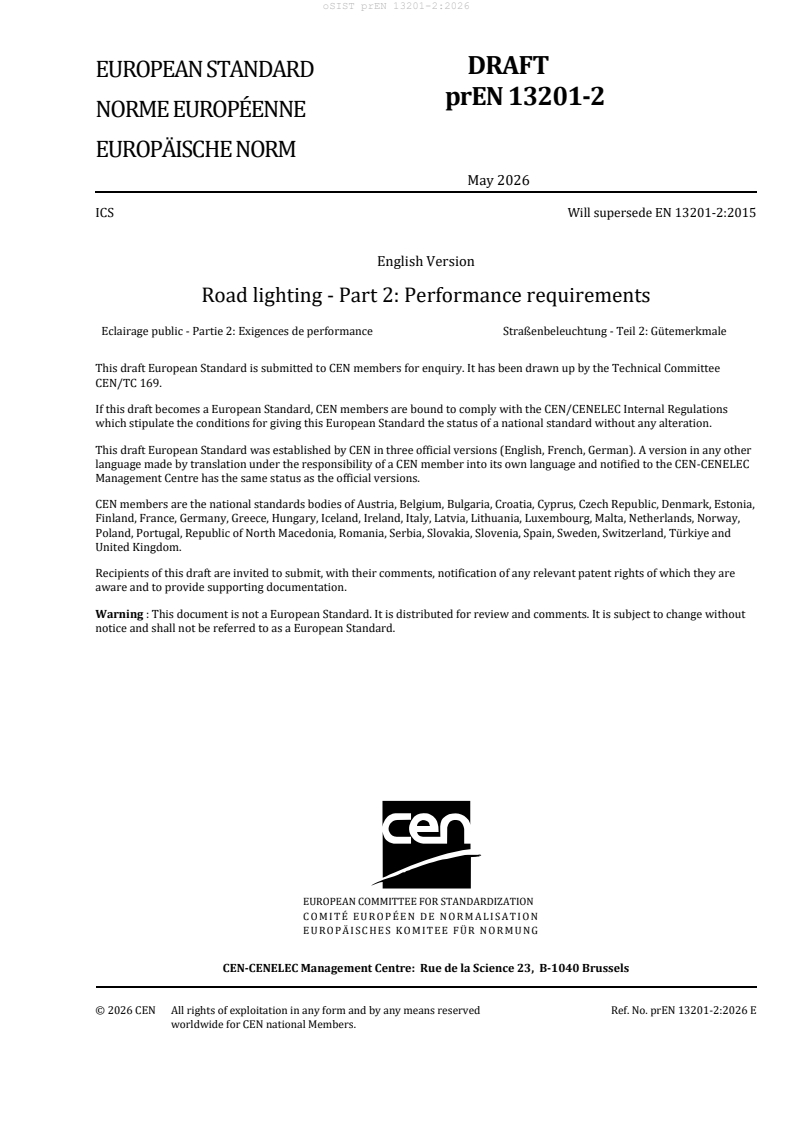
DRAFT
EUROPEAN STANDARD
NORME EUROPÉENNE
EUROPÄISCHE NORM
May 2026
ICS Will supersede EN 13201-2:2015
English Version
Road lighting - Part 2: Performance requirements
Eclairage public - Partie 2: Exigences de performance Straßenbeleuchtung - Teil 2: Gütemerkmale
This draft European Standard is submitted to CEN members for enquiry. It has been drawn up by the Technical Committee
CEN/TC 169.
If this draft becomes a European Standard, CEN members are bound to comply with the CEN/CENELEC Internal Regulations
which stipulate the conditions for giving this European Standard the status of a national standard without any alteration.
This draft European Standard was established by CEN in three official versions (English, French, German). A version in any other
language made by translation under the responsibility of a CEN member into its own language and notified to the CEN-CENELEC
Management Centre has the same status as the official versions.
CEN members are the national standards bodies of Austria, Belgium, Bulgaria, Croatia, Cyprus, Czech Republic, Denmark, Estonia,
Finland, France, Germany, Greece, Hungary, Iceland, Ireland, Italy, Latvia, Lithuania, Luxembourg, Malta, Netherlands, Norway,
Poland, Portugal, Republic of North Macedonia, Romania, Serbia, Slovakia, Slovenia, Spain, Sweden, Switzerland, Türkiye and
United Kingdom.
Recipients of this draft are invited to submit, with their comments, notification of any relevant patent rights of which they are
aware and to provide supporting documentation.
Warning : This document is not a European Standard. It is distributed for review and comments. It is subject to change without
notice and shall not be referred to as a European Standard.
EUROPEAN COMMITTEE FOR STANDARDIZATION
COMITÉ EUROPÉEN DE NORMALISATION
EUROPÄISCHES KOMITEE FÜR NORMUNG
CEN-CENELEC Management Centre: Rue de la Science 23, B-1040 Brussels
© 2026 CEN All rights of exploitation in any form and by any means reserved Ref. No. prEN 13201-2:2026 E
worldwide for CEN national Members.
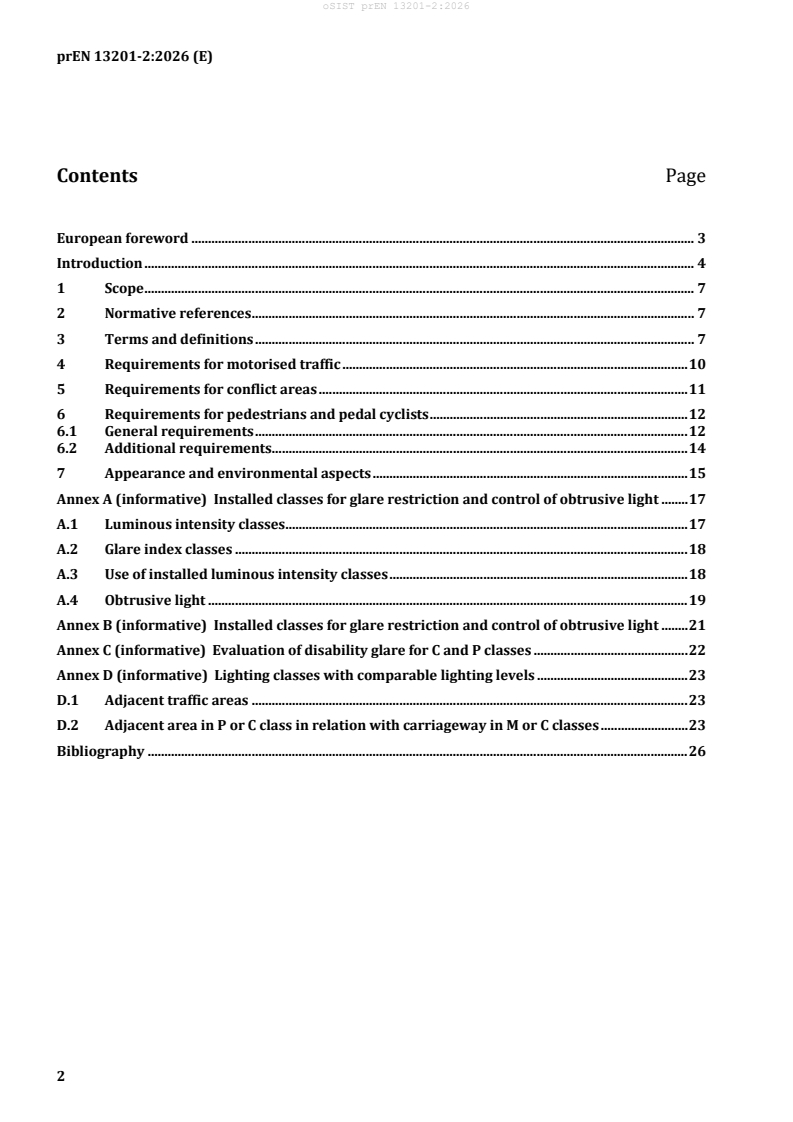
Contents Page
European foreword . 3
Introduction . 4
1 Scope . 7
2 Normative references . 7
3 Terms and definitions . 7
4 Requirements for motorised traffic . 10
5 Requirements for conflict areas . 11
6 Requirements for pedestrians and pedal cyclists . 12
6.1 General requirements . 12
6.2 Additional requirements. 14
7 Appearance and environmental aspects . 15
Annex A (informative) Installed classes for glare restriction and control of obtrusive light . 17
A.1 Luminous intensity classes. 17
A.2 Glare index classes . 18
A.3 Use of installed luminous intensity classes . 18
A.4 Obtrusive light . 19
Annex B (informative) Installed classes for glare restriction and control of obtrusive light . 21
Annex C (informative) Evaluation of disability glare for C and P classes . 22
Annex D (informative) Lighting classes with comparable lighting levels . 23
D.1 Adjacent traffic areas . 23
D.2 Adjacent area in P or C class in relation with carriageway in M or C classes . 23
Bibliography . 26
European foreword
This document (prEN 13201-2:2026) has been prepared by Technical Committee CEN/TC 169 “Light
and lighting”, the secretariat of which is held by DIN.
This document is currently submitted to the CEN Enquiry.
This document will supersede EN 13201-2:2015.
This document includes the following significant technical changes with respect to EN 13201-2:2015:
a) Simplification of Table 1 for M lighting classes;
b) Simplification of Table 3 for P lighting classes;
c) Introduction of a 20 % minimum U for new installations;
o
d) Updated HS table;
e) Revised and updated terminology;
f) Revised and updated table notes;
g) New Annex D on lighting classes with comparable lighting levels.
Introduction
A lighting class is defined by a set of photometric requirements aiming at the visual needs of certain
road users in certain types of road areas and environment. The needs can vary at different periods
during the night and also in different seasons of the year, thus the recommendations can vary during
these periods.
The purpose of introducing lighting classes is to make it easier to develop and use road lighting
products and services in CEN member countries. The lighting classes have been defined with
consideration of road lighting standards in these countries and the lighting classes defined in
CIE 115:2010 (2nd Edition) aiming at harmonization of requirements where possible. However, specific
circumstances concerned with the road layout, use and national approaches based on traditional,
climatic or other conditions could require different values of the uniformities. It is not intended that all
the classes describe in this standard are applied in a given country.
The M classes are intended for drivers of motorized vehicles for use on traffic routes, and in some
countries also residential roads, allowing medium to high driving speeds.
The main lighting criteria of these classes are based on the road surface luminance of the carriageway
and include the average luminance, the overall uniformity and the longitudinal uniformity for the dry
road surface condition. Additional criteria relate to disability glare quantified by the threshold
increment (TI)and the lighting of the surrounding areas quantified by the Edge Illuminance Ratio R . An
EI
additional criterion, used in some countries, is the overall uniformity of luminance in a wet condition.
The C classes are also intended for drivers of motorized vehicles, but for use on conflict areas such as
shopping streets, road intersections of some complexity, roundabouts and queuing areas, where the
conventions for road surface luminance calculations do not apply or are impracticable. The lighting
criteria are based on the horizontal illuminance and are expressed by the average and the overall
uniformity. These classes have applications also for pedestrians pedal cyclists and low speed traffic.
The P classes or the HS classes are intended for
— Pedestrians and pedal cyclists on footways lying separately or along the carriageway of a traffic
route and for pedestrian streets, parking places, schoolyards, etc.
— Low speed traffic on cycleways and on residential roads or pedestrian streets.
The maximum speed for low-speed vehicles is defined by national authorities for use on cycleways and
other road areas lying separately or along the carriageway of a traffic route and for residential roads,
parking places, etc.
The lighting criteria of the P classes are based on the horizontal illuminance on the road area and are
expressed by the average horizontal illuminance and the overall uniformity U . Additionally, to improve
o
facial recognition, an increased E uniformity can be expressed.
v
The lighting criteria of the HS classes are based on the hemispherical illuminance of the road area and
are expressed by the average hemispherical illuminance and the overall uniformity of this illuminance.
The SC classes are intended as an additional class in situations where public lighting is necessary for the
identification of persons and objects and in road areas with a higher than normal crime risk.
The EV classes are intended as an additional class in situations where vertical surfaces need to be seen
in such road areas as toll stations, interchange areas, etc.
The requirements of the lighting classes reflect the category of road user in question or the type of road
area. Thus, the M classes are based on the road surface luminance, while the C, P classes are based on
the horizontal illuminance of the road area and HS classes are based on hemispherical illuminance. The
SC classes are based on semi-cylindrical illuminance, while the EV classes are based on the vertical
plane illuminance.
Each series of lighting classes presents decreasing requirements in their order and form steps of
lighting level.
The specified lighting levels are maintained levels which are defined as the design levels reduced by a
maintenance factor to allow for depreciation (refer to 3.10). The required maintenance factor, or a
maintenance regime that allows deduction of the maintenance factor, normally is included in tender
specifications. The maintenance factor can be determined according to publication
ISO/CIE 22012 TS:2019.
The light output of some light sources is sensitive to temperature. As photometric data are generally
published considering a reference temperature of 25 °C, a correction factor is used for these light
sources, if ambient temperatures are different.
Environmental aspects of road lighting are considered in Clause 7 in terms of daytime appearance, night
time appearance and light emitted in directions, where it is neither necessary nor desirable. The
purpose is to highlight criteria that can be included in tender specifications or similar, where relevant.
Installed luminous intensity classes for the restriction of disability glare and control of obtrusive light
G*1, G*2, G*3, G*4, G*5 and G*6 are introduced in the informative Annex A. The use of G* classes is
mentioned in Clause 5 for conflict areas and in Clause 7 on appearance and environmental aspects.
Installed glare index classes for the restriction of discomfort glare D0, D1, D2, D3, D4, D5 and D6 are
introduced in the informative Annex A as well. These classes are intended mainly for road areas lighted
for the benefit of pedestrians and pedal cyclists.
Additional items considered in the Annex A are the use of installed luminous intensity classes and
obtrusive lighting.
Local lighting of pedestrian crossings is considered in the informative Annex B. The intention of local
lighting is to attract the attention of drivers of motorized vehicles to the presence of the pedestrian
crossing and to illuminate pedestrians in or at the crossing area.
For the C and P classes, disability glare conditions considering f are described in the informative
TI
Annex C.
All photometric quantities are based on photopic photometry and confirmed by photometric
measurements.
From an energy efficiency and environmental perspective, a lighting installation ideally has a lighting
level that matches the minimum required value of the relevant lighting class, and meets all other
relevant requirements, for instance uniformity, lighting of surrounding areas or additional classes (SC
or EV). In that sense, the lighting levels specified in the tables are target values for minimum maintained
levels.
NOTE Maximum lighting levels is normally included in tender specifications or national regulations.
When designing new road lighting installations, all the lighting requirements specified in Clauses 4, 5
and 6 are relevant, along with the requirements on environmental aspects as considered in Clause 7,
In areas characterized by reduced feelings of security or increased criminal activities, special
considerations should be made. These relate to the design of the spatial conditions and the lighting of
these areas, meaning there can be extended and differing requirements regarding the quality
characteristics of the lighting compared to the requirements of this document. The size of the area to be
lit and the improvement of uniformity to minimize fragmentation of illuminated areas are relevant.
Additionally, only a moderate increase in illuminance above the highest maintained illuminance value
specified in this document reduces any increased potential for aggression associated with higher
illuminance levels. It is important to choose the appropriate spectrum for mutual recognition,
acceptance by the general public, and for the evidence-secure use of recordings in planned video
surveillance. When modifying the optical components or the geometry of existing lighting installations
(for instance by changing the luminaires), it is appropriate to attempted to comply with all
requirements of this document. However, this can be highly impractical or expensive in some cases,
while deviations from one or more of the requirements might lead to more practicable and less
expensive solutions. In such cases, practical decisions include careful consideration of all the aspects of
the lighting installation.
1 Scope
This document defines performance requirements which are specified as lighting classes for road
lighting aiming at the visual needs of road users, and it considers environmental aspects of road
lighting.
NOTE Installed luminous intensity classes for the restriction of disability glare and control of obtrusive light
and installed glare index classes for the restriction of discomfort glare are defined in the informative Annex A.
Lighting of pedestrian crossings is discussed in the informative Annex B. Disability glare evaluation for conflict
areas (C classes) and pedestrian and pedal cyclists (P classes) is discussed in the informative Annex C.
2 Normative references
The following documents are referred to in the text in such a way that some or all of their content
constitutes requirements of this document. For dated references, only the edition cited applies. For
undated references, the latest edition of the referenced document (including any amendments) applies.
EN 13201-3, Road lighting - Part 3: Calculation of performance
EN 13201-4, Road lighting - Part 4: Methods of measuring lighting performance
3 Terms and definitions
For the purposes of this document, the following terms and definitions apply.
ISO and IEC maintain terminology databases for use in standardization at the following addresses:
— ISO Online browsing platform: available at https://www.iso.org/obp/
— IEC Electropedia: available at https://www.electropedia.org/
3.1
average road surface luminance
L
luminance of the road surface averaged over the carriageway
−2
Note 1 to entry: Average road surface luminance is expressed in candelas per square metre (cd·m ).
[SOURCE:_ EN 12665:2024, 3.2.56]
3.2
longitudinal uniformity
U
l
lowest of the ratios determined for each driving lane of
the carriageway as the ratio of the lowest to the highest road surface luminance found in a line in the
centre along the driving lane
[SOURCE:_ EN 12665:2024, 3.2.45]
3.3
threshold increment
TI
f
TI
percentage increase of contrast of an object that is needed to make it
stay at threshold visibility in presence of disability glare generated by luminaires of a road lighting
installation
Note 1 to entry: f is a measure of the effect of disability glare, described as an equivalent veiling luminance
TI
caused by scattering of light in the human eye. f values are calculated in accordance with EN 13201-3 by means
TI
of an equation for the equivalent veiling luminance which represents a young person. When setting requirements
for the limitation of the fTI, or when evaluating calculated fTI values, it should be considered that the scattering in
the eye tends to increase with the age of the person. The increase is individual and can be low for some, by a factor
of two for others and can be high for persons suffering from untreated eye conditions.
3.4
edge illuminance ratio
EIR
REI
average horizontal illuminance on a strip
just outside the edge of a carriageway in proportion to the average horizontal illuminance on a strip
inside the edge, where the strips have the width of one driving lane of the carriageway
Note 1 to entry: Separate values apply for each of the two sides of a carriageway, and for each of the two sides of
both carriageways of a dual carriageway. When a minimum requirement is made for the EIR of a lighting
installation, each of the separate values shall meet the requirement.
[SOURCE:_ EN 12665:2024, 3.2.58]
3.5
average illuminance
Ē
h
horizontal illuminance averaged over a road area
Note 1 to entry: Average illuminance is expressed in lux (lx).
3.6
minimum illuminance
E
min
lowest illuminance on a road area
Note 1 to entry: Minimum illuminance is expressed in lux (lx).
3.7
hemispherical illuminance
Ehs
total luminous flux falling on the curved surface of a very small hemisphere
located at the specified point divided by the curved surface area of the hemisphere
Note 1 to entry: Hemispherical illuminance is expressed in lux (lx).
[SOURCE:_ EN 12665:2024, 3.2.17, modified: adapted for road areas, Note 1 to entry omitted]
3.8
average hemispherical illuminance
Ē
hs
hemispherical illuminance averaged over a road area
Note 1 to entry: Average hemispherical illuminance is expressed in lux (lx).
3.9
overall uniformity
Uo
ratio of the lowest to the average value of road surface luminance, illuminance on a road area or
hemispherical illuminance
3.10
maintained level (of average road surface luminance, average or minimum illuminance on road
area, average hemispherical illuminance, minimum semi-cylindrical illuminance or minimum
vertical plane illuminance)
design level reduced by a maintenance factor to allow for depreciation
3.11
semi-cylindrical illuminance
E
sc
total luminous flux falling on the curved surface of a very small semi cylinder divided by
the curved surface area of the semi cylinder
Note 1 to entry: The axis of the semi cylinder is to be vertical and the direction of the normal to the flat face inside
the semi cylinder is to be the direction of orientation of the semi cylinder.
Note 2 to entry: Semi-cylindrical illuminance is expressed in lux (lx).
3.12
minimum semi-cylindrical illuminance (on a plane above a road area)
E
sc,min
lowest semi-cylindrical illuminance on a plane at a specified height above a road area
Note 1 to entry: Minimum semi-cylindrical illuminance is expressed in lux (lx).
3.13
vertical plane illuminance (at a point)
E
v
illuminance at a point on a vertical plane
Note 1 to entry: Vertical plane illuminance is expressed in lux (lx).
3.14
minimum vertical plane illuminance (on a plane above a road area)
E
v,min
lowest vertical plane illuminance on a plane at a specified height above the road area
Note 1 to entry: Minimum vertical plane illuminance is expressed in lux (lx).
4 Requirements for motorised traffic
The M classes in Table 1 are intended for drivers of motorized vehicles on traffic routes of medium to
high driving speeds.
NOTE Information on the application of these classes is given in CEN/TR 13201-1.
L
The average road surface luminance ( ), the overall uniformity of the luminance (Uo), the longitudinal
uniformity of the luminance (Ul), the threshold increment (f ) and the edge illuminance ratio (REI)
TI
shall be calculated and measured in accordance with EN 13201-3 and EN 13201-4.
The road surface luminance is the result of the illumination of the road surface, the reflection properties
of the road surface and the geometrical conditions of observation. Conventions are given in EN 13201-3
and EN 13201-4, aiming at driving along stretches of road with viewing distances of between 60 m and
160 m.
L
The average luminance ( ) reflects the general luminance level at which the driver performs. At the
low level of lighting used for road lighting, performance improves with luminance in terms of increasing
contrast sensitivity, increasing visual acuity and amelioration of glare.
The overall uniformity (Uo) measures in a general way the variation of luminances and indicates how
well the road surface serves as a background for road markings, objects and other road users.
The longitudinal uniformity (Ul) provides a measure of the conspicuity of the repeated pattern of bright
and dark patches on the road. It relates to visual conditions on long uninterrupted sections of road.
The threshold increment (f ) indicates that although road lighting improves visual conditions it also
TI
causes disability glare to a degree depending on the type of luminaires, light sources and geometric
situation. The calculated f values represent a young driver. The underlying cause of glare is scattering
TI
in the human eye which tends to increase with the age of the person. The increase is individual and can
be low for some, by a factor of two for others and can be high for persons suffering from untreated eye
conditions.
Lighting confined to the carriageway is inadequate for revealing the immediate surrounds of the road
and revealing road users at the kerb. EIR provides a means of ensuring adequate light falls on the
surrounds.
In some countries, the road surface is damp or wet for a significant part of the hours of darkness. For a
selected wet condition, an additional requirement to the overall uniformity (Uo) can be made to avoid a
serious downgrading of the performance for some of the damp periods.
Table 1 — M lighting classes
Lighting Luminance and its uniformity on the road surface in Disability Lighting of
class dry and wet road surface conditions glare surroundings
Dry conditions Wet Dry Dry
L
conditions conditions conditions
[minimum
a b c d
maintained]
U U U f R
o l ow TI EI
−2
[minimum] [minimum] [minimum] [maximum] [minimum]
cd·m
%
M1 2,00 0,40 0,70 0,15 10 0,35
M2 1,50 0,40 0,70 0,15 10 0,35
M3 1,00 0,40 0,60 0,15 15 0,30
M4 0,75 0,40 0,60 0,15 15 0,30
M5 0,50 0,35 0,40 0,15 15 0,30
M6 0,30 0,35 0,40 0,15 20 0,30
a
Longitudinal uniformity (Ul) is only relevant to visual conditions on long uninterrupted sections of road
and should therefore only be applied in such circumstances. The values stated in the column are the
minimum recommended for the specific lighting class, however, they may be amended where specific
circumstances relating to the road layout or use are determined by analysis or where specific national
requirements exist.
b
This is the only criterion for assessing uniformity for wet road conditions. It may be applied in addition to
criteria for the dry condition in accordance with specific national requirements and using a road surface
specific to wet road conditions for the calculation.
c
The values stated in the column fTI are the maximum recommended for the specific lighting class,
however, they may be amended where specific national requirements exist.
d
This criterion can be applied where there are no other traffic areas with their own lighting requirements
adjacent to the carriageway or traffic area under consideration and when there are no structural
restrictions. The values shown are indicative and may be amended where specific national or individual
scheme requirements exist. Such values may be higher or lower than the values shown, however care
should be taken to ensure adequate illumination of the areas is provided.
5 Requirements for conflict areas
The C classes in Table 2 are intended for drivers of motorized vehicles, and other road users, on conflict
areas such as shopping streets, road intersections of some complexity, roundabouts, queuing areas, etc.
NOTE 1 Information on the application of these classes is given in CEN/TR 13201-1.
NOTE 2 For adjacent traffic areas that have different lighting requirements in terms of luminance or horizontal
illuminance, see also Annex D.
C classes can also be applied to areas used by pedestrians and pedal cyclists, e.g. underpasses.
The average illuminance (Ē) and the overall uniformity of the illuminance (U ) are to be calculated and
o
measured in accordance with EN 13201-3 and EN 13201-4.
The road area for which the requirements of Table 2 apply can include the carriageway only, when
applying separate requirements for the adequate lighting of other road areas for pedestrian and
cyclists, or it can include also other road areas.
Limitation of disability glare can be demonstrated by evaluating f values for all relevant combinations
TI
of observation directions and observer positions (see Annex C) or achieved by the selection of
luminaires according to the classes G*1, G*2, G*3, G*4, G*5 or G*6 (see A.1).
The C classes are mainly intended for use when the conventions for road surface luminance calculations
do not apply or are impracticable. This can occur when the viewing distances are less than 60 m and
when several observer positions are relevant. The C classes are simultaneously intended for other road
users on the conflict area. The C classes have further application for pedestrian and pedal cyclists in
such cases, where P and HS classes defined in 6.1 are not adequate.
Table 2 — C lighting classes based on road surface illuminance
Class Horizontal illuminance
Ē U
o
[minimum [minimum]
maintained]
lx
C0 50 0,40
C1 30 0,40
C2 20,0 0,40
C3 15,0 0,40
C4 10,0 0,40
C5 7,50 0,40
C6 5,00 0,40
6 Requirements for pedestrians and pedal cyclists
6.1 General requirements
The P classes in Table 3 or the HS classes in Table 4 are intended fo
...