

FprEN 18319
(Main)Fertilizers, liming materials and inhibitors - Determination of the phosphonates content by ion chromatography and conductivity detection (IC-CD)
- Abstract
This document specifies a method for the extraction and determination of phosphonates (P-PO3) in fertilizers, liming materials and inhibitors using ion chromatography and conductivity detection (IC-CD).
This document is applicable to fertilizing product blends, where the blend is a mix of at least two of the following components, fertilizers, liming materials, soil improvers, growing media, inhibitors and plant biostimulants, and where the following category, fertilizers, liming materials and inhibitors, is the highest % in the blend by mass or volume, or in the case of liquid form, by dry mass.
If fertilizers, liming materials and inhibitors is not the highest % in the blend, the European Standard for the highest % of the blend applies. In case a fertilizing product blend is composed of components in equal quantity, the user decides which standard to apply.
NOTE Variations in analytical methods for fertilizing product blends can lead to differing results as some components or matrix interactions can affect the outcome. Validation procedures have shown that developed standard methods are robust and reliable across diverse product compositions, but possible interferences and unexpected results when analysing fertilizing product blends are possible.
- Status
- Not Published
- Publication Date
- 24-Feb-2027
- Technical Committee
- CEN/TC 260 - Fertilizers and liming materials
- Drafting Committee
- CEN/TC 260/WG 3 - Liming materials

FprEN 18319 is a draft European Standard from CEN for measuring phosphonates in fertilizers, liming materials and inhibitors by ion chromatography with conductivity detection (IC-CD). It specifies how to extract the sample, separate phosphonates from other ions, calculate the result and report it, for laboratories checking fertilizing products and fertilizing product blends.
What does FprEN 18319 specify?
FprEN 18319 specifies a water-extraction and IC-CD method for phosphonates (P-PO3) in fertilizers, liming materials and inhibitors. It also covers fertilizing product blends when those categories are the highest share in the blend; if another component class is dominant, the standard for that class applies instead.
The document is organized into 11 clauses and 3 informative annexes. Clause 1 sets the scope, Clauses 2 and 3 cover references and terms, Clauses 4 to 11 cover principle, reagents, apparatus, sampling and sample preparation, procedure, calculation, precision and test report.
| Annex | What it covers |
|---|---|
| Annex A | Separation of phosphonates from interfering ions in a standard mixture |
| Annex B | Results of the inter-laboratory study used for precision data |
| Annex ZA | Link between this standard and Regulation (EU) 2019/1009 |
What are the key requirements of FprEN 18319?
Sampling, preparation and extraction
FprEN 18319 relies on a representative sample and on sample preparation carried out according to EN 1482-2:2024. Sampling itself is outside the method, but the document points users to EN 1482-1 and EN 1482-3 for sampling guidance.
The main extraction uses about 10 g of sample and 100 mL of water, shaken for 60 minutes. In practice, this means the laboratory must choose a test portion and extraction conditions that keep the sample representative and prevent settling, because poor extraction changes the measured phosphonate content.
For precipitating or strongly alkaline samples, the standard prefers 2 g of sample with sulfuric acid solution. For highly non-homogeneous samples, a larger test portion and larger extraction volume may be used, and completely water-soluble samples may be dissolved instead of extracted.
Calibration and chromatographic separation
FprEN 18319 uses external calibration with a blank and at least three calibration solutions in the linear range. The standard also allows inline calibration approaches such as inline dilution or partial loop injection, which can reduce manual preparation work in busy laboratories.
The method requires separation of phosphonates from other anions by ion chromatography before conductivity detection. A check solution with phosphonate, chloride and nitrate is used to confirm separation, and the phosphonate peak must be baseline-separated from chloride and nitrate peaks. This matters because co-elution would distort the result.
Measurement and quality control
FprEN 18319 calls for all blanks, calibration solutions and samples to be measured under the same optimized conditions. The document gives example IC-CD settings and recommends an anion-exchange column, a guard column and, where possible, suppressed conductivity detection for better signal-to-noise.
The procedure also requires ongoing quality control during the run. The laboratory should check sensitivity with a calibration solution during the sequence, analyze internal reference samples or perform spike recovery if references are unavailable, and watch for memory effects after high-level samples.
Calculation, precision and reporting
FprEN 18319 calculates phosphonate content from the calibration function, with blank correction and dilution factors, and expresses the result as P-PO3 on a dry matter basis. That means the laboratory must know the sample dry matter content and apply the dilution steps correctly.
Precision information is summarized from an inter-laboratory study in Annex B, with repeatability and reproducibility limits given in Table 3. The study supports routine use, but the document notes that performance can vary with matrix and concentration range, especially below 1000 mg/kg.
The test report must identify the sample, the standard used, the method, the result, the sampling and analysis dates, and any deviations, optional settings or unusual observations.
What terms does FprEN 18319 define?
- Phosphonate - A salt derived from phosphonic acid; in this method the result is expressed as phosphorus bound in free water-soluble phosphonates.
- Ion chromatography (IC) - The separation step used to isolate phosphonate from other ions in the extract.
- Conductivity detection (CD) - The detector that measures the separated ions by their conductivity.
- IC-CD - The combined method of ion chromatography with conductivity detection used throughout the document.
- Blank test solution - A solution prepared like the sample but without sample material, used to correct background contribution.
- Repeatability - The closeness of results obtained in the same laboratory under the same conditions.
- Reproducibility - The closeness of results obtained in different laboratories under different conditions.
Who uses FprEN 18319?
FprEN 18319 is used by analytical laboratories, quality control teams and conformity assessment bodies working with fertilizers, liming materials, inhibitors and fertilizing product blends. It is relevant where phosphonate content must be measured for product control, process control or regulatory checking of EU fertilising products.
Which standards are used with FprEN 18319?
| Standard | What it contributes |
|---|---|
| EN 1482-2:2024 | General sample preparation provisions |
| EN 1482-1:2024 | General sampling provisions cited for guidance |
| EN 1482-3:2024 | Sampling of static heaps cited for guidance |
| prEN 12944-1:2026 | General vocabulary for fertilizers, liming materials and inhibitors |
| prEN 12944-2:2026 | Vocabulary terms relating to fertilizers |
| EN 12944-3:2025 | Vocabulary terms relating to liming materials |
| ISO 5725-1 | General principles and definitions for precision statistics |
| ISO 5725-3 | Intermediate precision and collaborative study design |
| EN 17246 | Related IC-CD method for perchlorate in mineral fertilizers |
| EN 17705 | Related phosphonate method for plant biostimulants |
What does the FprEN 18319 document contain?
FprEN 18319 contains the method principle, reagent list, apparatus requirements and a step-by-step procedure for water extraction, calibration and IC-CD measurement. It also includes calculation formulas for concentration and content, plus precision data derived from an inter-laboratory study.
The annexes add a chromatographic example of separating phosphonates from chloride, nitrate, sulfate and phosphate, and a statistical summary of the precision study. Annex ZA provides the correspondence with Regulation (EU) 2019/1009 for EU fertilising products.
Get Certified
Connect with accredited certification bodies for this standard

Control Union Certifications
Global certification for agriculture and sustainability.

ECOCERT
Organic and sustainability certification.

FSC International
Forest Stewardship Council certification.
Sponsored listings
Frequently Asked Questions
FprEN 18319 is a draft published by the European Committee for Standardization (CEN). Its full title is "Fertilizers, liming materials and inhibitors - Determination of the phosphonates content by ion chromatography and conductivity detection (IC-CD)". This standard covers: This document specifies a method for the extraction and determination of phosphonates (P-PO3) in fertilizers, liming materials and inhibitors using ion chromatography and conductivity detection (IC-CD). This document is applicable to fertilizing product blends, where the blend is a mix of at least two of the following components, fertilizers, liming materials, soil improvers, growing media, inhibitors and plant biostimulants, and where the following category, fertilizers, liming materials and inhibitors, is the highest % in the blend by mass or volume, or in the case of liquid form, by dry mass. If fertilizers, liming materials and inhibitors is not the highest % in the blend, the European Standard for the highest % of the blend applies. In case a fertilizing product blend is composed of components in equal quantity, the user decides which standard to apply. NOTE Variations in analytical methods for fertilizing product blends can lead to differing results as some components or matrix interactions can affect the outcome. Validation procedures have shown that developed standard methods are robust and reliable across diverse product compositions, but possible interferences and unexpected results when analysing fertilizing product blends are possible.
This document specifies a method for the extraction and determination of phosphonates (P-PO3) in fertilizers, liming materials and inhibitors using ion chromatography and conductivity detection (IC-CD). This document is applicable to fertilizing product blends, where the blend is a mix of at least two of the following components, fertilizers, liming materials, soil improvers, growing media, inhibitors and plant biostimulants, and where the following category, fertilizers, liming materials and inhibitors, is the highest % in the blend by mass or volume, or in the case of liquid form, by dry mass. If fertilizers, liming materials and inhibitors is not the highest % in the blend, the European Standard for the highest % of the blend applies. In case a fertilizing product blend is composed of components in equal quantity, the user decides which standard to apply. NOTE Variations in analytical methods for fertilizing product blends can lead to differing results as some components or matrix interactions can affect the outcome. Validation procedures have shown that developed standard methods are robust and reliable across diverse product compositions, but possible interferences and unexpected results when analysing fertilizing product blends are possible.
FprEN 18319 is classified under the following ICS (International Classification for Standards) categories: 65.080 - Fertilizers. The ICS classification helps identify the subject area and facilitates finding related standards.
FprEN 18319 is associated with the following European legislation: EU Directives/Regulations: 2019/1009; Standardization Mandates: M/564, M/564 Amd 1, M/564 Amd 2. When a standard is cited in the Official Journal of the European Union, products manufactured in conformity with it benefit from a presumption of conformity with the essential requirements of the corresponding EU directive or regulation.
FprEN 18319 is available in PDF format for immediate download after purchase. The document can be added to your cart and obtained through the secure checkout process. Digital delivery ensures instant access to the complete standard document.
Standards Content (Sample)
SLOVENSKI STANDARD
01-april-2026
Gnojila, sredstva za apnjenje in inhibitorji - Določanje fosfonatov z ionsko
kromatografijo in detekcijo na osnovi prevodnosti (IC-CD)
Fertilizers, liming materials and inhibitors - Determination of the phosphonates content
by ion chromatography and conductivity detection (IC-CD)
Düngemittel, Kalkdünger und Hemmstoffe - Bestimmung des Phosphonatgehaltes
mittels Ionenchromatographie und Leitfähigkeitsdetektion (IC-CD)
Engrais, amendements minéraux basiques et inhibiteurs - Détermination de la teneur en
phosphonates par chromatographie ionique et détection conductimétrique (IC-CD))
Ta slovenski standard je istoveten z: prEN 18319
ICS:
65.080 Gnojila Fertilizers
2003-01.Slovenski inštitut za standardizacijo. Razmnoževanje celote ali delov tega standarda ni dovoljeno.
DRAFT
EUROPEAN STANDARD
prEN 18319
NORME EUROPÉENNE
EUROPÄISCHE NORM
February 2026
ICS 65.080
English Version
Fertilizers, liming materials and inhibitors - Determination
of the phosphonates content by ion chromatography and
conductivity detection (IC-CD)
Engrais, amendements minéraux basiques et Düngemittel, Kalkdünger und Hemmstoffe -
inhibiteurs - Détermination de la teneur en Bestimmung des Phosphonatgehaltes mittels
phosphonates par chromatographie ionique et Ionenchromatographie und Leitfähigkeitsdetektion
détection conductimétrique (IC-CD) (IC-CD)
This draft European Standard is submitted to CEN members for enquiry. It has been drawn up by the Technical Committee
CEN/TC 260.
If this draft becomes a European Standard, CEN members are bound to comply with the CEN/CENELEC Internal Regulations
which stipulate the conditions for giving this European Standard the status of a national standard without any alteration.
This draft European Standard was established by CEN in three official versions (English, French, German). A version in any other
language made by translation under the responsibility of a CEN member into its own language and notified to the CEN-CENELEC
Management Centre has the same status as the official versions.
CEN members are the national standards bodies of Austria, Belgium, Bulgaria, Croatia, Cyprus, Czech Republic, Denmark, Estonia,
Finland, France, Germany, Greece, Hungary, Iceland, Ireland, Italy, Latvia, Lithuania, Luxembourg, Malta, Netherlands, Norway,
Poland, Portugal, Republic of North Macedonia, Romania, Serbia, Slovakia, Slovenia, Spain, Sweden, Switzerland, Türkiye and
United Kingdom.
Recipients of this draft are invited to submit, with their comments, notification of any relevant patent rights of which they are
aware and to provide supporting documentation.
Warning : This document is not a European Standard. It is distributed for review and comments. It is subject to change without
notice and shall not be referred to as a European Standard.
EUROPEAN COMMITTEE FOR STANDARDIZATION
COMITÉ EUROPÉEN DE NORMALISATION
EUROPÄISCHES KOMITEE FÜR NORMUNG
CEN-CENELEC Management Centre: Rue de la Science 23, B-1040 Brussels
© 2026 CEN All rights of exploitation in any form and by any means reserved Ref. No. prEN 18319:2026 E
worldwide for CEN national Members.
prEN 18319:2026 (E)
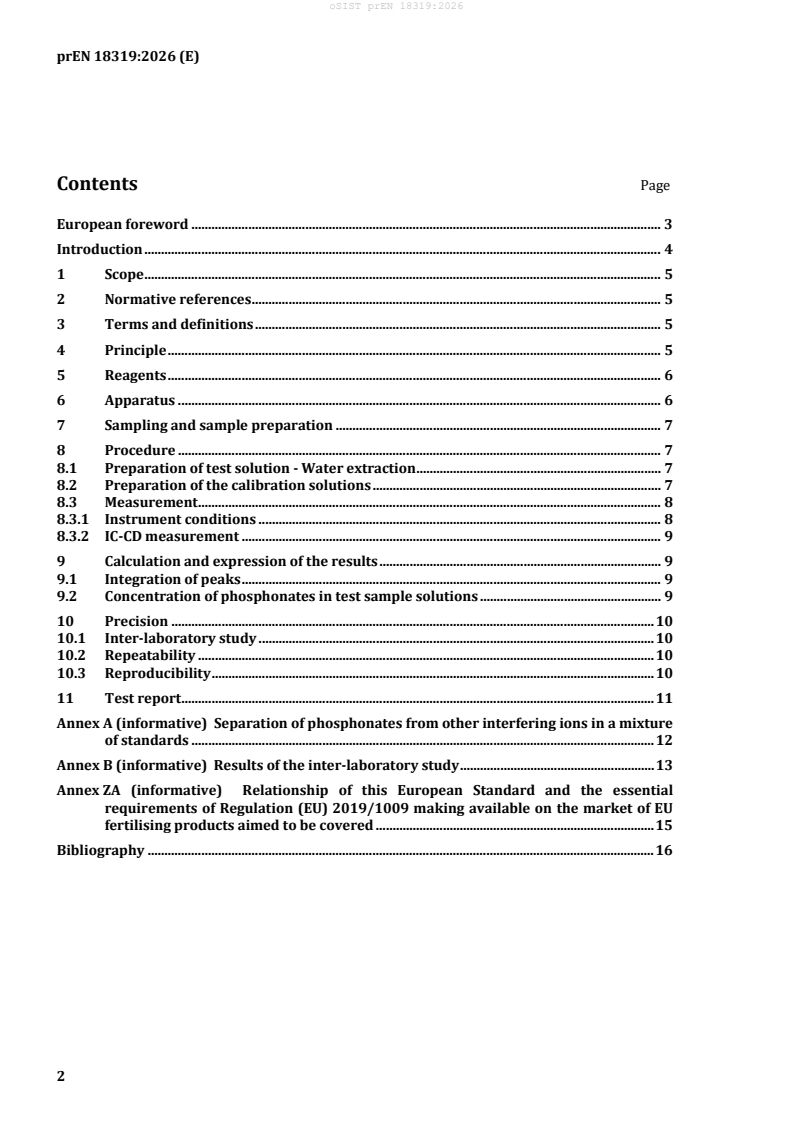
Contents Page
European foreword . 3
Introduction . 4
1 Scope . 5
2 Normative references . 5
3 Terms and definitions . 5
4 Principle . 5
5 Reagents . 6
6 Apparatus . 6
7 Sampling and sample preparation . 7
8 Procedure . 7
8.1 Preparation of test solution - Water extraction . 7
8.2 Preparation of the calibration solutions . 7
8.3 Measurement . 8
8.3.1 Instrument conditions . 8
8.3.2 IC-CD measurement . 9
9 Calculation and expression of the results . 9
9.1 Integration of peaks . 9
9.2 Concentration of phosphonates in test sample solutions . 9
10 Precision . 10
10.1 Inter-laboratory study . 10
10.2 Repeatability . 10
10.3 Reproducibility . 10
11 Test report . 11
Annex A (informative) Separation of phosphonates from other interfering ions in a mixture
of standards . 12
Annex B (informative) Results of the inter-laboratory study . 13
Annex ZA (informative) Relationship of this European Standard and the essential
requirements of Regulation (EU) 2019/1009 making available on the market of EU
fertilising products aimed to be covered . 15
Bibliography . 16
prEN 18319:2026 (E)
European foreword
This document (prEN 18319:2026) has been prepared by Technical Committee CEN/TC 260 “Fertilizers
and liming materials”, the secretariat of which is held by DIN.
This document is currently submitted to CEN Enquiry.
This document has been prepared under a Standardization Request addressed to CEN by the European
Commission. The Standing Committee of the EFTA States subsequently approves these requests for its
Member States.
For the relationship with EU Legislation, see informative Annex ZA, which is an integral part of this
document.
prEN 18319:2026 (E)
Introduction
This document describes a procedure for the extraction and measurement for the determination of
phosphonate (phosphite) in fertilizers, liming materials and inhibitors. It is based on a water extraction
of phosphonate (phosphite) followed by ion chromatography with conductivity detection (IC-CD).
The ion chromatography with conductivity detection (IC-CD) method can be used in well-equipped
analytical laboratories for the determination of different ions. In the field of fertilizing products, the
method is used and standardized for the determination of perchlorates in mineral fertilizers [1] and for
the determination of phosphonates in plant biostimulants [2]. The IC-CD method can determine ions
simultaneously.
According to Regulation (EU) 2019/1009 [3], phosphonates must not be intentionally added to any EU
fertilising product. Unintentional presence of phosphonates must not exceed 0,5 % (mass fraction). The
method described in this document was adapted to achieve this requirement and simultaneously to
reduce interferences from other co-extracted anions as much as possible.
The definition of phosphonates is not clearly stated in Regulation (EU) 2019/1009 [3] and to avoid any
misunderstanding, the results are expressed as a content of phosphorus (P) bound in the form of free
water-soluble phosphonates (P-PO ).
prEN 18319:2026 (E)
1 Scope
This document specifies a method for the extraction and determination of phosphonates (P-PO ) in
fertilizers, liming materials and inhibitors using ion chromatography and conductivity detection (IC-CD).
This document is applicable to fertilizing product blends, where the blend is a mix of at least two of the
following components, fertilizers, liming materials, soil improvers, growing media, inhibitors and plant
biostimulants, and where the following category, fertilizers, liming materials and inhibitors, is the highest
% in the blend by mass or volume, or in the case of liquid form, by dry mass.
If fertilizers, liming materials and inhibitors is not the highest % in the blend, the European Standard for
the highest % of the blend applies. In case a fertilizing product blend is composed of components in equal
quantity, the user decides which standard to apply.
NOTE Variations in analytical methods for fertilizing product blends can lead to differing results as some
components or matrix interactions can affect the outcome. Validation procedures have shown that developed
standard methods are robust and reliable across diverse product compositions, but possible interferences and
unexpected results when analysing fertilizing product blends are possible.
2 Normative references
The following documents are referred to in the text in such a way that some or all of their content
constitutes requirements of this document. For dated references, only the edition cited applies. For
undated references, the latest edition of the referenced document (including any amendments) applies.
EN 1482-2:2024, Fertilizers, liming materials and inhibitors - Sampling and sample preparation - Part 2:
General sample preparation provisions
prEN 12944-1:2026, Fertilizers, liming materials and inhibitors — Vocabulary — Part 1: General terms
prEN 12944-2:2026, Fertilizers, liming materials and inibitors — Vocabulary — Part 2: Terms relating to
fertilizers
EN 12944-3:2025, Fertilizers, liming materials and inhibitors — Vocabulary — Part 3: Terms relating to
liming materials
3 Terms and definitions
For the purposes of this document, the terms and definitions given in prEN 12944-1:2026,
prEN 12944-2:2026, and EN 12944-3:2025 and the following apply.
ISO and IEC maintain terminology databases for use in standardization at the following addresses:
— ISO Online browsing platform: available at https://www.iso.org/obp
— IEC Electropedia: available at https://www.electropedia.org
3.1
phosphonate
salt derived from phosphonic acid (H PO )
3 3
4 Principle
A representative test portion of the sample is extracted with water. Phosphonate in the extract is
selectively separated from other compounds using ion chromatography (IC) and determined by a
conductivity detection (CD). External calibration is used for quantification of the amount of the
phosphonate.
prEN 18319:2026 (E)
WARNING 1 — Persons using this document should be familiar with usual laboratory practice. This
document does not purport to address all of the safety issues, if any, associated with its use. It is the
responsibility of the user to establish appropriate health and safety practices and to ensure compliance
with any national regulatory conditions.
WARNING 2 — It is absolutely essential that tests conducted according to this document are carried out
by suitably trained staff.
5 Reagents
All reagents shall be of recognized analytical grade. The concentration of phosphonate in the reagents
and water used shall be low enough not to affect the results of the determination.
5.1 Water with a specific conductivity not higher than 0,2 mS/m at 25 °C.
5.2 Phosphonate standard stock solution, mass concentration ρ = 1 000 mg/l is prepared by
(P-PO3)
dissolving sodium phosphite dibasic pentahydrate salt (M = 216,04 g/mol, purity ≥ 98 %). For
preparation the phosphonate standard stock solution 0,697 g ± 0,001 g is weighed, transferred to 100 ml
volumetric flask, fill with water (5.1) to final volume and mix thoroughly.
5.3 Phosphonate working standard solution, ρ = 100 mg/l is prepared from a standard stock
(P-PO3)
solution (5.2) by appropriate dilution with water (5.1). Pipette 10 ml of stock solution (5.2) to a 100 ml
volumetric flask, fill with water (5.1) to final volume and mix thoroughly.
5.4 Mobile phase, KOH cartridge for ion chromatography (commercially supplied). Concentration of
the KOH mobile phase is electrolytically generated in externally supplied water (5.1).
Different mobile phase may be used according to the instructions of the manufacturer of the column.
5.5 Chloride standard, ρ = 1 000 mg/l.
(Cl−)
5.6 Nitrate standard, ρ = 1 000 mg/l.
(NO3−)
5.7 Solution for checking chromatographic separation, ρ = 10 mg/l, ρ = 50 mg/l and
(P-PO3) (Cl−)
ρ = 50 mg/l is prepared by pipetting 1 ml of phosphonate standard stock solution (5.2), 5 ml of
(NO3−)
chloride standard (5.5), 5 ml of nitrate standard (5.6) to 100ml volumetric flask and fill to final volume
with water (5.1).
5.8 Sulfuric acid, ρ = 1,84 g/ml.
20(H2SO4)
5.9 Sulfuric acid solution, c = 0,56 mol/L, prepared by adding 30 ml of sulfuric acid (5.8) to 800 ml of
water in 1 000 ml volumetric flask. Addition is performed slowly with occasional swirling. Volumetric
flask is filled to the mark with water (5.1).
6 Apparatus
6.1 Common laboratory glassware and plastic.
6.2 Analytical balance, capable of weighing to the nearest ≤ 1 mg.
6.3 Shaker, rotary or horizontal shaker. Shaking shall prevent any settling of the sample during
extraction.
6.4 Extraction vessels, capacity 200 ml to 500 ml.
prEN 18319:2026 (E)
−1
6.5 Centrifuge (optional), for minimum 4 000 min (approx. 2 000 g).
6.6 Single use syringe filters (0,22 µm) or vials with filters, for filtering of test solutions prior to
analysis.
6.7 Ion chromatograph, with conductivity detection (IC-CD).
For higher signal/noise a supressed conductivity detector is preferred.
6.8 Chromatographic column for anion exchange, suitable for the selective separation of
phosphonates from other anions present in the sample.
It is recommended to use a guard column to prolong the lifetime of the analytical column.
Other columns recommended by a manufacturer may also be used, providing the results are comparable.
7 Sampling and sample preparation
Sampling is not part of the method specified in this document. Recommended sampling methods are
given in EN 1482-1 [4] and EN 1482-3 [5].
It is important that the laboratory receives a sample that is representative of both the product under
consideration and the given analysis. The sample should not have been damaged or changed during
transpor
...