


FprEN 17160
(Main)Product category rules for ceramic tiles
Product category rules for ceramic tiles
This document defines Product Category Rules (PCR) providing guidelines and rules for developing a type III environmental declaration (as in EN 15804:2012+A2:2019) for ceramic tiles produced by extrusion and dry-pressing techniques, mainly used for internal and/or external floorings and walls coverings, facade cladding.
The c-PCR:
- define the indicators to be declared, information to be provided and the way in which they are collated and reported;
- describe which stages of ceramic tiles’ life cycle are considered in the EPD and which processes are to be included in the life cycle stages;
- define rules for the development of scenarios;
- include the rules for calculating the Life Cycle Inventory and the Life Cycle Impact Assessment underlying the EPD, including the specification of the data quality to be applied;
- include the rules for reporting predetermined, environmental and health information, that is not covered by LCA for a ceramic tile, construction process and construction service where necessary;
- define the conditions under which ceramic tiles can be compared based on the information provided by EPD;
- includes Annex A to Annex E in alignment to EN 15804:2012+A2:2019.
This PCR is intended to be used for cradle to grave and module D assessment.
Produktkategorieregeln für keramische Fliesen und Platten
Dieses Dokument legt Produktkategorieregeln (PCR) fest, welche Leitlinien und Regeln für die Entwicklung einer Typ-III-Umweltdeklaration (EPD) (wie nach EN 15804:2012+A2:2019) für keramische Fliesen und Platten bereitstellen, die mittels Strangpress- und Trockenpresstechniken hergestellt werden und hauptsächlich in Innen- und/oder Außenbereichen für Boden- und Wandbeläge, Fassadenbekleidungen und Decken angewendet werden.
ANMERKUNG Die Beurteilung der sozialen und ökonomischen Qualität auf Produktebene ist nicht Gegenstand dieses Dokuments.
Die grundlegenden Produktkategorieregeln:
- legen die zu deklarierenden Indikatoren, die bereitzustellenden Informationen und die Art, in der sie zusammengestellt und angegeben werden, fest,
- beschreiben, welche Phasen des Lebenszyklus von keramischen Fliesen und Platten in der EPD berücksichtigt werden und welche Prozesse in die Phasen des Lebenszyklus einzubeziehen sind;
- legen Regeln für die Entwicklung von Szenarien fest;
- beinhalten die Regeln zur Berechnung der Sachbilanz und der Wirkungsabschätzung, die der EPD zugrunde liegen, einschließlich der Festlegung der anzuwendenden Datenqualität;
- beinhalten die Regeln für die Kommunikation zuvor festgelegter Umwelt- und Gesundheitsinformationen, die für eine keramische Fliese und Platte, einen Bauprozess und eine Bauleistung nicht von einer Ökobilanz (LCA) abgedeckt sind, soweit erforderlich;
- legen die Bedingungen fest, unter welchen keramische Fliesen und Platten auf der Basis der Informationen aus den EPD verglichen werden können.
Diese PCR sind für die Beurteilung "von der Wiege bis zur Bahre" und des Moduls D vorgesehen.
Nach der Verifizierung ist eine EPD für eine Dauer von 5 Jahren ab dem Datum ihrer Ausstellung gültig, wonach sie überprüft und verifiziert werden muss.
Règles de définition des catégories de produits pour les carreaux céramiques
Le présent document définit des règles de définition de catégorie de produit (PCR) qui fournissent des lignes directrices et des règles permettant d'élaborer une déclaration environnementale de type III (comme dans l’EN 15804 :2012+A2 :2019) pour les carreaux céramiques fabriqués par extrusion ou autres techniques de pressage à sec, principalement utilisés pour les revêtements de sol intérieurs et/ou extérieurs, les revêtements muraux, les bardages, et les plafonds.
NOTE L'évaluation des performances sociales et économiques au niveau du produit n'est pas couverte par le présent document.
Ces PCR spécifient les règles de calcul conformément à l'EN 15804:2012+A2:2019 pour l'Analyse du Cycle de Vie (ACV) des carreaux céramiques en vue de l'élaboration d'une DEP, ainsi que les exigences relatives au contexte de l'ACV.
L’essentiel de ces PCR :
- définissent les indicateurs à déclarer, les informations à fournir, et la manière dont ils sont regroupés et consignés ;
- décrivent les étapes du cycle de vie des carreaux céramiques prises en compte dans la DEP, ainsi que les processus qui doivent être inclus dans les étapes du cycle de vie ;
- définissent les règles pour l'élaboration de scénarios ;
- comprennent les règles de calcul de l'inventaire du cycle de vie et de l'évaluation de l'impact du cycle de vie servant de base à la DEP, y compris la spécification de la qualité des données à appliquer ;
- comprennent les règles pour rendre compte d'informations prédéterminées relatives à l'environnement et à la santé, qui ne sont pas couvertes par l'ACV des carreaux céramiques, au processus de construction et au service de construction si nécessaire ;
- définissent les conditions dans lesquelles les carreaux céramiques peuvent être comparés sur la base des informations fournies par la DEP.
Ces DEP sont destinées à être utilisées pour l'évaluation du berceau à la tombe et du module D.
Après vérification, une DEP est valable pendant une période de cinq ans à compter de la date de publication, période au terme de laquelle elle doit être revue et vérifiée.
Pravila za kategorije proizvodov za keramične ploščice
General Information
- Status
- Not Published
- Publication Date
- 28-Apr-2026
- Technical Committee
- CEN/TC 67 - Ceramic tiles
- Current Stage
- 5060 - Closure of Vote - Formal Approval
- Start Date
- 19-Feb-2026
- Due Date
- 02-Jan-2026
- Completion Date
- 19-Feb-2026
Relations
- Effective Date
- 22-Nov-2023
Overview
FprEN 17160 - Product category rules for ceramic tiles (CEN draft) provides harmonized Product Category Rules (PCR) for preparing Type III Environmental Product Declarations (EPD) for ceramic tiles manufactured by extrusion and dry‑pressing. The PCR covers tiles used for internal/external flooring, wall coverings, facade cladding and ceilings (including mosaics, slabs and panels) and is intended for cradle‑to‑grave assessments with Module D included.
Key features:
- Aligns EPD requirements with EN 15804:2012+A2:2019 (core rules).
- Requires EPD verification and revalidation every 5 years.
- Sets a reference service life (RSL) of at least 50 years for the functional unit.
Key Topics and Requirements
- Scope and product category definition for ceramic tiles (extrusion & dry‑press).
- Life cycle stages and modules to be included (A, B, C and D) per EN 15804.
- Functional or declared unit rules: based on 1 m (characteristic weight expressed in kg/m²) and at least 50‑year service life.
- System boundaries and detailed process flow diagrams for cradle‑to‑grave + Module D.
- Life Cycle Inventory (LCI) and Life Cycle Impact Assessment (LCIA) calculation rules, including data quality criteria.
- Rules for developing product‑level scenarios (construction, use, end‑of‑life).
- Reporting of predetermined environmental and health information not covered by LCA (e.g., emissions, releases).
- Conditions for comparability of ceramic tile EPDs.
- Inclusion of Annex A–E aligned with EN 15804:2012+A2:2019.
Note: social and economic performance assessment at product level is not covered.
Practical Applications and Users
Who uses FprEN 17160:
- Tile manufacturers preparing verified EPDs for product marketing, procurement or sustainability reporting.
- LCA practitioners implementing PCR‑specific LCI/LCIA modelling for ceramic tiles.
- EPD programme operators and verifiers ensuring compliance with EN 15804 alignment and data quality rules.
- Architects, specifiers, contractors and public procurers using EPDs to compare products and support green building certifications.
- Sustainability consultants and policy makers assessing life cycle impacts of building materials.
Benefits:
- Enables consistent, comparable environmental declarations for ceramic tiles.
- Supports lifecycle‑based product selection in sustainable construction and procurement.
- Clarifies scenario and data‑quality expectations for reliable LCA results.
Related Standards
- EN 15804:2012+A2:2019 - Core rules for EPDs of construction products (primary reference).
- EN 14411:2016 - Definition, classification and performance of ceramic tiles (referenced for product characteristics).
- Annex A–E (included) - Aligned reporting templates and rules as per EN 15804.

Get Certified
Connect with accredited certification bodies for this standard

ICC Evaluation Service
Building products evaluation and certification.

QAI Laboratories
Building and construction product testing and certification.

Aboma Certification B.V.
Specialized in construction, metal, and transport sectors.
Sponsored listings
Frequently Asked Questions
FprEN 17160 is a draft published by the European Committee for Standardization (CEN). Its full title is "Product category rules for ceramic tiles". This standard covers: This document defines Product Category Rules (PCR) providing guidelines and rules for developing a type III environmental declaration (as in EN 15804:2012+A2:2019) for ceramic tiles produced by extrusion and dry-pressing techniques, mainly used for internal and/or external floorings and walls coverings, facade cladding. The c-PCR: - define the indicators to be declared, information to be provided and the way in which they are collated and reported; - describe which stages of ceramic tiles’ life cycle are considered in the EPD and which processes are to be included in the life cycle stages; - define rules for the development of scenarios; - include the rules for calculating the Life Cycle Inventory and the Life Cycle Impact Assessment underlying the EPD, including the specification of the data quality to be applied; - include the rules for reporting predetermined, environmental and health information, that is not covered by LCA for a ceramic tile, construction process and construction service where necessary; - define the conditions under which ceramic tiles can be compared based on the information provided by EPD; - includes Annex A to Annex E in alignment to EN 15804:2012+A2:2019. This PCR is intended to be used for cradle to grave and module D assessment.
This document defines Product Category Rules (PCR) providing guidelines and rules for developing a type III environmental declaration (as in EN 15804:2012+A2:2019) for ceramic tiles produced by extrusion and dry-pressing techniques, mainly used for internal and/or external floorings and walls coverings, facade cladding. The c-PCR: - define the indicators to be declared, information to be provided and the way in which they are collated and reported; - describe which stages of ceramic tiles’ life cycle are considered in the EPD and which processes are to be included in the life cycle stages; - define rules for the development of scenarios; - include the rules for calculating the Life Cycle Inventory and the Life Cycle Impact Assessment underlying the EPD, including the specification of the data quality to be applied; - include the rules for reporting predetermined, environmental and health information, that is not covered by LCA for a ceramic tile, construction process and construction service where necessary; - define the conditions under which ceramic tiles can be compared based on the information provided by EPD; - includes Annex A to Annex E in alignment to EN 15804:2012+A2:2019. This PCR is intended to be used for cradle to grave and module D assessment.
FprEN 17160 is classified under the following ICS (International Classification for Standards) categories: 91.100.23 - Ceramic tiles. The ICS classification helps identify the subject area and facilitates finding related standards.
FprEN 17160 has the following relationships with other standards: It is inter standard links to EN 17160:2019. Understanding these relationships helps ensure you are using the most current and applicable version of the standard.
FprEN 17160 is available in PDF format for immediate download after purchase. The document can be added to your cart and obtained through the secure checkout process. Digital delivery ensures instant access to the complete standard document.
Standards Content (Sample)
SLOVENSKI STANDARD
oSIST prEN 17160:2025
01-januar-2025
Pravila za kategorije proizvodov za keramične ploščice
Product category rules for ceramic tiles
Produktkategorieregeln für keramische Fliesen und Platten
Règles de définition des catégories de produits pour les carreaux céramiques
Ta slovenski standard je istoveten z: prEN 17160
ICS:
91.100.23 Keramične ploščice Ceramic tiles
oSIST prEN 17160:2025 en,fr,de
2003-01.Slovenski inštitut za standardizacijo. Razmnoževanje celote ali delov tega standarda ni dovoljeno.
oSIST prEN 17160:2025
oSIST prEN 17160:2025
DRAFT
EUROPEAN STANDARD
prEN 17160
NORME EUROPÉENNE
EUROPÄISCHE NORM
October 2024
ICS 91.100.23 Will supersede EN 17160:2019
English Version
Product category rules for ceramic tiles
Règles de définition des catégories de produits pour les Produktkategorieregeln für keramische Fliesen und
carreaux céramiques Platten
This draft European Standard is submitted to CEN members for enquiry. It has been drawn up by the Technical Committee
CEN/TC 67.
If this draft becomes a European Standard, CEN members are bound to comply with the CEN/CENELEC Internal Regulations
which stipulate the conditions for giving this European Standard the status of a national standard without any alteration.
This draft European Standard was established by CEN in three official versions (English, French, German). A version in any other
language made by translation under the responsibility of a CEN member into its own language and notified to the CEN-CENELEC
Management Centre has the same status as the official versions.
CEN members are the national standards bodies of Austria, Belgium, Bulgaria, Croatia, Cyprus, Czech Republic, Denmark, Estonia,
Finland, France, Germany, Greece, Hungary, Iceland, Ireland, Italy, Latvia, Lithuania, Luxembourg, Malta, Netherlands, Norway,
Poland, Portugal, Republic of North Macedonia, Romania, Serbia, Slovakia, Slovenia, Spain, Sweden, Switzerland, Türkiye and
United Kingdom.
Recipients of this draft are invited to submit, with their comments, notification of any relevant patent rights of which they are
aware and to provide supporting documentation.
Warning : This document is not a European Standard. It is distributed for review and comments. It is subject to change without
notice and shall not be referred to as a European Standard.
EUROPEAN COMMITTEE FOR STANDARDIZATION
COMITÉ EUROPÉEN DE NORMALISATION
EUROPÄISCHES KOMITEE FÜR NORMUNG
CEN-CENELEC Management Centre: Rue de la Science 23, B-1040 Brussels
© 2024 CEN All rights of exploitation in any form and by any means reserved Ref. No. prEN 17160:2024 E
worldwide for CEN national Members.
oSIST prEN 17160:2025
prEN 17160:2024 (E)
Contents Page
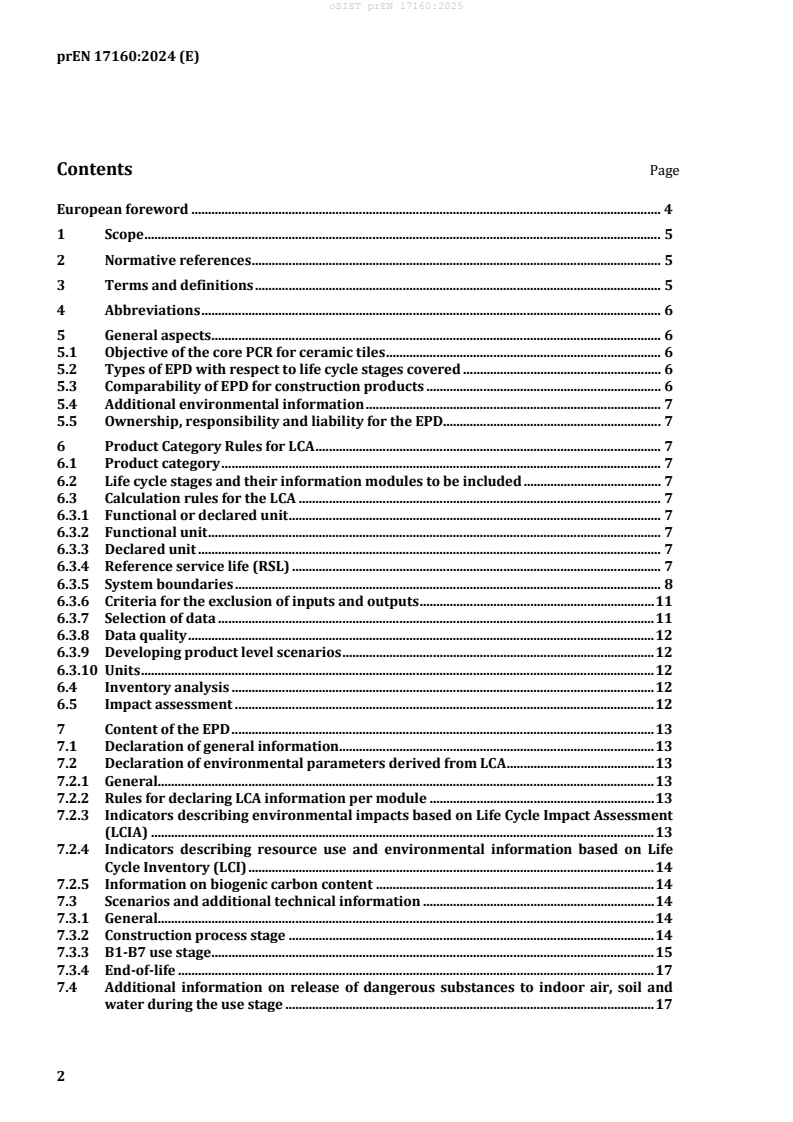
European foreword . 4
1 Scope . 5
2 Normative references . 5
3 Terms and definitions . 5
4 Abbreviations . 6
5 General aspects . 6
5.1 Objective of the core PCR for ceramic tiles . 6
5.2 Types of EPD with respect to life cycle stages covered . 6
5.3 Comparability of EPD for construction products . 6
5.4 Additional environmental information . 7
5.5 Ownership, responsibility and liability for the EPD. 7
6 Product Category Rules for LCA . 7
6.1 Product category . 7
6.2 Life cycle stages and their information modules to be included . 7
6.3 Calculation rules for the LCA . 7
6.3.1 Functional or declared unit . 7
6.3.2 Functional unit . 7
6.3.3 Declared unit . 7
6.3.4 Reference service life (RSL) . 7
6.3.5 System boundaries . 8
6.3.6 Criteria for the exclusion of inputs and outputs . 11
6.3.7 Selection of data . 11
6.3.8 Data quality . 12
6.3.9 Developing product level scenarios . 12
6.3.10 Units . 12
6.4 Inventory analysis . 12
6.5 Impact assessment . 12
7 Content of the EPD . 13
7.1 Declaration of general information. 13
7.2 Declaration of environmental parameters derived from LCA . 13
7.2.1 General. 13
7.2.2 Rules for declaring LCA information per module . 13
7.2.3 Indicators describing environmental impacts based on Life Cycle Impact Assessment
(LCIA) . 13
7.2.4 Indicators describing resource use and environmental information based on Life
Cycle Inventory (LCI) . 14
7.2.5 Information on biogenic carbon content . 14
7.3 Scenarios and additional technical information . 14
7.3.1 General. 14
7.3.2 Construction process stage . 14
7.3.3 B1-B7 use stage . 15
7.3.4 End-of-life . 17
7.4 Additional information on release of dangerous substances to indoor air, soil and
water during the use stage . 17
oSIST prEN 17160:2025
prEN 17160:2024 (E)
7.4.1 Indoor air . 17
7.4.2 Soil and water . 17
7.5 Aggregation of information modules . 17
8 Project report . 17
9 Verification and validity of an EPD. 17
Bibliography . 18
oSIST prEN 17160:2025
prEN 17160:2024 (E)
European foreword
This document (prEN 17160:2024) has been prepared by Technical Committee CEN/TC 67 “Ceramic
Tiles”, the secretariat of which is held by UNI.
This document is currently submitted to the CEN Enquiry.
This document will supersede EN 17160:2019.
EN 17160:2024 includes the following significant technical changes with respect to EN 17160:2019:
— update in relation to the latest revision of EN 15804:2012+A2:2019.
oSIST prEN 17160:2025
prEN 17160:2024 (E)
1 Scope
This document defines Product Category Rules (PCR) providing guidelines and rules for developing a
type III environmental declaration (as in EN 15804:2012+A2:2019) for ceramic tiles produced by
extrusion and dry-pressing techniques, mainly used for internal and/or external floorings and walls
coverings, facade cladding and ceilings.
NOTE The assessment of social and economic performances at product level is not covered by this document.
The core PCR:
— define the indicators to be declared, information to be provided and the way in which they are
collated and reported,
— describe which stages of ceramic tiles’ life cycle are considered in the EPD and which processes are
to be included in the life cycle stages;
— define rules for the development of scenarios;
— include the rules for calculating the Life Cycle Inventory and the Life Cycle Impact Assessment
underlying the EPD, including the specification of the data quality to be applied;
— include the rules for reporting predetermined, environmental and health information, that is not
covered by LCA for a ceramic tile, construction process and construction service where necessary;
— define the conditions under which ceramic tiles can be compared based on the information provided
by EPD.
These PCR are intended to be used for cradle to grave and module D assessment.
After verification an EPD is valid for a 5-year period from the date of issue, after which it is reviewed and
verified.
2 Normative references
The following documents are referred to in the text in such a way that some or all of their content
constitutes requirements of this document. For dated references, only the edition cited applies. For
undated references, the latest edition of the referenced document (including any amendments) applies
EN 14411:2016, Ceramic tiles — Definition, classification, characteristics, assessment and verification of
constancy of performance and marking
EN 15804:2012+A2:2019, Sustainability of construction works — Environmental product declarations —
Core rules for the product category of construction products
3 Terms and definitions
For the purposes of this document, the terms and definitions given in EN 15804:2012+A2:2019 and the
following apply:
3.1
ceramic tile
tile made from clays and/or other inorganic raw materials
[SOURCE: EN 14411:2016, 3.1]
As impacted by EN 15804:2012+A2:2019/AC:2021.
oSIST prEN 17160:2025
prEN 17160:2024 (E)
3.2
mosaic
any piece that can fit into a square the side of which is up to 7 cm
3.3
tile panel/slab/surface
ceramic tile of size greater than or equal to 1 m
4 Abbreviations
For the purpose of this document, the abbreviations given in EN 15804:2012+A2:2019 and the following
apply.
BREF best available techniques reference document
EPBD Energy performance of buildings directive
5 General aspects
5.1 Objective of the core PCR for ceramic tiles
The objective is as in EN 15804:2012+A2:2019 and the Scope of this document.
5.2 Types of EPD with respect to life cycle stages covered
Types of EPD that may be provided are (see Figure 1):
— cradle to grave and module D (A, B, C and D). This declaration shall be based on functional unit or
declared unit.
For an EPD type “Cradle to grave and Module D” all modules are mandatory as described in Figure 1.
Figure 1 —Types of EPD with respect to life cycle stages covered and life cycle stages and
modules for the building assessment (EN 15804:2012+A2:2019) Mand = Mandatory.
5.3 Comparability of EPD for construction products
For the purposes of this document, comparability of EPD for construction products given in
EN 15804:2012+A2:2019 apply.
oSIST prEN 17160:2025
prEN 17160:2024 (E)
5.4 Additional environmental information
For the purposes of this document, additional environmental information given in
EN 15804:2012+A2:2019 apply.
5.5 Ownership, responsibility and liability for the EPD
A manufacturer or a group of manufacturers are the sole owners and have liability and responsibility for
an EPD.
6 Product Category Rules for LCA
6.1 Product category
The product category referred to in these PCR includes all ceramic tiles coverings for flooring and/or
wall, facade cladding and ceilings, both indoor and outdoor, including mosaics, slabs, surfaces, panels,
special and decorative pieces.
6.2 Life cycle stages and their information modules to be included
The life cycle stages shall be as in EN 15804:2012+A2:2019 and 5.2 of this document.
6.3 Calculation rules for the LCA
6.3.1 Functional or declared unit
The functional or declared unit shall be as in EN 15804:2012+A2:2019.
6.3.2 Functional unit
The functional unit shall be as in EN 15804:2012+A2:2019, in addition: the functional unit is defined as
a 1 m of ceramic tile with various functions, including flooring and/or cladding of walls, terraces and
facades for a period of at least 50 years (in accordance with 6.3.4 of this document).
The functional unit is characterized by performance characteristics under defined conditions
(EN 14411:2016) and over the defined time period in accordance with 6.3.4 of this document.
2 2
A functional unit shall contain the characteristic weight referred to 1 m (express as kg/m ) to allow
materials characterized by different thicknesses to be compared consistently.
6.3.3 Declared unit
The declared unit shall be as in EN 15804:2012+A2:2019 and 5.2 of this document.
2 2
A declared unit shall contain the characteristic weight referred to 1m (express as kg/m ) and expressed
for a specified period of time (of at least 50 years ) under reference in-use conditions, considering the
RSL in accordance with 6.3.4 of this document.
6.3.4 Reference service life (RSL)
The RSL shall be as in EN 15804:2012+A2:2019.
In addition, the RSL shall be at least 50 years.This statement is based on practical experience showing
that RSL of ceramic tiles can be the same as the life time of the building .
NOTE Longer RSL might be eligible in accordance with other regulation.
EN 14411:2016 - Table ZA.1.1
EN 14411:2016 - Table ZA.1.1
EN 14411:2016 - Table ZA.1.1
oSIST prEN 17160:2025
prEN 17160:2024 (E)
6.3.5 System boundaries
6.3.5.1 General
System boundaries shall be as in EN 15804:2012+A2:2019.
Figure 2 illustrates a detailed example of a cradle-to-gate and module D ceramic tile process flow
diagram.
Figure 2—Example of a cradle-to-grave ceramic tile process flow diagram
6.3.5.2 Product stage
The product stage shall be as in EN 15804:2012+A2:2019.
oSIST prEN 17160:2025
prEN 17160:2024 (E)
6.3.5.3 Construction stage
The construction stage shall be as in EN 15804:2012+A2:2019.
6.3.5.4 Use stage
6.3.5.4.1 General
The use stage includes the information modules covering the period from the handover of the building or
construction works to when it is deconstructed or demolished. The duration of the use stage of ceramic
tiles should coincide with the required service life of a building.
The use stage includes the use of ceramic tiles, equipment and services in their proper function. It also
includes their use for protecting, conserving, moderating or controlling a building, e.g. modules
describing the building operation through building related services such as heating, cooling and lighting.
It also includes maintenance (including cleaning), repair, replacement and refurbishment.
It is recognized that it may be difficult to separate all use stage processes and the connected aspects and
impacts into these separate modules.
6.3.5.4.2 B1 - B5 Use stage information modules related to the building fabric
6.3.5.4.2.1 B1 —Use of the installed ceramic tile in terms of any emissions to the environment
(not covered by B2 to B7)
B1 stage shall be as in EN 15804:2012+A2: 2019.
In addition, ceramic tiles are intrinsically inert and therefore do not have environmental impacts during
their use to be addressed in B1 module. Impacts may be declared as “zero” in module B1.
6.3.5.4.2.2 B2 — Maintenance
B2 stage shall be as in EN 15804:2012+A2: 2019.
6.3.5.4.2.3 B3 — Repair
B3 stage shall be as in EN 15804:2012+A2: 2019.
In addition, ceramic tiles are a long-lasting product, and repair is not expected if the product is installed
and handled in the correct manner and satisfy the requirement specified in EN 14411:2016, therefore
impacts may be declared as “zero” in module B3.
6.3.5.4.2.4 B4 — Replacement
B4 stage shall be as in EN 15804:2012+A2: 2019.
In addition, ceramic tiles are a long-lasting product and under normal use conditions do not require
replacement during the use phase, as the Reference Service Life (see 6.3.4) coincides with the Estimated
Service Life of the building. In case the ceramic tile breaks during the use phase it can be replaced, this
occurrence is rare therefore impacts due to replacement are negligible and therefore impacts may be
declared as “zero” in module B4 (see EN 14411:2016).
6.3.5.4.2.5 B5 — Refurbishment
B5 stage shall be as in EN 15804:2012+A2: 2019.
In addition, ceramic tiles require no refurbishment during the use phase as the Reference Service Life
(see 6.4.3) coincides with the Estimated Service Life of the building; therefore impacts may be declared
as “zero” in module B5 (see EN 14411:2016).
oSIST prEN 17160:2025
prEN 17160:2024 (E)
6.3.5.4.3 B6-B7 Use stage information modules related to the operation of the building
6.3.5.4.3.1 B6 Energy use to operate building integrated technical systems
B6 stage shall be as in EN 15804:2012+A2: 2019.
In addition, when the ceramic tile is integrated in a building, no energy use is expected for its normal
operation therefore impacts may be declared as “zero” in module B6.
6.3.5.4.3.2 B7 Operational water use by building integrated technical systems
B7 stage shall be as in EN 15804:2012+A2: 2019.
In addition, when the ceramic tile is integrated in a building, no water use is expected for its normal
operation therefore impacts may be declared as “zero” in module B7.
6.3.5.5 End-of-life stage
The end of life stage shall be as in EN 15804:2012+A2:2019.
6.3.5.6 Benefits and loads beyond the product system boundary in module D
The benefits and loads beyond the product system boundary in module D shall be as in
EN 15804:2012+A2:2019, in addition:
Recycling of ceramic tiles
After the demolition/deconstruction stage, ceramic tiles can be crushed and then used in a range of
different applications:
— road construction in filled embankment;
— concrete aggregates;
— when ceramic tile is crushed, it forms recycled ceramic aggregates which can be integrated as a partial
substitute of natural aggregate in hot-mix asphalt;
— recycled ceramic aggregates can be used in the construction of landfills;
— recycled ceramic aggregates can be utilized in the construction of sub-based courses on secondary
roads.
Reuse of ceramic tiles
— There are dry-laying systems for ceramic tiles that allow their installation without the use of any
adhesives. These dry-laying systems allow the disassembly of ceramic tiles at the end of their life, and
their reuse even in a different place. Installation technology in the case of dry-laying systems, widely
varies, with the use of plastic or cork substrates, magnetic laying, floating floors involving the use of
plastic substrates, and many more.
— There are certain anchorage systems that permit to install ventilated façades without the use of
adhesive.
Below a generic definition is given of module C and module D. This default scenario can be used to assess
impacts, loads and benefit for ceramic tiles.
Module C:
— Demolition/deconstruction of ceramic tiles;
...
Questions, Comments and Discussion
Ask us and Technical Secretary will try to provide an answer. You can facilitate discussion about the standard in here.
Loading comments...