

EN 14891:2017
(Main)Liquid applied water impermeable products for use beneath ceramic tiling bonded with adhesives - Requirements, test methods, assessment and verification of constancy of performance, classification and marking
- Abstract
This European Standard applies to all liquid-applied water impermeable products, based on polymer modified cementitious mortars, dispersions and reaction resin coatings, used beneath ceramic tiling, for external tile installations on walls and floors and in swimming pools.
This European Standard gives the terminology concerning the products and specifies the test methods and the values of performance requirements for liquid-applied water impermeable products associated with tile adhesives.
This European Standard specifies the evaluation of conformity and the classification and designation of liquid-applied water impermeable products beneath ceramic tiling.
This European Standard does not contain recommendations for the design and installation of ceramic tiles and grouts in combination with water impermeable products.
NOTE 1 Liquid-applied water impermeable products may also be used beneath other types of tiles (natural and agglomerated stones, etc.), where they do not adversely affect these materials.
NOTE 2 The user of this European Standard should be familiar with normal laboratory practice. This European Standard does not purport to address all the safety problems associated with its use. It is the responsibility of the user to establish appropriate health and safety practices and to ensure compliance with any European and national regulatory conditions.
- Status
- Published
- Publication Date
- 14-Feb-2017
- Withdrawal Date
- 29-Nov-2018
- Technical Committee
- CEN/TC 67 - Ceramic tiles
- Drafting Committee
- CEN/TC 67/WG 3 - Adhesives and grouts for tiles
- Current Stage
- 9093 - Decision to confirm - Review Enquiry
- Start Date
- 13-Oct-2025
- Completion Date
- 14-Oct-2026

Overview
EN 14891:2017 is the CEN (European) standard specifying requirements, test methods, assessment and verification of constancy of performance (AVCP), classification and marking for liquid-applied water impermeable products used beneath ceramic tiling. It applies to products based on polymer-modified cementitious mortars, dispersions and reaction resin coatings for external walls, floors and swimming pools. The standard defines terminology, required performance characteristics and how manufacturers and testing bodies demonstrate conformity. It does not provide design or installation instructions for tiles and grouts.
Key topics and technical requirements
EN 14891:2017 covers the following technical areas and requirements:
- Product scope and terminology - definitions for CM (polymer-modified cementitious), DM (dispersions) and RM (reaction resins) and related terms (primer, crack bridging, etc.).
- Performance characteristics - water impermeability, tensile adhesion (initial and after conditioning), crack-bridging ability, durability after heat ageing, freeze–thaw, contact with chlorinated water and lime water, and release of dangerous substances.
- Test methods and sampling - standardized procedures for preparing test specimens, conditioning and reporting results (see Annex A for detailed test method descriptions).
- Assessment & verification of constancy of performance (AVCP) - type testing, Factory Production Control (FPC) requirements and rules for shared results and product modifications.
- Classification, designation, marking and labelling - how waterproofing products must be classified and what information must appear on labels to demonstrate conformity with EN 14891.
- Relationship to the Construction Products Regulation (CPR) - informative Annex ZA connects EN 14891 to Regulation (EU) No. 305/2011.
Practical applications and who uses it
EN 14891:2017 is intended for stakeholders involved with tile installations and waterproofing who require clear, harmonized performance requirements and conformity assessment:
- Manufacturers of liquid-applied waterproofing systems (polymer-modified mortars, dispersions, reaction resin coatings) for certification and CE marking.
- Testing laboratories performing type testing and issuing test reports in line with the standard.
- Specifiers, architects and engineers who need to reference harmonized performance classes when selecting waterproofing beneath ceramic tiles, especially in external applications and swimming pools.
- Contractors and pool builders who require products with demonstrated durability and adhesion properties compatible with tile adhesives.
- Certification bodies and authorities performing AVCP, FPC audits and compliance checks.
Note: EN 14891 may also be used beneath other tile types (natural stone, agglomerates) provided no adverse interactions occur.
Related standards
Relevant referenced documents include (examples): EN 12004-1 / EN 12004-2 (tile adhesives), EN 14411 (ceramic tiles), EN 196-1 / EN 197-1 (cement testing/specifications), and EN ISO 15605 (adhesive sampling). These help ensure coordinated testing and conformity across tile and adhesive systems.
Relations
- Effective Date
- 22-Feb-2017
- Effective Date
- 22-Feb-2017
- Effective Date
- 28-Jan-2026
- Effective Date
- 28-Jan-2026
- Effective Date
- 28-Jan-2026
- Effective Date
- 28-Jan-2026
- Effective Date
- 28-Jan-2026
- Effective Date
- 28-Jan-2026
- Effective Date
- 28-Jan-2026
- Effective Date
- 28-Jan-2026
- Refers
EN 12390-2:2019 - Testing hardened concrete - Part 2: Making and curing specimens for strength tests - Effective Date
- 28-Jan-2026
- Effective Date
- 28-Jan-2026
- Effective Date
- 28-Jan-2026
- Effective Date
- 18-Jan-2023
- Effective Date
- 25-Dec-2019
Get Certified
Connect with accredited certification bodies for this standard

DIBt (Deutsches Institut für Bautechnik)
German Institute for Building Technology.
DIN CERTCO
DIN Group product certification.

Aboma Certification B.V.
Specialized in construction, metal, and transport sectors.
Sponsored listings
Frequently Asked Questions
EN 14891:2017 is a standard published by the European Committee for Standardization (CEN). Its full title is "Liquid applied water impermeable products for use beneath ceramic tiling bonded with adhesives - Requirements, test methods, assessment and verification of constancy of performance, classification and marking". This standard covers: This European Standard applies to all liquid-applied water impermeable products, based on polymer modified cementitious mortars, dispersions and reaction resin coatings, used beneath ceramic tiling, for external tile installations on walls and floors and in swimming pools. This European Standard gives the terminology concerning the products and specifies the test methods and the values of performance requirements for liquid-applied water impermeable products associated with tile adhesives. This European Standard specifies the evaluation of conformity and the classification and designation of liquid-applied water impermeable products beneath ceramic tiling. This European Standard does not contain recommendations for the design and installation of ceramic tiles and grouts in combination with water impermeable products. NOTE 1 Liquid-applied water impermeable products may also be used beneath other types of tiles (natural and agglomerated stones, etc.), where they do not adversely affect these materials. NOTE 2 The user of this European Standard should be familiar with normal laboratory practice. This European Standard does not purport to address all the safety problems associated with its use. It is the responsibility of the user to establish appropriate health and safety practices and to ensure compliance with any European and national regulatory conditions.
This European Standard applies to all liquid-applied water impermeable products, based on polymer modified cementitious mortars, dispersions and reaction resin coatings, used beneath ceramic tiling, for external tile installations on walls and floors and in swimming pools. This European Standard gives the terminology concerning the products and specifies the test methods and the values of performance requirements for liquid-applied water impermeable products associated with tile adhesives. This European Standard specifies the evaluation of conformity and the classification and designation of liquid-applied water impermeable products beneath ceramic tiling. This European Standard does not contain recommendations for the design and installation of ceramic tiles and grouts in combination with water impermeable products. NOTE 1 Liquid-applied water impermeable products may also be used beneath other types of tiles (natural and agglomerated stones, etc.), where they do not adversely affect these materials. NOTE 2 The user of this European Standard should be familiar with normal laboratory practice. This European Standard does not purport to address all the safety problems associated with its use. It is the responsibility of the user to establish appropriate health and safety practices and to ensure compliance with any European and national regulatory conditions.
EN 14891:2017 is classified under the following ICS (International Classification for Standards) categories: 91.100.23 - Ceramic tiles; 91.100.25 - Terracotta building products; 91.100.50 - Binders. Sealing materials. The ICS classification helps identify the subject area and facilitates finding related standards.
EN 14891:2017 has the following relationships with other standards: It is inter standard links to EN 14891:2012/AC:2012, EN 14891:2012, EN 12620:2002+A1:2008, EN 1008:2002, EN 12004-2:2017, EN 480-1:2014, EN 12004-1:2017, EN 1067:2005, EN 196-1:2016, EN 14411:2016, EN 12390-2:2019, EN ISO 15605:2004, EN 197-1:2011, prEN 14891-2, FprEN 14891-1. Understanding these relationships helps ensure you are using the most current and applicable version of the standard.
EN 14891:2017 is associated with the following European legislation: EU Directives/Regulations: 305/2011; Standardization Mandates: M/102. When a standard is cited in the Official Journal of the European Union, products manufactured in conformity with it benefit from a presumption of conformity with the essential requirements of the corresponding EU directive or regulation.
EN 14891:2017 is available in PDF format for immediate download after purchase. The document can be added to your cart and obtained through the secure checkout process. Digital delivery ensures instant access to the complete standard document.
Standards Content (Sample)
2003-01.Slovenski inštitut za standardizacijo. Razmnoževanje celote ali delov tega standarda ni dovoljeno.PLþQLPLMHFlüssig zu verarbeitende wasserundurchlässige Produkte im Verbund mit keramischen Fliesen und Plattenbelägen - Anforderungen, Prüfverfahren, Bewertung und Überprüfung der Leistungsbeständigkeit, Klassifizierung und BezeichnungProduits d'imperméabilisation appliqués en phase liquide utilisés sous carrelage collé - Spécifications, méthodes d'essai, évaluation et vérification de la constance de performance, classification et marquageLiquid applied water impermeable products for use beneath ceramic tiling bonded with adhesives - Requirements, test methods, assessment and verification of constancy of performance, classification and marking91.100.50Veziva. Tesnilni materialiBinders. Sealing materials91.100.23Ceramic tilesICS:Ta slovenski standard je istoveten z:EN 14891:2017SIST EN 14891:2017en,fr,de01-maj-2017SIST EN 14891:2017SLOVENSKI
STANDARDSIST EN 14891:2012/AC:2013SIST EN 14891:20121DGRPHãþD
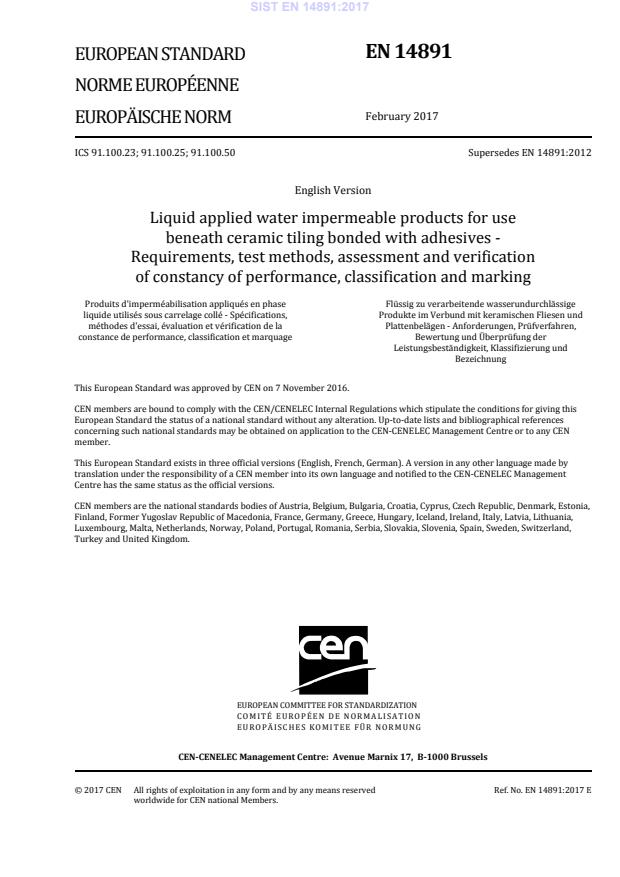
EUROPEAN STANDARD NORME EUROPÉENNE EUROPÄISCHE NORM
EN 14891
February
t r s y ICS
{ sä s r rä t uâ
{ sä s r rä t wâ
{ sä s r rä w r Supersedes EN
s v z { sã t r s tEnglish Version
Liquid applied water impermeable products for use beneath ceramic tiling bonded with adhesives æ Requirementsá test methodsá assessment and verification of constancy of performanceá classification and marking Produits d 5imperméabilisation appliqués en phase liquide utilisés sous carrelage collé æ Spécificationsá méthodes d 5essaiá évaluation et vérification de la constance de performanceá classification et marquage Flüssig zu verarbeitende wasserundurchlässige Produkte im Verbund mit keramischen Fliesen und Plattenbelägen æ Anforderungená Prüfverfahrená Bewertung und Überprüfung der Leistungsbeständigkeitá Klassifizierung und Bezeichnung This European Standard was approved by CEN on
y November
t r s xä
egulations which stipulate the conditions for giving this European Standard the status of a national standard without any alterationä Upætoædate lists and bibliographical references concerning such national standards may be obtained on application to the CENæCENELEC Management Centre or to any CEN memberä
translation under the responsibility of a CEN member into its own language and notified to the CENæCENELEC Management Centre has the same status as the official versionsä
CEN members are the national standards bodies of Austriaá Belgiumá Bulgariaá Croatiaá Cyprusá Czech Republicá Denmarká Estoniaá Finlandá Former Yugoslav Republic of Macedoniaá Franceá Germanyá Greeceá Hungaryá Icelandá Irelandá Italyá Latviaá Lithuaniaá Luxembourgá Maltaá Netherlandsá Norwayá Polandá Portugalá Romaniaá Serbiaá Slovakiaá Sloveniaá Spainá Swedená Switzerlandá Turkey and United Kingdomä
EUROPEAN COMMITTEE FOR STANDARDIZATION COMITÉ EUROPÉEN DE NORMALISATION EUROPÄISCHES KOMITEE FÜR NORMUNG
CEN-CENELEC Management Centre:
Avenue Marnix 17,
B-1000 Brussels
t r s y CEN All rights of exploitation in any form and by any means reserved worldwide for CEN national Membersä Refä Noä EN
s v z { sã t r s y ESIST EN 14891:2017
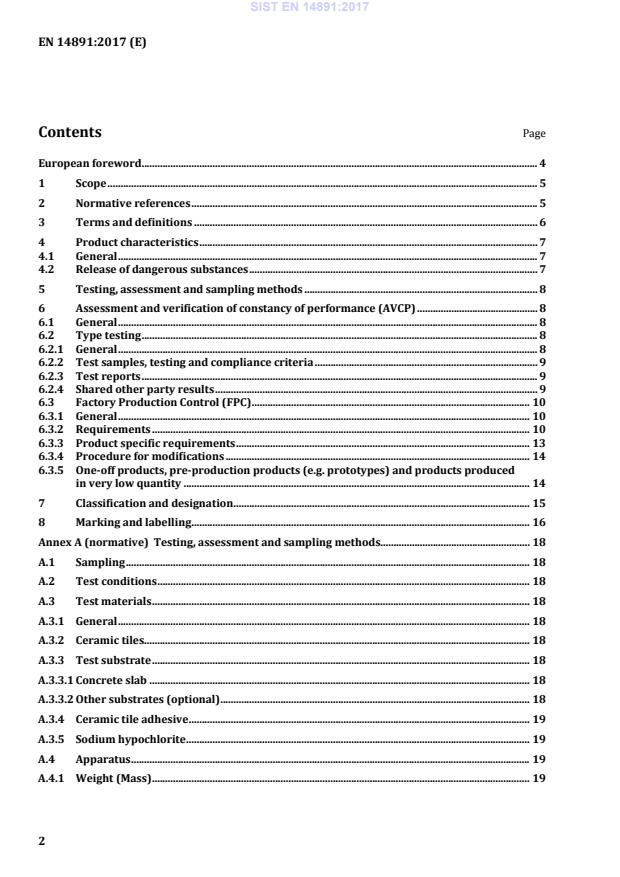
Testing, assessment and sampling methods. 18 A.1 Sampling . 18 A.2 Test conditions . 18 A.3 Test materials . 18 A.3.1 General . 18 A.3.2 Ceramic tiles . 18 A.3.3 Test substrate . 18 A.3.3.1 Concrete slab . 18 A.3.3.2 Other substrates (optional) . 18 A.3.4 Ceramic tile adhesive . 19 A.3.5 Sodium hypochlorite . 19 A.4 Apparatus . 19 A.4.1 Weight (Mass) . 19 SIST EN 14891:2017
Relationship of this European Standard with Regulation (EU) No.305/2011 . 32 ZA.1 Scope and relevant characteristics . 32 ZA.2 System of Assessment and Verification of Constancy of Performance (AVCP) . 33 ZA.3 Assignment of AVCP tasks . 33 Bibliography . 35
· 0,5 N/mm2 A.6.2 Tensile adhesion strength after water contact
· 0,5 N/mm2 A.6.3 or A.6.4 Tensile adhesion strength after heat ageing
· 0,5 N/mm2 A.6.5 Tensile adhesion strength after freeze–thaw cycles
· 0,5 N/mm2 A.6.6 Tensile adhesion strength after contact with lime water
· 0,5 N/mm2 A.6.9 Waterproofing No penetration and
¶ 20 g weight gain A.7 Crack bridging ability under standard conditions
· 0,75 mm A.8.2 1 b OPTIONAL CHARACTERISTICS Characteristic Requirement Test method Tensile adhesion strength after contact with chlorinated water (P)
· 0,5 N/mm2 A.6.7 or A.6.8 Crack bridging ability at low temperature (- 5°C) (O1)
· 0,75 mm A.8.3 Crack bridging ability at very low temperature (- 20°C) (O2)
· 0,75 mm A.8.3 4.2 Release of dangerous substances Materials used in products shall not release any dangerous substances in excess of the maximum permitted levels specified in a relevant European Standard for the material or permitted in the national regulations of the member state of destination. National regulations on dangerous substances may require verification and declaration on release, and sometimes content, when construction products covered by this standard are placed on those markets. In the absence of European harmonized test methods, verification and declaration on release/content should be done taking into account national provisions in the place of use. NOTE An informative database covering European and national provisions on dangerous substances is available at the Construction website on EUROPA accessed through: http://ec.europa.eu/growth/tools-databases/cp-ds/
cementitious liquid-applied water impermeable products; — DM
dispersion liquid-applied water impermeable products; — RM
reaction resin liquid-applied water impermeable products. For each type it is possible to have different classes, related to the different optional characteristics given in Table 1, section 1b. These classes are designated by the following abbreviations: — O1
— O2
with improved crack bridging ability at very
— P
resistant to contact with chlorinated water (i.e. for use in swimming pools). The product is designated by the symbol for the type (CM, DM or RM), followed by the abbreviation of the class or classes it belongs to. Table 4 describes the designation of the products types and classes which shall be used. Table 4 — Classification and designation of liquid-applied water impermeable products SYMBOL DESCRIPTION TYPE CLASS CM
Normal cementitious liquid-applied water impermeable product DM
Normal dispersion liquid-applied water impermeable product RM
Normal reaction resin liquid-applied water impermeable product CM O1 Cementitious liquid-applied water impermeable product with improved crack bridging ability at
CM O2 Cementitious liquid-applied water impermeable product with improved crack bridging ability at very
DM O1 Dispersion liquid-applied water impermeable product with improved crack bridging ability at low
DM O2 Dispersion liquid-applied water impermeable product with improved crack
RM O1 Reaction resin liquid-applied water impermeable product with improved crack bridging ability at low
RM O2 Reaction resin liquid-applied water impermeable product with improved crack bridging ability at very
CM P Cementitious liquid-applied water impermeable product resistant to contact with chlorinated water DM P Dispersion liquid-applied water impermeable product resistant to contact with chlorinated water RM P Reaction resin liquid-applied water impermeable product resistant to contact with chlorinated water SIST EN 14891:2017
...