

FprEN 18255
(Main)Soil improvers and growing media - Determination of organic nitrogen
- Abstract
This document specifies a method for the determination of the organic nitrogen content in soil improvers and growing media.
NOTE This method has been validated in an interlaboratory study with specific products that were present on the market during the study (as included in Annex A, being composted bark (20 mm to 40 mm), biowaste compost (Rottegrad 3), green compost (Rottegrad 5,0 mm to 15 mm), solid digestate and growing media blend 1: white peat, green compost, wood fibre, lime, inorganic fertilizer (NPK + micro elements))).
- Status
- Not Published
- Publication Date
- 13-Jan-2027
- Technical Committee
- CEN/TC 223 - Soil improvers and growing media
- Drafting Committee
- CEN/TC 223/WG 4 - Analytical methods
- Current Stage
- 5020 - Submission to Vote - Formal Approval
- Start Date
- 24-Sep-2026
- Due Date
- 21-Dec-2024
- Completion Date
- 24-Sep-2026

FprEN 18255 is a CEN draft European Standard for determining organic nitrogen in soil improvers and growing media. It specifies a calculation based on total nitrogen, CAT-extractable nitrogen and urea nitrogen, with urea measured by a spectrophotometric method after extraction. Laboratories, manufacturers and quality teams use it when they need a common test method for these materials.
What does FprEN 18255 specify?
FprEN 18255 specifies a method for determining the organic nitrogen content in soil improvers and growing media. Sampling is handled by EN 12579, and sample preparation and dry-matter correction are taken from prEN 13040-1.
The document is organized into scope, normative references, terms and definitions, principle, a detailed urea-nitrogen procedure, calculation and expression of results, test report requirements, and validation of the method. A scope note says the method was validated on market products including composted bark, biowaste compost, green compost, solid digestate, and a growing media blend with white peat, green compost, wood fibre, lime and inorganic fertilizer.
| Annex | What it covers |
|---|---|
| Annex A (informative) | Performance characteristics of the method from an interlaboratory study. |
What are the key requirements of FprEN 18255?
FprEN 18255 builds organic nitrogen from separate nitrogen measurements. In practice, users need total nitrogen, CAT-extractable nitrogen and urea nitrogen before they can calculate the final result.
Measuring urea nitrogen
- Clause 5 extracts the sample with water and a clarifying agent, filters the suspension, and reacts dissolved urea with 4-(dimethylamino)benzaldehyde (4-DMAB).
- The coloured product is measured at 435 nm, so a spectrophotometer is required.
- Clause 5.2 and 5.3 list the main reagents and equipment, including Carrez solutions, activated carbon, a horizontal shaker and a balance accurate to 0.001 g.
- Clause 5.4 says sampling is outside the method and refers users to EN 12579; the sample must be representative and unchanged by transport or storage.
- Clause 5.5 requires dried samples prepared according to prEN 13040-1 and gives the test-portion approach for unknown or highly staining samples.
- The urea result is corrected with dry matter data, so the laboratory needs the dry matter content of the 70 °C dried sample from prEN 13040-1.
Converting results to organic nitrogen
- Clause 4 states that organic nitrogen is calculated as total nitrogen minus CAT-extractable nitrogen.
- CAT-extractable nitrogen is the sum of ammonium nitrogen, nitrate nitrogen and urea nitrogen.
- Clause 6 combines total nitrogen from prEN 13654-1 or prEN 13654-2, CAT extraction from prEN 13651, and dry matter and laboratory bulk density from prEN 13040-1.
- Results below the limit of quantification are set to zero for the calculation, and individual results below the LOQ are not used.
- Clause 7 requires the report to identify the sample, give the result in g/kg sample as whole numbers, and record sampling information and any unusual operating details.
- Clause 8 and Annex A provide the validation basis, so users can see the method’s repeatability and reproducibility from interlaboratory testing.
What terms does FprEN 18255 define?
FprEN 18255 applies the terms and definitions of CEN/TS 17732:2022. The document also uses these key terms and abbreviations in the method and calculation.
- CAT - calcium chloride/DTPA extractable nutrients and elements, used for the extractable nitrogen part of the calculation.
- LOQ - limit of quantification; values below it are not carried into the calculation in the same way as measurable results.
- DM - dry matter content of the original sample, used to report results on a dry basis.
- 4-DMAB - 4-(dimethylamino)benzaldehyde, the reagent that forms the measured urea derivative.
- Urea nitrogen - the urea fraction determined in Clause 5 and included in the CAT-extractable nitrogen sum.
- Repeatability - closeness of results under the same conditions, used in Annex A to describe method precision.
- Reproducibility - closeness of results between laboratories, also reported in Annex A.
Who uses FprEN 18255?
FprEN 18255 is used by laboratories that test soil improvers and growing media for product control, incoming inspection or specification checks. It is also relevant to manufacturers, buyers and quality managers who need comparable nitrogen results across lots, suppliers or test reports.
The method is especially useful for organizations handling composted materials, digestates and blended growing media, because Annex A validates the method on five such materials. Certification and regulatory teams can also use it when they need a documented procedure and a defined reporting format.
Which standards are used with FprEN 18255?
| Standard | What it contributes |
|---|---|
| CEN/TS 17732:2022 | Terms and definitions for soil improvers and growing media. |
| EN 12579:2024 | Sampling of soil improvers and growing media. |
| prEN 13040-1:2025 | Sample preparation, dry matter content, moisture content and laboratory bulk density. |
| prEN 13651:2025 | CAT extraction for soluble nutrients and elements used in the calculation. |
| prEN 13654-1:2025 | Total nitrogen by the modified Kjeldahl method. |
| prEN 13654-2:2025 | Total nitrogen by the Dumas method. |
| ISO 5725-2 | Accuracy, repeatability and reproducibility framework used for validation. |
| EN 15604 and CEN/TS 17771 | Other nitrogen-determination methods mentioned as alternatives for urea or nitrogen analysis. |
What does the FprEN 18255 document contain?
FprEN 18255 contains a wet-chemical spectrophotometric procedure for urea nitrogen, including extraction, clarification, filtration, calibration and measurement at 435 nm. It also contains the calculation formulas that turn the measured urea value, total nitrogen and CAT-extractable nitrogen into organic nitrogen on a dry-matter basis.
Clause 7 gives the test report items, so laboratories know what to record and report. Clause 8 and Annex A summarize the validation work, including the interlaboratory study and the precision data in Tables A.1 and A.2.
Get Certified
Connect with accredited certification bodies for this standard

Control Union Certifications
Global certification for agriculture and sustainability.

ECOCERT
Organic and sustainability certification.

FSC International
Forest Stewardship Council certification.
Sponsored listings
Frequently Asked Questions
FprEN 18255 is a draft published by the European Committee for Standardization (CEN). Its full title is "Soil improvers and growing media - Determination of organic nitrogen". This standard covers: This document specifies a method for the determination of the organic nitrogen content in soil improvers and growing media. NOTE This method has been validated in an interlaboratory study with specific products that were present on the market during the study (as included in Annex A, being composted bark (20 mm to 40 mm), biowaste compost (Rottegrad 3), green compost (Rottegrad 5,0 mm to 15 mm), solid digestate and growing media blend 1: white peat, green compost, wood fibre, lime, inorganic fertilizer (NPK + micro elements))).
This document specifies a method for the determination of the organic nitrogen content in soil improvers and growing media. NOTE This method has been validated in an interlaboratory study with specific products that were present on the market during the study (as included in Annex A, being composted bark (20 mm to 40 mm), biowaste compost (Rottegrad 3), green compost (Rottegrad 5,0 mm to 15 mm), solid digestate and growing media blend 1: white peat, green compost, wood fibre, lime, inorganic fertilizer (NPK + micro elements))).
FprEN 18255 is classified under the following ICS (International Classification for Standards) categories: 65.080 - Fertilizers. The ICS classification helps identify the subject area and facilitates finding related standards.
FprEN 18255 is associated with the following European legislation: EU Directives/Regulations: 2003/2003, 2019/1009; Standardization Mandates: M/564, M/564 Amd 1, M/564 Amd 2, M/588, M/XXX. When a standard is cited in the Official Journal of the European Union, products manufactured in conformity with it benefit from a presumption of conformity with the essential requirements of the corresponding EU directive or regulation.
FprEN 18255 is available in PDF format for immediate download after purchase. The document can be added to your cart and obtained through the secure checkout process. Digital delivery ensures instant access to the complete standard document.
Standards Content (Sample)
SLOVENSKI STANDARD
oSIST prEN 18255:2025
01-december-2025
Izboljševalci tal in rastni substrati - Določanje organskega dušika
Soil improvers and growing media - Determination of organic nitrogen
Bodenverbesserungsmittel und Kultursubstrate - Bestimmung von organischem
Stickstoff
Amendements du sol et supports de culture - Dosage de l’azote organique
Ta slovenski standard je istoveten z: prEN 18255
ICS:
65.080 Gnojila Fertilizers
oSIST prEN 18255:2025 en,fr,de
2003-01.Slovenski inštitut za standardizacijo. Razmnoževanje celote ali delov tega standarda ni dovoljeno.
oSIST prEN 18255:2025
oSIST prEN 18255:2025
DRAFT
EUROPEAN STANDARD
prEN 18255
NORME EUROPÉENNE
EUROPÄISCHE NORM
October 2025
ICS 65.080
English Version
Soil improvers and growing media - Determination of
organic nitrogen
Bodenverbesserungsmittel und Kultursubstrate -
Bestimmung von organischem Stickstoff
This draft European Standard is submitted to CEN members for enquiry. It has been drawn up by the Technical Committee
CEN/TC 223.
If this draft becomes a European Standard, CEN members are bound to comply with the CEN/CENELEC Internal Regulations
which stipulate the conditions for giving this European Standard the status of a national standard without any alteration.
This draft European Standard was established by CEN in three official versions (English, French, German). A version in any other
language made by translation under the responsibility of a CEN member into its own language and notified to the CEN-CENELEC
Management Centre has the same status as the official versions.
CEN members are the national standards bodies of Austria, Belgium, Bulgaria, Croatia, Cyprus, Czech Republic, Denmark, Estonia,
Finland, France, Germany, Greece, Hungary, Iceland, Ireland, Italy, Latvia, Lithuania, Luxembourg, Malta, Netherlands, Norway,
Poland, Portugal, Republic of North Macedonia, Romania, Serbia, Slovakia, Slovenia, Spain, Sweden, Switzerland, Türkiye and
United Kingdom.
Recipients of this draft are invited to submit, with their comments, notification of any relevant patent rights of which they are
aware and to provide supporting documentation.
Warning : This document is not a European Standard. It is distributed for review and comments. It is subject to change without
notice and shall not be referred to as a European Standard.
EUROPEAN COMMITTEE FOR STANDARDIZATION
COMITÉ EUROPÉEN DE NORMALISATION
EUROPÄISCHES KOMITEE FÜR NORMUNG
CEN-CENELEC Management Centre: Rue de la Science 23, B-1040 Brussels
© 2025 CEN All rights of exploitation in any form and by any means reserved Ref. No. prEN 18255:2025 E
worldwide for CEN national Members.
oSIST prEN 18255:2025
prEN 18255:2025 (E)
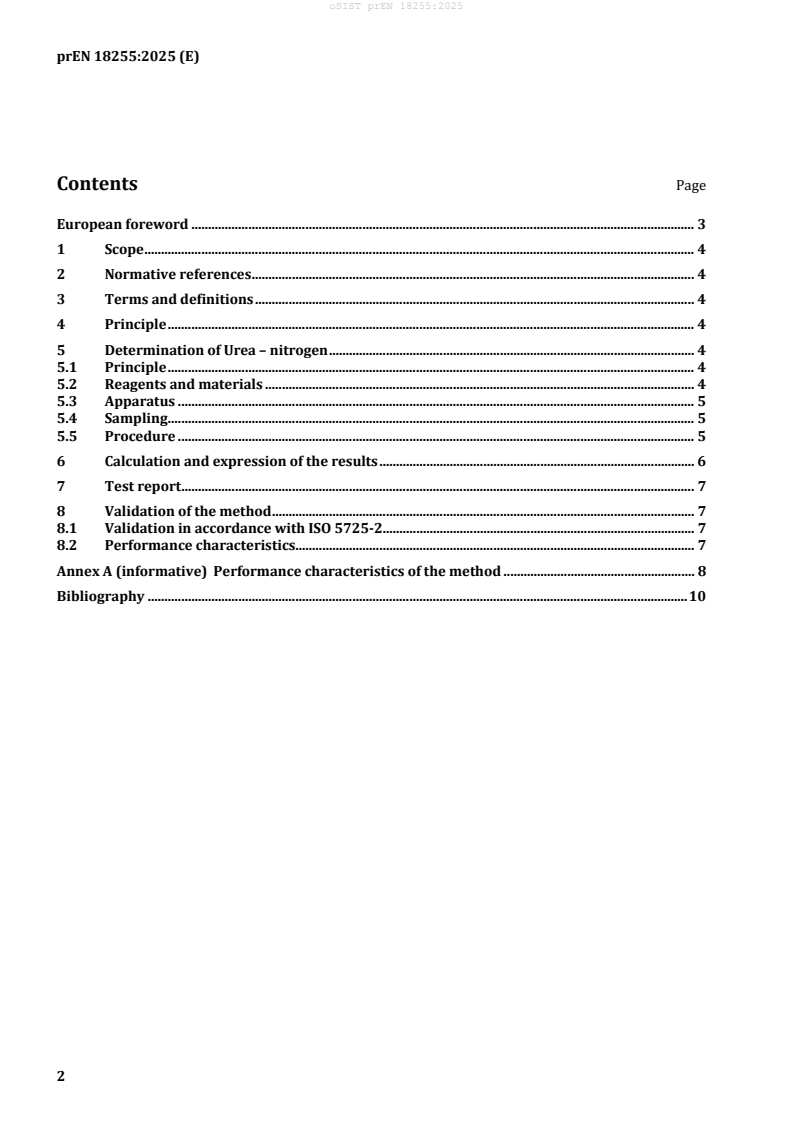
Contents Page
European foreword . 3
1 Scope . 4
2 Normative references . 4
3 Terms and definitions . 4
4 Principle . 4
5 Determination of Urea – nitrogen . 4
5.1 Principle . 4
5.2 Reagents and materials . 4
5.3 Apparatus . 5
5.4 Sampling . 5
5.5 Procedure . 5
6 Calculation and expression of the results . 6
7 Test report . 7
8 Validation of the method . 7
8.1 Validation in accordance with ISO 5725-2. 7
8.2 Performance characteristics. 7
Annex A (informative) Performance characteristics of the method . 8
Bibliography . 10
oSIST prEN 18255:2025
prEN 18255:2025 (E)
European foreword
This document (prEN 18255:2025) has been prepared by Technical Committee CEN/TC 223 “Soil
improvers and growing media”, the secretariat of which is held by NEN, in collaboration with CEN/TC 260
“Fertilizers and liming materials”.
This document is currently submitted to the CEN Enquiry.
This document has been prepared under a standardization request addressed to CEN by the European
Commission. The Standing Committee of the EFTA States subsequently approves these requests for its
Member States.
oSIST prEN 18255:2025
prEN 18255:2025 (E)
1 Scope
This document specifies a method for the determination of the organic nitrogen content in organic soil
improvers.
2 Normative references
The following documents are referred to in the text in such a way that some or all of their content
constitutes requirements of this document. For dated references, only the edition cited applies. For
undated references, the latest edition of the referenced document (including any amendments) applies.
CEN/TS 17732:2022, Soil improvers and growing media - Terminology
EN 12579:2024, Soil improvers and growing media - Sampling
prEN 13040-1:2025, Soil improvers and growing media — Sample preparation — Part 1: Sample
preparation for chemical and physical tests, determination of dry matter content, moisture content and
laboratory bulk density
prEN 13651:2025, Soil improvers and growing media — Extraction of calcium chloride/DTPA (CAT)
soluble nutrients and elements
prEN 13654-1:2025, Soil improvers and growing media — Determination of nitrogen — Part 1: Modified
Kjeldahl method
prEN 13654-2:2025, Soil improvers and growing media — Determination of nitrogen — Part 2: Dumas
method
3 Terms and definitions
For the purposes of this document, the terms and definitions given in CEN/TS 17732:2022 apply.
4 Principle
The content of organic nitrogen is calculated as the difference of the total nitrogen content and the
content of CAT extractable nitrogen calculated as the sum of ammonium nitrogen, nitrate nitrogen and
the urea nitrogen determined as described in this document.
5 Determination of Urea – nitrogen
5.1 Principle
The sample is extracted with water with the addition of a clarifying agent. The suspension is filtered. The
urea that has gone into solution is converted in the filtrate by the addition of 4-
dimethylaminobenzaldehyde (4-DMAB) into a urea-aldehyde condensation compound, the absorbance
of which is measured at 435 nm.
NOTE Additionally to the method described, other methods for the determination of urea nitrogen are possible,
e.g. CEN/TS 17771 or EN 15604.
5.2 Reagents and materials
5.2.1 Ethanol (C H OH), 96 %.
2 5
5.2.2 Hydrochloric acid (HCl) = 37 %; (HCl) = 1,19 g/ml.
oSIST prEN 18255:2025
prEN 18255:2025 (E)
5.2.3 4-(Dimethylamino)benzaldehyde (C H NO) (DMBA).
9 11
5.2.4 4-Dimethylaminobenzaldehyde solution: dissolve 1,6 g DMAB (5.2.3) in 100 ml ethanol (5.2.1)
and add 10 ml hydrochloric acid (5.2.2). The solution is stable for 2 weeks.
5.2.5 Zinc acetate dih
...