

EN 1069-1:2026
(Main)Water slides - Part 1: Safety requirements and test methods
- Abstract
This document is applicable to all water slides installed at open water areas for public use or in swimming pools for public use.
This document specifies general safety requirements for water slides installed at open water areas for public use or in swimming pools for public use and specific requirements for defined types of water slides. These specific safety requirements are also applicable to undefined types as far as possible.
These requirements concern safety and the technical rules for design, calculation and testing.
- Status
- Published
- Publication Date
- 27-Sep-2026
- Drafting Committee
- CEN/TC 136/WG 3 - Water slides and water play equipment
- Current Stage
- 6060 - Definitive text made available (DAV) - Publishing
- Start Date
- 29-Jul-2026
- Due Date
- 28-Sep-2026
- Completion Date
- 28-Sep-2026

EN 1069-1:2026 is a CEN standard for water slides installed in open water areas or swimming pools for public use. It specifies general safety requirements, specific requirements for defined water slide types, and the test methods used to check them. It is written for designers, manufacturers, installers, operators, testers, and others who need to assess whether a water slide is safe to build and use.
What does EN 1069-1:2026 specify?
EN 1069-1:2026 applies to water slides for public use in open water areas and swimming pools. It sets safety requirements and technical rules for design, calculation, and testing, and it also extends type-specific safety provisions to undefined types where that is reasonably possible.
The document is organized into 10 clauses and 4 annexes. Clauses 4 to 10 cover classification, materials and construction, design analysis, safety requirements, additional requirements by type, check and test runs, and designation and marking.
| Annex | What it covers |
|---|---|
| Annex A | Splashdown areas and their dimensions |
| Annex B | Use of stainless steels for water slides |
| Annex C | Design loads, accesses, and platforms |
| Annex D | Acceleration and speed measurements |
What are the key requirements of EN 1069-1:2026?
EN 1069-1:2026 combines geometry, structural design, user safety, and verification rules. In practice, it tells a designer or operator what type of slide they have, how to size and support it, how to control landing and access risks, and what to prove by test.
Classification and special elements
Clause 4 classifies water slides into Types 1 to 7 and also identifies special elements: bowl, lateral oscillation element, uphill element, and wild river. The classification matters because later safety and dimensional requirements depend on the type, especially for slide width, curvature, maximum speed, and landing arrangements.
Materials and construction
Clause 5 requires materials and finishes to suit the intended use, the environment, and high humidity or corrosive conditions. It also requires materials to avoid promoting bacterial growth and limits certain hazardous substances, which matters when selecting plastics, coatings, or metals for wet public facilities.
For safety-critical building materials, Clause 5 points to inspection documentation, and welders must be qualified according to EN ISO 9606-1. The designer must also specify protection or inspection frequency, because corrosion control is part of the slide’s safety case, not just maintenance.
Design analysis and structural loads
Clause 6 treats water slides as structures and requires a preliminary risk analysis at design stage for every slide. That risk analysis has to consider the user group, the setting, and risks such as ejection, impact, falls, entrapment, interference between users, and hazards in the landing area.
The structural analysis uses Eurocode principles and load combinations for self-weight, water load, user load, snow, wind, temperature, impacts, and stabilization actions. This matters in practice because the slide, supports, accesses, and platforms must be designed not only for use loads but also for the environmental and operational loads that affect safety over time.
Accesses, platforms, and fall protection
Clause 7 gives detailed requirements for access routes, stairs, stepladders, platforms, handrails, barriers, slip resistance, and protection against falling. For example, platforms need barriers, access should prevent unintended entry when the slide is not operating, and the slide start area must be arranged so users are not forced forward by people coming from behind.
These provisions matter because many accidents happen before a rider even reaches the slide proper. The clause also controls surface quality, edges, entrapping openings, and start-section layout so that the user stays contained and does not hit exposed parts.
Slide path, landing, and splashdown
Clause 7 also controls the slide proper, the final part, and the landing area. The sliding path must limit instability, turning, tipping, lateral oscillation, and ejection, and acceleration on the rider has to stay within defined limits.
Landing can be by catch unit, sofa unit, surf landing, or splashdown area, depending on the slide type and speed. This matters because landing is one of the main injury points: the slide must slow the rider safely, leave enough water depth or clearance, and prevent collisions with pool walls, obstacles, or other users.
Water supply and user separation
Clause 7.12 requires the water flow rate to be defined at commissioning and protected against unauthorized interference. For some slide types, the preliminary risk analysis determines whether flow monitoring and an alarm are needed.
Clauses 7.13 and 7.14 require the slide to be arranged so users do not interfere with one another or with non-users. In practice, this means spacing, access control, and clearance zones must be designed into the facility, not left to operating rules alone.
Check, test runs, and marking
Clause 9 requires technical and physical checks, and for Types 3 to 7 and special elements it requires a practical test by at least 3 slide testers under supervision. When accelerations or speeds cannot be calculated with enough certainty, measurements are taken using Annex D or an equivalent method.
Clause 10 requires a designation system and marking on the installed slide. That helps operators identify the slide type and gives users and inspectors a visible reference for the installed equipment.
What terms does EN 1069-1:2026 define?
- Water slide - Equipment or an installation with a sliding surface on which the user moves with water as the friction- and/or speed-reducing medium.
- Public use - Use open to everyone or to a defined user group, not limited to the owner’s family and guests.
- Slide proper - The part intended for sliding, distinct from the access, start, and landing areas.
- Final part - The part of the slide proper that prepares the user for landing.
- Catch unit - An integral part that brings the rider to a halt in the sliding position.
- Sofa unit - An integral part that slows the rider and moves them sideways out of the path of following users.
- Splashdown area - A pool or part of a pool where the user lands from the slide and is stopped in the water.
- Clearance zone - Controlled space around the user on the slide proper and final part designed to prevent impact with obstacles.
Who uses EN 1069-1:2026?
EN 1069-1:2026 is used by slide designers, manufacturers, installers, operators, slide testers, and inspection bodies. It is also relevant for swimming pool owners, facility managers, and buyers who need to define or review a slide project.
In practice, designers use it for layout, loads, and risk assessment; manufacturers use it for materials, fabrication, and marking; operators use it for commissioning, inspection, and flow control; and testers use it for practical checks and test reports. It is especially relevant in public swimming pools and open-water leisure facilities where user safety depends on both the structure and the way it is operated.
What changed in EN 1069-1:2026 from the previous edition?
EN 1069-1:2026 supersedes EN 1069-1:2017+A1:2019. The stated technical changes are:
- The scope was extended to include open water areas for public use.
- Clause 2 on normative references was revised.
- Clause 3 on terms and definitions was revised.
- Clause 4 on classification was revised, with deletion of Type 2.2 and Types 8, 9, and 10, and addition of special elements.
- Protection against falling was revised and made applicable to all types.
- Landing device and landing area requirements were revised and reorganized.
- Splashdown area requirements were moved and revised.
- Clause 8 on additional safety requirements was revised, including updated dimensional requirements and figures.
- Editorial changes were made throughout the document.
Which standards are used with EN 1069-1:2026?
| Reference | What it contributes |
|---|---|
| prEN 1069-2:2025 | Instructions for water slides, including information and documentation requirements |
| EN 1990 | Basis for structural and geotechnical design |
| EN 1991-1-1 | Imposed loads and self-weight for structures |
| EN 1991-1-3:2025 | Snow loads |
| EN 1991-1-4 | Wind actions |
| EN 10088-1 | List of stainless steels |
| EN 10088-2 | Technical delivery conditions for stainless steel sheet, plate, and strip |
| EN 10204:2004 | Types of inspection documents for safety-critical materials |
| EN 13451-1:2020+A1:2024 | General safety requirements and test methods for pool equipment |
| EN 13451-2 | Safety requirements for ladders, stepladders, and handle bends |
| EN 13451-3 | Safety requirements for inlets, outlets, and water/air-based leisure features |
| EN 15288-1:2018+A1:2024 | Safety requirements for design of public swimming pools |
| EN 15288-2 | Safety requirements for operation of public swimming pools |
| EN 22768-1 | General tolerances for linear and angular dimensions |
| EN ISO 9606-1 | Qualification testing of welders for fusion welding |
| EN ISO/IEC 17025 | Competence requirements for testing and calibration laboratories |
What does the EN 1069-1:2026 document contain?
EN 1069-1:2026 contains classification tables, dimensional rules, structural load rules, and type-specific safety provisions. It also includes normative annexes with splashdown area layouts, stainless steel selection guidance, and design loads for accesses and platforms.
The document gives practical test methods for checking sliding behavior, acceleration, speed, and landing safety. It also includes a test-report structure, so results can be documented in a way that supports commissioning, inspection, and conformity assessment.
Relations
- Effective Date
- 09-Jul-2024
- Effective Date
- 22-Nov-2026
- Refers
EN 15288-1:2018+A1:2024 - Swimming pools for public use - Part 1: Safety requirements for design - Effective Date
- 28-Oct-2026
- Effective Date
- 07-Oct-2026
- Effective Date
- 07-Oct-2026
- Effective Date
- 07-Oct-2026
- Effective Date
- 07-Oct-2026
- Effective Date
- 05-Aug-2026
- Effective Date
- 05-Aug-2026
- Effective Date
- 05-Aug-2026
- Effective Date
- 05-Aug-2026
- Effective Date
- 05-Aug-2026
- Effective Date
- 05-Aug-2026
- Effective Date
- 05-Aug-2026
Frequently Asked Questions
EN 1069-1:2026 is a standard published by the European Committee for Standardization (CEN). Its full title is "Water slides - Part 1: Safety requirements and test methods". This standard covers: This document is applicable to all water slides installed at open water areas for public use or in swimming pools for public use. This document specifies general safety requirements for water slides installed at open water areas for public use or in swimming pools for public use and specific requirements for defined types of water slides. These specific safety requirements are also applicable to undefined types as far as possible. These requirements concern safety and the technical rules for design, calculation and testing.
This document is applicable to all water slides installed at open water areas for public use or in swimming pools for public use. This document specifies general safety requirements for water slides installed at open water areas for public use or in swimming pools for public use and specific requirements for defined types of water slides. These specific safety requirements are also applicable to undefined types as far as possible. These requirements concern safety and the technical rules for design, calculation and testing.
EN 1069-1:2026 is classified under the following ICS (International Classification for Standards) categories: 97.220.40 - Outdoor and water sports equipment. The ICS classification helps identify the subject area and facilitates finding related standards.
EN 1069-1:2026 has the following relationships with other standards: It is inter standard links to EN 1069-1:2017+A1:2019, EN ISO 2768:2026, EN 15288-1:2018+A1:2024, EN 1991-1-1:2025, EN 13451-2:2015+A1:2020, EN 1991-1-3:2025, EN 1991-1-4:2026, EN 13451-3:2011+A1:2013, EN 13451-3:2022+A1:2025, EN 13451-3:2011+A2:2014, EN 13451-3:2011+A3:2016, EN 17232:2020, EN 13451-3:2022, EN 13451-3:2011. Understanding these relationships helps ensure you are using the most current and applicable version of the standard.
EN 1069-1:2026 is available in PDF format for immediate download after purchase. The document can be added to your cart and obtained through the secure checkout process. Digital delivery ensures instant access to the complete standard document.
Standards Content (Sample)
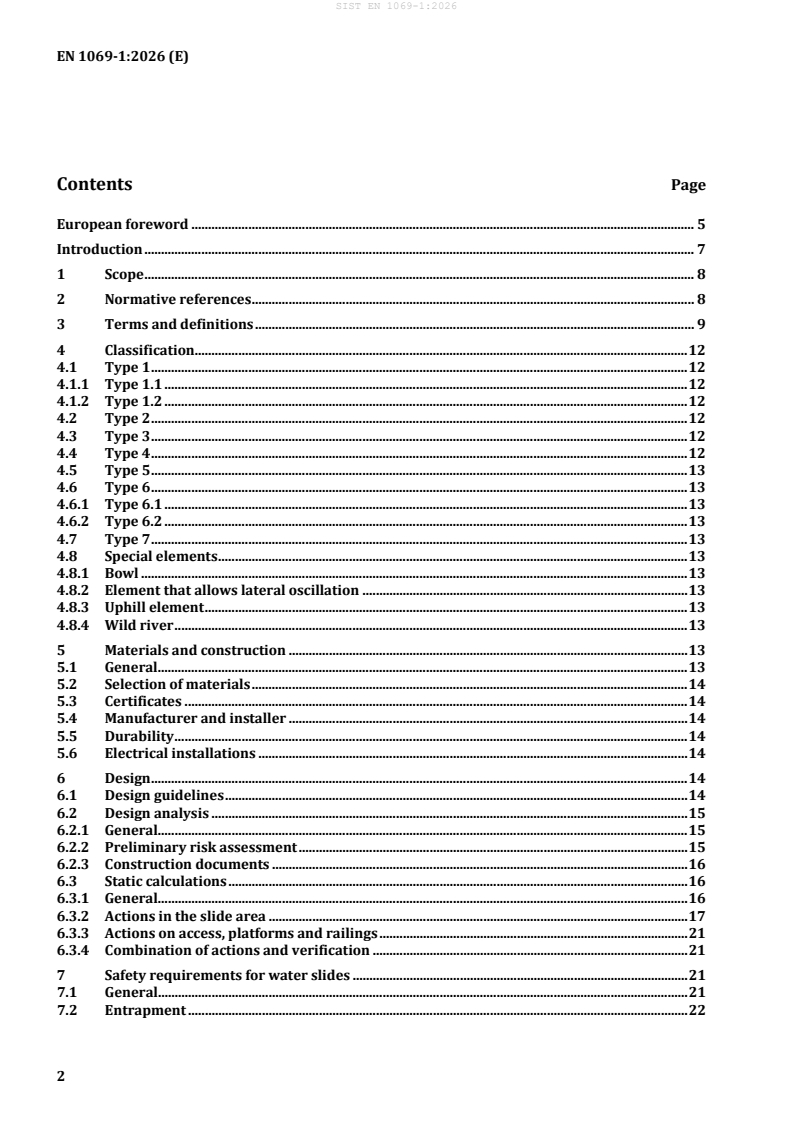
Contents
- Introduction
- 1 Scope
- 2 Normative references
- 3 Terms and definitions
- 3.1 pool/swimming pool
- 3.2 open water area
- 3.3 public use
- 3.4 water slide
- 3.5 platform
- 3.6 start section
- 3.7 slide proper
- 3.8 final part
- 3.9 landing
- 3.10 catch unit
- 3.11 sofa unit
- 3.12 splashdown area
- 3.13 water level
- 3.14 tube
- 3.15 cover
- 3.16 riser
- 3.17 wave screen
- 3.18 ride enhancement device
- 3.19 barrier
- 3.20 average inclination
- 3.21 clearance zone
- 4 Classification
- 4.8 Special elements
- 5 Materials and construction
- 5.1 General
- 5.2 Selection of materials
- 5.3 Certificates
- 5.4 Manufacturer and installer
- 5.5 Durability
- 5.6 Electrical installations
- 6 Design
- 6.1 Design guidelines
- 6.2 Design analysis
- 6.3 Static calculations
- 7 Safety requirements for water slides
- 7.1 General
- 7.2 Entrapment
- 7.3 Surfaces
- 7.4 Corners and edges
- 7.5 Access to water slides
- 7.6 Start section
- 7.7 Slide proper
- 7.8 Tubes and covered sections
- 7.9 Final part
- 7.10 Landing device/landing area
- 7.11 Accessories
- 7.12 Water supply
- 7.13 Interference between users
- 8 Additional safety requirements for Types 1 to 7 and special elements
- 8.1 Slide proper
- 8.2 Splashdown area
- 8.3 Clearance zones
- 8.4 Interference between users and non-users
- 9 Check and test runs
- 9.1 General
- 9.2 Technical and physical checks
- 9.3 Practical test
- 9.4 Test report
- 10 Designation and marking
- 10.1 Designation
- 10.2 Marking
- Annex A
- Annex B
- Annex C
- Annex D
- Bibliography
Introduction
The market for water slides is extremely wide and specific and still developing. It is impossible to define an all-embracing safety specification, including dimensions and design requirements as required by a standard, without limiting the design possibilities and preventing innovative and new but safe products. This document is intended to establish safety requirements and design guidance rules to serve anyone involved with water slides, especially designers, manufacturers, operators and users, to ensure safe and more efficient products. Its basic approach is the consciousness that the sliding action usually implies for the users a higher risk level than using a pool. For certain aspects of design, manufacturing, installation, operation and use only specific guidelines, without any technical specification, are given, which should be taken into consideration and be fulfilled in order to ensure safety for operators and users.
SIST EN 1069-1:2026 EN 1069-1:2026 (E)
1 Scope
This document is applicable to all water slides installed at open water areas for public use or in swimming pools for public use.
This document specifies general safety requirements for water slides installed at open water areas for public use or in swimming pools for public use and specific requirements for defined types of water slides. These specific safety requirements are also applicable to undefined types as far as possible. These requirements concern safety and the technical rules for design, calculation and testing.
2 Normative references
The following documents are referred to in the text in such a way that some or all of their content constitutes requirements of this document. For dated references, only the edition cited applies. For undated references, the latest edition of the referenced document (including any amendments) applies. EN 1069-2:2026, Water slides — Part 2: Instructions EN 1990, Eurocode — Basis of structural and geotechnical design EN 1991-1-1, Eurocode 1 — Actions on structures — Part 1-1: Specific weight of materials, self-weight of construction works and imposed loads for buildings EN 1991-1-3:2025, Eurocode 1 — Actions on structures — Part 1-3: Snow loads EN 1991-1-4, Eurocode 1: Actions on structures — Part 1-4: General actions — Wind actions EN 10088-1, Stainless steels — Part 1: List of stainless steels EN 10088-2, Stainless steels — Part 2: Technical delivery conditions for sheet/plate and strip of corrosion resistant steels for general purposes EN 10204:2004, Metallic products — Types of inspection documents EN 13451-1:2020+A1:2024, Swimming pool equipment — Part 1: General safety requirements and test methods for equipment installed in pools for public use EN 13451-2, Swimming pool equipment — Part 2: Additional specific safety requirements and test methods for ladders, stepladders and handle bends EN 13451-3, Swimming pool equipment — Part 3: Additional specific safety requirements and test methods for inlets and outlets and water/air based water leisure features installed in pools for public use EN 15288-1:2018+A1:2024, Swimming pools for public use — Part 1: Safety requirements for design EN 15288-2, Swimming pools for public use — Part 2: Safety requirements for operation EN 22768-1, General tolerances — Part 1: Tolerances for linear and angular dimensions without individual tolerance indications (ISO 2768-1) EN ISO 9606-1, Qualification testing of welders — Fusion welding — Part 1: Steels (ISO 9606-1) EN ISO/IEC 17025, General requirements for the competence of testing and calibration laboratories (ISO/IEC 17025)
SIST EN 1069-1:2026 EN 1069-1:2026 (E)
3 Terms and definitions
For the purposes of this document, the following terms and definitions apply. ISO and IEC maintain terminology databases for use in standardization at the following addresses:
- ISO Online browsing platform: available at https://www.iso.org/obp/
- IEC Electropedia: available at https://www.electropedia.org/
3.1 pool/swimming pool
facility, with one or more water areas, intended for swimming, leisure or other water-based physical activities [SOURCE: EN 15288-1:2018+A1:2024, 3.1]
3.2 open water area
surface water intended for swimming, leisure without water treatment Note 1 to entry: Water collected on the ground e.g. lakes, rivers, sea …
3.3 public use
use of an installation open to everyone or to a defined group of users, not designated solely for the owner’s/proprietor’s/operator’s family and guests independently from paying an entrance fee Note 1 to entry: Pools serving houses rented for private use are not of public use. [SOURCE: EN 15288-1:2018+A1:2024, 3.5, modified – Note 1 to entry has been added.]
3.4 water slide
piece of equipment or installation with a sliding surface on which the user slides with water as a frictionand/or speed-reducing medium; the user slides freely or with the use of a ride enhancement device Note 1 to entry: On some water slides the user can also be pushed e.g. by a water stream. Note 2 to entry: For classification see Clause 4.
3.5 platform
area providing access to the start section
3.6 start section
area where the user enters the water slide proper and takes the sliding position
3.7 slide proper
area intended for sliding
SIST EN 1069-1:2026 EN 1069-1:2026 (E)
3.8 final part
part of the water slide proper designed to prepare the user for landing
3.9 landing
conclusion of sliding action Note 1 to entry: Types of conclusion can be fall, being slowed down and stopped in a catch unit or sofa.
3.10 catch unit
integral part of a water slide, which brings the rider to a halt in his sliding position Note 1 to entry: See Figure 1 as example.
Key 1 water line Figure 1 — Example of typical catch unit
3.11 sofa unit
integral part of a water slide, which slows down the rider on the sliding surface and moves him additionally sideways out of the sliding path of the following users Note 1 to entry: See Figure 2 as example.
SIST EN 1069-1:2026 EN 1069-1:2026 (E)
Key 1 water line Figure 2 — Example of typical sofa unit
3.12 splashdown area
specific pool or area which is part of a general purpose pool, in which the user lands from the end of the water slide, and is brought to a halt in the water
3.13 water level
defined operating water surface in the landing area
3.14 tube
closed section, not necessarily circular in cross section, of a water slide, with a fully utilisable sliding surface
3.15 cover
device to enclose an open water slide, not intended for sliding
3.16 riser
extension for the water slide proper, intended for sliding
3.17 wave screen
device, placed within the clearance zone, to control spilling water
3.18 ride enhancement device
device to slide on or in, designed for a particular water slide
3.19 barrier
device to restrict users from falling over, under or through it
SIST EN 1069-1:2026 EN 1069-1:2026 (E)
3.20 average inclination
inclination x in percent (%) calculated with the formula xh× 100 / l
where h is the height between start section and beginning of final part, in metres; l is the developed length of the water slide proper excluding the final part, in metres.
3.21 clearance zone
controlled space around the user on the water slide proper and on the final part, designed to prevent the impact of the users with obstacles
4 Classification
4.1 Type 1 4.1.1 Type 1.1 Straight water slides not exceeding 1 000 mm in height from start section to water level and with an average inclination ≤ 70 %.
NOTE This water slide is typically designed for small children. 4.1.2 Type 1.2 Straight slide with an average inclination of ≤ 70 % and a height of 1 000 mm < h ≤ 3 000 mm from start section to water level.
NOTE This water slide is typically designed for children.
4.2 Type 2 Curved single-track water slide with an average inclination of ≤ 70 % and a height of ≤ 3 000 mm from start section to water level.
NOTE This water slide is typically designed for children.
4.3 Type 3 Single-track water slide, with an average inclination of maximum 13 %, excluding the final part. The maximum speed of the users shall be ≤ 8 m/s.
NOTE The average speed of the users is usually ≤ 6 m/s.
4.4 Type 4 Speed single-track water slide with an average inclination between 13 % and 20 %, excluding the final part. The maximum speed of the users shall be ≤ 14 m/s.
NOTE The average speed of the users is usually ≤ 10 m/s.
SIST EN 1069-1:2026 EN 1069-1:2026 (E) 4.5 Type 5 High-speed single-track water slide with an average inclination of at least 20 %, excluding the final part. The maximum speed of the users may be > 14 m/s.
4.6 Type 6 4.6.1 Type 6.1 Multi-track water slide with separate parallel tracks, with an average inclination of maximum 13 % excluding the final part, one beside the other over the full length. The maximum speed of the users shall be ≤ 8 m/s.
NOTE The average speed of the users is usually ≤ 6 m/s.
4.6.2 Type 6.2 Multi-track water slide with separate parallel tracks, with an average inclination of between 13 % and 30 %, excluding the final part. The maximum speed of the users shall be ≤ 14 m/s. NOTE The average speed of the users is usually ≤ 10 m/s.
4.7 Type 7 Wide straight water slide with an average inclination of maximum 35 %. The maximum speed of the users shall be ≤ 8 m/s.
4.8 Special elements
4.8.1 Bowl
Special element within a water slide where the user exits from a water slide of another type into a circular bowl and descends in a spiral path, before either free falling through a hole at the bottom into the splashdown area or entering an additional slide.
4.8.2 Element that allows lateral oscillation
A special element where the user exits from a water slide of another type into a U-shaped part allowing free transversal oscillating sliding in direction to the end of the element. EXAMPLE A cone or a halfpipe.
4.8.3 Uphill element
A special element where the user slides upwards, sometimes with the help of jets or a specific device.
4.8.4 Wild river
A combination of water slide elements with various cross sections where the user slides, floats or swims in a volume of water. The slide can divide in multiple tracks of other types which can congregate to a single track.
5 Materials and construction
5.1 General
Any material may be used for the construction of water slides, supports and ride enhancement devices, provided that it fulfils the requirements of this document.
SIST EN 1069-1:2026 EN 1069-1:2026 (E)
5.2 Selection of materials
All materials and finishes used shall be:
a) suitable for the selected use, the respective surroundings and conditions; b) able to withstand conditions of high humidity with occasional saturation and/or corrosiveness; c) not encouraging the growth of bacteria.
The use of stressed stainless steel subjected to intergranular stress corrosion cracking shall be avoided, unless it can be inspected and regularly cleaned. Where stainless steel is used, the grade used shall be in accordance with Annex B.
5.3 Certificates
Certificates for safety critical building materials (e.g. load bearing materials) shall comply at least with EN 10204:2004, test report “Type 2.2”.
NOTE Specific national regulations can apply.
5.4 Manufacturer and installer
The manufacturer and the installer shall ensure that persons engaged in the construction and the installation of the water slide are competent to carry out the work, and that welders are suitably qualified and accepted according to EN ISO 9606-1. Any assembling, modification, adjustment or alteration of parts shall only be done by persons with appropriate experience and skills.
5.5 Durability
The designer shall specify the method of protection or frequency of inspection. All components shall be protected to minimize degradation caused by corrosion or rot by an approved method. The quality of protection shall depend on the use of the components. Where hollow section structural steel is used, internal corrosion shall be considered.
5.6 Electrical installations
Relevant national and European regulations for electrical installations in and at buildings (e.g. swimming pool, swimming pool surround) apply.
NOTE See HD 60364-7-702.
6 Design
6.1 Design guidelines
The design of a water slide, as a standard model or a one-off installation conforming to the client’s specifications, shall consider at least:
- EN 15288-1 and EN 15288-2;
- the intended user group, e.g. children, adults, users with special requirements;
- ambient conditions, e.g. indoor, outdoor.
In the design document’s possible/allowed user groups, their characteristics and limits shall be indicated. NOTE Various risks can be involved in using a water slide, e.g. ejection from the water slide, impacts, falls, burns, or entrapment. For guidance to a risk assessment, see EN 15288-2 and EN 1069-2.
SIST EN 1069-1:2026 EN 1069-1:2026 (E)
6.2 Design analysis
6.2.1 General
Water slides shall be treated as structures, Type 1 and Type 2 water slides only when applicable. Attention is drawn to the statutory requirements e.g. with regard to means of access and means of support.
6.2.2 Preliminary risk assessment
A preliminary risk assessment shall be performed by the designer at the design stage for every water slide, with the purpose of identifying possible hazards and hazardous situations that can occur by its use, paying attention to the fact that the riding of water slides can be a vigorous physical activity and the risks associated are greater than those usually encountered in a swimming pool. The preliminary risk assessment shall consider different user groups (e.g. adults, children, people with reduced ability). The risk assessment shall ensure the conformity of the design to this document. Some typical issues to be considered are:
- type of water slide;
- intended users;
- implementation of the water slide into a new swimming pool complex;
- integration of the water slide into an existing facility;
- distance control (e.g. interference between users);
- access control (e.g. interference between users and non-users);
- hazards related to the slide proper including those coming from possible vandalism especially parts freely accessible;
- hazards related to the landing;
- risky behaviours of the users;
- surroundings;
- traffic to and from the water slide;
- influence of the use of the water slide on the regular operation of the whole facility. The risks shall be assessed against the safety of user groups, especially of those with special needs. This assessment is even more important for water slides not yet classified in this document and shall also consider the specific safety requirements given in Clause 8, to comply with them as far as possible. The results of the preliminary risk assessment shall be made available to the water slide tester who will perform the practical test according to 9.3.
NOTE Specific national regulation can apply.
SIST EN 1069-1:2026 EN 1069-1:2026 (E)
6.2.3 Construction documents
The construction documents shall be provided to the customer. They shall contain all documents required for the assessment of the stability and operational safety of the water slide. The requirements for documentation given in EN 1069-2:2026, Clause 6 shall be observed. The construction documents for Type 3 to Type 7 and special elements shall include as a minimum:
- type of water slide;
- declaration of conformity to this document for the construction;
- full design and fabrication drawings;
- statement about intended use;
- construction method statement;
- comprehensive stress and stability analysis as required by the Eurocodes;
- description of special features of the water slide;
- description and dimensions of any clearance zones;
- specification of all materials;
- specification of electrical installation;
- any restrictions related to the users;
- name and/or logo and the address of the manufacturer, supplier, importer or installer;
- designation.
NOTE Type 1 and Type 2 water slides can require a simplified documentation.
6.3 Static calculations
6.3.1 General
The structural analysis of the complete water slide including the supports shall be performed using the safety concept according to Eurocode EN 1990 and associated parts using the partial factor method according to Table 1, Table 2 and Table 3 and the combination factors according to Table 4. Table 1 — Partial factors for Ultimate Limit combinations Permanent actions Variable actions Unfavourable Favourable Leading variable action Accompanying action γ = 1,35 γ = 1,00 γ = 1,50 γ = 1,50 G,i G,i Q,1 Q,i
SIST EN 1069-1:2026 EN 1069-1:2026 (E) Table 2 — Partial factors for serviceability combinations Permanent actions Variable actions Unfavourable Favourable Leading variable action Accompanying action γ = 1,00 γ = 1,00 γ = 1,00 γ = 1,00 G,i G,i Q,1 Q,i
Table 3 — Partial factors for combinations of accidental actions Permanent actions Variable actions Unfavourable Favourable Leading variable action Accompanying action γG,i = 1,00 γG,i = 1,00 γQ,1 = 1,00 γQ,i = 1,00
Table 4 — Combination factors ψ , ψ and ψ 0 1 2 Action ψ ψ ψ 0 1 2 Snow loads - Sites located at altitude > 1 000 m a.s.L 0,35 0,25 0,1 - Sites located at altitude < 1 000 m a.s.L 0,25 0,1 0 Wind loads 0,30 0,1 0 Temperature changes 0,30 0,25 0 NOTE In some European countries, a certificate on the correct construction of the water slide by an inspection body can be required to certify that the entire construction of the water slide and the way it is erected complies with all relevant standards and laws.
6.3.2 Actions in the slide area
6.3.2.1 Self-weight G
k The self-weight of each part of the water slide shall be determined by an expert using calculations or tests of the material of each part.
The self-weight is a permanent action with the duration “permanent”.
6.3.2.2 Action of water Wa
k To determine the load of the water, the real amount of water on the water slide shall be calculated considering cross-section and slope of the slide.
If the water slide is combined from sections with different slopes, each section shall be calculated separately, e.g. for sections with a slope of < 5 % and > 20 %. If users can dam up water in sections with a slope of < 20 % then the calculated amount of water in this section shall be doubled. The action of water is a variable action with the duration “short”.
6.3.2.3 Action by the users Q and F
k,i x,i Actions caused by the users of the water slide shall be calculated according to Table 5.
SIST EN 1069-1:2026 EN 1069-1:2026 (E) Table 5 — Actions by the users of the water slide a Data to calculate centrifugal forces F x,i Point of load Actions by the Length of application Type users of the Max. speed of Length of load weight above bottom water slide Q k,i users application (according to Figure 3) m m/s m m 1 0,8 kN/m — — — — e 2 0,8 kN/m 5,0 3,5 5,0 0,1 e 3 1,5 kN/m 5,0 3,5 5,0 0,1 b b 8,0 1,0 4 1,5 kN/m 1,0 14,0 1,0 0,35 5 1,5 kN/m 1,0 16,0 1,0 0,35 e 6.1 1,5 kN/m 5,0 3,5 5,0 0,1 b b 8,0 1,0 6.2 1,5 kN/m 1,0 14,0 1,0 0,35 2 c e 7 1,5 kN/m — 8,0 5,0 0 d 0,5 kN — — Special elements shall be considered according to their type of use, e.g. single sliding or chain sliding. It is important that the length or area of load is set correctly. a Max. acceleration on a sliding person 7.7.3.
b Single person.
Over the complete sliding surface.
d Horizontal force on the side of the water slide in a height of 0,5 m above the bottom. e Chain sliding with max. 5 persons.
...