

prEN 14972-18
(Main)Fixed firefighting systems - Water mist systems - Part 18: Test protocol for local application involving flammable liquid fires for open nozzle systems
- Abstract
This document specifies the evaluation of the fire performance of water mist systems used for local application involving flammable liquid fires.
The tests specified in this document are applicable to the following:
a) flammable liquid pool fires where the liquid release can be confined to a bunded area, where the entire surface of the bunded area is protected by the water mist system;
b) flammable liquid channel fires in channels not exceeding the maximum specified width of the water mist system and with no limited channel length;
c) partially obstructed flammable liquid pool fires where the percentage of obstructed surface is limited to that tested;
d) spray fires up to 6 MW fuelled by flammable liquids;
e) spray and pool fire combinations where confined to a bunded area;
f) flammable liquid residues (ink and paper dust) on printing presses.
- Status
- Not Published
- Publication Date
- 26-Apr-2028
- Technical Committee
- CEN/TC 191 - Fixed firefighting systems
- Drafting Committee
- CEN/TC 191/WG 10 - Water mist systems
- Current Stage
- 4060 - Closure of enquiry - Enquiry
- Start Date
- 10-Sep-2026
- Due Date
- 08-Apr-2027
- Completion Date
- 10-Sep-2026

prEN 14972-18 is a draft European Standard from CEN for testing fixed water mist systems with open nozzles. It specifies how to evaluate fire performance for local application on flammable-liquid hazards, including pool fires, channel fires, spray fires, combined pool-and-spray fires, obstructed pool fires, and residues on printing presses. Manufacturers, test laboratories, and specifiers use it to check whether a water mist system is suitable for the intended application.
What does prEN 14972-18 specify?
prEN 14972-18 specifies the evaluation of fire performance for water mist systems used for local application involving flammable liquid fires. The standard is focused on open nozzle systems and ties each intended use to a defined set of fire tests.
The scope covers these application types:
| Application type | What it covers |
|---|---|
| Flammable liquid pool fires | Fires confined to a bunded area where the whole surface is protected by the water mist system |
| Flammable liquid channel fires | Fires in channels up to the maximum specified width of the system |
| Partially obstructed pool fires | Pool fires where only a limited share of the surface is obstructed |
| Spray fires | Spray fires up to 6 MW fuelled by flammable liquids |
| Combined spray and pool fires | Spray and pool fire combinations confined to a bunded area |
| Printing press residues | Flammable liquid residues such as ink and paper dust on printing presses |
The document is organized into clauses on scope, normative references, terms and definitions, general requirements, test enclosure requirements, test equipment, instrumentation, fire tests, and the test report. Table 1 in Clause 4 links each application type to the fire test scenarios that must be used.
What are the key requirements of prEN 14972-18?
prEN 14972-18 is built around a simple rule: the water mist system has to extinguish the fire scenarios that match its intended application, and it has to do so under controlled, repeatable test conditions. Clause 4 and Table 1 define which scenarios apply, while Clause 8 defines how the tests are run.
Test selection and pass criteria
- Clause 4.1 requires the system to be capable of extinguishing the fire scenarios for the application for which it is intended.
- Table 1 determines which test scenarios apply to square pool fires, channel pool fires, spray fires, combined pool-and-spray fires, obstructed pool fires, offset pool fires, and external ignition cases.
- Clause 4.2.5 limits the protocol to open nozzles only.
- Clause 4.2.2 requires the system to complete all prescribed performance fire tests without manual intervention.
- Clause 4.2.3 requires each fire test to continue until extinguishment.
- Clause 4.2.4 requires the system components, component locations, operating conditions, and test enclosure details to stay unchanged during the test series for a given application.
Installation, supply, and operating conditions
Clause 4.2 sets the conditions that make the comparison meaningful in practice. The water supply has to meet the manufacturer’s minimum operating pressure and flow rate based on the actual pipework layout used in the test scenario, and the tests must use the manufacturer’s DIOM manual [design, installation, operation and maintenance manual] for nozzle placement, spray flux, and spray duration.
The tests are run at the maximum spacing and minimum discharge conditions stated by the manufacturer for that application, with the maximum allowed delay in water pressure build-up. If the system uses intermittent spraying, the off period must stay within the limits given in Clause 4.2.8. In practice, this means a supplier cannot tune the system mid-test - the layout and operating mode must already represent the claimed application.
Clause 4.2.1 also requires keeping up to five nozzles for later verification. That gives traceability if results are reviewed after testing.
Test hall, equipment, and measurements
Clause 5 requires a large open test hall with a minimum ceiling height of 5.0 m and an ambient temperature of (20 ± 10) °C before the test starts. Ventilation is required between tests and for cooling the enclosure.
Clause 6 defines the test hardware. Square pool fires use three tray sizes, channel pool fires use three channel lengths, and the fuel choice depends on volatility: diesel for lower-volatility hazards and heptane for higher-volatility cases within the stated range. Spray fire tests use conventional oil burner nozzles mounted in a fixed flame-stabilizer arrangement.
Clause 7 specifies the measurements that matter for judging the outcome: fuel pressure and flow, hall temperature, fuel temperature, pool or spray temperatures, extinguishment temperature, oxygen, carbon monoxide, carbon dioxide, and ventilation rate where relevant. Measurements are taken at intervals not exceeding 1 s, starting before ignition and continuing after extinguishment. In practice, this gives a record of both fire behavior and the test conditions that influenced it.
Fire test programmes
Clause 8 turns the general rules into test series for each hazard type.
- Clause 8.2 covers square pool fires with different pool sizes and nozzle heights, with a constant grid pattern and constant spray coverage ratio.
- Clause 8.3 covers channel pool fires of increasing length, with nozzles along opposite sides and constant coverage ratio.
- Clause 8.4 covers 6 MW spray fires, including horizontal and vertical spray directions and different nozzle distances from the hazard.
- Clause 8.5 combines a pool fire and a 6 MW spray fire above the pool.
- Clause 8.6 adds an obstruction above a 3X by 3X pool fire using a metal drum.
- Clause 8.7 places a small pool fire in the area of least mist flux to check for weak coverage zones.
- Clause 8.8 adds an external propane torch ignition source to the spray fire test.
Across these cases, the timing before system activation matters. Clause 8 uses different pre-burn times for diesel and heptane, so the hazard is tested when the fire is fully developed enough to be representative but still controlled.
What terms does prEN 14972-18 define?
- Water mist system - A fixed firefighting system that uses water mist to control or extinguish fire in the protected area.
- Open nozzle system - A water mist arrangement with open nozzles, which is the only nozzle type covered by this protocol.
- Bunded area - A contained area that keeps a flammable liquid release within a defined surface for testing.
- DIOM manual - The manufacturer’s design, installation, operation and maintenance manual used to set nozzle placement, spray flux, and spray duration.
- Pre-burn time - The time allowed between ignition and activation of the water mist system.
- Mist flux - The amount and spread of mist over the hazard surface, which must remain comparable as test size changes.
- Extinguishment - The condition used to judge success in the tests, confirmed by the fire going out and the temperature response dropping and staying down.
Who uses prEN 14972-18?
This standard is mainly used by manufacturers of water mist systems, fire test laboratories, and designers who want to qualify an open nozzle system for a specific flammable-liquid hazard. It also matters to quality managers, certification bodies, and buyers who need evidence that a system was tested against a defined fire scenario rather than by general claim.
In practice, users apply it to:
- choose the correct test scenario for a given hazard
- set up the nozzle layout and water supply for testing
- run extinguishment tests under controlled conditions
- document results for product approval, specification, or procurement
- compare performance across pool, channel, spray, and combined fire cases
Which standards are used with prEN 14972-18?
| Standard | What it contributes |
|---|---|
| EN 14972-1:2020+A1:2025 | The base document for design, installation, inspection and maintenance, and the source of the terms and definitions used here |
| EN ISO/IEC 17025 | The laboratory competence framework named for carrying out tests under a recognized testing and calibration system |
The foreword also places this part in the EN 14972 series, which groups the water mist system documents for other occupancies and hazards.
What does the prEN 14972-18 document contain?
- A test matrix in Table 1 that links application types to the required fire scenarios.
- Detailed set-ups for square pool, channel pool, spray, combined pool-and-spray, obstructed pool, offset pool, and external ignition tests.
- Figures that show the nozzle layout, tray arrangement, obstruction placement, and spray-fire geometry.
- Measurement instructions for temperatures, fuel conditions, gas concentrations, and extinguishment confirmation.
- A reporting requirement that sends the results to the test report format in EN 14972-1.
Get Certified
Connect with accredited certification bodies for this standard

CIS Institut d.o.o.
Personal Protective Equipment (PPE) certification body. Notified Body NB-2890 for EU Regulation 2016/425 PPE.

Kiwa BDA Testing
Building and construction product certification.
Kmetijski inštitut Slovenije
Agricultural Institute of Slovenia. Soil testing, plant health, agricultural product analysis.
Sponsored listings
Frequently Asked Questions
prEN 14972-18 is a draft published by the European Committee for Standardization (CEN). Its full title is "Fixed firefighting systems - Water mist systems - Part 18: Test protocol for local application involving flammable liquid fires for open nozzle systems". This standard covers: This document specifies the evaluation of the fire performance of water mist systems used for local application involving flammable liquid fires. The tests specified in this document are applicable to the following: a) flammable liquid pool fires where the liquid release can be confined to a bunded area, where the entire surface of the bunded area is protected by the water mist system; b) flammable liquid channel fires in channels not exceeding the maximum specified width of the water mist system and with no limited channel length; c) partially obstructed flammable liquid pool fires where the percentage of obstructed surface is limited to that tested; d) spray fires up to 6 MW fuelled by flammable liquids; e) spray and pool fire combinations where confined to a bunded area; f) flammable liquid residues (ink and paper dust) on printing presses.
This document specifies the evaluation of the fire performance of water mist systems used for local application involving flammable liquid fires. The tests specified in this document are applicable to the following: a) flammable liquid pool fires where the liquid release can be confined to a bunded area, where the entire surface of the bunded area is protected by the water mist system; b) flammable liquid channel fires in channels not exceeding the maximum specified width of the water mist system and with no limited channel length; c) partially obstructed flammable liquid pool fires where the percentage of obstructed surface is limited to that tested; d) spray fires up to 6 MW fuelled by flammable liquids; e) spray and pool fire combinations where confined to a bunded area; f) flammable liquid residues (ink and paper dust) on printing presses.
prEN 14972-18 is classified under the following ICS (International Classification for Standards) categories: 13.220.20 - Fire protection. The ICS classification helps identify the subject area and facilitates finding related standards.
prEN 14972-18 is available in PDF format for immediate download after purchase. The document can be added to your cart and obtained through the secure checkout process. Digital delivery ensures instant access to the complete standard document.
Standards Content (Sample)
SLOVENSKI STANDARD
01-september-2026
Vgrajeni gasilni sistemi - Sistemi s pršečo vodo - 18. del: Protokol preskušanja
sistemov za lokalno uporabo pri požarih z vnetljivimi tekočinami za sisteme z
odprtimi šobami
Fixed firefighting systems - Water mist systems - Part 18: Test protocol for local
application involving flammable liquid fires for open nozzle systems
Ortsfeste Brandbekämpfungsanlagen - Wassernebelsysteme - Teil18: Prüfprotokoll für
den örtlichen Einsatz bei Bränden mit brennbaren Flüssigkeiten für offene
Düsensysteme
Ta slovenski standard je istoveten z: prEN 14972-18
ICS:
13.220.10 Gašenje požara Fire-fighting
2003-01.Slovenski inštitut za standardizacijo. Razmnoževanje celote ali delov tega standarda ni dovoljeno.
DRAFT
EUROPEAN STANDARD
NORME EUROPÉENNE
EUROPÄISCHE NORM
June 2026
ICS 13.220.20
English Version
Fixed firefighting systems - Water mist systems - Part 18:
Test protocol for local application involving flammable
liquid fires for open nozzle systems
Ortsfeste Brandbekämpfungsanlagen -
Wassernebelsysteme - Teil18: Prüfprotokoll für den
örtlichen Einsatz bei Bränden mit brennbaren
Flüssigkeiten für offene Düsensysteme
This draft European Standard is submitted to CEN members for enquiry. It has been drawn up by the Technical Committee
CEN/TC 191.
If this draft becomes a European Standard, CEN members are bound to comply with the CEN/CENELEC Internal Regulations
which stipulate the conditions for giving this European Standard the status of a national standard without any alteration.
This draft European Standard was established by CEN in three official versions (English, French, German). A version in any other
language made by translation under the responsibility of a CEN member into its own language and notified to the CEN-CENELEC
Management Centre has the same status as the official versions.
CEN members are the national standards bodies of Austria, Belgium, Bulgaria, Croatia, Cyprus, Czech Republic, Denmark, Estonia,
Finland, France, Germany, Greece, Hungary, Iceland, Ireland, Italy, Latvia, Lithuania, Luxembourg, Malta, Netherlands, Norway,
Poland, Portugal, Republic of North Macedonia, Romania, Serbia, Slovakia, Slovenia, Spain, Sweden, Switzerland, Türkiye and
United Kingdom.
Recipients of this draft are invited to submit, with their comments, notification of any relevant patent rights of which they are
aware and to provide supporting documentation.
Warning : This document is not a European Standard. It is distributed for review and comments. It is subject to change without
notice and shall not be referred to as a European Standard.
EUROPEAN COMMITTEE FOR STANDARDIZATION
COMITÉ EUROPÉEN DE NORMALISATION
EUROPÄISCHES KOMITEE FÜR NORMUNG
CEN-CENELEC Management Centre: Rue de la Science 23, B-1040 Brussels
© 2026 CEN All rights of exploitation in any form and by any means reserved Ref. No. prEN 14972-18:2026 E
worldwide for CEN national Members.
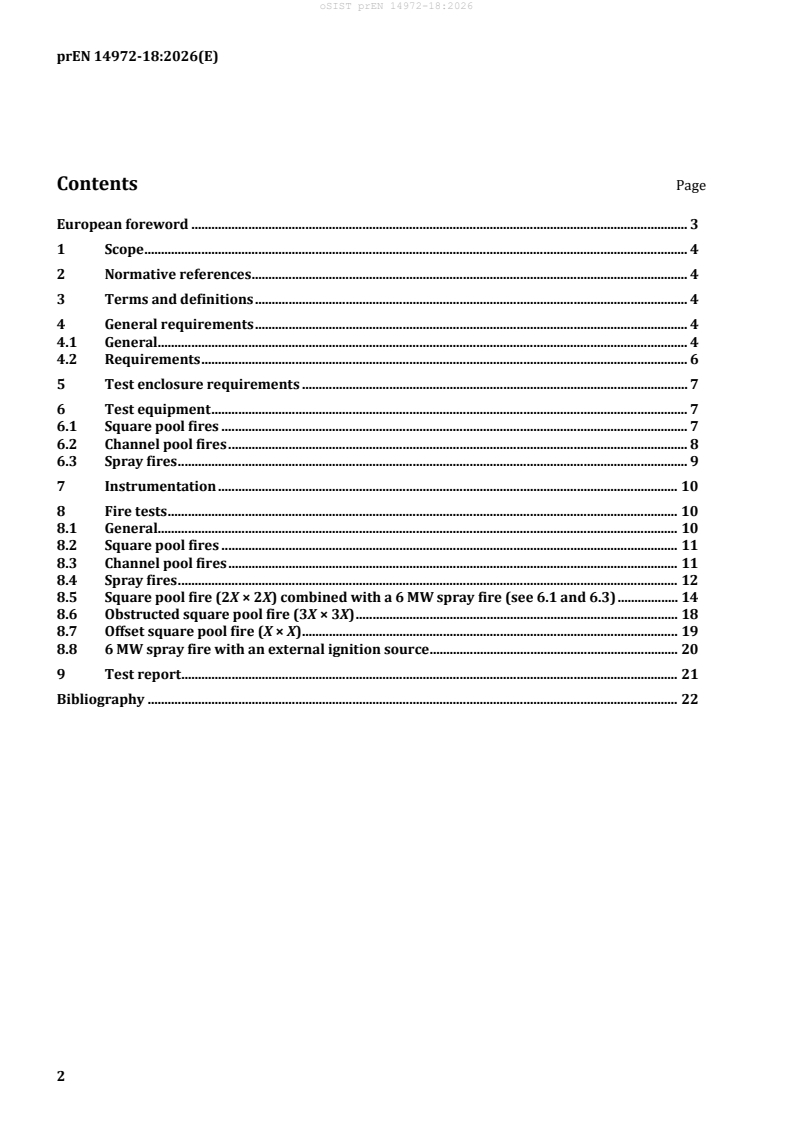
Contents Page
European foreword . 3
1 Scope . 4
2 Normative references . 4
3 Terms and definitions . 4
4 General requirements . 4
4.1 General. 4
4.2 Requirements . 6
5 Test enclosure requirements . 7
6 Test equipment . 7
6.1 Square pool fires . 7
6.2 Channel pool fires . 8
6.3 Spray fires . 9
7 Instrumentation . 10
8 Fire tests . 10
8.1 General. 10
8.2 Square pool fires . 11
8.3 Channel pool fires . 11
8.4 Spray fires . 12
8.5 Square pool fire (2X × 2X) combined with a 6 MW spray fire (see 6.1 and 6.3) . 14
8.6 Obstructed square pool fire (3X × 3X) . 18
8.7 Offset square pool fire (X × X) . 19
8.8 6 MW spray fire with an external ignition source . 20
9 Test report . 21
Bibliography . 22
European foreword
This document (prEN 14972-18:2026) has been prepared by Technical Committee CEN/TC 191 “Fixed
firefighting systems”, the secretariat of which is held by BSI.
This document is currently submitted to the CEN Enquiry.
EN 14972, Fixed firefighting systems — Water mist systems, consists of the following parts:
— Part 1: Design, installation, inspection and maintenance;
— Part 2: Test protocol for shopping areas for automatic nozzle systems;
— Part 3: Test protocol for office, school class rooms and hotel for automatic nozzle systems;
— Part 4: Test protocol for non-storage occupancies for automatic nozzle systems;
— Part 5: Test protocol for car garages for automatic nozzle systems;
— Part 6: Test protocol for false floors and false ceilings for automatic nozzle systems;
— Part 7: Test protocol for commercial low hazard occupancies for automatic nozzle systems;
— Part 8: Test protocol for machinery in enclosures exceeding 260 m for open nozzle systems;
— Part 9: Test protocol for machinery in enclosures not exceeding 260 m for open nozzle systems;
— Part 10: Test protocol for atrium protection with sidewall nozzles for open nozzle systems;
— Part 11: Test protocol for cable tunnels for open nozzle systems;
— Part 12: Test protocol for commercial deep fat cooking fryers for manually activated open nozzle
systems;
— Part 13: Test protocol for wet benches and other similar processing equipment for open nozzle systems;
— Part 14: Test protocol for combustion turbines in enclosures exceeding 260 m for open nozzle systems;
— Part 15: Test protocol for combustion turbines in enclosures not exceeding 260 m for open nozzle
systems;
— Part 16: Test protocol for industrial oil cookers for open nozzle systems;
— Part 17: Test protocol for residential occupancies for automatic nozzle systems;
— Part 18: Test protocol for local application involving flammable liquid fires for open nozzle systems.
NOTE This list includes standards that are in preparation and other standards might be added. For current
status of published standards refer to www.cencenelec.eu.
1 Scope
This document specifies the evaluation of the fire performance of water mist systems used for local
application involving flammable liquid fires.
The tests specified in this document are applicable to the following:
a) flammable liquid pool fires where the liquid release can be confined to a bunded area, where the
entire surface of the bunded area is protected by the water mist system;
b) flammable liquid channel fires in channels not exceeding the maximum specified width of the water
mist system and with no limited channel length;
c) partially obstructed flammable liquid pool fires where the percentage of obstructed surface is limited
to that tested;
d) spray fires up to 6 MW fuelled by flammable liquids;
e) spray and pool fire combinations where confined to a bunded area;
f) flammable liquid residues (ink and paper dust) on printing presses.
2 Normative references
The following documents are referred to in the text in such a way that some or all of their content
constitutes requirements of this document. For dated references, only the edition cited applies. For
undated references, the latest edition of the referenced document (including any amendments) applies.
EN 14972-1:2020+A1:2025, Fixed firefighting systems — Water mist systems — Part 1: Design,
installation, inspection and maintenance
3 Terms and definitions
For the purposes of this document, the terms and definitions given in EN 14972-1 apply.
ISO and IEC maintain terminology databases for use in standardization at the following addresses:
— ISO Online browsing platform: available at https://www.iso.org/obp/
— IEC Electropedia: available at https://www.electropedia.org/
4 General requirements
4.1 General
The water mist system shall be capable of extinguishing the fire scenarios in this document for the
application for which it is intended to be used. Table 1 shall be used to determine the fire test scenarios
to be tested.
Table 1 — Fire test scenarios
Application type
Fire test description 2D ignitable combination 2D Spray fire – 2D ignitable
liquid pool fire ignitable liquid pool fire point liquid channel
protection and spray fire protection protection
protection
Square pool fire (see 8.2)
(X × X) pool at X X — —
maximum nozzle
height
(2X × 2X) pool at X X — —
maximum nozzle
height
(3X × 3X) pool at
X X — —
maximum nozzle
height
(3X × 3X) pool at X X — —
minimum nozzle
height
Channel pool fire (see 8.3)
(Y × Y) channel at — — — X
maximum nozzle
height
(Y × 2Y) channel at — — — X
maximum nozzle
height
(Y × 3Y) channel at — — — X
maximum nozzle
height
(Y × 3Y) at minimum — — — X
nozzle height
Spray fire (see 8.4)
Horizontal spray at — — X —
maximum nozzle
distance from spray
Horizontal spray at — — X —
minimum nozzle
distance from spray
Vertical spray at
— — X —
maximum nozzle
distance from spray
Vertical spray at — — X —
minimum nozzle
distance from spray
Combined pool and spray fire (see 8.5)
Arrangement — X — —
Figure 4 a) at
Application type
Fire test description 2D ignitable combination 2D Spray fire – 2D ignitable
liquid pool fire ignitable liquid pool fire point liquid channel
protection and spray fire protection protection
protection
maximum nozzle
height
Arrangement — X — —
Figure 4 b) at
maximum nozzle
height
Arrangement — X — —
Figure 4 c) at
maximum nozzle
height
Arrangement — X — —
Figure 4 d) at
maximum nozzle
height
Arrangement — X — —
Figure 4 e) at
maximum nozzle
height
Obstructed pool fire (see 8.6)
(3X × 3X) at maximum X X — —
nozzle height
(3X × 3X) at minimum X X — —
nozzle height
Obstructed pool fire (see 8.7)
Offset (X × Y) at X X — —
maximum nozzle
height
Offset (X × Y) at X X — —
minimum nozzle
height
6 MW spray fire with an external ignition source (see 8.8)
maximum nozzle — X — —
height
minimum nozzle — X — —
height
4.2 Requirements
4.2.1 Up to a maximum of 5 nozzles used in the fire tests shall be kept for later verification.
4.2.2 The water mist system, operating without manual intervention, shall successfully complete all
described performance fire tests for their specific applications.
4.2.3 The fire tests shall be conducted until the fire is extinguished.
4.2.4 System components, component locations, operating conditions and test enclosure details shall
remain unaltered throughout all of the fire tests for a given application.
4.2.5 The test protocol is only applicable to open nozzles.
4.2.6 The water supply shall be capable of supplying a flow rate and pressure at the minimum operating
pressure and flow rate as specified by the manufacturer. These parameters shall be met based on the
actual layout of the pipework installation as used in the test scenario.
4.2.7 The tests with the water mist system shall be conducted at maximum spacing and minimum
discharge conditions regarding water flow and pressure as specified by the manufacturer for this
application. The system shall be installed to achieve the maximum allowed time delay of water pressure
build up of the system.
4.2.8 All fire tests shall be conducted using the specifications from the manufacturer’s DIOM manual
(design, installation, operation and maintenance manual) in regard to nozzle placement, spray flux, and
spray duration. Sprays may be continuous or intermittent in time. In the case of intermittent, or cycled,
sprays, the time period during which the system is not discharging shall not be greater than 50 % of one
complete on/off cycle. The system off period shall not exceed 1 min.
4.2.9 The tests can be carried out in accordance with EN ISO/IEC 17025.
5 Test enclosure requirements
The fire tests should be conducted in a large open test hall, greater than 500 m in volume, with a
minimum ceiling height of 5,0 m. Ventilation for between tests and cooling of the enclosure shall be
provided.
The test hall shall be at an ambient temperature of (20 ± 10) °C prior to the start of the test. The test hall
shall be at as uniform an ambient temperature as reasonably possible.
6 Test equipment
6.1 Square pool fires
Three test pools, of sizes (X × X), (2X × 2X) and (3X × 3X), as specified by the manufacturer, shall be used.
Each test pool shall be comprised of a square pan or tray, of steel construction, with wall thickness
between 1,73 mm and 3,0 mm and wall height of 100 mm without lip, with smooth surfaces and edges
that are free from imperfections.
Each test pool shall contain a water base of 50 mm in height, with a fuel load of at least 20 mm above the
water surface. Freeboard should be 30 mm. Freeboard may be greater than 30 mm high, if a constant
freeboard height is used for all fire tests.
The test pools shall be configured according to Figure 1.
For hazards with diesel fuels, the test pools shall contain diesel. Where it is intended to use flammable
liquids with volatilities greater than those of diesel, but not greater than those of heptane, the tests shall
be conducted using heptane.
a) (X × X) pool fire
b) (2X × 2X) pool fire
c) (3X × 3X) pool fire
Key
S Maximum nozzle spacing (manufacturer’s specification)
1 Nozzle
Figure 1 — Configuration for square pool
6.2 Channel pool fires
Three test pools of sizes (Y × Y), (Y × 2Y) and (Y × 3Y), as specified by the manufacturer, shall be used.
Each test pool shall be comprised of pan or tray, of steel construction, with wall thickness between
1,73 mm and 3,0 mm thick and wall height of 100 mm high without lip, with smooth surfaces and edges
that are free from imperfections.
Each test pool shall contain a water base of 50 mm in height, with a fuel load of at least 20 mm above the
water surface. Freeboard should be 30 mm. Freeboard may be greater than 30 mm high, if a constant
freeboard height is used for all fire tests.
The test pools shall be configured according to Figure 2.
For hazards with diesel fuels, the test pools shall contain diesel. Where it is intended to use flammable
liquids with volatilities greater than those of diesel, but not greater than those of heptane, then the tests
shall be conducted using heptane.
Key
1 Nozzle
X Maximum latitudinal nozzle spacing (manufacturer’s specification)
Y Maximum channel width (manufacturer’s specification)
Z Maximum nozzle spacing (manufacturer’s specification)
Figure 2 — Configuration for channel pool
6.3 Spray fires
For the spray fire tests, conventional oil burner nozzles according to Table 2 shall be used.
Table 2 — Characteristics of oil burners for tests involving spray fires
Fire type Spray Fuel type Nominal oil Fuel flow Fuel Nominal
a
nozzles pressure temperature heat release
rate
bar kg/s °C MW
Low Lechler Light diesel 8,2 0,16 ± 0,01 20 ± 10 5,8 ± 0,6
pressure model
Heptane 8,2 0,14 ± 0,01 20 ± 10 5,8 ± 0,6
490.728
or
460.728
a
Lechler model 460.728 and Lechler model 490.728 is the trademark of a product supplied by Lechler GmbH,
Ulmer Straße
...