

EN 71-1:2026
(Main)Safety of toys - Part 1: Mechanical and physical properties
- Abstract
This document specifies requirements and methods of tests for mechanical and physical properties of toys.
This document applies to toys for children, toys being any product or material designed or intended, whether or not exclusively, for use in play by children of less than 14 years. It refers to new toys taking into account the period of foreseeable and normal use, and that the toys are used as intended or in a foreseeable way, bearing in mind the behaviour of children.
It includes specific requirements for toys intended for children under 36 months, children under 18 months and for children who are too young to sit up unaided. For example, soft-filled toys with simple features intended for holding and cuddling are considered as intended for use by children under 36 months.
NOTE Information relating to the age grading and age determination of toys can be found in CEN ISO/TR 8124 8 [22] and the European Commission’s Guidance Documents on the Toy Safety Directive.
This document also specifies requirements for packaging, marking and labelling.
This document does not apply to the following toys:
- automatic playing machines, whether coin operated or not, intended for public use;
- toy vehicles equipped with combustion engines;
- toy steam engines;
- toy slings and toy catapults, supplied without projectiles;
- remote control flying toys incorporating rotor blade(s) which are capable of spinning approximately horizontally, each blade being greater than 175 mm in length, measured from the centre of rotation to the blade tip, and with an overall mass of the flying toy greater than 50 g.
This document does not cover musical instruments, sports equipment or similar items but does include their toy counterparts.
Toy slings and toy catapults supplied with projectiles are covered by this document.
This document does not cover electrical safety aspects of toys which are covered by EN IEC 62115.
Furthermore, it does not cover the following items which, for the purpose of this document, are not considered as toys:
a) decorative objects for festivities and celebrations;
b) products for collectors, provided that the product or its packaging bears a visible and legible indication that it is intended for collectors of 14 years of age and above; examples of this category are:
1) detailed and faithful scale models (see A.2),
2) kits for the assembly of detailed scale models,
3) folk dolls and decorative dolls and other similar articles,
4) historical replicas of toys,
5) reproductions of real fire arms;
c) sports equipment including roller skates, inline skates, and skateboards intended for children with a body mass of more than 20 kg;
d) bicycles with a maximum saddle height of more than 435 mm, measured as the vertical distance from the ground to the top of the seat surface, with the seat in a horizontal position and with the seat pillar set to the minimum insertion mark;
e) scooters and other means of transport designed for sport, or which are intended to be used for travel on public roads or public pathways;
f) electrically-driven vehicles which are intended to be used for travel on public roads, public pathways, or the pavement thereof;
g) aquatic equipment intended to be used in deep water, and swimming learning devices for children, such as swim seats and swimming aids;
h) puzzles with more than 500 pieces;
i) guns and pistols using compressed gas, with the exception of water guns and water pistols;
j) bows for archery over 120 cm long;
k) fireworks, including percussion caps which are not specifically designed for toys;
l) products and games using sharp-pointed missiles, such as sets of darts with metallic points;
m) functional educational products, such as electric ovens, irons or other functional products, as defined in EU Directive 2009/48/EC (Toy Safety Directive) [21], operated at a nominal voltage exceeding 24 V which are sold exclusively for teaching purposes under adult supervision...
- Status
- Published
- Publication Date
- 27-Jan-2026
- Technical Committee
- CEN/TC 52 - Safety of toys
- Current Stage
- 6060 - Definitive text made available (DAV) - Publishing
- Start Date
- 28-Jan-2026
- Due Date
- 12-Dec-2024
- Completion Date
- 28-Jan-2026

Overview
EN 71-1:2026 - Safety of toys - Part 1: Mechanical and physical properties (CEN) defines mechanical and physical safety requirements and test methods for toys. It applies to products designed or intended for play by children under 14 years, addressing foreseeable and normal use and typical child behaviour. The standard includes specific provisions for very young children (under 36 months, under 18 months, and those unable to sit unaided) and covers packaging, marking and labelling. Several non‑toy items and specific toy categories (for example certain coin‑operated machines, combustion‑engine toy vehicles, and large flying‑rotor toys) are explicitly excluded.
Key topics and technical requirements
- Scope and age grading: Requirements differ by intended age group (notably under 36 months and under 18 months); guidance on age determination is referenced.
- Mechanical hazards: Tests and limits related to sharp edges/points, protruding parts, moving parts, small parts and choking hazards.
- Structural integrity: Requirements for assembly, tensile and torque strength, impact, drop and compression resistance to ensure parts do not detach or create hazards during normal use.
- Specific toy types: Rules for soft‑filled toys, liquid‑filled toys, balloons, projectile toys, aquatic/inflatable toys, toys intended to bear a child’s weight and heavy immobile toys.
- Functional hazards: Speed limitation for electrically driven ride‑ons, kinetic energy limits for projectiles, magnetic safety tests and acoustic/noise emission limits.
- Packaging, marking and instructions: Mandatory warnings, age labels and user instructions for safe use and foreseeable misuse.
- Comprehensive test methods: Standardised methods are specified - small parts cylinder, torque, tension, drop, impact, compression, soaking, leakage tests, sharpness tests, magnet flux and tension, projectile range/energy, sound pressure measurement, temperature rise and many more.
Applications
- Product safety design and verification for toy manufacturers, designers, R&D and quality teams.
- Third‑party test laboratories and conformity assessment bodies performing type testing and certification.
- Regulatory compliance for importers, distributors and retailers selling toys in CEN member markets.
- Legal and compliance teams ensuring conformity with the Toy Safety Directive and national market surveillance.
Who should use this standard
- Toy manufacturers and OEMs
- Testing and certification laboratories
- Regulatory authorities and market surveillance bodies
- Design engineers and safety officers in the toy supply chain
Related standards
- EN IEC 62115 (electrical safety of toys) - electrical aspects not covered by EN 71‑1
- CEN ISO/TR 8124‑8 and EU Toy Safety Directive guidance - age grading and determination
Keywords: EN 71‑1:2026, safety of toys, mechanical and physical properties, toy testing, CEN, toy standards, packaging, labelling, age grading, projectiles, magnets, acoustics.
Relations
- Effective Date
- 19-Jan-2023
- Effective Date
- 25-Feb-2026
- Effective Date
- 25-Feb-2026
- Refers
ISO 4593:1993 - Plastics — Film and sheeting — Determination of thickness by mechanical scanning - Effective Date
- 25-Feb-2026
- Effective Date
- 25-Feb-2026
- Effective Date
- 25-Feb-2026
- Effective Date
- 25-Feb-2026
- Effective Date
- 25-Feb-2026
- Effective Date
- 25-Feb-2026
- Effective Date
- 25-Feb-2026
- Effective Date
- 25-Feb-2026
- Effective Date
- 25-Feb-2026
- Effective Date
- 25-Feb-2026
- Effective Date
- 25-Feb-2026
- Effective Date
- 25-Feb-2026
Frequently Asked Questions
EN 71-1:2026 is a standard published by the European Committee for Standardization (CEN). Its full title is "Safety of toys - Part 1: Mechanical and physical properties". This standard covers: This document specifies requirements and methods of tests for mechanical and physical properties of toys. This document applies to toys for children, toys being any product or material designed or intended, whether or not exclusively, for use in play by children of less than 14 years. It refers to new toys taking into account the period of foreseeable and normal use, and that the toys are used as intended or in a foreseeable way, bearing in mind the behaviour of children. It includes specific requirements for toys intended for children under 36 months, children under 18 months and for children who are too young to sit up unaided. For example, soft-filled toys with simple features intended for holding and cuddling are considered as intended for use by children under 36 months. NOTE Information relating to the age grading and age determination of toys can be found in CEN ISO/TR 8124 8 [22] and the European Commission’s Guidance Documents on the Toy Safety Directive. This document also specifies requirements for packaging, marking and labelling. This document does not apply to the following toys: - automatic playing machines, whether coin operated or not, intended for public use; - toy vehicles equipped with combustion engines; - toy steam engines; - toy slings and toy catapults, supplied without projectiles; - remote control flying toys incorporating rotor blade(s) which are capable of spinning approximately horizontally, each blade being greater than 175 mm in length, measured from the centre of rotation to the blade tip, and with an overall mass of the flying toy greater than 50 g. This document does not cover musical instruments, sports equipment or similar items but does include their toy counterparts. Toy slings and toy catapults supplied with projectiles are covered by this document. This document does not cover electrical safety aspects of toys which are covered by EN IEC 62115. Furthermore, it does not cover the following items which, for the purpose of this document, are not considered as toys: a) decorative objects for festivities and celebrations; b) products for collectors, provided that the product or its packaging bears a visible and legible indication that it is intended for collectors of 14 years of age and above; examples of this category are: 1) detailed and faithful scale models (see A.2), 2) kits for the assembly of detailed scale models, 3) folk dolls and decorative dolls and other similar articles, 4) historical replicas of toys, 5) reproductions of real fire arms; c) sports equipment including roller skates, inline skates, and skateboards intended for children with a body mass of more than 20 kg; d) bicycles with a maximum saddle height of more than 435 mm, measured as the vertical distance from the ground to the top of the seat surface, with the seat in a horizontal position and with the seat pillar set to the minimum insertion mark; e) scooters and other means of transport designed for sport, or which are intended to be used for travel on public roads or public pathways; f) electrically-driven vehicles which are intended to be used for travel on public roads, public pathways, or the pavement thereof; g) aquatic equipment intended to be used in deep water, and swimming learning devices for children, such as swim seats and swimming aids; h) puzzles with more than 500 pieces; i) guns and pistols using compressed gas, with the exception of water guns and water pistols; j) bows for archery over 120 cm long; k) fireworks, including percussion caps which are not specifically designed for toys; l) products and games using sharp-pointed missiles, such as sets of darts with metallic points; m) functional educational products, such as electric ovens, irons or other functional products, as defined in EU Directive 2009/48/EC (Toy Safety Directive) [21], operated at a nominal voltage exceeding 24 V which are sold exclusively for teaching purposes under adult supervision...
This document specifies requirements and methods of tests for mechanical and physical properties of toys. This document applies to toys for children, toys being any product or material designed or intended, whether or not exclusively, for use in play by children of less than 14 years. It refers to new toys taking into account the period of foreseeable and normal use, and that the toys are used as intended or in a foreseeable way, bearing in mind the behaviour of children. It includes specific requirements for toys intended for children under 36 months, children under 18 months and for children who are too young to sit up unaided. For example, soft-filled toys with simple features intended for holding and cuddling are considered as intended for use by children under 36 months. NOTE Information relating to the age grading and age determination of toys can be found in CEN ISO/TR 8124 8 [22] and the European Commission’s Guidance Documents on the Toy Safety Directive. This document also specifies requirements for packaging, marking and labelling. This document does not apply to the following toys: - automatic playing machines, whether coin operated or not, intended for public use; - toy vehicles equipped with combustion engines; - toy steam engines; - toy slings and toy catapults, supplied without projectiles; - remote control flying toys incorporating rotor blade(s) which are capable of spinning approximately horizontally, each blade being greater than 175 mm in length, measured from the centre of rotation to the blade tip, and with an overall mass of the flying toy greater than 50 g. This document does not cover musical instruments, sports equipment or similar items but does include their toy counterparts. Toy slings and toy catapults supplied with projectiles are covered by this document. This document does not cover electrical safety aspects of toys which are covered by EN IEC 62115. Furthermore, it does not cover the following items which, for the purpose of this document, are not considered as toys: a) decorative objects for festivities and celebrations; b) products for collectors, provided that the product or its packaging bears a visible and legible indication that it is intended for collectors of 14 years of age and above; examples of this category are: 1) detailed and faithful scale models (see A.2), 2) kits for the assembly of detailed scale models, 3) folk dolls and decorative dolls and other similar articles, 4) historical replicas of toys, 5) reproductions of real fire arms; c) sports equipment including roller skates, inline skates, and skateboards intended for children with a body mass of more than 20 kg; d) bicycles with a maximum saddle height of more than 435 mm, measured as the vertical distance from the ground to the top of the seat surface, with the seat in a horizontal position and with the seat pillar set to the minimum insertion mark; e) scooters and other means of transport designed for sport, or which are intended to be used for travel on public roads or public pathways; f) electrically-driven vehicles which are intended to be used for travel on public roads, public pathways, or the pavement thereof; g) aquatic equipment intended to be used in deep water, and swimming learning devices for children, such as swim seats and swimming aids; h) puzzles with more than 500 pieces; i) guns and pistols using compressed gas, with the exception of water guns and water pistols; j) bows for archery over 120 cm long; k) fireworks, including percussion caps which are not specifically designed for toys; l) products and games using sharp-pointed missiles, such as sets of darts with metallic points; m) functional educational products, such as electric ovens, irons or other functional products, as defined in EU Directive 2009/48/EC (Toy Safety Directive) [21], operated at a nominal voltage exceeding 24 V which are sold exclusively for teaching purposes under adult supervision...
EN 71-1:2026 is classified under the following ICS (International Classification for Standards) categories: 97.200.50 - Toys. The ICS classification helps identify the subject area and facilitates finding related standards.
EN 71-1:2026 has the following relationships with other standards: It is inter standard links to EN 71-1:2014+A1:2018, EN IEC 60318-7:2022, EN 50332-1:2013, ISO 4593:1993, EN 61672-1:2013, EN ISO 11201:2010, EN ISO 21920-2:2022, ISO 48-4:2018, EN ISO 3744:2010, EN ISO 25649-3:2024, EN ISO 11202:2010/A1:2021, EN ISO 3745:2012/A1:2017, EN ISO 11202:2010, EN 14682:2014, EN ISO 3745:2012. Understanding these relationships helps ensure you are using the most current and applicable version of the standard.
EN 71-1:2026 is associated with the following European legislation: EU Directives/Regulations: 2009/48/EC; Standardization Mandates: M/589, M/XXX. When a standard is cited in the Official Journal of the European Union, products manufactured in conformity with it benefit from a presumption of conformity with the essential requirements of the corresponding EU directive or regulation.
EN 71-1:2026 is available in PDF format for immediate download after purchase. The document can be added to your cart and obtained through the secure checkout process. Digital delivery ensures instant access to the complete standard document.
Standards Content (Sample)
SLOVENSKI STANDARD
01-julij-2026
Nadomešča:
SIST EN 71-1:2015+A1:2018
Varnost igrač - 1. del: Mehanske in fizikalne lastnosti
Safety of toys - Part 1: Mechanical and physical properties
Sicherheit von Spielzeug - Teil 1: Mechanische und physikalische Eigenschaften
Sécurité des jouets - Partie 1: Propriétés mécaniques et physiques
Ta slovenski standard je istoveten z: EN 71-1:2026
ICS:
97.200.50 Igrače Toys
2003-01.Slovenski inštitut za standardizacijo. Razmnoževanje celote ali delov tega standarda ni dovoljeno.
EN 71-1
EUROPEAN STANDARD
NORME EUROPÉENNE
January 2026
EUROPÄISCHE NORM
ICS 97.200.50 Supersedes EN 71-1:2014+A1:2018
English Version
Safety of toys - Part 1: Mechanical and physical properties
Sécurité des jouets - Partie 1: Propriétés mécaniques et Sicherheit von Spielzeug - Teil 1: Mechanische und
physiques physikalische Eigenschaften
This European Standard was approved by CEN on 14 December 2025.
CEN members are bound to comply with the CEN/CENELEC Internal Regulations which stipulate the conditions for giving this
European Standard the status of a national standard without any alteration. Up-to-date lists and bibliographical references
concerning such national standards may be obtained on application to the CEN-CENELEC Management Centre or to any CEN
member.
This European Standard exists in three official versions (English, French, German). A version in any other language made by
translation under the responsibility of a CEN member into its own language and notified to the CEN-CENELEC Management
Centre has the same status as the official versions.
CEN members are the national standards bodies of Austria, Belgium, Bulgaria, Croatia, Cyprus, Czech Republic, Denmark, Estonia,
Finland, France, Germany, Greece, Hungary, Iceland, Ireland, Italy, Latvia, Lithuania, Luxembourg, Malta, Netherlands, Norway,
Poland, Portugal, Republic of North Macedonia, Romania, Serbia, Slovakia, Slovenia, Spain, Sweden, Switzerland, Türkiye and
United Kingdom.
EUROPEAN COMMITTEE FOR STANDARDIZATION
COMITÉ EUROPÉEN DE NORMALISATION
EUROPÄISCHES KOMITEE FÜR NORMUNG
CEN-CENELEC Management Centre: Rue de la Science 23, B-1040 Brussels
© 2026 CEN All rights of exploitation in any form and by any means reserved Ref. No. EN 71-1:2026 E
worldwide for CEN national Members.
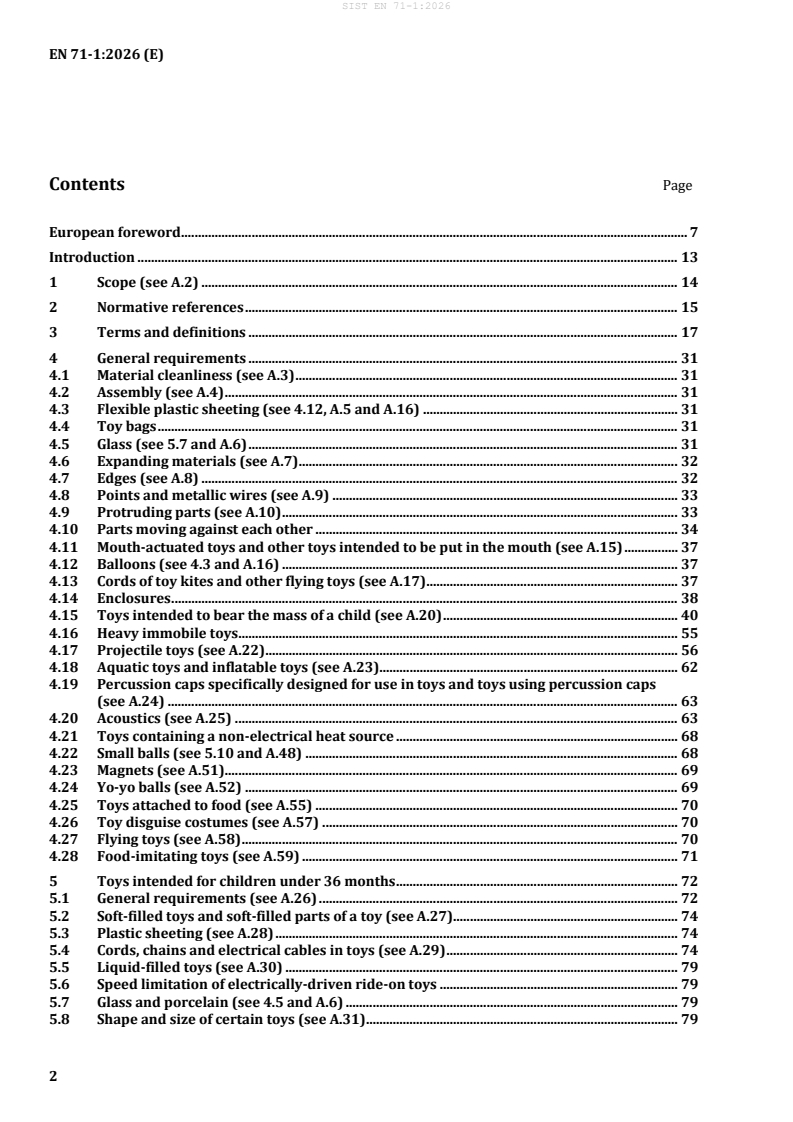
Contents Page
European foreword . 7
Introduction . 13
1 Scope (see A.2) . 14
2 Normative references . 15
3 Terms and definitions . 17
4 General requirements . 31
4.1 Material cleanliness (see A.3) . 31
4.2 Assembly (see A.4) . 31
4.3 Flexible plastic sheeting (see 4.12, A.5 and A.16) . 31
4.4 Toy bags . 31
4.5 Glass (see 5.7 and A.6) . 31
4.6 Expanding materials (see A.7) . 32
4.7 Edges (see A.8) . 32
4.8 Points and metallic wires (see A.9) . 33
4.9 Protruding parts (see A.10) . 33
4.10 Parts moving against each other . 34
4.11 Mouth-actuated toys and other toys intended to be put in the mouth (see A.15) . 37
4.12 Balloons (see 4.3 and A.16) . 37
4.13 Cords of toy kites and other flying toys (see A.17) . 37
4.14 Enclosures . 38
4.15 Toys intended to bear the mass of a child (see A.20) . 40
4.16 Heavy immobile toys . 55
4.17 Projectile toys (see A.22) . 56
4.18 Aquatic toys and inflatable toys (see A.23) . 62
4.19 Percussion caps specifically designed for use in toys and toys using percussion caps
(see A.24) . 63
4.20 Acoustics (see A.25) . 63
4.21 Toys containing a non-electrical heat source . 68
4.22 Small balls (see 5.10 and A.48) . 68
4.23 Magnets (see A.51) . 69
4.24 Yo-yo balls (see A.52) . 69
4.25 Toys attached to food (see A.55) . 70
4.26 Toy disguise costumes (see A.57) . 70
4.27 Flying toys (see A.58) . 70
4.28 Food-imitating toys (see A.59) . 71
5 Toys intended for children under 36 months . 72
5.1 General requirements (see A.26) . 72
5.2 Soft-filled toys and soft-filled parts of a toy (see A.27). 74
5.3 Plastic sheeting (see A.28) . 74
5.4 Cords, chains and electrical cables in toys (see A.29) . 74
5.5 Liquid-filled toys (see A.30) . 79
5.6 Speed limitation of electrically-driven ride-on toys . 79
5.7 Glass and porcelain (see 4.5 and A.6) . 79
5.8 Shape and size of certain toys (see A.31) . 79
5.9 Toys comprised of monofilament fibres (see A.32) . 80
5.10 Small balls (see also 4.22 and A.48) . 80
5.11 Play figures . 80
5.12 Hemispheric-shaped toys (see A.50) . 81
5.13 Suction cups (see A.54) . 83
5.14 Straps intended to be worn fully or partially around the neck (see A.53) . 83
5.15 Sledges with cords for pulling . 83
6 Packaging (see A.56) . 84
7 Warnings, markings and instructions for use (see A.33) . 84
7.1 General . 84
7.2 Toys not intended for children under 36 months (see 4.22 and A.34) . 85
7.3 Latex balloons (see 4.12 and A.16) . 86
7.4 Aquatic toys (see 4.18 and A.23) . 87
7.5 Functional toys (see A.35) . 87
7.6 Hazardous sharp functional edges and points (see 4.7 and 4.8) . 87
7.7 Projectile toys (see 4.17.3.1 and A.22) . 87
7.8 Imitation protective masks and helmets (see 4.14.2 and A.19) . 87
7.9 Toy kites (see 4.13) . 87
7.10 Toys intended to be strung across a cradle, cot, or perambulator (see 5.4.9.1) . 88
7.11 Liquid-filled teethers (see 5.5) . 88
7.12 Percussion caps specifically designed for use in toys (see 4.19) . 88
7.13 Acoustics (see 4.19 and 4.20) . 88
7.14 Toys intended to bear the mass of a child (see 4.15) . 88
7.15 Toys comprised of monofilament fibres (see 5.9) . 92
7.16 Magnetic/electrical experimental sets (see 4.23.3 and A.51) . 92
7.17 Toys with electrical cables exceeding 300 mm in length (see 5.4.6) . 92
7.18 Toys with cords or chains intended for children of 18 months and over but under 36
months (see 5.4.3) . 92
7.19 Toys intended to be attached to a cradle, cot or perambulator (see 5.4.9.2) . 92
7.20 Sledges with cords for pulling . 93
7.21 Flying toys (see 4.27). 93
7.22 Improvised projectiles (see 4.17.4) . 93
8 Test methods . 93
8.1 General requirements for testing . 93
8.2 Small parts cylinder (see 4.6, 4.11, 4.18, 4.23, 4.25, 4.28, 5.1, 5.2 and A.36) . 94
8.3 Torque test (see 4.6, 4.11, 4.14, 4.17, 4.18, 4.22, 4.23, 4.25, 4.28, 5.1, 5.10, 5.12, 5.13
and Clause 6) . 94
8.4 Tension test (see 4.6, 4.9, 4.11, 4.14, 4.17, 4.18, 4.22, 4.23, 4.25, 4.27, 4.28, 5.1, 5.2,
5.3, 5.10, 5.12, 5.13, Clause 6 and A.37) . 95
8.5 Drop test (see 4.5, 4.6, 4.10, 4.14, 4.22, 4.23, 4.25, 5.1, 5.10, 5.12 and 5.13) . 98
8.6 Tip over test (see 4.10, 4.22, 4.23, 5.1, 5.10, 5.12 and 5.13). 98
8.7 Impact test (see 4.5, 4.6, 4.10, 4.14, 4.15, 4.17, 4.22, 4.23, 4.25, 5.1, 5.10, 5.12, 5.13,
8.14 and A.38) . 99
8.8 Compression test (see 4.6, 4.14, 4.17, 4.22, 4.23, 4.25, 5.1, 5.10, 5.12, 5.13 and A.39) . 99
8.9 Soaking test (see 4.11, 4.23, 5.1, 5.10 and 5.12) . 100
8.10 Accessibility of a part or component (see 4.5, 4.7, 4.8, 4.10.2, 4.10.4, 4.15, 4.21, 4.23,
4.27, 4.28, 5.1, 5.2 and 5.7) . 100
8.11 Sharpness of edges (see 4.5, 4.7, 4.9, 4.10, 4.14, 4.15, 4.17, 5.1 and 7.6) . 102
8.12 Sharpness of points (see 4.5, 4.8, 4.9, 4.10, 4.14, 4.15, 4.17, 5.1 and A.40) . 104
8.13 Flexibility of metallic wires (see 4.8 and A.41) . 106
8.14 Expanding materials (see 4.6 and A.7) . 107
8.15 Leakage of liquid-filled toys (see 5.5 and A.42) . 109
8.16 Geometric shape of certain toys (see 5.8 and A.43) . 110
8.17 Durability of mouth-actuated toys (see 4.11 and A.44) . 111
8.18 Folding or sliding mechanisms (see 4.10.1 and A.45) . 111
8.19 Electric resistivity of cords (see 4.13) . 113
8.20 Cords cross-sectional dimension (see 5.4.7) . 113
8.21 Toys intended to bear the mass of a child . 114
8.22 Stability, heavy immobile toys (see 4.16). 133
8.23 Kinetic energy and Kinetic energy density of projectiles (see 4.17.3 and 4.17.4) . 134
8.24 Plastic sheeting . 139
8.25 Determination of emission sound pressure levels (see 4.20) . 139
8.26 Measurement of temperature rises (see 4.21) . 152
8.27 Toy chest lids (see 4.14.1 c)) . 152
8.28 Small balls and suction cups test (see 4.17, 4.22, 4.25, 5.10 and 5.13). 153
8.29 Test for play figures (see 5.11) . 154
8.30 Tension test for magnets (see 4.23.2 and A.51) . 154
8.31 Magnetic flux index (see 4.23.2 and 4.23.3) . 155
8.32 Perimeter of cords and chains (see 5.4.4) . 157
8.33 Yo-yo balls measurements (see 4.24) . 161
8.34 Breakaway feature separation test (see 5.4.2, 5.4.3 and 5.14) . 164
8.35 Self-retracting cords (see 5.4.8) . 164
8.36 Length of cords, chains and electrical cables (see 5.4.2, 5.4.3, 5.4.5 and 5.4.6) . 164
8.37 Assessment of the tangle potential of two cords or chains (see 5.4.3) . 165
8.38 Determination of projectile range (see 4.17) . 166
8.39 Assessment of leading parts of projectiles and flying toys (see 4.27.1 and 4.17.2) . 167
8.40 Length of suction cup projectiles . 168
8.41 Wall impact test for projectiles (see A.22) . 169
8.42 Escape force for toys that a child can enter (See 4.14.1) . 169
8.43 Combinations of ventilation openings (See 4.14.1 and 4.14.2) . 170
Annex A (informative) Background and rationale for this European Standard . 171
A.1 General . 171
A.2 Scope (see Clause 1) . 171
A.3 Material cleanliness (see 4.1) . 171
A.4 Assembly (see 4.2) . 172
A.5 Flexible plastic sheeting (see 4.3) . 172
A.6 Glass (see 4.5 and 5.7) . 172
A.7 Expanding materials (see 4.6 and 8.14) . 172
A.8 Edges (see 4.7) . 173
A.9 Points and metallic wires (see 4.8) . 173
A.10 Protruding parts (see 4.9 and 4.15) . 174
A.11 Folding and sliding mechanisms (see 4.10.1) . 174
A.12 Driving mechanisms (see 4.10.2) . 175
A.13 Hinges (see 4.10.3) . 175
A.14 Springs (see 4.10.4) . 176
A.15 Mouth-actuated toys and other toys intended to be put in the mouth (see 4.11) . 176
A.16 Balloons (see 4.3, 4.12 and 7.3) . 176
A.17 Cords of toy kites (see 4.13) . 176
A.18 Toys which a child can enter (see 4.14.1) . 177
A.19 Masks and helmets (see 4.14.2 and 7.8) . 177
A.20 Toys intended to bear the mass of a child (see 4.15 and 7.14) . 177
A.21 Rocking horses and similar toys (see 4.15.9) . 182
A.22 Projectile toys (see 4.17) . 182
A.23 Aquatic toys and inflatable toys (see 4.18 and 7.4) . 186
A.24 Percussion caps specifically designed for use in toys and toys using percussion caps
(see 4.19) . 187
A.25 Acoustics (see 4.20) . 187
A.26 General requirements for toys intended for children under 36 months (see 5.1) . 190
A.27 Soft-filled toys and soft-filled parts of a toy (see 5.2) . 193
A.28 Adhesion of plastic sheeting (see 5.3) . 193
A.29 Cords and chains in toys (see 5.4) . 193
A.30 Liquid-filled toys (see 5.5 and A.42) . 198
A.31 Shape and size of certain toys (see 5.8 and A.43) . 198
A.32 Toys comprised of monofilament fibres (see 5.9) . 199
A.33 Warnings, markings and instructions for use (see 7.1) . 199
A.34 Warning for toys not intended for children under 36 months (see 7.2) . 201
A.35 Warnings in connection with functional toys (see 7.5) . 201
A.36 Small parts cylinder (see 8.2) . 201
A.37 Tension test (see 8.4) . 202
A.38 Impact test (see 8.7) . 202
A.39 Compression test (see 8.8) . 202
A.40 Sharpness of points (see 8.12) . 202
A.41 Flexibility of metallic wires (see 8.13) . 202
A.42 Leakage of liquid-filled teethers (see 8.15 and A.30) . 202
A.43 Geometric shape of certain toys (see 8.16 and A.31). 202
A.44 Durability of mouth-actuated toys (see 8.17) . 203
A.45 Folding or sliding mechanisms (see 8.18) . 203
A.46 Static strength (see 8.21) . 203
A.47 Kinetic energy of projectiles, bows and arrows (see 8.23) . 203
A.48 Small balls (see 4.22 and 5.10) . 203
A.49 Toy scooters (see 4.15.5) . 205
A.50 Hemispheric-shaped toys (see 5.12) . 205
A.51 Magnets (see 4.23) . 205
A.52 Yo-yo balls (see 4.24) . 208
A.53 Straps intended to be worn fully or partially around the neck (see 5.14) . 211
A.54 Suction cups (see 5.13). 211
A.55 Toys attached to food (see 4.25) . 211
A.56 Packaging (see Clause 6) . 212
A.57 Cords and drawstrings (see 4.26) . 213
A.58 Flying toys, rotors and propellers (see 4.27) . 213
A.59 Food-imitating toys (see 4.28) . 215
Annex ZA (informative) Relationship between this European Standard and the essential
requirements of Directive 2009/48/EC (OJ L 170, 30.6.2009) aimed to be covered . 217
Bibliography . 219
European foreword
This document (EN 71-1:2026) has been prepared by Technical Committee CEN/TC 52 “Safety of toys”,
the secretariat of which is held by DS.
This European Standard shall be given the status of a national standard, either by publication of an
identical text or by endorsement, at the latest by July 2026, and conflicting national standards shall be
withdrawn at the latest by July 2027.
Attention is drawn to the possibility that some of the elements of this document may be the subject of
patent rights. CEN shall not be held responsible for identifying any or all such patent rights.
This document supersedes EN 71-1:2014+A1:2018.
This document has been prepared under a standardization request addressed to CEN by the European
Commission. The Standing Committee of the EFTA States subsequently approves these requests for its
Member States.
For the relationship with EU Legislation, see informative Annex ZA, which is an integral part of this
document.
Additional information on the background and rationale for various requirements are given in Annex A.
This document constitutes the first part of the EN 71 series of standards on safety of toys.
EN 71, Safety of toys, consists of the following parts:
— Part 1: Mechanical and physical properties (this document);
— Part 2: Flammability;
— Part 3: Migration of certain elements;
— Part 4: Experimental sets for chemistry and related activities;
— Part 5: Chemical toys (sets) other than experimental sets;
— Part 7: Finger paints — Requirements and test methods;
— Part 8: Activity toys for domestic use;
— Part 10: Organic chemical compounds — Sample preparation and extraction;
— Part 11: Organic chemical compounds — Methods of analysis;
— Part 12: N-Nitrosamines and N-nitrosatable substances;
— Part 13: Olfactory board games, cosmetic kits and gustative games;
— Part 14: Trampolines for domestic use;
— Part 15: Formamide in foam toy materials (content);
— Part 16: Certain chlorinated phosphorus flame retardants (TCEP, TCPP, TDCP) in toy materials;
— Part 17: Certain isothiazolinones (MIT, CIT, BIT) in aqueous toy materials;
— Part 18: Phenol in aqueous (content) and polymeric (migration) toy materials;
— Part 19: Migration of bisphenol A from toy materials;
— Part 20: Microbiological safety of toys containing accessible aqueous media.
It is up to the user of the standard to determine whether or not a toy is included in the scope of several of
the above parts of the EN 71 series, and to apply each applicable standard accordingly. Normative
references from one part of the EN 71 series to another, are therefore normally not provided in the
individual parts.
NOTE 1 In addition to the above parts of the EN 71 series, the following deliverables have been published:
— CEN/TR 15071, Safety of toys — National translations of warnings and instructions for use in the EN 71 series;
— CEN/TR 15371 (all parts), Safety of toys — Interpretations;
— CEN/TR 16918, Safety of toys — Children’s mouthing behaviour in contact with toys;
— CEN/TR 17695, Safety of toys — Mechanical and physical properties — Guidance on categorisation of projectile
toys within EN 71-1;
— CEN/TS 17973, Safety of toys — Categorization of slime type materials;
— CEN/TR 18217, Safety of toys — Migration of certain elements from polymers;
— CEN/TR 18240, Safety of toys — Mechanical and physical properties — Guidance on the requirements for food-
imitating toys in EN 71-1; and
— CEN ISO/TR 8124-8, Safety of toys — Part 8: Age determination — First age grade for the appropriate play of
toys.
NOTE 2 Words in italics (apart from document titles) are defined in Clause 3 (Terms and definitions).
The following significant editorial and technical changes have been implemented in this new edition:
Clause/Paragraph/ Change
Table/Figure
3.11 Update and clarification of the definition of “close-to-the-ear toy”.
3.28 New definition of the term “flash”.
3.39 Updated definition of the term “large and bulky toy”.
3.40 New definition of the term “latex balloon”.
Deleted the definition of maximum saddle height (was 3.44).
Deleted the definition of plastic sheeting (was 3.52).
3.57 New definition of the term “reference box”.
3.60 New definition of the term “resilient material”.
3.62 New subclause heading for definitions related to ride-on toys.
3.63 Update and clarification of the definition of “soft-filled toy”.
Clause/Paragraph/ Change
Table/Figure
3.78 New definition of the term “toy chest”.
4.6 Revised the requirements for expanding materials.
4.7 Added an exemption for trampolines covered by EN 71-14.
4.8 Added an exemption for trampolines covered by EN 71-14.
4.9 Added clarification about protrusions addressed by the requirements. Added
an exemption for trampolines covered by EN 71-14.
4.10.4 Added an exemption for trampolines covered by EN 71-14.
4.14.1 Updated and clarified the requirement with respect to ventilation, particularly
when multiple openings are used. Added a reference to a new test method for
assessing groups of openings. Added a reference to a new test method for
assessing the escape force.
4.14.2 Updated and clarified the requirement with respect to ventilation, particularly
when multiple openings are used. Added a reference to a new test method for
assessing groups of openings. The figure was updated.
4.15 Update and reformat of the requirements for toys intended to bear the mass of
a child. All requirements for toys intended to bear the mass of a child have been
consolidated under this clause.
4.17.3.2 Updated the note to clarify how leading edges on projectiles can be determined.
4.17.4.3 Clarified that the reference to 4.17.3.2 does not apply.
4.17.4.4 Clarified that the reference to 4.17.3.2 does not apply.
4.18 Clarified which provisions of the referenced standard are excluded.
4.23.3 Clarified the exemption also applies to magnetic components.
4.24 Clarified that yo-yo balls comply with the requirement if the tether breaks
during the testing.
4.28 Added a new requirement for food-imitating toys.
5.1 Added an exemption from the requirements for sand in some circumstances
and confirmed that inflatable toys are assessed inflated or deflated.
5.1 a) Clarified that the test for paperboard components applies to components which
are individually separate and distinct and that it does not apply to parts of
paperboard torn or broken off of larger paperboard components.
5.1 e) Clarified that the requirement also applies to glued wooden components.
5.2 b) Clarified that holes which permit small parts to pass through are not excluded
from the requirement.
5.4.9.1 Clarified that the requirement applies to toys intended to be strung across a
cradle, cot or perambulator by means of strings, cords, elastics or straps.
5.8 Clarified that the requirements do not apply to elements intended to fix toys to
a crib provided the instructions for use indicate the fixings are to be removed
before giving the item to a child.
Clause/Paragraph/ Change
Table/Figure
5.14 Added a requirement to ensure it is possible to join the parts of cords after they
have been separated in line with 5.4.
6 Clarified that the packaging requirements apply regardless of whether the toy
is marked for adult assembly.
7.1 Further clarified that although the subclauses of 7 each include the word
warning, it is permissible to replace several uses of the word warning with a
single use of the word warning.
7.2 Clarified that where the symbol is used it is to be preceded by the word
“warning”.
7.7 Added an example of a toy where it would be considered unreasonable to be
able aim it at the face.
7.14 All warning requirements related to toys intended to bear the mass of a child
have been consolidated under 7.14.
7.14.2 Added a new option of using graphical symbols for indicating that protective
equipment shall be worn.
7.14.10 Added a new requirement that toys intended to bear the mass of a child should
come with appropriate maintenance instructions for use.
8 Clarified the use of the terms “load” and “mass” throughout the clause.
8.4.2.1 Deleted incorrect references to suction cups. Clarified that the tension force is
to be applied in line with the major axis of the component under test or at right
angles to the edge of the component under test.
8.4.2.5 Clarified that the perpendicular tension test should be carried out in the most
onerous direction.
8.4.2.6 Clarified that tension force should be applied to the blade and its connecting
parts only and not to parts such as the centre hub or motor spindle.
8.5 Added an allowance to drop in random orientations when the most onerous
drop orientation cannot be located. Updated the references to standards.
8.7 Clarified the position of the part under test.
8.8 Clarified that the disc through which the compression force is applied, is to be
applied flat, to the surface of the toy.
8.9 Changed the temperature of the water used in the soaking test to align with
other international standards and added tolerances.
8.11.2.2 Updated the normative reference.
8.13 Clarified that the wire should be bent at the clamping point rather than
allowing flexibility of the wire. Clarified what is meant by one test cycle.
8.14 Revised the test method for expanding materials.
8.16 Clarified the test method for the geometric shape of certain toys and divided
into subclauses for templates A and B.
8.21 All test methods related to toys intended to bear the mass of a child have been
consolidated under 8.21.
Clause/Paragraph/ Change
Table/Figure
8.21.3 A revised stability requirement has been included to address fore and aft
stability as well as sideways stability.
8.21.4 A new test method for handlebar impact has been introduced.
8.21.5 A new test method addressing brake performance has been introduced.
8.21.7 Revised forces and an updated method have been introduced in the test method
for the strength of toy scooter steering tubes.
8.21.8 A new method to assess the security of handlebar stems is introduced.
8.21.9 A new method to test the strength of stabilizers is introduced.
8.21.10 A new method to test the security of seat posts has been introduced.
8.23 The test methods related to projectile speed and energy have been updated and
clarified.
8.25.1.5 Removed the referenced standard for the reference box in favour of the newly
defined term.
8.30 Added a requirement for toys that contain one magnet only and no metal
mating component
8.33.2 Clarified that for yo-yo balls where the tether breaks during the test are
considered to comply with the requirement
8.41 The previous 8.4.2.5 (wall impact test) was moved to this new clause.
8.42 Introduced a new method to test the escape force of toys that a child can enter.
8.43 Introduced a new test method to check when combinations of ventilation
openings can be considered a single group.
Annex A Several sections have been updated.
A.2 Updated for clarity and added a new section on fireworks.
A.3 Deleted superfluous lines related to cleanliness and infestation.
A.7 Updated to reflect the new requirements. Flowchart was added.
A.10 Added explanation of the risks related to spokes on umbrellas.
A.13 Clarified text related to hinge lines.
A.16 Added text related to the warning requirement for balloons.
A.18 Clarified text related to the play value of toy chests.
A.19 Added further explanation of the relationship with PPE requirements
A.20 Added explanation of the new requirements. Added new table. Added new
figures.
A.22 Added a new text related to the requirements for expanding gel projectiles.
A.23 Updated references to standards.
A.26 Added further information related to small pieces of paper/paperboard.
Updated the figure.
Clause/Paragraph/ Change
Table/Figure
A.29 Clarified the explanation of requirements related to toys attached to a cradle,
cot or perambulator.
A.31 Clarified how the shape and size requirements apply to certain toys for children
who are too young to sit up unaided.
A.38 Clarified certain points about the application of the impact test
A.41 Clarified the explanation of the test method.
A.42 Removed duplicated text and added a simple explanation of the test method.
A.59 Added new clause to explain the new food imitation requirements (4.28).
Any feedback and questions on this document should be directed to the users’ national standards body.
A complete listing of these bodies can be found on the CEN website.
According to the CEN-CENELEC Internal Regulations, the national standards organisations of the
following countries are bound to implement this European Standard: Austria, Belgium, Bulgaria, Croatia,
Cyprus, Czech Republic, Denmark, Estonia, Finland, France, Germany, Greece, Hungary, Iceland, Ireland,
Italy, Latvia, Lithuania, Luxembourg, Malta, Netherlands, Norway, Poland, Portugal, Republic of North
Macedonia, Romania, Serbia, Slovakia, Slovenia, Spain, Sweden, Switzerland, Türkiye and the United
Kingdom.
Introduction
This document aims at reducing as far as possible those hazards which are not evident to users; it does
not cover inherent hazards (e.g. instability of two-wheeled scooters, sharp needles in a sewing kit, etc.)
that are obvious to children or the persons in charge of them. Assuming that the toys are used in the
intended manner they should not present any further hazard to children for whom they are intended.
Allowance should also be made for foreseeable use, bearing in mind the behaviour of children who do not
generally share the same degree of care as the average adult user.
As a general rule, toys are designed and manufactured for particular ages of children. Their
characteristics are related to the age and stage of development of the children, and their use presupposes
certain aptitudes.
Accidents are frequently due to a toy either being given to a child for whom it is not intended or being
used for a purpose other than that for which it was designed. Great care should therefore be taken when
choosing a toy or game; account should be taken of the mental and physical development of the child who
will be using it.
The requirements of this document do not release parents or carers from their responsibility of watching
over the child while he or she is playing.
1 Scope (see A.2)
This document specifies requirements and methods of tests for mechanical and phy
...