

EN 10225-3:2019+A1:2023
(Main + Amendment)Weldable structural steels for fixed offshore structures - Technical delivery conditions - Part 3: Hot finished hollow sections
- Abstract
This document specifies requirements for weldable structural steels made of hot finished seamless and high frequency welded hollow sections to be used in the fabrication of fixed offshore structures.
The following thickness limitations are given in this standard:
- for seamless hollow sections up to and including 65 mm;
- for HFW hollow sections up to and including 25,4 mm.
Greater thicknesses can be agreed, provided the technical requirements of this European Standard are maintained.
This European Standard is applicable to steels for offshore structures, designed to operate in the offshore sector but not to steels supplied for the fabrication of subsea pipelines, risers, process equipment, process piping and other utilities. It is primarily applicable to the North Sea Sector, but may also be applicable in other areas provided that due consideration is given to local conditions e.g. design temperature.
NOTE This document has an informative Annex E on the prequalification of steels for fixed offshore structures in arctic areas.
Minimum yield strengths up to 770 MPa are specified together with impact properties at temperatures down to -40 °C.
- Status
- Published
- Publication Date
- 23-May-2023
- Technical Committee
- ECISS/TC 103 - Structural steels other than reinforcements
- Drafting Committee
- ECISS/TC 103/WG 8 - Revision of EN 10225:2009
- Current Stage
- 9093 - Decision to confirm - Review Enquiry
- Start Date
- 06-Jan-2025
- Completion Date
- 21-Oct-2026

Overview
EN 10225-3:2019+A1:2023 - “Weldable structural steels for fixed offshore structures - Technical delivery conditions - Part 3: Hot finished hollow sections” specifies technical delivery requirements for hot finished seamless and high-frequency welded (HFW) hollow sections used in the fabrication of fixed offshore structures. The standard covers manufacturing, testing, inspection and marking for steels intended to operate in offshore environments (primarily the North Sea), with options for application in other regions when local design temperatures are considered.
Key scope limits:
- Seamless hollow sections: thicknesses up to and including 65 mm
- HFW hollow sections: thicknesses up to and including 25.4 mm
- Greater thicknesses may be agreed if standard requirements are maintained
An informative Annex E supports prequalification for arctic-area use. The standard includes minimum yield strengths up to 770 MPa and impact property requirements at temperatures down to -40 °C.
Key Topics and Requirements
- Classification and designation of hot finished hollow sections for offshore use
- Manufacturing processes for steel and hollow section production, including qualification of NDT personnel
- Chemical composition controls and product/heat analyses, plus carbon equivalent (CEV) guidance for weldability
- Mechanical properties: tensile, yield and impact testing with specified test temperatures
- Weldability data and post-weld heat treatment (PWHT) requirements where applicable
- Non-destructive testing (NDT): requirements for weld seams of HFW sections and full peripheral NDT for seamless sections; ultrasonic testing for laminar imperfections
- Surface quality, dimensions, tolerances and mass criteria
- Inspection, testing frequency, sample preparation and documentation (test reports, certificates)
- Annexes with normative procedures for steel manufacturing details and various weldability tests (butt-welds, bead-on-plate, CTS) and an informative arctic prequalification annex
Practical Applications
This standard is used when sourcing, specifying or fabricating hot finished hollow steel sections for fixed offshore structural elements such as jacket legs, braces and piles (i.e., structural members of fixed platforms). It ensures material traceability, weldability and toughness for the demanding offshore environment and colder service temperatures.
Who should use this standard
- Offshore structural designers and engineers specifying materials
- Steel manufacturers and mills producing hot finished hollow sections
- Fabricators and welding contractors for fixed platform components
- NDT and quality assurance inspectors, certification bodies and purchasers
Related standards (if applicable)
- Other parts of the EN 10225 series (general provisions and other product forms)
- National and international offshore material standards and purchasing specifications that reference EN 10225-3
Keywords: EN 10225-3, EN 10225-3:2019+A1:2023, weldable structural steels, hot finished hollow sections, HFW, seamless hollow sections, fixed offshore structures, offshore steel standards, weldability, PWHT, CEV, NDT, arctic prequalification.
Relations
- Effective Date
- 29-Mar-2023
- Effective Date
- 29-Mar-2023
- Effective Date
- 25-Aug-2026
- Effective Date
- 25-Aug-2026
- Effective Date
- 25-Aug-2026
- Effective Date
- 12-Aug-2026
- Effective Date
- 28-Jan-2026
- Effective Date
- 28-Jan-2026
- Effective Date
- 28-Jan-2026
- Effective Date
- 28-Jan-2026
- Effective Date
- 28-Jan-2026
- Effective Date
- 28-Jan-2026
- Effective Date
- 28-Jan-2026
- Effective Date
- 28-Jan-2026
- Effective Date
- 28-Jan-2026
Get Certified
Connect with accredited certification bodies for this standard

Element Materials Technology
Materials testing and product certification.

Inštitut za kovinske materiale in tehnologije
Institute of Metals and Technology. Materials testing, metallurgical analysis, NDT.
Sponsored listings
Frequently Asked Questions
EN 10225-3:2019+A1:2023 is a standard published by the European Committee for Standardization (CEN). Its full title is "Weldable structural steels for fixed offshore structures - Technical delivery conditions - Part 3: Hot finished hollow sections". This standard covers: This document specifies requirements for weldable structural steels made of hot finished seamless and high frequency welded hollow sections to be used in the fabrication of fixed offshore structures. The following thickness limitations are given in this standard: - for seamless hollow sections up to and including 65 mm; - for HFW hollow sections up to and including 25,4 mm. Greater thicknesses can be agreed, provided the technical requirements of this European Standard are maintained. This European Standard is applicable to steels for offshore structures, designed to operate in the offshore sector but not to steels supplied for the fabrication of subsea pipelines, risers, process equipment, process piping and other utilities. It is primarily applicable to the North Sea Sector, but may also be applicable in other areas provided that due consideration is given to local conditions e.g. design temperature. NOTE This document has an informative Annex E on the prequalification of steels for fixed offshore structures in arctic areas. Minimum yield strengths up to 770 MPa are specified together with impact properties at temperatures down to -40 °C.
This document specifies requirements for weldable structural steels made of hot finished seamless and high frequency welded hollow sections to be used in the fabrication of fixed offshore structures. The following thickness limitations are given in this standard: - for seamless hollow sections up to and including 65 mm; - for HFW hollow sections up to and including 25,4 mm. Greater thicknesses can be agreed, provided the technical requirements of this European Standard are maintained. This European Standard is applicable to steels for offshore structures, designed to operate in the offshore sector but not to steels supplied for the fabrication of subsea pipelines, risers, process equipment, process piping and other utilities. It is primarily applicable to the North Sea Sector, but may also be applicable in other areas provided that due consideration is given to local conditions e.g. design temperature. NOTE This document has an informative Annex E on the prequalification of steels for fixed offshore structures in arctic areas. Minimum yield strengths up to 770 MPa are specified together with impact properties at temperatures down to -40 °C.
EN 10225-3:2019+A1:2023 is classified under the following ICS (International Classification for Standards) categories: 77.140.10 - Heat-treatable steels. The ICS classification helps identify the subject area and facilitates finding related standards.
EN 10225-3:2019+A1:2023 has the following relationships with other standards: It is inter standard links to EN 10225-3:2019, EN 10225-3:2019/FprA1, ISO 11484:2019, ISO 12135:2021, ISO 15653:2018, EN ISO 4885:2026, EN 10168:2004, EN 10020:2000, EN 10210-2:2019, EN 1011-1:2009, EN ISO 10893-9:2011, EN 10079:2007, EN ISO 10893-10:2011, EN 10021:2006, EN ISO 20743:2021. Understanding these relationships helps ensure you are using the most current and applicable version of the standard.
EN 10225-3:2019+A1:2023 is available in PDF format for immediate download after purchase. The document can be added to your cart and obtained through the secure checkout process. Digital delivery ensures instant access to the complete standard document.
Standards Content (Sample)
SLOVENSKI STANDARD
01-julij-2023
Konstrukcijska jekla za varjene konstrukcije naftnih ploščadi - Tehnični dobavni
pogoji - 3. del: Vroče izdelani votli profili (vključno z dopolnilom A1)
Weldable structural steels for fixed offshore structures - Technical delivery conditions -
Part 3: Hot finished hollow sections
Schweißgeeignete Baustähle für feststehende Offshore-Konstruktionen - Technische
Lieferbedingung - Teil 3: Warmgefertigte Hohlprofile
Aciers de construction soudables destinés à la fabrication de structures marines fixes -
Conditions techniques de livraison - Partie 3 : Profils creux finis à chaud
Ta slovenski standard je istoveten z: EN 10225-3:2019+A1:2023
ICS:
75.180.10 Oprema za raziskovanje, Exploratory, drilling and
vrtanje in odkopavanje extraction equipment
77.140.10 Jekla za toplotno obdelavo Heat-treatable steels
77.140.70 Jekleni profili Steel profiles
2003-01.Slovenski inštitut za standardizacijo. Razmnoževanje celote ali delov tega standarda ni dovoljeno.
EN 10225-3:2019+A1
EUROPEAN STANDARD
NORME EUROPÉENNE
May 2023
EUROPÄISCHE NORM
ICS 77.140.10 Supersedes EN 10225-3:2019
English Version
Weldable structural steels for fixed offshore structures -
Technical delivery conditions - Part 3: Hot finished hollow
sections
Aciers de construction soudables destinés à la Schweißgeeignete Baustähle für feststehende Offshore-
fabrication de structures marines fixes - Conditions Konstruktionen - Technische Lieferbedingung - Teil 3:
techniques de livraison - Partie 3 : Profils creux finis à Warmgefertigte Hohlprofile
chaud
This European Standard was approved by CEN on 23 December 2018 and includes Amendment approved by CEN on 17 April
2023.
CEN members are bound to comply with the CEN/CENELEC Internal Regulations which stipulate the conditions for giving this
European Standard the status of a national standard without any alteration. Up-to-date lists and bibliographical references
concerning such national standards may be obtained on application to the CEN-CENELEC Management Centre or to any CEN
member.
This European Standard exists in three official versions (English, French, German). A version in any other language made by
translation under the responsibility of a CEN member into its own language and notified to the CEN-CENELEC Management
Centre has the same status as the official versions.
CEN members are the national standards bodies of Austria, Belgium, Bulgaria, Croatia, Cyprus, Czech Republic, Denmark, Estonia,
Finland, France, Germany, Greece, Hungary, Iceland, Ireland, Italy, Latvia, Lithuania, Luxembourg, Malta, Netherlands, Norway,
Poland, Portugal, Republic of North Macedonia, Romania, Serbia, Slovakia, Slovenia, Spain, Sweden, Switzerland, Türkiye and
United Kingdom.
EUROPEAN COMMITTEE FOR STANDARDIZATION
COMITÉ EUROPÉEN DE NORMALISATION
EUROPÄISCHES KOMITEE FÜR NORMUNG
CEN-CENELEC Management Centre: Rue de la Science 23, B-1040 Brussels
© 2023 CEN All rights of exploitation in any form and by any means reserved Ref. No. EN 10225-3:2019+A1:2023 E
worldwide for CEN national Members.
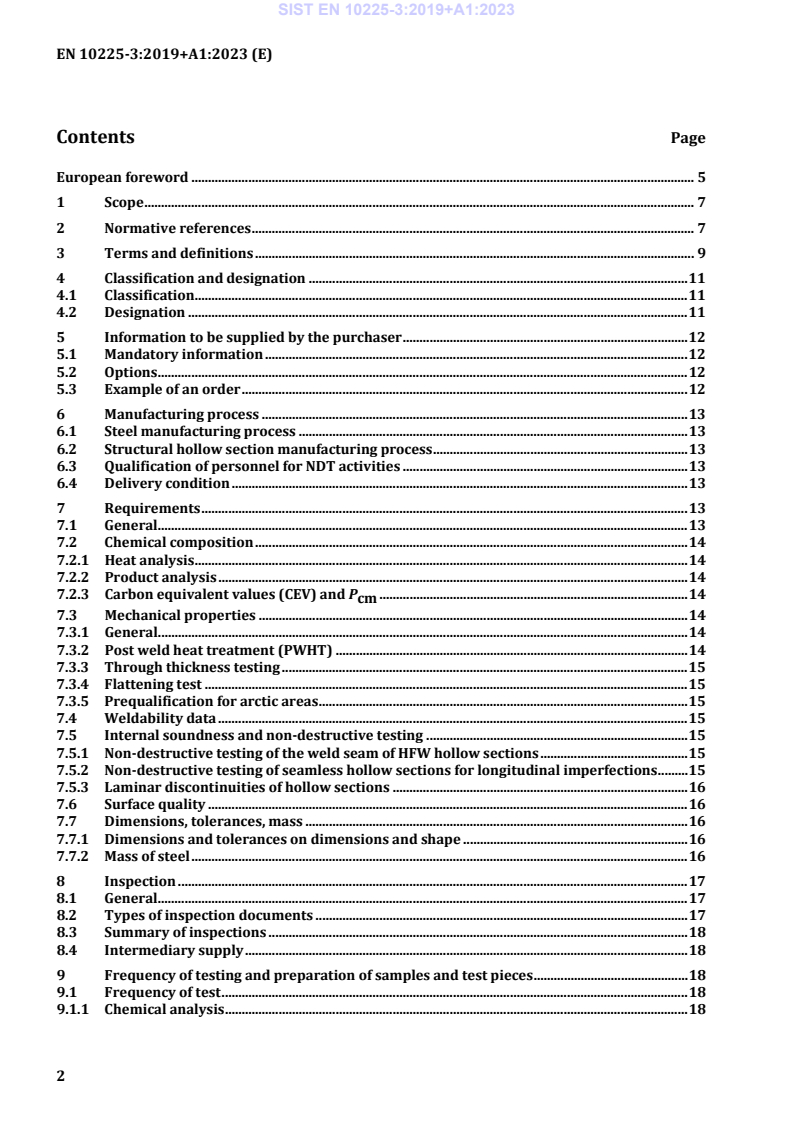
Contents Page
European foreword . 5
1 Scope . 7
2 Normative references . 7
3 Terms and definitions . 9
4 Classification and designation . 11
4.1 Classification . 11
4.2 Designation . 11
5 Information to be supplied by the purchaser . 12
5.1 Mandatory information . 12
5.2 Options . 12
5.3 Example of an order . 12
6 Manufacturing process . 13
6.1 Steel manufacturing process . 13
6.2 Structural hollow section manufacturing process . 13
6.3 Qualification of personnel for NDT activities . 13
6.4 Delivery condition . 13
7 Requirements . 13
7.1 General . 13
7.2 Chemical composition . 14
7.2.1 Heat analysis . 14
7.2.2 Product analysis . 14
7.2.3 Carbon equivalent values (CEV) and P . 14
cm
7.3 Mechanical properties . 14
7.3.1 General . 14
7.3.2 Post weld heat treatment (PWHT) . 14
7.3.3 Through thickness testing . 15
7.3.4 Flattening test . 15
7.3.5 Prequalification for arctic areas . 15
7.4 Weldability data . 15
7.5 Internal soundness and non-destructive testing . 15
7.5.1 Non-destructive testing of the weld seam of HFW hollow sections . 15
7.5.2 Non-destructive testing of seamless hollow sections for longitudinal imperfections . 15
7.5.3 Laminar discontinuities of hollow sections . 16
7.6 Surface quality . 16
7.7 Dimensions, tolerances, mass . 16
7.7.1 Dimensions and tolerances on dimensions and shape . 16
7.7.2 Mass of steel . 16
8 Inspection . 17
8.1 General . 17
8.2 Types of inspection documents . 17
8.3 Summary of inspections . 18
8.4 Intermediary supply . 18
9 Frequency of testing and preparation of samples and test pieces . 18
9.1 Frequency of test . 18
9.1.1 Chemical analysis . 18
9.1.2 Tensile test and impact test . 19
9.1.3 Testing the weld seam of welded hollow sections . 19
9.1.4 Testing of the corner regions for rectangular hollow sections . 19
9.2 Selection and preparation of samples for product analysis. 19
9.3 Location of samples and orientation of tensile test pieces . 19
9.4 Location of samples and orientation of impact test pieces . 20
9.5 Preparation of test pieces for mechanical tests. 20
9.5.1 General . 20
9.5.2 Preparation of tensile test pieces . 20
9.5.3 Preparation of impact test pieces . 20
10 Test methods . 21
10.1 Chemical analysis . 21
10.2 Mechanical tests . 21
10.2.1 Test temperatures . 21
10.2.2 Tensile test . 21
10.2.3 Impact test . 22
10.3 Visual inspection and dimensional check . 22
10.4 Non-destructive tests . 22
10.4.1 General . 22
10.4.2 NDT for the weld seam of HFW hollow sections . 22
10.4.3 Full peripheral NDT for seamless hollow sections . 23
10.4.4 Ultrasonic testing for laminar imperfections . 23
10.4.5 NDT for surface quality . 23
10.5 Retests, sorting and reprocessing . 23
11 Marking and bundling . 23
11.1 Die stamping and paint marking . 23
11.2 Bundling . 23
12 Options . 24
Annex A (normative when Option 1 is specified by the purchaser) Further details of steel
manufacturing procedures to be supplied by the manufacturer . 37
Annex B (normative when Option 17 is specified by the purchaser) Weldability testing and
mechanical testing of butt welds. 38
B.1 General requirements . 38
B.2 Welding processes and procedure . 38
B.3 Butt-weld requirements . 39
B.3.1 General . 39
B.3.2 Test piece dimensions. 39
B.3.3 Bevel detail . 40
B.3.4 Welding processes . 40
B.3.5 Nominal heat input. 40
B.3.6 Heat treatment . 41
B.3.7 Dehydrogenation of test pieces . 41
B.4 Mechanical testing . 42
B.4.1 General . 42
B.4.2 Charpy V-notch impact tests . 43
B.4.3 Fracture mechanic test . 44
B.4.4 Macrohardness . 45
B.4.5 Cross-weld tensile test . 46
Annex C (normative when Option 17 is specified by the purchaser) Weldability testing - Bead-
on-plate . 51
C.1 General . 51
C.2 Test material dimension . 51
C.3 Welding method . 51
C.4 Test condition . 51
C.5 Specific test requirements: macrosection and hardness tests . 52
Annex D (normative when Option 17 is specified by the purchaser) Weldability testing –
Controlled thermal severity tests (CTS) . 54
D.1 General . 54
D.2 Test block dimensions . 54
D.3 General welding details . 54
D.3.1 Anchor welds . 54
D.3.2 Test welds . 54
D.4 Evaluation of the test welds . 55
D.5 Hardness testing . 55
Annex E (informative) Prequalification of steels for offshore structures operating in arctic
areas . 61
Bibliography. 62
European foreword
This document (EN 10225-3:2019+A1:2023) has been prepared by Technical Committee
CEN/TC 459/SC 3 “Structural steels other than reinforcements”, the secretariat of which is held by DIN.
This European Standard shall be given the status of a national standard, either by publication of an
identical text or by endorsement, at the latest by November 2023, and conflicting national standards
shall be withdrawn at the latest by November 2023.
Attention is drawn to the possibility that some of the elements of this document may be the subject of
patent rights. CEN shall not be held responsible for identifying any or all such patent rights.
EN 10225-3:2019, together with EN 10225-1:2019, EN 10225-2:2019, and EN 10225-4:2019,
superseded EN 10225:2009.
This document EN 10225-3:2019+A1:2023 supersedes EN 10225-3:2019.
This document includes Amendment 1 approved by CEN on 7 April 2023.
The start and finish of text introduced or altered by amendment is indicated in the text by tags !".
This European Standard consists of the following parts, under the general title 'Weldable structural
steels for fixed offshore structures – Technical delivery conditions':
— Part 1: Plates
— Part 2: Sections
— Part 3: Hot finished hollow sections
— Part 4: Cold formed welded hollow sections
In comparison to the previous edition EN 10225:2009 the following technical changes were made:
— split of the standard in four parts;
— the steel names were adapted to EN 10027-1;
— former grades of group 3 are no longer listed, new options with the same enhanced properties have
been introduced (Options 2 and 3);
— an informative Annex E was added for the prequalification of steels for fixed offshore structures in
arctic areas.
Any feedback and questions on this document should be directed to the users’ national standards body.
A complete listing of these bodies can be found on the CEN website.
According to the CEN-CENELEC Internal Regulations, the national standards organisations of the
following countries are bound to implement this European Standard: Austria, Belgium, Bulgaria,
Croatia, Cyprus, Czech Republic, Denmark, Estonia, Finland, France, Germany, Greece, Hungary, Iceland,
Ireland, Italy, Latvia, Lithuania, Luxembourg, Malta, Netherlands, Norway, Poland, Portugal, Republic of
North Macedonia, Romania, Serbia, Slovakia, Slovenia, Spain, Sweden, Switzerland, Türkiye and the
United Kingdom.
1 Scope
This document specifies requirements for weldable structural steels made of hot finished seamless and
high frequency welded hollow sections to be used in the fabrication of fixed offshore structures.
The following thickness limitations are given in this standard:
— for seamless hollow sections up to and including 65 mm;
— for HFW hollow sections up to and including 25,4 mm.
Greater thicknesses can be agreed, provided the technical requirements of this European Standard are
maintained.
This European Standard is applicable to steels for offshore structures, designed to operate in the
offshore sector but not to steels supplied for the fabrication of subsea pipelines, risers, process
equipment, process piping and other utilities. It is primarily applicable to the North Sea Sector, but may
also be applicable in other areas provided that due consideration is given to local conditions e.g. design
temperature.
NOTE This document has an informative Annex E on the prequalification of steels for fixed offshore
structures in arctic areas.
Minimum yield strengths up to 770 MPa are specified together with impact properties at temperatures
down to –40 °C.
2 Normative references
The following documents are referred to in the text in such a way that some or all of their content
constitutes requirements of this document. For dated references, only the edition cited applies. For
undated references, the latest edition of the referenced document (including any amendments) applies.
EN 1011-1, Welding — Recommendations for welding of metallic materials — Part 1: General guidance
for arc welding
EN 10020, Definition and classification of grades of steel
EN 10021, General technical delivery conditions for steel products
EN 10027-1, Designation systems for steels — Part 1: Steel names
EN 10027-2, Designation systems for steels — Part 2: Numerical system
EN 10079, Definition of steel products
EN 10164, Steel products with improved deformation properties perpendicular to the surface of the
product — Technical delivery conditions
EN 10168, Steel products — Inspection documents — List of information and description
EN 10204, Metallic products — Types of inspection documents
EN 10210-2, Hot finished structural hollow sections of non-alloy and fine grain steels — Part 2:
Tolerances, dimensions and sectional properties
CEN/TR 10261, Iron and steel — European standards for the determination of chemical composition
EN ISO 148-1, Metallic materials — Charpy pendulum impact test — Part 1: Test method (ISO 148-1)
EN ISO 377, Steel and steel products — Location and preparation of samples and test pieces for
mechanical testing (ISO 377)
EN ISO 643, Steels — Micrographic determination of the apparent grain size (ISO 643)
EN ISO 2566-1, Steel — Conversion of elongation values — Part 1: Carbon and low alloy steels (ISO 2566-
1)
EN ISO 4063, Welding and allied processes — Nomenclature of processes and reference numbers (ISO
4063)
EN ISO 4136, Destructive tests on welds in metallic materials — Transverse tensile test (ISO 4136)
EN ISO 4885, Ferrous materials — Heat treatments — Vocabulary (ISO 4885)
EN ISO 6507-1, Metallic materials — Vickers hardness test — Part 1: Test method (ISO 6507-1)
EN ISO 6892-1, Metallic materials — Tensile testing — Part 1: Method of test at room temperature (ISO
6892-1)
EN ISO 6947, Welding and allied processes — Welding positions (ISO 6947)
EN ISO 8492, Metallic materials — Tube — Flattening test (ISO 8492)
EN ISO 9712, Non-destructive testing — Qualification and certification of NDT personnel (ISO 9712)
EN ISO 10893-2, Non-destructive testing of steel tubes — Part 2: Automated eddy current testing of
seamless and welded (except submerged arc-welded) steel tubes for the detection of imperfections (ISO
10893-2)
EN ISO 10893-3, Non-destructive testing of steel tubes — Part 3: Automated full peripheral flux leakage
testing of seamless and welded (except submerged arc-welded) ferromagnetic steel tubes for the detection
of longitudinal and/or transverse imperfections (ISO 10893-3)
EN ISO 10893-5, Non-destructive testing of steel tubes — Part 5: Magnetic particle inspection of seamless
and welded ferromagnetic steel tubes for the detection of surface imperfections (ISO 10893-5)
EN ISO 10893-8, Non-destructive testing of steel tubes — Part 8: Automated ultrasonic testing of seamless
and welded steel tubes for the detection of laminar imperfections (ISO 10893-8)
EN ISO 10893-9, Non-destructive testing of steel tubes — Part 9: Automated ultrasonic testing for the
detection of laminar imperfections in strip/plate used for the manufacture of welded steel tubes (ISO
10893-9)
EN ISO 10893-10, Non-destructive testing of steel tubes — Part 10: Automated full peripheral ultrasonic
testing of seamless and welded (except submerged arc-welded) steel tubes for the detection of longitudinal
and/or transverse imperfections (ISO 10893-10)
EN ISO 10893-11, Non-destructive testing of steel tubes — Part 11: Automated ultrasonic testing of the
weld seam of welded steel tubes for the detection of longitudinal and/or transverse imperfections (ISO
10893-11)
EN ISO 14284, Steel and iron — Sampling and preparation of samples for the determination of chemical
composition (ISO 14284)
EN ISO 15614-1, Specification and qualification of welding procedures for metallic materials — Welding
procedure test — Part 1: Arc and gas welding of steels and arc welding of nickel and nickel alloys (ISO
15614-1)
ISO 11484, Steel products — Employer’s qualification system for non-destructive testing (NDT) personnel
ISO 12135, Metallic materials — Unified method of test for the determination of quasistatic fracture
toughness
ISO 15653, Metallic materials — Method of test for the determination of quasistatic fracture toughness of
welds
3 Terms and definitions
For the purposes of this document, the terms and definitions given in EN 10020, EN 10021,
EN ISO 4885, EN 10079 and EN ISO 14284 and the following apply.
ISO and IEC maintain terminological databases for use in standardization at the following addresses:
— IEC Electropedia: available at https://www.electropedia.org/
— ISO Online browsing platform: available at https://www.iso.org/obp
3.1
continuous casting process route (concast)
steel produced by a continuous casting process route
3.2
fine grain steel
steels with fine grain structure with an equivalent index of ferritic grain size ≥ 6
Note 1 to entry: For the determination of grain sizes except for +QT steels see EN ISO 643.
3.3
high frequency welded hollow section (HFW)
hollow long product, open at both ends, of circular, elliptical, square or rectangular section, made by
pressure welding in a continuous or non-continuous process, in which strip is formed cold into a hollow
profile and the seam weld made by heating the adjacent edges through the resistance to the passage of a
high frequency current and pressing the edges together
Note 1 to entry: The electric current may be applied by direct electrode contact or by induction or conduction.
After welding, the hollow section is further hot finished (see 3.4).
3.4
hot finished
for this standard: hollow sections formed hot, with or without subsequent heat treatment, or formed
cold with subsequent heat treatment equal to or greater than AC3 to obtain equivalent metallurgical
conditions to those obtained in the hot formed product
3.5
intermediary
organization that is supplied with products by the manufacturers and that then, in turn, supplies them
without further processing or after processing without changing the properties specified in the
purchase order and referenced product specification
3.6
manufacturer
organization that manufactures the respective products according to the requirements of the order and
to the properties specified in the referenced product specification to the final customer
3.7
normalized rolled
rolling process in which the final deformation is carried out in a certain temperature range leading to a
material condition equivalent to that obtained after normalizing so that the specified values of the
mechanical properties are retained even after normalizing
Note 1 to entry: In international publications for both the normalizing rolling, as well as the thermomechanical
rolling, the expression “controlled rolling” may be found. However in view of the different applicability of the
products a distinction of the terms is necessary.
3.8
normalizing
heat treatment with the object of refining and eventually making uniform the grain size of a ferrous
product and comprising heating it at a temperature slightly above A [A for hypereutectoid steels],
3 1
without prolonged soaking at this temperature, followed by cooling at a suitable rate !to produce a
fine ferritic-pearlitic structure"
3.9
parent product
product produced from one piece of steel
3.10
purchaser
purchaser or their representative
3.11
quenching
operation which consists of cooling a ferrous product more rapidly than in still air !, such cooling is
intended to produce a predominantly bainitc or martensitic microstructure"
Note 1 to entry: Quenching includes direct quenching.
3.12
seamless hollow section (S)
hollow long product, open at both ends, of circular, elliptical, square or rectangular section, made by
piercing a solid product to obtain a tube hollow which is further hot finished into its final dimensions
(see 3.4)
3.13
tempering
heat treatment applied to a ferrous product generally after quenching or other heat treatment to bring
the properties to the required level
Note 1 to entry: Tempering consists of heating to specific temperatures (
C1
followed by cooling at an appropriate rate.
!3.14
accelerated cooling
operation which consists of cooling a ferrous product faster than achieved in still air but with a rate less
than achieved by quenching, for this document, such cooling is intended to produce a predominantly
ferritic-pearlitic microstructure"
4 Classification and designation
4.1 Classification
All steel grades specified in this European Standard are classified as special steels according to
EN 10020.
NOTE The steel grades in this standard are substantially modified from steel grades in EN 10210–1.
4.2 Designation
4.2.1 For the products covered by this European Standard the steel names are allocated in accordance
with EN 10027-1; the steel numbers are allocated in accordance with EN 10027-2.
4.2.2 For steels for offshore structures the steel designation consists of:
— the number of this European Standard (EN 10225-3);
— the capital letter S for structural steel;
— the indication of the minimum specified yield strength for thicknesses ≤ 16 mm expressed in MPa;
— further designations for either
— normalized/normalized rolled structural steels: capital letters N - letter N to indicate
normalized or normalized rolled; or
— normalized/normalized rolled structural steels: capital letters NL - letter N to indicate
normalized or normalized rolled, letter L to indicate specified impact properties at –40 °C (see
6.4); or
— quenched and tempered structural steels: capital letters QL - capital letter Q to indicate the
quenched and tempered condition, letter L to indicate specified impact properties at –40 °C
(see 6.4); and
— the capital letter H for hollow sections;
— a further capital letter H for hot-finished; and
— the capital letter O for offshore structures.
EXAMPLE 1 Structural steel (S) with a specified minimum yield strength for a thickness not greater than
16 mm of 355 MPa, normalized condition (N), with a minimum impact energy value of 50 J at −40 °C (L), hollow
section hot finished (HH), for offshore application (O):
EN 10225–3 — S355NLHHO
or
EN 10225–3 — 1.1182
NOTE For a transition period the old steel names and numbers are given in Tables 3 to 8 in brackets.
5 Information to be supplied by the purchaser
5.1 Mandatory information
The following information shall be supplied by the purchaser at the time of enquiry and order:
a) the quantity (number of hollow sections, total length or mass);
b) details of the product form: HFCHS = hot finished circular hollow sections (or HFEHS for elliptical,
HFRHS for square or rectangular);
c) the name of the standard for dimensions and tolerances and the dimensions and tolerances:
EN 10210-2;
d) the name of this standard (EN 10225-3) and the steel designation (steel name or steel number, see
4.2.2);
e) standard designation in accordance with EN 10204 for an inspection certificate 3.1 or, if required,
inspection certificate 3.2 (see also Option 24).
5.2 Options
A number of options are specified in Clause 12. In the event that the purchaser does not indicate a wish
to implement any of these options, the manufacturer shall supply in accordance with the basic
specification (see 5.1). The options in Clause 12 are numbered through all four parts of EN 10225,
therefore some options are not available for this part.
5.3 Example of an order
50 hot-finished circular hollow sections in accordance with EN 10210-2 with specified dimensions
244,5 mm × 25,0 mm × 4 500 mm, made according to EN 10225-3 from structural steel S355NLHHO for
offshore application, supplied with inspection certificate 3.1 and a product analysis:
50 HFCHS – EN 10210-2 — 244,5 × 25,0 × 4 500
EN 10225-3 — S355NLHHO – inspection certificate 3.1, Option 7
or
50 HFCHS – EN 10210-2 — 244,5 × 25,0 × 4 500
EN 10225-3 — 1.1182 inspection certificate 3.1, Option 7
6 Manufacturing process
6.1 Steel manufacturing process
The steel manufacturing process shall be at the discretion of the manufacturer with the exception that
the open hearth (Siemens-Martin) process shall not be employed.
All steels shall be fully killed.
All steels shall be made to fine grain practice.
See Option 1 (further details of steel manufacturing process)
See Option 2 (vacuum degassed and/or ladle refined)
See Option 3 (reduced S-content)
All products shall be traceable to the cast.
6.2 Structural hollow section manufacturing process
Hot finished structural hollow sections shall be manufactured by a seamless or by a high frequency
welding process. Welded sections manufactured by a continuous process shall not include the welds
used to join the lengths of strip prior to forming the hollow section.
HFW welded hollow sections shall be supplied with the external weld bead trimmed to an essentially
flush condition. Internal trimming is at the discretion of the manufacturer. Normally sections are
supplied without trimming the internal weld bead unless Option 21 is specified, see 7.5.1.
The ends of the hollow section shall be cut perpendicular to the axis of the product.
6.3 Qualification of personnel for NDT activities
All NDT activities shall be carried out by qualified and competent level 1, 2 and/or 3 personnel
authorised to carry out this work by the employer.
The qualification shall be in accordance with ISO 11484 or ASNT TC-1A or ISO 9712.
It is recommended that the level 3 personnel be certified in accordance with EN ISO 9712 or ASNT.
The operating authorisation issued by the employer shall be in accordance with a written procedure.
NDT operations shall be authorised by a level 3 NDT individual approved by the employer.
NOTE The definition of levels 1, 2 and 3 can be found in the appropriate standards, e.g. EN ISO 9712 and
ISO 11484.
6.4 Delivery condition
Hollow sections shall be supplied full body heat treated, either in the normalized/normalized rolled (N)
or quenched and tempered (Q) condition as shown in Tables 3 to 8.
!If normalized grades S420NLHHO and S460NLHHO are delivered with accelerated cooling (+DC)
they get the addition +DC in the steel name."
7 Requirements
7.1 General
In addition to the requirements of this European Standard, the general technical delivery requirements
specified in EN 10021 apply.
7.2 Chemical composition
7.2.1 Heat analysis
The chemical composition determined by heat analysis shall comply with the values in Tables 3 and 6.
The deliberate addition of any elements other than those listed in Tables 3 and 6 shall not be permitted.
For residual element control, Boron (B) shall not be intentionally added to steel grades up to and
including S460.
Any further restrictions in heat analysis shall be agreed between the manufacturer and the purchaser at
the time of the enquiry and order, see Option 6 (restricted heat analysis).
7.2.2 Product analysis
The chemical composition determined by product analysis shall comply with the values given in Tables
3 and 6; for verification see Option 7 (product analysis);
Any further restrictions in product analysis shall be agreed between the manufacturer and the
purchaser at the time of enquiry and order, see Options 6 and 7 (restricted product analysis).
7.2.3 Carbon equivalent values (CEV) and P
cm
CEV and P shall be calculated using the following equations where each element is expressed as a
cm
mass percentage:
Mn Cr++Mo V Ni+ Cu
CEV=C++ +
6 5 15
(1)
Si Mn+ Cu+ Cr Ni Mo V
Pcm=C++ + + ++ 5B
30 20 60 15 10
(2)
The maximum permissible CEV and P values are given in Tables 4 and 7. Either the P or/and the
cm cm
CEV is reported at the discretion of the manufacturer, unless otherwise agreed between manufacturer
and purchaser at the time of enquiry and order. See Option 8 (agreement whether to report a P
cm
or/and CEV value).
7.3 Mechanical properties
7.3.1 General
Under the inspection and testing conditions as specified in Clause 8 and, if requested, in the simulated
heat treatment conditions given in 7.3.2, the mechanical properties at the verification test temperature
shall comply with the relevant requirements given in Tables 5 and 8. Samples (from which test pieces
are taken) shall be tested in the delivery condition.
!The grades S420NLHHO+DC and S460NLHHO+DC have a predominantly ferritic-pearlitic structure,
but they have received an accelerated cooling and therefore it may not be possible to achieve the
certified mechanical properties after normalizing again."
7.3.2 Post weld heat treatment (PWHT)
Where a requirement for PWHT is foreseen, the items concerned shall be ordered with additional
testing according to Option 9.
IIW, International Institute of Welding formula
The simulated PWHT shall be at 580 °C ± 20 °C if not otherwise agreed (see Option 10) for a minimum
soaking time of 1 h per 25 mm thickness of product but maximum 4 h.
7.3.3 Through thickness testing
Through-thickness testing shall not be carried out, except when Option 12 is specified.
See Option 12 (through thickness testing)
7.3.4 Flattening test
A flattening test shall not be carried out except when Option 13 is specified for circular welded hollow
sections.
See Option 13 (flattening test)
7.3.5 Prequalification for arctic areas
If specified at the time of enquiry and order testing at specified lower temperatures shall be carried out.
See informative Annex E (testing at lower temperatures as prequalification for arctic areas shall be
done, e.g. for arctic area 1, 2 or 3 at −20 °C, −30 °C or −40 °C).
7.4 Weldability data
Weldability data is not required, except when Option 17 is specified.
See Option 17 (weldability data, this option shall already be requested at the time of enquiry)
Regardless of the revision of the standard, weldability studies performed with a former version of
EN 10225 remain valid, provided chemical composition and mechanical properties comply with the
current version.
This data refers only to the weldability of the material being supplied and is intended for use in
development and preparation of fabrication procedures. The manufacturer does not have to fulfil the
requirements of a welding procedure qualification test (WPQT), nor provide data to it.
7.5 Internal soundness and non-destructive testing
7.5.1 Non-destructive testing of the weld seam of HFW hollow sections
The weld seam of welded hollow sections shall be tested full length for longitudinal def
...