


prEN 18316
(Main)Inorganic fertilizers - Determination of the total K2O content
Inorganic fertilizers - Determination of the total K2O content
This document specifies two different methods (Method A and B) for the determination of the content of potassium (expressed as K2O) in inorganic fertilizers. Method A specifies a gravimetric method. Method B specifies the method using inductively coupled plasma optical emission spectrometry (ICP-OES).
This document is applicable to fertilizing product blends, where the blend is a mix of at least two of the following components, fertilizers, liming materials, soil improvers, growing media, inhibitors and plant biostimulants, and where inorganic fertilizers are the highest % in the blend by mass or volume, or in the case of liquid form, by dry mass.
If inorganic fertilizers are not the highest % in the blend, the European Standard for the highest % of the blend applies. In case a fertilizing product blend is composed of components in equal quantity, the user decides which standard to apply.
NOTE Variations in analytical methods for fertilizing product blends can lead to differing results as some components or matrix interactions can affect the outcome. Validation procedures have shown that developed standard methods are robust and reliable across diverse product compositions, but possible interferences and unexpected results when analysing fertilizing product blends are possible.
Anorganische Düngemittel - Bestimmung des Gesamtgehalts an K2O
Dieses Dokument legt zwei verschiedene Verfahren (Verfahren A und B) für die Bestimmung des Kaliumgehalts (angegeben als K2O) in anorganischen Düngemitteln fest. Verfahren A legt die Bestimmung mittels Gravimetrie fest. Verfahren B legt die Bestimmung mittels optischer Emissionsspektrometrie mit induktiv gekoppeltem Plasma (ICP-OES) fest.
Dieses Dokument ist anwendbar auf Düngeproduktmischungen, bei denen eine Mischung aus mindestens zwei der folgenden Komponenten besteht: Düngemittel, Kalkdünger, Bodenverbesserungsmittel, Kultursubstrate, Hemmstoffe, Pflanzen-Biostimulanzien und wenn anorganische Düngemittel den höchsten Prozentsatz in der Mischung bezüglich Masse oder Volumen, oder im Falle von flüssigen Formen bezüglich Trockenmasse ausmachen.
Wenn anorganische Düngemittel nicht den höchsten Prozentsatz in der Mischung ausmachen, gilt die Europäische Norm für den höchsten Prozentsatz der Mischung. Im Falle, dass die Düngeproduktmischung aus Komponenten gleicher Menge besteht, entscheidet der Anwender, welche Norm angewendet wird.
ANMERKUNG Variationen in analytischen Verfahren für Düngeproduktmischungen können zu unterschiedlichen Ergebnissen führen, da einige Komponenten oder Matrixwechselwirkungen das Ergebnis beeinflussen können. Validierungen haben gezeigt, dass die entwickelten Standardverfahren robust und zuverlässig über unterschiedliche Produktzusammensetzungen hinweg sind. Jedoch sind mögliche Interferenzen und unerwartete Ergebnisse bei der Analyse von Düngeproduktmischungen möglich.
Engrais inorganiques - Détermination de la teneur en K2O total
Le présent document spécifie deux méthodes différentes (méthodes A et B) pour la détermination de la teneur en potassium (exprimée en K2O) dans les engrais inorganiques. La méthode A utilise la gravimétrie. La méthode B emploie la spectrométrie d’émission optique par plasma à couplage inductif (ICP-OES).
Le présent document est applicable aux mélanges de fertilisants constitués d’au moins deux des composants suivants: engrais, amendements minéraux basiques, amendements du sol, supports de culture, inhibiteurs et biostimulants des végétaux, et dans lesquels les engrais inorganiques représentent le pourcentage le plus élevé du mélange en masse ou en volume, ou dans le cas d’un liquide, en masse sèche.
Si les engrais inorganiques ne représentent pas le pourcentage le plus élevé du mélange, la Norme européenne relative au composant représentant le pourcentage le plus élevé du mélange s’applique. Dans le cas où le mélange de fertilisants est constitué de composants en quantités égales, l’utilisateur décide quelle norme appliquer.
NOTE Les variations dans les méthodes d’analyse des mélanges de fertilisants peuvent conduire à des résultats différents, car certaines interactions de composants ou de la matrice peuvent affecter le résultat. Les procédures de validation ont montré que les méthodes normalisées développées sont robustes et fiables pour diverses compositions de produits, mais que des interférences éventuelles et des résultats inattendus lors de l’analyse des mélanges de fertilisants sont possibles.
Anorganska gnojila - Določanje celotnega kalijevega oksida K2O
General Information
- Status
- Not Published
- Publication Date
- 28-Feb-2028
- Technical Committee
- CEN/TC 260 - Fertilizers and liming materials
- Drafting Committee
- CEN/TC 260/WG 7 - Chemical analysis
- Current Stage
- 4060 - Closure of enquiry - Enquiry
- Start Date
- 21-May-2026
- Due Date
- 05-Jan-2027
- Completion Date
- 21-May-2026

Overview
prEN 18316: Inorganic fertilizers - Determination of the total K₂O content is a draft European Standard developed by CEN/TC 260, focused on establishing standardized methods to determine the total potassium oxide (K₂O) content in inorganic fertilizers and related product blends. This standard is critical for ensuring reliable, accurate, and repeatable quantification of potassium-an essential macronutrient in agricultural applications. The document specifies two validated methods: a gravimetric procedure (Method A) and an advanced instrumental method using inductively coupled plasma optical emission spectrometry (ICP-OES) (Method B).
The standard’s scope covers not only pure inorganic fertilizers but also blends, provided inorganic fertilizers form the majority by mass or volume, or, for liquids, by dry mass. Where inorganic fertilizers are not predominant, the applicable European standard for the blend’s main component takes precedence.
Key Topics
Two Analytical Methods:
- Method A (Gravimetric): A classical chemical analysis using precipitation and filtration to isolate the potassium as potassium tetraphenylborate, followed by precise weighing.
- Method B (ICP-OES): A modern, highly sensitive technique utilizing inductively coupled plasma optical emission spectrometry for improved detection and quantification of potassium.
Sample Preparation:
- Rigorous requirements for sample homogenization, acid dissolution, filtration, and dilution to ensure accurate measurement.
- Emphasis on using representative, undamaged samples for compliance with quality standards.
Application to Blends:
- Covers blends with multiple fertilizing components where inorganic fertilizer is predominant by mass or volume.
- Guidance for cases where components are in equal proportion or other components dominate.
Matrix Interferences and Validation:
- Notes possible effects of blend components or matrix interactions on test results.
- Endorses standard method validation for robust performance across diverse fertilizers, while encouraging awareness of potential analytical interferences.
Reporting and Control:
- Outlines procedures for blank tests, control tests, use of calibration standards, and quality checks as part of routine laboratory quality assurance.
Applications
This standard is applicable in various scenarios across the fertilizer industry, regulatory compliance, and agricultural research:
Fertilizer Manufacturers:
- Enables consistent, harmonized determination of potassium content in production, quality control, and labeling to meet European and international market standards.
Regulatory Authorities:
- Supports monitoring and enforcement of fertilizer composition under EU Regulation (EU) 2019/1009 for market placement and consumer safety.
Testing Laboratories:
- Provides clear, validated methodologies to deliver accurate and comparable data, essential for certification and inter-laboratory studies.
Blending Facilities:
- Assures accurate analysis for complex fertilizer blends, soil improvers, and associated products to optimize nutrient management strategies.
Research and Development:
- Facilitates innovation in fertilizer formulation and efficacy trials through reliable potassium analysis.
Related Standards
The application of prEN 18316 often incorporates or references the following standards for sampling, terminology, and analytic procedures:
- EN 1482-2: Fertilizers, liming materials and inhibitors - Sampling and sample preparation - Part 2: General sample preparation provisions
- EN 12944-1 & EN 12944-2: Vocabulary standards for fertilizers, liming materials, and inhibitors
- EN 1482-1, EN 1482-3: Additional sampling procedures
- EN 16964: Alternative procedures using aqua regia digestion, when equivalency can be demonstrated
By adhering to prEN 18316 and its referenced standards, industry stakeholders can ensure precision, repeatability, and regulatory compliance in the determination of total K₂O content in inorganic fertilizers and blends, thus supporting quality assurance, informed agronomic decisions, and sustainable agricultural practices.
Keywords: inorganic fertilizers, potassium oxide determination, K₂O analysis, gravimetric method, ICP-OES, fertilizer blends, CEN standards, fertilizer testing, EU fertilizer regulation, laboratory quality assurance
Get Certified
Connect with accredited certification bodies for this standard

Control Union Certifications
Global certification for agriculture and sustainability.

ECOCERT
Organic and sustainability certification.

FSC International
Forest Stewardship Council certification.
Sponsored listings
Frequently Asked Questions
prEN 18316 is a draft published by the European Committee for Standardization (CEN). Its full title is "Inorganic fertilizers - Determination of the total K2O content". This standard covers: This document specifies two different methods (Method A and B) for the determination of the content of potassium (expressed as K2O) in inorganic fertilizers. Method A specifies a gravimetric method. Method B specifies the method using inductively coupled plasma optical emission spectrometry (ICP-OES). This document is applicable to fertilizing product blends, where the blend is a mix of at least two of the following components, fertilizers, liming materials, soil improvers, growing media, inhibitors and plant biostimulants, and where inorganic fertilizers are the highest % in the blend by mass or volume, or in the case of liquid form, by dry mass. If inorganic fertilizers are not the highest % in the blend, the European Standard for the highest % of the blend applies. In case a fertilizing product blend is composed of components in equal quantity, the user decides which standard to apply. NOTE Variations in analytical methods for fertilizing product blends can lead to differing results as some components or matrix interactions can affect the outcome. Validation procedures have shown that developed standard methods are robust and reliable across diverse product compositions, but possible interferences and unexpected results when analysing fertilizing product blends are possible.
This document specifies two different methods (Method A and B) for the determination of the content of potassium (expressed as K2O) in inorganic fertilizers. Method A specifies a gravimetric method. Method B specifies the method using inductively coupled plasma optical emission spectrometry (ICP-OES). This document is applicable to fertilizing product blends, where the blend is a mix of at least two of the following components, fertilizers, liming materials, soil improvers, growing media, inhibitors and plant biostimulants, and where inorganic fertilizers are the highest % in the blend by mass or volume, or in the case of liquid form, by dry mass. If inorganic fertilizers are not the highest % in the blend, the European Standard for the highest % of the blend applies. In case a fertilizing product blend is composed of components in equal quantity, the user decides which standard to apply. NOTE Variations in analytical methods for fertilizing product blends can lead to differing results as some components or matrix interactions can affect the outcome. Validation procedures have shown that developed standard methods are robust and reliable across diverse product compositions, but possible interferences and unexpected results when analysing fertilizing product blends are possible.
prEN 18316 is classified under the following ICS (International Classification for Standards) categories: 65.080 - Fertilizers. The ICS classification helps identify the subject area and facilitates finding related standards.
prEN 18316 is associated with the following European legislation: EU Directives/Regulations: 2019/1009; Standardization Mandates: M/564, M/564 AMD 1, M/564 AMD 2. When a standard is cited in the Official Journal of the European Union, products manufactured in conformity with it benefit from a presumption of conformity with the essential requirements of the corresponding EU directive or regulation.
prEN 18316 is available in PDF format for immediate download after purchase. The document can be added to your cart and obtained through the secure checkout process. Digital delivery ensures instant access to the complete standard document.
Standards Content (Sample)
SLOVENSKI STANDARD
01-april-2026
Anorganska gnojila - Določanje celotnega kalijevega oksida K2O
Inorganic fertilizers - Determination of the total K2O content
Anorganische Düngemittel - Bestimmung des Gesamtgehalts an K2O
Engrais inorganiques - Détermination de la teneur en K2O total
Ta slovenski standard je istoveten z: prEN 18316
ICS:
65.080 Gnojila Fertilizers
2003-01.Slovenski inštitut za standardizacijo. Razmnoževanje celote ali delov tega standarda ni dovoljeno.
DRAFT
EUROPEAN STANDARD
NORME EUROPÉENNE
EUROPÄISCHE NORM
February 2026
ICS 65.080
English Version
Inorganic fertilizers - Determination of the total K2O
content
Engrais inorganiques - Détermination de la teneur en Anorganische Düngemittel - Bestimmung des
K2O total Gesamtgehalts an K2O
This draft European Standard is submitted to CEN members for enquiry. It has been drawn up by the Technical Committee
CEN/TC 260.
If this draft becomes a European Standard, CEN members are bound to comply with the CEN/CENELEC Internal Regulations
which stipulate the conditions for giving this European Standard the status of a national standard without any alteration.
This draft European Standard was established by CEN in three official versions (English, French, German). A version in any other
language made by translation under the responsibility of a CEN member into its own language and notified to the CEN-CENELEC
Management Centre has the same status as the official versions.
CEN members are the national standards bodies of Austria, Belgium, Bulgaria, Croatia, Cyprus, Czech Republic, Denmark, Estonia,
Finland, France, Germany, Greece, Hungary, Iceland, Ireland, Italy, Latvia, Lithuania, Luxembourg, Malta, Netherlands, Norway,
Poland, Portugal, Republic of North Macedonia, Romania, Serbia, Slovakia, Slovenia, Spain, Sweden, Switzerland, Türkiye and
United Kingdom.
Recipients of this draft are invited to submit, with their comments, notification of any relevant patent rights of which they are
aware and to provide supporting documentation.
Warning : This document is not a European Standard. It is distributed for review and comments. It is subject to change without
notice and shall not be referred to as a European Standard.
EUROPEAN COMMITTEE FOR STANDARDIZATION
COMITÉ EUROPÉEN DE NORMALISATION
EUROPÄISCHES KOMITEE FÜR NORMUNG
CEN-CENELEC Management Centre: Rue de la Science 23, B-1040 Brussels
© 2026 CEN All rights of exploitation in any form and by any means reserved Ref. No. prEN 18316:2026 E
worldwide for CEN national Members.
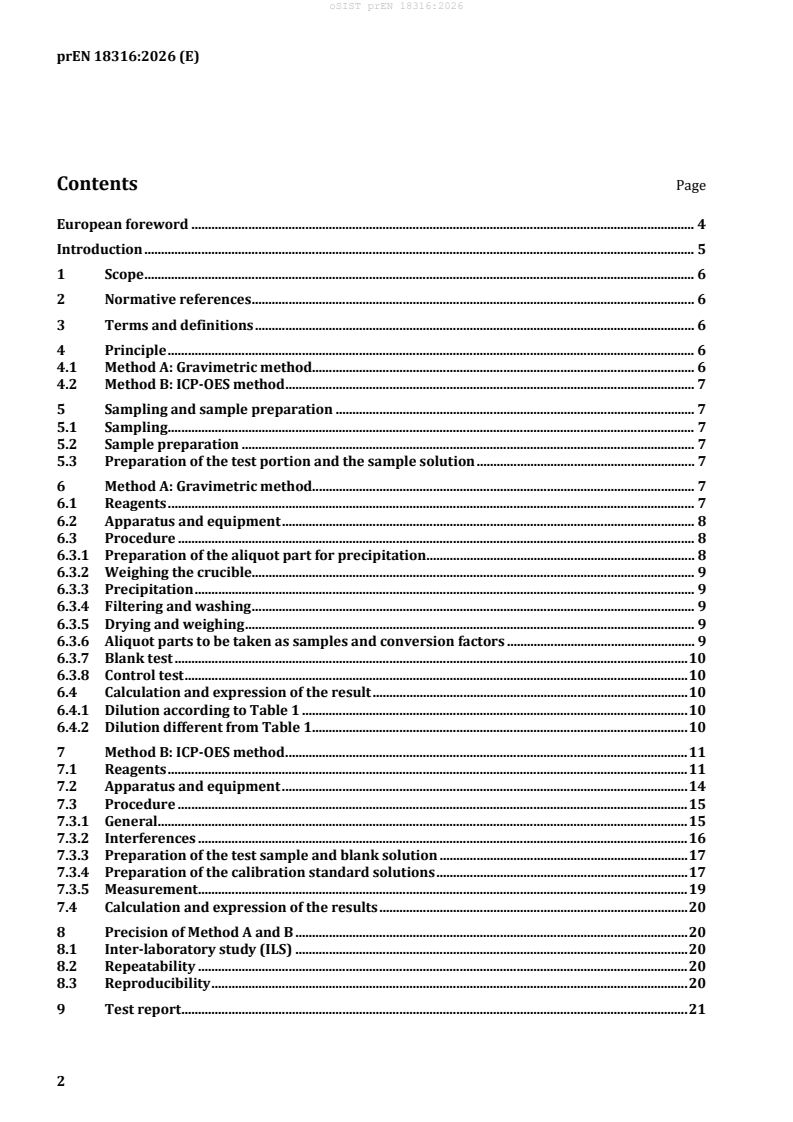
Contents Page
European foreword . 4
Introduction . 5
1 Scope . 6
2 Normative references . 6
3 Terms and definitions . 6
4 Principle . 6
4.1 Method A: Gravimetric method. 6
4.2 Method B: ICP-OES method . 7
5 Sampling and sample preparation . 7
5.1 Sampling . 7
5.2 Sample preparation . 7
5.3 Preparation of the test portion and the sample solution . 7
6 Method A: Gravimetric method. 7
6.1 Reagents . 7
6.2 Apparatus and equipment . 8
6.3 Procedure . 8
6.3.1 Preparation of the aliquot part for precipitation . 8
6.3.2 Weighing the crucible. 9
6.3.3 Precipitation . 9
6.3.4 Filtering and washing . 9
6.3.5 Drying and weighing . 9
6.3.6 Aliquot parts to be taken as samples and conversion factors . 9
6.3.7 Blank test . 10
6.3.8 Control test . 10
6.4 Calculation and expression of the result . 10
6.4.1 Dilution according to Table 1 . 10
6.4.2 Dilution different from Table 1. 10
7 Method B: ICP-OES method . 11
7.1 Reagents . 11
7.2 Apparatus and equipment . 14
7.3 Procedure . 15
7.3.1 General. 15
7.3.2 Interferences . 16
7.3.3 Preparation of the test sample and blank solution . 17
7.3.4 Preparation of the calibration standard solutions . 17
7.3.5 Measurement . 19
7.4 Calculation and expression of the results . 20
8 Precision of Method A and B . 20
8.1 Inter-laboratory study (ILS) . 20
8.2 Repeatability . 20
8.3 Reproducibility . 20
9 Test report . 21
Annex A (informative) Results of the inter-laboratory study . 22
Bibliography . 24
European foreword
This document (prEN 18316:2026) has been prepared by Technical Committee CEN/TC 260 “Fertilizers
and liming materials”, the secretariat of which is held by DIN.
This document is currently submitted to the CEN Enquiry.
This document has been prepared under a standardization request addressed to CEN by the European
Commission. The Standing Committee of the EFTA States subsequently approves these requests for its
Member States.
Introduction
Regulation (EU) 2019/1009 [1] specifies requirements on the making available on the market of EU
fertilizing products and the specific safety and quality requirements for the defined product function
categories (PFCs). Inorganic fertilizers have been classified into PFC 1(C).
1 Scope
This document specifies two different methods (Method A and B) for the determination of the content of
potassium (expressed as K O) in inorganic fertilizers. Method A specifies a gravimetric method. Method
B specifies the method using inductively coupled plasma optical emission spectrometry (ICP-OES).
This document is applicable to fertilizing product blends, where the blend is a mix of at least two of the
following components, fertilizers, liming materials, soil improvers, growing media, inhibitors and plant
biostimulants, and where inorganic fertilizers are the highest % in the blend by mass or volume, or in the
case of liquid form, by dry mass.
If inorganic fertilizers are not the highest % in the blend, the European Standard for the highest % of the
blend applies. In case a fertilizing product blend is composed of components in equal quantity, the user
decides which standard to apply.
NOTE Variations in analytical methods for fertilizing product blends can lead to differing results as some
components or matrix interactions can affect the outcome. Validation procedures have shown that developed
standard methods are robust and reliable across diverse product compositions, but possible interferences and
unexpected results when analysing fertilizing product blends are possible.
2 Normative references
The following documents are referred to in the text in such a way that some or all of their content
constitutes requirements of this document. For dated references, only the edition cited applies. For
undated references, the latest edition of the referenced document (including any amendments) applies.
EN 1482-2, Fertilizers, liming materials and inhibitors - Sampling and sample preparation - Part 2: General
sample preparation provisions
EN 12944-1, Fertilizers, liming materials and inhibitors — Vocabulary — Part 1: General terms
EN 12944-2, Fertilizers, liming materials and inhibitors — Vocabulary — Part 2: Terms relating to
fertilizers
3 Terms and definitions
For the purposes of this document, the terms and definitions given in EN 12944-1 and EN 12944-2 apply.
ISO and IEC maintain terminology databases for use in standardization at the following addresses:
— ISO Online browsing platform: available at http://www.iso.org/obp
— IEC Electropedia: available at http://www.electropedia.org/
4 Principle
4.1 Method A: Gravimetric method
The potassium in the homogenized sample to be analysed is dissolved in diluted hydrochloric acid
solution. After eliminating or fixing the substances that might interfere with the quantitative
determination, the potassium is precipitated in a slightly alkaline medium in the form of potassium
tetraphenylborate (KTPB).
A revision is under preparation. Stage at the time of preparation, prEN12944-1:2026
A revision is under preparation. Stage at the time of preparation, prEN12944-1:2026
4.2 Method B: ICP-OES method
The potassium in the homogenized sample to be analysed is dissolved in diluted hydrochloric acid
solution. If undissolved material remains, filtering is needed. The mass concentration of potassium is
determined by optical emission spectrometry with inductively coupled plasma (ICP-OES).
ICP-OES instruments using sequential or simultaneous optical systems and axial, radial or dual viewing
of the plasma may be used. The quantification of potassium is achieved by using linear calibration
functions.
5 Sampling and sample preparation
5.1 Sampling
Sampling is not part of the method specified in this document. Recommended sampling methods are
given in EN 1482-1 [2] and EN 1482-3 [3].
It is important that the laboratory receives a sample that is representative of both the product under
consideration and the given analysis. The sample should not have been damaged or changed during
transport or storage.
5.2 Sample preparation
Sample preparation shall be carried out in accordance with EN 1482-2.
Grinding of the sample is recommended for homogeneity reasons.
5.3 Preparation of the test portion and the sample solution
Weigh, to the nearest 0,001 g, 10 g of the prepared sample (5 g for samples with an expected mass
fraction of potassium oxide of more than 50 %). Transfer this test portion to a 600 ml beaker. In a fume
cupboard add slowly 300 ml of the hydrochloric acid solution (6.1.1), cover the beaker with a watch glass
and bring to the boil and continue boiling for 30 min. Allow to cool. Transfer quantitatively into a 1 000 ml
graduated flask, make up the volume with the hydrochloric acid solution (6.1.1), mix well and filter into
a dry beaker. Discard the first 50 ml of the filtrate.
NOTE Alternatively, aqua regia digestion according to EN 16964 can be used, if the operator ensures the
equivalence results and adjust the dilution factors in Clauses 6 and Clause 7 of this standard.
6 Method A: Gravimetric method
6.1 Reagents
Use only reagents of recognized analytical grade.
The electrical conductivity of distilled or demineralized water used in the analysis shall at least
be < 0,5 mS/m (at 25 °C).
6.1.1 Hydrochloric acid, diluted solution 1 + 9 volume fraction, c = 1 mol/l
In a fume cupboard, add 200,0 ml of concentrated hydrochloric acid (ρ = 1,18 g/ml) to about 1 600 ml
of water and cool. Dilute the solution with water to 2 000 ml and mix.
6.1.2 Formaldehyde, clear formaldehyde solution with a mass fraction of 25 % to 35 % formaldehyde.
6.1.3 Potassium chloride, w = 63,18 %, dried at (200 ± 10) °C for 2 h.
K2O
6.1.4 Sodium hydroxide solution, c = 10 mol/l.
Care should be taken to ensure that only potassium free sodium hydroxide is used.
Store the reagent in a plastics container.
6.1.5 Indicator solution
Dissolve 0,5 g of phenolphthalein in ethanol at 90 % and make the volume up to 100 ml.
NOTE Alternatively, an indicator solution, which is not a hazardous substance, e.g. bromothymol blue, can be
used, if the operator ensures the equivalence to the phenolphthalein solution.
6.1.6 EDTA solution, c = 0,137 mol/l.
Dissolve 4 g of the dihydrated disodium salt of ethylenediaminetetraacetic acid in water in a 100 ml
graduated flask. Make up to volume and mix.
Store the reagent in a plastics container.
6.1.7 STPB solution, c = 0,19 mol/l.
STPB
Dissolve 32,5 g of sodium tetraphenylborate in 480 ml of water, add 2 ml of the sodium hydroxide
solution (6.1.4) and 20 ml of a magnesium chloride solution (100 g of MgCl ∙6H O per litre).
2 2
Stir for 15 min and filter through a fine, ashless filter.
Store this reagent in a plastics container.
6.1.8 Liquid for washing.
Dilute 20 ml of the STPB solution (6.1.7) to 1 000 ml with water.
6.2 Apparatus and equipment
Usual laboratory apparatus and, in particular, the following:
6.2.1 Graduated flasks, capacity 1 000 ml and 2 000 ml.
6.2.2 Pipettes, capacity 10 ml, 25 ml, and 50 ml.
6.2.3 Beakers, capacity 250 ml and 600 ml.
6.2.4 Measuring cylinder, capacity 500ml.
6.2.5 Filter crucibles, porosity 5 μm to 20 μm.
6.2.6 Boiling water (steam) bath.
6.2.7 Drying oven, regulated at 120 °C ± 10 °C.
6.2.8 Desiccator.
6.2.9 Analytical balance, precision ± 0,1 mg.
6.3 Procedure
6.3.1 Preparation of the aliquot part for precipitation
Transfer by pipette an aliquot part of the filtrate (5.3) containing 25 mg to 50 mg of potassium oxide (see
Table 1) and place it in a 250 ml beaker. If required, make up to 50 ml with water.
To remove any interference, add 25 ml of the EDTA solution (6.1.6), several drops of the phenolphthalein
solution (6.1.5) and stir in, drop by drop, sodium hydroxide solution (6.1.4) until it turns red, then finally
add a few more drops of sodium hydroxide to ensure an excess.
Boil gently for 15 min.
NOTE Where no ammoniacal nitrogen is present in the analysed sample there is no need to boil for 15 min.
If necessary, add water to make the volume up to 75 ml.
Bring the solution to the boil, remove the beaker from the heat and add 10 ml of formaldehyde (6.1.2).
Add several drops of phenolphthalein and, if necessary, some more sodium hydroxide until a distinct red
colour appears. Cover the beaker with a watch glass and place it on a boiling water (steam) bath for
15 min.
6.3.2 Weighing the crucible
Dry the filter crucible to a constant mass (about 15 min) in the oven at 120 °C.
Allow the crucible to cool in a desiccator and then weigh it (precision ± 0,1 mg).
6.3.3 Precipitation
Remove the beaker from the boiling water (steam) bath, stir in drop-by-drop 10 ml of the STPB solution
(6.1.7). This addition should take about 2 min. Wait for at least 20 min (but no more than 30 min) before
filtering.
6.3.4 Filtering and washing
Filter under vacuum into the weighed crucible, rinse the beaker with the liquid for washing (6.1.8), wash
the precipitate three times with the liquid for washing (60 ml in all of the liquid for washing), and twice
with 5 ml to 10 ml of water.
6.3.5 Drying and weighing
Wipe the outside of the crucible with a filter paper. Place the crucible with its contents in the oven for
1,5 h at 120 °C. Allow the crucible to cool in a desiccator to ambient temperature and weigh immediately.
6.3.6 Aliquot parts to be taken as samples and conversion factors
Regarding the aliquot parts to be taken as samples, and the conversion factors, see Table 1.
Table 1 — Aliquot parts and conversion factors
Aliquot part to
K O K
2 Sample
be taken as a Conversion Conversion
for
in the in the
sample for factor F factor F’
analysis
fertilizer fertilizer
precipitation
%K O
%K
% % g ml
g KTPB
g KTPB
5 to 10 4,2 to 8,3 10 50 26,280 21,812
10 to 20 8,3 to 16,6 10 25 52,560 43,624
20 to 50 16,6 to 41,5 10 10 131,400 109,060
more than 50 more than 41,5 5 10 262,800 218,120
6.3.7 Blank test
For each series of determinations, carry out a blank test using only the reagents in the proportions used
in the analysis and allow for this when calculating the final result.
6.3.8 Control test
In order to obtain a control for the method of analysis, carry out a determination on an aliquot part of a
solution of potassium chloride dissolved in diluted hydrochloric acid (6.1.1), containing at the most 40 mg
of K O.
6.4 Calculation and expression of the result
6.4.1 Dilution according to Table 1
Calculate the K O content, w , as mass fraction in percent of the fertilizer according to Formula (1):
KO
(1)
w = mm− × F
( )
KO 1 2
Calculate the K content, w , as mass fraction in percent of the fertilizer according to Formula (2):
K
w= mm− × F' (2)
( )
K 12
where
m is the mass of the precipitate from the sample, in g;
m is the mass of the precipitate from the blank, in g;
F and F' are conversion factors (see Table 1).
6.4.2 Dilution different from Table 1
Calculate the K O content, , as mass fraction in percent of the fertilizer according to Formula (3):
2 w
KO
mm− × 0,1314××D 100
( )
w = (3)
KO
m
Calculate the K content, w , as mass fraction in percent of the fertilizer according to Formula (4):
K
mm− × 0,109××D 100
( )
w = (4)
K
m
where
m is the mass of the precipitate from the sample, in g;
m is the mass of the precipitate from the blank, in g;
0,1314 is the conversion factor, KTPB into K O;
0,109 is the conversion factor, KTPB into K;
D is the dilution factor;
m is the mass of the sample for analysis (test portion), in g.
7 Method B: ICP-OES method
7.1 Reagents
7.1.1 General
All reagents, excluding acids, but including water shall be of recognized analytical grade and they shall
have negligible concentration of the element to be determined if compared to the lowest concentration
of that element in the sample solution. Regarding the quality of water used for analytical work involving
trace analysis, the electrical conductivity shall at least be < 0,2 mS/m (at 25°C).
7.1.2 Nitric acid, substance concentration c(HNO ) ≈ 14,3 mol/l, ρ ≈ 1,4 g/ml; trace metal grade or
similar purity grade.
7.1.3 Potassium chloride (KCl), trace metal grade or similar purity grade, dried at least at
(250 ± 10)°C.
7.1.4 Potassium sulphate (K SO ), trace metal grade or similar purity grade, dried at least at
2 4
(250 ± 10) °C.
7.1.5 Potassium nitrate (KNO ).
7.1.6 Sodium sulphate (Na SO ), trace metal grade or similar purity grade, dried at least at
2 4
(250 ± 10) °C.
7.1.7 Sodium chloride (NaCl), trace metal grade or similar purity grade, dried at least at (250 ± 10)
°C.
7.1.8 Magnesium sulphate heptahydrate (MgSO⋅7 H O), trace metal grade or similar purity grade,
4 2
dried at least at (250 ± 10) °C.
7.1.9 Di-Ammonium hydrogen phosphate ((NH ) HPO ).
4 2 4
7.1.10 Ammonium sulphate ((NH ) SO ).
4 2 4
7.1.11 Calcium sulphate dihydrate (CaSO⋅2 H O).
4 2
7.1.12 Standard stock solutions for magnesium, calcium, sodium, and phosphate, concentration of
10 000 mg/l (10 g/l) for each element.
Both single-element stock solutions and multi-element stock solutions with adequate specification,
stating the acid used and the preparation technique, are commercially available. These solutions are
considered to be stable for more than one year, but in reference to guaranteed stability, the
recommendations of the manufacturer should be considered. Alternatively, the stock solutions may be
prepared by the dissolution of high purity salts.
The standard stock solutions for magnesium and calcium should have been made from Mg(NO ) and
3 2
Ca(NO ) , respectively.
3 2
7.1.13 Standard stock solutions for lithium, concentration of 1 000 mg/l (1 g/l).
Single-element stock solutions with adequate specification, stating the acid used and the preparation
technique, are commercially available. These solutions are considered to be stable for more than one
year, but in reference to guaranteed stability, the recommendations of the manufacturer should be
considered. Alternatively, the stock solutions may be prepared by the dissolution of high purity salts.
7.1.14 Argon, purity 99,995 % or better.
7.1.15 Calibration stock solution I, including matrix modifier for universal application.
Transfer 11,677 g of Na SO (7.1.6), 300 ml of PO standard stock solution 10 g/l (7.1.12), and 10 ml of
2 4 4
nitric acid (7.1.2) into a 1 000 ml graduated flask, dissolve with water, temper, fill up to the mark, and
homogenize.
NOTE The calibration stock solutions are important to ensure universal use of the calibration for as many
inorganic fertilizers as possible. The composition of these solutions serves on the one hand as a matrix modifier and
on the other hand to adjust the salt content in the ICP-OES measurement.
7.1.16 Calibration stock solution II, including matrix modifier for universal application.
Transfer 9,953 g of KCl (7.1.3), 200 ml of Mg standard stock solution 10 g/l (7.1.12), 100 ml of Ca
standard stock solution 10 g/l (7.1.12), and 10 ml of nitric acid (7.1.2) into a 1 000 ml graduated flask,
dissolve with water, temper, fill up to the mark, and homogenize.
7.1.17 Dilution solution.
Transfer 5,0 ml of standard stock solution for Li 1 g/l (7.1.13) and 10 ml of nitric acid (7.1.2) into a
1 000 ml graduated flask, dissolve with water, temper, fill up to the mark, and homogenize.
NOTE Alternatively, a Y-piece on the nebuliser can be used for online dosing of the internal standard (Li).
If a Y-piece on the nebuliser is used for online dosing of the internal standard (Li), the Li standard stock
solution (7.1.13) should not be added to this dilution solution. To do so, the added Li solution
concentration in the spray chamber (and plasma) should be chosen according to the intensity of the K
signal. Also, it requires a very good, proven long-term precision of the online dosing method.
7.1.18 Control sample, muriate of potash (MOP).
Transfer 9,550 g of KCl (7.1.3), 0,350 g of NaCl (7.1.7) and 0,200 g of MgSO⋅7 H O (7.1.8) into a 1 000 ml
4 2
graduated flask. Add approx. 500 ml of water, 10 ml of nitric acid (7.1.2) and mix until the salts are
dissolved. Then fill up to the mark with water, temper, and homogenize.
w = (60,33 ± 0,18) %
K2O
where
w is the target mass fraction of K O, in %, of the fertilizer.
K2O 2
NOTE The absolute standard deviation is based on empirical observation while using the method on daily
O control standard. The user of this method can set its own
basis. The ± 0,18 % is the maximum SD for the 60 % K2
appropriate acceptance limits for the control samples,
...