

EN 13658-2:2005
(Main)Metal lath and beads - Definitions, requirements and test methods - Part 2: External rendering
- Abstract
This European Standard specifies the requirements and test methods of metal lath and beads for external render-ing.
This European Standard covers metal lath intended to be used for fixing to structures or solid backgrounds to pro-vide a key to hold the plaster in position. Used in this way it enables fire protecting plastering systems to be pro-vided.
This European Standard covers metal beads intended to be used to improve the protection of external angles and also provide features to the external finish of the construction and which can also be used as movement or expan-sion beads. They also contribute to fire protection.
- Status
- Published
- Publication Date
- 17-May-2005
- Withdrawal Date
- 27-Feb-2007
- Technical Committee
- CEN/TC 241 - Gypsum and gypsum based products
- Drafting Committee
- CEN/TC 241/WG 1 - Powders
- Current Stage
- 6060 - Definitive text made available (DAV) - Publishing
- Start Date
- 18-May-2005
- Completion Date
- 18-May-2005
- Directive
- 305/2011 - Regulation (eu) No 305/2011 of the European Parliament and of the Council of 9 march 2011 laying down harmonised conditions for the marketing of construction products and repealing council directive 89/106/eecOJ Ref: C, C 259 OJ Date: 08-Aug-2014
89/106/EEC - Construction productsOJ Ref: C, C 319 OJ Date: 14-Dec-2005

Overview
EN 13658-2:2005 - published by CEN - is the European standard that defines metal lath and beads for external rendering. It specifies definitions, material and dimensional requirements, and test methods for products used to provide a key for plaster, protect external angles, form stop and drip profiles, act as movement/expansion features and contribute to fire protection of rendered façades. This Part 2 standard complements Part 1 (internal plastering) and supports CE marking and conformity under the EU Construction Products framework.
Key topics and requirements
- Scope and product types: Covers a wide range of metal lath (expanded flat, corrugated, ribbed, paperbacked wire, welded mesh, stainless claylath) and metal beads (angle beads, stop beads, plastered socle beads, movement/corner movement beads).
- Materials and corrosion resistance: Requirements for base metals and coatings (stainless steels, aluminium, zinc/alloys, organic coatings) to ensure durability for external exposure.
- Fire behaviour: Addresses both reaction to fire and fire resistance characteristics relevant to rendered systems and references fire test standards and classifications.
- Dimensional and physical tests: Sampling and measurement methods for thickness/diameter, length, width, straightness, profile dimensions and coating thickness.
- Functional features: Definitions and performance expectations for beads used as edge protection, control joints and movement joints (movement capability example: ±1.5 mm range specified for flexible connectors).
- Conformity & quality control: Type testing, initial and further type testing, and Factory Production Control (FPC) requirements covering personnel, equipment, raw materials, product testing, traceability, marking, handling non-conformances and corrective action.
- Marking and CE: Guidance on product designation, marking, labelling, packaging and Annex ZA explaining relationship to the EU Construction Products Directive and CE marking procedures.
Applications and users
- Applications: External render systems, fire-protecting plastering systems, façade detailing (corners, reveals, stops, socle/drip details), movement joints and repair/retrofitting of rendered façades.
- Who uses this standard:
- Manufacturers of metal lath and render beads
- Façade contractors and plasterers specifying components for external rendering
- Specifiers, architects and engineers ensuring compliance and fire performance
- Testing and certification bodies performing type tests and FPC audits
- Distributors and clients requiring CE-marked building products
Related standards
- EN 13658-1 (Internal plastering)
- EN 13914-1 (Design and application of external rendering)
- Fire test standards (EN 13501‑1/2, EN 1364‑1, EN 1365 series)
- Material standards referenced for metals and coatings (e.g., EN 10088, EN 10327)
Keywords: EN 13658-2:2005, metal lath, metal beads, external rendering, requirements, test methods, fire protection, CE marking, CEN.
Relations
- Effective Date
- 21-Oct-2026
- Effective Date
- 25-Mar-2026
- Effective Date
- 28-Jan-2026
- Effective Date
- 28-Jan-2026
- Effective Date
- 28-Jan-2026
- Effective Date
- 28-Jan-2026
- Effective Date
- 28-Jan-2026
- Effective Date
- 28-Jan-2026
- Effective Date
- 28-Jan-2026
- Refers
EN 10218-2:2012 - Steel wire and wire products - General - Part 2: Wire dimensions and tolerances - Effective Date
- 28-Jan-2026
- Effective Date
- 28-Jan-2026
- Effective Date
- 28-Jan-2026
- Effective Date
- 28-Jan-2026
- Effective Date
- 28-Jan-2026
- Effective Date
- 28-Jan-2026
Get Certified
Connect with accredited certification bodies for this standard

DIBt (Deutsches Institut für Bautechnik)
German Institute for Building Technology.
DIN CERTCO
DIN Group product certification.

Element Materials Technology
Materials testing and product certification.
Sponsored listings
Frequently Asked Questions
EN 13658-2:2005 is a standard published by the European Committee for Standardization (CEN). Its full title is "Metal lath and beads - Definitions, requirements and test methods - Part 2: External rendering". This standard covers: This European Standard specifies the requirements and test methods of metal lath and beads for external render-ing. This European Standard covers metal lath intended to be used for fixing to structures or solid backgrounds to pro-vide a key to hold the plaster in position. Used in this way it enables fire protecting plastering systems to be pro-vided. This European Standard covers metal beads intended to be used to improve the protection of external angles and also provide features to the external finish of the construction and which can also be used as movement or expan-sion beads. They also contribute to fire protection.
This European Standard specifies the requirements and test methods of metal lath and beads for external render-ing. This European Standard covers metal lath intended to be used for fixing to structures or solid backgrounds to pro-vide a key to hold the plaster in position. Used in this way it enables fire protecting plastering systems to be pro-vided. This European Standard covers metal beads intended to be used to improve the protection of external angles and also provide features to the external finish of the construction and which can also be used as movement or expan-sion beads. They also contribute to fire protection.
EN 13658-2:2005 is classified under the following ICS (International Classification for Standards) categories: 77.140.65 - Steel wire, wire ropes and link chains; 91.100.10 - Cement. Gypsum. Lime. Mortar. The ICS classification helps identify the subject area and facilitates finding related standards.
EN 13658-2:2005 has the following relationships with other standards: It is inter standard links to EN 10346:2026, EN 573-3:2026, EN 1365-1:2012, EN 10088-1:2023, EN 485-2:2016+A1:2018, EN 988:1996, EN 10169:2022, EN 13501-2:2023, EN 485-3:2003, EN 10218-2:2012, EN 10088-2:2024, EN ISO 9445-2:2010, EN 13501-1:2018, EN 1365-4:1999, EN 13914-1:2016. Understanding these relationships helps ensure you are using the most current and applicable version of the standard.
EN 13658-2:2005 is associated with the following European legislation: EU Directives/Regulations: 305/2011, 89/106/EEC; Standardization Mandates: M/106. When a standard is cited in the Official Journal of the European Union, products manufactured in conformity with it benefit from a presumption of conformity with the essential requirements of the corresponding EU directive or regulation.
EN 13658-2:2005 is available in PDF format for immediate download after purchase. The document can be added to your cart and obtained through the secure checkout process. Digital delivery ensures instant access to the complete standard document.
Standards Content (Sample)
2003-01.Slovenski inštitut za standardizacijo. Razmnoževanje celote ali delov tega standarda ni dovoljeno.Metal lath and beads - Definitions, requirements and test methods - Part 2: External renderingKovinski profili – Definicije, zahteve in preskusne metode – 2. del: Zunanji ometLattis et cornieres métalliques - Définitions, exigences et méthodes d'essai - Partie 2: Enduits extérieursPutzträger und Putzprofile aus Metall - Begriffe, Anforderungen und Prüfverfahren - Teil 2: AußenputzeTa slovenski standard je istoveten z:EN 13658-2:2005SIST EN 13658-2:2005en91.100.1077.140.65ICS:SLOVENSKI
STANDARDSIST EN 13658-2:200501-julij-2005
EUROPEAN STANDARDNORME EUROPÉENNEEUROPÄISCHE NORMEN 13658-2May 2005ICS 77.140.65; 91.100.10English versionMetal lath and beads - Definitions, requirements and testmethods - Part 2: External renderingLattis et cornières métalliques - Définitions, exigences etméthodes d' essai - Partie 2 : Enduits extérieursPutzträger und Putzprofile aus Metall - Begriffe,Anforderungen und Prüfverfahren - Teil 2: AußenputzeThis European Standard was approved by CEN on 24 March 2005.CEN members are bound to comply with the CEN/CENELEC Internal Regulations which stipulate the conditions for giving this EuropeanStandard the status of a national standard without any alteration. Up-to-date lists and bibliographical references concerning such nationalstandards may be obtained on application to the Central Secretariat or to any CEN member.This European Standard exists in three official versions (English, French, German). A version in any other language made by translationunder the responsibility of a CEN member into its own language and notified to the Central Secretariat has the same status as the officialversions.CEN members are the national standards bodies of Austria, Belgium, Cyprus, Czech Republic, Denmark, Estonia, Finland, France,Germany, Greece, Hungary, Iceland, Ireland, Italy, Latvia, Lithuania, Luxembourg, Malta, Netherlands, Norway, Poland, Portugal, Slovakia,Slovenia, Spain, Sweden, Switzerland and United Kingdom.EUROPEAN COMMITTEE FOR STANDARDIZATIONCOMITÉ EUROPÉEN DE NORMALISATIONEUROPÄISCHES KOMITEE FÜR NORMUNGManagement Centre: rue de Stassart, 36
B-1050 Brussels© 2005 CENAll rights of exploitation in any form and by any means reservedworldwide for CEN national Members.Ref. No. EN 13658-2:2005: E
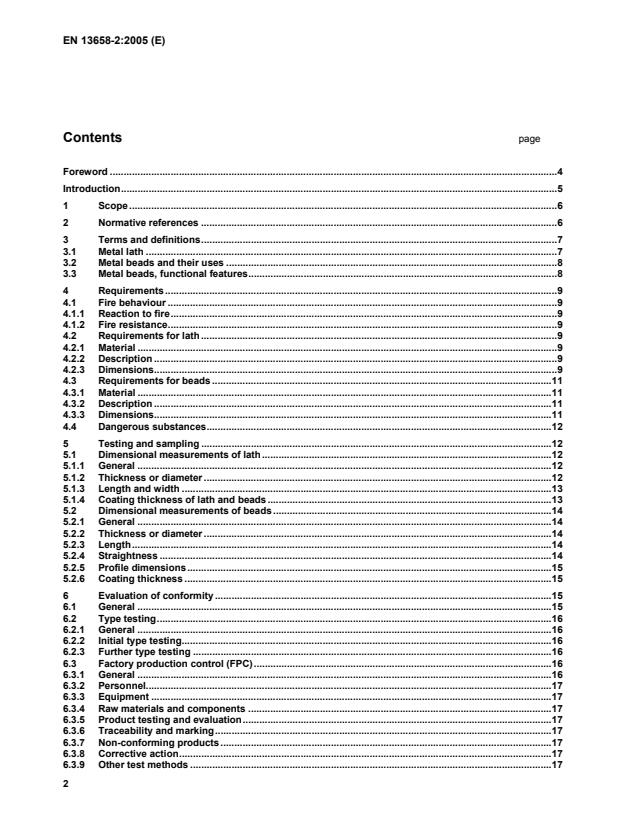
Clauses of this European Standard addressing the provisions of the EU Construction Products Directive.31 ZA.1 Scope and relevant characteristics.31 ZA.2 Procedure(s) for the attestation of conformity of metal lath and beads.32 ZA.3 CE marking and labelling.33 Bibliography.36
Raw gypsum
A1 – Gypsum binders for direct use or further processing
A2 – Direct use on site
A3 – Further processing
Gypsum plasters: B1 – Gypsum building plaster B2 – Gypsum based building plaster B3 – Gypsum-lime building plaster B4 – Lightweight gypsum building plasterB5 – Lightweight gypsum based building plaster B6 – Lightweight gypsum-lime building plaster
B7 – Gypsum plaster with enhanced surface hardness
Gypsum plasters for special purposes: C1 – Gypsum plaster for
fibrous plasterworksC2 – Gypsumbricklaying
plaster C3 – Acoustic plaster C4 – Thermal insulating plaster C5 – Fire protection plaster C6 – Thin coat plaster
Manufactured elements, e. g.: gypsum blocks fibrous plaster casts ceiling tiles plasterboards gypsum boards with fibrous rein-forcement metal lath and beads Diagram 1 Family of Gypsum products
corrosion resistant diamond mesh to provide extra stiffness (see Figure 3b) 3.1.3 expanded ribbed lath
corrosion resistant mesh formed by expanding with integral solid ribs of at least 7 mm height to provide extra stiff-ness (see Figure 4) 3.1.4 expanded mini ribbed lath
corrosion resistant mesh formed by expanding with integral solid ribs between 4 mm and 7 mm height (see Figure 4) 3.1.5 stainless steel ribbed lath stainless steel mesh with integral solid ribs of at least 7 mm height 3.1.6 paperbacked ribbed lath corrosion protected paperbacked mesh with integral ribs of at least 7 mm height 3.1.7 standard paperbacked wire lath corrosion resistant wire spot welded to form a square mesh to provide a key for plastering; between the horizontal and vertical wires a sheet of cardboard is positioned (see Figure 5) 3.1.8 reinforced paperbacked wire lath same as 3.1.7, but the reinforcing wires are thicker and less widely spaced in order to increase stiffness 3.1.9 high ribbed paperbacked wire lath same as 3.1.8, but with thicker wires to provide still greater stiffness 3.1.10 damp proof regular paperbacked wire lath same as 3.1.8, but with a bituminous paper bonded to the back of the cardboard sheet to provide extra damp con-trol
3.2 Metal beads and their uses 3.2.1 angle bead corrosion resistant profiled section used to protect the plastered external angles NOTE this section can also be fabricated from wire 3.2.2 stop bead corrosion resistant profiled section used to provide a straight and protected edge to receive the plaster NOTE this section can also be fabricated from wire 3.2.3 plastered stop bead and soccle bead corrosion resistant profiled section used to provide a straight and protective edge at the lower horizontal edge of the plaster also forming a drip profile to enable water to fall away from the wall below the plaster NOTE this section can also be fabricated from wire 3.2.4 movement bead corrosion resistant profiled section connected with a flexible plastic extrusion capable of a movement within the range of ± 1,5 mm of the external render surface
3.2.5 corner movement bead corrosion resistant profiled section as 3.2.4, with a flexible plastic extrusion used to locate the stop beads at 90° (maximum movement ± 1,5 mm) 3.2.6 expansion bead corrosion resistant profiled section with a flexible extrusion capable of movement greater than ± 1,5 mm, i.e. to al-low for background movement which provides vertical and horizontal flexibility 3.2.7 corner expansion bead corrosion resistant profiled section as 3.2.6 to allow for background movement in 90° inner corners 3.3 Metal beads, functional features 3.3.1 profiled face/edge surface or edge of bead used to provide the feature or function 3.3.2 wing area of metal strip joining the bead face or edge, usually expanded or perforated or welded wire used for fixing and also key for plaster
1) according to commission decision 96/603/EC as amended.
(1) for stop and featured beads 600L
(2)
...