

prEN 12119
(Main)Plastics piping systems - Polyethylene (PE) valves - Test method for resistance to thermal cycling
- Abstract
This standard specifies a test method for the evaluation of leaktightness of a valve under pressure while it is under external thermal cycling.
This standard is applicable to polyethylene (PE) valves and valves with PE spigot-ends having a nominal outside diameter greater than 63 mm and intended for the transport of fluids.
For diameters equal to or lower than 63 mm EN 1704 is applicable
When specified in the product standard, this document can be applied to valves of material other than PE.
- Status
- Not Published
- Publication Date
- 03-Jul-2028
- Technical Committee
- CEN/TC 155 - Plastics piping systems and ducting systems
- Drafting Committee
- CEN/TC 155/WG 32 - Valves
- Current Stage
- 4020 - Submission to enquiry - Enquiry
- Start Date
- 15-Oct-2026
- Due Date
- 23-Mar-2027
- Completion Date
- 15-Oct-2026

prEN 12119 is a CEN draft European Standard for testing the resistance to thermal cycling of polyethylene (PE) valves used in plastics piping systems. It specifies how to check a valve’s leaktightness under pressure while the valve is exposed to external thermal cycling, and it also covers the actuation torque before and after the test. The document applies to PE valves and valves with PE spigot-ends above a nominal outside diameter of 63 mm, and it can also apply to other valve materials when the product standard says so.
What does prEN 12119 specify?
prEN 12119 specifies a test method for evaluating whether a valve remains leaktight while it is pressurized and subjected to thermal cycling. The document is aimed at valves intended for the transport of fluids, and for nominal outside diameters of 63 mm or below it points users to EN 1704 instead.
The document is arranged as follows:
- Clause 1 Scope
- Clause 2 Normative references
- Clause 3 Terms and definitions
- Clause 4 Principle
- Clause 5 Apparatus
- Clause 6 Test pieces
- Clause 7 Procedure
- Clause 8 Test report
- Bibliography
In practice, this structure takes the user from the test purpose, through the equipment and sample preparation, to the cycle itself and the reporting requirements. That makes it usable both as a laboratory method and as a reference for product standards that need a thermal-cycling acceptance test.
What are the key requirements of prEN 12119?
Principle and measurement
prEN 12119 requires the valve to be pressurized with air or nitrogen, isolated from the supply, and then exposed to cyclic thermal stresses while pressure changes are recorded. The test also requires leaktightness and actuation torque to be checked before and after the thermal cycling.
In practice, this means the test is not just a temperature exposure - it is a combined pressure and temperature assessment. A lab must be able to observe any leak, track pressure behavior through the cycles, and compare torque results before and after the test.
Apparatus
prEN 12119 calls for a temperature-controlled chamber that can be programmed between the specified low and high temperatures and can change temperature at the required rate. It also requires a data recording system for pressure, temperature and time, a pressure gauge meeting EN 837-1 accuracy class 1.5, a compressed air or nitrogen supply, and pipework that allows the test piece and gauge to be isolated from the pressure supply.
In practice, the equipment has to support stable cycling and traceable measurements. If the chamber cannot hold the temperature extremes or the gauge is not suitable for the test pressure, the result is not reliable.
Test pieces
prEN 12119 requires a complete valve in the as-manufactured condition unless a referring product standard sets different rules. Sampling comes from the referring standard, and the default number of test pieces is one unless otherwise specified.
Before testing, the valve is conditioned at 23 °C and then checked for leaktightness according to EN 1555-4 and actuation torque according to EN ISO 8233. This gives a baseline so that any change after cycling can be identified.
Procedure
prEN 12119 sets out a cycle in which the pressurized valve is taken through repeated temperature extremes. The document gives the default temperature range and cycle timing, but it also allows a referring standard to set different test temperatures or duration.
During cycling, the user records pressure upstream and downstream of the obturating element, temperature values, and any leak location. After the cycles, the valve is conditioned again at 23 °C and the leaktightness and actuation torque checks are repeated.
For bidirectional valves, the procedure is performed on both pipe ends as stated in the procedure table. That matters because flow direction can affect how a valve seals and how it behaves under repeated thermal changes.
Test report
prEN 12119 requires the report to identify the standard used, the test piece, material type, nominal size, number of specimens, pressure, leak location and temperature, torque results before and after cycling, leaktightness results, and any factors that may have affected the outcome. It also requires the test date and the testing facility reference.
In practice, this makes the report usable for conformity assessment, supplier approval and product qualification.
Who uses prEN 12119?
prEN 12119 is used by valve manufacturers, plastics piping system manufacturers, test laboratories, and conformity assessment bodies. It is also used by quality managers and product standard writers who need a repeatable way to verify thermal-cycling resistance.
For buyers and specifiers, the document matters when a product standard refers to this method for acceptance testing. For laboratories, it defines the equipment, conditioning, measurements and reporting needed to produce comparable results.
What changed in prEN 12119 from the previous edition?
prEN 12119 will supersede EN 12119:1997. The foreword states three significant technical changes:
- the document can also be applied to valves of other material when the product standard specifies it
- the normative references have been updated
- the clause text has been revised to align with new product standards
These changes mainly affect applicability and alignment with current referenced documents.
Which standards are used with prEN 12119?
- EN 837-1 - gives the requirements for the pressure gauge used in the test setup.
- EN 1555-4 - provides the leaktightness test reference used before and after thermal cycling.
- EN ISO 8233 - provides the actuation torque test method used before and after thermal cycling.
- EN 1704 - is named in the scope for valves with nominal outside diameters of 63 mm or below.
- CEN/TS 1555-7 - is cited in a note as an example of a referring standard for conformity assessment or an internal manufacturer quality plan.
What does the prEN 12119 document contain?
prEN 12119 contains a procedure-based laboratory method rather than design requirements. It includes the principle of the test, apparatus requirements, test piece preparation, a step-by-step procedure in Table 1, and a thermal cycle shown in Figure 1.
The document also specifies what to record during the test and what to include in the final report. That makes it suitable for testing, product qualification, and conformity assessment where traceable evidence of thermal-cycling resistance is needed.
Relations
- Effective Date
- 06-May-2026
Get Certified
Connect with accredited certification bodies for this standard

Institut za varilstvo d.o.o. (Welding Institute)
Slovenia's leading welding institute since 1952. ISO 3834, EN 1090, pressure equipment certification, NDT personnel, welder qualification. Only IIW Au
Sponsored listings
Frequently Asked Questions
prEN 12119 is a draft published by the European Committee for Standardization (CEN). Its full title is "Plastics piping systems - Polyethylene (PE) valves - Test method for resistance to thermal cycling". This standard covers: This standard specifies a test method for the evaluation of leaktightness of a valve under pressure while it is under external thermal cycling. This standard is applicable to polyethylene (PE) valves and valves with PE spigot-ends having a nominal outside diameter greater than 63 mm and intended for the transport of fluids. For diameters equal to or lower than 63 mm EN 1704 is applicable When specified in the product standard, this document can be applied to valves of material other than PE.
This standard specifies a test method for the evaluation of leaktightness of a valve under pressure while it is under external thermal cycling. This standard is applicable to polyethylene (PE) valves and valves with PE spigot-ends having a nominal outside diameter greater than 63 mm and intended for the transport of fluids. For diameters equal to or lower than 63 mm EN 1704 is applicable When specified in the product standard, this document can be applied to valves of material other than PE.
prEN 12119 is classified under the following ICS (International Classification for Standards) categories: 23.060.01 - Valves in general. The ICS classification helps identify the subject area and facilitates finding related standards.
prEN 12119 has the following relationships with other standards: It is inter standard links to EN 12119:1997. Understanding these relationships helps ensure you are using the most current and applicable version of the standard.
prEN 12119 is associated with the following European legislation: EU Directives/Regulations: 305/2011. When a standard is cited in the Official Journal of the European Union, products manufactured in conformity with it benefit from a presumption of conformity with the essential requirements of the corresponding EU directive or regulation.
prEN 12119 is available in PDF format for immediate download after purchase. The document can be added to your cart and obtained through the secure checkout process. Digital delivery ensures instant access to the complete standard document.
Standards Content (Sample)
SLOVENSKI STANDARD
01-december-2026
Cevni sistemi iz polimernih materialov - Ventili iz polietilena (PE) - Metoda za
preskus odpornosti proti cikličnim spremembam temperature
Plastics piping systems - Polyethylene (PE) valves - Test method for resistance to
thermal cycling
Kunststoff-Rohrleitungssysteme - Armaturen aus Polyethylen (PE) - Prüfverfahren für die
Beständigkeit gegen Temperaturwechsel
Systèmes de canalisations en plastique - Robinets en polyéthylène (PE) - Méthode
d'essai de résistance aux cycles thermiques
Ta slovenski standard je istoveten z: prEN 12119
ICS:
23.060.01 Ventili na splošno Valves in general
83.140.30 Polimerne cevi in fitingi za Plastics pipes and fittings for
snovi, ki niso tekočine non fluid use
2003-01.Slovenski inštitut za standardizacijo. Razmnoževanje celote ali delov tega standarda ni dovoljeno.
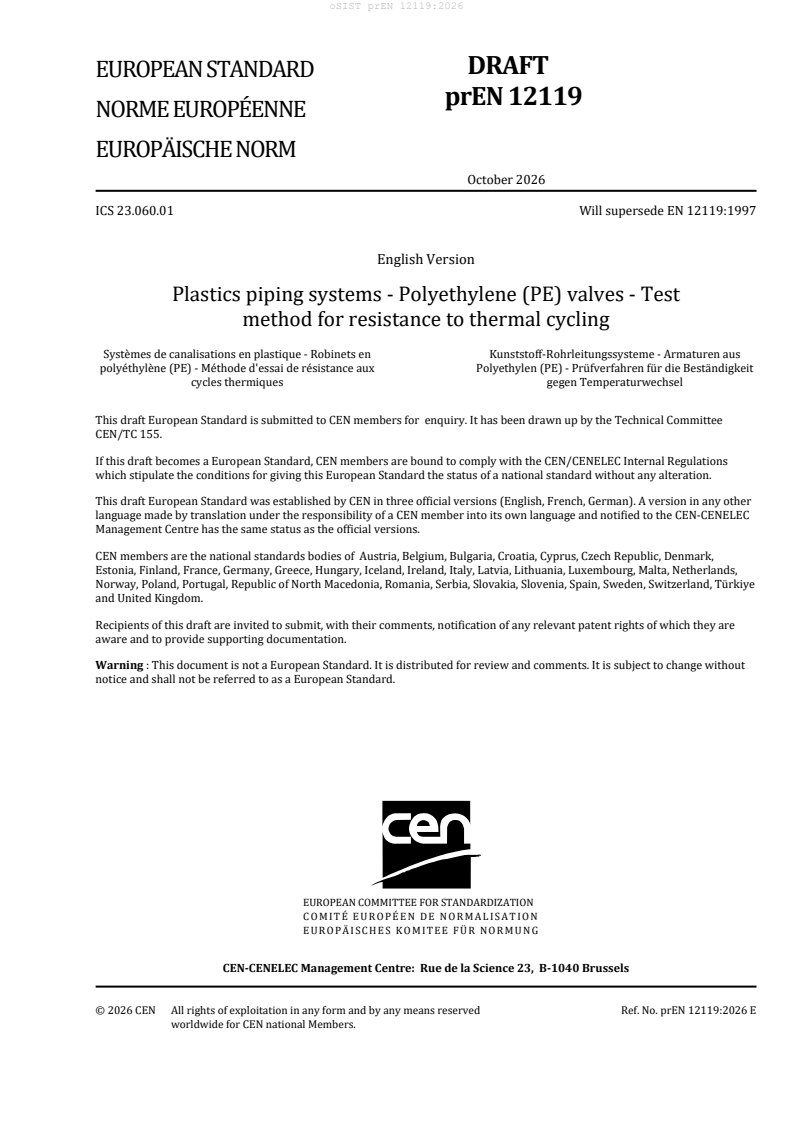
DRAFT
EUROPEAN STANDARD
NORME EUROPÉENNE
EUROPÄISCHE NORM
October 2026
ICS 23.060.01 Will supersede EN 12119:1997
English Version
Plastics piping systems - Polyethylene (PE) valves - Test
method for resistance to thermal cycling
Systèmes de canalisations en plastique - Robinets en Kunststoff-Rohrleitungssysteme - Armaturen aus
polyéthylène (PE) - Méthode d'essai de résistance aux Polyethylen (PE) - Prüfverfahren für die Beständigkeit
cycles thermiques gegen Temperaturwechsel
This draft European Standard is submitted to CEN members for enquiry. It has been drawn up by the Technical Committee
CEN/TC 155.
If this draft becomes a European Standard, CEN members are bound to comply with the CEN/CENELEC Internal Regulations
which stipulate the conditions for giving this European Standard the status of a national standard without any alteration.
This draft European Standard was established by CEN in three official versions (English, French, German). A version in any other
language made by translation under the responsibility of a CEN member into its own language and notified to the CEN-CENELEC
Management Centre has the same status as the official versions.
CEN members are the national standards bodies of Austria, Belgium, Bulgaria, Croatia, Cyprus, Czech Republic, Denmark,
Estonia, Finland, France, Germany, Greece, Hungary, Iceland, Ireland, Italy, Latvia, Lithuania, Luxembourg, Malta, Netherlands,
Norway, Poland, Portugal, Republic of North Macedonia, Romania, Serbia, Slovakia, Slovenia, Spain, Sweden, Switzerland, Türkiye
and United Kingdom.
Recipients of this draft are invited to submit, with their comments, notification of any relevant patent rights of which they are
aware and to provide supporting documentation.
Warning : This document is not a European Standard. It is distributed for review and comments. It is subject to change without
notice and shall not be referred to as a European Standard.
EUROPEAN COMMITTEE FOR STANDARDIZATION
C O M I T É E U R O P É E N D E N O R M A L I S A T I O N
E U R O P Ä I S C H E S K O M I T E E F Ü R N O R M U N G
CEN-CENELEC Management Centre: Rue de la Science 23, B-1040 Brussels
© 2026 CEN All rights of exploitation in any form and by any means reserved Ref. No. prEN 12119:2026 E
worldwide for CEN national Members.
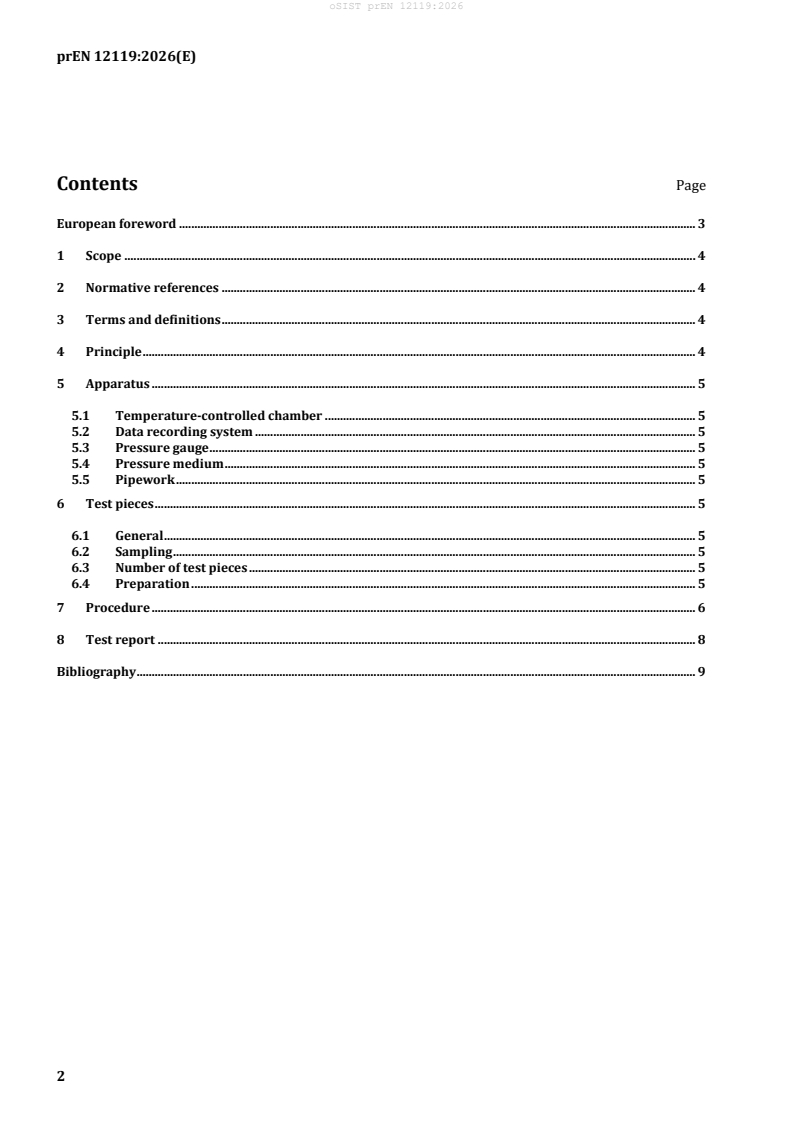
Contents Page
European foreword . 3
1 Scope . 4
2 Normative references . 4
3 Terms and definitions . 4
4 Principle . 4
5 Apparatus . 5
5.1 Temperature-controlled chamber . 5
5.2 Data recording system . 5
5.3 Pressure gauge . 5
5.4 Pressure medium . 5
5.5 Pipework . 5
6 Test pieces . 5
6.1 General . 5
6.2 Sampling . 5
6.3 Number of test pieces . 5
6.4 Preparation . 5
7 Procedure . 6
8 Test report . 8
Bibliography . 9
European foreword
This document (prEN 12119 2026) has been prepared by Technical Committee CEN/TC 155 “Plastics
piping systems and ducting systems”, the secretariat of which is held by NEN.
This document is currently submitted to the CEN Enquiry.
This document will supersede EN 12119:1997.
— the document can be applied to valves of material other than PE when specified in the product
standard;
— the normative references have been updated;
— the text of the clauses have been revised in relation to the new product standards.
1 Scope
This document specifies a test method for the evaluation of leaktightness of a valve under pressure while
it is under external thermal cycling.
This document is applicable to polyethylene (PE) valves and valves with PE spigot-ends having a nominal
outside diameter greater than 63 mm and intended for the transport of fluids.
For diameters equal to or lower than 63 mm EN 1704[1] is applicable
When specified in the product standard, this document can be applied t
...