

EN 1996-1-1:2022/FprA1
(Amendment)Eurocode 6 - Design of masonry structures - Part 1-1: General rules for reinforced and unreinforced masonry structures
- Abstract
(1) The basis for the design of building and civil engineering works in masonry is given in this Part 1-1 of EN 1996, which deals with unreinforced masonry, reinforced masonry and confined masonry. Principles for the design of prestressed masonry are also given. This Part 1-1 of EN 1996 is not valid for masonry elements with a plan area of less than 0,04 m2.
(2) For those types of structures not covered entirely, for new structural uses for established materials, for new materials, or where actions and other influences outside normal experience have to be resisted, the provisions given in this Part 1-1 of EN 1996 may be applicable, but may need to be supplemented.
(3) Part 1-1 of EN 1996 gives detailed rules which are mainly applicable to ordinary buildings. The applicability of these rules may be limited, for practical reasons or due to simplifications; any limits of applicability are given in the text where necessary.
(4) Part 1-1 of EN 1996 does not cover:
- resistance to fire (which is dealt with in EN 1996-1-2);
- particular aspects of special types of building (for example, dynamic effects on tall buildings);
- particular aspects of special types of civil engineering works (such as masonry bridges, dams, chimneys or liquid-retaining structures);
- particular aspects of special types of structures (such as arches or domes);
- masonry where gypsum, with or without cement, mortars are used;
- masonry where the units are not laid in a regular pattern of courses (rubble masonry);
- masonry reinforced with other materials than steel.
- Status
- Not Published
- Publication Date
- 17-Feb-2027
- Technical Committee
- CEN/TC 250 - Structural Eurocodes
- Current Stage
- 4599 - Dispatch of FV draft to CMC - Finalization for Vote
- Start Date
- 03-Nov-2026
- Due Date
- 26-Aug-2027
- Completion Date
- 26-Aug-2027

EN 1996-1-1:2022/FprA1 is a CEN draft amendment to Eurocode 6, Part 1-1, for the design of masonry structures. It updates the general rules for reinforced and unreinforced masonry structures, with linked changes to references, terminology, and design notes used by structural designers and national standards bodies.
What does EN 1996-1-1:2022/FprA1 specify?
EN 1996-1-1:2022/FprA1 specifies amendments to the general masonry design rules in EN 1996-1-1:2022. The base part covers unreinforced masonry, reinforced masonry, confined masonry, and principles for prestressed masonry, mainly for ordinary buildings.
The scope text also limits where the rules apply. EN 1996-1-1 is not valid for masonry elements with a plan area of less than 0,04 m2, and it does not cover fire resistance, special building or civil engineering cases, arches or domes, rubble masonry, gypsum-based mortars, or masonry reinforced with materials other than steel.
The document is organized as a foreword and clauses 1 to 8:
- document-wide modification
- Introduction
- Clause 2, Normative references
- Clause 3, Terms, definitions and symbols
- Clause 4, Basis of design
- Clause 6, Durability
- Clause 7, Structural analysis
- Bibliography
What are the key requirements of EN 1996-1-1:2022/FprA1?
This amendment mainly updates references and clarifies terminology used in the design rules. It also aligns several notes with newer Eurocode parts, so readers can trace the design basis to the current companion standards.
Document-wide reference update
Throughout the document, EN 1990 is replaced with EN 1990-1, except in subclause 0.1. In practice, this keeps the Eurocode design basis consistent with the revised structural and geotechnical design reference.
Introduction updates
Clause 0.1 adds EN 19100 Eurocode 10 and revises wording about new Eurocode parts under development. Clause 0.5 also clarifies that national choice is allowed through notes to specified clauses. For users, this signals where national decisions may be made when preparing a National Annex.
Normative references
Clause 2 replaces the references to EN 1990 and EN 1992-1-1 with updated titles for EN 1990-1 and EN 1992-1-1. This matters because the design checks in masonry often depend on the linked rules for load combinations and concrete elements.
Terms, definitions and symbols
Clause 3 adds the term ring beam, also called ring tie, as a structural element at the top of a wall that ties wall parts together and helps distribute the load above. It also adjusts the symbols for reinforcement yield strength and two reduction factors. This helps designers use the same terms and symbols when calculating stability and load effects.
Basis of design
In Clause 4, a note now points to EN 1990-1:2023+A1:2026. That gives the current design basis used alongside masonry design when selecting actions and combinations.
Durability
Clause 6 updates a note to EN 1996-2:2024. For practice, this links durability decisions to the companion masonry execution and material guidance.
Structural analysis
Clause 7 updates a note to EN 1997-1. This matters where masonry structural analysis interacts with geotechnical design, such as foundations and soil-supported behaviour.
What terms does EN 1996-1-1:2022/FprA1 define?
- Ring beam / ring tie - A structural element at the top of a wall that ties the wall together and spreads load from above.
- Characteristic value yield strength of reinforcement (
f_yk) - The reference yield strength used for reinforcement design calculations. - Reduction factor for height (
α_h) - A factor used in the document’s design rules to adjust results for wall height effects. - Reduction factor for number of vertical loadbearing elements (
α_m) - A factor used to account for how many vertical loadbearing elements share the load. - National Annex - The national document that sets permitted national choices for Eurocode application.
- CEN - The European Committee for Standardization, which publishes the draft amendment.
- CEN/TC 250 - The CEN technical committee responsible for the Structural Eurocodes.
Who uses EN 1996-1-1:2022/FprA1?
EN 1996-1-1:2022/FprA1 is used by structural engineers, masonry designers, checking engineers, and code writers who work on building and civil engineering projects in masonry. It is also relevant to national standards bodies preparing National Annexes, and to organizations that align product, test, and execution standards with Eurocode design rules.
In practice, these users apply it when reviewing design references, updating national clauses, checking terminology, and keeping masonry design documentation aligned with the latest Eurocode family.
What changed in EN 1996-1-1:2022/FprA1 from the previous edition?
This draft amendment modifies EN 1996-1-1:2022. The stated changes are:
- replacement of EN 1990 with EN 1990-1 throughout, with one exception
- updated wording in the Introduction, including EN 19100 and revised text on future Eurocode parts
- updated normative references in Clause 2
- addition of the ring beam / ring tie term in Clause 3
- updates to the symbols in Clause 3
- updated notes in Clauses 4, 6, and 7
- bibliography update to include EN 1997-1
Which standards are used with EN 1996-1-1:2022/FprA1?
- EN 1990-1 - Provides the basis of structural and geotechnical design for new structures.
- EN 1992-1-1 - Provides general rules and building, bridge, and civil engineering rules for concrete design where masonry design refers to concrete elements.
- EN 1996-2:2024 - Supports masonry durability and related execution or material guidance.
- EN 1997-1 - Provides geotechnical design rules used where masonry design interacts with ground and foundation behaviour.
- EN 772-1 - A masonry unit test method cited in the bibliography for compressive strength determination.
What does the EN 1996-1-1:2022/FprA1 document contain?
The document contains amendment text rather than a full rewritten standard. It shows where EN 1996-1-1:2022 is changed in the Introduction, Clauses 2, 3, 4, 6, and 7, plus the bibliography. The foreword explains that the amendment was prepared by CEN/TC 250 and is under CEN Enquiry, and that some changes are editorial corrections.
It also contains the updated wording that aligns the masonry rules with newer Eurocode references and the current terminology used across the Eurocode family.
Get Certified
Connect with accredited certification bodies for this standard

DIBt (Deutsches Institut für Bautechnik)
German Institute for Building Technology.

DIN CERTCO
DIN Group product certification.

Aboma Certification B.V.
Specialized in construction, metal, and transport sectors.
Sponsored listings
Frequently Asked Questions
EN 1996-1-1:2022/FprA1 is a draft published by the European Committee for Standardization (CEN). Its full title is "Eurocode 6 - Design of masonry structures - Part 1-1: General rules for reinforced and unreinforced masonry structures". This standard covers: (1) The basis for the design of building and civil engineering works in masonry is given in this Part 1-1 of EN 1996, which deals with unreinforced masonry, reinforced masonry and confined masonry. Principles for the design of prestressed masonry are also given. This Part 1-1 of EN 1996 is not valid for masonry elements with a plan area of less than 0,04 m2. (2) For those types of structures not covered entirely, for new structural uses for established materials, for new materials, or where actions and other influences outside normal experience have to be resisted, the provisions given in this Part 1-1 of EN 1996 may be applicable, but may need to be supplemented. (3) Part 1-1 of EN 1996 gives detailed rules which are mainly applicable to ordinary buildings. The applicability of these rules may be limited, for practical reasons or due to simplifications; any limits of applicability are given in the text where necessary. (4) Part 1-1 of EN 1996 does not cover: - resistance to fire (which is dealt with in EN 1996-1-2); - particular aspects of special types of building (for example, dynamic effects on tall buildings); - particular aspects of special types of civil engineering works (such as masonry bridges, dams, chimneys or liquid-retaining structures); - particular aspects of special types of structures (such as arches or domes); - masonry where gypsum, with or without cement, mortars are used; - masonry where the units are not laid in a regular pattern of courses (rubble masonry); - masonry reinforced with other materials than steel.
(1) The basis for the design of building and civil engineering works in masonry is given in this Part 1-1 of EN 1996, which deals with unreinforced masonry, reinforced masonry and confined masonry. Principles for the design of prestressed masonry are also given. This Part 1-1 of EN 1996 is not valid for masonry elements with a plan area of less than 0,04 m2. (2) For those types of structures not covered entirely, for new structural uses for established materials, for new materials, or where actions and other influences outside normal experience have to be resisted, the provisions given in this Part 1-1 of EN 1996 may be applicable, but may need to be supplemented. (3) Part 1-1 of EN 1996 gives detailed rules which are mainly applicable to ordinary buildings. The applicability of these rules may be limited, for practical reasons or due to simplifications; any limits of applicability are given in the text where necessary. (4) Part 1-1 of EN 1996 does not cover: - resistance to fire (which is dealt with in EN 1996-1-2); - particular aspects of special types of building (for example, dynamic effects on tall buildings); - particular aspects of special types of civil engineering works (such as masonry bridges, dams, chimneys or liquid-retaining structures); - particular aspects of special types of structures (such as arches or domes); - masonry where gypsum, with or without cement, mortars are used; - masonry where the units are not laid in a regular pattern of courses (rubble masonry); - masonry reinforced with other materials than steel.
EN 1996-1-1:2022/FprA1 is classified under the following ICS (International Classification for Standards) categories: 91.010.30 - Technical aspects; 91.080.30 - Masonry. The ICS classification helps identify the subject area and facilitates finding related standards.
EN 1996-1-1:2022/FprA1 is available in PDF format for immediate download after purchase. The document can be added to your cart and obtained through the secure checkout process. Digital delivery ensures instant access to the complete standard document.
Standards Content (Sample)
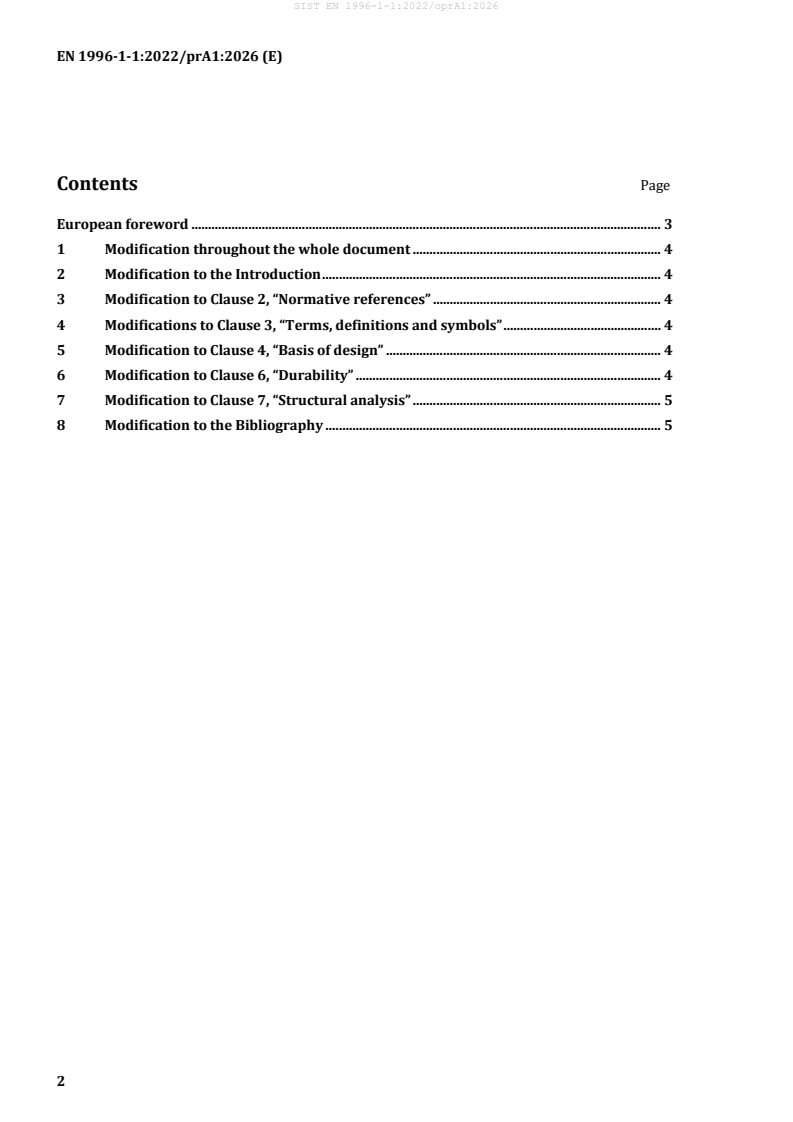
Contents
- European foreword
- 1 Modification throughout the whole document
- 2 Modification to the Introduction
- 3 Modification to Clause 2, “Normative references”
- 4 Modifications to Clause 3, “Terms, definitions and symbols”
- 5 Modification to Clause 4, “Basis of design”
- 6 Modification to Clause 6, “Durability”
- 7 Modification to Clause 7, “Structural analysis”
- 8 Modification to the Bibliography
European foreword
This document (EN 1996-1-1:2022/prA1:2026) has been prepared by Technical Committee CEN/TC 250 “Structural Eurocodes”, the secretariat of which is held by BSI. CEN/TC 250 is responsible for all Structural Eurocodes and has been assigned responsibility for structural and geotechnical design matters by CEN.
This document is currently submitted to the CEN Enquiry.
This document will amend EN 1996-1-1:2022.
NOTE Some modifications are purely editorial corrections to improve the quality of the document and these will not be tagged in the consolidated publication, as noted after the modification. The first generation of EN Eurocodes was published between 2002 and 2007. This document forms part of the second generation of the Eurocodes, which have been prepared under Mandate M/515 issued to CEN by the European Commission and the European Free Trade Association. The Eurocodes have been drafted to be used in conjunction with relevant execution, material, product and test standards, and to identify requirements for execution, materials, products and testing that are relied upon by the Eurocodes.
The Eurocodes recognize the responsibility of each Member State and have safeguarded their right to determine values related to regulatory safety matters at national level through the use of National Annexes.
...