

EN 1996-2:2024
(Main)Eurocode 6 - Design of masonry structures - Part 2: Design considerations, selection of materials and execution
- Abstract
(1) This document gives basic rules for the selection of materials and execution of masonry to enable it to comply with the design assumptions of the other parts of Eurocode 6.
(2) This document deals with ordinary aspects of masonry design and execution including:
- selection of masonry materials;
- factors affecting the performance and durability of masonry;
- masonry detailing, joint finishes, movement joints, resistance of buildings to moisture penetration;
- storage, preparation and use of materials on site;
- execution of masonry;
- masonry protection during execution;
(3) This document does not cover the following items:
- aesthetic aspects;
- applied finishes;
1.2 Assumptions
(1) The assumptions of EN 1990 apply to this document.
(2) This document is intended to be used together with EN 1990, EN 1991, EN 1996 1-1, EN 1996-1-2 and EN 1996-3.
(3) The design of masonry is carried out in accordance with EN 1996 1 1.
- Status
- Published
- Publication Date
- 24-Sep-2024
- Technical Committee
- CEN/TC 250 - Structural Eurocodes
- Drafting Committee
- CEN/TC 250/SC 6 - Eurocode 6: Design of masonry structures
- Current Stage
- 9093 - Decision to confirm - Review Enquiry
- Start Date
- 01-Oct-2026
- Completion Date
- 21-Oct-2026

Overview
EN 1996-2:2024 - Eurocode 6, Part 2 (Design of masonry structures - Design considerations, selection of materials and execution) provides the basic rules for selecting materials and executing masonry so that built work meets the design assumptions of the other Eurocode 6 parts. It focuses on practical requirements affecting the durability, performance and execution of masonry, and is intended to be used together with EN 1990, EN 1991, EN 1996‑1‑1, EN 1996‑1‑2 and EN 1996‑3. The document excludes aesthetic aspects and applied finishes.
Key topics
- Selection of masonry materials
- Guidance on choosing masonry units, mortars, concrete infill, ancillary components and reinforcement for intended exposure and durability.
- Informative tables and provisions for material acceptance, handling and storage on site.
- Factors affecting durability
- Classification of environmental and micro‑exposure conditions, including aggressive chemical environments and wetting regimes.
- Recommendations to control moisture, frost action and chemical attack.
- Masonry detailing and construction
- Requirements for masonry detailing, joint finishes, movement joints, permissible deviations and resistance to moisture penetration.
- Execution topics: site preparation, mixing (site-made and factory-made mortars), laying, pointing, incorporation of damp‑proof courses, insulation and cleaning.
- Execution controls and protection
- Procedures for curing, protection against rain, freeze/thaw, low humidity and mechanical damage during construction.
- Storage, handling and acceptance criteria for materials, plus workmanship tolerances.
- Informative annexes
- Annex A: classification of micro exposure conditions.
- Annex B: acceptable combinations of masonry units and mortar for durability.
- Annex C: material selection and corrosion protection for ancillary components.
Applications
EN 1996-2:2024 is a practical reference for ensuring that masonry works meet design and durability expectations. Typical applications include:
- Design and specification of new masonry buildings, walls and partitions.
- Preparation of technical specifications for tenders and contracts (materials and execution).
- Site quality control: acceptance of materials, workmanship tolerances and curing/protection procedures.
- Assessment and detailing of external walls for moisture resistance and movement joint layout.
Who should use it
- Structural and masonry engineers
- Architects and specification writers
- Contractors, site managers and quality inspectors
- Product manufacturers and testing laboratories
- Regulatory authorities and building control bodies
Related standards
- EN 1990 (Basis of structural design)
- EN 1991 (Actions on structures)
- EN 1996‑1‑1, EN 1996‑1‑2, EN 1996‑3 (complementary Eurocode 6 parts)
- Applicable execution, product and test standards referenced by the Eurocodes
Keywords: Eurocode 6, EN 1996-2:2024, design of masonry structures, selection of materials, execution of masonry, masonry detailing, movement joints, masonry durability, masonry mortar, masonry units.
Relations
- Effective Date
- 02-Oct-2024
- Effective Date
- 20-Feb-2019
- Effective Date
- 11-Mar-2026
- Effective Date
- 11-Mar-2026
- Effective Date
- 28-Jan-2026
- Refers
EN 771-2:2011+A1:2015 - Specification for masonry units - Part 2: Calcium silicate masonry units - Effective Date
- 28-Jan-2026
- Effective Date
- 28-Jan-2026
- Effective Date
- 28-Jan-2026
- Refers
EN 1996-1-2:2024 - Eurocode 6 - Design of masonry structures - Part 1-2: Structural fire design - Effective Date
- 28-Jan-2026
- Refers
EN 771-5:2011+A1:2015 - Specification for masonry units - Part 5: Manufactured stone masonry units - Effective Date
- 28-Jan-2026
- Effective Date
- 28-Jan-2026
- Effective Date
- 28-Jan-2026
- Effective Date
- 28-Jan-2026
- Effective Date
- 28-Jan-2026
- Effective Date
- 28-Jan-2026
Get Certified
Connect with accredited certification bodies for this standard

DIBt (Deutsches Institut für Bautechnik)
German Institute for Building Technology.
DIN CERTCO
DIN Group product certification.

Aboma Certification B.V.
Specialized in construction, metal, and transport sectors.
Sponsored listings
Frequently Asked Questions
EN 1996-2:2024 is a draft published by the European Committee for Standardization (CEN). Its full title is "Eurocode 6 - Design of masonry structures - Part 2: Design considerations, selection of materials and execution". This standard covers: (1) This document gives basic rules for the selection of materials and execution of masonry to enable it to comply with the design assumptions of the other parts of Eurocode 6. (2) This document deals with ordinary aspects of masonry design and execution including: - selection of masonry materials; - factors affecting the performance and durability of masonry; - masonry detailing, joint finishes, movement joints, resistance of buildings to moisture penetration; - storage, preparation and use of materials on site; - execution of masonry; - masonry protection during execution; (3) This document does not cover the following items: - aesthetic aspects; - applied finishes; 1.2 Assumptions (1) The assumptions of EN 1990 apply to this document. (2) This document is intended to be used together with EN 1990, EN 1991, EN 1996 1-1, EN 1996-1-2 and EN 1996-3. (3) The design of masonry is carried out in accordance with EN 1996 1 1.
(1) This document gives basic rules for the selection of materials and execution of masonry to enable it to comply with the design assumptions of the other parts of Eurocode 6. (2) This document deals with ordinary aspects of masonry design and execution including: - selection of masonry materials; - factors affecting the performance and durability of masonry; - masonry detailing, joint finishes, movement joints, resistance of buildings to moisture penetration; - storage, preparation and use of materials on site; - execution of masonry; - masonry protection during execution; (3) This document does not cover the following items: - aesthetic aspects; - applied finishes; 1.2 Assumptions (1) The assumptions of EN 1990 apply to this document. (2) This document is intended to be used together with EN 1990, EN 1991, EN 1996 1-1, EN 1996-1-2 and EN 1996-3. (3) The design of masonry is carried out in accordance with EN 1996 1 1.
EN 1996-2:2024 is classified under the following ICS (International Classification for Standards) categories: 91.010.30 - Technical aspects; 91.080.30 - Masonry. The ICS classification helps identify the subject area and facilitates finding related standards.
EN 1996-2:2024 has the following relationships with other standards: It is inter standard links to EN 1996-2:2006/AC:2009, EN 1996-2:2006, EN 206-2:2026, EN 206-1:2026, EN 1015-17:2000, EN 771-2:2011+A1:2015, EN 771-1:2011+A1:2015, EN 206:2013+A2:2021, EN 1996-1-2:2024, EN 771-5:2011+A1:2015, EN 1015-11:2019, EN 998-2:2016, EN 771-6:2011+A1:2015, EN 771-3:2011+A1:2015, EN 771-4:2011+A1:2015. Understanding these relationships helps ensure you are using the most current and applicable version of the standard.
EN 1996-2:2024 is associated with the following European legislation: EU Directives/Regulations: 305/2011; Standardization Mandates: M/515. When a standard is cited in the Official Journal of the European Union, products manufactured in conformity with it benefit from a presumption of conformity with the essential requirements of the corresponding EU directive or regulation.
EN 1996-2:2024 is available in PDF format for immediate download after purchase. The document can be added to your cart and obtained through the secure checkout process. Digital delivery ensures instant access to the complete standard document.
Standards Content (Sample)
SLOVENSKI STANDARD
oSIST prEN 1996-2:2022
01-december-2022
Evrokod 6 - Projektiranje zidanih konstrukcij - 2. del: Projektiranje z upoštevanjem
izbire materialov in izvedbe zidovja
Eurocode 6 - Design of masonry structures - Part 2: Design considerations, selection of
materials and execution of masonry
Eurocode 6 - Bemessung und Konstruktion von Mauerwerksbauten - Teil 2: Planung,
Auswahl der Baustoffe und Ausführung von Mauerwerk
Eurocode 6 - Calcul des ouvrages en maçonnerie - Partie 2: Conception, choix des
matériaux et mise en oeuvre des maçonneries
Ta slovenski standard je istoveten z: prEN 1996-2
ICS:
91.010.30 Tehnični vidiki Technical aspects
91.080.30 Zidane konstrukcije Masonry
oSIST prEN 1996-2:2022 en,fr,de
2003-01.Slovenski inštitut za standardizacijo. Razmnoževanje celote ali delov tega standarda ni dovoljeno.
oSIST prEN 1996-2:2022
oSIST prEN 1996-2:2022
DRAFT
EUROPEAN STANDARD
prEN 1996-2
NORME EUROPÉENNE
EUROPÄISCHE NORM
September 2022
ICS 91.010.30; 91.080.30 Will supersede EN 1996-2:2006
English Version
Eurocode 6 - Design of masonry structures - Part 2: Design
considerations, selection of materials and execution of
masonry
Eurocode 6 - Calcul des ouvrages en maçonnerie - Eurocode 6 - Bemessung und Konstruktion von
Partie 2: Conception, choix des matériaux et mise en Mauerwerksbauten - Teil 2: Planung, Auswahl der
oeuvre des maçonneries Baustoffe und Ausführung von Mauerwerk
This draft European Standard is submitted to CEN members for enquiry. It has been drawn up by the Technical Committee
CEN/TC 250.
If this draft becomes a European Standard, CEN members are bound to comply with the CEN/CENELEC Internal Regulations
which stipulate the conditions for giving this European Standard the status of a national standard without any alteration.
This draft European Standard was established by CEN in three official versions (English, French, German). A version in any other
language made by translation under the responsibility of a CEN member into its own language and notified to the CEN-CENELEC
Management Centre has the same status as the official versions.
CEN members are the national standards bodies of Austria, Belgium, Bulgaria, Croatia, Cyprus, Czech Republic, Denmark, Estonia,
Finland, France, Germany, Greece, Hungary, Iceland, Ireland, Italy, Latvia, Lithuania, Luxembourg, Malta, Netherlands, Norway,
Poland, Portugal, Republic of North Macedonia, Romania, Serbia, Slovakia, Slovenia, Spain, Sweden, Switzerland, Turkey and
United Kingdom.
Recipients of this draft are invited to submit, with their comments, notification of any relevant patent rights of which they are
aware and to provide supporting documentation.
Warning : This document is not a European Standard. It is distributed for review and comments. It is subject to change without
notice and shall not be referred to as a European Standard.
EUROPEAN COMMITTEE FOR STANDARDIZATION
COMITÉ EUROPÉEN DE NORMALISATION
EUROPÄISCHES KOMITEE FÜR NORMUNG
CEN-CENELEC Management Centre: Rue de la Science 23, B-1040 Brussels
© 2022 CEN All rights of exploitation in any form and by any means reserved Ref. No. prEN 1996-2:2022 E
worldwide for CEN national Members.
oSIST prEN 1996-2:2022
prEN 1996-2:2022 (E)
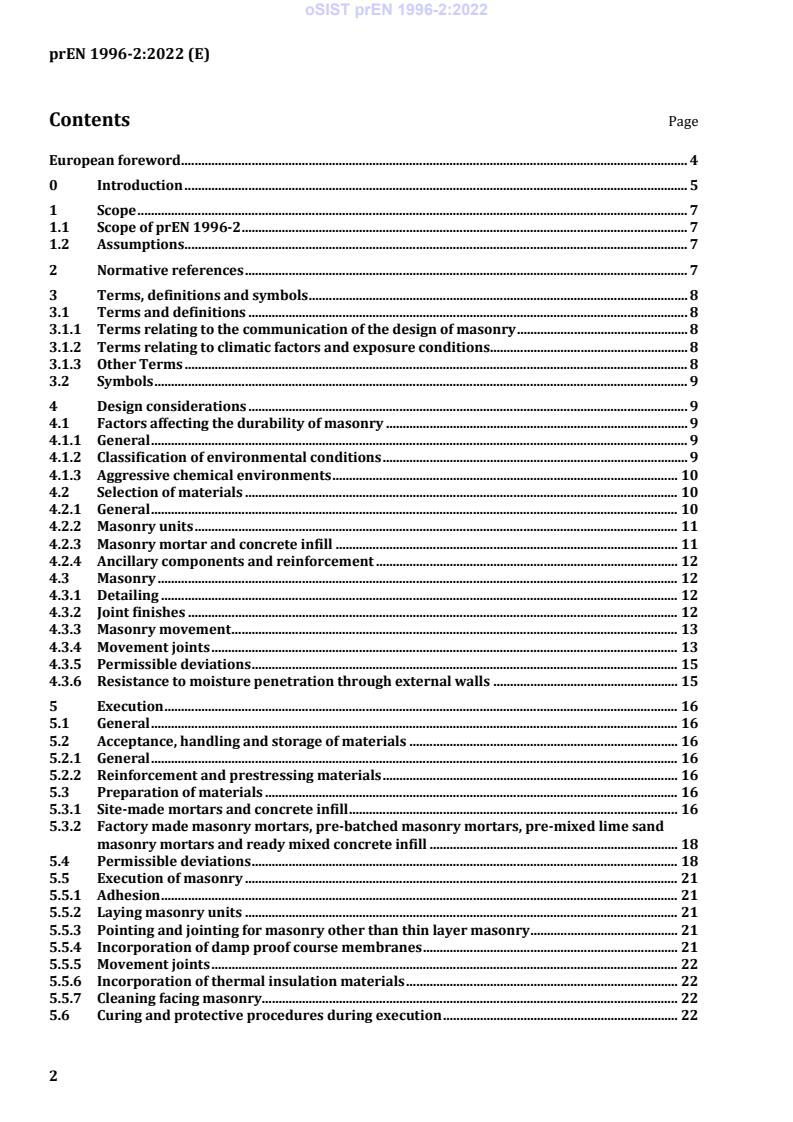
Contents Page
European foreword . 4
0 Introduction . 5
1 Scope . 7
1.1 Scope of prEN 1996-2 . 7
1.2 Assumptions . 7
2 Normative references . 7
3 Terms, definitions and symbols . 8
3.1 Terms and definitions . 8
3.1.1 Terms relating to the communication of the design of masonry . 8
3.1.2 Terms relating to climatic factors and exposure conditions . 8
3.1.3 Other Terms . 8
3.2 Symbols . 9
4 Design considerations . 9
4.1 Factors affecting the durability of masonry . 9
4.1.1 General . 9
4.1.2 Classification of environmental conditions . 9
4.1.3 Aggressive chemical environments . 10
4.2 Selection of materials . 10
4.2.1 General . 10
4.2.2 Masonry units . 11
4.2.3 Masonry mortar and concrete infill . 11
4.2.4 Ancillary components and reinforcement . 12
4.3 Masonry . 12
4.3.1 Detailing . 12
4.3.2 Joint finishes . 12
4.3.3 Masonry movement . 13
4.3.4 Movement joints . 13
4.3.5 Permissible deviations . 15
4.3.6 Resistance to moisture penetration through external walls . 15
5 Execution . 16
5.1 General . 16
5.2 Acceptance, handling and storage of materials . 16
5.2.1 General . 16
5.2.2 Reinforcement and prestressing materials . 16
5.3 Preparation of materials . 16
5.3.1 Site-made mortars and concrete infill . 16
5.3.2 Factory made masonry mortars, pre-batched masonry mortars, pre-mixed lime sand
masonry mortars and ready mixed concrete infill . 18
5.4 Permissible deviations . 18
5.5 Execution of masonry . 21
5.5.1 Adhesion . 21
5.5.2 Laying masonry units . 21
5.5.3 Pointing and jointing for masonry other than thin layer masonry . 21
5.5.4 Incorporation of damp proof course membranes . 21
5.5.5 Movement joints . 22
5.5.6 Incorporation of thermal insulation materials . 22
5.5.7 Cleaning facing masonry. 22
5.6 Curing and protective procedures during execution . 22
oSIST prEN 1996-2:2022
prEN 1996-2:2022 (E)
5.6.1 General . 22
5.6.2 Protection against rain . 22
5.6.3 Protection against freeze/thaw cycling . 22
5.6.4 Protection against effects of low humidity . 22
5.6.5 Protection against mechanical damage . 23
5.6.6 Construction height of masonry . 23
Annex A (informative) Classification of micro conditions of exposure of completed masonry . 24
A.1 Use of this Informative Annex . 24
A.2 Scope and field of application . 24
A.3 Classification . 25
A.4 Exposure to wetting . 26
Annex B (informative) Acceptable specifications of masonry units and mortar for durable
masonry in various exposure conditions . 28
B.1 Use of this Informative Annex . 28
B.2 Scope and field of application . 28
B.3 Selection of masonry units and mortar . 28
Annex C (informative) Selection of material and corrosion protection specifications for
ancillary components according to exposure class . 31
C.1 Use of this Informative Annex . 31
C.2 Scope and field of application . 31
C.3 Exposure classes . 31
C.4 Selection of materials . 31
Bibliography . 35
oSIST prEN 1996-2:2022
prEN 1996-2:2022 (E)
European foreword
This document (prEN 1996-2:2022) has been prepared by Technical Committee CEN/TC 250 “Structural
Eurocodes”, the secretariat of which is held by BSI. CEN/TC 250 is responsible for all Structural
Eurocodes and has been assigned responsibility for structural and geotechnical design matters by CEN.
This document is currently submitted to CEN Enquiry.
This document will supersede EN 1996-2:2006.
The first generation of EN Eurocodes was published between 2002 and 2007. This document forms part
of the second generation of the Eurocodes, which have been prepared under a Mandate M/515 given to
CEN by the European Commission and the European Free Trade Association.
The Eurocodes have been drafted to be used in conjunction with relevant execution, material, product
and test standards, and to identify requirements for execution, materials, products and testing that are
relied upon by the Eurocodes.
The Eurocodes recognize the responsibility of each Member State and have safeguarded their right to
determine values related to regulatory safety matters at national level through the use of National
Annexes.
oSIST prEN 1996-2:2022
prEN 1996-2:2022 (E)
0 Introduction
0.1 Introduction to the Eurocodes
The Structural Eurocodes comprise the following standards generally consisting of a number of Parts:
— EN 1990 Eurocode: Basis of structural and geotechnical design
— EN 1991 Eurocode 1: Actions on structures
— EN 1992 Eurocode 2: Design of concrete structures
— EN 1993 Eurocode 3: Design of steel structures
— EN 1994 Eurocode 4: Design of composite steel and concrete structures
— EN 1995 Eurocode 5: Design of timber structures
— EN 1996 Eurocode 6: Design of masonry structures
— EN 1997 Eurocode 7: Geotechnical design
— EN 1998 Eurocode 8: Design of structures for earthquake resistance
— EN 1999 Eurocode 9: Design of aluminium structures
— New parts are under development, e.g. Eurocode for design of structural glass
The Eurocodes are intended for use by designers, clients, manufacturers, constructors, relevant
authorities (in exercising their duties in accordance with national or international regulations),
educators, soft-ware developers, and committees drafting standards for related product, testing and
execution standards.
NOTE Some aspects of design are most appropriately specified by relevant authorities or, where not specified,
can be agreed on a project-specific basis between relevant parties such as designers and clients. The Eurocodes
identify such aspects making explicit reference to relevant authorities and relevant parties.
0.2 Introduction to EN 1996 (all parts)
EN 1996 (all parts) apply to the design of building and civil engineering works, or parts thereof, in
unreinforced, reinforced, prestressed and confined masonry.
EN 1996 (all parts) deal only with the requirements for resistance, serviceability and durability of
structures. Other requirements, for example, concerning thermal or sound insulation, are not considered.
EN 1996 (all parts) do not cover the special requirements of seismic design. Provisions related to such
requirements are given in EN 1998, which complements, and is consistent with EN 1996.
EN 1996 (all parts) do not cover numerical values of the actions on building and civil engineering works
to be taken into account in the design. They are provided in EN 1991 (all parts).
0.3 Introduction to prEN 1996-2
This document describes the rules for design considerations, selection of materials and execution of
masonry structures.
oSIST prEN 1996-2:2022
prEN 1996-2:2022 (E)
0.4 Verbal forms used in the Eurocodes
The verb “shall" expresses a requirement strictly to be followed and from which no deviation is permitted
in order to comply with the Eurocodes.
The verb “should” expresses a highly recommended choice or course of action. Subject to national
regulation and/or any relevant contractual provisions, alternative approaches could be used/adopted
where technically justified.
The verb “may" expresses a course of action permissible within the limits of the Eurocodes.
The verb “can" expresses possibility and capability; it is used for statements of fact and clarification of
concepts.
0.5 National annex for prEN 1996-2
National choice is allowed in this standard where explicitly stated within notes. National choice includes
the selection of values for Nationally Determined Parameters (NDPs).
The national standard implementing this document can have a National Annex containing all national
choices to be used for the design of buildings and civil engineering works to be constructed in the relevant
country.
When no national choice is given, the default choice given in this standard is to be used.
When no national choice is made and no default is given in this standard, the choice can be specified by a
relevant authority or, where not specified, agreed for a specific project by appropriate parties.
National choice is allowed in prEN 1996-2 through a note to the following clause:
4.3.4.2 (7)
National choice is allowed in prEN 1996-2 on the application of the following informative annexes
Annex A Annex B Annex C
The National Annex can contain, directly or by reference, non-contradictory complementary information
for ease of implementation, provided it does not alter any provisions of the Eurocodes.
oSIST prEN 1996-2:2022
prEN 1996-2:2022 (E)
1 Scope
1.1 Scope of prEN 1996-2
(1) This document gives basic rules for the selection of materials and execution of masonry to enable it
to comply with the design assumptions of the other parts of Eurocode 6.
(2) This document deals with ordinary aspects of masonry design and execution including:
— selection of masonry materials;
— factors affecting the performance and durability of masonry;
— masonry detailing, joint finishes, movement joints, resistance of buildings to moisture penetration;
— storage, preparation and use of materials on site;
— execution of masonry;
— masonry protection during execution;
(3) This document does not cover the following items:
— aesthetic aspects;
— applied finishes;
1.2 Assumptions
(1) The assumptions of EN 1990 apply to this document.
(2) This document is intended to be used together with EN 1990, EN 1991, EN 1996-1-1, EN 1996-1-2
and EN 1996-3.
(3) The design of masonry is carried out in accordance with EN 1996-1-1.
2 Normative references
The following documents are referred to in the text in such a way that some or all of their content
constitutes requirements of this document. For dated references, only the edition cited applies. For
undated references, the latest edition of the referenced document (including any amendments) applies.
NOTE See the Bibliography for a list of other documents cited that are not normative references, including
those referenced as recommendations (i.e. in ‘should’ clauses), permissions (‘may’ clauses), possibilities ('can'
clauses), and in notes.
EN 206, Concrete — Specification, performance, production and conformity
EN 771-1, Specification for masonry units — Part 1: Clay masonry units
EN 771-2, Specification for masonry units — Part 2: Calcium silicate masonry units
EN 771-3, Specification for masonry units — Part 3: Aggregate concrete masonry units (Dense and
lightweight aggregates)
EN 771-4, Specification for masonry units — Part 4: Autoclaved aerated concrete masonry units
EN 771-5, Specification for masonry units — Part 5: Manufactured stone masonry units
oSIST prEN 1996-2:2022
prEN 1996-2:2022 (E)
EN 771-6, Specification for masonry units — Part 6: Natural stone masonry units
EN 998-2, Specification for mortar for masonry — Part 2: Masonry mortar
EN 1015-11, Methods of test for mortar for masonry — Part 11: Determination of flexural and compressive
strength of hardened mortar
EN 1015-17, Methods of test for mortar for masonry — Part 17: Determination of water-soluble chloride
content of fresh mortars
EN 1990, Basis of structural and geotechnical design
EN 1996-1-1, Eurocode 6 — Design of masonry structures — Part 1-1: General rules for reinforced and
unreinforced masonry structures
3 Terms, definitions and symbols
3.1 Terms and definitions
For the purposes of this document, the terms and definitions given in EN 1990, EN 1996-1-1 and the
following apply.
3.1.1 Terms relating to the communication of the design of masonry
3.1.1.1
design specification
documents describing the designer's requirements for the construction, including drawings, schedules,
test reports, references to parts of other documents and written instructions
3.1.2 Terms relating to climatic factors and exposure conditions
3.1.2.1
macro conditions
climatic factors depending on the general climate of the region in which a structure is built, modified by
the effects of local topography and/or other aspects of the site
3.1.2.2
micro conditions
localized climatic and environmental factors depending on the position of a masonry element within the
overall structure and taking into account the effect of protection, or lack of protection, by constructional
details or finishes
3.1.3 Other Terms
3.1.3.1
applied finish
covering of material bonded to the surface of the masonry
3.1.3.2
cavity width
distance perpendicular to the plane of the wall between the cavity faces of the masonry leaves of a cavity
wall or that between the cavity face of a veneer wall and the masonry backing structure
oSIST prEN 1996-2:2022
prEN 1996-2:2022 (E)
3.1.3.3
cladding
covering of material(s) fastened or anchored in front of the masonry and not in general bonded to it
3.2 Symbols
For the purposes of this document, the material-independent symbols given in EN 1990, the material-
dependent symbols given in EN 1996-1-1 and the following material-dependent symbols apply.
Latin lower case letters
d minimum depth for pointing;
p
l maximum horizontal distance between vertical movement joints in external non-loadbearing
m
walls.
4 Design considerations
4.1 Factors affecting the durability of masonry
4.1.1 General
(1) Masonry shall be designed to have the performance required for its intended use.
4.1.2 Classification of environmental conditions
4.1.2.1 Micro conditions of exposure
(1) The micro conditions to which the masonry is expected to be exposed shall be taken into account in
the design.
(2) When deciding the micro conditions of exposure of the masonry, the effect of applied finishes,
protective claddings and details should be taken into account.
(3) Micro conditions of exposure of completed masonry should be categorized into classes, as follows:
— MX1 - In a dry environment;
— MX2 - Exposed to moisture or wetting;
— MX3 - Exposed to moisture or wetting plus freeze/thaw cycling;
— MX4 - Exposed to saturated salt air, seawater or de-icing salts;
— MX5 - In an aggressive chemical environment.
NOTE 1 For a structure more than one exposure class can apply.
NOTE 2 When necessary, more closely defined conditions within these classes can be specified using the sub-
classes in Annex A (e.g. MX2.1 or MX2.2 and M X 3.1 or M X 3.2).
(4) To produce masonry that meets specified performance criteria and withstands the environmental
conditions to which it is exposed, the determination of the exposure class should take into account:
— climatic factors;
— severity of exposure to moisture or wetting;
oSIST prEN 1996-2:2022
prEN 1996-2:2022 (E)
— exposure to freeze/thaw cycling;
— presence of chemical materials that may lead to damaging reactions.
4.1.2.2 Climatic factors (macro conditions of exposure)
(1) The effect of the macro conditions on the micro conditions shall be taken into account when
determining the wetting of masonry and its exposure to freeze/thaw cycling.
(2) Concerning the macro conditions, the following should be taken into account:
— rain and snow;
— combination of wind and rain;
— temperature variation;
— relative humidity variation.
NOTE It is acknowledged that climates (macro conditions) vary considerably throughout Europe and that
certain aspects of climate can influence the risk of exposure of masonry to wetting and/or freeze/thaw cycling.
However, it is the classification of the micro conditions that is relevant for determining the durability of masonry
rather than the ranking of the macro conditions. Examples of relative exposure to wetting of masonry elements in
a typical building are shown in Annex A.
4.1.3 Aggressive chemical environments
(1) In coastal areas, the exposure of masonry to airborne chlorides or seawater should be taken into
account.
(2) Possible sources of sulphates include the following:
— natural soils;
— groundwater;
— waste deposits and filled ground;
— construction materials;
— airborne pollutants.
(3) Where the presence of aggressive chemicals in the environment, other than airborne chlorides or
seawater, can affect masonry, class MX5 should be assumed. Where salts can be transported by water
moving through the masonry, the potential for increased concentrations and quantities of available
chemicals should be taken into account.
4.2 Selection of materials
4.2.1 General
(1) Materials, where incorporated in the works, shall be able to resist the actions to which they are
expected to be exposed, including environmental actions.
(2) Only materials, products, and systems with established suitability shall be used.
NOTE Acceptable masonry unit specifications and mortar can be selected from Annex B, Table B.1 and B.2, in
relation to durability.
oSIST prEN 1996-2:2022
prEN 1996-2:2022 (E)
4.2.2 Masonry units
(1) The requirements for masonry units shall be specified in accordance with the relevant product
standard:
— EN 771-1 for clay masonry units;
— EN 771-2 for calcium silicate masonry units;
— EN 771-3 for aggregate concrete masonry units;
— EN 771-4 for autoclaved aerated concrete masonry units;
— EN 771-5 for manufactured stone masonry units;
— EN 771-6 for natural stone masonry units.
(2) For reclaimed products, the design specification should state the required product performance
characteristics and the means of their verification including the requirements for sampling and frequency
of testing.
(3) Flatness and parallelism of the bed faces should be taken into account when applicable.
(4) Where masonry units are to be used with thin layer mortar the tolerance specification for the masonry
units should be at least as follows for:
— clay masonry units: T1+ or T2+ and R1+ or R2+;
— calcium silicate masonry units: T2 or T3;
— aggregate concrete masonry units: D3 or D4;
— autoclaved aerated concrete masonry units: TLMA or TLMB;
— manufactured stone masonry units: Dm (+/- 1 mm);
— natural stone masonry units: D3.
(5) When TLMA is specified, the thin layer mortar should accommodate joint thicknesses up to 3 mm.
4.2.3 Masonry mortar and concrete infill
4.2.3.1 General
(1) Masonry mortar should be selected according to the exposure condition of the masonry, the
specification of the masonry units, the required compressive strength and the required adhesion.
(2) Until a European Standard method of test for durability is available, the suitability of masonry mortars
should be determined on the basis of established local experience of the performance of the particular
materials and mix proportions.
4.2.3.2 Selection of factory-made masonry mortar and concrete infill
(1) When factory-made masonry mortar or concrete infill is considered for use in exposure classes MX4
or MX5, the manufacturer's advice should be sought as to its suitability.
oSIST prEN 1996-2:2022
prEN 1996-2:2022 (E)
4.2.3.3 Selection of site-made masonry mortar and concrete infill
(1) For site-made masonry mortar and concrete infill, the design specification should state the required
product performance characteristics and the means of their verification including the requirements for
sampling and frequency of testing. In addition, where the design specification provides a prescriptive
specification with the required performance, a detailed specification of the constituent materials, their
proportions and the method of mixing may be given either on the basis of tests carried out on trial mixes
and/or on the basis of authoritative publicly available references acceptable in the place of use.
(2) The guidance in 5.3.1 on the preparation of site-made masonry mortar and concrete infill should be
taken into account particularly where admixtures, additions and pigments are to be used.
(3) In exposure classes MX1, MX2 or MX3, the masonry mortar shall be specified for durability using the
terms defined in EN 998-2:
— masonry subjected to passive exposure;
— masonry subjected to moderate exposure;
— masonry subjected to severe exposure.
NOTE (1) requires performance characteristics to be specified in all cases. For durability, (3) requires it to be
done by reference to the stated terminology. It is then an option for the designer to give a prescriptive specification
that will fulfil the performance requirements, informed if necessary by the result of tests carried out in accordance
with 5.3.1.1(2). For general applications, mortar durability designations can be selected from Table B.2.
(4) When site-made masonry mortar or concrete infill is to be specified for use in exposure classes MX4
or MX5, the mix proportions to provide adequate durability for the particular conditions should be
selected on the basis of authoritative publicly available references acceptable in the place of use.
(5) Where adhesion between masonry units and mortar (bond strength) is a particular design
requirement, the mix proportions should take this into account.
NOTE The manufacturer of masonry units can give advice on the type of masonry mortar to be used or tests
can be carried out in accordance with relevant parts of EN 1052.
4.2.4 Ancillary components and reinforcement
(1) Ancillary components and their fixings shall be corrosion resistant in the environment in which they
are used.
NOTE 1 Annex C gives guidance on materials and corrosion protection systems for ancillary components in
relation to exposure classes.
NOTE 2 Reinforcing steel can be selected following the recommendations given in 6.3.3 of EN 1996-1-1:2022.
4.3 Masonry
4.3.1 Detailing
(1) Where the detailing of masonry is not otherwise covered in this document, it should be done in
accordance with local practice and experience.
4.3.2 Joint finishes
(1) Pointing mortar should be compatible with the jointing mortar.
oSIST prEN 1996-2:2022
prEN 1996-2:2022 (E)
4.3.3 Masonry movement
(1) The possibility of masonry movement shall be allowed for in the design such that the performance of
the masonry in use is not adversely affected by such movement.
(2) Where intersecting walls do not all have similar deformation behaviour, the connection between such
walls should be able to accommodate any resulting differential movement.
(3) Movement tolerant ties should be provided where required to accommodate relative in-plane
movements between masonry leaves or between masonry and other structures to which the masonry is
attached.
(4) Where cavity wall ties that are not movement tolerant are used, the uninterrupted height between
horizontal movement joints in the outer leaf of external cavity walls should be limited to avoid the
loosening of the wall ties.
(5) Movement joints should be used, or reinforcement should be incorporated into the masonry, in order
to minimize cracking, bowing or distortion caused by expansion, shrinkage, differential movements or
creep.
4.3.4 Movement joints
4.3.4.1 General
(1) Vertical and horizontal movement joints should be provided to allow for the effects of thermal and
moisture movement, creep and deflection and the possible effects of internal stresses caused by vertical
or lateral loading, so that the masonry does not suffer damage.
(2) The position of movement joints should take into account the need to maintain the structural integrity
of the wall.
(3) Movement joints should be designed and positioned having regard to:
— the type of masonry unit material and mortar taking into account the moisture movement (expansion
and/or shrinkage), thermal properties and creep characteristics of the masonry (see EN 1996-1-1);
— the geometry of the structure taking into account openings (location, dimensions and intermediate
distance) and the proportions of panels as well as the location of the fixed and restrained points of
the masonry construction;
— the degree of restraint;
— the response of the masonry to long and short term loading;
— the response of the masonry to thermal and climatic conditions;
— fire resistance;
— sound and thermal insulation requirements;
— the presence or not of reinforcement.
(4) The detailing of a movement joint should enable the movement joint to accommodate the anticipated
movements, both reversible and irreversible, without damage to the masonry.
(5) All movement joints should pass through the full thickness of the wall or the outer leaf of a cavity wall
and through any finishes that are insufficiently flexible to be able to accommodate the movement.
(6) Movement joints in fire resistant masonry walls shall be designed and constructed in accordance with
EN 1996-1-2.
oSIST prEN 1996-2:2022
prEN 1996-2:2022 (E)
(7) Movement joints in masonry walls complying with sound and thermal insulation requirements shall
be designed and constructed accordingly.
(8) Slip planes should be designed to allow parts of the construction to slide, one in relation to the other,
to reduce tensile and shear stresses in the adjacent elements.
(9) In external walls, movement joints should be designed to allow any water to flow off without causing
harm to the masonry or penetrating into the building. Particular attention should be given to possible
external inclined movement joints.
(10) There should be a clear distinction between any separation joints required to isolate parts of a
building or buildings and movement joints.
4.3.4.2 Spacing of movement joints
(1) The horizontal spacing of vertical movement joints in masonry walls should take into account the type
of wall, masonry units, mortar, the specific construction details, humidity and temperature variation.
(2) The positioning of movement joints should take into account the need to maintain structural integrity
of loadbearing internal walls.
(3) In unreinforced loadbearing masonry walls vertical movement joints should be considered at:
— strong discontinuities in the geometry of the wall;
— strong discontinuities in the loads of the walls.
(4) The distance between the movement joints should take into account characteristics of the mortar: e.g.
the adhesion of the mortar to the masonry unit and the compressive strength of the mortar.
(5) The distance between movement joints in external non-loadbearing walls also should take into
account the type of wall ties, allowing or not independent in plane movement between masonry leaves
or between the external masonry leaf and other structures to which the external masonry is attached.
(6) The need for vertical movement joints in loadbearing unreinforced walls should be considered.
(7) Unless specified, the horizontal distance between vertical movement joints in external non-
loadbearing unreinforced masonry walls should not exceed l .
m
NOTE 1 The values for l are given in Table 4.2 (NDP), unless the National Annex gives different values (a single
m
value or a range of values) for each type of masonry.
NOTE 2 Table 4.2 (NDP) is applicable for unreinforced non-loadbearing external single-leaf walls, for
unreinforced non-loadbearing leaf of cavity walls, and for unreinforced veneer walls, etc.
Table 4.2 (NDP) — Horizontal distance, l , between vertical movement joints for unreinforced,
m
non-loadbearing external walls
Type of masonry l (m)
m
Clay masonry 10 to18
Calcium silicate masonry 5 to 9
Dense aggregate concrete and
5 to 9
manufactured stone masonry
Lightweight aggregate concrete masonry 4 to 8
Autoclaved aerated concrete masonry 4 to 8
Natural stone masonry 10 to 20
oSIST prEN 1996-2:2022
prEN 1996-2:2022 (E)
NOTE 3 Exposed features such as parapets and freestanding walls can require the spacing of movement joints to
be reduced.
(8) The maximum horizontal spacing of vertical movement joints may be increased for walls containing
bed joint reinforcement conforming to EN 845-3.
NOTE Guidance can be obtained from the manufacturers of bed joint reinforcement and /or the manufacturers
of the masonry units.
(9) The distance of the first vertical joint from a restrained vertical edge or any other restrained point of
a wall of a wall should not exceed half the value of l .
m
NOTE In order to avoid a restrained edge, a movement joint can be provided at the edge, or in the case of cavity
walls tied with wall ties, the first tie can be placed at a suitable distance from the edge. The distance of the ties from
the corner can be determined on the basis of the movements which can occur in the corner and on the stiffness of
the ties and their anchorage.
(10) Where horizontal movement joints are required to accommodate vertical movement in an
unreinforced veneer wall or in an unreinforced non-loadbearing outer leaf of a cavity wall, the spacing of
horizontal movement joints should take into account the type and positioning of the support system.
Unless determined by calculation, the vertical spacing of horizontal movement joints should be limited
to 9 m.
(11) For the evaluation of the spacing of movement joints, specific calculations may be performed using
the information provided in EN 1996-1-1.
4.3.5 Permissible deviations
(1) Permissible deviations of the constructed masonry from its intended position should be specified.
(2) The permissible deviations should be stated as values in the design specification.
NOTE Compliance with tolerances is important in order to ensure that, despite the inevitable inaccuracies at
each stage in the building process, the functional requirements can be met and the correct assembly of structures
and components can take place without the need for adjustment or reworking.
(3) Unless specifically allowed for in the structural design, the permissible construction deviations should
not be greater than the lesser of the values given in Table 5.1 and the values specified by locally accepted
practice.
NOTE Table 5.1 gives the maximum permissible construction deviations that have been taken into account in
EN 1996-1-1.
4.3.6 Resistance to moisture penetration through external walls
(1) Where there is a need for greater resistance to moisture penetration than can be provided by the
masonry alone, the application of a suitable rendering, ventilated cladding or other suitable surface
treatment should be used.
NOTE Guidance on the use of external renderings is given in EN 13914-1. Where a total barrier to rain
penetration is required, a ventilated waterproof cladding system can be applied to the masonry.
oSIST prEN 1996-2:2022
prEN 1996-2:2022 (E)
5 Execution
5.1 General
(1) All materials used and all work constructed shall be in accordance with the design specification.
Mortar joints should be in accordance with the requirements of 10.1.5 of EN 1996-1-1:2022.
(2) Precautions shall be taken to ensure the overall stability of the structure or of individual walls during
construction.
5.2 Acceptance, handling and storage of materials
5.2.1 General
(1) The handling and storage of materials and masonry products for use in masonry shall be such that
the materials are not damaged, thus becoming unsuitable for their purpose.
(2) Where required by the design specification, materials should be sampled and tested.
(3) Different materials should be stored separately.
5.2.2 Reinforcement and prestressing materials
(1) The surface condition of reinforcement and prestressing materials shall be examined prior to use and
it shall be free from deleterious substances, which may affect adversely the steel, concrete or mortar or
the bond between them.
(2) Damage or deformation of reinforcement should be avoided during storage and handling.
(3) Steel reinforcing bars, steel prestressing bars and/or tendons and prefabricated bed joint
reinforcement should be clearly identified, stored off the ground, and kept away from mud, oil, grease,
paint or welding operations.
(4) During storage and handling of prestressing steel, welding in the vicinity of tendons, without the
provision of special protection (from welding splatter), should be prevented.
(5) For sheaths, the following should be taken into account:
— local damage and corrosion inside should be avoided;
— water-tightness should be ensured.
5.3 Preparation of materials
5.3.1 Site-made mortars and concrete infill
5.3.1.1 General
(1) Site-made mortars and concrete infill should be produced using a mix prescription that will result in
the required performance characteristics. When a mix prescription is not given in the design
specification, the detailed specification of constituent materials, their proportions and the method of
mixing should be selected on the basis of tests carried out on trial mixes and/or on the basis of
authoritative publicly available references acceptable in the place of use.
(2) When tests are required, they should be carried out in accordance with the design specification. When
test results indicate that the mix prescription is not giving the required performance characteristics, the
mix prescription should be amended an
...