

EN 14126:2003
(Main)Protective clothing - Performance requirements and tests methods for protective clothing against infective agents
General Information
- Abstract
This standard specifies requirements and test methods for re-usable and limited use protective clothing providing protection against infective agents. Clothing worn by surgical teams or drapes laid on patients to prevent cross-contamination during surgical interventions, are not covered by the scope of this standard.
- Status
- Published
- Publication Date
- 16-Sep-2003
- Current Stage
- 9092 - Decision on results of review/2YR ENQ - revise - Review Enquiry
- Start Date
- 05-Mar-2025
- Completion Date
- 30-Sep-2026
- Directive
- 2016/425 - Regulation (EU) 2016/425 of the European Parliament and of the Council of 9 March 2016 on personal protective equipment and repealing Council Directive 89/686/EECOJ Ref: C, C 113 OJ Date: 27-Mar-2018
89/686/EEC - Personal protective equipment (PPE)OJ Ref: C 247, C 3, C 306, C 91 OJ Date: 06-Oct-2005

Overview
EN 14126:2003 - "Protective clothing - Performance requirements and test methods for protective clothing against infective agents" (CEN) specifies performance criteria and laboratory test methods for re-usable and limited‑use protective clothing designed to protect wearers and others from infective agents. The standard covers material, seam and whole‑suit requirements, classification levels for liquid, aerosol and particle challenges, marking and manufacturer information. Surgical gowns and patient drapes for cross‑contamination in surgery are excluded.
Key topics and technical requirements
- Scope and application: Applies to protective clothing against biological hazards (infective agents); excludes surgical drapes/gowns used as medical devices.
- Materials and conditioning: Materials intended to be reprocessed must be subjected to the number of cleaning cycles stated by the manufacturer - typically five cycles before testing if care instructions allow. Test specimens are conditioned (20 ±2 °C, 65 ±5 % RH) prior to testing.
- Performance classes:
- Resistance to contaminated liquids under hydrostatic pressure (ISO/FDIS 16603; bacteriophage test ISO/FDIS 16604) - classified by pressure breakthrough levels.
- Resistance to penetration by contaminated liquids due to mechanical contact (normative Annex A - wet bacterial barrier test).
- Resistance to contaminated liquid aerosols (ISO/DIS 22611) - classified by penetration ratio (log).
- Resistance to contaminated solid particles/dust (ISO/DIS 22612) - classified by logarithmic colony forming units (log cfu).
- Seams and joins: Seams, joins and assemblages must meet strength and barrier requirements per prEN 14325.
- Whole suit requirements: Comply with EN 340 general PPE requirements and the appropriate chemical-protective clothing standard (e.g., EN 943-1/2 for gas-tight suits, EN 466/465/ prEN ISO 13982-1 / prEN 13034 for other types). Suits are classified with a “-B” suffix (e.g., type 3‑B).
- Marking & information: Clothing must be marked with the standard number, type designation, and the biological hazard pictogram. Manufacturer information must include tested biological performance levels and use/maintenance guidance.
Practical applications and users
- Who uses EN 14126:
- PPE manufacturers validating protective clothing performance against biological hazards.
- Independent testing laboratories performing barrier and penetration tests.
- Occupational health & safety professionals specifying PPE for high‑risk environments.
- Industrial and public sectors: microbiology/biotech labs, waste and sewage treatment, animal handling with zoonotic risk, emergency response and hazardous‑materials teams, and hospital/clinical settings (non‑surgical uses).
- Benefits: Provides objective test methods and classification to select appropriate protective suits for specific biological exposure risks (liquid, aerosol, dust), supports regulatory compliance and informed procurement.
Related standards
- EN 340 (general PPE requirements)
- EN 943-1 / EN 943-2 (gas‑tight chemical suits)
- prEN 14325 (chemical protective clothing test methods)
- ISO/FDIS 16603, ISO/FDIS 16604 (synthetic blood and bacteriophage penetration tests)
- ISO/DIS 22611, ISO/DIS 22612 (aerosol and dust penetration tests)
- prEN ISO 13982-1, prEN 13034 (type 5/6 protective clothing)
Keywords: EN 14126:2003, protective clothing, infective agents, biological hazard, test methods, performance requirements, protective suits, hydrostatic pressure, bacteriophage test, aerosol penetration.
Relations
- Effective Date
- 25-Aug-2026
- Effective Date
- 25-Aug-2026
- Effective Date
- 25-Aug-2026
- Effective Date
- 25-Aug-2026
- Effective Date
- 28-Jan-2026
- Effective Date
- 28-Jan-2026
- Effective Date
- 28-Jan-2026
- Effective Date
- 28-Jan-2026
- Effective Date
- 28-Jan-2026
- Effective Date
- 28-Jan-2026
- Effective Date
- 28-Jan-2026
- Effective Date
- 28-Jan-2026
- Effective Date
- 28-Jan-2026
- Effective Date
- 28-Jan-2026
- Effective Date
- 28-Jan-2026
Get Certified
Connect with accredited certification bodies for this standard

CIS Institut d.o.o.
Personal Protective Equipment (PPE) certification body. Notified Body NB-2890 for EU Regulation 2016/425 PPE.

Kiwa BDA Testing
Building and construction product certification.
Kmetijski inštitut Slovenije
Agricultural Institute of Slovenia. Soil testing, plant health, agricultural product analysis.
Sponsored listings
Frequently Asked Questions
EN 14126:2003 is a standard published by the European Committee for Standardization (CEN). Its full title is "Protective clothing - Performance requirements and tests methods for protective clothing against infective agents". This standard covers: This standard specifies requirements and test methods for re-usable and limited use protective clothing providing protection against infective agents. Clothing worn by surgical teams or drapes laid on patients to prevent cross-contamination during surgical interventions, are not covered by the scope of this standard.
This standard specifies requirements and test methods for re-usable and limited use protective clothing providing protection against infective agents. Clothing worn by surgical teams or drapes laid on patients to prevent cross-contamination during surgical interventions, are not covered by the scope of this standard.
EN 14126:2003 is classified under the following ICS (International Classification for Standards) categories: 13.340.10 - Protective clothing. The ICS classification helps identify the subject area and facilitates finding related standards.
EN 14126:2003 has the following relationships with other standards: It is inter standard links to ISO 16603:2004, ISO 16604:2004, ISO 139:1973, ISO 22612:2005, EN ISO 11607-1:2020, EN 943-1:2015+A1:2019, EN 943-2:2019, EN ISO 4016:2011, EN 14605:2005+A1:2009, EN 13034:2005+A1:2009, EN 13795-2:2025, EN 14180:2003/prA2, EN 14325:2018+A1:2024, EN ISO 4014:2011, EN ISO 13982-1:2004. Understanding these relationships helps ensure you are using the most current and applicable version of the standard.
EN 14126:2003 is associated with the following European legislation: EU Directives/Regulations: 2016/425, 89/686/EEC, 93/68/EEC, 93/95/EEC, 96/58/EC; Standardization Mandates: M/BC/CEN/88/10. When a standard is cited in the Official Journal of the European Union, products manufactured in conformity with it benefit from a presumption of conformity with the essential requirements of the corresponding EU directive or regulation.
EN 14126:2003 is available in PDF format for immediate download after purchase. The document can be added to your cart and obtained through the secure checkout process. Digital delivery ensures instant access to the complete standard document.
Standards Content (Sample)
2003-01.Slovenski inštitut za standardizacijo. Razmnoževanje celote ali delov tega standarda ni dovoljeno.Protective clothing - Performance requirements and tests methods for protective clothing against infective agentsVetements de protection - Exigences de performances et méthodes d'essai pour les vetements de protection contre les agents infectieuxSchutzkleidung - Leistungsanforderungen und Prüfverfahren für Schutzkleidung gegen Infektionserreger13.340.10Varovalna oblekaProtective clothingICS:SIST EN 14126:2003enTa slovenski standard je istoveten z:EN 14126:200301-december-2003SIST EN 14126:2003SLOVENSKI
STANDARD
EUROPEAN STANDARDNORME EUROPÉENNEEUROPÄISCHE NORMEN 14126September 2003ICS 13.340.10English versionProtective clothing - Performance requirements and testsmethods for protective clothing against infective agentsVêtements de protection - Exigences de performances etméthodes d'essai pour les vêtements de protection contreles agents infectieuxSchutzkleidung - Leistungsanforderungen undPrüfverfahren für Schutzkleidung gegen InfektionserregerThis European Standard was approved by CEN on 1 August 2003.CEN members are bound to comply with the CEN/CENELEC Internal Regulations which stipulate the conditions for giving this EuropeanStandard the status of a national standard without any alteration. Up-to-date lists and bibliographical references concerning such nationalstandards may be obtained on application to the Management Centre or to any CEN member.This European Standard exists in three official versions (English, French, German). A version in any other language made by translationunder the responsibility of a CEN member into its own language and notified to the Management Centre has the same status as the officialversions.CEN members are the national standards bodies of Austria, Belgium, Czech Republic, Denmark, Finland, France, Germany, Greece,Hungary, Iceland, Ireland, Italy, Luxembourg, Malta, Netherlands, Norway, Portugal, Slovakia, Spain, Sweden, Switzerland and UnitedKingdom.EUROPEAN COMMITTEE FOR STANDARDIZATIONCOMITÉ EUROPÉEN DE NORMALISATIONEUROPÄISCHES KOMITEE FÜR NORMUNGManagement Centre: rue de Stassart, 36
B-1050 Brussels© 2003 CENAll rights of exploitation in any form and by any means reservedworldwide for CEN national Members.Ref. No. EN 14126:2003 E
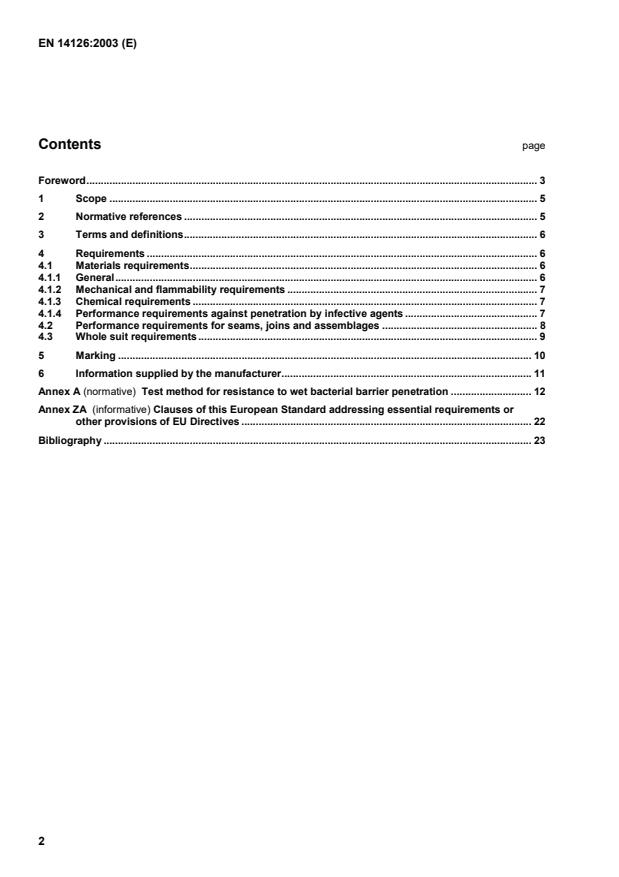
Test method for resistance to wet bacterial barrier penetration.12Annex ZA
(informative) Clauses of this European Standard addressing essential requirements orother provisions of EU Directives.22Bibliography.23
to be sterilized - Part 1: Generalrequirements and test methods.EN 943-1, Protective clothing against liquid and gaseous chemicals, including liquid aerosols and solidparticles — Part 1: Performance requirements for ventilated and non-ventilated “gas-tight” (Type 1) and “non-gas-tight” (Type 2) chemical protective suits.EN 943-2, Protective clothing against liquid and gaseous chemicals, including liquid aerosols and solidparticles — Part 2: Performance requirements for “gas-tight” (Type 1) chemical protective suits for emergencyteams (ET).prEN 13034, Protective clothing for use against liquid chemicals — Performance requirements for chemicalprotective clothing offering limited protective performance against liquid chemicals (type 6 equipment).EN 13795-1, Surgical drapes, gowns and clean air suits, used as medical
devices, for patients, clinical stuffand equipment - Part 1:
General requirements for manufacturers, processors and
products.prEN ISO 13982-1, Protective clothing for use against solid particulate chemicals — Part 1: Performancerequirements for chemical protective clothing providing protection to the full body against solid particulatechemicals (type 5 clothing) (ISO/DIS 13982-1:2000).prEN 14325, Protective clothing against chemicals — Test methods and performance classification ofchemical protective clothing materials, seams, joins and assemblages.ISO 139, Textiles; Standard atmospheres for conditioning and testing.
1)revision currently in progress
2)European Directive 90/679/EEC on the protection of workers from the risk related to exposure to biological agents atwork.
2) °C and (65
5) % relative humidity before testing. Tests shall be carried out in thesame atmosphere or within 5 min of removing the sample from the conditioning atmosphere.4.1.2 Mechanical and flammability requirementsThe materials shall be tested and classified in accordance with the test methods and performanceclassification system specified in the relevant clauses of prEN 14325.4.1.3 Chemical requirementsIf protection against chemicals is claimed, the materials shall be tested and classified in accordance with thetest methods and performance classification system specified in the relevant clauses of prEN 14325.4.1.4 Performance requirements against penetration by infective agents4.1.4.1 Resistance to penetration by contaminated liquids under hydrostatic pressureWhen tested in accordance with ISO/FDIS 16603 and ISO/FDIS 16604 the material shall be classifiedaccording to the levels of performance given in Table 1, as obtained in the bacteriophage test(ISO/FDIS 16604).NOTEThe synthetic blood test (ISO/FDIS 16603) is used for screening purposes, i.e. to predict the level where astrikethrough can be expected when performing the bacteriophage test (ISO/FDIS 16604)Table 1 — Classification of resistance to penetration by contaminated liquids under hydrostaticpressure (ISO/FDIS 16604)ClassHydrostatic pressure at whichthe material passes the test620 kPa514 kPa47 kPa33,5 kPa21,75 kPa10 kPa aathis means that the material is only exposed tothe hydrostatic pressure of the liquid in the test cell4.1.4.2 Resistance to penetration by infective agents due to mechanical contact with substancescontaining contaminated liquids.When tested in accordance with Annex A the material shall be classified according to the levels ofperformance given in Table 2.
330 < t
215 < t
14.1.4.3 Resistance to penetration by contaminated liquid aerosolsWhen tested in accordance with ISO/DIS 22611 the material shall be classified according to the levels ofperformance given in Table 3.Table 3 — Classification of resistance to penetration by contaminated liquid aerosolsClassPenetration ratio (log)3 log > 523 < log 11 < log 4.1.4.4 Resistance to penetration by contaminated solid particles.When tested in accordance with ISO/DIS 22612 the material shall be classified according to the levels ofperformance given in Table 4.Table 4 — Classification of resistance to penetration by contaminated solid particlesClassPenetration (log cfu)3 121 < log cfu
212 < log cfu
34.2 Performance requirements for seams, joins and assemblagesSeams, joins and assemblages of protective clothing against infective agents shall fulfil the requirementsspecified in the relevant clauses of prEN 14325 Seam strength shall be classified according to 5.5 of prEN14325:2001.
...