

FprEN 868-9
(Main)Packaging for terminally sterilized medical devices - Part 9: Uncoated nonwoven materials of polyolefines - Requirements and test methods
- Abstract
This document specifies test methods and values for uncoated nonwoven materials of polyolefins used for single-use sterile barrier systems and/or packaging systems for terminally sterilized medical devices.
Other than the general requirements as specified in EN ISO 11607-1 and EN ISO 11607-2, this part of EN 868 series specifies materials, test methods and values that are specific to the products covered by this document.
- Status
- Not Published
- Publication Date
- 13-Jan-2027
- Technical Committee
- CEN/TC 102 - Sterilizers for medical purposes
- Drafting Committee
- CEN/TC 102/WG 4 - Packaging materials
- Current Stage
- 5020 - Submission to Vote - Formal Approval
- Start Date
- 24-Sep-2026
- Due Date
- 02-Nov-2026
- Completion Date
- 24-Sep-2026

FprEN 868-9 is a CEN draft European Standard for uncoated nonwoven materials of polyolefins used in single-use sterile barrier systems and packaging systems for terminally sterilized medical devices. It sets product-specific test methods, performance values, labelling rules and information to be provided for these materials. In practice, it helps manufacturers, test laboratories and users check whether a polyolefin nonwoven material fits a sterile packaging application alongside EN ISO 11607-1 and EN ISO 11607-2.
What does FprEN 868-9 specify?
FprEN 868-9 covers the requirements and test methods specific to uncoated nonwoven polyolefin materials used in sterile barrier systems and packaging systems for terminally sterilized medical devices. The document sits on top of the general requirements in EN ISO 11607-1 and EN ISO 11607-2, so it adds product-specific details rather than replacing the general framework.
The document is organized into:
- Clause 1 - Scope
- Clause 2 - Normative references
- Clause 3 - Terms and definitions
- Clause 4 - General requirements
- Clause 5 - Performance requirements and test methods
- Clause 6 - Sterilization compatibility
- Clause 7 - Labelling of the protective packaging
- Clause 8 - Information to be provided
- Annex A - Environmental aspects, informative
- Bibliography
What are the key requirements of FprEN 868-9?
FprEN 868-9 requires the material to be assessed as part of the EN ISO 11607-1 and EN ISO 11607-2 framework, and it makes clear that compliance with this part alone does not automatically mean compliance with EN ISO 11607-1. For a buyer or quality manager, that means the certificate or declaration should state whether EN ISO 11607-1 is included.
Material and sampling conditions
The uncoated material shall be translucent or opaque, made of continuous filaments of polyolefins, and of high purity, without releasing substances at levels that could create a health risk. Test samples are conditioned at 23 °C and 50 % relative humidity for at least 24 h unless the method allows otherwise. This matters because the test result must reflect a controlled, repeatable state of the material.
Core performance checks
Clause 5 requires checks for colour release, grammage, tearing resistance, delamination strength where relevant, air permeance and water penetration resistance. The hot-extract colour check uses ISO 6588-2 with a modified test temperature of 60 °C, grammage is checked against the declared nominal value, and the material must meet minimum tearing resistance and air permeance values. In practice, these tests show whether the web is strong enough, breathable enough and clean enough for sterile packaging use.
Polymer-specific strength requirements
FprEN 868-9 splits tensile and bursting strength requirements by polymer family. Polyethylene based materials and polypropylene based materials have different minimum tensile strength and bursting strength values, tested with EN ISO 1924-2 and EN ISO 2758. That distinction matters because the packaging design and acceptance criteria must match the actual polyolefin type.
Sterilization compatibility
The sterilization processes applicable to the packaging material shall be defined, and compatibility shall be evaluated under EN ISO 11607-1 for the intended process or processes and intended number of cycles. For practice, this means the material is not just tested as a web - its behavior after sterilization must be considered before release or use.
Labelling and information
Protective packaging shall be legibly and durably labelled. For deliveries to health care facilities, the label includes identification, quantity, supplier details, date of manufacture in ISO 8601-1 format, lot number, nominal mass, nominal size or roll width and length, and any specific storage conditions. Clause 8 also requires regulatory and technical information and sets rules for environmental labels, declarations and recyclability information.
What terms does FprEN 868-9 define?
FprEN 868-9 uses the terms and definitions from EN ISO 11607-1:2020. Key terms in the document include:
- Sterile barrier system (SBS) - the packaging system that maintains sterility up to the point of use.
- Packaging system - the set of materials and components used to protect the medical device during sterilization, storage and distribution.
- Protective packaging - packaging used to protect the material or packaged item during handling and transport.
- Conditioned material - material brought to the specified temperature and humidity before testing.
- Delamination strength - the force needed to separate layers when the material can be split apart.
- Air permeance - how readily air passes through the material under the stated test condition.
- Grammage - the mass per unit area used to identify the nominal weight of the material.
Who uses FprEN 868-9?
FprEN 868-9 is used by manufacturers and suppliers of polyolefin nonwoven packaging materials, by laboratories that run material tests, and by sterile packaging designers who need to select or qualify a material for terminally sterilized medical devices. It is also relevant to quality and regulatory teams writing specifications, test plans, acceptance criteria and compliance statements.
The document is useful in health care facility sterilization processes, and the introduction notes that materials complying with this part can also be used for industrial sterilization. That makes it relevant for both hospital supply chains and industrial medical device packaging operations.
What changed in FprEN 868-9 from the previous edition?
FprEN 868-9 supersedes EN 868-9:2018. The foreword states these changes:
- Clause 4 was revised for clarity and aligned with the other parts of the EN 868 series.
- A statement was added to clarify when acceptance criteria apply.
- Clause 8 on environmental declarations was added.
- The list of major changes was moved to the foreword, and the former annex on technical changes was deleted.
- A new Annex A on environmental aspects was added.
Which standards are used with FprEN 868-9?
FprEN 868-9 uses EN ISO 11607-1 as the main general requirement reference, and EN ISO 11607-2 as the validation companion for forming, sealing and assembly processes. It also relies on test and declaration standards including EN ISO 536, EN ISO 811, EN ISO 1924-2, EN ISO 1974, EN ISO 2758, ISO 5636-3, ISO 6588-2, ISO 8601-1, ASTM D2724, EN ISO 14021 and EN ISO 14025.
The EN 868 series context is also important: Part 9 sits alongside parts covering sterilization wrap, papers, paper bags, pouches and reels, low-temperature sterilization papers, adhesive coated papers, reusable sterilization containers and adhesive coated nonwoven materials.
What does the FprEN 868-9 document contain?
FprEN 868-9 contains the general requirements, performance tests, sterilization compatibility requirements, packaging labelling rules and information to be provided for uncoated nonwoven polyolefin materials. Clause 5 gives the main test methods and acceptance values, while clause 6 tells users how to evaluate sterilization effects on the material.
Annex A gives environmental guidance across the product life cycle, including materials, production, transport packaging and end-of-life handling. The bibliography points readers to related standards and guidance used to support testing, declarations and environmental considerations.
Relations
- Effective Date
- 13-Nov-2024
Get Certified
Connect with accredited certification bodies for this standard

BSI Group
BSI (British Standards Institution) is the business standards company that helps organizations make excellence a habit.

TÜV Rheinland
TÜV Rheinland is a leading international provider of technical services.

TÜV SÜD
TÜV SÜD is a trusted partner of choice for safety, security and sustainability solutions.
Sponsored listings
Frequently Asked Questions
FprEN 868-9 is a draft published by the European Committee for Standardization (CEN). Its full title is "Packaging for terminally sterilized medical devices - Part 9: Uncoated nonwoven materials of polyolefines - Requirements and test methods". This standard covers: This document specifies test methods and values for uncoated nonwoven materials of polyolefins used for single-use sterile barrier systems and/or packaging systems for terminally sterilized medical devices. Other than the general requirements as specified in EN ISO 11607-1 and EN ISO 11607-2, this part of EN 868 series specifies materials, test methods and values that are specific to the products covered by this document.
This document specifies test methods and values for uncoated nonwoven materials of polyolefins used for single-use sterile barrier systems and/or packaging systems for terminally sterilized medical devices. Other than the general requirements as specified in EN ISO 11607-1 and EN ISO 11607-2, this part of EN 868 series specifies materials, test methods and values that are specific to the products covered by this document.
FprEN 868-9 is classified under the following ICS (International Classification for Standards) categories: 11.080.30 - Sterilized packaging. The ICS classification helps identify the subject area and facilitates finding related standards.
FprEN 868-9 has the following relationships with other standards: It is inter standard links to EN 868-9:2018. Understanding these relationships helps ensure you are using the most current and applicable version of the standard.
FprEN 868-9 is available in PDF format for immediate download after purchase. The document can be added to your cart and obtained through the secure checkout process. Digital delivery ensures instant access to the complete standard document.
Standards Content (Sample)
SLOVENSKI STANDARD
oSIST prEN 868-9:2026
01-marec-2026
Embalaža za končno sterilizirane medicinske pripomočke - 9. del: Površinsko
neobdelani netkani materiali iz poliolefinov - Zahteve in preskusne metode
Packaging for terminally sterilized medical devices - Part 9: Uncoated nonwoven
materials of polyolefines - Requirements and test methods
Verpackungen für in der Endverpackung zu sterilisierende Medizinprodukte - Teil 9:
Unbeschichtete Faservliesmaterialien aus Polyolefinen - Anforderungen und
Prüfverfahren
Emballages des dispositifs médicaux stérilisés au stade terminal - Partie 9 : Matériaux
non tissés à base de polyoléfines, non enduits - Exigences et méthodes d'essai
Ta slovenski standard je istoveten z: prEN 868-9
ICS:
11.080.30 Sterilizirana embalaža Sterilized packaging
oSIST prEN 868-9:2026 en,fr,de
2003-01.Slovenski inštitut za standardizacijo. Razmnoževanje celote ali delov tega standarda ni dovoljeno.
oSIST prEN 868-9:2026
oSIST prEN 868-9:2026
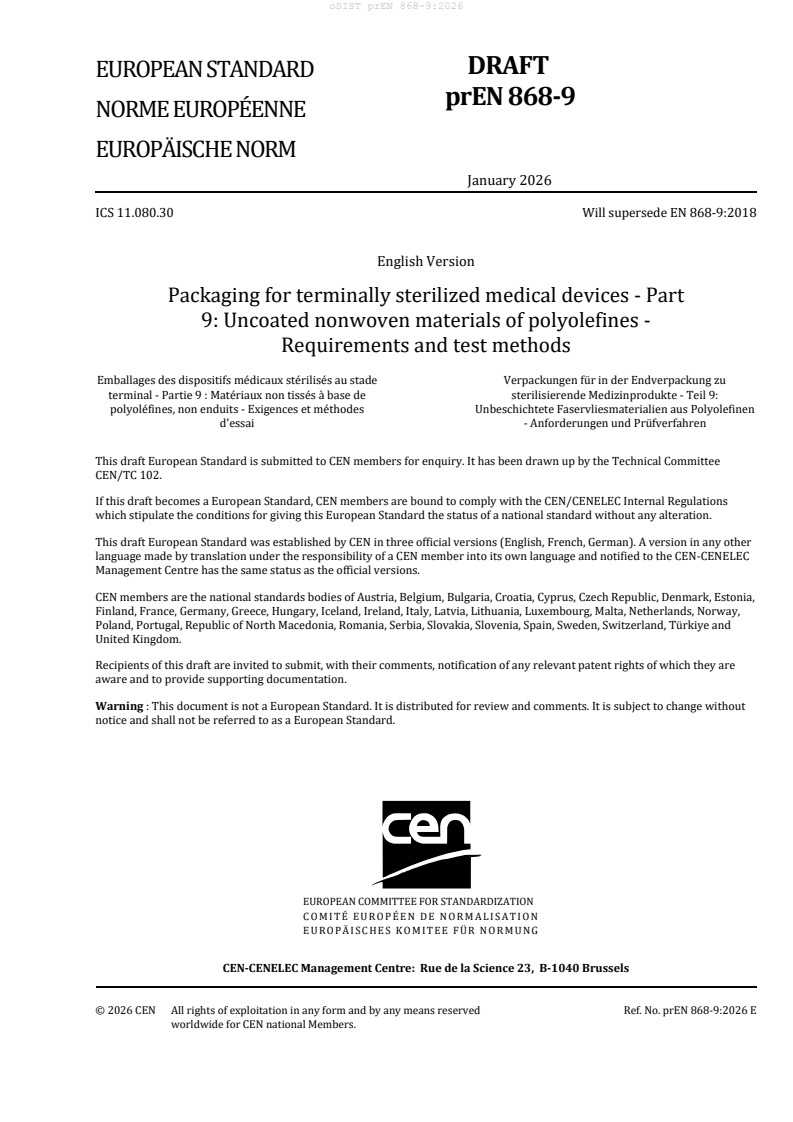
DRAFT
EUROPEAN STANDARD
prEN 868-9
NORME EUROPÉENNE
EUROPÄISCHE NORM
January 2026
ICS 11.080.30 Will supersede EN 868-9:2018
English Version
Packaging for terminally sterilized medical devices - Part
9: Uncoated nonwoven materials of polyolefines -
Requirements and test methods
Emballages des dispositifs médicaux stérilisés au stade Verpackungen für in der Endverpackung zu
terminal - Partie 9 : Matériaux non tissés à base de sterilisierende Medizinprodukte - Teil 9:
polyoléfines, non enduits - Exigences et méthodes Unbeschichtete Faservliesmaterialien aus Polyolefinen
d'essai - Anforderungen und Prüfverfahren
This draft European Standard is submitted to CEN members for enquiry. It has been drawn up by the Technical Committee
CEN/TC 102.
If this draft becomes a European Standard, CEN members are bound to comply with the CEN/CENELEC Internal Regulations
which stipulate the conditions for giving this European Standard the status of a national standard without any alteration.
This draft European Standard was established by CEN in three official versions (English, French, German). A version in any other
language made by translation under the responsibility of a CEN member into its own language and notified to the CEN-CENELEC
Management Centre has the same status as the official versions.
CEN members are the national standards bodies of Austria, Belgium, Bulgaria, Croatia, Cyprus, Czech Republic, Denmark, Estonia,
Finland, France, Germany, Greece, Hungary, Iceland, Ireland, Italy, Latvia, Lithuania, Luxembourg, Malta, Netherlands, Norway,
Poland, Portugal, Republic of North Macedonia, Romania, Serbia, Slovakia, Slovenia, Spain, Sweden, Switzerland, Türkiye and
United Kingdom.
Recipients of this draft are invited to submit, with their comments, notification of any relevant patent rights of which they are
aware and to provide supporting documentation.
Warning : This document is not a European Standard. It is distributed for review and comments. It is subject to change without
notice and shall not be referred to as a European Standard.
EUROPEAN COMMITTEE FOR STANDARDIZATION
COMITÉ EUROPÉEN DE NORMALISATION
EUROPÄISCHES KOMITEE FÜR NORMUNG
CEN-CENELEC Management Centre: Rue de la Science 23, B-1040 Brussels
© 2026 CEN All rights of exploitation in any form and by any means reserved Ref. No. prEN 868-9:2026 E
worldwide for CEN national Members.
oSIST prEN 868-9:2026
prEN 868-9:2026 (E)
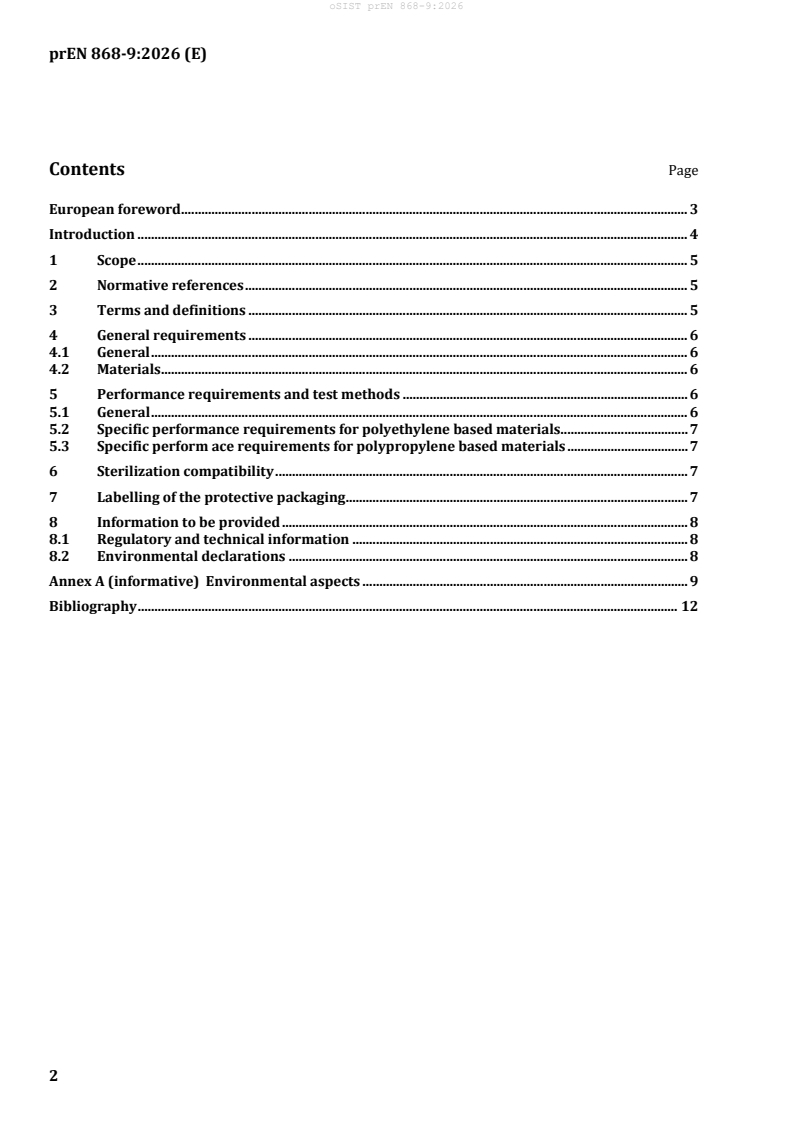
Contents Page
European foreword . 3
Introduction . 4
1 Scope . 5
2 Normative references . 5
3 Terms and definitions . 5
4 General requirements . 6
4.1 General . 6
4.2 Materials . 6
5 Performance requirements and test methods . 6
5.1 General . 6
5.2 Specific performance requirements for polyethylene based materials. 7
5.3 Specific perform ace requirements for polypropylene based materials . 7
6 Sterilization compatibility . 7
7 Labelling of the protective packaging . 7
8 Information to be provided . 8
8.1 Regulatory and technical information . 8
8.2 Environmental declarations . 8
Annex A (informative) Environmental aspects . 9
Bibliography . 12
oSIST prEN 868-9:2026
prEN 868-9:2026 (E)
European foreword
This document (prEN 868-9:2026) has been prepared by Technical Committee CEN/TC 102 “Sterilizers
and associated equipment for processing of medical devices”, the secretariat of which is held by DIN.
This document is currently submitted to the CEN Enquiry.
This document will supersede EN 868-9:2018.
prEN 868-9:2026 includes the following significant technical changes with respect to EN 868-9:2018:
a) Clause 4 “General requirements” was slightly revised for clarity and aligned with the other parts of
the EN 868 series, and a statement was added clarifying when acceptance criteria apply.
b) Clause 8 “Environmental declarations” was added and aligned with the other parts of EN 868 series.
c) The list of major changes was moved to the foreword, thus the Annex with “Details of significant
technical changes between this European Standard and the previous edition” (former Annex A) was
deleted.
d) New Annex A regarding environmental aspects was added.
EN 868 series consists of the following parts, under the general title Packaging for terminally sterilized
medical devices:
— Part 2: Sterilization wrap — Requirements and test methods;
— Part 3: Paper for use in the manufacture of paper bags (specified in EN 868-4) and in the manufacture
of pouches and reels (specified in EN 868-5) — Requirements and test methods;
— Part 4: Paper bags — Requirements and test methods;
— Part 5: Sealable pouches and reels constructed of porous materials and plastic film— Requirements and
test methods;
— Part 6: Paper for low temperature sterilization processes — Requirements and test methods;
— Part 7: Adhesive coated paper for low temperature sterilization processes — Requirements and test
methods;
— Part 8: Re-usable sterilization containers for large steam sterilizers — Requirements and test methods;
— Part 9: Uncoated nonwoven materials of polyolefins — Requirements and test methods;
— Part 10: Adhesive coated nonwoven materials of polyolefins — Requirements and test methods.
oSIST prEN 868-9:2026
prEN 868-9:2026 (E)
Introduction
The EN ISO 11607 series of standards consists of two parts under the general title “Packaging for
terminally sterilized medical devices”. EN ISO 11607-1 specifies general requirements and test methods
for materials, preformed sterile barrier systems, sterile barrier systems and packaging systems that are
intended to maintain sterility of terminally sterilized medical devices to the point of use. EN ISO 11607-2
specifies validation requirements for forming, sealing and assembly processes.
General requirements for all types of sterile barrier systems are provided by EN ISO 11607-1 and
EN ISO 11607-2 [2].
The EN 868 series of standards have been developed mainly for materials and sterile barrier systems
used in health care facilities sterilization processes. Materials complying with part 9 of the EN 868 series
can also be used for industrial sterilization. The EN 868 series of standards can be used to demonstrate
compliance with one or more of the requirements specified in EN ISO 11607-1.
Considering CEN guide 4 [4] and the CEN environmental checklists, this revision has been complemented
with a new annex with guidance to encourage users to also include environmental aspects when applying
the EN 868 series of standards with the objective to minimize the environmental impact. Environmental
aspects have also been included into the description of test methods with the same objective.
oSIST prEN 868-9:2026
prEN 868-9:2026 (E)
1 Scope
This document specifies test methods and values for uncoated nonwoven materials of polyolefins used
for single-use sterile barrier systems and/or packaging systems for terminally sterilized medical devices.
Other than the general requirements as specified in EN ISO 11607-1 and EN ISO 11607-2, this part of
EN 868 series specifies materials, test methods and values that are specific to the products covered by
this document.
2 Normative references
The following documents are referred to in the text in such a way that some or all of their content
constitutes requirements of this document. For dated references, only the edition cited applies. For
undated references, the latest edition of the referenced document (including any amendments) applies.
EN ISO 536, Paper and board - Determination of grammage (ISO 536)
EN ISO 811, Textiles - Determination of resistance to water penetration - Hydrostatic pressure test (ISO 811)
EN ISO 1924-2, Paper and board - Determination of tensile properties - Part 2: Constant rate of elongation
method (20 mm/min) (ISO 1924-2)
EN ISO 1974, Paper - Determination of tearing resistance - Elmendorf method (ISO 1974)
EN ISO 2758, Paper - Determination of bursting strength (ISO 2758)
EN ISO 11607-1:2020, Packaging for terminally sterilized medical devices - Part 1: Requirements for
materials, sterile barrier systems and packaging systems (ISO 11607-1:2019)
EN ISO 14021, Environmental labels and declarations - Self-declared environmental claims (Type II
environmental labelling) (ISO 14021)
EN ISO 14025, Environmental labels and declarations - Type III environmental declarations - Principles and
procedures (ISO 14025)
ISO 5636-3, Paper and board — Determination of air permeance (medium range) — Part 3: Bendtsen
method
ISO 6588-2:2021, Paper, board and pulps — Determination of pH of aqueous extracts — Part 2: Hot
extraction
ISO 8601-1, Date and time — Representations for information interchange — Part 1: Basic rules
ASTM D2724, Standard Test Methods for Bonded, Fused, and Laminated Apparel Fabrics
3 Terms and definitions
For the purposes of this document, the terms and definitions given in EN ISO 11607-1:2020 apply.
ISO and IEC maintain terminology databases for use in standardization at the following addresses:
As impacted by EN ISO 11607-1:2020/A1:2023 and EN ISO 11607-1:2020/A11:2022.
oSIST prEN 868-9:2026
prEN 868-9:2026 (E)
— IEC Electropedia: available at http://www.electropedia.org/
— ISO Online browsing platform: available at https://www.iso.org/obp
4 General requirements
4.1 General
4.1.1 For any material, preformed sterile barrier system or sterile barrier system, the requirements of
EN ISO 11607-1 shall apply.
4.1.2 Polyethylene and polypropylene non-wovens have different specific performance requirements
and this shall be considered during design and use of sterile barrier systems for specific applications.
NOTE When additional materials are used inside the sterile barrier system in order to ease the organization,
drying or aseptic presentation (e.g. inner wrap, indicators, packing lists, mats, instrument organizer sets, tray liners
or an additional envelope around the medical device) then other requirements, including the determination of the
acceptability of these materials during validation activities, can apply.
4.1.3 This part of EN 868 series only introduces performance requirements and test methods that are
specific to the products covered by this part of EN 868 series but does not add or modify the general
requirements specified in EN ISO 11607-1.
4.1.4 As such, the particular requirements in Clause 5 can be used to demonstrate compliance with one
or more but not all of the requirements of EN ISO 11607-1.
NOTE Conformity with this document does not automatically mean conformity with EN ISO 11607-1.
4.1.5 A confirmation of compliance to this document shall contain a statem
...