

EN 17708:2024
(Main)Plant biostimulants - Preparation of sample for microbial analysis
General Information
- Abstract
This document specifies general rules for the aerobic preparation of the initial suspension and of dilutions for microbiological examinations of microbial plant biostimulants.
This horizontal method might not be applicable in very detail for certain products. In this case, different methods which are specific to these products can be used if necessary, for justified technical reasons.
This document is applicable to the blends of fertilizing products where a blend is a mix of at least two of the following component EU fertilising products categories: Fertilizers, Liming Materials, Soil Improvers, Growing Media, Plant Biostimulant and where the following category Plant Biostimulants is the highest % in the blend by mass or volume, or in the case of liquid form by dry mass. If Plant Biostimulants is not the highest % in the blend, the European Standard for the highest % of the blend applies. In case a blend of fertilizing products is composed of components in equal quantity or in case the component EU fertilising products used for the blend have identical formulations , the user decides which standard to apply.
- Status
- Published
- Publication Date
- 26-Nov-2024
- Technical Committee
- CEN/TC 455 - Plant Biostimulants and Agricultural Micro-Organisms
- Drafting Committee
- CEN/TC 455/WG 3 - Pathogenic and non-pathogenic microorganisms
- Current Stage
- 6060 - Definitive text made available (DAV) - Publishing
- Start Date
- 27-Nov-2024
- Due Date
- 09-Apr-2024
- Completion Date
- 27-Nov-2024

Overview
EN 17708:2024 - Plant biostimulants: Preparation of sample for microbial analysis (CEN) sets out general, aerobic procedures for preparing the initial suspension and serial dilutions used in microbiological examination of microbial plant biostimulants. The standard supports laboratory consistency and compliance with the EU Fertilising Products Regulation (FPR) by standardizing how samples are handled, diluted and prepared for enumeration or detection of microorganisms.
Key topics and technical requirements
- Scope and applicability
- Applies to microbial plant biostimulants and blends where the Plant Biostimulant category is the largest component by mass/volume (or dry mass for liquids).
- Horizontal method - may be adapted or replaced by product‑specific methods when technically justified.
- Sampling and storage
- Laboratories must receive representative, undamaged samples; sampling follows EN 17702‑1:2024.
- Transport and storage conditions must minimise microbial alteration.
- Preparation principles
- Establish a uniform distribution of microorganisms in a test portion, prepare an initial suspension (commonly 1:10 ratio) and produce further dilutions for plating or enrichment.
- Examples include dispensing 25 mL (or g) into 225 mL sterile diluent for many liquid and solid forms.
- Formulation‑specific protocols
- Protocols are provided for liquid (water‑based), oil‑based emulsions (EC), wettable powders (WP) and water‑dispersible granules (WDG), with recommended mixing times and dispersion steps.
- Special instructions for mycorrhizal products (base concentration reference 500 UPM/g) and concentration classes: H (>100 000 UPM/g), M (1 000–100 000 UPM/g), L (<1 000 UPM/g).
- Diluents and additives
- Composition guidance and examples are in Annex B; surface‑active agents may be used if they do not affect viability.
- Apparatus
- Lists required microbiological equipment (sterile pipettes, incubators, stomacher, vortex, sonicator, centrifuge, etc.) and references Annex A for plating procedures.
- Protocols covered
- Enumeration of beneficial organisms, enumeration of non‑beneficial/pathogenic organisms, anaerobic plate counts, pathogen detection and further dilution strategy.
Applications and users
- Who uses it: microbiology laboratories, plant biostimulant manufacturers, quality control teams, conformity assessment bodies, regulators and agronomic product developers.
- Practical uses: routine microbial quality testing, product safety assessment, regulatory compliance with FPR, lot release testing, method harmonization across EU labs, and validating product label claims about microbial content.
Related standards and context
- EN 17702‑1:2024 (Sampling and sample preparation - Part 1: Sampling) - normative reference for sampling.
- Linked to Regulation (EU) 2019/1009 (Fertilising Products Regulation) and developed by CEN/TC 455 to support harmonised market access and reliable biostimulant supply chains.
Relations
- Effective Date
- 15-Feb-2023
- Effective Date
- 28-Jan-2026
- Effective Date
- 28-Jan-2026
- Effective Date
- 28-Jan-2026
- Effective Date
- 28-Jan-2026
- Effective Date
- 28-Jan-2026
- Effective Date
- 28-Jan-2026
- Effective Date
- 28-Jan-2026
- Effective Date
- 28-Jan-2026
- Effective Date
- 28-Jan-2026
- Effective Date
- 28-Jan-2026
Get Certified
Connect with accredited certification bodies for this standard

Control Union Certifications
Global certification for agriculture and sustainability.

ECOCERT
Organic and sustainability certification.

FSC International
Forest Stewardship Council certification.
Sponsored listings
Frequently Asked Questions
EN 17708:2024 is a standard published by the European Committee for Standardization (CEN). Its full title is "Plant biostimulants - Preparation of sample for microbial analysis". This standard covers: This document specifies general rules for the aerobic preparation of the initial suspension and of dilutions for microbiological examinations of microbial plant biostimulants. This horizontal method might not be applicable in very detail for certain products. In this case, different methods which are specific to these products can be used if necessary, for justified technical reasons. This document is applicable to the blends of fertilizing products where a blend is a mix of at least two of the following component EU fertilising products categories: Fertilizers, Liming Materials, Soil Improvers, Growing Media, Plant Biostimulant and where the following category Plant Biostimulants is the highest % in the blend by mass or volume, or in the case of liquid form by dry mass. If Plant Biostimulants is not the highest % in the blend, the European Standard for the highest % of the blend applies. In case a blend of fertilizing products is composed of components in equal quantity or in case the component EU fertilising products used for the blend have identical formulations , the user decides which standard to apply.
This document specifies general rules for the aerobic preparation of the initial suspension and of dilutions for microbiological examinations of microbial plant biostimulants. This horizontal method might not be applicable in very detail for certain products. In this case, different methods which are specific to these products can be used if necessary, for justified technical reasons. This document is applicable to the blends of fertilizing products where a blend is a mix of at least two of the following component EU fertilising products categories: Fertilizers, Liming Materials, Soil Improvers, Growing Media, Plant Biostimulant and where the following category Plant Biostimulants is the highest % in the blend by mass or volume, or in the case of liquid form by dry mass. If Plant Biostimulants is not the highest % in the blend, the European Standard for the highest % of the blend applies. In case a blend of fertilizing products is composed of components in equal quantity or in case the component EU fertilising products used for the blend have identical formulations , the user decides which standard to apply.
EN 17708:2024 is classified under the following ICS (International Classification for Standards) categories: 65.080 - Fertilizers. The ICS classification helps identify the subject area and facilitates finding related standards.
EN 17708:2024 has the following relationships with other standards: It is inter standard links to CEN/TS 17708:2022, EN 17702-1:2024, EN 17719:2024, EN 17712:2024, EN 17710:2024, EN 17717:2024, EN 17715:2024, EN 17716:2024, EN 17707:2024, EN 17714:2024, EN 17720:2024. Understanding these relationships helps ensure you are using the most current and applicable version of the standard.
EN 17708:2024 is associated with the following European legislation: EU Directives/Regulations: 2019/1009; Standardization Mandates: M/564, M/564 Amd 1. When a standard is cited in the Official Journal of the European Union, products manufactured in conformity with it benefit from a presumption of conformity with the essential requirements of the corresponding EU directive or regulation.
EN 17708:2024 is available in PDF format for immediate download after purchase. The document can be added to your cart and obtained through the secure checkout process. Digital delivery ensures instant access to the complete standard document.
Standards Content (Sample)
SLOVENSKI STANDARD
01-februar-2025
Nadomešča:
SIST-TS CEN/TS 17708:2023
Rastlinski biostimulanti - Priprava vzorcev za mikrobiološko analizo
Plant biostimulants - Preparation of sample for microbial analysis
Pflanzen-Biostimulanzien - Probenvorbereitung für die mikrobielle Analyse
Biostimulants des végétaux - Préparation de l'échantillon pour l'analyse microbienne
Ta slovenski standard je istoveten z: EN 17708:2024
ICS:
65.080 Gnojila Fertilizers
2003-01.Slovenski inštitut za standardizacijo. Razmnoževanje celote ali delov tega standarda ni dovoljeno.
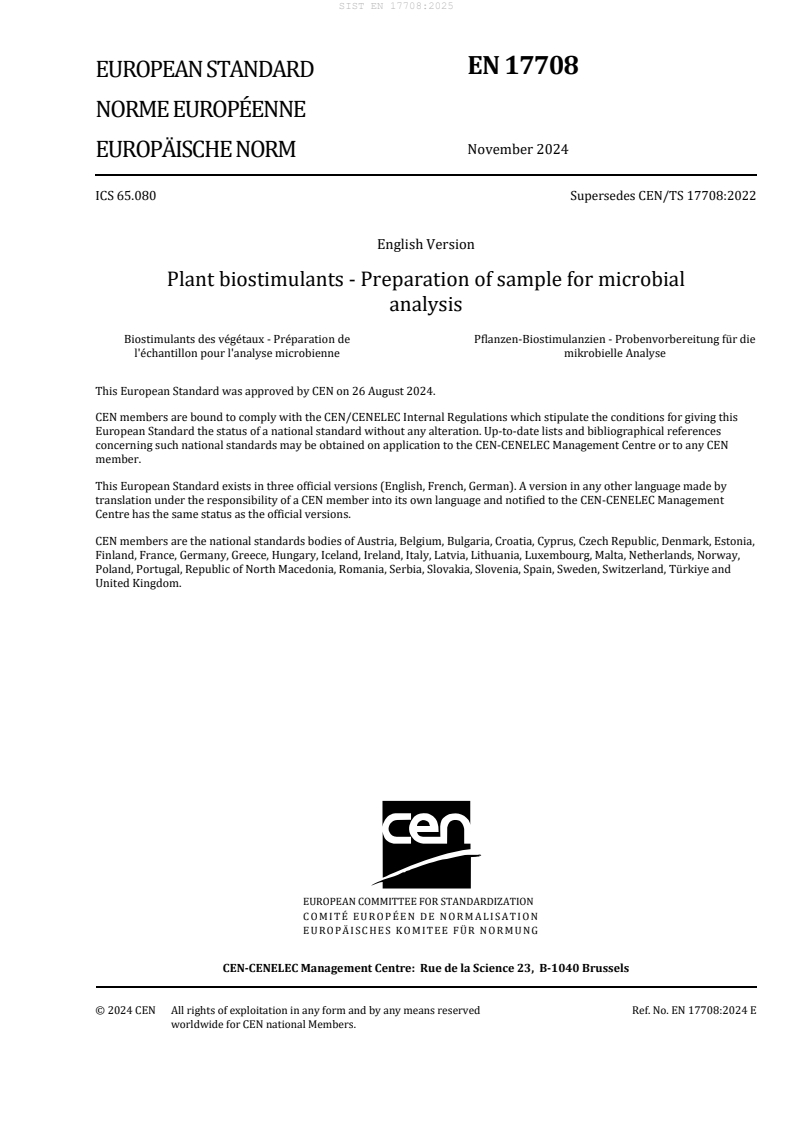
EN 17708
EUROPEAN STANDARD
NORME EUROPÉENNE
November 2024
EUROPÄISCHE NORM
ICS 65.080 Supersedes CEN/TS 17708:2022
English Version
Plant biostimulants - Preparation of sample for microbial
analysis
Biostimulants des végétaux - Préparation de Pflanzen-Biostimulanzien - Probenvorbereitung für die
l'échantillon pour l'analyse microbienne mikrobielle Analyse
This European Standard was approved by CEN on 26 August 2024.
CEN members are bound to comply with the CEN/CENELEC Internal Regulations which stipulate the conditions for giving this
European Standard the status of a national standard without any alteration. Up-to-date lists and bibliographical references
concerning such national standards may be obtained on application to the CEN-CENELEC Management Centre or to any CEN
member.
This European Standard exists in three official versions (English, French, German). A version in any other language made by
translation under the responsibility of a CEN member into its own language and notified to the CEN-CENELEC Management
Centre has the same status as the official versions.
CEN members are the national standards bodies of Austria, Belgium, Bulgaria, Croatia, Cyprus, Czech Republic, Denmark, Estonia,
Finland, France, Germany, Greece, Hungary, Iceland, Ireland, Italy, Latvia, Lithuania, Luxembourg, Malta, Netherlands, Norway,
Poland, Portugal, Republic of North Macedonia, Romania, Serbia, Slovakia, Slovenia, Spain, Sweden, Switzerland, Türkiye and
United Kingdom.
EUROPEAN COMMITTEE FOR STANDARDIZATION
COMITÉ EUROPÉEN DE NORMALISATION
EUROPÄISCHES KOMITEE FÜR NORMUNG
CEN-CENELEC Management Centre: Rue de la Science 23, B-1040 Brussels
© 2024 CEN All rights of exploitation in any form and by any means reserved Ref. No. EN 17708:2024 E
worldwide for CEN national Members.
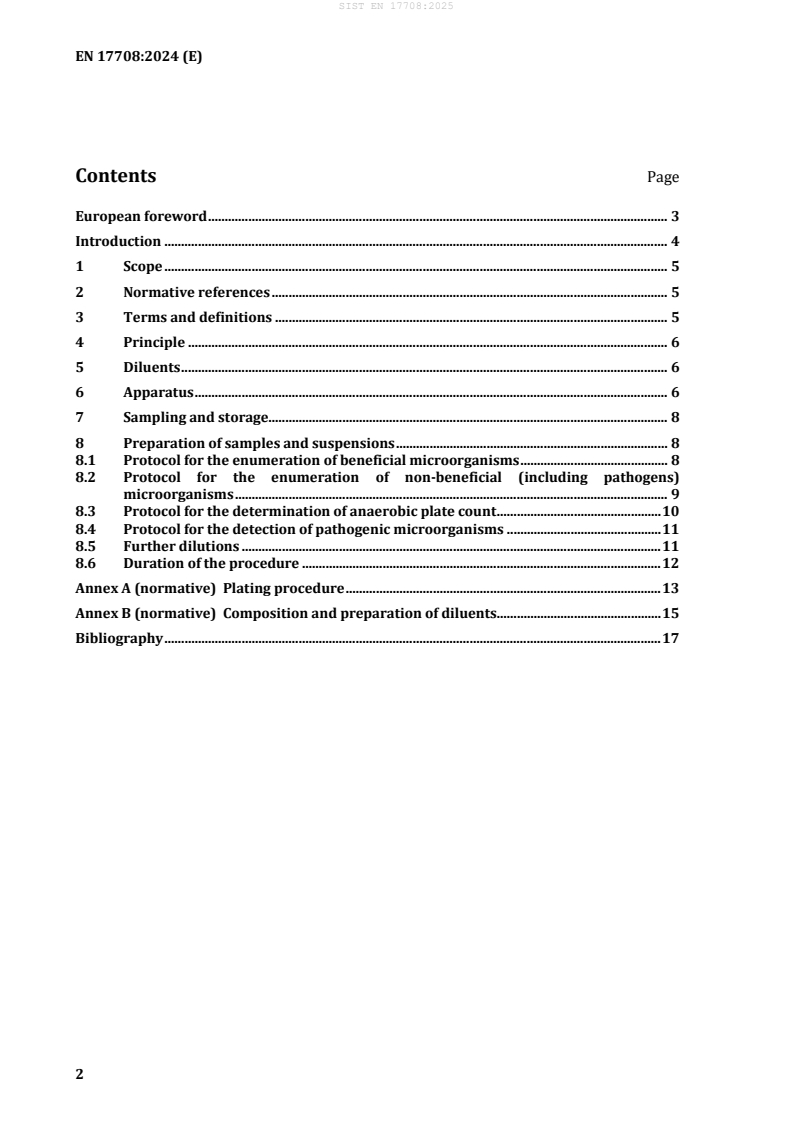
Contents Page
European foreword . 3
Introduction . 4
1 Scope . 5
2 Normative references . 5
3 Terms and definitions . 5
4 Principle . 6
5 Diluents . 6
6 Apparatus . 6
7 Sampling and storage . 8
8 Preparation of samples and suspensions . 8
8.1 Protocol for the enumeration of beneficial microorganisms . 8
8.2 Protocol for the enumeration of non-beneficial (including pathogens)
microorganisms . 9
8.3 Protocol for the determination of anaerobic plate count . 10
8.4 Protocol for the detection of pathogenic microorganisms . 11
8.5 Further dilutions . 11
8.6 Duration of the procedure . 12
Annex A (normative) Plating procedure . 13
Annex B (normative) Composition and preparation of diluents . 15
Bibliography . 17
European foreword
This document (EN 17708:2024) has been prepared by Technical Committee CEN/TC 455 “Plant
Biostimulants”, the secretariat of which is held by AFNOR.
This European Standard shall be given the status of a national standard, either by publication of
an identical text or by endorsement, at the latest by May 2025, and conflicting national standards
shall be withdrawn at the latest by May 2025.
Attention is drawn to the possibility that some of the elements of this document may be the subject
of patent rights. CEN shall not be held responsible for identifying any or all such patent rights.
This document supersedes CEN/TS 17708:2022.
CEN/TS 17708:2022:
— the introduction has been updated and Table 1 has been removed;
— Clause 2, Normative references, has been updated;
— Annex B has been revised.
Any feedback and questions on this document should be directed to the users’ national standards
body. A complete listing of these bodies can be found on the CEN website.
According to the CEN-CENELEC Internal Regulations, the national standards organisations of the
following countries are bound to implement this European Standard: Austria, Belgium, Bulgaria,
Croatia, Cyprus, Czech Republic, Denmark, Estonia, Finland, France, Germany, Greece, Hungary,
Iceland, Ireland, Italy, Latvia, Lithuania, Luxembourg, Malta, Netherlands, Norway, Poland,
Portugal, Republic of North Macedonia, Romania, Serbia, Slovakia, Slovenia, Spain, Sweden,
Switzerland, Türkiye and the United Kingdom.
Introduction
The European Committee for Standardization (CEN) was requested by the European Commission
(EC) to draft European Standards or European Standardization deliverables to support the
implementation of Regulation (EU) 2019/1009 of 5 June 2019 [1] laying down rules on the
making available on the market of EU fertilising products (“FPR” or “Fertilising Products
Regulation”).
This standardization request, presented as SR M/564 and relevant amendments, also contributes
to the Communication on “Innovating for Sustainable Growth: A Bio economy for Europe”. The
interest in plant biostimulants has increased significantly in Europe as a valuable tool to use in
agriculture. Standardization was identified as having an important role in order to promote the
use of biostimulants. The work of CEN/TC 455 seeks to improve the reliability of the supply chain,
thereby improving the confidence of farmers, industry, and consumers in biostimulants, and will
promote and support commercialisation of the European biostimulant industry.
WARNING — Persons using this document should be familiar with normal laboratory practice.
This document does not purport to address all of the safety problems, if any, associated with its
use. It is the responsibility of the user to establish appropriate safety and health practices and to
ensure compliance with any national regulatory conditions.
IMPORTANT — It is absolutely essential that tests conducted in accordance with this document
be carried out by suitably trained staff.
1 Scope
This document specifies general rules for the aerobic preparation of the initial suspension and of
dilutions for microbiological examinations of microbial plant biostimulants.
This horizontal method might not be applicable in very detail for certain products. In this case,
different methods which are specific to these products can be used if necessary, for justified
technical reasons.
This document is applicable to the blends of fertilizing products where a blend is a mix of at least
two of the following component EU fertilising products categories: Fertilizers, Liming Materials,
Soil Improvers, Growing Media, Plant Biostimulant and where the following category Plant
Biostimulants is the highest % in the blend by mass or volume, or in the case of liquid form by dry
mass. If Plant Biostimulants is not the highest % in the blend, the European Standard for the
highest % of the blend applies. In case a blend of fertilizing products is composed of components
in equal quantity or in case the component EU fertilising products used for the blend have identical
formulations , the user decides which standard to apply.
2 Normative references
The following documents are referred to in the text in such a way that some or all of their content
constitutes requirements of this document. For dated references, only the edition cited applies.
For undated references, the latest edition of the referenced document (including any
amendments) applies.
EN 17702-1:2024, Plant biostimulants — Sampling and sample preparation — Part 1: Sampling
3 Terms and definitions
For the purposes of this document, the following terms and definitions apply.
ISO and IEC maintain terminological databases for use in standardization at the following
addresses:
— ISO Online browsing platform: available at https://www.iso.org/obp
— IEC Electropedia: available at https://www.electropedia.org/
3.1
laboratory sample
sample sent to the laboratory and intended for inspection or testing
3.2
test sample
sample prepared from the laboratory sample (3.1) according to the procedure specified in the
method of test and from which test portions (3.3) are taken
3.3
test portion
measured (volume or mass) representative sample taken from the laboratory sample (3.1) for use
in the preparation of the initial suspension (3.4)
An example of such a blend is a product with 2 claimed functions consisting of a non-microbial plant
biostimulant and an organic fertilizer composed of 1 kg/kg of plant biostimulant from seaweed.
3.4
initial suspension
suspension, solution or emulsion obtained after a weighed or measured quantity of the product
under examination has been mixed with, normally, a nine-fold quantity of diluent, or other ratios
if required for specific purposes, allowing large particles, if present, to settle
3.5
further dilution
suspension or solution obtained by mixing a measured volume of the initial suspension (3.4) with
an x-fold volume of diluent and by repeating this operation with further dilutions until a dilution
series, suitable for the inoculation of culture media, is obtained
Note 1 to entry: Ten-fold dilutions are normally used to produce a decimal dilution series, but other ratios
can be required for specific purposes.
3.6
specific standard
standard or guidance document describing the examination of a specific product for the detection
or enumeration of a specific microorganism
4 Principle
Preparation of initial suspension (3.4) in such a way as obtain as uniform a distribution as possible
of the microorganisms contained in the test portion (3.3).
Preparation, if necessary, of further dilutions (3.5) in order to reduce the number of
microorganisms per unit volume to allow, after incubation, observation of their growth or not (in
case of tubes or bottles) or colony counting (in the case of plates).
5 Diluents
For the preparation of diluents follow the current laboratory practices and the manufacturer’s
instructions for commercial preparations.
In Annex B there are examples of diluents for general use.
It is possible to add surface-active agents to diluents to improve the uniformity of the suspension
while avoiding the formation of clusters of microorganisms, and verifying that the added
concentration does not alter cell viability.
6 Apparatus
Usual microbiological laboratory equipment as listed below:
6.1 Apparatus for dry sterilization (oven) and wet sterilization (autoclave).
6.2 Protective cabinets, for all work involving the handling of microbiological products.
6.3 Scales, capable of weighing to 1 % of the mass.
6.4 Incubator, capable of operating at the required temperatures of the test.
6.5 Total delivery pipettes, sterile, of nominal capacity of 1 ml, and graduated in divisions of
0,1 ml.
6.6 Water bath, or similar apparatus, to maintain a specific temperature.
6.7 pH meter, accurate to 0,1 pH units at room temperature.
6.8 Bottles, flasks and tubes, for boiling and storage of culture media, and for making of
dilutions.
6.9 Petri dishes, sterile, of glass or plastic, with a diameter from 90 mm to 100 mm.
6.10 Optical microscope, for bacteriological examinations, objectives with magnification from
x10 (dry lens) to about x100 (oil immersion).
6.11 Spreaders, made of glass or plastic (of a diameter less than 2 mm and a length of 80 mm).
Diameter should not exceed 2 mm in order to minimize the amount of samples adhering to them
at the end of the spreading procedure.
6.12 Binocular magnifier, for discriminating and differentiation colonies/cells of yeasts and
moulds (magnification 6,5 to 50 times).
6.13 Refrigerator, chambers which allow maintenance of cold storage.
6.14 Centrifuge, to separate suspended particles from fluids.
For the preparation of the test sample, of the initial suspension or for the decimal dilution series,
use one or more of the common apparatus reported below:
®2
6.15 Peristaltic blender (stomacher ) with sterile bags.
6.16 Rotatory homogenizer (blender), with a sterilizable glass or metals bowls equipped with
covers (speed between 8 000 r/min and 45 000 r/min).
®2
6.17 Vibrational mixer (pulsifier ) with sterile bags (usual operating time is 0,5 min to
1 min).
®2
6.18 Ultraturrax , a dispersing tool and homogenizer instrumentation that produces
homogenous, uniform sample preparations.
®2
6.19 Ultrasonic sonicator .
6.20 Mechanical stirrer.
6.21 Magnetic stirrer.
6.22 Vortex mixer, mainly used for liquid samples and decimal dilutions preparation.
6.23 Glass beads can be used for the preparation, by shaking, of the initial suspension of certain
viscous or thick products.
Trademark of product. This information is given for the convenience of users of this document and does not constitute
an endorsement by CEN of the product named. Equivalent products may be used if they can be shown to lead to the
same results.
7 Sampling and storage
Sampling shall be carried out in accordance with EN 17702-1:2024. The laboratory shall receive
a sample which is representative and has not been damaged or changed during transport or
storage.
The samples should be delivered to the laboratory with conditions maintained as closely as
possible to those of the original storage.
The sample should be submitted in the original, unopened container.
Upon arrival, check the condition of the samples. Identify samples clearly and completely and
record the sample information.
The mode of transportation of the samp
...